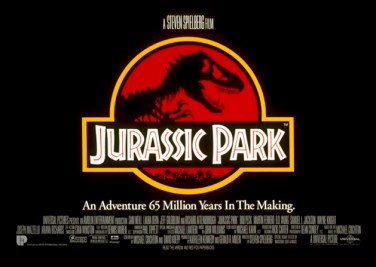
65 million years in the making.
Country: USA
Language: English
Runtime: 127 minutes
BBFC: PG
MPAA: PG-13

Original Release: 11th June 1993 (USA)
UK Release: 16th July 1993
First Seen: cinema, 1993
Stars
Sam Neill (Dead Calm, Event Horizon)
Laura Dern (Wild at Heart, Inland Empire)
Jeff Goldblum (The Fly, Independence Day)
Richard Attenborough (10 Rillington Place, Miracle on 34th Street)
Director
Steven Spielberg (Jaws, Indiana Jones and the Temple of Doom)
Screenwriters
Michael Crichton (Westworld, Twister)
David Koepp (Death Becomes Her, Panic Room)
Based on
Jurassic Park, a novel by Michael Crichton.
The Story
Invited to a remote island by an eccentric billionaire, a group of scientists, investors, and children discover he’s managed to clone and resurrect dinosaurs, which he intends to exhibit in his theme park: Dinosaur Land!
…not really — it’s called Jurassic Park. As the visitors tour the park looking at the creatures, a nice two-hour nature documentary unfolds.
…not really — the dinosaurs escape and run amok and people die and it’s basically a horror/disaster movie with giant prehistoric lizards as the killer/natural disaster. Good times.
Our Heroes
Dr Alan Grant and Dr Ellie Sattler are palaeontologists invited to Jurassic Park’s test run by enthusiastic grandfatherly billionaire John Hammond. There’s also Dr Ian Malcolm, a sexy mathematician (oxymoron?), and Hammond’s grandkids, siblings Tim and Lex, who Grant is essentially left to babysit. There’s also a handful of other characters who are essentially dinosaur-food… er, I mean, who are totally going to survive to the end of the movie.
Our Villains
It’s a bit mean to call the dinosaurs villains — they’re just behaving as nature intended. Of course, when uber-predators like Tyrannosaurus Rex and Velociraptors are involved, they’re still the main threat. Their impromptu freedom is all the fault of greedy, traitorous tech geek Dennis Nedry, though.
Best Supporting Character
For what may be the only time in movie history, Samuel L. Jackson is in this movie and isn’t the coolest character. That honour goes to Bob Peck as the park’s badass head ranger, Muldoon.
Memorable Quote
“Don’t move! He can’t see us if we don’t move.” — Dr Alan Grant
Quote Most Likely To Be Used in Everyday Conversation
“Clever girl.” — Muldoon
Memorable Scene
As the newly-arrived visitors drive across the island, Hammond whispers to the driver to stop. Dr Grant idly looks off to the side, and his mouth falls open in shock. He pulls off his hat. He stands. He fumbles to take off his sunglasses, not believing his eyes. Dr Sattler is distracted by a leaf that shouldn’t exist. Grant reaches over to grab her head, turns it to face what he sees. Now she looks shocked, standing and pulling off her glasses. Whatever they’re looking at, it’s big. And only then, as John Williams’ music swells, does Spielberg cut to it: towering over them, a Brachiosaurus — a real, living dinosaur.
Write the Theme Tune…
Some chap named John Williams totally lucked out writing the film’s iconic main theme, which is one of music’s best evocations of the feelings of awe and wonder.
Technical Wizardry
It’s easily overlooked among all the visual antics, but the film’s sound design is incredible, too. Spielberg insisted on all-new sounds being captured throughout (rather than using any library effects) to help ensure the dinosaur roars sounded unique. The T-Rex’s roar was a combination of sounds from dogs, tigers, alligators, elephants, and… penguins.
Truly Special Effect
Spielberg thought about using a combination of animatronics and groundbreaking CGI to create the dinosaurs, but they just resurrected some real ones instead. More seriously, there’s actually only 15 minutes of dinosaur footage in the film. Nine minutes of that is animatronics — despite its fame and influence, just six minutes were created with CGI.
Making of
Spielberg came up with the idea for the famous rippling glass of water when he saw the mirror in his car vibrate because of sound. When the effects team tried to replicate that with water, nobody could do it… but they told Spielberg they could. The night before the effect was to be shot, effects supervisor Michael Lantieri placed a glass of water on a guitar, plucked the strings, and got the desired effect. For the film — where the glass is on a car dashboard, not a musical instrument — guitar strings were attached to the underside of the dashboard. These days you know they’d just do all that with CGI, and this is why older movies are better.
Next time…
Spielberg returned to helm first sequel The Lost World: Jurassic Park in 1997, which has its fans, but not that many. Joe Johnston took over for Jurassic Park III, which is less epic than either of is predecessors, and more of a brisk (just 90 minutes long), straightforward action-adventure movie. After many years of aborted plans, the series was revived last year in Colin Trevorrow’s Jurassic World, which met with incredible financial success and a mixed (though generally favourable) reception. A fifth film, directed by The Impossible’s J.A. Bayona, will be a direct sequel to Jurassic World and is slated for release in 2018.
Awards
3 Oscars (Visual Effects, Sound, Sound Effects Editing)
1 BAFTA (Special Effects)
1 BAFTA nomination (Sound)
4 Saturn Awards (Science Fiction Film, Director, Writing, Special Effects)
7 Saturn nominations (Actress (Laura Dern), Supporting Actor (both Jeff Goldblum and Wayne Knight), Performance by a Younger Actor (both Joseph Mazzello and Ariana Richards), Music, Costumes)
3 MTV Movie Awards nominations (including Best Villain — for the dinosaurs? I don’t know.)
Won the Hugo for Best Dramatic Presentation
What the Critics Said
“As he did in Jaws, Spielberg has crafted a man-vs.-nature masterpiece with admirable logic, darkly funny violence and enthralling state-of-the-art special effects. Watching Jurassic Park, one gets the same feeling of wonderment, glee and old-fashioned fright that moviegoers must have felt 60 years ago when King Kong roared out of the jungle and scaled the Empire State Building. […] We ask for two things from big-budget thrillers like this: Make us believe and make us jump. Jurassic Park delivers on both counts; it’s the best gasp-between-the-giggles movie made since a cocky young director and a clunky Bruce the Shark scared the beach out of us 18 summers ago.” — Steve Persall, Tampa Bay Times
(I want to quote so much of this review, because it’s full of good bits, like how it’s “the most intelligent, pro-feminist adventure movie yet made”; or how “a faithful version of Crichton’s tale would have cost at least twice the film’s $60 million price tag” — a film costing $120 million? Unthinkable!)
 Score:
 93%
93%What the Public Say
“We’re kept waiting for the first full shot of a dinosaur, and it’s worth the wait, the little jeep carrying Sam Neill and Laura Dern stopping long enough for them to gawp in helpless wonder at the sight of Brachiosaurs eating. It works for two reasons. One is the reactions of the actors, which only adds to the moment’s sense of authenticity and gravitas. The second is the use of CGI. Jurassic Park was like a great leap forward in special effects technology. Before this, the only way to see dinosaurs on film was the stop-motion animated models shot painstakingly by Ray Harryhausen and his peers. Suddenly, all that was consigned to cinema history thanks to digital effects, work that holds up today because Spielberg knew how to use CGI judiciously rather than too often […] The combination of CGI and puppetry to create the dinosaur looks seamless, and whilst it must have been painstaking to develop and film there’s no doubt it’s great to watch” — Mike, Films on the Box

For a certain generation, Star Wars is undeniably the defining cinematic experience. For a more recent one, I guess it’s Harry Potter or something. In between, you have my lot — and as became quite clear with the unexpectedly phenomenal response to Jurassic World this time last year, we have Jurassic Park. It was the first film I ever saw at the cinema, and much of it has been lodged in my memory every since.
That it’s beloved shouldn’t be such a surprise, really: it was huge back in 1993, and is one of only ten films that can lay claim to ever having been The Highest Grossing Movie Of All Time. It wasn’t the first film to employ computer-generated special effects, but by featuring them so prominently it paved the way for further effects breakthroughs. The groundbreaking imagery still holds up today — and when you consider that the effects in some movies out last week are already dated, that’s even more impressive.
It’s certainly not just about the effects, though: it’s a fantastic adventure movie, putting its likeable characters through the ringer in a story that is by turns exciting, funny, scary, and genuinely awe-inspiring.

#48 will be… a roaring rampage of revenge.
 Finally done with most of these (still need to find time for the last two Legends of Tomorrows). One shouldn’t have that attitude to something one is choosing to watch, should one? I have a certain loyalty to Arrow, because they did a good job for seasons one and two, even if it’s waxed and waned since; but I’ve never really got on board with the adulation The Flash has received, and Legends of Tomorrow is mediocre to poor with regularity… though now and then they all exhibit flashes of worthwhileness. I rarely make the conscious choice to give up on a series (do it all the time by accident, though), but I’d consider abandoning a couple of these before the start of their next seasons… were it not for the ‘promise’ that they’re all about to be completely interconnected, at least for one almighty four-way crossover (with moving-to-the-same-network Supergirl).
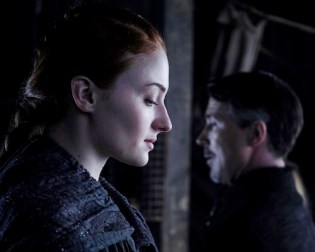 First up: The Door, surely one of Thrones’ best-ever episodes. That ending rather overshadows everything else (because wow, in so many ways), but before that there was Sansa being badass, proper development of Arya’s storyline, the hilarious play-within-a-play, a marvellous scene between Dany and Jorah, and a great moment for Varys, too. The week after’s Blood of My Blood was more about setting things up the second half of the season, which is an important role to fulfil but less dramatic in itself. A couple of surprise returns, though, including a big reveal for book readers (maybe).
 Sometimes it’s hard to separate what one might count as story development versus mere place-setting in Thrones, but at its best they can be one and the same, and episode seven managed that. Finally for now, No One did actually bring some storylines to a head, including some very long-awaited developments, particularly in Braavos. Throw in an equally-long-awaited reunion and a couple more unexpected returns, and you have a pretty satisfying episode.
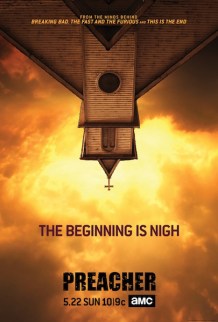 Sam Catlin of Breaking Bad and Seth Rogen & Evan Goldberg of… all those films Seth Rogen & Evan Goldberg have made (you know
  This month, I have mostly been missing anything I watch with my other half. It’s prime tennis season — eight weeks that starts with Geneva and flows through the French Open, Stuttgart, Nottingham, Birmingham, Queen’s, Eastbourne, and ends with the crowning jewel of all tennisdom, Wimbledon; all with near wall-to-wall coverage thanks to Eurosport, ITV4, and the BBC. It largely takes over the time we normally spend watching stuff together, so no room yet for the final seasons of Wallander or The Musketeers (not that we’ve watched season two yet, actually — oops), nor the just-finished fourth season of The Most Underrated Show On Television™, The Americans. Apparently it ended with “the Best Episode of TV So Far This Year”, according to one review’s headline (which obviously I can’t read because spoilers). Maybe in July.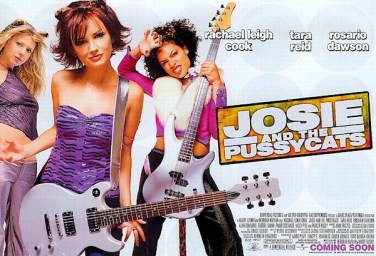


 Regular readers will surely remember
 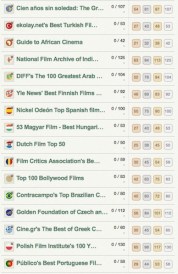 There are pretty obvious reasons why I’ve never seen any films on many of those lists — quite a lot are country or continent specific, and as Western film viewers we’re notoriously poor at having seen movies from, say, Africa. The lack of acclaimed films I’ve seen from the likes of Belgium, Finland, Holland, Hungary, Norway, Poland, Portugal, and Spain is my own fault though, I guess. Anyway, this is something I intend to rectify in the coming days / weeks / months / years / decades — however obscure some of my missing lists may seem, there’s at least one film I’ve heard of on all but one or two of them, so there’s that.
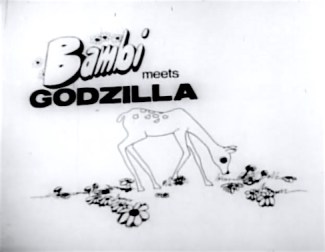 Why is this film notable? In fact, is it notable? Well, it was voted in to The 50 Greatest Cartoons by some of 1,000 animation professionals, so there’s clearly something there. It was created by animator Marv Newland while he was a film student in L.A., after a live-action project he’d been planning to submit was scuppered (according to



















 Favourite Film of the Month