The Godfather (1972)

100 Films’ 100 Favourites #39

An offer you can’t refuse.

Country: USA
Language: English, Italian & Latin
Runtime: 175 minutes
BBFC: X (cut, 1972) | 18 (1987) | 15 (2008)
MPAA: R

Original Release: 24th March 1972
UK Release: 18th August 1972
First Seen: DVD, c.2001

Stars
Marlon Brando (On the Waterfront, Apocalypse Now)
Al Pacino (Dog Day Afternoon, Scarface)
James Caan (Rollerball, Misery)
Robert Duvall (The Seven-Per-Cent Solution, Network)

Director
Francis Ford Coppola (The Godfather Part II, Apocalypse Now)

Screenwriters
Mario Puzo (Earthquake, Superman)
Francis Ford Coppola (The Great Gatsby, The Conversation)

Based on
The Godfather, a novel by Mario Puzo.

The Story
1945: Michael takes his girlfriend to his sister’s wedding, where she’s introduced to his family, including his father, Vito — the Don of New York’s Corleone crime family. Over the next decade, decisions made by the family lead to escalating gang war, and just as he thought he was out, Michael is pulled in to the family business.

Our Hero
A good college kid who dropped out to fight in World War 2, Michael Corleone has distanced himself from his family’s criminal activities… until a series of events find him drawn inescapably in.

Our Villain
According to the AFI, Michael is the 11th most iconic villain in film history. Of course, he winds up a Mafia Don, so he’s hardly a good guy in the traditional sense, but we’re surely on his side, at least throughout this film. Even in that context, I think you could argue the titular Godfather himself, Don Corleone, is the villain: his one son who tried to escape the life of crime is pulled into it after a string of poor choices and unfortunate incidents land the family in trouble.

Best Supporting Character
James Caan is Vito’s hot-headed eldest son, Sonny, heir apparent to the crime empire. Unfortunately, that very hot-headedness is liable to leave the position open…

Memorable Quote
“Luca Brasi sleeps with the fishes.” — Clemenza

Quote Most Likely To Be Used in Everyday Conversation
“I’m gonna make him an offer he can’t refuse.” — Don Corleone
(According to the AFI, this is the second best movie quote ever.)

Memorable Scene
The opening is the perfect scene-setter for the movie. On the day of his daughter’s wedding, Don Corleone hears requests for favours. One man asks for retribution against men who assaulted his daughter, which he has been denied by the legal system. Corleone questions why the man didn’t come straight to him, but ultimately grants the grovelling father his wish. Here, the film has established its pace, its tone, and themes of family, respect, and the important point that these criminals think of themselves as the honourable ones.

Write the Theme Tune…
Italian composer Nino Rota composed the majority of the soundtrack (Carmine Coppola contributed some music), including the famous main theme. Apparently a Paramount executive described Rota’s score as too “highbrow” and urged it be ditched, but Coppola won out. Considering the music’s subsequent fame and familiarity, I think we know who was right.

Technical Wizardry
The dark but amber-tinged cinematography by Gordon Willis is gorgeous. It’s stuff like this that high definition was made for.

Making of
Cinematographer Gordon Willis insisted that every shot represent a point of view, placing his camera around 4ft off the ground and keeping the angle flat. Coppola persuaded him to do a single aerial shot, in the scene when Don Corleone is gunned down, by telling Willis that the angle represented God’s perspective.

There’s a first time for everything…
According to IMDb, “Coppola turned in an initial director’s cut running 126 minutes. Paramount production chief Robert Evans rejected this version and demanded a longer cut with more scenes about the family. The final release version was nearly 50 minutes longer”. Studios love extended cuts for DVD these days, but choosing to take up more time in theatres? Not bloody likely.

Next time…
Debate rages as to whether sequel The Godfather Part II is an even better film. Either way, it was the first sequel to win Best Picture (and still one of only two). In 1977, Coppola edited the two films together in chronological order, along with some deleted scenes, to form The Godfather Saga miniseries, aka The Godfather: A Novel for Television. (Although it’s not been released on home media since VHS, it has been repeated on TV in HD, meaning copies can be… acquired.) Over a decade later, Coppola turned his duology into a trilogy with The Godfather Part III. Although generally reviled whenever it’s spoken about, it has a not-bad 7.6 on IMDb and was also nominated for Best Picture, as well as six other Oscars. (Part III was later added to the chronological cut to make The Godfather Trilogy: 1901-1980.)

Awards
3 Oscars (Picture, Actor (Marlon Brando), Adapted Screenplay)
8 Oscar nominations (Supporting Actor (James Caan, Robert Duvall, and Al Pacino), Director, Costume Design, Sound, Editing, Score)
1 BAFTA (Music)
4 BAFTA nominations (Actor (Marlon Brando), Supporting Actor (Robert Duvall), Costume Design, Most Promising Newcomer to Leading Film Roles (Al Pacino))

What the Critics Said
“It seems that the first question everyone asks about The Godfather is concerned with Marlon Brando’s interpretation of the title role. That is the way the movie has been programmed and promoted: Brando, Brando, Brando, and more Brando. The word from advance hush-hush screenings was wow all caps and exclamation point. […] So to answer belatedly the first question everyone asks about The Godfather: Brando gives an excellent performance as Don Vito Corleone [however,] though Brando’s star presence dominates every scene in which he appears, the part itself is relatively small, and there are other people who are equally good with considerably less strain, among them the extraordinarily versatile James Caan as the hot-headed, ill-fated Sonny Corleone, Richard Castellano as the jovially gruesome Clemenza, and Robert Duvall as Don Vito Corleone’s non-Italian consigliere, Tom Hagen.” — Tony Ortega, The Village Voice

What One Single Critic Said
“I don’t see how any gifted actor could have done less than Brando does here. His resident power, his sheer innate force, has rarely seemed weaker. […] Al Pacino, as Brando’s heir, rattles around in a part too demanding for him. James Caan is OK as his older brother. The surprisingly rotten score by Nino Rota contains a quotation from “Manhattan Serenade” as a plane lands in Los Angeles. Francis Ford Coppola, the director and co-adapter (with Mario Puzo), has saved all his limited ingenuity for the shootings and stranglings, which are among the most vicious I can remember on film. The print of the picture showed to the New York press had very washed-out colors.” — Stanley Kauffmann, New Republic (the one and only critical review on Rotten Tomatoes)

Score: 99%

What the Public Say
“Few people could have anticipated during the course of adapting Mario Puzo’s best-seller The Godfather to the big screen that it would become a lasting legacy in cinema. Forty-plus years have passed since its theatrical release, yet it stands the test of time as not only one of the greatest depictions of a crime family, but as one of the best films ever made. […] That lasting popularity isn’t a fluke; the Godfather films stand the test of time because these aren’t just movies, they’re cultural touchstones.” — Colin Biggs, Movie Mezzanine

Verdict

Has it really been almost eight years since the IMDb Top 250’s unshakeable #1 was usurped? The Godfather sat pretty at the top of that user-voted ranking for the best part of nine years, its balance between critically-acclaimed filmmaking finesse and quotable gangster machinations almost perfectly calibrated for that website’s prevailing demographic. (It’s since settled at #2, hardly a failure.) It’s not just IMDb users, though: The Godfather places 6th on the latest iteration of The 1,000 Greatest Films, the as-near-to-definitive-as-you-can-get poll-of-polls compilation. It’s for the same reasons, really: The Godfather combines thriller elements and striking violence with a strong understanding of character and a believable exploration of organised crime, a world as fascinating as it is morally repulsive, for a whole that is as artistically accomplished as it is palatable to the mainstream.

Sky Movies Select are showing the complete Godfather trilogy today from 4:30pm.

Next… you know the name, you know the number — it’s #40.
The Past Month on TV #4

It’s the moments we’ve all been waiting for, as David Tennant returns to Doctor Who and Game of Thrones returns to our screens. Spoiler-free reviews of both (and more) follow…

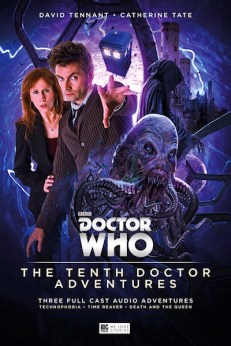
Doctor Who: The Tenth Doctor Adventures Volume 1

One of Doctor Who’s most popular eras is revived this week, as David Tennant returns to the headline role for the first time since 2013 for a debut series of Big Finish audio dramas. By his side is Catherine Tate’s Donna — what initially sounded like terrible casting but turned out to be a fantastic Doctor/companion pairing. (I know not everyone’s convinced by her even now, but you can’t win ’em all.) Given Tennant’s enduring popularity as the 10th Doctor, it’s no surprise his return to the role has brought Big Finish more attention than ever — their website even went down for a few hours on Monday, unable to cope with the rush of fans downloading the new stories. (And yes, I’m kinda bending the rules by reviewing audio drama in a TV column… but, a) these are designed to recreate a TV series in audio form, and b) it’s my column and I can review what I like.) So do they live up to expectations? Thankfully, yes. Setting out to emulate the era they’re from, they follow the model set out by the first three episodes of every Russell T Davies-helmed season of NuWho: a present day one, a future one, and a past one.

The first is Technophobia by Matt Fitton, which is set in our recent past (and therefore Donna’s near-future) when the new M-Pad tablet computer seems to be causing the populace to forget how to use technology. Tennant and Tate hit the ground running — it’s a cliché, but it really does sound like they’ve never been away. Their sprightly performances contain little of the stilted “I’m reading this script aloud for the first time” acting that sometimes plagues audio drama. Fitton captures the style and tone of their single TV season to a tee — if they’d done a second year together, you can well believe this as its first episode. Even Howard Carter’s incidental music is a mostly-fitting substitute for Murray Gold’s iconic work.
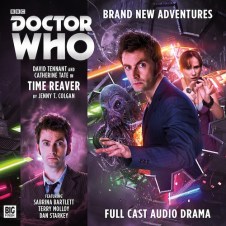
The middle tale is sci-fi adventure Time Reaver by Jenny T. Colgan, a best-selling romantic novelist who’s turned her hand to multiple Who projects (including a 10th Doctor and Donna novel published last week to tie-in with these dramas). For me, this was the weak link of the trilogy, though it’s by no means bad. There are some fantastic ideas, but at times their inspirations show through too clearly, and the execution is sometimes lacking. This was Colgan’s first audio drama, and dare I say it shows. Sequences like an action-packed barroom brawl are a little too ambitious to convey in an audio-only medium, and the dialogue is regularly forced to describe what’s going on. On the bright side, Mr Carter offers more magnificent sound design — the noises made by cephalopod villain Gully are immensely evocative.

The final episode is the group’s historical outing, Death and the Queen by James Goss, and it may be the best of the lot. Our intrepid duo find themselves in the kingdom of Goritania in 1780, when it comes under siege from a destructive cloud that contains Death himself. Goss mixes comedy with peril in just the right quantities to create a story that is an entertaining romp but also manages to expose different facets of the Doctor and Donna’s relationship. If Fitton has bottled the essence of RTD, here Goss evokes Steven Moffat, with a time-jumping opening ten minutes that you can well imagine on TV, but which also work perfectly in audio. Things slow a bit later on, with the dialogue sometimes going in circles — a fault of all three of these plays, actually. They could’ve benefited from a trim to fit within the TV series’ 45-minute slot, rather than allowing the freedom of not having to conform to a schedule let them to slide to 55-ish.
That’s only a niggle, though, and one that pales beside the excitement of having Tennant and Tate back in the TARDIS. This is a run of adventures that largely evoke the pair’s time on TV without being a needless carbon copy of it, meaning they work as both a marvellous hit of nostalgia and exciting new adventures in their own right.

All three stories are currently available exclusively from the Big Finish website, going on general release from 1st September. They can be purchased individually (either as a CD+download or download-only), or as part of a limited edition box set (CD+download) that comes with a 78-minute behind-the-scenes documentary and an hour-long introduction to other Big Finish works, all encased in a book with exclusive photography and articles.

Eurovision Song Contest: Stockholm 2016
Ah, love a bit of Eurovision, even if the songs weren’t as good this year. Ok, you might say they never are, but there’s often one or two half-decent ones (I still listen to Conchita Wurst’s Rise Like a Phoenix sometimes, mainly because it’s the best Bond theme released in the last decade). Even then, the winner wasn’t the best of that middling bunch, though it probably had the best message. In fact, the best song of the night was the Swedish hosts’ half-time number, Eurovision-spoofing Love Love Peace Peace (watch it here). The much-heralded new voting system worked like a charm… at least for audience tension purposes. Poor Australia with that last-minute lose… though as they shouldn’t really have been there in the first place, it’s hard to feel too bad for them.
Game of Thrones (Season 6 Episodes 1-4)
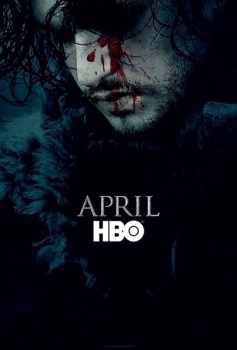
Good luck to you if you’re not watching Game of Thrones but still trying to avoid spoilers this year, with the huge and widely-covered news that [REDACTED] was [REDACTED], or that [REDACTED] killed [REDACTED], or when [REDACTED] and [REDACTED] were [REDACTED] for the first time since [REDACTED], or when [REDACTED] was [REDACTED] but [REDACTED] the [REDACTED] and [REDACTED] of [REDACTED] in the process — even if more people seemed interested in discussing her [REDACTED]s.
Trying not to add to the tumult of spoilers (just in case), I thought that The Red Woman was the now-standard GoT season opener (a mix of recapping/establishing where everyone is, and just beginning to shuffle those players around the board for their next moves) done as well as it’s ever been. Home was where the season really kicked into gear, though — quicker than some other years have managed, that’s for sure. One particular moment was much discussed, understandably, but events elsewhere — both in Westeros and Essos — would’ve been enough to excite interest without it. Oathbreaker engaged more with its flashbacks than its ‘present day’ actions, though another episode-ending scene at Castle Black reiterated the series’ warts-and-all vision of the world. Finally, Book of the Stranger was an immensely satisfying hour — the kind of thing Thrones allows us all too rarely, considering how often its heroes are crushed. Apparently the writers have said this is the year the series’ female characters finally begin to really ‘fight back’, and it would seem this episode is where it begins.

Upstart Crow (Series 1 Episodes 1-2)
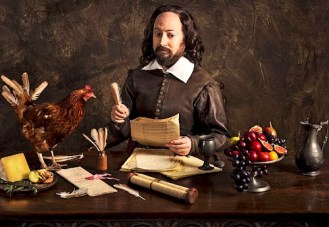
I can’t remember the last time I saw a new multi-camera sitcom that wasn’t either, a) a bit meta (like Miranda or Mrs Brown’s Boys), or b) a revival (like Red Dwarf X). I don’t know if that says more about the current TV landscape or the kind of things I watch, but either way it surprised me when that was the form Upstart Crow took. It’s just one element that gives it the feel of Blackadder, which I don’t mean as a criticism. Even if it feels a little dated in its execution, there are plenty of laughs — some easy, some clever — and, really, what more do you want from a comedy than to laugh? It may not be up to Blackadder’s highest highs (yet — there’s still time; you never know), but I’d wager it stands fair comparison to the classic’s comparatively-lesser instalments… which I mean to be a less critical assessment than it sounds.
Also watched…
  • The British Academy Television Awards 2016Wolf Hall director Peter Kosminsky’s barnstorming defence-of-the-BBC acceptance speech set the tone for the evening, which consequently was one of the best BAFTA ceremonies ever. The BBC broadcast had to cut some of his speech, no doubt out of fear of the government, but the full text can be read here.
  • The Flash Season 2 Episodes 15-19 / Arrow Season 4 Episodes 15-18 / DC’s Legends of Tomorrow Season 1 Episodes 6-9 — this is all getting a bit much now… and next year they’re probably adding Supergirl to the mix, as it’s moving to The CW too. I may have to give up on one or two of them at that point, I think.
  • Gilmore Girls Season 6 Episode 10-Season 7 Episode 7 — the much-maligned seventh season really is not good. I just want it to be over so I can switch to being excited for the Netflix revival.
  • Person of Interest Season 4 Episodes 16-22 — with the cancelled-after-filming final season underway in the US now, one of the showrunners was talking about how the series will nonetheless come to an ending, because they’ve tried to conclude every season with a suitable stopping point. I really, really hope they’ve done something different with season five, though, because the cliffhanger endings of seasons three and four would actually have been terrible places to end forever.

    Things to Catch Up On
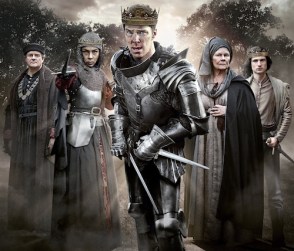
    This month, I have mostly been missing the second run of The Hollow Crown, the BBC’s all-star adaptation of Shakespeare’s War of the Roses plays… though as I still haven’t got round to watching the first run from 2012, that’s no real surprise. In fact, Upstart Crow aside, I’ve not yet watched any of their still-running Shakespeare Festival, other highlights (so I’ve heard) of which have included the Shakespeare Live from the RSC celebration and spoof documentary Cunk on Shakespeare. There’s also Russell T Davies’ new version of A Midsummer Night’s Dream, which is on Monday 30th.
    Next month… as was just announced yesterday, AMC’s Preacher adaptation comes to the UK via Amazon.

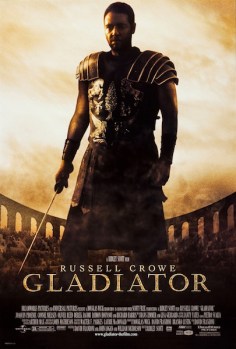
  • Gladiator (2000)

    100 Films’ 100 Favourites #38

    The general who became a slave.
    The slave who became a gladiator.
    The gladiator who defied an empire.

    Country: USA & UK
    Language: English
    Runtime: 155 minutes | 171 minutes (extended edition)
    BBFC: 15
    MPAA: R

    Original Release: 4th May 2000 (Australia)
    US Release: 5th May 2000
    UK Release: 12th May 2000
    First Seen: DVD, c.2001

    Stars
    Russell Crowe (L.A. Confidential, A Beautiful Mind)
    Joaquin Phoenix (Walk the Line, Her)
    Connie Nielsen (The Devil’s Advocate, One Hour Photo)
    Oliver Reed (Women in Love, The Three Musketeers)
    Richard Harris (This Sporting Life, Unforgiven)

    Director
    Ridley Scott (Kingdom of Heaven, Exodus: Gods and Kings)

    Screenwriters
    David Franzoni (Amistad, King Arthur)
    John Logan (The Aviator, Skyfall)
    William Nicolson (Shadowlands, Mandela: Long Walk to Freedom)

    Story by
    David Franzoni (Jumpin’ Jack Flash, Citizen Cohn)

    The Story
    Roman Emperor Marcus Aurelius believes his son and heir, Commodus, is unfit to rule, so plans to appoint victorious General Maximus Decimus Meridius as regent. Before he can, Commodus murders Marcus and orders Maximus’ execution. Maximus escapes, but returns home to find Commodus has had his wife and son murdered. Captured by slavers, Maximus becomes a gladiator, and when Commodus announces gladiatorial games to commemorate his father, he spots a chance for revenge…

    Our Hero
    Maximus Decimus Meridius, commander of the Armies of the North, General of the Felix Legions and loyal servant to the old emperor, Marcus Aurelius. Father to a murdered son, husband to a murdered wife, becomes a gladiator, will have his vengeance against the new emperor, in this life or the next.

    Our Villain
    Said new emperor, Commodus. Murders his father because Marcus favours Maximus. Fancies his sister. That kinda guy.

    Best Supporting Character
    Even if his performance is partially computer generated (more on that later), Oliver Reed still stands out as Proximo, the slave owner who buys Maximus and turns him into a gladiator. For a fella who does that kind of thing, he turns out to be very honourable.

    Memorable Quote
    “My name is Maximus Decimus Meridius, commander of the Armies of the North, General of the Felix Legions and loyal servant to the true emperor, Marcus Aurelius. Father to a murdered son, husband to a murdered wife. And I will have my vengeance, in this life or the next.” — Maximus Decimus Meridius, commander of the Armies of the North, General of the Felix Legions, loyal servant to the true emperor Marcus Aurelius; father to a murdered son, husband to a murdered wife.

    Quote Most Likely To Be Used in Everyday Conversation
    “Are you not entertained? Are you not entertained?” — Maximus Decimus Meridius, commander of the Armies of the— yeah, you know the rest.

    Memorable Scene
    After Maximus secures a surprise victory in the Colosseum, Commodus enters the arena to congratulate the victor. Maximus reveals himself (cue famous speech), but holds back on his plan to murder the Emperor. As the Praetorian Guard prepare to execute Maximus, the crowd chant: “live!” Not prepared to risk unpopularity, Commodus spares him… for now.

    Truly Special Effect
    Oliver Reed died halfway through filming, with his key supporting role only partially complete. Famously, his performance was completed with computers, one of the first times such a thing had been done. Effects company The Mill created the additional footage by filming a body double and then mapping on a computer-generated mask of Reed’s face. The work totalled two minutes of screentime, at an estimated cost of $3.2 million.

    Making of
    When the HBO/BBC TV series Rome started, I read an interview with the programme’s historical advisor, who’d performed the same role for Gladiator. Asked to compare the experience of working on a major Hollywood movie versus a BBC-produced TV series, she cited the way the makers asked for information about something they wanted to include: on TV they’d ask, “did this exist?”; on Gladiator they’d say, “find us proof this existed.”

    Next time…
    A prequel or sequel was discussed ever since the film was a hit. The best/worst idea came from a re-write by Nick Cave (yes, that one) in which Maximus was “reincarnated by the Roman gods and returned to Rome to defend Christians against persecution; then transported to other important periods in history, including World War II, the Vietnam War, and finally being a general in the modern-day Pentagon.” As awesome as that sounds, it was rejected for “being too far-fetched, and not in keeping with the spirit and theme of the original”. Spoilsports.

    Awards
    5 Oscars (Picture, Actor (Russell Crowe), Costume Design, Sound, Visual Effects)
    7 Oscar nominations (Supporting Actor (Joaquin Phoenix), Director, Original Screenplay, Cinematography, Editing, Score, Art Direction-Set Decoration)
    5 BAFTAs (Film, Cinematography, Production Design, Editing, Audience Award)
    10 BAFTA nominations (Actor (Russell Crowe), Supporting Actor (both Joaquin Phoenix and Oliver Reed), Director, Original Screenplay, Music, Costume Design, Sound, Visual Effects, Make Up/Hair)
    2 World Stunt Awards (Best Fight, Best Work with an Animal)
    1 MTV Movie Award (Best Movie)
    5 MTV Movie Awards nominations (including Best Line from a Movie for “It vexes me, I am terribly vexed!”)

    What the Critics Said
    “There isn’t much difference between the crowds cheering Maximus and fans of modern mayhem entertainment. Money is the root of all violent exploitation then and now. One of Maximus’ endearing qualities is the way he resents the attention. It’s insane to view these fights as fun. We like him enough to agree, then realize we’re gawkers, too. Scott plays cagey with this paradox, as if to say: If you want to be a ghoul, do it right. Mano a mano, with much more than profit in the balance. Viewers shouldn’t feel guilty watching Gladiator, but its impatience with trash-sports showmanship is unmistakable.” — Steve Persall, St. Petersburg Times

    Score: 76%

    What the Public Say
    “As far as elements of technical filmmaking go, Gladiator is nothing short of a marvel. Production design team does a magnificent job in putting up set pieces that are grand, imposing & meticulously refined with the real standout being the Colosseum itself which is undeniably a sight to behold. The culture, politics & life within the Roman Empire is illustrated in splendid detail. Costumes, artefacts & other props are in sync with the timeline its story is set in but it also incorporates a slightly urban touch to it that brings a flavour of its own into the picture and enhances the look & feel of the whole imagery.” — CinemaClown @ Letterboxd

    Verdict

    Gladiator’s influence is plain to see: it was hailed at the time for reviving the classic swords-and-sandals epic — and indeed it did, because in its wake we’ve had so many that my original plan to list them here became untenable. The ‘original’ is still the best, though, thanks to director Ridley Scott’s feel for the epic, Russell Crowe’s strong hero, Joaquin Phoenix’s slimily unstable villain, and a mix of a straight revenge tale with familial/political plotting and the importance of public relations, thumping action sequences, and groundbreaking special effects.

    #39 will make you… an offer you can’t refuse.

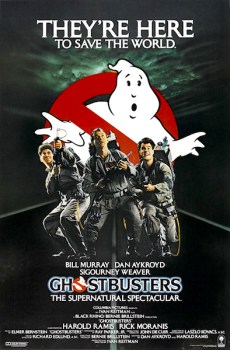
    Ghostbusters (1984)

    100 Films’ 100 Favourites #37

    They’re here to save the world.

    Also Known As: Ghost Busters, technically.

    Country: USA
    Language: English
    Runtime: 105 minutes
    BBFC: PG (1984) | 12A (2011)
    MPAA: PG

    Original Release: 8th June 1984
    UK Release: 7th December 1984
    First Seen: VHS, c.1990

    Stars
    Bill Murray (Groundhog Day, Lost in Translation)
    Dan Aykroyd (The Blues Brothers, Trading Places)
    Harold Ramis (Stripes, The Last Kiss)
    Ernie Hudson (The Crow, Congo)
    Sigourney Weaver (The Year of Living Dangerously, Gorillas in the Mist)
    Rick Moranis (Little Shop of Horrors, Honey, I Shrunk the Kids)

    Director
    Ivan Reitman (Stripes, Kindergarten Cop)

    Screenwriters
    Dan Aykroyd (The Blues Brothers, Dragnet)
    Harold Ramis (Animal House, Groundhog Day)

    The Story
    After losing their university jobs, a trio of paranormal researchers set up a ghost extermination business. They’re soon hired by Dana Barrett, who believes her apartment is haunted. Turns out it is, by an evil demigod who posses Dana and sets about bringing the world to an end…

    Our Heroes
    They ain’t afraid of no ghosts! Discredited parapsychologists Peter Venkman, Ray Stantz and Egon Spengler set up the Ghostbusters to combat the increasing problem of paranormal activity in New York City, and later recruit Winston Zeddemore to cope with demand.

    Our Villain
    Gozer the Gozerian, a Sumerian god of destruction. Likes to turn his servants into supernatural hounds and allow the good guys to choose the form of their ‘destructor’ — which is how you end up having to fight a 112½-foot marshmallow man.

    Best Supporting Character
    Among a strong cast of memorable characters, one has to feel for William Atherton as antagonistic EPA agent Walter Peck. Peck is so unlikeable that, according to director Ivan Reitman, it “ruined” Atherton’s life: people confronted him as if he were the character, including starting fights in bars. He’s just too good at being a slimy little so-and-so, I guess.

    Memorable Quote
    “Don’t cross the streams.” — Dr. Egon Spengler

    Quote Most Likely To Be Used in Everyday Conversation
    “Dogs and cats, living together!” — Dr. Peter Venkman (well, we used it a lot…)

    Memorable Scene
    The Ghostbusters fail to stop the coming of Gozer, who shortly declares that the destructor will follow, in a physical form chosen by the team. Although three of them manage to clear their minds, something pops into Ray’s head — “the most harmless thing. Something I loved from my childhood. Something that could never, ever possibly destroy us.” Unless it was eleven storeys tall and motivated by evil, of course.

    Sing the Theme Tune…
    “If there’s something strange in you neighbourhood, who you gonna call?” Ray Parker Jr.’s theme song is as iconic as the movie itself. It lost the Oscar to Stevie Wonder’s I Just Called to Say I Love You. Won the BAFTA, though.

    Truly Special Effect
    The film is full of excellent effects work — all done practically, of course, in those pre-CGI days. That also means an abundance of techniques were used, from simple stuff like hanging things on wires or using wind blowers to make library cards fly around, to miniatures with a Godzilla-style man in a suit, to full animation for things like the proton packs’ streams. And it was all produced on such a tight schedule that, according to the film’s effects mastermind, 70-80% of the work was achieved in the first take.

    Making of
    Dan Aykroyd wrote the part of Winston with Eddie Murphy in mind, having just worked with him on Trading Places. When Murphy was unavailable due to working on Beverly Hills Cop, Ernie Hudson was cast. He was so excited by the part that he agreed to do it for half his usual salary, only to then receive a revised script in which Winston had a greatly reduced role. In 2015, Hudson commented, “I love the character and he’s got some great lines, but I felt the guy was just kind of there. I love the movie, I love the guys. I’m very thankful to Ivan for casting me. I’m very thankful that fans appreciate the Winston character. But it’s always been very frustrating — kind of a love/hate thing, I guess.”

    Next time…
    First came The Real Ghostbusters, an animated series that ran from 1986 to 1991 and produced 140 episodes (the addition of The Real to the title being due to another series from the ’70s). Due to its success, the cast and crew were cajoled into making a film sequel, Ghostbusters II, which scared the life out of me when I was about 4. In 2009, Ghostbusters: The Video Game used the likenesses and voices of many of the original cast, and Dan Aykroyd described it as “essentially the third movie.” Rumours and/or plans for a genuine second sequel persisted for a very, very long time (there’s a mass of details here, if you’re interested), though finally seem to have been abandoned in favour of this summer’s all-female reboot.

    Awards
    2 Oscar nominations (Visual Effects, Original Song)
    1 BAFTA (Original Song)
    1 BAFTA nomination (Visual Effects)
    1 Saturn Award (Fantasy Film)
    Nominated for the Hugo for Best Dramatic Presentation.

    What the Critics Said
    “The cast could not be better. Although his role is too small, Aykroyd is endearingly serious as a diehard, but easily scared, ghost-hunter. Harold Ramis, the co-writer of the script, is extremely funny as a hopeless egghead […] But Ghostbusters is primarily a showcase for Murray, who slinks through the movie muttering his lines in his usual cheeky fashion and getting off an occasionally hilarious crack that proves he’s thoroughly enjoying himself.” — Kathleen Carroll, New York Daily News

    Score: 97%

    What the Public Say
    “the use of special effects, specifically practical effect, shines as well. The ghosts may not be perfectly rendered, but they are so interesting in design and they have so much energy onscreen that you don’t mind it. The practical effects, like having the ground open up or drawers being opened by unseen ghosts are done very well. In a time where many effects-heavy films rely solely on CGI, it’s nice to look back to a time when practical effects were still commonplace in movies and done well in movies.” — Joey Sack, Reel Reactions

    Verdict

    Along with Teenage Mutant Ninja Turtles and ThunderCats, I loved Ghostbusters when I was a kid — I had a dressing up set, with a jumpsuit and a proton pack with a yellow foam whatsit for the stream, and one of the traps, and an Ecto-1, and the firehouse playset, and one time I got my fingers caught in the grill on the roof (which was there to pour goo through, because toys) and I’m sure I panicked until liberal application of butter freed me… Good times. I guess back then my love for it was more to do with the animated series than the movie, but the film itself is a work of blockbuster comedy art. The characters are a joy to be around, the dialogue is hilarious and quotable, multiple sequences lodge themselves indelibly in the memory, the special effects are exemplary, and the dramatic stakes can be surprisingly effective for what’s primarily a comedy.

    All together now: “bustin’ makes me feel good!

    #38 will have its revenge… in this post or the next.

    Ghost in the Shell (1995)

    100 Films’ 100 Favourites #36

    It’s found its voice…
    now it needs a body.

    Original Title: Kôkaku Kidôtai
    Also Known As: Mobile Armored Riot Police: Ghost in the Shell (Japan)

    Country: Japan
    Language: Japanese
    Runtime: 83 minutes
    BBFC: 15

    Original Release: 18th November 1995 (Japan)
    UK Release: 8th December 1995
    First Seen: DVD, 2000

    Stars
    Atsuko Tanaka (Ghost in the Shell 2: Innocence, Bayonetta: Bloody Fate)
    Akio Ôtsuka (Black Jack, Paprika)
    Kôichi Yamadera (Ninja Scroll, Cowboy Bebop: The Movie)
    Yutaka Nakano (Cowboy Bebop: The Movie, Ghost in the Shell 2: Innocence)
    Tamio Ôki (Journey to Agartha, Wolf Children)

    Director
    Mamoru Oshii (Patlabor: The Movie, Ghost in the Shell 2: Innocence)

    Screenwriter
    Kazunori Itō (Patlabor: The Movie, .hack//SIGN)

    Based on
    The Ghost in the Shell (攻殻機動隊 Kōkaku Kidōtai, literally Mobile Armoured Riot Police), a manga by Masamune Shirow.

    The Story
    Japan, 2029: Public Security officer Major Motoko Kusanagi and her team are assigned to track down and capture a dangerous hacker known as the Puppet Master, but they soon find themselves embroiled in a far-reaching conspiracy…

    Our Hero
    In a future world where humans can undergo varying degrees of cyberisation, Major Motoko Kusanagi is a “full-body prosthesis augmented-cybernetic human” — only her brain is organic. Her body is a generic mass production model, so she can blend in while being a kick-ass law enforcement officer.

    Our Villain
    The Puppet Master, a cyber criminal who hacks into people’s brains and gives them false memories. But is there something even worse going on behind the hacker?

    Best Supporting Character
    Kusanagi’s second-in-command Batou is stoic to the point of brusqueness — apparently quite a different characterisation to his portrayal in other Ghost in the Shell media.

    Memorable Quote
    “If we all reacted the same way, we’d be predictable, and there’s always more than one way to view a situation. What’s true for the group is also true for the individual. It’s simple: overspecialise, and you breed in weakness. It’s slow death.” — Major Kusanagi

    Memorable Scene
    Pursuing the Puppet Master, Kusanagi comes face to face with a six-legged tank. After a blazing gun battle, she tries to physically rip it open, her cybernetic body straining to breaking point — and beyond…

    Technical Wizardry
    Ghost in the Shell was groundbreaking in its skilful combination of traditional 2D animation with CGI additions. It used a process called “digitally generated animation” (DGA), which combined cel animation with computer graphics to create lens effects that simulated depth, motion, and unusual lightning techniques, as well as mixing in 3D CGI and digital audio.

    Letting the Side Down
    In 2008, Oshii revisited the film to create Ghost in the Shell 2.0, which regraded the colour, replaced some of the original animation with new CGI, omitted several scenes, and featured a remixed and re-recorded soundtrack. (More details here.) As is almost always the case when directors fiddle with their creations decades later, it wasn’t well received by fans.

    Next time…
    As befalls many a popular anime franchise, Ghost in the Shell has spawned a raft of sequels and reboots. The only direct sequel, Innocence, was released in 2004. TV series Ghost in the Shell: Stand Alone Complex ran for two seasons between 2002 and 2005, with the first run compiled into movie The Laughing Man and the second into Individual Eleven, all of which were followed by a final film, Solid State Society. Another reboot came in 2013 with direct-to-video series Ghost in the Shell: Arise, which so far totals five episodes and, last year, continuation film Ghost in the Shell: The New Movie. (Only four episodes have so far been released in the West, but the movie — which continues the story from the fifth episode — came out on Monday in the UK. Just to make things more complicated.) A live-action American remake is currently shooting for release in March 2017 — you’ve probably heard about it.

    Awards
    5 Annie Awards nominations (Animated Feature, Directing, Producing, Writing, Production Design)

    What the Critics Said
    “When Akira first blasted out of Japan back in 1991 it looked like the Western concept of widescreen animation would be changed forever. […] Unfortunately, it was not to be. Sure, on video, the Manga scene has gone from strength to strength, but as far as theatrical releases are concerned, nothing has really come along to match Akira’s sheer retina-scalding magnificence. Until now. […] From its baddie-eviscerating opening sequence through innumerable car chases, shoot outs and tongue-in-cheek dialogue exchanges, this is exactly the kind of film that James Cameron would make if they ever let him through the Disney front gates.” — Clark Collis, Empire

    Score: 95%

    What the Public Say
    “both the film and Oshii have fallen into a kind of disrepute among the anime community. The common line on GITS is that it’s wordy, masturbatory, and pretentious with nothing going on intellectually and that the (plainly inferior but more easily accessible) GITS: SAC is a better alternative. I wanted to write this article to respond to that notion. GITS is a highly thoughtful film and worthy of comparison to virtually any scifi feature you could name. ” — tamerlane, too long for twitlonger

    Verdict

    Ghost in the Shell was the first anime I consciously saw, which maybe helps it earn a place here. It’s an initially accessible movie that’s also very complicated — there are pulse-pounding action scenes and a thriller storyline to keep things exciting, but also a lot of deep philosophical discussions, touching on themes of gender and identity. I think for some viewers the latter are a negative, while for others they’re the entire point. (I imagine the forthcoming Hollywood remake will either ditch or seriously curtail them, but you never know.) The combination makes for a stimulating (in multiple senses) sci-fi actioner.

    Next… who ya gonna call? #37 !

    Gangs of New York (2002)

    100 Films’ 100 Favourites #35

    America was born in the streets

    Country: USA & Italy
    Language: English
    Runtime: 168 minutes
    BBFC: 18
    MPAA: R

    Original Release: 20th December 2002
    UK Release: 9th January 2003
    First Seen: cinema, 2003

    Stars
    Leonardo DiCaprio (Titanic, The Revenant)
    Daniel Day-Lewis (My Left Foot, Lincoln)
    Cameron Diaz (There’s Something About Mary, My Sister’s Keeper)
    Jim Broadbent (Moulin Rouge!, Another Year)
    Liam Neeson (Schindler’s List, Kingdom of Heaven)

    Director
    Martin Scorsese (Goodfellas, The Departed)

    Screenwriters
    Jay Cocks (The Age of Innocence, Silence)
    Steven Zaillian (Schindler’s List, The Girl with the Dragon Tattoo)
    Kenneth Lonergan (The Adventures of Rocky & Bullwinkle, Margaret)

    Story by
    Jay Cocks (Strange Days, De-Lovely)

    Inspired by
    The Gangs of New York: An Informal History of the Underworld, a non-fiction book written in 1927 by Herbert Asbury.

    The Story
    New York City, 1846: after his father is murdered in a fight by fellow gang leader Bill ‘the Butcher’, young Amsterdam Vallon is dumped in an orphanage. Sixteen years later, he returns to the Five Points district. With revenge in mind, he tries to establish himself with the ruling gang and get close to their leader — Bill.

    Our Hero
    In the first of his five (to date) collaborations with Scorsese (or six if you count that advertising short they were paid an insane amount for), Leonardo DiCaprio is Amsterdam Vallon, son of a murdered gang leader who, decades later, plots his revenge. His nemesis is a cunning so-and-so, however…

    Our Villain
    Although he’s a ruthless killer, and the unquestionable villain from the outset, Daniel Day-Lewis manages to render Bill a perversely charming creation, who unavoidably captivates your attention whenever he’s on screen.

    Best Supporting Character
    Priest Vallon, Amsterdam’s father, only appears in the opening sequence, but his influence and death hangs over the rest of the movie. That’s why you need an actor of Liam Neeson’s calibre for the part, and of course such casting pays off.

    Memorable Quote
    “I’m 47. 47 years old. You know how I stayed alive this long? All these years? Fear. The spectacle of fearsome acts. Somebody steals from me, I cut off his hands. He offends me, I cut out his tongue. He rises against me, I cut off his head, stick it on a pike, raise it high up so all on the streets can see. That’s what preserves the order of things. Fear.” — Bill

    Memorable Scene
    Scorsese captures an entire lifecycle in New York’s Five Points within a single tracking shot, which begins with immigrants arriving fresh off the boat and ends with coffins lined up on the quay.

    Memorable Music
    I have mixed feelings about U2 (because, y’know, Bono), but the theme they crafted for GangsThe Hands That Built America — is a pretty good track, and sits very appropriately at the end of the movie. It was Oscar-nominated, but lost to Eminem’s Lose Yourself from 8 Mile.

    Letting the Side Down
    Scorsese tried to make Gangs of New York for ages. At one point, he wanted Meryl Streep for the lead female role. He ended up with Cameron Diaz. Say no more, eh.

    Making of
    Unable to film in New York, which no longer looked like it did back in the mid-1800s, the production was mounted on a large set at Rome’s Cinecittà Studio. According to Wikipedia, production designer Dante Ferretti constructed “over a mile of mid-nineteenth century buildings, consisting of a five-block area of Lower Manhattan, including the Five Points slum, a section of the East River waterfront and two full-sized sailing ships, a thirty-building stretch of lower Broadway, a patrician mansion, and replicas of Tammany Hall, a church, a saloon, a Chinese theater, and a gambling casino.” Now that is a set!

    Awards
    10 Oscar nominations (Picture, Director, Actor (Daniel Day-Lewis), Original Screenplay, Cinematography, Art Direction-Set Decoration, Costume Design, Film Editing, Sound, Original Song)
    1 BAFTA (Actor (Daniel Day-Lewis))
    11 BAFTA nominations (Film, Director, Original Screenplay, Cinematography, Music, Production Design, Costume Design, Editing, Sound, Visual Effects, Make Up/Hair)
    2 World Stunt Award nominations (Best Fight (the opening), Best Stunt Coordinator and/or 2nd Unit Director)
    1 Teen Choice Award nomination (Choice Movie Liplock)

    What the Critics Said
    “The ambition is immense. This is Scorsese’s version of D.W. Griffith’s Birth of a Nation and Michael Cimino’s Heaven’s Gate and there are echoes of Kurosawa, Eisenstein and Visconti, as well as the nod to Welles […] As with Heaven’s Gate, judgment on this film must await Scorsese’s longer version. Nevertheless, this remains an astonishing achievement, a film with a passionate sense of life, by one of the greatest filmmakers at work today.” — Philip French, The Observer

    Score: 75%

    What the Public Say
    “This movie, even if it ended with Amsterdam’s degradation rather than his triumph, would be fabulous, probably only inferior to Raging Bull and Goodfellas among Scorsese’s oeuvre. The problem is that the movie is nearly three hours long, and that the movie continues after Amsterdam’s maiming. There is a marvelous story to be told about American tyranny, about the immigrant experience, about just how firmly entrenched the powerful are. Do you choose bellicose racism as Bill does, or do you throw your lot in with benevolent corruption as Tweed does? It hardly seems to matter; you will be expunged and forgotten in the slop and grime of the Five Points all the same while someone else wears a tall hat and eats well.” — speakerformediocrities, Seeing Things Secondhand

    Verdict

    Gangs of New York ended up with a bit of a mixed reception when it finally came out in 2002, which is only to be expected after Scorsese had been intending to make it for over 20 years, and the version he had shot was stuck in editing for a year (considering all the Director’s Cuts we get nowadays, why have we never had Scorsese’s original 48-minutes-longer cut?) It’s undoubtedly a compromised film, then, but one that retains a rich atmosphere, engaging performances (even if it suffers from two of the leads, DiCaprio and Diaz, being two of the least accomplished), and an impressive sense of scale. It may have a relatively simplistic revenge-tale throughline, but class swirls around it.

    #36 will be… 攻殻機動隊.

    The Game (1997)

    100 Films’ 100 Favourites #34

    Players Wanted

    Country: USA
    Language: English
    Runtime: 128 minutes
    BBFC: 15
    MPAA: R

    Original Release: 12th September 1997 (USA)
    UK Release: 10th October 1997
    First Seen: TV, c.2000

    Stars
    Michael Douglas (Wall Street, Basic Instinct)
    Sean Penn (Dead Man Walking, Milk)
    Deborah Kara Unger (Crash, Stander)

    Director
    David Fincher (Panic Room, Gone Girl)

    Screenwriters
    John Brancato (The Net, Terminator 3: Rise of the Machines)
    Michael Ferris (Terminator Salvation, Surrogates)

    The Story
    What do you buy the man who has everything? After high-flying businessman Nicholas Van Orton is enrolled in a mysterious alternate reality game by his estranged brother, it’s no surprise that unusual things start to happen. But as those happenings begin to take on a sinister edge, it may be Nicholas has been targeted by something more serious, and potentially life-threatening.

    Our Hero
    Nicholas Van Orton is an immensely successful financier, but so low on friends that he even spends his birthday completely alone. He could do with fun in his life, or so believes his brother… or does he?

    Our Villains
    The game is run by a company called Consumer Recreation Services, or CRS. But they just run games… or do they?

    Best Supporting Character
    Early on in his experience, Nicholas runs into waitress Christine, who has also been affected by the game… or is she actually a part of it? Just who can he trust?!

    Memorable Quote
    “You know, I envy you. I wish I could go back and do it for the first time, all over again. Here’s to new experiences.” — Ted

    Memorable Scene
    On the run and tired, Nicholas hops in a cab. He doesn’t notice the doors lock, until the maniacal cab driver begins to speed down the hill. As Nicholas desperately tries to escape, the driver leaps out — and the cab soars into the river, with Nicholas trapped inside…

    Awards
    1 Saturn nomination (Action/Adventure/Thriller Film)

    What the Critics Said
    “Crafted with a commanding, aloof precision by David Fincher in his first outing since hitting the jackpot with Seven, this unusual dive into the ambiguous world of an undefined pastime without apparent rules generates a chilly intellectual intrigue that will arouse buffs, trendies and techies more than it will mainstream [audiences. It] projects the same sense of suffocating enclosure and mounting despair in a style that will inevitably be compared to that of Stanley Kubrick in its steely technical mastery and remote, disenchanted worldview, all in the service of a story that resembles a highbrow puzzle as much as it does an involving narrative.” — Todd McCarthy, Variety

    Score: 72%

    What the Public Say
    “just when we’ve finally come to a part of the story we can accept and trust, it turns out that we’ve once again been led astray. In this cinematic game, Fincher’s directorial ability wins out; his ability to pace his films; to completely draw the audience’s attention in whichever direction he requires, as well as keeping them emotionally attached to the protagonists is a balancing act which Fincher has mastered time and again over his career, and The Game is no exception.” — jyapp8715, Through the 4th Wall

    Elsewhere on 100 Films
    I reviewed The Game as part of a retrospective on Fincher’s films back in 2011, saying it “is by far at its best on your first viewing, when you don’t know how it will end and it’s stuffed with mysteries and twists. That’s not to say it doesn’t bear repeat viewings — as with most twist-ending-ed films, there’s naturally some interest in seeing it again knowing what’s going on — but a lot of the film’s enjoyment comes from being played with, the back-and-forth of what the truth is.”

    Verdict

    In fairness, The Game probably comes near the bottom of my top 100, because I remain a little dubious about its re-watch value — not because it’s poorly made (far from it), but because the twists and reveals are such a big part of its appeal, and once you know them, you know them. Also, arguments continue between its fans and its haters about whether the plot makes sense or not, and how much that actually matters — personally, I think it makes enough sense (maybe for some parts you have to switch on your “it’s a movie” filter, however). The reason it makes my list nonetheless is the quality of a first viewing, especially if you do buy into its conceit and just go with it. Few other films have kept me guessing from the start up to the very closing moments, and consequently on the edge of my seat throughout. That experience may be unrepeatable, but as one-time deals go, it was immeasurably memorable and effective.

    #35 will be… the hands that built America.

    The Delayed Monthly Update for April 2016

    I was away this weekend and didn’t have much time for blogging, and most of what I did have was spent finishing 1999 Week, so that’s why this post is later than normal (and also why I have plenty of your posts & comments still to catch up on!)

    (Also-also, if you were wondering where the “top films of 1999” post I promised had got to, I wrote about three-quarters of it before I decided it was rubbish, so I abandoned it. I’m sure I’ve published lots of rubbish on this blog over the years, but never deliberately.)

    Anyway, on with what I watched in April…


    #68 Of Human Bondage (1934)
    #69 Jack Ryan: Shadow Recruit (2014)
    #70 Cool World (1992)
    #71 Warrior (2011)
    #72 The Limey (1999)
    #73 The Thomas Crown Affair (1999)
    #74 Election (1999)
    #75 The Eight Diagram Pole Fighter (1984), aka Wu Lang ba gua gun
    #76 Ghosts of Mars (2001)
    #77 Caesar Must Die (2012), aka Cesare deve morire
    #78 300: Rise of an Empire (2014)
    #79 Lost River (2014)
    #80 The Fighter (2010)
    #81 Wuthering Heights (2011)
    #82 A Royal Night Out (2015)
    #83 Locke (2013)
    #84 Maleficent (2014)
    #85 Christine (1983)
    #86 The Iron Giant (1999)
    #87 Badlands (1973)
    #88 Pixels (2015)

    .


    • This is the earliest I’ve ever reached #75 — the previous best was 1st June, last year.
    • Coincidentally, I reached #75 this year on the date that I reached #50 last year (8th April) — which at the time was a record.
    • “What Do You Mean You Haven’t Seen” continues at pace with Brad Bird’s popular animated B-movie homage The Iron Giant. I’ve already reviewed it here.
    • Four films from 1999 this month. We know what that led to.


    For the fourth month in a row, I’ve crossed the 20 film boundary. Out of 112 months I’ve been doing this, it’s only the 7th time that’s happened. Expressed another way, it only happens 6.25% of the time; before 2016, it only happened 2.78% of the time (and before 2015, it only happened 1.04% of the time!)

    The final number of films this month was actually 21, which is slightly behind the 2016 average — but only slightly, because that was 22.3. It’s now adjusted to a round 22. Conversely, being five films better than April’s previous best, it raises the April average from 8.25 to 9.67.

    Predictions are typically futile, though it’s beginning to look like I’ll be away for most of December, which throws an interesting variable in the mix. (I say “interesting” in a relative sense.) Of course, “most” is not “all”, so it likely won’t count for 0 — but will it reach the 10-per-month minimum I’ve been holding steady on for nearly two years now? Well, that’s a discussion for December itself. In the meantime, even if December doesn’t reach 10, my final tally should be in excess of 160 — easily enough to score the second best year ever. If I hew closer to that 22 average, 2016 could wind up passing 250…



    Foreign deconstructions of American values, genre revisionism, high camp, one of the greatest Bond films, and paternal revelations — it’s all go in this month’s eight favourites!


    The 11th Monthly Arbitrary Awards

    Favourite Film of the Month
    Quite an easy choice this month. Films that are made ‘artily’ (for want of a better word) sit on a fine line, for me: too far one way and they tip off into pretentious dullardom, but get it right and they can be utterly fantastic. A couple of films erred on the right side of that line this month, thankfully, but only one really nailed it, and that was The Limey.

    Least Favourite Film of the Month
    Even in a month that includes multiple critically-reviled films (Cool World, Ghosts of Mars, Lost River, Pixels), my pick for this category was really easy — and it’s none of those. This winner’s predecessor wasn’t exactly high art (far from it), but it had something to it — some innovation; some merit in its extremeness. This sequel doesn’t have that. For being almost entirely vacuous and looking cheap as chips, this month’s travesty of cinema is 300: Rise of an Empire.

    Most Inexplicably Popular Film of the Month
    I’m going to steal a bit from the draft of my forthcoming review to explain this one: “The weirdest thing is, this is the kind of movie I regularly give 4-stars to, while loads of other people give it 3 and I think they’re being a bit harsh but I can see where they’re coming from. Yet somehow Warrior transcends such criticism from people who usually have too much ‘taste’ — they acknowledge it’s terribly clichéd, but then give it a pass on that. Why? Why don’t you give the same leniency to the tonnes of other movies you cruelly rip to shreds for their clichés?” (For more on this theme, see table9mutant’s review.)

    Most Critically-Reviled Film of the Month That I Actually Really Enjoyed
    As I alluded to above, there are several contenders for this trophy (not Cool World, though — that is rubbish). Leaving aside a couple of sci-fi blockbusters that, while not as bad as many critics made out, are still not really more than “entertaining while they’re on”, the winner here is Ryan Gosling’s directorial debut Lost River. Heavily influenced by other filmmakers, certainly, and almost self-consciously elliptical with its pace and storytelling, I nonetheless thought there was a lot to like if you’re open to ‘that kind of film’ (think Lynch).

    The Audience Award for Most-Viewed New Post of the Month
    Thanks to a retweet by Film4, views for Starman went through the roof (relative to my normal posts, anyway). It wasn’t enough to challenge Harry Potter 1&2 for the most-viewed post of the month overall, but then nothing ever is.


    Once upon a time, I made a comment that can be summarised as, “Perhaps one day I could reach #100 in May — ha ha ha ha ha, like that could ever happen!”

    Well…

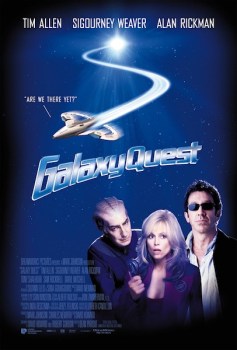
    Galaxy Quest (1999)

    100 Films’ 100 Favourites #33

    The show was cancelled…
    but the adventure has only begun.

    Country: USA
    Language: English
    Runtime: 102 minutes
    BBFC: PG
    MPAA: PG

    Original Release: 25th December 1999 (USA)
    UK Release: 28th April 2000
    First Seen: DVD, c.2001

    Stars
    Tim Allen (The Santa Clause, Christmas with the Kranks)
    Sigourney Weaver (Alien, Avatar)
    Alan Rickman (Dogma, Harry Potter and the Philosopher’s Stone)
    Tony Shaloub (Men in Black, Pain & Gain)
    Sam Rockwell (Confessions of a Dangerous Mind, Moon)

    Director
    Dean Parisot (Fun with Dick and Jane, RED 2)

    Screenwriters
    David Howard
    Robert Gordon (Addicted to Love, Lemony Snicket’s A Series of Unfortunate Events)

    Story by
    David Howard

    The Story
    The cast of ’70s sci-fi series Galaxy Quest have been reduced to convention appearances and mall openings since their show was cancelled; but when a group of aliens, who believe the series was an historical document and have built the show’s spaceship for real, ask for the crew’s help to defeat a genocidal general, the actors must endeavour to become their characters for real.

    Our Heroes
    A ragtag gang of washed-up actors who used to star on a space opera TV series, now co-opted into being real heroes. They’re all based on the cast and characters of Star Trek, of course: Tim Allen’s Jason Nesmith, the ship’s captain, is obviously William Shatner/James T. Kirk; Sigourney Weaver’s Gwen Demarco, the token female, is Nichelle Nichols/Uhuru; Alan Rickman’s Alexander Dane, the classically-trained actor playing an alien science officer, is a combination of Leonard Nimoy/Spock and Patrick Stewart; Tony Shaloub’s Fred Kwan, a fake-foreign engineer, is a mixture of James Doohan/Scotty and Walter Koenig/Chekov; and Daryl Mitchell’s Tommy Webber, a young helmsman from an ethnic minority, is a mixture of George Takei/Sulu and Wil Wheaton/Wesley Crusher.

    Our Villain
    General Sarris, a reptilian warlord waging war against the kindly Thermians. No discredit to Robin “Ethan Rayne off Buffy” Sachs, but he’s kind of beside the point, really.

    Best Supporting Character
    Enrico Colantoni (Veronica Mars, Person of Interest) plays the leader of the friendly aliens, Mathesar, a naïve soul who speaks in a sing-song monotone.

    Memorable Quote
    “By Grabthar’s hammer, by the suns of Worvan, you shall be avenged.” — Sir Alexander Dane

    Memorable Scene
    Our heroes arrive in the bowels of their screen-faithful ship to find “a bunch of chompy, crushy things” impeding their path — for absolutely no reason. “We shouldn’t have to do this, it makes no logical sense, why is it here?… This episode was badly written!”

    Making of
    In cinemas, the film began with a 4:3 aspect ratio for clips from the old TV series, then widened to 1.85:1 for the Earth-based scenes, before widening again to a highly cinematic 2.35:1 once Tim Allen’s character realises he’s on a real spaceship. It was decided to ditch the middle stage for the home video releases, which I suppose makes sense, but is a lot less fun.

    Previously on…
    Galaxy Quest is an original creation, but it’s heavily inspired by the Star Trek franchise and its fans.

    Next time…
    A reboot TV series was supposedly in the works at Amazon, though comments made by co-star Sam Rockwell just last month suggest the project had developed into a direct sequel, which was then sadly scuppered by the untimely death of Alan Rickman.

    Awards
    1 Saturn Award (Actor (Tim Allen))
    9 Saturn nominations (Science Fiction Film, Actress (Sigourney Weaver), Supporting Actor (Alan Rickman), Performance by a Younger Actor/Actress (Justin Long), Director, Music, Costumes, Make-Up, Special Effects)
    Won the Hugo Award for Best Dramatic Presentation

    What the Critics Said
    “Whether you love Star Trek or laugh at it, your starship is about to come in, docking in the form of Galaxy Quest, an amiable comedy that simultaneously manages to spoof these popular futuristic space adventures and replicate the very elements that have made them so durable. […] If Galaxy Quest never attains consistently giddy heights as it plays out its combination of knowing satire and heroic adventure, it nevertheless keeps its tongue firmly in its cheek, offers a few genuine laughs, moves swiftly, if not at warp speed, and is led by a talented cast.” — Lawrence Van Gelder, The New York Times

    Score: 90%

    What the Public Say
    “As a fan of the various science fiction classic series, like Star Trek and Star Wars, I’ve met most of the people parodied in Galaxy Quest – from the overzealous fans to the has-been and bitter celebrities making a living off a series’ memories. A movie like Galaxy Quest manages to poke fun at a wide range of people but still be loveable and sympathetic at the same time.” — Kevin Carr, 7M Pictures

    What the Trekkies Say
    In 2013, just after Star Trek Into Darkness came out, a massive convention of Trekkies decided to vote on the best Trek movies. Galaxy Quest muscled its way in to 7th place, besting six real Trek flicks. (Infamously, Into Darkness came dead last.)

    Verdict

    Managing to satirise both classic sci-fi TV shows and their (shall we say) enthusiastic fanbase, while remaining relatively respectful to both, is quite a feat, and is surely one reason Galaxy Quest has proven so popular. Another is its accessibility: you don’t need to be a Trekkie to get all the gags. Combine those two and you have a film for fans and non-fans alike. To really cement the issue, it’s a solid adventure movie as well as a funny comedy.

    #34 will be… what you get for the man who has everything.

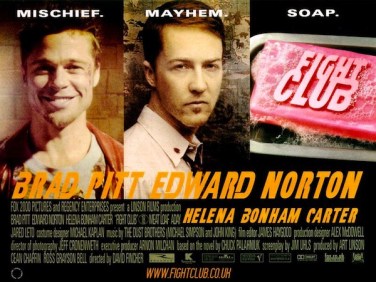
    Fight Club (1999)

    100 Films’ 100 Favourites #29

    Mischief. Mayhem. Soap.

    Country: USA & Germany
    Language: English
    Runtime: 139 minutes
    BBFC: 18 (cut, 1999) | 18 (uncut, 2005)
    MPAA: R

    Original Release: 15th October 1999 (USA)
    UK Release: 12th November 1999
    First Seen: TV, c.2001

    Stars
    Edward Norton (American History X, 25th Hour)
    Brad Pitt (Interview with the Vampire, World War Z)
    Helena Bonham Carter (Room with a View, The King’s Speech)
    Meat Loaf (The Rocky Horror Picture Show, Tenacious D in The Pick of Destiny)

    Director
    David Fincher (Se7en, The Social Network)

    Screenwriter
    Jim Urls (Sweet Talk, Jumper)

    Based on
    Fight Club, a novel by Chuck Palahniuk.

    The Story
    The film’s nameless narrator is growing increasingly disillusioned with his mundane consumerist lifestyle, when he bumps into Tyler Durden. A free-spirited soap salesman, the pair have a fight for the heck of it. Finally experiencing some kind of genuine feeling, they set up an underground club for fighting, but it gradually becomes clear that Tyler may have bigger ideas…

    Our Heroes
    I am Jack’s nameless narrator. I am also Jack’s friend, Tyler Durden. Yes, just his friend…

    Our Villains
    The establishment! Capitalism! What’ve you got?

    Best Supporting Character
    Helena Bonham Carter hasn’t been fucked like that since grade school.

    Memorable Quote
    “The first rule of Fight Club is: you do not talk about Fight Club. The second rule of Fight Club is: you do not talk about Fight Club! ” — Tyler Durden

    Quote Most Likely To Be Used in Everyday Conversation
    “You are not special. You are not a beautiful or unique snowflake. You’re the same decaying organic matter as everything else.” — Tyler Durden

    Memorable Scene
    Called into his manager’s office to discuss his bad behaviour, the Narrator decides the best method of getting his own way is by enacting physical violence… on himself.

    Technical Wizardry / Truly Special Effect
    For what’s essentially a drama, Fight Club is overloaded with special effects and visual trickery. I don’t know if any are particularly groundbreaking in and of themselves, but several are particularly striking. A personal favourite, thanks to the perfect execution of the idea, is the shot where the Narrator’s condo is transformed into a living IKEA catalogue.

    Making of
    Marla’s original post-coital line was, “I want to have your abortion.” The studio objected to such an offensive line, so Fincher agreed to change it on the condition that the new line had to be used. The studio agreed, apparently unaware that such an agreement was never going to end well. Fincher wrote the replacement line, “I haven’t been fucked like that since grade school.” The studio asked for the original line back; Fincher refused. (It must say something about American values that abortion is considered more shocking than underage sex.)

    Next time…
    Nothing from the film, but Chuck Palahniuk has continued his novel in 10-issue comic book series Fight Club 2. A second comic series, Fight Club 3, is planned.

    Awards
    1 Oscar nomination (Sound Effects Editing)
    1 MTV Movie Awards nominations (Best Fight for Edward Norton fighting himself)
    1 BRIT Award nomination (Best Soundtrack — it lost to Notting Hill)

    What the Critics Said
    “Three factors elevate Fincher’s apocalyptic stew to something approaching art. First is Norton’s performance, as sneaky and shocking as that in his film debut Primal Fear. Second is Palahniuk’s story, which dances on a razor’s edge between life and death, expression and repression, ecstasy and agony. Third is Fincher’s dedication to making a film that looks and sound likes no other, one that powerfully illustrates what dementia looks like from inside and out.” — Carrie Rickey, Philadelphia Inquirer

    Score: 79%

    What the Public Say
    “it’s hard to believe Fight Club is now 15 years old. As I was watching the film last night I found it hard to review because it is so ingrained in pop culture now it would be almost sacrilegious to say something bad about it. […] The first time I saw Fight Club I did not see the twist of [REDACTED] coming. I remember being surprised, but also very confused. I didn’t really understand how it worked then. On the second viewing it is easy to see a million clues pointing to this from the very beginning. Director David Fincher is very clever in how he orchestrates the film by giving you all these hints. He’s very good at walking that tight rope of not giving away too much. The twist is definitely one of the highlights of the film and why it is so memorable. It doesn’t feel cheap to me as some of these things normally do.” — Sherise, The Girl that Loved to Review

    Elsewhere on 100 Films
    I reviewed Fight Club as part of a retrospective on Fincher’s films back in 2011, saying “Fincher’s films often look great, but Fight Club is surely the most visually inventive. A list of exciting spectacles could be endless […] To top it off, the ‘regular’ cinematography is grounded in Fincher’s trademark darkness, as if every shot was conceived as just black and he added only what light was necessary.”

    Verdict

    A controversial film to this day, Fight Club is a violent, explicit exploration of the turn-of-the-millennium Western male psyche, which hasn’t necessarily lost its relevance in the ensuing decade-and-a-half. Criticised by some for endorsing the anarchic lifestyle it depicts, praised by others for satirising that mode of thinking, and criticised by other others for not satirising it well enough, the film can certainly provoke a spread of views. There’s little doubt that David Fincher’s direction is memorably slick and inspired, however, and it has one of the most talked-about twists in movie history.

    #33 will… boldly go where no comedy has gone before.