Yesterday I published the full list of my 2017 viewing. Well, I say “full” — I didn’t put my Rewatchathon viewing in there. I’m not going to include it in these stats either (mostly). Maybe I’ll do something differently about that at the end of 2018, but for now this all remains focused on my primary goal: watching at least 100 films every year that I’ve never seen before.
In today’s post we do the fun stuff: look at all sorts of statistics about that viewing. Hurrah!

In the end, I watched 174 new feature films in 2017. That’s my third highest final total, behind 2016’s 195 and 2015’s 200, though it’s quite far ahead of fourth place, 2014’s 136.
I also watched two extended or altered cuts of features I’d seen before. They’ll be included in all the stats that follow (except the running time one we’ll get to in a sec).

However, those 176 films are not the full story. As I mentioned in my introduction, this year I set myself a secondary goal — Rewatchathon — in which I aimed to make myself watch again at least 52 films I’d seen before. Obviously this took viewing time away from my main goal, and I became curious how 2017 would compare to previous years if those rewatches had been main list views. To keep things fair I had to go back and tot up my rewatches from previous years. Fortunately, I have complete records for that as far back as 2009 (I have a little over half of 2008, which suggests it was a good year, but not good enough to challenge the last couple). The number of films I rewatched fluctuated wildly at times (21 in 2013, 4 in 2014, 20 in 2015, etc), but unsurprisingly the biggest overall totals came in the years when 100 Films was also high. The only years that passed 200 were the last two: altogether I watched 206 films in 2016 and 223 in 2015. In 2017, I watched… 228. So, yes, this is officially my most film-filled year on record.
(An additional bit of stats business: in previous years there was the odd rewatch that I also reviewed, meaning it was included in the stats (it’s the “other reviews” bit in the graph above). My Rewatchathon is putting an end to that. I’ve reviewed some stuff from it but certainly not everything, so it would be a bit weird to just count the handful of films I did happen to review. I could count every single film I watched for the Rewatchathon, but that feels somehow against the point. It means my stats for previous years don’t compare with 100% accuracy to these, but I was always inconsistent on which rewatches I counted anyway.)
Additionally to all that, I also watched five short films. They don’t count in any stats… except the one they do, which we’ll get to in half a sec.
The total running time of the 174 new features was 316 hours and 43 minutes, which (as the graph shows) is in line with what you’d expect given the number of films. Add in the two alternate cuts and five shorts and the total running time of all films was 321 hours and 59 minutes.

This year’s most prolific viewing format was streaming for the third year in a row, but it suffered a bit of a drop: it accounted for 76 films, which was 43.2% of my viewing — down from 57% last year, and even below the 47% from the year before. Where did those percentage of views go? Well, a few different places. I’ll get onto those in a sec. Firstly: this year I bothered to count up which streaming services I used. It was all divided between the three main players on this side of the pond: Netflix, Amazon (including both Prime and rentals), and Now TV. Amazon accounted for precisely 50% (38 films), with Netflix on more-or-less 30% (23 films), and Now TV bringing up the rear on 20% (15 films). I’ve mostly used Netflix for series this year, mind, whereas I don’t think I’ve watched more than a couple of episodes of anything on Amazon (and Now TV do TV as a separate subscription).

Second place went to Blu-ray, with 46 films (26.1%) — up from last year, but otherwise my lowest since 2012. As I say every year: I own hundreds of the things, I need to watch them more. (It’s worse for DVD, mind, but we’ll come to that.)
There’s more of an ‘upset’ in third place, however: cinema! It’s been in last place for five of the last six years (the one exception, 2012, it was second-last), and it didn’t have a particular strong showing before that. Indeed, 2017 marks my greatest number of cinema trips in one year since this blog began, with 18 films (10.2%). In fact, that’s more than the last seven years combined. I intend for this to continue in 2018, but I don’t know if it’ll increase — it’s so much more cost effective to wait for films at home these days…
Next, there’s a small increase for downloads, with 14½ films (8.2%) — the half because I had to download City of God when my DVD copy crapped out halfway through. It’s overleaped television, which continues its slide from dominance (it was first from 2009 to 2012) with 13 films (7.4%).
Bringing up the rear is an even more ignominious faller: the humble once-beloved DVD, with 8½ films (4.8%) — actually a slight increase from last year! I mean, it’s up from 8 to 8½ and from 4% to 4.8%, but still…
In amongst all that, I watched 11 films in 3D (a mix of Blu-rays, downloads, a TV rental, and one in the cinema) and 1 in 4K. I have a feeling the latter will increase in 2018, but I’ve no idea by how much.
Which brings me to the HD vs. SD, to which I’ve added that meagre UHD offering this year. HD includes all but one stream, all of Blu-ray and cinema, all but one download, and just under a third of my TV viewings. In the SD camp there’s one streamer and one download (obv.), just over two-thirds of my TV viewing, and the handful of DVDs. The final result is 88.4% in HD, boosted by 0.6% in UHD. It’s slightly up on last year, but not a huge amount.
In terms of the films’ age, the most popular decade was the 2010s (same as since 2012) with 114 films (64.8%). That number’s down on last year, though the percentage went up (I watched about 20 fewer films overall, remember). In second, however, the 2000s saw real gains (albeit small ones), going from 18 up to 21 (11.9%). The only other decade to make double figures was the ’90s, holding steady on 15 (8.5%).
Below that, there were a smattering of films for every decade back to the ’20s: the ’80s clocked eight (4.6%), the ’70s reached seven (3.98%), the ’60s had four (2.3%), the ’50s only two (1.1%), the ’40s a slightly better three (1.7%), and the ’30s and the ’20s netted just one each (0.6%).
Last year, the percentage of films I watched in English dipped below 90% for the first time. This year it was back over it, though only at 90.1%. That’s 160 films wholly or partially in English. However, there were more others than recently: 32 languages were spoken in total (plus one silent film), up from 24 in the 2015 and 2016. Distant second was an uncommonly strong showing for Japanese in 15 films (8.5%), while everything else was in single figures. Of particular note is American Sign Language cropping up in three films, and Ancient Egyptian and Pawnee both putting in appearances for the second year in a row.
It’s the same story in countries of production, with the USA producing 138 films — 78.4%, up from last year’s 73.6%. Distant second was the UK with 42 films — that’s 23.9%, identical to last year. Again mirroring the language stats, Japan had an unusually strong showing with 14 films (7.95%), by far its best result (its previous high on record was six). Just behind were Canada and France on 13 (7.4%) each. Next was China, its nine representing a continuing increase, mostly co-productions as Hollywood continues its interests there, I’d wager. Concurrently, former co-production fave Germany is on the way down, with just six (almost half its figure from last year), which is tied with Australia.
Running down the list, there’s Hong Kong on five (after a big bump last year thanks to a load of Shaw Brothers films, this is back to normal), New Zealand on four, and three each for Denmark and Ireland. Five more countries had two apiece, and 12 countries contributed to a single film each. That’s a total of 29 countries represented, just one down from last year.

A total of 143 directors plus 13 directing partnerships appear on 2017’s main list. Of those, 18 had multiple credits. The man with the most was David Lynch on four — and that doesn’t even include Twin Peaks: The Return (or whatever we’re calling it nowadays). Behind him on three apiece we find Clint Eastwood and Keishi Ōtomo (the Rurouni Kenshin trilogy). Then there’s Taika Waititi, who directed two films himself plus one as co-director; and Michael Bay, who directed two films plus an alternate cut; and George Miller, who only has one main list film to his solo name, but was also behind an alternate cut and a quarter or another film. Keeping things simple with a pure two each there’s Mel Brooks, Paul Feig, Ron Howard, Duncan Jones, Shūsuke Kaneko, David Mackenzie, Penny Marshall, Tokuzô Tanaka, and Adam Wingard. Finally, Wes Anderson and David Leitch both helmed a main list feature and a short, while this blog’s most-featured director of all time, Steven Spielberg, had one new feature and a quarter of another. The rest took one each, although in the shorts we can find Luke Scott, son of Ridley, taking charge of two of the Blade Runner 2049 prequels.
For the past two years I’ve specifically charted the number of female directors whose work I’ve watched. There were just four female directors in 2017’s viewing, with five films between them, which is 2.84%. That’s better than last year, but worse than 2015 — and none of them are very good figures in any case.
On a brighter note (for me), 11 films from the main list currently appear on the IMDb Top 250 (or whatever it’s called nowadays). Their positions ranges from 21st (City of God) to 210th (Thor: Ragnarok). However, because that list is ever-changing, the number I have left to see has only gone down by seven, to 69.
At the end of my annual “top ten” post I always include a list of 50 notable films I missed from that year’s releases, and continue to track my progress at watching those ‘misses’. In 2017, I’ve seen at least one more movie from every year’s list. To rattle through them (including the overall total seen in brackets), this year I watched: one from 2007 (34); four from 2008 (24); three from 2009 (29); three from 2010 (30); one from 2011 (33); two from 2012 (32); one from 2013 (32); five from 2014 (41); and four from 2015 (32).
Finally, in the first year of watching 2016’s 50, I saw 30 of them. That’s the best ‘first year’ ever, just beating the 28 from 2015’s list that I watched during 2016.
In total, I’ve now seen 317 out of 500 of those ‘missed’ movies. That’s 63.4%, up from the 58.4% I’d got through by the end of last year. Basically, I’m watching them faster than I add them — which is a good thing. (As usual, this year’s new 50 will be listed in my next post.)
To finish off 2017’s statistics, then, it’s the climax of every review: the scores.
At the top end of the spectrum, I awarded 32 five-star ratings in 2017. That’s more than last year, even though I watched fewer films, meaning the percentage was well up — 18.2% vs. 2016’s 13.2%. It’s above my all-time five-star average too, which is 16.85%. Am I getting more generous or just picking better films? Such is always the debate. Maybe it’s the latter, though, because my four-star ratings dipped to 78 films — still second place, but at 44.3% it’s well down on last year and below the all-time average of 45.8%. Commensurately, the percentage of three-star ratings were above average: those 49 films equal 27.8%, over the all-time 26.4%. All that said, we’re not talking numbers that massively outside the norm here (as we’ll see shortly).
Rounding things out at the bottom end, there were 15 two-star films (8.5%), which is very much a normal amount, and a mere two one-star films (1.14%), which is also pretty normal (across ten years the average number is 2.1 a year).
And so all of that brings us the average score — the single figure that (arguably) asserts 2017’s quality compared to other years. The short version is 3.7, the same as the last two years, as well as 2007 and 2009. We have to add a few more decimal places to get a precise idea, however (if we don’t, seven out of eleven years score either 3.6 or 3.7). To three decimal places, 2017 scores 3.699. That’s 0.024 higher than 2016, meaning it takes fourth place on the all-time chart, sitting just 0.031 behind 2015 in third. These are tiny margins, as always — I guess that means my scoring is pretty consistent.
And that’s all your numbers and graphs done for another year! It’s OK, you can read them again if you want.
More quality assessments, with my lists of the best and worst films I saw last year.

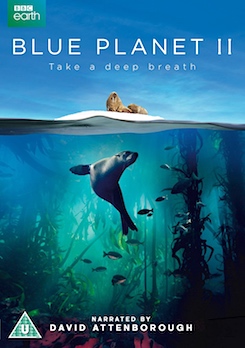 Despite the massive hype, I missed this when it aired. I say “missed” — I always intend to watch these big natural history shows, then never get round to them. I confess, it was new tech that persuaded me: after I saw it was all available in UHD on iPlayer, I had to give that a go. And…
 Now, I didn’t do a comparison to the regular HD stream, so I can’t really say how much better the UHD made things, but I do have a few observations. Related to it looking “more real”, after viewing I saw a good resolution photo taken for the series of one creature (this chap) which didn’t seem to capture the texture of its body in the same way the episode did. That could be the added effect of motion vs a still photo, but it could also be the extra detail from 4K. And talking of comparing still images, when a UHD episode was selected it displayed the iPlayer menu in UHD/HDR too, so I was able to do a direct comparison of each episodes’ key image. In particular, the one pictured above (from episode five) really showed off the vibrancy of HDR.
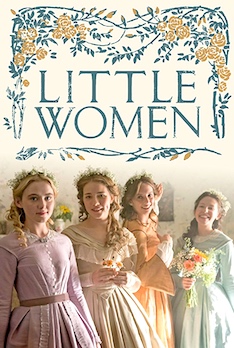 As I mentioned last time, I’ve never seen or read a previous version of Little Women, but apparently this new one was pretty faithful so I figure I’m all learned about it now. The biggest change appears to be in the ages of the four eponymous heroines: in this version they look to be about the same age, in their late teens or early 20s at the start, but in fact they should be 16, 15, 13 and 12. Quite different. A challenge for adapters, though, because the story covers a timespan of five or more years (by my reckoning). Other films have dodged this by casting two actresses in some roles, but this adaptation sought to avoid that. It has its cons (an early petulant act comes across very differently if done by a 12-year-old versus a c.17-year-old, I think), but it is what it is.
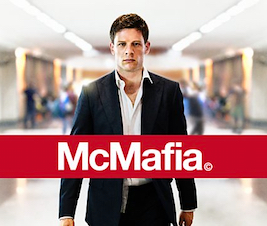 This month, I have mostly been missing the BBC’s pair of big, grim January dramas, McMafia and Hard Sun. They both seem to have received a very mixed reaction (not that I’ve been following too closely because, y’know, spoilers), but both have intriguing setups: the former a drama about the global business of the Russian mafia inspired by a non-fiction book; the latter a pre-apocalyptic sci-fi/crime thriller from the creator of Luther.

































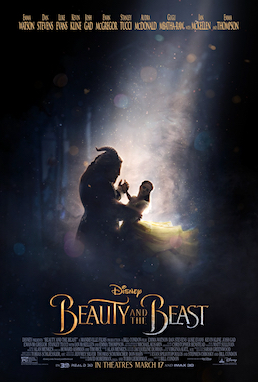






































 Favourite Film of the Month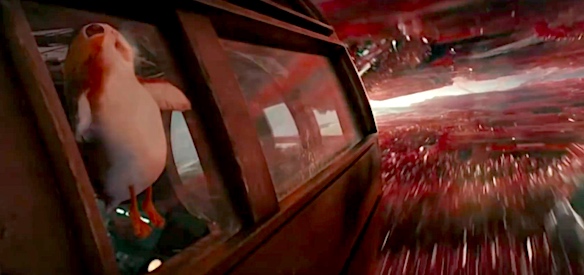



























 Another year, another divisive Doctor Who Christmas special. It’s the third time that the Christmas Day spectacular has to serve double duty by writing out the programme’s lead actor, and it follows the format set out by David Tennant’s swan-song The End of Time and Matt Smith’s finale The Time of the Doctor by being a very inward-looking fan-focused edition. I’m not sure that’s the right tack to take on Christmas, quite frankly, when the show’s playing to a wider audience of more casual viewers than normal. Former showrunner Russell T Davies and immensely popular leading man Tennant had earnt that kind of indulgence by the time they exited, and the series was pretty much the biggest thing on British TV at the time, so most of those so-called “casual viewers” were actually regular watchers of the show anyway. I’m not convinced exiting showrunner Steven Moffat and departing Doctor Peter Capaldi are quite in the same position.
 The BBC’s two-part adaptation of Jessie Burton’s 2014 bestseller promised to be a supernatural treat, though in that respect the trailers were somewhat misleading. Set in 17th century Amsterdam, it’s about a girl who marries a wealthy merchant, but finds his strict and secretive household is not all she’d hoped. He buys her a dolls house as a wedding gift and she commissions a miniaturist to produce items for it, but she soon starts to receive things she didn’t order — things which suggest the miniaturist somehow knows people’s secrets, and can possibly see the future… In actuality, The Miniaturist is more of a period drama, albeit one with lashings of Gothic that were right up my street. It was beautifully made, with a fantastic eye on the costumes and locations, and cinematography that evoked painting of the era. There were strong performances too, particularly from Anya Taylor-Joy (yes, her out of
 “Oh God, I’d forgotten,” says one character early in the first instalment for almost 15 years of BBC Two’s pitch-black comedy series. He’s been confronted with some other returning characters, but I have to say that the sentiment kind of sums up my reaction to a lot of this revival, in two ways: firstly because I had to keep rummaging in my memory to make connections back to a series I haven’t watched for a decade and a half, and secondly because the hilarious grotesquery of the League came crashing back. Revivals of once-great comedies can be a mistake — they’re often little more than an exercise in nostalgia; and this one is certainly aimed at fans, as the vast majority of it continues or riffs off stuff from before — but, in spite of that, it still felt fresh and edgy, not like a gang of middle-aged men reliving past glories (the other thing that goes wrong with revivals). So it was all really rather good, and it’s gone down very well too. Officially it’s a 20th anniversary special rather than a fourth series, but might we see more? I think it would be welcomed.
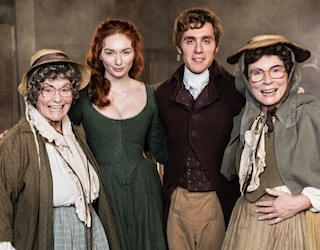 So much comedy, so much of it a passable time-killer that I have little else to say about. The highlight was probably 300 Years of French and Saunders, an excellent celebration of the comedy double act, reminding us of many of their greatest hits alongside a few nice additions. It made me want a whole highlights series repeating all their many hilarious film spoofs. Shakespearean satire Upstart Crow offered a neat riff on one of the better-remembered storylines from modern Christmas classic Love Actually, which it executed with surprising subtly (or, at least, I had to point out the references to my fellow viewers, which was followed by half-an-hour of scouring through Richard Curtis’ film for the relevant scenes). I enjoyed the pilot for Tim Vine Travels Through Time back in
  Black Mirror series four was released last Friday, but I haven’t even watched series three yet. Well, I did only watch
 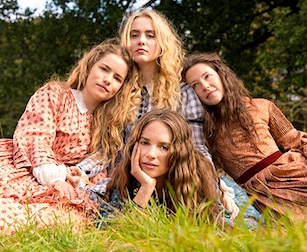 I may’ve watched 26 different programmes, but there’s still an awful lot I’ve missed. Like the BBC’s new three-part adaptation of Little Women — I’ve never read it or watched another version, so here’s my chance to get cultured. Less worthy but no less lovely, there’ve been a couple of Great British Bake Off specials featuring contestants from the BBC years even though it’s now on Channel 4. Gasp, indeed. And despite that long list up above, there’s still a handful of comedy specials I’ve got to catch up on, like Not Going Out, Would I Lie to You?, and even some not featuring Lee Mack. There’s bound to be something else I’ve forgotten — I’ll have to go through the Radio Times, again…
 1991 Academy Awards