
Clint Eastwood | 126 mins | DVD | 15 / R
 It’s been two years since I reviewed the second in Clint Eastwood’s 2006 double bill of World War II films; thanks to the machinations of my DVD rental site, it’s taken this long to see the first. In a somewhat innovative move, the pair examine both sides of the battle for Iwo Jima: Letters from Iwo Jima from the (losing) Japanese perspective, while Flags of Our Fathers shows the (victorious, obviously) American view. I found Letters to be a fair effort, if undeserving of some of the praise and nominations it garnered, but the consensus seems to have it that this first half isn’t as good.
Perhaps that’s because Flags is a different kind of war film. While it seems to have been promoted as the story of the battle for Iwo Jima, it’s more about the experience of three men, both on the island and upon their return to America — hailed as heroes and paraded around the country trying to raise money for the war effort, purely because they happened to be in a photograph raising a flag. While there are still plenty of battle sequences and the occasional bit of “who will survive?” suspense — not to mention an examination of such issues as honour, duty, responsibility and so forth — Eastwood is clearly aiming for something different here. Indeed, while those themes may be standard war movie fare, by placing them in slightly different contexts Eastwood finds new (or at least uncommon) perspectives on them. Perhaps this explains why Letters came off better: by comparison it’s a much more typical war movie, therefore more what was expected.
Many of Flags’ weak spots also arise from this approach however. It adopts a time-jumping structure, flitting between the battle itself and what happened after. It’s debatable how well that works: at times it’s fine, at others it needlessly complicates matters. The final stretch also gets a bit meta/hyper/intertextual, following the author of the book on which the film is based as he conducts research for the book… then rams it home when the three lead actors also appear as his brothers. (To be fair, the latter is in a single shot where their faces are almost hidden.) In the end, Flags offers neither of the usual clear-cut war movie endings (“we won!” or “we lost nobly!”), closing with no easy answers or conclusions to the issues it raises. This at least sticks to its realism, but won’t be to all tastes (with reservations, I liked it).
One side effect of such a different approach is that Eastwood’s two Iwo Jima films make good companion pieces. In no serious way do they present Part One and Part Two of a story, but instead two vastly different perspectives on the same events. The points of crossover between the two are neatly used, occurring naturally rather than forcing “you’ll understand this later”-style mysteries upon the viewer, but mainly they explore the way two very different cultures reacted to the same battle.
They do directly share something however, and that’s a debt to Saving Private Ryan in their depiction of combat. A beach-storming sequence naturally invites direct comparisons, with Flags unquestionably coming off worse due to a lack of focus. It’s still an effective sequence and it’s not a clone of Ryan, but the comparison is hard to avoid and Ryan’s opening is famous for a reason.
Despite the verisimilitude the Ryan-esque visual style now has, Eastwood nonetheless shies away from some of the reality. It seems he can’t bear to explain or show what happened to Iggy, for example, though in fairness the viewer should be glad he didn’t. (If you want, some of the details can be found on Wikipedia, but be warned that his fate was truly distressing.) Knowing the truth, one can only imagine the trauma and guilt felt by ‘Doc’ Bradley in the wake of the incident.
On a lesser level, one also imagines it must be difficult as a filmmaker deciding whether to include such details or not — on one hand, I’m glad we weren’t confronted with them on screen (certainly, to show a body would have been too much), but, while the details are horrific, knowing them adds an extra layer of emotion that is absent when kept a mystery. An externally-gained awareness of the reality of Iwo Jima adds a weight that is arguably missing from the film, but which improved it for me.
Flags of Our Fathers is an unusual war movie, probably not what many were expecting when told Eastwood was doing a War Film about the battle of Iwo Jima. But by being different it has a lot to say about the experience of war — both on an individual level and in a broader sense — that is rarely (if ever) expressed on film in quite this way.

My thoughts on the second half of this pair can be read here.
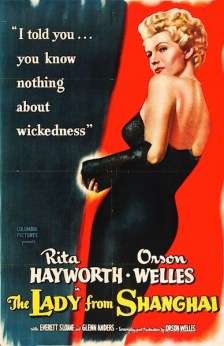 The Lady from Shanghai is an Orson Welles film… which means his original 155-minute cut was forcibly cut down by over an hour, the studio insisted he include more beauty shots of Rita Hayworth, as well as a song for her to sing, and the temp score he provided to the composer was ignored in favour of something Welles hated. Yet for all that — not to mention Welles’ distractingly atrocious Irish accent — it’s still a highly enjoyable film.
 Stand By Me is a film an awful lot of people love an awful lot, which it always seemed to me was down to first seeing it at the right age (more or less the age of the main characters, I think) and possibly to being part of a certain generation — would it have the same effect for kids today, when the relative innocence and freedom of the ’50s is arguably lost? As I say, “seemed”, because now I’m not sure either of these factors really matter.
 Alien Resurrection is much maligned, to the point that even screenwriter Joss Whedon has publicly disowned it. Which is interesting to me, because I really liked it.
 We’re used to seeing big studio’s logos transformed at the start of films — Universal perhaps do it most often, having a handy globe, though others are far from immune — but I think Alien³ is the first instance I’ve seen where the logo is left untouched but the music is altered. Right from the disconcerting modification of the famous Fox fanfare you can tell this is going to be something a bit different and a bit edgy. Unfortunately, it’s also a bit rubbish.
 Once upon a time, sequels were universally regarded as Bad — the inferior product of a great original; most frequently a remake in continuation’s clothing. These days we regularly see sequels that continue and expand on their predecessor, frequently leading to higher praise and a better reputation. It’s almost become expected, in fact — look at the number of reviews of
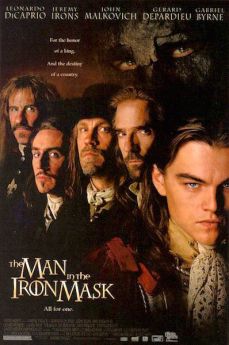 From the off it’s clear that The Man in the Iron Mask is not going to go well. It’s an adaptation of a tale of the Three Musketeers, so naturally is set in historical Paris… where everyone has a different accent and very few of them are French. It is, to be blunt, a horrid mishmash — much like the whole film.
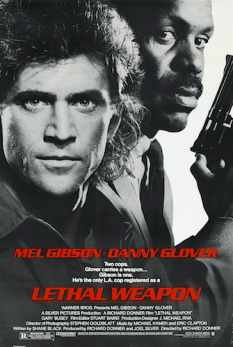 Lethal Weapon comes from another era — an era in which R-rated films were still allowed to be blockbusters. One only needs to look at the classifications attached to the most recent instalments of formerly-R-rated ’80s franchises — primarily,
  Ed Zwick seems to like war. More accurately, Zwick likes making films about war, but clearly isn’t a fan of the act itself. Since gaining attention with multi Oscar-winner Glory, about the first black regiment during the American Civil War, he’s directed a number of films concerned with wars and those that fight them:
  100Films.co.uk