2015 #76
Matthew Vaughn | 129 mins | Blu-ray | 2.39:1 | UK / English | 15* / R
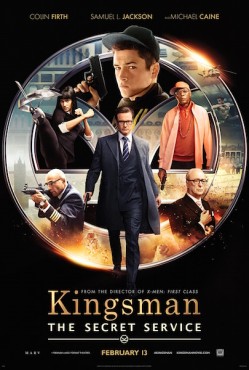 The team behind Kick-Ass bring that same reverent irreverence to the spy genre in this comedy-action-thriller that aims to bring the fun of ’60s/’70s spy-fi back to a genre that’s become oh so serious.
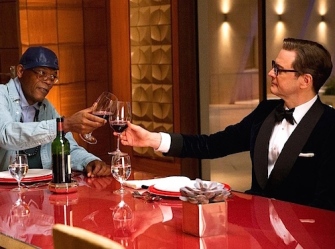
Developed alongside the Mark Millar/Dave Gibbons comic book The Secret Service, Matthew Vaughn’s film casts Colin Firth as Harry Hart, an agent for an independent intelligence operation, Kingsman, who recruits council estate kid Eggsy (Taron Egerton), the son of a fallen comrade, into the group’s elite training programme. As Eggsy battles tough training challenges and the snobbery of his Oxbridge-sourced competitors, Harry investigates suspicious tech mogul Richmond Valentine (Samuel L. Jackson), who is secretly kidnapping people of importance and publicly giving away free SIM cards to everyone on the planet, but for what nefarious purpose?
There are several things going on in Kingsman that make it a uniquely entertaining proposition, especially in the current blockbuster climate. Part of the setup is “My Fair Lady with gentlemen spies”, as chavvy Eggsy is reshaped to be an old-fashioned besuited gent, inspired by the story of how Dr. No director Terence Young took a rough young Scottish chap called Sean Connery under his wing and taught him how to dress and behave as a gentlemen in preparation for his star-making role as the original superspy. It’s one of those ideas that you wonder why no one thought of developing into a fiction sooner. It could have come across as datedly classist, but Vaughn and co-screenwriter Jane Goldman nail it as a 21st Century character arc: being a gentlemen is not about speaking correctly or lording it over the lower classes, but about a universal level of good behaviour, politeness, and doing the right thing. It successfully and acutely dodges any potential accusations of classism.
 An even bigger part of the film’s triumph, and what likely led it to over $400 million worldwide in spite of its higher-than-PG-13 classifications (it’s Vaughn’s highest-grossing film to date, incidentally; even more so than his X-Men instalment), is that it takes the ever-popular James Bond formula and brings it up to date. However much you might love Casino Royale and Skyfall (and I do), the Bourne influence is undeniable. They’re not Bond movies in the same mould as the Connery and Moore movies that established the franchise’s enduring popularity around the globe; they’re modern thrillers, faithful in their way to Ian Fleming’s creation, but also zeitgeisty. Vaughn and co have looked at the DNA of those ’60s and ’70s Bond classics and given them a fresh lick of paint. So we have just-beyond-possible gadgets, a megalomaniacal supervillain, complete with epic mountain base, his own personal army, a physical tic, a uniquely-gifted almost-superhuman henchwoman, and a tongue-in-cheek tone that isn’t all-out spoof but lets you know no one believes any of this could actually happen and that’s OK.
Despite the overall tone of modern blockbusters, I don’t think the appetite for movies like this ever went away; or if it did, it quite quickly made a resurgence: a similar itch has been scratched in recent years by superhero movies, especially the Marvel ones. Audiences — or, perhaps, studio execs — seem currently more ready to accept outlandish action sequences, melodramatic stakes, and an occasionally-humorous tone if they were dressed up in colourful suits and pitched in the realm of sci-fi/fantasy, 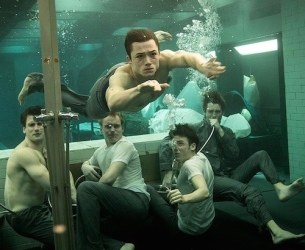 rather than the supposed real-world universe of spy movies. What the worldwide success of Kingsman proves is that audiences don’t need the set-dressing of superpowers to accept an action movie that’s less than deadly serious. It’s a place I don’t think the Bond movies could go anymore — not without accusations of returning to the disliked Moore or late-Brosnan films — but it’s one many people clearly like, and Kingsman fulfils it.
Another clever move by Vaughn and co was to aim it at adults. Every blockbuster is PG-13 these days to keep the box office high, but Kingsman shows you can cut loose and still make good money. By specifically setting out to make an R-rated version of the classic Bond formula, everything gets ramped up to 11. On the one hand, that earns the controversy of That Joke in the final act (as Vaughn has said, not wrongly, it’s a variation on the classic Bond film finale; Mark Strong’s Merlin even closes his videoscreen, Q-style), but on the other it allows for crazed action sequences. The (faked-)single-take church massacre has to be seen to be believed; a highly-choreographed orgy of violence that is a marvellous assault on the senses, demonstrating the benefits of clear camerawork and highly-trained professional stunt- and effects-people over fast-cut close-up ShakyCam handwavery. Later on, a certain sequence set to Land of Hope and Glory would be inconceivable in any other movie. Things like this perfectly demonstrate why the world needs these less-than-serious kinds of film: they let creativity loose, crafting moments and sequences that are exciting, funny, unique, and memorable.
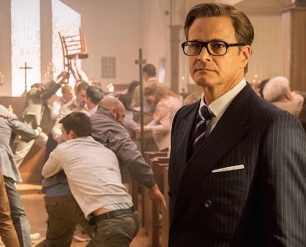 Criticisms of the film tend to pan out to nought, in my opinion. Is there too much violence? There’s a lot, certainly, but part of the point of that church sequence (for instance) is just how long it goes on. Other excellent action sequences (the pub fight you might’ve seen in clips; the car chase in reverse gear; the skydiving) aren’t predicated on killing. Similarly, Samuel L. Jackson’s baseball-capped lisping billionaire is a perfect modern riff on the traditional Bond villain, not some kind of attack on Americans or people with speech impediments. Some have even attempted a political reading of the film, arguing it’s fundamentally conservative and right-wing because the villain is an environmentalist. Again, I don’t think the film really supports such an interpretation. In fact, I think it’s completely apolitical — just like its titular organisation, in fact — and such perspectives are being entirely read into it by the kind of people who read too much of this kind of thing into everything.
If there’s any fault, it’s perhaps in an overabundance of ideas. One fewer training sequence might’ve been better — but then, which would you lose? Based on the trailer, some scenes were cut as it is (sadly there’s no deleted scenes section on the Blu-ray), and the film doesn’t really outstay its welcome. For me, it wasn’t as balls-to-the-wall revolutionary as Kick-Ass and, when we have actually had lighter-toned action films in the past few years, it doesn’t reconstruct its genre quite as much as Vaughn and Goldman’s adaptation of Stardust did for fantasy.
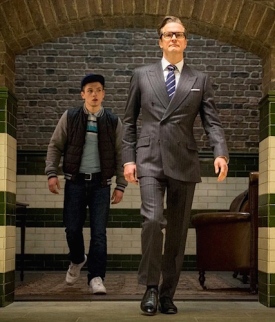 Not everything hinges on being wall-to-wall groundbreaking, though, and Kingsman has so much to recommend it. It ticks all the requisite boxes of being exciting and funny, and some of its sequences are executed breathtakingly. The plot may move along familiar tracks — deliberately so — but it pulls out a few mysteries and surprises along the way. There’s an array of likeable performances, particularly from Firth, Egerton (sure to get a lot of work off the back of this), Jackson and Strong, and Sofia Boutella’s blade-legged henchwoman is yet another why-has-no-one-done-that great idea.
I’m more than happy for the Bond series to carry on down its current, serious-minded path, but I’m ever so glad Kingsman has come along to provide the level of pure entertainment and unabashed fun that series used to do so well. If they can keep this quality up, may there be many sequels.
Kingsman: The Secret Service is released on DVD and Blu-ray in the UK today, and the US tomorrow.
It placed 13th on my list of The 20 Best Films I Saw For the First Time in 2015, which can be read in full here.
* During editing, the BBFC advised the film would receive an 18 certificate unless changes were made. The submitted version was classified 15. Normally such edits are applied globally (despite what some websites like to claim), but this has been a less clear case: vastly different running times were posted by the BBFC and their German equivalent, but Vaughn stated in an interview that nothing was cut for the UK. Now, the UK and US Blu-rays have identical running times, so it seems likely he was (unsurprisingly) telling the truth. Another “the UK version is cut!” storm in a teacup? Yessir. ^

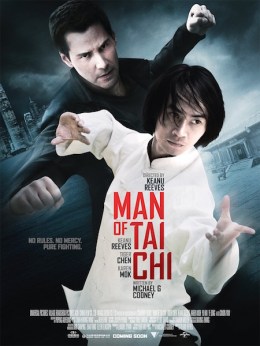 Matrix star Keanu Reeves makes his directorial debut with this thoroughly entertaining martial arts actioner.
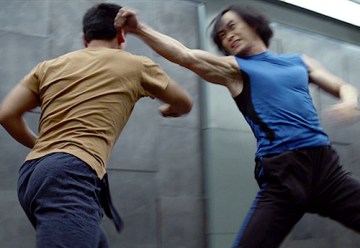 Some have opined that it’s over-edited. Early on I thought it was a mite too chopped up (during a plain old dialogue scene, funnily enough), but for most of the film it’s fine. Fast at times, sure, but so’s the fighting. There’s a style and rhythm to it all — some near-montage-like sequences are surely meant to be exactly that — and the fighting is never needlessly obscured, because (unlike in so many Hollywood action movies) these guys can actually do it and Reeves wants to show us that. He really focuses on them, too. These aren’t fights as part of elaborate chase sequences, or action interludes whose drama is reliant on the sheer volume of competitors being offed. Nearly every bout is one-on-one (there’s a single instance of two-on-one), all executed in nondescript rooms or arenas. It’s the straight-up fight choreography that does the talking here.
 A mention also for the score by Kwong Wing Chan. Apparently it’s made up of “Techno-styled, bass-heavy beats” or something (I got that from another review). Not the kind of music I normally listen to for pleasure, but its pounding electronic rhythms fit here, making their presence felt while never crossing into the over-dominance that kind of music is wont to do.
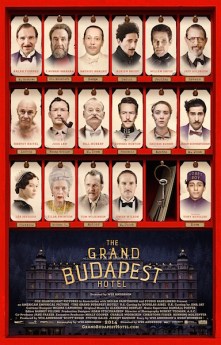 The latest from cult auteur Wes Anderson, which managed that rare feat of enduring from a March release to being an awards season contender, sees the peerless concierge of a magnificent mid-European hotel (Ralph Fiennes) accused of murdering a rich elderly guest (Tilda Swinton, caked in Oscar-winning prosthetics) and attempting to flee across the country to clear his name. More or less, anyway, because this is a Wes Anderson film and so it takes in all kinds of amusing asides, tangents, and recognisable cameos.
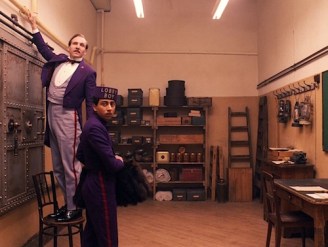 I suppose the kooky idiosyncrasies of Anderson’s brand of storytelling and filmmaking will rub some viewers up the wrong way, looking on it all as vacuous affectations signifying nothing. To each their own, but, whatever the merits (or not) of Anderson’s style as a kind of one-man genre played out across his oeuvre, The Grand Budapest Hotel displays a synthesis of contributing elements that creates a movie that’s ceaselessly inventive, surprising, amusing, and entirely entertaining.
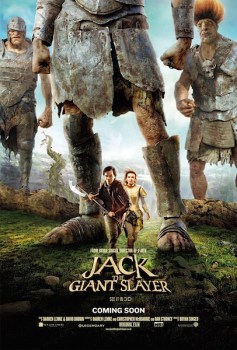 The influence of Peter Jackson’s
 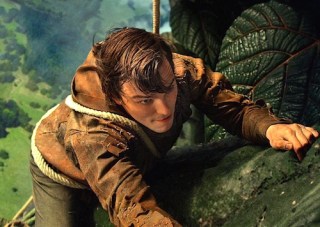 A computer-animated prologue wants to be the one from
  overacted characters, and bright-and-cheerful CGI are more or less acceptable, in a “it’s no classic but it’ll pass two hours just fine” kind of way. Produced on those kinds of terms, this might have passed muster for some. Might.
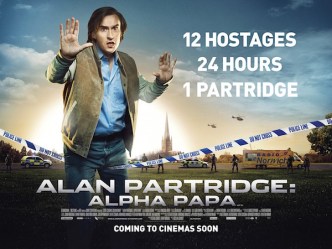 Steve Coogan brings his popular character to the big screen. When Partridge’s radio station colleague Pat (Colm Meaney) is fired, he takes a group of employees hostage at gunpoint. At Pat’s request, Partridge is sent in to negotiate.
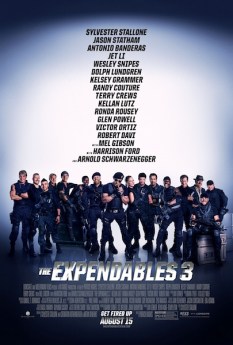 Oscar-nominated screenwriter Sylvester Stallone continues his examination of masculinity and machismo amongst older men in this trilogy-forming instalment of his Expendables franchise.
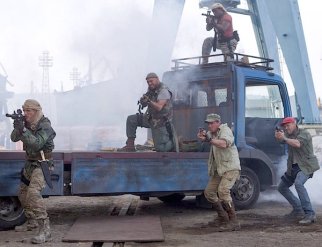 though occasionally obscured by camerawork and editing that turns it into a cacophony of violence. The Blu-ray release helps expose this: the special features include an extended version of Statham’s main battle from the climax, and in that focused form you can see how it’s been carefully constructed and designed. In the film itself, it’s chopped up into ten-second chunks and intercut with everyone else’s duels. It becomes like an impressionistic painting of shooting, punching, kicking, stabbing, running, jumping… It’s a war, as the now-double-sized team of heroes takes on a literal army, and some will revel in the over-the-top-ness of it all. The sheer excess does have a certain charm.
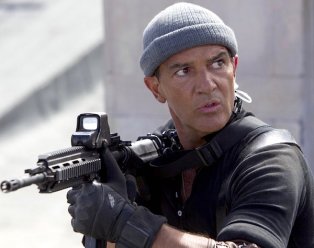 The best addition, unquestionably, is Antonio Banderas. He’s a parkour-performing blabbermouth who keeps pestering Grammer for a job, but no one wants him because he won’t stop talking. And he’s hilarious. Of the 93 changes in the five-minutes-longer extended version (yes,
 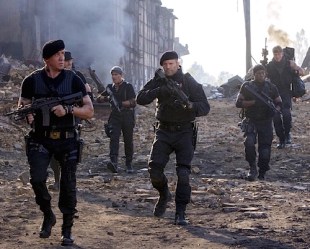 I kind of hope they do make more. The Expendables movies aren’t great films — heck, they aren’t even really great action films — and they’re a bit too cheesy and in-joke-y for the own good — and yet, somehow, I can’t resist them, and I’ll be happy to keep watching them for as long as Stallone and co can keep making them. After all, there are an awful lot of ageing action actors who’ve not appeared yet…
 The first of Summer 2013’s “
 In fact, it takes itself very seriously indeed — Fuqua even puts characters’ names and jobs up on screen, as well as timecodes and locations, as if it’s a dramatisation of a real event. Obviously we all know it isn’t, making it feel incredibly odd. The CGI is just as bad as White House Down’s, though the exterior White House stuff looks more real than the obviously-greenscreen locales of the other film. Strikingly, this cost less than half as much ($70m vs. $150m).
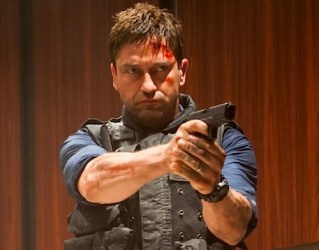 however, Olympus Has Fallen looks like a far lesser movie. It’s a shame it made it out of the gate first, and that some viewers are not blessed with enough of a sense of humour, because their comparative success has left some quarters with the impression this is the better movie and White House Down is just a clone. Hopefully that’s a wrong we can eventually right.
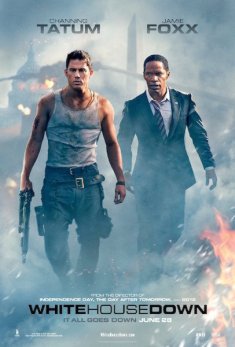 US Capitol policeman Channing Tatum is visiting the White House, trying and failing both to impress his estranged daughter and get a job in the Secret Service, when terrorists attack and try to take President Jamie Foxx hostage. Tatum rescues him from some of them, but with the rest occupying the building the stage is set for “
 If there’s a downside, it’s that this $150 million movie looks like it was made for closer to $15. There’s an overabundance of digital sets, ‘exteriors’ obviously shot on incorrectly-lit soundstages, and terrible CGI. Goodness only knows where all that money went — the actors’ salaries? Tatum and Foxx are good, but I’m not sure they’re worth that much. And here’s a good a time as any to say that this year I’ve become a bit of a Channing Tatum convert. I’d written him off because, to be honest, he looks a bit of a lug and I still think he’s woefully miscast as Gambit in
  Possibly-crazy people offer definitely-crazy theories on the subtextual meaning of
  After winning the Best Adapted Screenplay Oscar for
  Here, Fletcher either needs to settle on one or the other, or clearly signal his intentions earlier.
 100Films.co.uk