Bridesmaids (2011)

2016 #172
Paul Feig | 125 mins | streaming (HD) | 2.35:1 | USA / English | 15 / R

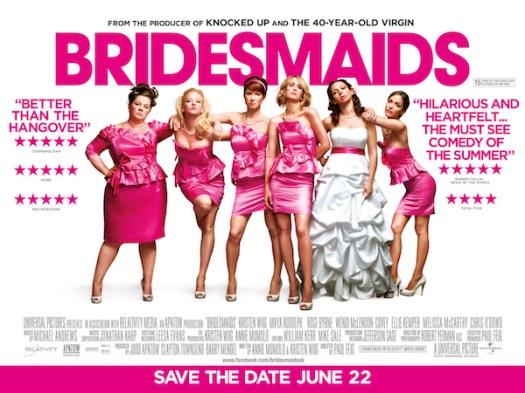
Bridesmaids

Bridesmaids opens on a shot of the outside of a house, but we can hear the people inside. It sounds like they’re having sex. “I’m so glad you could come over,” one says. Cut to a view of the closed bedroom door. Still sounds like sex. “Cup my balls,” says the male voice. Our assumption is still sex. Cut to inside the bedroom, where it looks like he’s on his back and she’s on top of him — you know, having sex. And it’s maybe at this point that you realise that, yes, they are just having sex — there is no clever, funny twist coming.

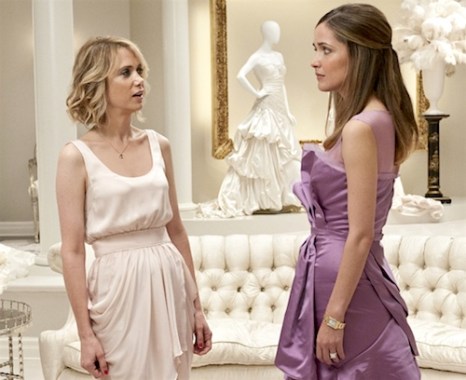
Thankfully this unimaginative sequence is not indicative of Bridesmaids’ overall quality. The female participant in that first scene is Annie (co-writer Kristen Wiig), a down-on-her-luck baker who’s struggling with life since her cake store went bust. When her best friend Lillian (Maya Rudolph) announces her engagement, she asks Annie to be her maid of honour. But Annie soon clashes with fellow bridesmaid Helen (Rose Byrne), the wealthy and glamorous wife of Lillian’s fiancé’s boss, who’s keen to replace Annie in Lillian’s affections. Wedding preparations and hilarity ensue.

Despite the rough start, there are some very, very funny parts later on; but, unexpectedly, it also works pretty well in more character-focused sections. You’re not going to mistake this for an emotional drama, but there’s more investment in the characters than you might anticipate given the cast and crew’s pedigree. I guess this is the on-screen result of a telling behind-the-scenes titbit: reportedly, producer Judd Apatow pushed hard for wild, physical comedy, while writers Wiig and Annie Mumolo preferred to go for subtler material. The film’s most notorious sequence — the diarrhoea scene — was largely at the insistence of Apatow and director Paul Feig. I feel like that probably explains a lot about how the film can be restrained and emotionally intelligent at times, and then ludicrously crude at others.

Bitch fight

Maybe it also explains how it ended up being too long. The ideal length of a comedy movie is about 90 minutes, so crossing the two-hour mark feels needless. At the very least it could do with just a tighten — trimming some scenes, or even individual shots, would make a pleasant difference. And to think, there’s an extended cut!

Even more baffling is the fact that this earnt Melissa McCarthy an Oscar nomination, which is just… daft. I mean, she’s not bad, and it’s a bit of an excursion from the kind of roles I’ve seen her play otherwise — and doing something different to your norm is the kind of thing that attracts awards attention — but an Oscar? For this? No. That’s just silly.

I guess that was due in some part to the mass of praise Bridesmaids received on its release, after which there was (of course) a massive backlash. Until I read online comments before writing, I’d forgotten just how hyped it was, and how much people turned against that. With several years’ distance things have calmed down, which probably works in the film’s favour: freed from that pressure, it entertains as a largely funny, surprisingly emotionally astute female-driven comedy.

4 out of 5

Paul Feig is a guest panellist on tonight’s episode of Insert Name Here, which is… random.

Kubo and the Two Strings (2016)

2017 #5
Travis Knight | 102 mins | Blu-ray | 2.40:1 | USA / English | PG / PG

Kubo and the Two Strings

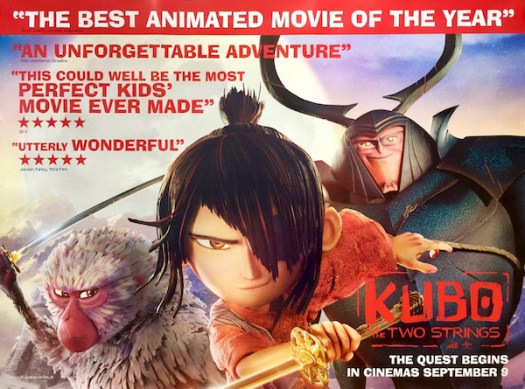
The latest film from animation studio Laika (Coraline, ParaNorman, The Boxtrolls), Kubo and the Two Strings is a samurai-action fantasy-adventure inspired by Japanese culture and folklore — but animated in stop-motion and rated PG! Not that either factor in any way undermines what may be the greatest animated movie of last year.

It is, unsurprisingly, the story of Kubo (voiced by Art “Rickon Stark” Parkinson), a young boy in olden-times Japan who regales the folk of his local town with fantastical adventure stories, which he brings to life with origami that he animates using magic from playing his shamisen (basically, Japan’s answer to the banjo). These stories actually come from Kubo’s mother and relate to his own life: Kubo’s grandfather is the evil Moon King (Ralph Fiennes), who they fled from when Kubo was a baby, while his father stayed behind to aid their escape, presumably to the death. Kubo mustn’t go out at night lest the Moon King see him and send his minions, Kubo’s creepy aunts (both Rooney Mara), to capture them. So Kubo never goes out at night and they all live happily ever after.

Not really! When the aunts come for them, Kubo’s mother uses the last of her magic to whisk Kubo away on a quest to find some mythical armour that he’ll need to defend himself against the Moon King. To help him, she brings his wooden monkey charm to life (voiced by Charlize Theron); and along the way they stumble across a man-sized beetle who used to be a samurai (voiced by Matthew McConaughey). Scrapes ensue as the trio hunt for the three pieces of the armour, with the vicious aunts in pursuit.

Monkey, Beetle and Boy

At its most basic, Kubo sounds like an archetypal “fantasy quest” narrative, with a gang of heroes in search of a MacGuffin to defeat a Big Bad. But the devil is in the details — something the folks at Laika know only too well. The Japanese myths they’ve tapped into here make for some fantastic detail; if anything, the familiarity of the broad story arc allows the unique aspects of the mythology to be all the more prominent, including some possibly surprising developments later on. I say “possibly” because I’ve read at least one complaint about the twists being guessable to adult viewers. Well, this is a fable and also, technically, a kids’ movie — just two reasons why plot guessability doesn’t really matter. I mean, if all you want from a movie is to be surprised, why not just watch 90 minutes of things popping out of boxes?

The other aspect massively in Kubo’s favour is the animation. It’s genuinely stunning — beautiful to look at, as well as being technically audacious and consequently impressive. Some of it is so grand that several times I forgot that most of what we’re seeing on screen was built for real and animated by hand over several years. I say “most” because it is augmented with CGI, just as any action-fantasy live-action movie would be these days. The fact there was green screen and compositing and some wholly CG elements doesn’t detract from the technical workmanship on display. That included the largest stop-motion puppet ever built. I won’t spoil what or where it is in the film, but there’s a behind-the-scenes glimpse during the end credits that is breathtaking.

Relatively dangerous

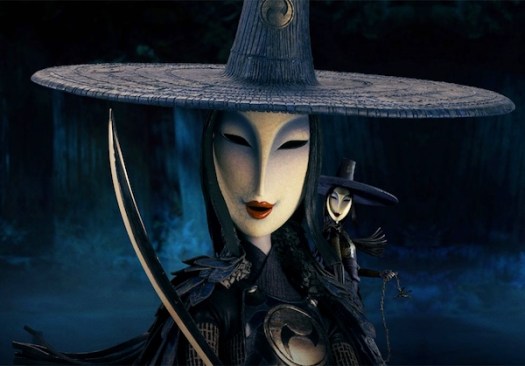
Another area the animation excels is in the action scenes. That’s a field which is rarely animation’s forte, especially stop-motion animation, but Laika took on the challenge and nailed it. Everything from the antics of Kubo’s animated origami to a centrepiece duel aboard a ship at sea are the equal to anything you’d find in a live-action samurai actioner. The character work is excellent too, especially the villains. The aunts are fabulously creepy, mainly thanks to their blank mask faces and the way they float everywhere, seemingly indestructible. There are a couple of other monstrous creatures too, but their wonders deserve to be discovered in situ.

It’s not just scale that Kubo does well: the attention to detail was immense, with Japanese cultural experts called in to inform the tiniest detail, like period-accurate stitching on the clothing. This is background detail on 10-inch puppets, remember, but they went to that much trouble. It’s indicative of the attention paid to every facet of the movie, and while using the correct stitching, or developing appropriate techniques for animating water, or applying genuine principles from Japanese beliefs, do not in themselves make for a great movie, they indicate the level of care taken over this project — which does help to produce a great movie.

Then there’s the music, composed by Dario Marianelli, which integrates the shamisen as well as other appropriate instruments into a consistently lyrical score. And the photography, by Frank Passingham — it’s not just the design work and high-quality builds that make the film so gorgeous to look at, but the quality of the light that’s captured. And I’ve been so busy singing the film’s production praises that I haven’t even mentioned how funny it is, or how emotional, with Mar Haimes and Chris Butler’s screenplay tucking some very positive lessons away in the final act. Indeed, the alternative perspective offered by embracing a different culture means that, for once, they might not just be lessons for kiddie viewers. By the time the credits roll — to a glorious cover version of a perfectly chosen song — the whole experience is completely enchanting.

The quest goes ever on

I think Laika as a name went a bit unnoticed with their first feature, Coraline, because it had the already-headlining names of writer Neil Gaiman and director Henry “Nightmare Before Christmas” Selick. Their two subsequent features seem to have been well-liked but not set the world on fire (I’ve still not seen either). But here, they’re firmly stamping their name as a mark of quality. Come in Pixar, your time may be up. I’m sure Kubo won’t be picking up many gongs in the current awards season, what with three big-name Disney-backed pictures arrayed against it, but I find it hard to believe any of those outdid the artistry on display here, both in its spectacular animation technique and its majestic storytelling. To say it’s 2016’s best animated film is underselling it — it’s one of my favourite films released last year, fullstop.

5 out of 5

Kubo and the Two Strings is released on DVD and Blu-ray in the UK today.

It placed 3rd on my list of The 17 Best Films I Saw For the First Time in 2017, which can be read in full here.

Hunt for the Wilderpeople (2016)

2017 #4
Taika Waititi | 101 mins | streaming (HD) | 2.35:1 | New Zealand / English | 12 / PG-13

Hunt for the Wilderpeople

The most recent feature from the director of the very-different-to-each-other What We Do in the Shadows and Thor: Ragnarok, this very-different-again* adventure-comedy-drama was a surprise hit in its native New Zealand, then around the rest of the world, before it wound up as Empire magazine’s pick for the best film of 2016.

Young Ricky Baker (Julian Dennison) is a delinquent who’s been rejected by every foster family in the city, so in a last-ditch attempt to avoid juvie he’s homed at the remote farm of kindly Bella (Rima Te Wiata) and her terse, irritable husband, Hec (Sam Neill). Despite initial misgivings, Ricky warms to his new home, so when child services threaten to take him away again he runs away into the bush. He’s soon found by Hec, but as child services launch a nationwide manhunt for the missing pair, they decide to go on the run as fugitives.

So yes, let’s get the obvious out of the way: Ricky and Hec end up bonding and working together and all that jazz. But this isn’t the kind of movie where it’s all about developing mutual respect and having heartfelt hugs and making declarations of everlasting father-son love. Well, maybe it is a little, in its own way — but it’s also the kind of movie where they (spoilers!) write awesome birthday songs, end up in a punch-up with some hunters, steal all-important loo roll, meet a girl worthy of the old Flake adverts, eat relaxing sausages, stumble into a vicious fight with a giant boar, and engage in the wildest third-act police car chase since… I dunno, Blues Brothers or something.

Skuxx 4 life

Writer-director Waititi (adapting the book Wild Pork and Watercress by Barry Crump) keeps a fairly tight hand on the film’s tone, a slightly leftfield view of the world that isn’t as extremely stylised as, say, Wes Anderson, but nonetheless is heightened beyond the normal boundaries of real-life. I only say a “fairly tight” grip because a couple of comic cameos arguably stretch things a little too far, but that’s a minor complaint. Mostly he’s skilful in balancing the comedy with genuine emotion, so that the former never neuters the latter, but equally the latter never dares become too sickly. The events of the plot may not be plausible, but the emotional underpinnings are.

Nonetheless, it’s regularly hilarious, especially when centred on Dennison and Neill’s interactions. It’s the kind of role and deadpan performance that will no doubt have some hailing Dennison as a real find, and maybe he will be, or maybe he’ll go the way of most child stars with “breakthrough” roles like this and never be heard from again. Pardon my cynicism, but it seems to be such a perfect marrying of actor and role that I’m not sure it marks the start of a glittering career so much as one superb turn. Maybe I’m wrong; time will tell. Neill, on the other hand, juggles grumpiness, likeability, and pathos in a manner that suggests his near-relegation to “the guy from Jurassic Park” for the last quarter-century is a real shame. I’m not intending to dismiss everything he’s done between then and now (some of which I’m a definite fan of), but this is likely the best showcase of his abilities for a long time.

Unhappy campers

The rest of the cast don’t shirk, with particular note to the kind of double act performed by Rachel House and Oscar Kightley as (respectively) the ‘dedicated’ child services agent and her escorting policeman who lead the manhunt. Whoever was in charge of the soundtrack did an excellent job with several amusing song picks, while the highlight of the score (credited to three composers) is an unusual use of the increasingly ubiquitous Christmas tune Carol of the Bells (the scene in question has nothing to do with Christmas, for starters). Cinematographically, DP Lachlan Milne makes marvellous use of New Zealand’s truly majestical scenery — well, why wouldn’t you?

Whether or not Hunt for the Wilderpeople is the best film of last year is immaterial — I mean, it’s a little film from a small country on the other side of the world: it’s not like it’s going to be in competition this awards season, is it? But maybe it should be. Few films get to be this funny without being overworked, this sweet without being cloying, and this quirky without being keraaazy, all at the same time.

5 out of 5

In the UK, Hunt for the Wilderpeople is available on Netflix now, and is released on DVD and Blu-ray tomorrow.

It placed 4th on my list of The 17 Best Films I Saw For the First Time in 2017, which can be read in full here.

* Well, from what I know they all seem very different to each other — I’ve not seen the other two. ^

The Last Dragonslayer (2016)

2016 #195
Jamie Stone | 101 mins | download (HD) | 2.00:1 | UK / English

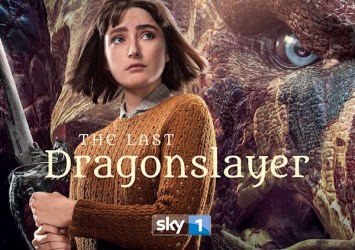
The Last DragonslayerI’m not sure whether to commend or condemn Sky1 for having the balls to schedule a light family-friendly fantasy drama against Doctor Who on Christmas Day — that seems like damning yourself to low ratings. But then Sky never exactly stands at the pinnacle of the charts, and, in the catch-up-driven landscape of modern TV, does it even matter? I mean, as if to show their disregard for schedules, the premiere broadcast was actually at 3am the night before.

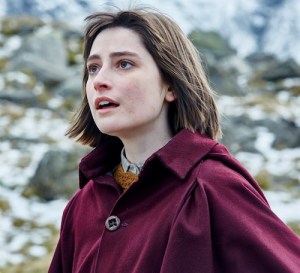
Anyway: adapted from the novel by Jasper Fforde (the first in a series, as will eventually become clear), The Last Dragonslayer is the story of Jennifer Strange (Ellise Chappell), a teenage orphan living in the Ununited Kingdom (a name never uttered on screen, perhaps for fear of looking like political commentary in the current climate). This is an alternate-world Britain where magic exists but is on the wane — it’s powered by dragons, but they’re dying out; besides which, the public have become more enamoured with things like technology and supermarkets. Adopted by the kindly wizard Zambini (Andrew Buchan), Jennifer learns about the importance of magic, and the importance of dragons to magic, which is a bit of a problem when the country’s seers have a mass vision that the last dragon will be slain on Sunday, and shortly thereafter Jennifer discovers her long-prophesied role as the last official dragonslayer.

Jennifer StrangeAbout now you’re probably thinking The Last Dragonslayer is completely derivative of every other major young-adult fantasy franchise of the last… well, forever. It’s hard to deny that the plot is, at least in its broadest thematic strokes, a pretty familiar affair. What makes the enterprise worthwhile is its humorous execution. This isn’t a spoof of the genre, more a satirical mash-up of familiar fantasy building blocks and modern life. So, for example, the king’s chief knight is also a pop star, followed around by a gaggle of adoring female fans; when Jennifer finds herself in need of money, her dragonslaying assistant signs a sponsorship deal with soft drink brand Fizzipop that requires her to film an advert, make at least two promotional appearances, and wear a branded T-shirt until the dragon is slain. It’s this whimsical slant on our world that is arguably Dragonslayer’s most successful aspect.

Another would be its characters. Chappell makes Jennifer a capable hero without having to resort to the kind of self-serious moping that dogs so many current young adult leads (Katniss, I’m looking at you). Buchan also gets to move away from the moping that’s so often called for in series like Broadchurch, making the affectionate, skilful Zambini an easily likeable character within just a few deceptively simple scenes. Without meaning to spoil the plot, he’s not in it enough. The slack is taken up by the likes of Pauline Collins and Ricky Tomlinson as a pair of batty magicians, Matt “Toast” Berry as the immature monarch, and Anna Chancellor as the smarmy corporate head of supermarket giant Stuff Co. The only weak like for me was Richard E. Grant as the voice of Maltcaisson, the last dragon — it just didn’t feel like he had the vocal presence to be playing a huge majestic beast. But not everyone can be John Hurt or Benedict Cumberbatch, I suppose.

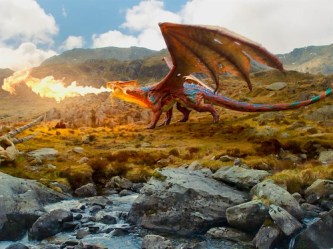
Dragon breathI guess The Last Dragonslayer’s irreverent, sometimes silly tone won’t be to all tastes, but I enjoyed it very much. Unsurprisingly (all things considered) the book is the first in a series, and so not everything is fully resolved by the film’s end. Let’s hope that, in spite of their scheduling, it’s done well enough for Sky that sequels are forthcoming.

4 out of 5

Kung Fu Panda 3 (2016)

2016 #176
Jennifer Yuh Nelson & Alessandro Carloni | 95 mins | Blu-ray | 2.35:1 | USA & China / English | PG / PG

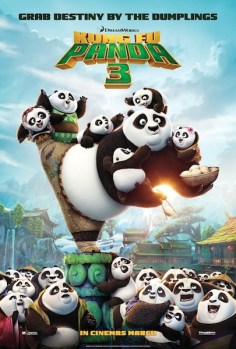
Kung Fu Panda 3Po and co are back in a movie that bucks the sequel trend by being perhaps the best Kung Fu Panda yet.

The two-pronged plot sees Po (Jack Black) finally meet his birth father (Bryan Cranston), while evil warrior Kai (J.K. Simmons) breaks out of the afterlife to hunt down the Dragon Warrior, putting Po’s new-found community in harm’s way.

After the occasionally muddled second film (which I felt improved a little with repeated viewings, at least), KFP3 sets the legendary adventures of awesomeness back on track with an appealing mix of humour, action, and moral lessons for kiddies and adult viewers alike. It keeps things focused and pacey, running just 83 minutes before credits, as well as maintaining the series’ typically stunning animation, which is just as polished whether creating epic scenery or up-close physical combat.

It’s also particularly satisfying when watched alongside its forerunners: it feels like Po’s story has come full circle, with the film linking in and wrapping up plot points from the first movie (as well as resolving things from the second). Reportedly DreamWorks have three more Kung Fu Panda films planned, but at this point it feels like a completed trilogy.

A downside for UK viewers, though: our localised soundtrack replaces the voices of two palace geese with members of the Vamps, who are a popular music combo, apparently. Wow. Aside from the underwhelmingness of the ‘famous’ guest voices, they’re appalling actors. They only have about three lines between them and they’re still terrible. To rub salt in the wound, some ‘clever’ disc coding means that if you have a Region B Blu-ray player this soundtrack is completely unavoidable, even if you import. Poor region-locked people. Family resemblanceI hope for humanity’s sake the version on Sky Cinema retains the original voices.

There are very few threequels that can lay claim to being a series’ best entry. Whether KFP3 actually tops the original or not is debatable, but it at least feels like a course correction after the somewhat disappointing first sequel.

4 out of 5

Kung Fu Panda 3 is available on Sky Cinema from today, screening on Premiere at 1:40pm and 7:15pm.

The Present (2014)

2016 #114
Jacob Frey | 4 mins | streaming (HD) | 16:9 | Germany / English

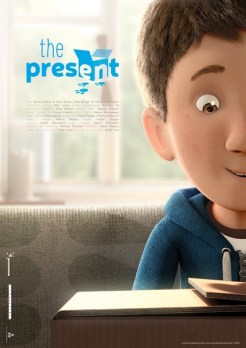
The PresentA short film about a boy and his dog, The Present was a graduation short for the Institute of Animation, Visual Effects and Digital Postproduction at the Filmakademie Baden-Wuerttemberg in Ludwigsburg, Germany (yeah, I copy & pasted that), which has since won more than 50 awards after playing at film festivals around the world. Reportedly it also single-handedly landed its animator/director a job at Disney — he went on to work on Zootopiatropolis.

The simple story sees a videogame-obsessed boy given a mysterious box by his mother. Distracted long enough to open it, inside he finds a puppy, and… well, the film’s only four minutes long — you’re better off watching it than having me describe the story.

Regular readers will know I’m a bit of a sucker for cute dogs nowadays, be they real or animated — I gave Disney short Feast a full five stars last year. If you enjoyed that, then I’m certain you’ll like The Present too. There are other similarities: it’s about a guy bonding with his dog; it’s told in near-silence, with the big emotional reveals left for you to pick up through the pictures rather than explanatory dialogue; and it certainly tugs on the heartstrings to a similar degree.

In fact, I don’t think it’s going too far to say The Present may even be the better of the two — though it’s a close call.

5 out of 5

You can watch The Present free on Vimeo.

P.S. A dog is for life, not just for Christmas.

Come Together (2016)

2016 #185a
Wes Anderson | 4 mins | streaming (HD) | 16:9 | USA / English

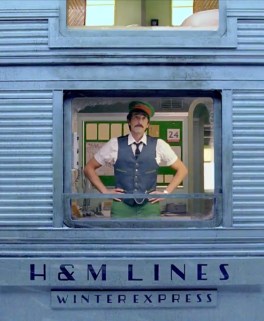
Come TogetherChristmas adverts are all the rage these days, thanks to the likes of John Lewis and their beautifully affecting tributes to the holiday season / twee pieces of emotionally manipulative crap (delete as appropriate). This year clothes retailer H&M got in on the act by hiring everyone’s favourite go-to example of an idiosyncratically quirky director, Wes Anderson, to helm a short film-cum-advertisement — the first part of that equation being why I’m reviewing it here.

For me, Anderson pitches the tone just right. Rather than making a four-minute festival of sappiness that rots your brain with its generic sugary sentiment, or a music video for a slow breathy cover of a once-famous song, or a long build-up to a cheap punchline, Anderson instead brings his own familiar style to a brief narrative that comes to a surprisingly heartwarming conclusion. In the process, he’s made an advert that doesn’t feel like an advert — another reason to factor it in here.

I suppose for that same reason it almost fails — I’m no more or less likely to shop at H&M than I was before (in truth, I had to even double check they were a clothes retailer) — but as brand awareness goes, well, it doesn’t make me want to kick their teeth in until they go away and never bother me with one of their stupid adverts every again. Suck on that, John Lewis.

4 out of 5

Come Together can be watched on YouTube here.

Wizardhood (2016)

2016 #186
edited by Tim Stiefler | 78 mins | download (HD) | 2.35:1 | UK & USA / English

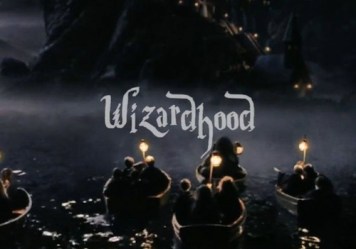
WizardhoodAt the tail end of last month, a story did the rounds on entertainment sites about a fan edit that took the eight-film, 20-hour Harry Potter series and reduced it into a single movie that ran just 78 minutes — a reduction of over 93%. You see stories about these kind of fan edits all the time (or you do if you read certain sites, anyway), but I usually don’t get round to watching them. I mean, who has time for a dozens-of-hours supercut that puts every piece of footage from every Marvel movie (and short) into chronological order, or whatever? But as I was off to Harry Potter Land — and as it’s less than an hour-and-a-half long — I did make time for Wizardhood (like Boyhood, see?)

(I did debate whether this merited a new number, because it’s a fan edit of other people’s movies; but it’s such a radical restructuring of that material, and (as I’ll come to in a moment) it’s designed to function as a film rather than as a long video summary, so I’ve decided it does count, as would any official major re-edit.)

So how exactly do you go about making such a huge reduction? Is it just a really, really long “previously on”-style montage? No, thank goodness, it isn’t. What editor Tim Stiefler (a 27-year-old New Yorker, if you’re interested) has produced is less an abridgement and more a complete retelling of the Potter story. His cut doesn’t even attempt to tell whole swathes of the story, instead ditching them entirely. Stiefler has clearly tried to make a film out of this material, not just a long précis of the story. That means we don’t just get a series of vital scenes that further the plot. Instead, moments are allowed to play out a bit to convey their emotional impact or their humour. He’s even selected a couple of the series’ many action sequences, presumably based on the points in his cut that benefit from that adrenaline boost — just as you would if you were pacing a ‘real’ film.

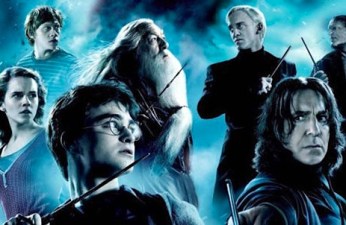
Harry Potter and the Streamlined StoryWizardhood focuses in on the main narrative of Harry vs Voldemort, and the need to destroy the Horcruxes. In practice, that means there’s a chunk of Film 1 to establish the world, followed by cursory scenes from Films 2, 3, 4 and 5, mainly for texture and pace, before great chunks of Films 6, 7 and 8 are used to complete the narrative. In the process it also focuses on certain characters. It’s centred around Harry, Ron and Hermione, obviously. The latter two are only really there because they’re always around Harry, although Stiefler makes a decent subplot out of their relationship. Also retaining much of their storylines are Dumbledore and Snape, who both have primary roles in Harry’s story. Draco Malfoy and Neville Longbottom get subplots, again mainly because they have vital roles to play in the main tale. There are a couple of scenes featuring major players like McGonagall, Hagrid, Ginny, and Umbridge, but otherwise every major character is cut: the Dursleys and Sirius Black don’t even appear; the likes of Lupin and Mrs Weasley are in a shot or two without any dialogue; and so on (I’m not going to list everyone!)

It’s a little hard to say how Wizardhood works as a standalone movie, because if you’ve seen all eight films in full then your brain can fill in the gaps. That said, it does seem fairly smooth. It’s so efficiently and cleverly edited that there are barely any lines or moments that aren’t relevant to the version of the story it’s telling, and the excised stuff is so thoroughly removed that you kind of don’t miss it. It’s not the ideal way to view the Harry Potter saga — it loses so much of the texture, the plot, the characters — but as an exercise in telling the series’ primary conflict in a single-film-length way, it’s an impressive piece of work.

4 out of 5

The full Harry Potter series is on ITV daily from Christmas Eve to New Year’s Eve, beginning with Philosopher’s Stone today at 1:30pm. If you want to see Wizardhood, you’ll have to go looking

Rogue One (2016)

aka Rogue One: A Star Wars Story

2016 #187
Gareth Edwards | 134 mins | cinema | 2.35:1 | USA / English | 12A / PG-13

This review contains major spoilers.

Rogue OneThe first live-action non-saga movie to take us to a long time ago in a galaxy far, far away, this initial entry in what is sure to be a never-ending series of so-called “Anthology” movies really puts the “War” into Star Wars.

It begins without the traditional opening crawl, which is somewhat ironic when you consider that, of all the Star Wars movies, this is the one that would most benefit from some scene-setting — fans are on a fairly sure footing, but casual viewers who still expect to see the further adventures of Rey, Finn, and BB-8 may be a little baffled. (And if you think the saturation media coverage will have prepared everyone, you’re underestimating Normal Folks’ capacity to be completely oblivious to movie news.) Anyway, where we actually are is 30-something years before The Force Awakens… but as this is a spoilery review you don’t need me to recap the plot, because you’ve not read this far if you haven’t seen the movie. Right? Good.

As I was saying, Rogue One is really a war movie, and is at its best when it’s consciously riffing off other (i.e. non-sci-fi) genres, like gritty World War 2 epics or daring heist thrillers. These are some new flavours for a franchise which has produced seven films in the action-adventure mould. Rogue One doesn’t deviate so far from that path — it’s a bit like Disney stablemate Marvel in that it mixes other-genre spice into the familiar recipe rather than striking out in a wholly different direction — but it’s enough to taste different.
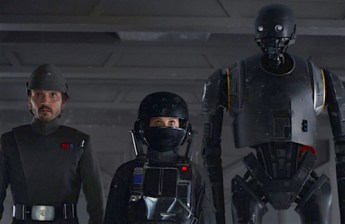
HeistUnfortunately, the plot starts off almost as jumbled as my mixed metaphors there. “Jumbled” may be unfair, but it’s a little scrappy, initially jumping around all over the place in a way that’s tricky to follow even if you’ve read up on the film and have an idea who you’re being introduced to and why. It must be a right pain for neophyte viewers. There can be a fine line between praising a film for requiring its viewers to pay attention and do some work, and criticising it for being disarrayed and not making things clear. Personally, I thought Rogue One was sat right on that line for much of its first act, until a few big expositional infodumps come along to explain the storyline.

A primary cause of this is the number of characters we need to be introduced to. Presumably aiming for a Dirty Dozen / Magnificent Seven / men-on-a-missionpeople-on-a-mission… beings-on-a-mission vibe, it leaves things occasionally a little scattered until the team comes together. The resultant volume of heroes means the movie is arguably a little short on the kind of memorable characters Star Wars is loved for, although that doesn’t mean there isn’t good work here. Felicity Jones makes Jyn a likeable, moderately complex heroine, at least when she’s not delivering cheesy speeches. Ben Mendelsohn produces a reliably snake-like villain as Imperial Director Krennic, while Riz Ahmed once again injects a lot of personality into a somewhat underwritten supporting role. Donnie Yen and Jiang Wen make a solid double act who it would’ve been lovely to see more of in a sequel, and Alan Tudyk gets all the best lines as snarky droid K-2SO. Most ill-served are Diego Luna as a conflicted Rebel captain whose internal struggles aren’t fully brought out, Forest Whitaker as an ageing extremist, and Mads Mikkelsen, who is lumped mainly with exposition. The latter two at least bring extra-textual gravitas to their smaller roles.
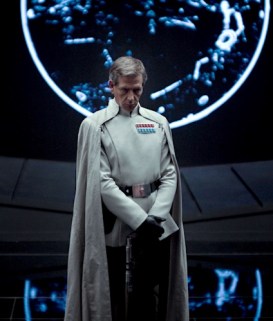
KrennicThen we come to perhaps the film’s most discussed character: Grand Moff Tarkin, played by Peter Cushing’s computer-generated face overlaid on the motion capture and voice of Holby City’s Guy Henry. Leaving aside the ethics of the enterprise, I found the character’s presence to be pretty distracting: you know it’s CGI and you can’t stop focusing on just Tarkin’s face, trying to judge how effective or not it is. For me, it proves that CGI isn’t yet quite up to creating a fully plausible human being. Your mileage will vary on whether it’s suitably competent nonetheless or an ill-conceived failure.

Elsewhere, there are tons of little nods to the wider Star Wars canon, including the animated series: Whitaker’s character actually comes from The Clone Wars, where he appeared in four episodes; and there are half-a-dozen background references to ongoing series Rebels, most prominently the ‘Hammerhead’ ship, which was introduced there. Lucasfilm do seem very keen to emphasise that all these different media really are one interconnected universe, unlike so many other cross-format franchises, which accept everything as canon until the main series decides they want to contradict it. For example, while I was on holiday recently I visited the Star Wars exhibition they currently have at Disney’s Hollywood Studios, which features various displays of, say, villain’s lightsabers or pilot’s helmets that put real-life recreations of ones from The Clone Wars and Rebels right alongside those from the original trilogy and the prequels as if that’s exactly where they belong. I must commend Lucasfilm for such an unusual commitment to institutionally tying these things together, rewarding the investment fans will inevitably make in doing the same. It does mean I feel I need to get on with watching the six seasons of Clone Wars and three (or more) seasons of Rebels, though.
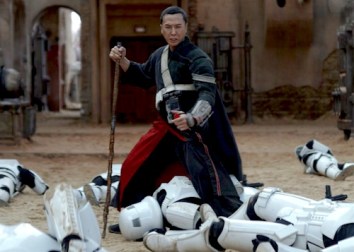
Donnie Yen: badassContinuing such comparison to the wider Star Wars galaxy, some have said Rogue One is the Empire Strikes Back of Disney-era Star Wars, because it’s the darker second (on the release schedule) film. Of course, the main reason it’s dark is that every major (new) character dies. You know what’s unique about Empire in the context of the entirety of live-action Star Wars movies? It’s the only one where no major character dies. Death isn’t the only signifier of darkness, of course, but my point is rather that I think people are grasping at straws if they think anyone inside Lucasfilm has consciously positioned Rogue One to serve an Empire-like role in their revived franchise. That doesn’t mean they’re not treating it seriously, mind: director Gareth Edwards has already revealed that the first draft had Jyn and Cassian survive the battle of Scarif, purely because the writers thought the execs would never agree to all the heroes being killed off, but those execs immediately suggested that everyone should die and that element was never questioned again. Yes, sometimes studio suits are actually on the side of narrative truthfulness.

Even if that got locked early on, other things certainly didn’t. The film’s reshoots made big news for no particularly good reason (it’s par for the course on blockbusters these days), but their results are easy to see thanks to the film’s trailers: there are a number of significant shots present there that didn’t make the final cut, suggesting some radically different events in the third act. You can watch a short compilation of those here. As far as I’m aware neither Edwards nor anyone else has said what was actually changed by the reshoots, but it would be interesting to find out. Considering the Scarif-set portion of the film is probably its most successful part, and that’s where the reshoots seem to have been focused, it might make a good defence of a process that is often seen as a sign of disaster (sometimes for good reason).

Star of deathMuch discussion of Rogue One seems to have revolved around whether it’s better than The Force Awakens. At the risk of sitting on the fence, I can see both sides. On the one hand, Edwards is a much more interesting filmmaker than J.J. Abrams. The latter is adept at aping the work of others, having now been in charge of multiple movies that are mostly derivative but nonetheless entertaining. Edwards’ career is still a little fresh and blockbuster-centric to risk describing him as an auteur, but his debut film was more indie than anything Abrams has even thought of creating, and his take on Godzilla attempted to be more interesting than the rote monster blockbuster it could’ve easily been. He brings similar qualities to Rogue One. On the other hand, that riskier take has resulted in a few fumbles, whereas The Force Awakens was a polished, crowd-pleasing entertainment. I’d hesitate to say I prefer one to the other because they provide slightly different thrills, but on a first viewing I did find Force Awakens more satisfying. Given time and distance, however, I wouldn’t be at all surprised to find Rogue One leapfrogging it in my estimations.

4 out of 5

Midnight Special (2016)

2016 #145
Jeff Nichols | 112 mins | streaming (HD) | 2.35:1 | USA & Greece / English | 12 / PG-13

Midnight SpecialI’m not sure I’d even heard the name Jeff Nichols before Midnight Special came along, at which point most of the gushing reviews that followed seemed to mention him with cult-like reverence. He’s the writer and director, by the way, for anyone still in the dark, and unbeknownst to me (and, I rather suspect, most people outside certain cinephile circles) he’d amassed something of a following over his first three movies (Shotgun Stories, Take Shelter, and Mud, two of which I’d at least heard of). It’s kind of odd to feel like everyone else loves this guy and has been eagerly anticipating his next work and is now discussing how it chimes with his existing canon, when you’ve not even heard of him.
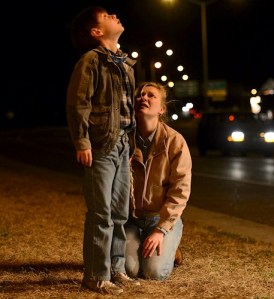
Anyway, his latest film* has a plot that makes me want to dub it Starman: A World Beyond… though that might indicate something about the ending, so, uh, shh! Anyway, the story concerns a dad (Michael Shannon) who’s kidnapped his son (Jaeden Lieberher) from some kind of cult, and is now on the run from both the authorities and the cultists who want the kid back. All the furore stems from the fact that the kid has some kind of special abilities, one of which has given them a destination to head for and time to be there…

The story’s style has made a comparison to Spielberg the go-to, not only for reviewers but for the writer-director himself, who’s labelled the film an homage to E.T. and Close Encounters. You can see that influence, certainly, but it lacks the effortless charm that Spielberg brings to his movies. If this is Spielberg, it’s by way of more indie arthouse fare. Is that a bad thing? Not necessarily. You could argue that it’s more refreshing than any of the I want to believestraight-up Spielberg rehashes we’ve seen over the past four decades; conversely, a strand of wilful obscurity means it may be ultimately less satisfying. Again, some people derive satisfaction explicitly from that lack of resolution or explanation, while others will find it damagingly frustrating. Even more than Spielberg, I felt the thing most evoked by this structure was The X Files: intriguing sci-fi mysteries that eventually lead to semi-reveals which don’t quite satisfy in themselves in part because they’re trying very hard to remain open-ended.

In that regard, it’s arguably a little too woolly on its sci-fi elements, and executes the chase-thriller aspect of its plot too slowly, to be fully considered a genre movie; but it’s also too indistinct on its cast to fully convince as a character-driven drama. You can certainly begin to infer some things about what their exact motivations are, what they’re thinking and feeling and why they’re doing what they do, but I’m not sure if it’s actually there or if I’m endeavouring to build something out of the little that we’re given. That said, if I’m prepared to do Zack Snyder the courtesy of reading something into his work that may or may not be there (cf. Sucker Punch), then Jeff Nichols deserves at least the same level of kindness. But for the kind of movie whose style makes it seem like it should be about Character or Theme over more genre- and/or narrative-focused concerns, it feels there’s an awful lot of attention paid to plot over anything else. Speaking as a fan of sci-fi and high-concepts and B-thrillers and blockbusters, I actually think I’d’ve liked it more if it toned down the sci-fi and the plot, and instead focused on the characters’ soul-searching and the unusual family dynamics.

That said, there’s some great imagery. Mainly the sci-fi stuff at the end — I don’t think it’s unfair to describe most of the movie as looking solidly unremarkable, but the climax is pretty darn good. However, I’ve read many reviews that criticise the effects. Are we not past that yet? Especially when it comes to a film of this budget and scale. Nuclear familyI thought they perfectly conveyed what they were intending to convey — usually, just a kind of otherworldly light. It’s not like it’s even over-stretching its means, like so many network TV series or Sharknado-esque movies do when they try to emulate a $200 million blockbuster on a TV budget. If you’re expecting some grand CGI, maybe go watch one of those $200 million blockbusters instead of an $18 million drama.

Midnight Special seems to provoke a wide range of responses — I mean, you can say that about most films, ultimately; but some more so than others, and skimming across reviews and comments online, this is definitely one of them. Fans of American indie-ish drama-driven semi-genre movies, or of more thoughtful science-fiction, will surely want to give it a go, but how much you’ll connect with its characters or its ideas seems to be a roll of the dice. I liked it well enough, but I don’t remember seeing any particular indication of what’s inspired the notion that we should all be fawning over Jeff Nichols as the best auteur to happen to cinema since sliced bread. (Sliced bread’s early movies were great, weren’t they?)

3 out of 5

Midnight Special is on Sky Cinema from today.

* In a coincidental similarity to when I started viewing the work of another much-hailed star-to-be indie director (Ben Wheatley), I’m beginning with his fourth film. ^