Shorts of FilmBath Festival 2019

Across the 2019 FilmBath Festival programme, 46 short films were screened — 23 attached to feature films, 17 at a dedicated ‘Shorts Showcase’, and six at the IMDb New Filmmaker Award ceremony (five in competition, one the film made from the winning screenplay of the IMDb Script to Screen Award). I saw 14 of these, one way or another, and have compiled my reviews into this (commensurately long) post.

First, the five films that competed for the IMDb New Filmmaker Award.
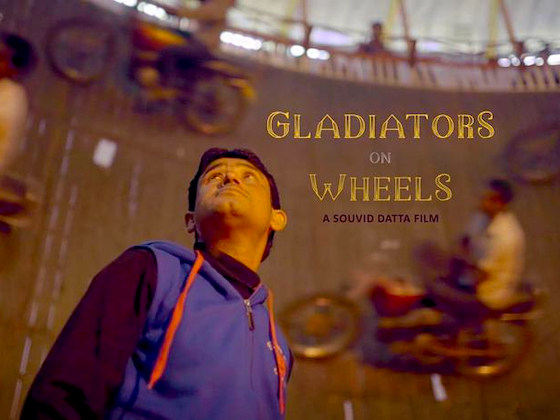
Gladiators on Wheels

The winner chosen by the judges was Gladiators on Wheels (2019, Souvid Datta, UK & India, Hindi, 6 mins, ★★★★☆), a documentary about the ‘Well of Death’ — an attraction at Indian circuses where daredevils ride motorbikes and drive cars around 60ft vertical walls, literally defying gravity. It’s both impressive and terrifying, especially considering they’re doing it without any kind of safety gear — no helmets or padded suits here, never mind nets or something. But the film isn’t just about the actual act, also touching on the way of life, and how it’s fading. It’s a well-shot bit of filmmaking, especially impressive when you learn it was all filmed in a single day. The script was compiled from interviews with the drivers, then voiced by actors, but if anything it’s a little cliché — lots of talk of “living on the edge” and how dangerous it is but how they wouldn’t have it any other way, etc. Still, like many of the best documentaries, it’s a fascinating glimpse at another world.

The audience at the ceremony also got a say, favouring Hey You (2019, Jared Watmuff, UK, English, 5 mins, ★★★★★), which is about gay men hooking up via text messaging. At first it feels like a lightly comedic bit of fun, possibly with some drama in that one of the men is closeted, but then it develops into something more serious. It’s a very well made short, in particular the shot choices and editing at the climax, which combine to produce some incredibly striking imagery. It’s tricky to say why it’s such an effective and vital film without spoiling where it goes in that finale, but it’s a meaningful piece that’s worth seeing if you can. It would’ve been a worthy winner.

Facing It

The three other finalists were … Tight Spot (2018, Kevin Haefelin, USA & Switzerland, English, 4 mins, ★★★★☆), a comedy bit about a shoe shiner and a suspicious customer, which was amusing albeit a little predictable; although it did, again, look nice … When Voices Unite (2017, Lewis Coates, UK, English, 4 mins, ★★★☆☆), a mini tech thriller that was suitably tense in places, but really needed some kind of twist or final development to give it a reason to exist … and Facing It (2018, Sam Gainsborough, UK, 8 mins, ★★★★★), which presented an imaginative visualisation of a relatable social difficulty. Rendered in a mix of live-action and stop-motion animation, it’s by far the most technically impressive short here, but all in service of telling its story and conveying the requisite emotion. Another one that would’ve been a more than worthy winner.

(You can watch Gladiators on Wheels and When Voices Unite on Vimeo. Sadly the others aren’t publicly available, although there is a short making-of for Facing It which I recommend for appreciating the filmmaking skill on display there.)

Of the other shorts I saw, my favourite was definitely Pleased to Eat You! (2019, Adrian Hedgecock, UK, English, 7 mins, ★★★★★). It’s a beautifully designed and hilariously funny musical comedy short… about cannibalism! Its colourful and clever staging evokes the handmade movie-reality worlds seen in films by the likes of Michel Gondry or Charlie Kaufman, while the full-blown song-and-dance number is like the best of old-fashioned Hollywood musicals, albeit twinned with a pun-filled cheekiness in its subject matter. An absolute delight from beginning to end.
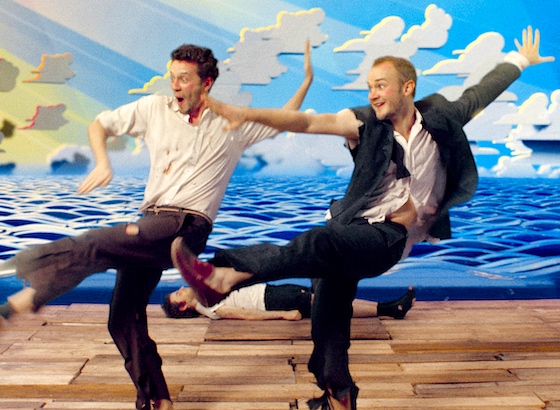
Pleased to Eat You!

If I were to rank all the other shorts too, I’d probably put Woman in Stall (2018, Dusty Mancinelli & Madeleine Sims-Fewer, Canada & UK, English, 10 mins, ★★★★☆) in second place. A very timely thriller, it sees a woman innocently enter a public bathroom cubicle to get changed, only for a man to turn up outside and start chatting, her wariness of him trapping her inside. Is he a predator she’s right to fear? Or is she just being paranoid? Part of the short’s cleverness lies in the way it plays with our emotions and expectations, swinging us back and forth into where our trust should lie. Working with a limited setting, it’s neatly shot — never dull, but without going OTT to try to jazz things up — and gets edge-of-your-seat tense as it goes on. Regular readers will know how much I love a “single location thriller”, and this is a perfect mini example of the form.

Quince: Fifteen (2018, Peiman Zekavat, UK & Peru, Spanish, 10 mins, ★★★★☆) is a real-time single-shot drama about a 15-year-old Peruvian schoolgirl whose carefree PE lesson turns into a tumult of life-upending dismay in just a few minutes following an unexpected discovery on social media. It’s another timely issue, and this is mostly a well-made short — I do love a single take, and the real-time aspect puts you in her shoes quite effectively. Unfortunately, it’s a bit inconclusive — it just stops, with no hint of how she’s going to deal with her new problem longer term, or what’s going to happen to her beyond a handful of initial reactions. It’s not bad as it is, but there’s also more to be told here.
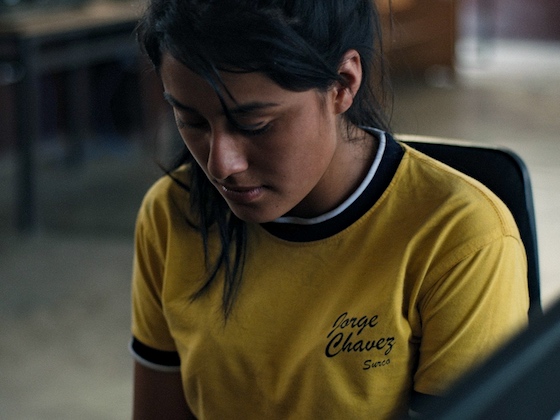
Quince: Fifteen

On a snowy winter’s day, a postie makes his rounds on a London estate. Meanwhile, one woman anxiously awaits his arrival… With its brief running time, Special Delivery (2018, Robert Hackett, UK, 4 mins, ★★★★☆) almost feels like an extended edit of one of those soppy commercials the big retailers always put out at Christmas — you know, the ones that have just started to pop up on the telly. Nicely shot in 2.35:1, it evokes a Christmassy feel without being overtly festive, and manages to avoid becoming quite as saccharine as those adverts, instead earning the story’s sentimentality. A sweet little slice of romance.

Coming just behind those frontrunners would be Spooning (2019, Rebecca Applebaum, Canada, English, 6 mins, ★★★★☆), a one-woman-show of a mockumentary about a theatre actress who specialises in playing spoons. Not “playing the spoons”, like a musical instrument, but anthropomorphised spoons, like in Beauty and the Beast. It’s basically a comedy sketch as a short film, but it was largely funny so I don’t begrudge it that.

I’m six films deep into this loose ranking now, but that’s not to discredit Allan + Waspy (2019, James Miller, UK, English, 8 mins, ★★★★☆). It’s about two working class schoolboys who hang out in the woods on their way to school each day, observing a bird’s nest full of chicks hatching and maturing — but one of the lads clearly has problems at home, and it all takes a very dark turn. Initially it’s a likeable slice-of-modern-life tale, managing to find an element of old-fashioned bucolic childhood even in a modern inner-city setting, and unfurling at a gentle pace by mixing shots of the surrounding world into the boys’ activities. But then there’s a thoroughly glum ending. It kinda ruined my day, but I liked it as a film nonetheless.
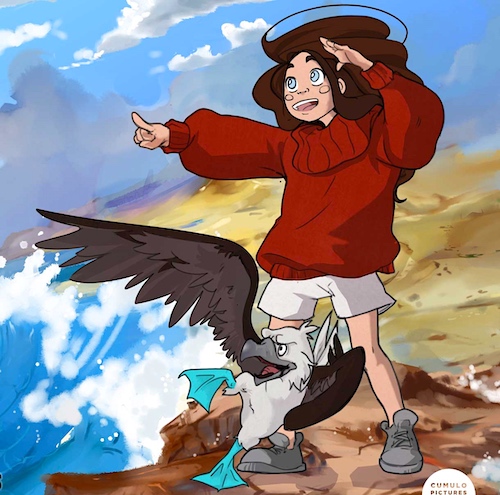
Cumulus

A young Welsh girl runs off from her dad and encounters a talking gull who’s worried about his kids leaving home in animation Cumulus (2018, Ioan Holland, UK, English, 9 mins, ★★★☆☆). Naturally, they both learn something from each other. It’s always nice to see 2D animation nowadays, especially when it’s as prettily designed as this, though it’s a shame that some of the movement is a little stilted and animatic-y. It’s also a bit longer/slower than it needs to be, but it’s still mostly charming.

Perhaps the most disappointing short was My Theatre (2019, Kazuya Ashizawa, Japan, 5 mins, ★★★☆☆), a documentary about an 81-year-old in Fukushima who closed his cinema 55 years ago but keeps it alive as a kind of museum. That’s mainly what I gathered from reading blurbs before viewing, though, because the short itself lacks any real context or conclusion, just presenting vignettes of life in this rundown old movie house. It’s perfectly pleasant, but ultimately unenlightening. My Theatre is listed on other festivals’ websites as running 20 minutes, so perhaps the five-minute version submitted to FilmBath is just an excerpt — that’s certainly what it felt like. A longer edit, with more of a sense of why this is a place and person worth observing, would’ve been better.

Finally, Terra (2019, Daniel Fickle, USA, English, 6 mins, ★★☆☆☆), which received some very negative feedback from a few audience members who didn’t feel it was appropriate for the film it was screened before, Honeyland. That’s a documentary about a traditional European way of beekeeping on the wane, whereas Terra is ostensibly about the tumultuous romantic relationship between two young Americans. The clue is in the title, though: it’s a metaphor for humankind’s relationship with Earth. Personally, I thought the analogy was a bit on the nose, but it seems others missed it entirely. The photography is quite pretty, in a no-budget-indie-drama kinda way, but other than that I didn’t think there was much to it. Other members of the FilmBath team were more impressed, so I think it’s fair to say it’s a divisive little number.
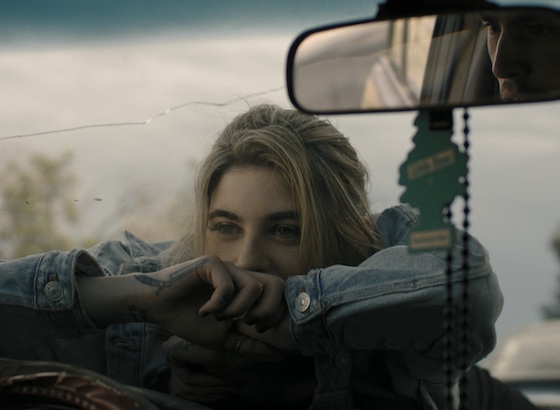
Terra

As I said at the start, there were 46 shorts screened at the festival, so this is just a small sampling of what was on offer (less than a third, to be precise). Although I didn’t love them all, I did enjoy most — and considering they would have entirely passed me by were it not for the festival, I’ll definitely take the handful of letdowns as part of the parcel for getting the good stuff.
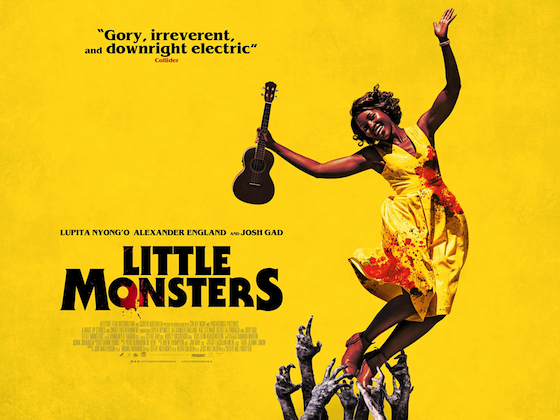
Little Monsters (2019)

2019 #138
Abe Forsythe | 94 mins | cinema | 2.39:1 | Australia, UK & USA / English | 15 / R

Little Monsters

The zombie comedy — or zom-com — is basically a recognised subgenre (or sub-subgenre, really) at this point, birthing both high-profile hits (Shaun of the Dead, Zombieland) and smaller cult successes (Cockneys vs Zombies). For some reason this doesn’t seem to work with other monsters (Lesbian Vampire Killers, anyone?), so what is it about zombies that lends them to comedy? Perhaps it’s their roots in social satire. Perhaps it’s just that an enemy who can only shamble along slowly is inherently ridicule-worthy.

Whatever, the latest entry in this sub-subgenre comes from Australian writer-director Abe Forsythe. We’re introduced to Dave (Alexander England), a washed-up wannabe musician whose argumentative long-term relationship has just imploded, leaving him on his sister’s couch being a bad influence on his young nephew, Felix (Diesel La Torraca). After he meets Felix’s kindergarten teacher, Miss Caroline (Lupita Nyong’o), Dave is smitten, agreeing to be a chaperone on a class trip to a farm. There they first meet kids’ TV star Teddy McGiggle (Josh Gad), and then an outbreak of zombies from a nearby military research facility.

I guess taking a leaf out of Shaun’s playbook, Little Monsters invests a lot of time in its setup before it gets to the promised zombie action. As we witness Dave’s life fall apart, it feels more like a blokey indie comedy than a genre sendup, and it’s an age before Nyong’o turns up, never mind the zombies. I guess this is meant to be character stuff to get us invested, but its problem is it’s not terribly original — Dave is basically Dewey from School of Rock, and/or every other character that has already imitated that. Later, Teddy McGiggle is revealed to actually hate kids; he wanted to be a serious actor; now he’s an alcoholic; etc, etc. Asking us to invest in the characters is fine, but it helps if their arcs aren’t entirely predictable.

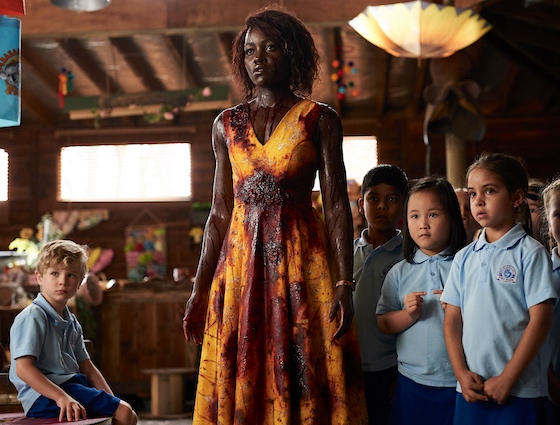
Miss, you've got red on you

Strumming a ukulele in her yellow sundress as she communicates with children on their level, Miss Caroline screams “Manic Pixie Dream Girl”. Fortunately, in the hands of Oscar-winner Nyong’o, there’s more to her than that, be it her savvy handling of Dave (clearly the latest in a long line of lustful dads) or wielding a spade to fight the undead. That sentiment perhaps extends to the film as a whole: it may be constructed from familiar building blocks, but its peppered with enough little moments of freshness that it provokes plenty of laughs. Most of that comes from having a class-full of little kids in tow, with the adults trying to pretend it’s all a big game for their benefit. Especially when watched with a late-night crowd up for the experience, it’s good fun.

Often with films of this nature I say they’re “for genre fans only” or something like that, but I wonder if Little Monsters might actually play best for those unfamiliar with all the other movies it’s a bit like. Of course, forgiving genre fans will also be entertained. It doesn’t reinvent the wheel, but it’s a light and largely likeable hour-and-a-half.

3 out of 5

Little Monsters is released on Sky Cinema and in some cinemas in the UK today.

The Twilight Saga: Breaking Dawn – Part 2 (2012)

2019 #132
Bill Condon | 110 mins | streaming (HD) | 2.35:1 | USA / English | 12 / PG-13

I may’ve been pretty quiet for most of October, but it’s Halloween today and that means it’s time to uphold a tradition I’ve had since 2015 — but for the final time! Well, all good things must come to an end. Fortunately, so too must Twilight.

The Twilight Saga: Breaking Dawn - Part 2

As usual with films this deep into an ongoing story, I won’t bother making much of an effort to set it up for newcomers. Film series like this are more like miniseries, just with feature-length episodes that are released theatrically and years apart. You wouldn’t just watch Episode 5 of a five-part TV series, would you? That goes double here, as the title indicates: it’s also the second half of the final book.

Ah, the title… As regular readers may’ve picked up by now, I’m a stickler for title accuracy (heck, it’s literally my job at the minute). The ‘correct’ title is what’s on the film’s title card… which you’d think is pretty straightforward, but every now and then something challenges that methodology. The Twilight films have consistently been a problem with that. Always promoted as “The Twilight Saga: [Film Title]”, the main title card in the films themselves use just the individual title bit. But Breaking Dawn has decided to be even more irritating, because Part 1 was called Part 1, but Part 2 is called Part Two. No, seriously. Look, I know this kind of thing matters not a joy to most viewers, but I feel like it’s indicative of the amount of effort and attention that was actually spent on these movies. (Despite all that, I’ve gone with Part 2 for the title of this review to match my Part 1 review, because I appreciate consistency, at least.)

Numerical formatting inconsistencies aside, the opening titles are really nice. I mean, they’re not so amazing that you should go seeking them out especially, but they look good. And for once, it’s not all downhill from there!

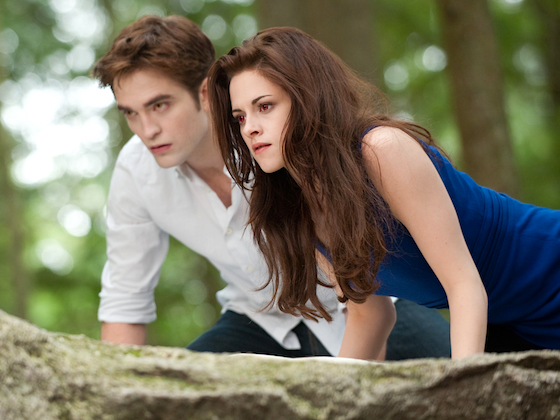
Bella the vamp

But only because the climax is probably the highlight of the whole saga — unless you’re primarily here for the romance stuff, which was mostly tied up in previous movies. It does make you wonder somewhat who this final part is for, actually. The central couple got married in the last film — that’s the end goal of all conservatively-minded relationship stories. You get married, then you live happily ever after, so naturally there’s no story beyond that point. (Heavy eye roll.) But Twilight isn’t quite an ordinary conservative romance, what with one of the pair being a vampire, so there’s some mythology stuff left to tackle. Well, no spoilers (yet), but Breaking Dawn isn’t ultimately very conclusive in that regard. Maybe author Stephenie Meyer was deliberately leaving room for a further book.

As a commercially-minded theory, that seems a reasonable presumption. But the narrative of Breaking Dawn suggests Meyer was more than ready to move on. Out of almost nowhere, everyone starts developing superpowers (element manipulation, forcefield projection, the ability to deliver electric shocks, etc), which they must then learn how to use. Sound familiar? I can only assume Meyer got bored of writing shitty novels about vampires and werewolves so decided to make this one a shitty version of the X-Men instead.

Further evidence of restlessness comes from the amount of plot we’re treated to. In almost all my Twilight reviews I’ve specifically noted how slow the films are, or that nothing happens; but this time so much happens they have to condense events with montage and voiceover. New characters are introduced at a rate of knots, simply to fill out an ‘army’ for the final battle. Any writer worth their salt would’ve known this was coming and spent time introducing these people earlier — it’s not as if there hasn’t been room for it in the sparsely-plotted earlier instalments. Simply, this saga is exceptionally poorly paced.

Almost all of these characters are introduced in this film

It’s certainly not the film’s only technical flaw. Apparently it cost $136 million, so why does it look like it was made for £3.50? Inadequate CGI has always been a feature of these films, so what possessed them to think they could pull off a CGI baby/toddler?! The result is fucking creepy; the very definition of the uncanny valley. Sometimes I think the people who made these movies shouldn’t be allowed to work again. The dialogue, the editing, the obvious green screen, the cheapo effects… it’s not just that it’s a crummy story with dubious morals, it’s that the films are so shittily made.

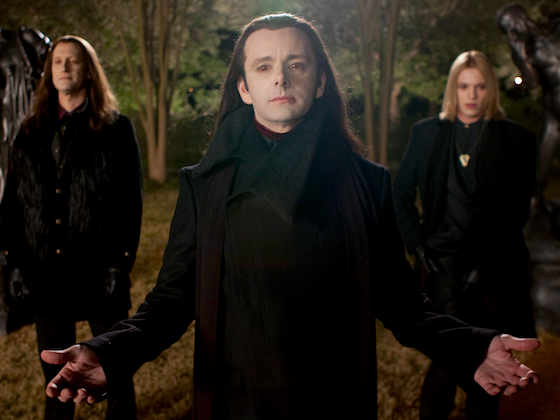
But, as I said earlier, there’s almost some redemption. First, Michael Sheen rocks up as the head of the Volturi, who are the top vampire coven or something (I don’t really remember, it was explained three films ago). I think he’s thoroughly aware it’s all rubbish (I believe I read he only did it because his daughter was a fan), so he gives a delicious performance. It’s not over the top — he’s not just phoning it in for the payday — but it also seems aware that it’s all daft, so why not have some fun? He’s the Big Bad, so his presence enlivens the climax, which also benefits from a good old “two armies face off across the battlefield with rousing music” approach.

And then they fight… and, wow, they should’ve called this The Twilight Saga: Breaking Off People’s Heads. It’s possibly the best of the series simply because of how fucking brutal it is. If you watched the previous films thinking, “I wish most of these characters would just die horrible deaths”, this is the sequel for you. And it’s still rated PG-13! They pull a woman’s head and arms off, and toss the head into a fire, and then they toss a toddler into the fire too… and it’s still rated PG-13! But half a glimpse of a woman’s nipple and you get an R. You’re fucked up, America.

Michael Sheen shines

Post-fight, the film has one final good bit. I’m just going to spoil it, because if you’ve got this far I figure you don’t care. It’s revealed that the entire battle — which, note, killed off a slew of major supporting characters — was all a premonition. “It was all a dream” is frowned upon as a rule, but here it’s actually quite a neat twist. I didn’t see it coming, anyway. I guess I didn’t think anyone involved with Twilight was capable of such structural ingenuity. How I wish it was in a better film, more deserving of its effectiveness.

Oh, but it’s not all sunshine and roses. It means the fight never happens, which means the bad guy isn’t actually defeated, he just decides not to bother (because he’d lose). But is he happy about it? Duh, no. So he… just goes home… still in a position of power, still not happy with our heroes… Is that a victory? Or has the villain gone away to cook up a new plan? As I said, it feels open for a further story. A pair of characters who wanted the good guys to win for their own nefarious reasons basically tell the heroes, “you’re all fools, the Volturi might’ve left but they’ll never forgive what happened”… and all the good guys just laugh, because they’ve won, because they’re the good guys. But they haven’t won, have they? They didn’t defeat him. They didn’t convince him. It won’t take much for him to come up with a new, better plan. Fuck it, I was glad this was over, but now I want to see The Twilight Saga Episode 6: The Volturi Slaughter All Those Cocky Bastards.

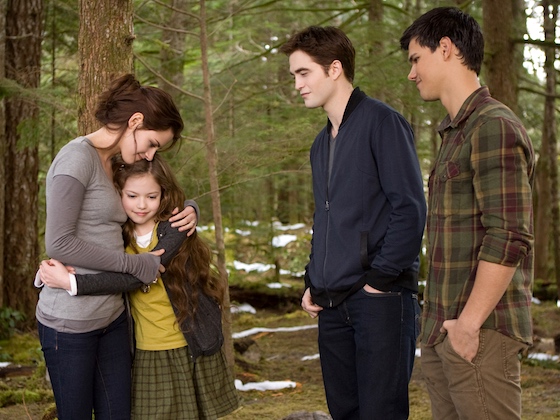
Happily ever after

But there isn’t a sixth instalment. This is it. I have completed The Twilight Saga, just over a decade since it first came to the big screen. Back then it was a relatively significant part of pop culture, with a rabid fanbase clamouring for the movies to be recognised, and turning them into major, much-discussed hits. But they were always critically reviled, both in print and on screen, and now it feels like their relevance is waning, presumably as old fans grow up and new ones fail to materialise. Or maybe they still do good numbers in book sales / TV airings / Netflix streams, but we just don’t talk about them widely because they’re not new anymore. Who knows. The only reason I care is because I’m wondering if I’ve spent ten hours of my life watching something I knew would be poor, spurred merely by its cultural significance, only to find that significance has quickly evaporated.

Oh well. At least I’ll always have Face Punch.

2 out of 5

Colossal (2016)

2018 #117
Nacho Vigalondo | 109 mins | streaming (HD) | 2.35:1 | Canada, USA, Spain & South Korea / English & Korean | 15 / R

Colossal

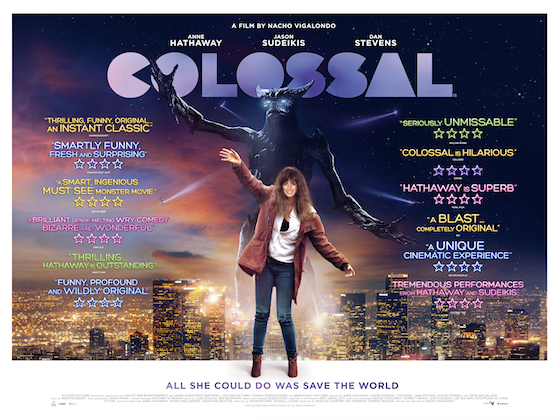
As it begins, you’d be forgiven for thinking Colossal is just another indie rom-com. Anne Hathaway stars as Gloria, an unemployed writer whose boyfriend (Dan Stevens) kicks her out of their New York apartment, forcing her to move back to her Nowheresville hometown. There she reconnects with childhood friend Oscar (Jason Sudeikis) — romance is surely in the air, right? But Colossal has a couple of surprises up its sleeve. One is hard to miss, what with it being on all the posters (and, I presume, in the trailers): concurrent with Gloria’s return home, a giant monster begins to rampage around Seoul, and she comes to realise these two disconnected events are, in fact, connected. Meanwhile, the relationship storyline has a few twists in store too.

Unsurprisingly, given the uniqueness of the concept, the film’s marketing foregrounds the giant monster. But anyone expecting “a giant monster movie” will probably be disappointed, because this isn’t a Godzilla clone. However, anyone open to an indie comedy-drama that uses giant monsters as a giant metaphor (arguably an on-the-nose one, but it’s an effective one also) should find something of interest here. I’m being coy about the facts of that metaphor because I think one of the movie’s biggest strengths is its ability to surprise, and to wrong-foot and unnerve you with those surprises — there are some very uncomfortable scenes, deliberately so. Writer-director Nacho Vigalondo is looking to explore timely themes here, and if you were to be aware of them before viewing I think you’d be looking for signs too early, and that would undermine part of the film’s point, which lies in how events develop.

To put that aside, Colossal’s biggest weakness comes in its sci-fi/fantasy element, where the rules of the situation don’t quite hang together. I’m not saying it needs an explanation for why the ordinary-woman/giant-monster connection happens — it’s the same reason that, say, the time loop in Groundhog Day happens: it just does. The ‘why’ is immaterial to the film’s purpose. But the rules the film establishes for how it works don’t entirely add up. I could go into specifics but, again, that might spoil things. And, ultimately, my issues are no more than niggles — the way things pan out is about getting satisfaction from the storyline, not adhering to the ins and outs of how a fantasy works. That said, I feel like a couple of logic tweaks here and there would’ve made it faultless.

Who's the bigger monster?

Nonetheless, it’s worth letting those complaints slide, because there’s so much to like in spite of them. The performances, for one. Hathaway negotiates Gloria’s interesting, tricky character with aplomb. By ‘tricky’ I really mean that it’s somewhat hard to put your finger on what her arc is exactly, but I think that’s because her evolution is believably fuzzy, just like real life, rather than conforming to a slick “this is the lesson she learned and now she’s better” movie thing. Co-lead Sudeikis has, I’d wager, never been better. I’ve not seen him in much, but enough to buy other people’s opinion that he’s a bit smug, a bit try-hard, a bit… of a dick, really. But all of those qualities work here, where Oscar is a loser trying to seem cool.

With some polishing up, Colossal could’ve been nigh on perfect; though it’d likely still be a cult favourite rather than any major success. Well, it’s probably still good enough for cult status, though, as a caveat, it will most appeal to those viewers who are prepared to accept a bit of a genre/tone mashup. It’s got an indie-funny quality, but then throws the sci-fi stuff in, before unveiling a serious side too; and, although that does get very dark, it’s really effectively managed — indeed, it’s all the better for how the quirkier first part sets it up. Vigalondo has points he wants to make, and his film gets them across. Whatever else, it’s definitely original and unique, and those qualities go a long way.

4 out of 5

Colossal is available on Netflix UK as of this month.

Downton Abbey (2019)

2019 #128
Michael Engler | 122 mins | cinema | 2.39:1 | UK & USA / English | PG / PG

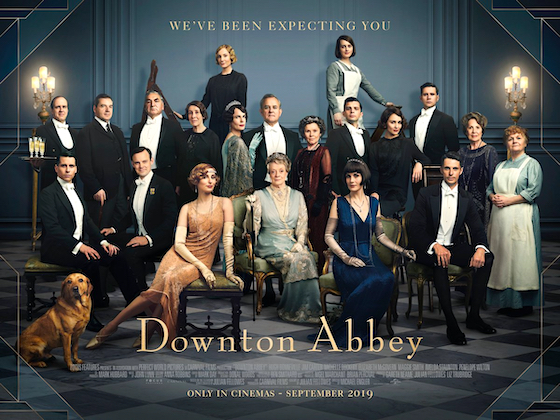
Downton Abbey

As the 2020s loom, with the world in a scary old place for a whole host of reasons, why not retreat to the safety of the 1920s, when posh toffs ran the country because their birthright had put them there rather than because the hoi polloi had actually chosen to vote for them in some act of retrograde nationalism. Downton Abbey does actually feature a subplot where a group of working-class servants secretly plot to overthrow the system… but the system in question is the one about who gets to serve the King and Queen their dinner. The working classes fighting amongst themselves about something fundamentally unimportant while the upper classes carry on serenely above them? It’s almost allegorical, although I suspect not on purpose.

No, like the TV show it’s a sequel to, Downton Abbey is much too busy being a comforting blanket of “it was better in the old days” jollity to bother with social commentary. Creator/screenwriter Julian Fellowes throws in the odd nod to more progressive concerns (republicanism, LGBT rights, the fading fortunes and relevance of the aristocracy), but they’re no more than hat-tips in the general direction of modernity. It’s as if he’s trying to say, “yes, I know this is all terribly outdated,” before adding, “but why don’t we just enjoy it for a bit, eh?” Well, we do all need an escape into fantasy sometimes, and not everyone likes it in the form of a bespandexed private army battling purple aliens.

Certainly, you’ll need to be prepared to engage with the concerns of this rarefied world if you want to find any drama here, where major points of jeopardy include whether there’s enough time to polish all the silver and if they can manage to put some chairs out while it’s raining. Sure, there are subplots including things like an assassination attempt and a police raid on a gay bar, but they’re not treated as being nearly so significant as who cooks dinner.

Polishing the silver. Not a euphemism.

So, yes, it’s mostly puff about pomp and pageantry — if you were after a film to perfectly encapsulate “heritage cinema”, you could hardly do better. But who would’ve expected anything else? Surely we’re all familiar with the TV series, even if you’ve never seen it, and naturally this big-screen version continues in a similar vein. At its core the series was really just a posh soap, and that style of melodrama is recreated here also: the engaged kitchen maid’s eye is caught by a hunky plumber; what’s behind the uncommonly close relationship between the Queen’s lady-in-waiting and her maid; will someone’s new royal appointment force them to miss the birth of their child; and so on.

If it’s beginning to sound like there are a lot of different storylines, well, there are. That’s another legacy of it originally being an ensemble TV show, of course: there’s a big, broad cast and every character must be given their due. Consequently, some reviews have accused the film of having no story, which I think is unfair. The primary plot is simple — literally just “the King and Queen visit Downton Abbey” — but it’s there. And the way the film chooses to depict this story — as a collage of subplots that, as a collective, show how the visit is prepared for and executed from the perspectives of a variety of roles at every level — is hardly an unheard of cinematic format for providing an overview of an event or situation. The reasons for Downton taking this approach are rooted in its televisual origins, but if you wanted to consider it divorced from that context then you’d merely see a structural similarity to something like Nashville, for example.

Of course, the fact that Downton is a sequel to a six-season TV series is something most of us won’t ignore, whether because you’re a dedicated viewer coming to this as the 53rd episode, or you’re a neophyte with a background awareness that anything you don’t understand may be because it was explained in the TV show. I find myself in the slightly unusual position of someone who straddles both these stools: I stopped watching somewhere in the third series, so I know who most of the characters are and where their stories began, but I’m unaware of what went on for them in later years and who some of the later additions are. Fortunately, the highly structured class divide of the setting makes it easy to get a grasp on most things. Characters’ backgrounds are not as clearly explained as you’d expect to find in a truly standalone movie, but I think the fundamentals can be ascertained well enough. That said, I say that as someone who had a leg up from watching some of the series, so a total newcomer may find it more bewildering.

What's the deference?

One thing that’s interesting, returning to this world as someone who skipped a few years of it, is how much the emphasis has changed in places. By which I mean, some characters who once had a major role are now given short shrift. For example, Hugh Bonneville has always been the de facto lead face of the programme, which makes sense as he’s Lord Grantham, head of the Downton household; and he’s still top billed in the opening credits, although I think that may be more a happy accident (I believe it listed the entire returning series cast in alphabetical order) than an indication of status. Either way, he has very little to do here, with other cast members taking centre stage. The real headliner in the series was always Maggie Smith’s acerbic Dowager Countess, and that continues to be the case here, as she snags both the lion’s share of the funny lines and the film’s most genuinely emotional scene. It feels like something of an ode to the venerable actress herself as much as it is a bit of in-universe business, and who could really begrudge such merited reverence? As to the rest of the cast, there are plenty of reviews out there that approach the film in more detail from either a fan or newbie perspective, so if you’re interested in specifics it may be worth seeking those out.

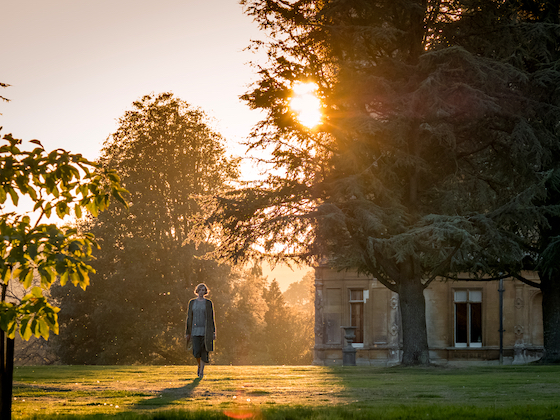
Some might argue this movie could’ve just as well turned up as a TV special, and, story-wise, it’s hard to disagree. Nonetheless, director Michael Engler and DP Ben Smithard have given proceedings a bit of big-screen pizzazz, using a 2.39:1 frame to accentuate grander shot choices and occasional cinematic flourishes, and much of the photography exhibits a warm-sunlight glow that makes you wonder if they somehow shot the whole thing during golden hour. And while too many big-screen re-dos ignore the emotive power of familiar music (see the Spooks movie for one where I specifically complained about it, for instance), here composer David Lunn’s familiar Downton theme is used to striking effect. I must admit that, even as someone who didn’t stick with the series and hasn’t watched it for years, the opening minutes gave me goosebumps.

Is the sun setting on this empire?

Truth be told, that’s not a terrible analogy for my reaction to the movie as a whole. Its near-fetishisation of regressive social modes should be distasteful, and some of its soapy scenes are accompanied by clunky dialogue and stiff acting that make it feel like you’re watching a period-dress episode of Coronation Street; but it can also unleash a sharp wit or well-constructed bit of farce (I laughed often), and there’s a certain majesty to the scenic, pretty-postcard photography that sweeps you up into its less complicated world. If you take it for what it is — a portrait of a time gone by — then it’s a likeable little jaunt.

4 out of 5

Downton Abbey is in cinemas now.

Battle at Big Rock (2019)

2019 #127a
Colin Trevorrow | 9 mins | streaming (HD) | 2.00:1 | USA / English

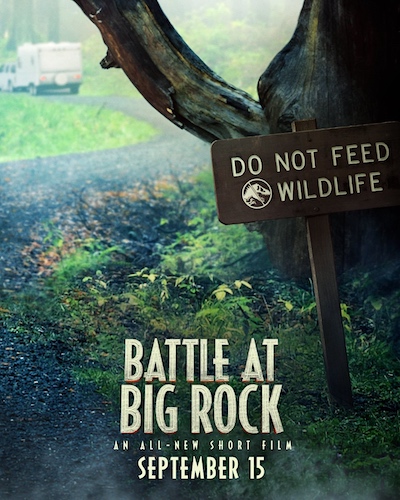
Battle at Big Rock

Surprised-announced by co-writer/director Colin Trevorrow on Twitter just a week ago (although, reading about it after the fact, it seems dedicated fans were already aware something was coming thanks to that regular modern blockbuster spoiler source: action figures), Battle at Big Rock is a short film entry in the Jurassic Park/World franchise, which premiered on the US FX channel on Sunday night (early Monday morning for us Brits) and is now on YouTube.

Set one year on from the cliffhanger-ish ending to the last film, Fallen Kingdom, this short presents a vignette in the Jurassic world that will help bridge the gap between the previous feature and 2021’s third/sixth instalment. But aside from that large franchise-minded goal, it’s also a chance to see some different characters have a different kind of encounter within the films’ universe.

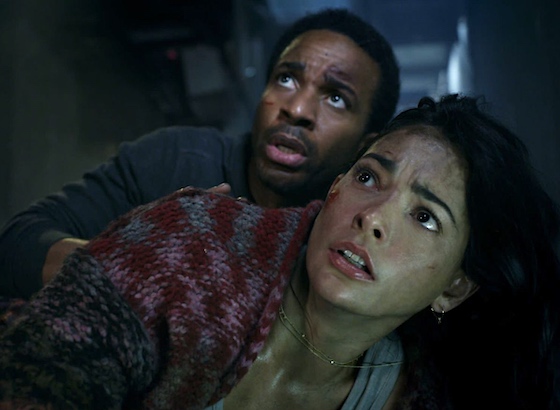
Well, I say “different” — dinosaurs fight dinosaurs until humans are caught in the crosshairs, then a big toothy dinosaur goes after said humans. The real difference is that this happens to just an ordinary family out on an ordinary camping trip in California, not people who’ve chosen to go to a remote island filled with giant prehistoric lizards. Of course, they’ve decided to go camping in a region where it’s known a bunch of the aforementioned giant prehistoric lizards escaped a year ago and might be roaming about, but whatcha gonna do? When you gotta go camping you gotta go camping, I guess. Also, they’re not white, which is a notable characteristic in this franchise, unfortunately. (That lack of representation across five feature-length movies is hardly rectified by one short, but I’m certain it was part of the intention.)

A family-sized snack

What Battle at Big Rock lacks in originality it makes up for with brevity. This is a concise hit of dino action, cramming many of the franchise’s familiar thrills into a sub-nine-minute package. It also looks great for a short film. Yeah, sure, it still has the backing of Universal Studios — this isn’t exactly an indie production — but it’s not got the full weight of a theatrically-released blockbuster behind it, either. Nonetheless, it manages to include two species of dinosaur, one achieved via a mixture of CGI and a genuine animatronic, and adventure-movie set-piece-level action. It all looks mighty pretty too, although the nighttime fire-lit photography is no doubt partially about hiding the budgetary limitations.

Indeed, the film’s production is possibly its most impressive aspect. It was actually shot back in 2018, so they’ve kept it hush-hush for the best part of a year. And it can’t be easy to keep quiet a film shot on location, and outside of moviemaking’s usual stomping grounds, in Ireland, where apparently there’s a grove of trees that look exactly like a North Californian national park. Presumably the real deal was a no-go because they’d’ve been spotted even more easily there; but, equally, you’d think a big American production team rocking up in Ireland would attract attention — especially when they had a giant animatronic dinosaur in tow. Maybe the locals just presumed it was Game of Thrones

Anyway, the end result is a success, both as a little burst of dinosaur action for those of us who enjoy such hijinks, and as a tease for events we’ll see in the franchise’s next major instalment. Rumour has it the short’s budget spiralled beyond the limits Universal originally set, but, considering the ill-will generated by the underwhelming Fallen Kingdom, I’m sure they’ll consider the audience’s re-stoked interest (a sentiment I’ve seen expressed repeatedly across social media today) to have been a worthwhile investment.

4 out of 5

Battle at Big Rock is available on YouTube.

John Wick: Chapter 3 – Parabellum (2019)

2019 #127
Chad Stahelski | 131 mins | Blu-ray (UHD) | 2.39:1 | USA / English* | 15 / R

John Wick: Chapter 3 - Parabellum

The action-man with the second most quotable line about being back is, er, back — again — for the third chapter in the ongoing saga of what happens if you kill a man’s dog. Basically, lots of people die. Quite right too.

Chapter 3 begins exactly where Chapter 2 left off: John Wick (Keanu Reeves) has been made “excommunicado” from the organisation that controls the criminal underworld, the High Table, and he has just an hour’s grace before every assassin in the world will be out to claim his life. He’s just one man, with a $14 million bounty on his head, in a New York City where about 50% of the population seem to be highly trained killers — as Winston (Ian McShane) says, his odds are “about even”.

And so the first half-hour is basically nonstop action, first as Wick desperately tries to prepare for the all-out assault coming his way, and then as he faces it. The series’ reputation is built on its lengthy, stylish, inventive action sequences, and Chapter 3 does not disappoint, with some of its best material coming right out the gate. I feel like they could’ve expanded this first half-hour into an entire movie (i.e. John on the run, fighting endless assassins, until he finds some way out of his bind) and I’d’ve been happy with that — it would’ve mirrored the simplicity of the first one. But the previous film’s cliffhanger is not so simply resolved, because what John did to earn his excommunicado status cuts deep into the mythology of this world — oh so very deep — and the fallout of his actions, well, that’s the plot of the movie. And not just for John himself, because a High Table Adjudicator (Asia Kate Dillon) rocks up to decide the fate of any person or organisation who might’ve given John a helping hand when they really shouldn’t, including Winston, the Bowery King (Laurence Fishburne), and the Director (Anjelica Houston).

Adjudgement day

The first John Wick had a bit of fun introducing us to a rule-driven shadow-world of assassins. The first sequel put a lot of stock in extending that mythology. Now, the third chapter thrives on it. The first film’s plot was a straightforward revenge thriller with some extravagant flourishes; for the third, we’re (to borrow a phrase from Reeves’ other major action franchise) right down the rabbit hole. Just like the famed action sequences, if you’re onboard with it then there’s a ton of fun to be had; but if that kind of thing bores you, there’s little respite from it. Extravagant brutal action and gradually-unveiled ever-deepening mythology: these are John Wick’s twin raisons d’être.

Half the fun of how the films present their mythology lies in the way every character seems to be completely aware of all the rules. No one ever needs a symbolic coin or a judgement’s motivation explained to them; they inherently understand its significance or reasoning, the status and power that’s conferred. But we don’t know what any of it means, of course, because this is a fictional world that we’re being inducted into as and when parts of it become relevant to the narrative; and so we’re led along on a magical mystery tour of what these arcane rituals might mean and where they might lead us. As I said, it’s quite a particular kind of storytelling, and if it doesn’t engage you then that’s that, but if you do find it enjoyable then the John Wick films are spinning it into a fine art.

A hundred bad guys with swords? Who sent those goons to their lords? Why, John Wick!

Naturally, nowhere is the film’s sense of artistry more on display than in the fights. For all the mythology, director Chad Stahelski and the small team of screenwriters never forget what really made people love John Wick in the first place: the gonzo action. There’s a lot of competition in that arena (not just its own preceding instalments, but the past decade’s acclaimed imports like The Raid and its sequel, The Villainess, The Night Comes for Us, et al), but Chapter 3 is up to the challenge, boasting continual inventiveness among the slickly choreographed and expertly performed carnage. One innovation includes dogs getting involved in the action — appropriate for a series all about the love of pooches. The mutts in question are commanded by an old acquaintance of Wick’s, played by Halle Berry, who trained with the dogs so she could actually control them during takes. It’s that level of dedication that marks out the action here.

It all looks great as well, with the camerawork boasting precise movement and impressively long takes to celebrate the action and how well it’s been achieved. The actual phototography is fantastic too, the light looking gorgeous whether in the neon glow of New York or the sand-orange Moroccan desert (I watched it in UHD, where it’s a real showcase for why HDR is a bigger benefit than pure resolution; though that’s not to discredit the film’s crispness). It’s complemented further by the design work, in particular a glass-house set where several key scenes take place, which reportedly cost $4 million. On any technical merit you care to name, Chapter 3 is exceptional.

Unleash the dogs of bellum

That said, while there’s fun to be had throughout, by the end I felt like the story was the film’s real problem. Not the tone and style that I praised earlier (though it’s easily the most fantastical of the series so far, which might turn some off), but its significance: it ultimately feels like merely a dot-join between Chapter 2 and the already-announced Chapter 4. The film’s Latin subtitle, Parabellum, translates as “prepare for war”, and that’s apt: this film is a preparation for the next. But maybe I’m being unfair. Maybe, when this series is all said and done, we’ll see that Chapter 3’s contribution to the overarching narrative is equivalent to the other films. However, at first blush, it feels to me like this is either a kind of linking passage, or maybe Chapter 3 Part 1. I guess only time — specifically, the time until after we’ve seen the fourth chapter (currently slated for May 2021) — will tell.

In the meantime, let’s not get too distracted from storyline niggles in a film that’s really about style over substance, in a good way. Chapter 3 certainly knows what boxes it should tick, and it ticks every last one of them with considerable flair. (Can you tick a box with flair? I bet John Wick could. After all, we know how skilled he is with a pencil…)

4 out of 5

John Wick: Chapter 3 – Parabellum is released on DVD and Blu-ray in the UK today.

* The film’s primary language is undoubtedly English, but IMDb also lists seven more. Each only pops up briefly, in short lines or exchanges here and there, which is why I haven’t cluttered the top of this post by listing them. But for the record, they are: Mandarin, Latin, Russian, Japanese, Italian, Arabic, and Indonesian. ^

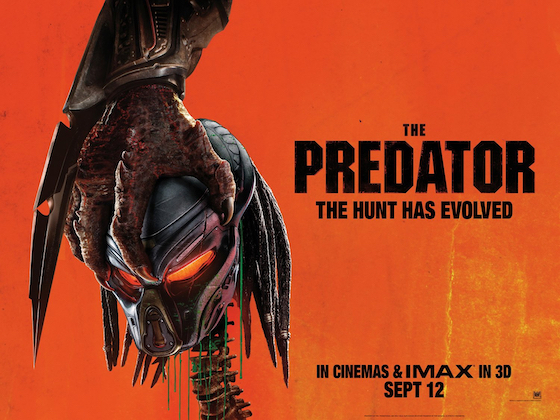
The Predator (2018)

2019 #28
Shane Black | 107 mins | download (UHD) | 2.39:1 | USA & Canada / English & Spanish | 15 / R

The Predator

Some films take me a while to review because I just don’t get round to them. Some take time because I need to coalesce my thoughts. Others, I barely have any thoughts in the first place. The trickiest are the ones where I feel like there are many thoughts, but I have little idea how to express them. The Predator is definitely in that final camp. Why? Well, I thought it was quite a poor film… but I also sort of enjoyed it. Not in a Gods of Egypt way (that was kinda “so bad it’s good”; or maybe “so strange it’s good”), nor in a “I can see what they were going for, they just couldn’t quite get there” way, but in a… well, there’s the rub. The film undoubtedly has its problems, but it also has bits I was okay with; liked, even. What it feels like is a decent, middle-of-the-road-ish sci-fi actioner… that they then, for some unfathomable reason, deliberately dicked around with to make it kinda bad.

The reason I put it that way is the film’s sense of narrative, which is really messy. It feels like someone decided the movie was too long and so got the running time down by just pulling out scenes at random. There’s an extensive IMDb Trivia entry here that broadly explains what was changed in the edit and via reshoots, and that suggests it feels like a lot of stuff was chopped out because, well, it was. Other movies have survived such tinkering, but here it feels cack-handed. The end result doesn’t flow. You can follow it, but it’s oddly disjointed.

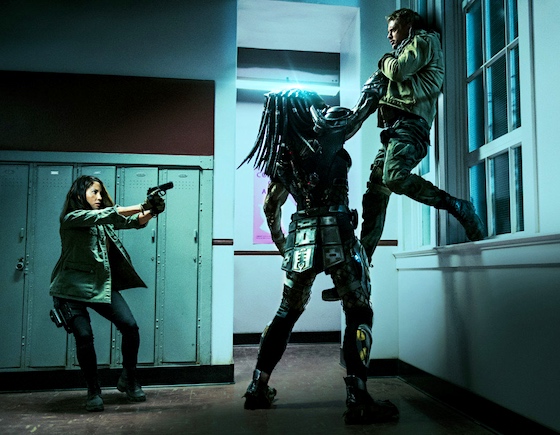
Other aspects suggest perhaps there were compromises on things like the age certificate. For example, at one point a female character is spared by the Predator because she’s naked. A vital piece of information for later? Um, no, it doesn’t come up again. So it’s gratuitous nudity? Well, not really, because it’s carefully shot so we don’t see anything. The film ended up going for an R, but perhaps they thought they’d have to make it PG-13? Either way, why is that ultimately pointless scene still in the movie?

“I don't care if you point a gun at me, so long as you don't get your tits out again!”

It’s not just the story and logic that’s mangled, there’s a real mishmash of tones as well. Writer-director Shane Black did such excellent work shepherding mixed moods in the superb Kiss Kiss Bang Bang, the perfect Nice Guys, and the best Iron Man film, but here he seems to have lost his handle on how to deliver the required blend of action, horror, and humour. Personally, I quite liked the humour, but sometimes it does just barge in out of nowhere. People who like their alien hunter action movies to be po-faced will not be impressed.

So, it’s an odd case all round. It’s an impossible movie to recommend because it’s certainly not good, but I also didn’t hate it as much as I feel I should’ve. It’s kind of a disaster, but it’s also… fine. Put it this way: one day I expect I’ll rewatch the Predator movies, and while I’ll probably skip AvP Requiem, I’ll include this one. Faint praise, I know.

Nonetheless, I really hope they make another Predator movie… mainly so I can see what they come up with for a title. Okay, sure, it’ll probably just be Predator: Meaningless Subtitle, but I live in hope they’ll continue this trend of adding a little something (pluralisation; the definitive article) and it’ll be called, like, Predatoring or something. (Hire me, Hollywood!)

3 out of 5

The Predator is available on Sky Cinema from today.

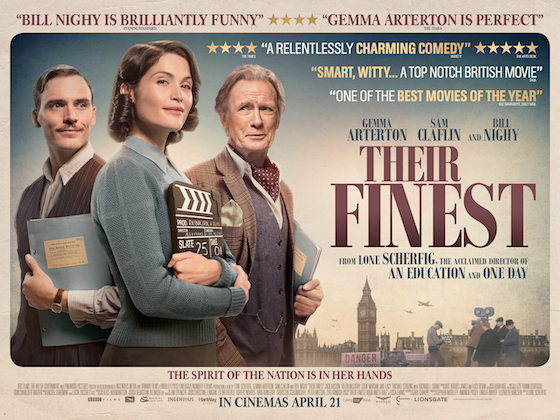
Their Finest (2016)

2018 #223
Lone Scherfig | 117 mins | streaming (HD) | 2.35:1 | UK & Sweden / English | 12 / R*

Their Finest

One of three Dunkirk-related movies released in 2017 (which is a bit random — it wasn’t a particular anniversary or anything), Their Finest is adapted from a novel by Lissa Evans called Their Finest Hour and a Half, which is a much better title. “Their Finest” is kinda bland and meaningless — slap it on any wartime film and it’d work just as well. The original title is a neat pun, though, mixing the famous saying (which comes from a 1940 Churchill speech, if you didn’t know) with the common running time of a movie, thereby indicating when the story is set (World War 2), what it’s about (the making of movies), and indicating a tone (it’s a pun, but not an outrageous one, suggesting lightness without going full-blown comedy). Maybe someone noticed this runs nearer two hours and didn’t want to give audiences the wrong idea…

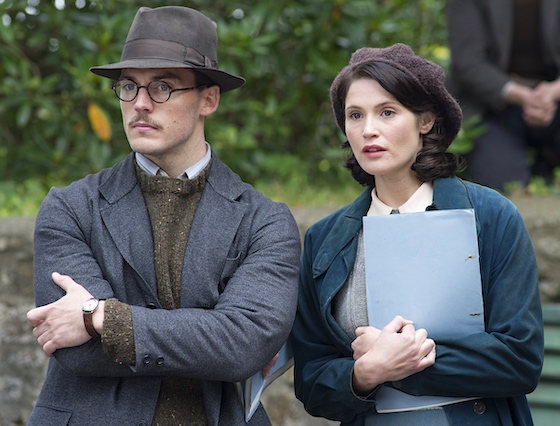
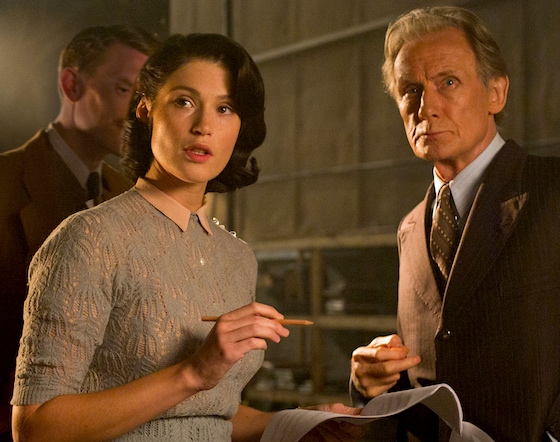
Their Finest Hour and a Half stars Gemma Arterton as Catrin Cole, a young woman in wartime London who finds work writing female characters’ dialogue in movies — “the slop”, as it’s derisively called by her combative superior, Tom Buckley (Sam Claflin). When a news story about twin sisters who took part in the evacuation of Dunkirk is fast-tracked into production, with a cast that includes fading leading man Ambrose Hilliard (Bill Nighy), Catrin and Tom wind up on location with the film, hastily rewriting to include changes mandated by the War Office. Despite Tom’s standoffish attitude and Catrin’s marriage to a good-for-nothing war artist (Jack Huston), who’s jealous of her newfound status as the breadwinner, affection begins to blossom between the two writers…

Hooray for the writers!

Yeah, much of Their Finest follows the expected shape of a story like this (the love triangle; the woman coming to be respected by her initially dubious colleagues; etc). Two things work to stop it feeling too staid: an engaging lead cast, and some weightier developments and subplots. The latter includes at least one wholly unexpected twist, which helps make this a more powerful film than the potentially-light “people go on a jolly to make a movie during the war” premise initially seems. There’s a somewhat classical balance of comedy and tragedy there, which is reminiscent of movies from the era the film’s set. Frame it in 4:3, shoot in black & white, and give everyone RP accents, and parts of it could almost be a ’40s melodrama.

Talking of accents, why oh why did they lumber Gemma Arterton with a Welsh one? It isn’t bad, exactly, but I did find it constantly distracting. Presumably it’s because the story is loosely based on the life of Diana Morgan, a Welsh screenwriter whose wartime work for Ealing Studios mostly went uncredited (though she does have one on the famous propaganda film Went the Day Well?, amongst a handful of others), but, considering it’s not actually a biopic, surely there’s no need for the accent? Well, other than to attract funding from the Welsh Government’s Media Investment Budget, I suspect… Anyway, it’s a minor complaint (as I said, her accent isn’t bad), and even with it Arterton is typically charming, generating good chemistry with Claflin, who plays a Mr Darcy-esque role as the initially-unlikeable inevitable love interest. As usual, Nighy threatens to steal the show, hamming it up just the right amount as Ambrose. He gets a significant subplot about his hard-fought transition from leading man to character actor, which also brings in Eddie Marsan and Helen McCrory — just two more high-quality actors helping round out a strong cast, which also includes Rachael Stirling, Richard E. Grant, and Jeremy Irons, among others.

She's holding a pencil, she must be a writer

Ambrose is another man who initially misreads Catrin but eventually comes round to her. I suppose the “a woman proves her worth” element is another that’s been well-worn, but it seems fitting here, given that women in the film industry are still struggling to be treated equally. In this case, it’s using the “women suddenly in the workplace” reality of WW2 to make it both feel relevant to the present while remaining era-appropriate, unlike so many period movies that project present-day values onto eras where they don’t truly fit. It’s not as heavy-handed in its moralising as others can be, either.

Indeed, I’d say the entire film is very well pitched. It straddles the comedy-drama divide skilfully, entertaining as a jolly romance set in the world of moviemaking, but with enough grit from the reality of wartime to give it an edge. Everyone involved has, I’m sure, given it their finest hour-and-a-half(-and-a-half).

4 out of 5

The UK TV premiere of Their Finest is on BBC Two tonight at 9pm.

* It’s rated R for “some language and a scene of sexuality” — there’s a couple of “fucking”s and a brief glimpse of one practically-silhouetted breast. God, the MPAA are daft. ^

Bad Times at the El Royale (2018)

2019 #75
Drew Goddard | 142 mins | streaming (HD) | 2.39:1 | USA / English | 15 / R

Bad Times at the El Royale

If you thought Tarantino copycats died out after the mid-’90s boom in Reservoir Dogs / Pulp Fiction wannabes, well, you’re sweetly naive — those still crop up from time to time, a quarter of a century too late. But the better emulators have evolved along with their inspiration, as writer-director Drew Goddard demonstrates in Bad Times at the El Royale, a film which feels like an imitation of latter-day Tarantino flicks. At least Goddard has the good sense to dodge the carbon-copy style of those Reservoir Dogs mimics by shifting genre, taking some of what QT brought to war movies in Inglourious Basterds and Westerns in The Hateful Eight and applying it to a neo-noir mystery-thriller. He even preempts Tarantino’s own oeuvre by including a Charles Manson-esque cult leader, thereby prefiguring Manson’s role in QT’s own Once Upon a Time in Hollywood.

Also like Once Upon a Time, El Royale sets its scene in 1969; and, like The Hateful Eight, its setting is an isolated establishment. That’s the eponymous hotel, a destination straddling the California/Nevada state line, which in its heyday attracted celebrities and what we’d now call “influencers”, but has faded since it lost its gambling licence and the wealthy patrons dried up. Now, over the course of one day and night, a variety of customers arrive, strangers, each with secrets, all of which will out in the twists of fate that ensue. All of that plays out in chaptered sections, divided with title cards, that mix in flashbacks and juggle the timeline of the present section as necessary — all of which are familiar Tarantino flourishes, of course.

One thing it shouldn’t’ve copied from Tarantino is the running time: just like many of his recent works, it’s longer than it needs to be. That’s not because the material is bad per se, but because the pacing isn’t tight enough. It seemed to drag its heels for no reason (again, I felt the Tarantino comparison), whereas a tighter pace might’ve contributed some tension, which I rarely felt despite the scenario screaming out for it.

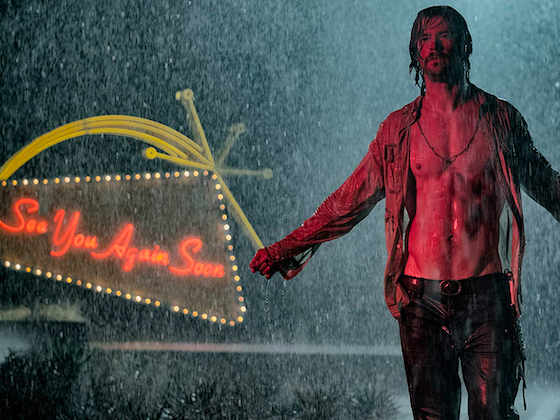
Heavy rain at the El Royale

Well, as the saying goes: if you’re going to steal, steal from the best. Heck, Tarantino has certainly borrowed plenty from his own wide-ranging influences. If you are going to imitate another filmmaker, this is the way to do it: by bringing your own characters and settings and plots and twists to the table. That might sound obvious, but so many of those wannabes are slavish in their borderline-plagiarism. Goddard doesn’t sink to that level overall, though there were some parts I felt were only a couple of steps above it. For example, the whole “the hotel is on the state line” bit seemed quirky for the sake of being quirky, imitating a bit that a filmmaker like Tarantino would use but without quite knowing how to use it (it plays a big role in the opening sequence, after which there’s one slight gag with it before it’s never mentioned again).

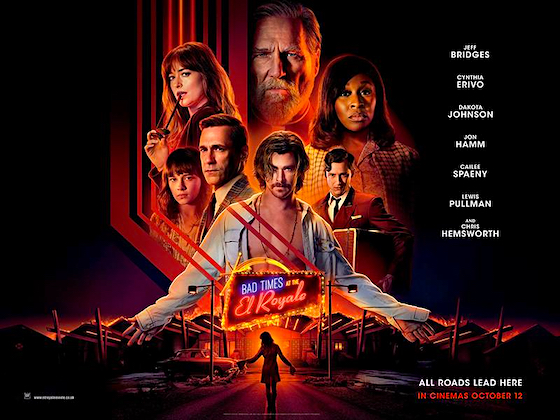
But such lapses were outweighed by the good. For one, there’s some very nice photography by Seamus McGarvey. It looks like it was shot on 35mm (I checked and it was, which proves Nolan & co are right when they say it does make a difference), which didn’t always translate too well to the 1080p stream I watched, but I suspect might look all the more stunning in 4K. Visual aside, much of what’s good stems from the characters, especially the strong performances by actors like Cynthia Erivo, Jeff Bridges, and Lewis Pullman. It was those, and in particular how each role comes together in the final act to define the whole character, that definitely elevated the quality of the film for me. And while those three are the highlights, there are also good turns from the likes of Jon Hamm, Dakota Johnson, Chris Hemsworth, and Cailee Spaeny. I’d say more, but so much of the meat of these characters comes from how they present themselves vs what the truth is revealed to be — the less you know, the more there is to uncover.

Rewatch you again soon

That said, I wonder if this is a film that will play better on a rewatch. There are several surprise plot developments I wouldn’t wish to spoil for a first-time viewer, for sure, and I do feel like that’s a worthy filmmaking tool (I don’t agree with that research that ‘proved’ audiences enjoy something more if they know the story beforehand — you don’t appreciate it more, you just appreciate different stuff, same as with a rewatch). But I feel like some of that plotting did distract focus from other bits of the film that were working well. Put another way, in my memory the niggles have damped down and I primarily recall the good stuff, so my enjoyment has gone up with hindsight. I’ll have to pick up the 4K disc at some point and give it another go.

For the time being, while I did like it overall, I judged it to be the kind of 4-star effort that could’ve easily become a 5-star top-ten-of-the-year film if it had just polished up everything that I felt didn’t work.

4 out of 5

Bad Times at the El Royale is available on Sky Cinema from today.