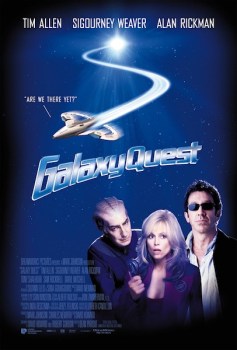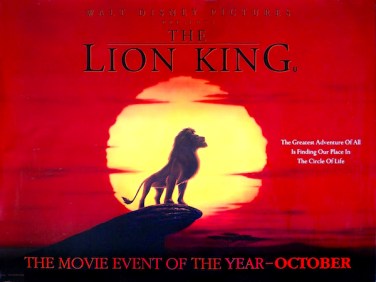
The Lion King (1994)

100 Films’ 100 Favourites #52

The greatest adventure of all is
finding our place in the circle of life.

Country: USA
Language: English
Runtime: 88 minutes
BBFC: U
MPAA: G

Original Release: 15th June 1994
UK Release: 7th October 1994
First Seen: VHS, c.1995

Stars
Matthew Broderick (Ferris Bueller’s Day Off, Election)
James Earl Jones (Star Wars, Conan the Barbarian)
Jeremy Irons (The French Lieutenant’s Woman, Die Hard with a Vengeance)
Rowan Atkinson (Bean, Johnny English)

Directors
Roger Allers (Open Season, The Prophet)
Rob Minkoff (Stuart Little, Mr. Peabody & Sherman)

Screenwriters
Irene Mecchi (Brave, Strange Magic)
Jonathan Roberts (James and the Giant Peach, Jack Frost)
Linda Woolverton (Beauty and the Beast, Alice Through the Looking Glass)

Story by
Deep breath… Burny Mattinson, Barry Johnson, Lorna Cook, Thom Enriquez, Andy Gaskill, Gary Trousdale, Jim Capobianco, Kevin Harkey, Jorgen Klubien, Chris Sanders, Tom Sito, Larry Leker, Joe Ranft, Rick Maki, Ed Gombert, Francis Glebas & Mark Kausler; with additional story by J.T. Allen, George Scribner, Miguel Tejada-Flores, Jenny Tripp, Bob Tzudiker, Chris Vogler, Kirk Wise & Noni White; and the story supervisor was Brenda Chapman.

Sort of based on
Hamlet, a play by William Shakespeare.

Songs by
Elton John (The Muse, Gnomeo & Juliet)
Tim Rice (Jesus Christ Superstar, Aladdin)

The Story
The savannahs of Africa are ruled by the lion Mufasa, a kindly king who is struggling to instil some sense of life’s importance in his reckless young son and heir, Simba. But Mufasa’s brother, Scar, lusts for power, and manipulates Mufasa and Simba to gain it…

Our Hero
Lion cub Simba is heir to his father’s throne as ruler of the Pride Lands, and a naughty, unruly prince who just can’t wait to be king. All that changes when he winds up outcast, and has to learn to grow up before returning to save his kingdom.

Our Villain
King Mufasa’s jealous brother, Scar, who also just can’t wait to be king. Obviously that’s not going to happen under the regular rules of succession, but Scar is a cunning and conniving sort. Well, he is the villain.

Best Supporting Characters
After running away, Simba falls in with meerkat Timon (voiced by Nathan Lane) and warthog Pumbaa (voiced by Ernie Sabella), who have a laid-back attitude to life, and raise the lion cub to have the same. So successful they had their own spin-off series and were the stars of a sequel, too.

Memorable Quote
Mufasa: “Everything you see exists together in a delicate balance. As king, you need to understand that balance and respect all the creatures, from the crawling ant to the leaping antelope.”
Simba: “But, Dad, don’t we eat the antelope?”
Mufasa: “Yes, Simba, but let me explain. When we die, our bodies become the grass, and the antelope eat the grass, and so we are all connected in the great circle of life.”

Quote Most Likely To Be Used in Everyday Conversation
“Hakuna matata” — a wonderful phrase, it means no worries for the rest of your days.

Memorable Scene
The opening sequence, in which all the animals gather to celebrate the birth of Simba, scored to Circle of Life, is a majestic sequence — so impressive, in fact, that Disney used it, uncut and unadorned, as the film’s trailer.

Best Song
Big romantic number Can You Feel the Love Tonight won the Oscar, and there were nominations for epic opener Circle of Life and quotable comedy hit Hakuna Matata, and you shouldn’t overlook the fun and impressive choreography of I Just Can’t Wait to Be King, but for me the best number is Scar’s Be Prepared. I do love a good villain’s song.

Technical Wizardry
The Lion King continues Disney’s integration of CGI into their animated features, this time using it to create the pivotal wildebeest stampede. A new program had to be written for the sequence, which allowed hundreds of computer generated animals to run without colliding into each other. It took the CG department three years to animate the scene.

Making of
Voice actor Frank Welker (who has over 760 credits to his name on IMDb, including originating Fred in Scooby-Doo and voicing Megatron in the Transformers animated series) provided all of the film’s lion roars. No recordings of actual lions were used.

Next time…
As one of the biggest successes of the Disney Renaissance, The Lion King has naturally had more than its share of follow-ups. The headline has to be the stage musical adaptation of the film, which opened in 1997. It’s the third longest-running show in Broadway history, and is “the highest-earning entertainment property in history in any medium”. In 1998, direct-to-video sequel The Lion King II: Simba’s Pride was released. Apparently its plot is influenced by Romeo and Juliet. A second direct-to-DVD sequel, The Lion King 1½ (known as The Lion King 3 in some countries, including the UK), was released in 2004. It’s based on Rosencrantz and Guildenstern are Dead, re-telling the first movie from Timon and Pumbaa’s perspective. I watched it years ago and really enjoyed it, an opinion supported by its strong 76% on Rotten Tomatoes. On television, spin-off series The Lion King’s Timon & Pumbaa ran for three seasons from 1995, and just last year TV ‘movie’ (it’s only 45 minutes) The Lion Guard: Return of the Roar heralded the start of a new series, The Lion Guard. It’s been renewed for a second season.

Awards
2 Oscars (Song (Can You Feel the Love Tonight), Score)
2 Oscar nominations (Song (both Circle of Life and Hakuna Matata))
2 BAFTA nominations (Music, Sound)
3 Annie Awards (Film, Voice Acting (Jeremy Irons), Individual Achievement for Story Contribution)
3 Annie nominations (Individual Achievement for Artistic Excellence (x3))
2 Saturn nominations (Fantasy Film, Performance by a Younger Actor (Jonathan Taylor Thomas))

What the Critics Said
“Even the inescapable hype cannot diminish the fact that this is one great film. Consider that this movie delivers strong characters, a sophisticated story, good music, captivating visuals and loads of emotion — all within the confines of a G-rated cartoon. […] The most exhilarating part of The Lion King is that it’s not just great animation, but superior filmmaking. Outstanding character animation is a given at Disney, which handles the nuances of movement better than anyone. But the last few animated features show an increasing mastery of cinematography techniques. In The Lion King, the eye of the camera ranges from point of view to overhead to moving with the scene. The opening sequence where the plains animals trek to see the newborn cub and the wildebeest stampede scene are breathtaking.” — Bill Wedo, Philadelphia Daily News

Score: 92%

What the Public Say
“Timone and Pumba [sic] are two of the more interesting comic relief characters in Disney films. I’d argue that they’re one of the most wonderful depictions of a same-sex parenting couple that I have ever seen. I don’t want to get drawn into a debate over their sexuality, but the pair are partners in the truest sense of the word, sharing a life. They sleep together, for crying out loud. I don’t care about their sexuality or anything like that, because we’ll never get an answer on that and it’s immaterial. All that matters is that they complete one another, and it’s sweet. […] Even when Simba arrives, it’s very clear that the dynamic is different – Simba isn’t an equal partner in the relationship like Timone and Pumba. They’re a family, but Timone and Pumba are more of a couple.” — Darren Mooney, the m0vie blog

Verdict

My third Disney pick is consecutive to my previous two (Aladdin and Beauty and the Beast) in Disney’s history of animated classics, which goes to show how successful their ’90s Renaissance was. (Also, when my childhood was.) The Lion King succeeds by combining a selection of memorable, hummable songs with an epic tale of royal politicking — but, y’know, in a Disney way. Unafraid to include plot twists that place it alongside Bambi in the company’s canon, but with some well-performed comedy characters to lighten the mood, it manages to be one of Disney’s most entertaining but also most philosophical (in its way) films.

#53 has… my sword, and my bow, and my axe.
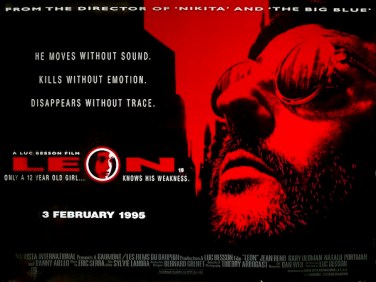

Léon (1994)

100 Films’ 100 Favourites #51

He moves without sound.
Kills without emotion.
Disappears without trace.

Also Known As: The Professional (USA) *shudder*

Country: France
Language: English
Runtime: 110 minutes | 132 minutes (version intégrale)
BBFC: 18 | 15 (version intégrale)
MPAA: R

Original Release: 14th September 1994 (France)
US Release: 18th November 1994
UK Release: 3rd February 1995
First Seen: VHS, c.1999

Stars
Jean Reno (Les visiteurs, Ronin)
Natalie Portman (Star Wars – Episode I: The Phantom Menace, Black Swan)
Gary Oldman (Bram Stoker’s Dracula, Tinker Tailor Soldier Spy)

Director
Luc Besson (Nikita, The Fifth Element)

Screenwriter
Luc Besson (The Transporter, Taken)

The Story
When her family are murdered by a corrupt police officer, 12-year-old Mathilda runs to hide with her quiet, reclusive neighbour, Léon. Turns out he’s a hitman, and she begins to train with him so she can exact her revenge…

Our Heroes
As the title character, Jean Reno’s child-like hired killer is likeable, sympathetic, and quite sweet — traits one wouldn’t typically associate with his profession. As his young ward, Mathilda, Natalie Portman is compelling, playing a hardened, emotionally bruised kid in desperate need of support and guidance, more so than she needs vengeance.

Our Villain
Gary Oldman brings pure entertainment value to the film in one of his most iconic performances: Stansfield, the crazy copper with a penchant for both drugs and quotable dialogue.

Best Supporting Character
There’s not much room for anyone else to stand out around the three lead performances, but Danny Aiello comes closest as Léon’s kindly mafioso handler, Tony.

Memorable Quote
Stansfield: “Bring me everyone.”
Benny: “What do you mean ‘everyone’?”
Stansfield: “EV-RY-ONE.

Memorable Scene
As Mathilda returns home from buying groceries, she sees the door to her family’s apartment open and a man standing suspiciously outside. As she nears, she catches a glimpse inside — her father sprawled on the floor in a pool of blood. She keeps walking, pretending not to have seen, and approaches Léon’s door — where he’s been watching through his peephole. Trying to hold back tears, she rings his bell. Behind the door, Léon fidgets, not answering — he doesn’t want to get involved. She pleads under her breath. She rings again. The man at her door watches, suspicious. She rings again, desperate. Léon is torn… OK, you know all along what he’s going to do, but Besson’s direction and the performances from Portman and Reno ring every second of tension out of the sequence.

Letting the Side Down
Some people find the relationship between Léon and Mathilda problematic, and that gets in the way of their enjoyment of the movie. I’ve never seen it that way. Mathilda tries to inappropriately push herself on Léon, but he never takes her up on it. He’s a child himself in many ways and that side of life doesn’t seem to engage him at all, never mind in an unacceptable fashion.

Making of
The film’s second shot (still in the credits) is a tracking shot that travels along a New York road without stopping. It was only possible after studying the pattern of the traffic lights along the route to make sure the camera truck didn’t encounter any red lights.

Previously on…
The film was inspired by Jean Reno’s role in Besson’s previous film, Nikita (aka La Femme Nikita), in which he turns up in the third act as “Victor the Cleaner”, dressed in an outfit similar to Léon’s, to deal with Nikita’s botched mission.

Next time…
Besson wrote a script for a sequel focusing on a grown-up Mathilda. While they waited for Portman to age into the role, Besson left Gaumont to start his own studio, EuropaCorp. Unhappy at his departure, Gaumont have apparently refused to let him have the necessary rights. According to Olivier Megaton (the director of Besson projects like Transporter 3 and both Taken sequels) it will now likely never happen. Reportedly the script was recycled into Colombiana, which I am now 100% more interested in seeing.

Awards
7 César nominations (Film, Actor (Jean Reno), Director, Music, Cinematography, Editing, Sound)

What the Critics Said
“For Luc Besson, [Léon] is a poetic brute, a man without humanity who has lived so close to darkness for so long that he has lost all connection to the light. The universe around him, too, is a symbolic construction, an interweaving of opera, film noir and existentialism, where the larger-than-life forces of innocence and corruption explode in blood and violence. […] Reno plays it minimally; Oldman splatters his performance all over the screen. Oldman is the least inhibited actor of his generation, and as this deranged detective, he keeps absolutely nothing in reserve. When the camera gets close to him, you feel as if you want to back away. […] Stansfield’s signature is his passion for music. He thinks of everything, even his blood orgies, in terms of rhythm and color. You want Beethoven? he asks, picking up a shotgun. I’ll play you some Beethoven. Fortunately, Besson structures his film in much the same way. Not only does music play an important role in giving texture to his material, his scenes — especially the violent ones — are presented as arias, chamber pieces, symphonies.” — Hal Hinson, The Washington Post

Worst Spurious Connection in a Supposedly Professional Review
“A favorite of IMDb fanboys (who have absurdly — but predictably — ranked it the 27th best movie of all time!) and reportedly of pedophiles as well” — Matt Brunson, Creative Loafing (You’re right about one thing, though, Matt: 27th is ridiculous — Léon is top ten material.)

Counterpoint to Mr Brunson
“[It] would go on to become one of his most highly-regarded films among audiences. Sadly it was not thought of nearly as well by critics, merely receiving somewhat average reviews, giving us another sad oversight [and] proving that there are those times where the general audience can have more perception into a film than those that analyze them for a living.” — Jeff Beck, examiner.com

Score: 71%

What the Public Say
“In spite of ranking on the top ten lists of many, many movie fans since its release, my love for [Léon] was not immediate. As a matter of fact I pretty much disliked it on the first and second outings because I couldn’t quite grasp what Luc Besson was going for with this film. It’s not an action movie, it’s more of a love story set to the tone of bloodshed and corruption, a subtle poetic masterpiece that relies on characterization and artistic strokes of pure raw emotion than some shoot em up gangster flick. […] I’ve come to truly appreciate what a pure piece of brilliant filmmaking this is and the loose allusions this has toward another Besson masterpiece La Femme Nikita. Everything about this film from the performances right down to the set pieces are like pieces of moving art, and Besson is the artist with the brush. […] Besson’s incomparable film is almost impossible to beat and there’s yet to be a director who could match his magnum opus. Even after almost twenty years, [Léon] stands as the superlative masterpiece of action filmmaking and has yet to be matched or toppled by any director in the business.” — Felix Vasquez, Cinema Crazed

Elsewhere on 100 Films
I reviewed the extended “version intégrale” cut of the film in 2008, asserting that “I prefer this version. Not because there’s anything wrong with the original — far from it — but because this one has more. […] I love the film and the characters, I could happily take more of them, and I very much enjoyed all of the added material. […] Léon (in either cut) is unquestionably essential.”

Verdict

Léon delivers the kind of tense sequences of action you’d imagine of a dramatic action-thriller (i.e. not highly-choreographed punch-ups every five minutes, but the action scenes that do appear are suspenseful), but the film’s real joy lies in its characters, who are expertly performed and wonderful to spend time with (in a movie context — in real life, I wouldn’t be so sure…) As a whole, Besson brews the grittily realistic with something far more fantastical to create a film that is, perhaps, a little too unique for some to get a handle on (I’m thinking of the handful of low-rated critics reviews on Rotten Tomatoes, which fly in the face of the consensus opinion). For the majority, however, Léon is a gripping, characterful, rewatchable masterpiece.

#52 just can’t wait… to be king.

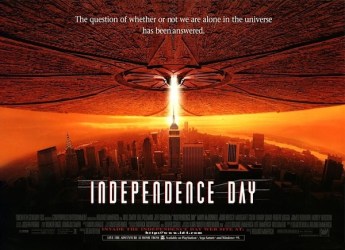
Independence Day: Special Edition (1996/1998)

2016 #102a
Roland Emmerich | 154 mins | Blu-ray | 2.39:1 | USA / English | 12 / PG-13

I’m not sure when I last watched ID4 (as it was so often branded and marketed, for only semi-clear reasons — sure, US Independence Day is July 4th, but other than that the “4” has nothing to do with anything), but it’s been a damn long time — my DVD copy, which I know I never watched (I have the shiny new remastered Blu-ray now), has a postcard inside advertising the forthcoming Planet of the Apes remake, in cinemas Summer 2001. The time I best remember seeing it was in cinemas on its initial release. Independence Day was a phenomenally huge deal back in 1996: it felt like that shot of the White House being destroyed was on TV on loop; there were making-of TV specials (I remember the behind-the-scenes footage of how they did those incredible, much-discussed effects as clearly as I remember anything from the film itself); I listened to the Radio 1 Independence Day UK audio drama on tape (it was… so-so), read the tie-in comic book adaptation, and also the tie-in novelisation — which was the first book I ever gave up on without finishing because I thought it was so badly written. Ten-year-old badblokebob, literary critic. The film itself was also the first 12-rated movie I went to see in the cinema, so it was even more of a big deal for me.
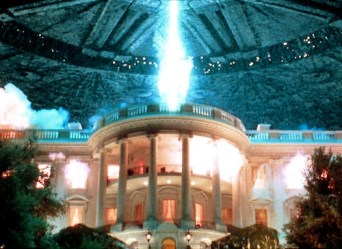
Revisiting it 20 years later, with a sequel imminent, ID4 obviously no longer has that attendant hype, but it does hold up pretty well in its own right as a blockbuster disaster epic. At least, it did for me — I read a review on Letterboxd from someone who watched it for the first time this January, saying that, in the age of the modern spectacle-based blockbuster, Independence Day doesn’t compete. Which feels weird, because it was all about the spectacle when it came out; but of course, things date, and what counted as sheer cinematic spectacle in 1996 is (it would seem) underwhelmingly run-of-the-mill in 2016. It’s fair to say that not all of the model effects still hold up, but there’s a physicality to them that really works. The best ones are still among the best movie effects ever.
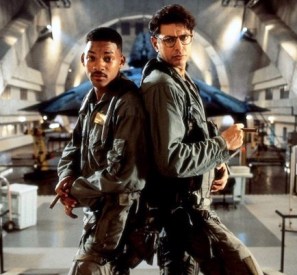
The film’s first half is superior to its second. Co-writer/director Roland Emmerich and co-writer/producer Dean Devlin conceived the film off the idea of 14-mile-wide spaceships just appearing one morning, and the realisation of that concept (and the ensuing destruction) is where the film really shines. That’s not to say there’s not good stuff after the aliens unleash their devastating destructive power — the famous presidential speech comes just before the climax, for one — but it’s from the midpoint on that some things begin to get a tad muddled, some subplots are rushed along, and other events get needlessly elongated. That said, it’s all relative: the 2016 version of this story with this many characters would surely run for five hours as it endeavoured to give them all a starring-role-level storyline and turn every effects-fuelled alien encounter into a 20-minute action sequence.

One area it really succeeds is humour. It doesn’t lose the scale or seriousness of the events, but it keeps the tone entertaining. That feels like a skill a lot of blockbusters used to have that’s gone awry in recent years, though you could use the tone of Marvel Studios’ movies to counterpoint that. Those Marvel films are definitely subject to a different criticism of modern blockbusters, however, which is their mindless destruction of whole cities. It’s a just criticism, and some of the blame for it can surely be traced back to the popularity of ID4. However, here the destruction isn’t so unfeeling: the morning after the aliens’ famous landmark obliteration, President Whitmore mulls over how many people died and how many didn’t have to if he’d made different choices. Both Marvel and DC have had to make that kind of reflection a plot point in sequels to retrospectively justify it happening in the first place.
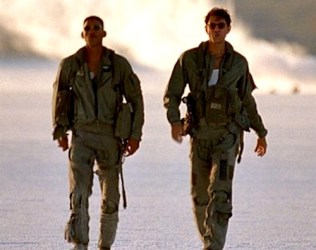
This was the first time I’d watched Independence Day’s extended Special Edition cut, and I’d advise not bothering. It adds around 8½ minutes of new material, but the scenes don’t add all that much, and some of them are so awkwardly rammed in that it’s almost irritating — for instance, several are inserted in the middle of an existing music cue by merely fading out the score immediately before the new scene, then fading it back in afterwards! They’re deleted scenes that have been shoved into the movie, with the score often fudged to make room and stuff like that, rather than it being a genuine “extended cut”. People seem to love extended cuts on disc, but sometimes a nice deleted scenes section is preferable.

With the way things are nowadays — every hit sequelised; old IPs regularly dragged up for new moneymaking opportunities — it was kind of inevitable we’d get ID4 2 eventually. I’m looking forward to it, but not insanely hyped up. It probably benefits from the 20-year wait story-wise, allowing for a drastically new status quo on Earth when the aliens return, but with blockbusters released all year round now, and CGI meaning every one is overloaded with effects shots that are far more epic than ID4 had, there’s little doubt that the sequel won’t have the same enduring impact on the blockbuster firmament. For its faults, you can’t deny ID4 that.
4 out of 5

Independence Day: Resurgence is in UK cinemas now, and is released in the US tomorrow.

Beverly Hills Cop III (1994)

2016 #105
John Landis | 100 mins | streaming (HD) | 16:9 | USA / English | 15 / R

Beverly Hills Cop III always seemed to be on TV when I was younger — on BBC1, quite late, but I guess not that late because I always seemed to stumble across it during the theme park climax. In reality it can probably have only been on a couple of times, but that’s how it seemed. And because it caught my attention, I somehow knew that one day I’d end up watching the entire movie, just to see. To see what, I’m not sure; but to see. Of course, that necessitated watching the first and second films first (because I’m me). I very much enjoyed them both. Unfortunately, the third is nothing like as good.
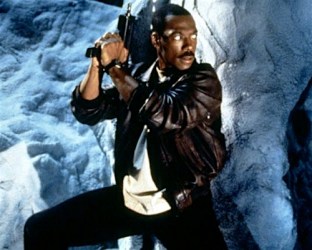
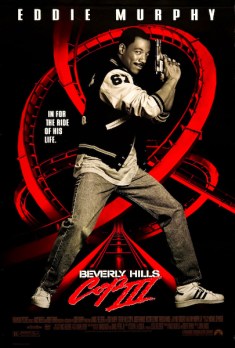
This time, Detroit cop Axel Foley (Eddie Murphy) tracks a gang of crooks to Disneyland Wonder World, an L.A. theme park. There, he ropes in his old chum in the Beverly Hills PD, Billy Rosewood (Judge Reinhold), and blatant stand-in for an actor who refused to come back his colleague Jon Flint (Héctor Elizondo), to investigate Wonder World’s head of security (Timothy Carhart), who Axel recognises as the head of the gang.

By all accounts Beverly Hills Cop III was a troubled production. Murphy was in a phase where he could be a pain to work with, and, according to director John Landis, was envious of the careers of Denzel Washington and Wesley Snipes, who were starring in straight action movies. Consequently, Murphy was keen to downplay the film’s comedy — much to its detriment, of course, as it’s Murphy’s comedy that makes this series work. Landis knew that: in the same interview, he says the screenplay for the first film was “one of the worst scripts I ever read […] It was a piece of shit, that script, but the movie’s very funny because Eddie Murphy and [the film’s director] Martin Brest made it funny.” The script for the threequel also wasn’t any good (according to some versions of events, that’s why original co-stars John Ashton and Ronny Cox didn’t return), but Landis tried to put Murphy in funny situations and see what improvisation threw up. Murphy, keen to be taken seriously, worked around that.
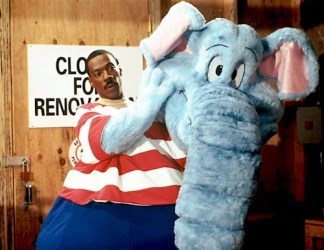
I don’t think all blame can be laid on Murphy, though. For an example, look at the sequence aboard a broken-down ride about halfway through the movie — it might just be one of the most tension-free thrill sequences ever filmed. Axel has to climb across the ride, storeys up in the air, to rescue two kids who are dangling from another compartment. It seems to take him forever to get there — far, far longer than those two young kids could plausibly hang on for — while interminable early-’90s electronic music throbs in the background. The park attendants stand around doing nothing. A whole crowd of people stare up at him with bored expressions. I’m not sure if that was deliberate, because I can’t really see what the point of a massive crowd of blank-faced onlookers serves, but I also can’t see how anyone involved in the film could’ve read their expressions as being in any way interested by or invested in the action they’re supposedly watching. Well, at least it reflects how the audience must’ve felt.

In my review of the original Beverly Hills Cop, I wrote about how I only really watched it so I could then see the sequels, because they were directed by Tony Scott and John Landis. Ironically, the first one turned out to be good entertainment, and certainly the most enjoyable of the trilogy. Scott’s sequel isn’t half bad; very much a “next best thing” situation. As for Landis’ effort… Well, Beverly Hills Cop III isn’t all bad — some fun slips through the cracks; the occasional glimmer of what made the previous movies memorable. But when taken as a whole film, it’s a crushingly mediocre experience that can’t measure up to either of its predecessors.

2 out of 5

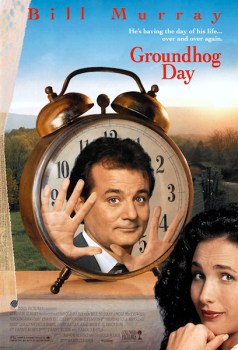
Groundhog Day (1993)

100 Films’ 100 Favourites #42

He’s having the day of his life…
over and over again.

Country: USA
Language: English
Runtime: 101 minutes
BBFC: PG
MPAA: PG

Original Release: 12 February 1993 (USA)
UK Release: 7th May 1993
First Seen: TV, c.1996

Stars
Bill Murray (Ghostbusters, The Life Aquatic with Steve Zissou)
Andie MacDowell (sex, lies, and videotape, Four Weddings and a Funeral)
Chris Elliott (Cabin Boy, There’s Something About Mary)
Stephen Tobolowsky (Thelma & Louise, Memento)

Director
Harold Ramis (Caddyshack, Analyze This)

Screenwriters
Harold Ramis (Animal House, Ghostbusters)
Danny Rubin (S.F.W.)

Story by
Danny Rubin (Hear No Evil, Stork Day)

The Story
Dispatched to cover the Groundhog Day ceremony in the small town of Punxsutawney, Pennsylvania, a TV news team get stuck overnight by a snowstorm. When weatherman Phil Connors wakes up the next morning, he finds it’s Groundhog Day again — he’s stuck in a time loop which no one else is aware of, reliving the despised day over and over again. The only advantage is he might be able to use the special knowledge he gains to woo his producer.

Our Hero
Grumpy TV weatherman Phil Connors definitely doesn’t want to be covering the ridiculous Groundhog Day ceremonies, so it’s a personal hell to relive that particular day over and over, possibly for the rest of time. Equally, it might just wind up making him a better man.

Our Villain
Who knows what caused Phil’s predicament? Maybe it was the groundhog — he’s in the title, after all.

Best Supporting Character
Now, don’t you tell me you don’t remember Ned because he’d sure as heckfire remember you. Ned Ryerson. Needlenose Ned. Ned the Head. From Case Western High. Ned Ryerson, did the whistling belly-button trick at the high school talent show? Bing! Ned Ryerson, got the shingles real bad senior year, almost didn’t graduate? Bing, again. Ned Ryerson, dated Phil’s sister Mary Pat a couple times until Phil told him not to anymore? Ned Ryerson? Bing!

Memorable Quote
“Well, what if there is no tomorrow? There wasn’t one today.” — Phil

Memorable Scene
Fed up with his limited immortality, Phil tries to commit suicide. It doesn’t work — so he keeps trying, in new and ingenious ways. I mean, when you put it like that it kinda doesn’t sound funny…

Making of
So, how long is Phil trapped in the time loop? Director Harold Ramis said the original idea was 10,000 years, though he later said it was probably more like 10 years. Various websites have tried to work it out, because of course. Estimates range from just under 9 years to more like 34 years, in order to account for all the time Phil spends learning to play the piano, become an ice sculptor, etc. In the film itself, we see events from just 38 days.

Next time…
The creative team behind the RSC’s successful musical Matilda are working on a stage musical adaptation of Groundhog Day, including songs by Tim Minchin, which will premiere at The Old Vic later this year before opening on Broadway in March 2017.

Awards
1 BAFTA (Original Screenplay)
1 British Comedy Award (Comedy Film)
1 Saturn Award (Actress (Andie McDowell))
5 Saturn nominations (Fantasy Film, Actor (Bill Murray), Director, Writing, Costumes)
Nominated for the Hugo for Best Dramatic Presentation.

What the Critics Said
“While Murray’s deadpan putdowns and dry dismissals of provincial peccadilloes are the comic highlights, Groundhog Day is no supercilious rip of small-town U.S.A. Under Ramis’ even-handed, smartly tilted direction, Groundhog Day also shows the strong virtues of small-town decencies and the maturing-effect they have on the glib media-slicker.” — Duane Byrge, The Hollywood Reporter

Score: 96%

What the Public Say
“What has always come best from Bill Murray is a kind of flat, dead-pan delivery, a manner of looking at bizarre situations and sizing them up […] Groundhog Day is right at home for Murray because it affords him at least two dozen moments like that. It is the perfect playground for his kind of humor. Yet, it is something more than that. Here he begins by playing a man who is smug and self-important and slowly transforms into a man who is happy.” — Jerry, armchaircinema

What the Philosophers Say
“perhaps the ultimate meditation on man’s struggle to give meaning to his life within the abyss of an inconsequential existence, at least as far as ’90s comedies go.” — Colin Newton, Mind Over Movies

Verdict

A Twilight Zone-esque setup gets a comedic twist in the hands of co-writer/director Harold Ramis and star Bill Murray (teaming up in a version of that configuration for the sixth time). While the film is undoubtedly a showcase for Murray’s comedic talents (which is no bad thing), alongside that it develops an endearing vein about what it means to be a good person, touching on some pretty philosophical stuff along the way. It’s also a movie about leading a repetitious life, but it isn’t repetitious itself — surely a feat all of its own.

How many #43s can there be? There can be only one.

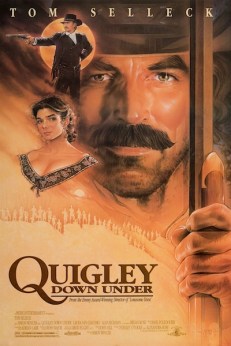
Quigley Down Under (1990)

2016 #27
Simon Wincer | 120 mins | streaming (HD) | 2.35:1 | Australia & USA / English | 15* / PG-13

Tom Selleck is Quigley, who has the ability to shoot things at implausibly long distances, and whose hair has the ability to stay implausibly coiffed even after days abandoned in the outback. He’s been employed by Alan Rickman, who we know is the villain because this was released in 1990. Alan Rickman has brought Quigley to Australia on the pretence that he’s to kill dingoes, but he actually wants Quigley to kill Aborigines. Quigley doesn’t take kindly to this, because he’s the hero, and so pretty much as soon as he turns up he’s left to die in the outback. The end.

No, not really! Quigley manages to acquire his gun and becomes some kind of mythical saviour of the Aborigines. (Let’s not get into the whole race politics of that, okay?)

Despite how the title sounds, it isn’t a sequel to a film called Quigley. It kinda feels like it is, though — you know, those sequels they used to do where you just send your hero off to a new place (often a different country) for essentially more of the same, but because it’s a churned-out cash-in it’s not as fine-tuned as the first film and so never quite as good? If I didn’t know better, I’d believe this was one of those.

It also has a very odd tone. Daft comedic bits rub up against brutal tragedies, like the mass slaughter of Aborigines, or the random death of innocent bystanders, or Crazy Cora’s backstory. It’s like someone wrote a very serious Western, then someone else came along and attempted to zhoosh it up so it could star Tom Selleck and The Funny Villain From Die Hard. And it has very cheesy, derivative, generic Western music, as if they felt it really needed ramming home that, yeah, it’s set in Australia, but actually it’s a Western.

I only heard about Quigley Down Under after Alan Rickman passed away, when a few blogs flagged it up as a great forgotten performance of his. He does bring some of his Die Hard / Prince of Thieves-era skills to the piece, but it’s a paler imitation of those roles. The rest of the film has things to commend it: Selleck is a decent, square-jawed, old-fashioned leading man; Laura San Giacomo finds surprising nuances in Cora, who could’ve just been crazy; leaving the dated politics aside, it’s a decent narrative. The end result is a solid, if ultimately unremarkable, Oz-set Western.

3 out of 5

* Rated 12 in cinemas in 1991, but rated 15 on video in 1991 and 2003. ^

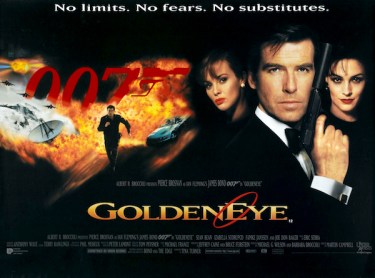
GoldenEye (1995)

100 Films’ 100 Favourites #40

You know the name.
You know the number.

Country: UK & USA
Language: English, Russian & Spanish
Runtime: 130 minutes
BBFC: 12 (cut, 1995) | 15 (uncut, 2006)
MPAA: PG-13

Original Release: 16th November 1995 (Canada)
US Release: 17th November 1995
UK Release: 24th November 1995
First Seen: VHS, 1996

Stars
Pierce Brosnan (Mrs. Doubtfire, Mamma Mia)
Sean Bean (Patriot Games, The Lord of the Rings: The Fellowship of the Ring)
Izabella Scorupco (Reign of Fire, Exorcist: The Beginning)
Famke Janssen (X-Men, Taken)
Judi Dench (A Room with a View, Notes on a Scandal)

Director
Martin Campbell (The Mask of Zorro, Casino Royale)

Screenwriters
Jeffrey Caine (The Constant Gardner, Exodus: Gods and Kings)
Bruce Feirstein (Tomorrow Never Dies, The World is Not Enough)

Story by
Michael France (Cliffhanger, The Punisher)

Based on
James Bond, a character created by Ian Fleming.

The Story
When Russian crime syndicate Janus steal the activation codes for a new satellite weapons system called “Goldeneye”, there’s only one man who can stop them using it for nefarious ends: Jack Bauer. Only kidding — it’s Jason Bourne. No, ‘course not — it’s Bond, James Bond.

Our Hero
Pierce Brosnan is Bond, James Bond, for the first time. After the almost-franchise-killing seriousness of Timothy Dalton, Brosnan nails Bond for the nostalgic ’90s: a dash of Sean Connery’s grit, a dash of Roger Moore’s raised-eyebrow humour, a whole lot of suaveness. For a while, the old “Connery or Moore?” question became “Connery, Moore or Brosnan?”

Our Villain
The mysterious Janus, who (spoiler alert!) turns out to be former MI6 agent and Bond’s chum Alec Trevelyan, out for revenge against the British Empire for betraying his family after World War 2, and against Bond for setting the bombs’ timers for three minutes instead of six.

Best Supporting Character
It was a bold choice to cast a woman as M back in 1995, even though she was inspired by the real director of MI6 at the time. Fortunately they cast the inestimable Dame Judi Dench, who naturally made the role her own — so much so that she survived the otherwise series-wide reboot in 2006, and having a male in the part now feels kinda odd.

Memorable Quote
“I think you’re a sexist, misogynist dinosaur. A relic of the Cold War” — M
(If a single line saved the Bond series, it’s this. In one fell swoop Dame Judi proves that a female M will work, and that this is a franchise aware of the need to drag itself into the present day.)

Memorable Scene
The villains are driving off with the kidnapped love interest. There’s no Aston Martin in sight. Does Bond take another car? Of course not — he takes a bloody tank.

Write the Theme Tune…
Bono and The Edge of U2, hired after…

Sing the Theme Tune…
Tina Turner. According to Wikipedia, “the producers did not collaborate with Bono or The Edge,” hence why (unlike previous Bonds) there’s nothing in the main score that references the title theme. That would rather become the Bond M.O. as the ’90s went on.

Truly Special Effect
The bungee jump off the damn — because it’s not a special effect, it’s real. The Bond series’ legacy of incredible, groundbreaking stunts continues with considerable style.

Letting the Side Down
Éric Serra’s score. Hiring someone to write a very modern (for the early ’90s) score for the newly-relaunched Bond must’ve seemed like a good idea at the time… but it wasn’t. It hasn’t improved any with age, either. Tellingly, after the score was finished the producers had someone else re-score the film’s big action sequence, the St. Petersburg tank chase, with music that sounds far more classically Bondian. Bonus problem: if you had an N64 (like I did), chances are you played GoldenEye the game far more than you watched the film. It too used Serra’s score, meaning I can’t hear it without being transported back to an idyllic adolescence playing blocky video games.

Making of
Pierce Brosnan was originally cast as Bond in 1986, but was forced to pull out when his TV series, Remington Steele, was unexpectedly renewed (according to one telling, that was purely to prevent him playing Bond — they only made six more episodes). Previously, Timothy Dalton had almost been cast when Roger Moore became Bond, and Moore had almost been cast before Sean Connery. Don’t be too surprised if Henry “Superman” Cavill — who was almost cast before the producers settled on Daniel Craig — is taking his martinis shaken not stirred in a few years’ time.

Previously on…
16 previous Bond films (which are all technically in the same continuity). The last was six years earlier, and the least financially successful for 15 years in the US (did alright worldwide, though).

Next time…
Brosnan played Bond thrice more, to increasing box office (if not critical) acclaim. He was due to do a fifth, but then the producers won back the rights to Casino Royale and the rest is history.

Awards
2 BAFTA nominations (Special Effects, Sound)
2 Saturn nominations (Action/Adventure Film, Best Actor (Pierce Brosnan))
2 MTV Movie Awards nominations (including Best Sandwich in a Movie for the submarine sandwich with tomatoes and provolone. It lost to the ham and cheese sandwich in Smoke).

What the Critics Said
“James Bond, the British spy with a taste for the high life and a licen[c]e to kill, comes back in surprisingly hardy and supple form. Gadgets firing, quips racing, libido unfurling, surrounded by a top-notch supporting crew of actors, designers and demolition experts, the new Agent 007 (now played by Pierce Brosnan) delivers whatever Bond devotees could reasonably want, or what newcomers anticipate. […] So much familiarity may lead to contempt in some quarters. But Bond, like Sherlock Holmes, Jeeves, Tarzan, Frankenstein or Dracula, is one of those mythical British pop figures who seem ageless, infinitely adaptable. […] Perhaps the reason is that Bond — as his detractors have always noted — is an adolescent fantasy figure, a Peter Pan popped onto the stage of international espionage. Like Peter, he can’t — won’t — grow up. [He has] caught the world’s imagination because he played out its darker dreams with fairy-tale lightness.” — Michael Wilmington, Chicago Tribune

Score: 78%

What the Public Say
“Rarely in the Bond franchise have directing, acting, cinematography, action, and music come together to create such a stylishly sublime experience. GoldenEye has undeniably earned its now-solidified status as a classic.” — Lukas, Lukas + Film

Verdict

After diminishing box office in the Dalton years, a long gap forced by legal battles, and the Cold War ending in the interim, bringing Bond back for the ’90s was perhaps a bit of a long shot. Fortunately, this fact didn’t escape the makers: there are numerous nods to Bond’s somewhat old-fashioned values (see also: memorable quote), and a whole heap of effort was expended on large-scale action sequences and stunts. Couple that with a solid storyline, several memorable villains, and a “greatest hits”-style leading performance from Brosnan, and you have a series that wasn’t just revived but was set to reach new heights (of box office, if nothing else).

Frankly my dear, #41 doesn’t give… a damn.

Ghost in the Shell (1995)

100 Films’ 100 Favourites #36

It’s found its voice…
now it needs a body.

Original Title: Kôkaku Kidôtai
Also Known As: Mobile Armored Riot Police: Ghost in the Shell (Japan)

Country: Japan
Language: Japanese
Runtime: 83 minutes
BBFC: 15

Original Release: 18th November 1995 (Japan)
UK Release: 8th December 1995
First Seen: DVD, 2000

Stars
Atsuko Tanaka (Ghost in the Shell 2: Innocence, Bayonetta: Bloody Fate)
Akio Ôtsuka (Black Jack, Paprika)
Kôichi Yamadera (Ninja Scroll, Cowboy Bebop: The Movie)
Yutaka Nakano (Cowboy Bebop: The Movie, Ghost in the Shell 2: Innocence)
Tamio Ôki (Journey to Agartha, Wolf Children)

Director
Mamoru Oshii (Patlabor: The Movie, Ghost in the Shell 2: Innocence)

Screenwriter
Kazunori Itō (Patlabor: The Movie, .hack//SIGN)

Based on
The Ghost in the Shell (攻殻機動隊 Kōkaku Kidōtai, literally Mobile Armoured Riot Police), a manga by Masamune Shirow.

The Story
Japan, 2029: Public Security officer Major Motoko Kusanagi and her team are assigned to track down and capture a dangerous hacker known as the Puppet Master, but they soon find themselves embroiled in a far-reaching conspiracy…

Our Hero
In a future world where humans can undergo varying degrees of cyberisation, Major Motoko Kusanagi is a “full-body prosthesis augmented-cybernetic human” — only her brain is organic. Her body is a generic mass production model, so she can blend in while being a kick-ass law enforcement officer.

Our Villain
The Puppet Master, a cyber criminal who hacks into people’s brains and gives them false memories. But is there something even worse going on behind the hacker?

Best Supporting Character
Kusanagi’s second-in-command Batou is stoic to the point of brusqueness — apparently quite a different characterisation to his portrayal in other Ghost in the Shell media.

Memorable Quote
“If we all reacted the same way, we’d be predictable, and there’s always more than one way to view a situation. What’s true for the group is also true for the individual. It’s simple: overspecialise, and you breed in weakness. It’s slow death.” — Major Kusanagi

Memorable Scene
Pursuing the Puppet Master, Kusanagi comes face to face with a six-legged tank. After a blazing gun battle, she tries to physically rip it open, her cybernetic body straining to breaking point — and beyond…

Technical Wizardry
Ghost in the Shell was groundbreaking in its skilful combination of traditional 2D animation with CGI additions. It used a process called “digitally generated animation” (DGA), which combined cel animation with computer graphics to create lens effects that simulated depth, motion, and unusual lightning techniques, as well as mixing in 3D CGI and digital audio.

Letting the Side Down
In 2008, Oshii revisited the film to create Ghost in the Shell 2.0, which regraded the colour, replaced some of the original animation with new CGI, omitted several scenes, and featured a remixed and re-recorded soundtrack. (More details here.) As is almost always the case when directors fiddle with their creations decades later, it wasn’t well received by fans.

Next time…
As befalls many a popular anime franchise, Ghost in the Shell has spawned a raft of sequels and reboots. The only direct sequel, Innocence, was released in 2004. TV series Ghost in the Shell: Stand Alone Complex ran for two seasons between 2002 and 2005, with the first run compiled into movie The Laughing Man and the second into Individual Eleven, all of which were followed by a final film, Solid State Society. Another reboot came in 2013 with direct-to-video series Ghost in the Shell: Arise, which so far totals five episodes and, last year, continuation film Ghost in the Shell: The New Movie. (Only four episodes have so far been released in the West, but the movie — which continues the story from the fifth episode — came out on Monday in the UK. Just to make things more complicated.) A live-action American remake is currently shooting for release in March 2017 — you’ve probably heard about it.

Awards
5 Annie Awards nominations (Animated Feature, Directing, Producing, Writing, Production Design)

What the Critics Said
“When Akira first blasted out of Japan back in 1991 it looked like the Western concept of widescreen animation would be changed forever. […] Unfortunately, it was not to be. Sure, on video, the Manga scene has gone from strength to strength, but as far as theatrical releases are concerned, nothing has really come along to match Akira’s sheer retina-scalding magnificence. Until now. […] From its baddie-eviscerating opening sequence through innumerable car chases, shoot outs and tongue-in-cheek dialogue exchanges, this is exactly the kind of film that James Cameron would make if they ever let him through the Disney front gates.” — Clark Collis, Empire

Score: 95%

What the Public Say
“both the film and Oshii have fallen into a kind of disrepute among the anime community. The common line on GITS is that it’s wordy, masturbatory, and pretentious with nothing going on intellectually and that the (plainly inferior but more easily accessible) GITS: SAC is a better alternative. I wanted to write this article to respond to that notion. GITS is a highly thoughtful film and worthy of comparison to virtually any scifi feature you could name. ” — tamerlane, too long for twitlonger

Verdict

Ghost in the Shell was the first anime I consciously saw, which maybe helps it earn a place here. It’s an initially accessible movie that’s also very complicated — there are pulse-pounding action scenes and a thriller storyline to keep things exciting, but also a lot of deep philosophical discussions, touching on themes of gender and identity. I think for some viewers the latter are a negative, while for others they’re the entire point. (I imagine the forthcoming Hollywood remake will either ditch or seriously curtail them, but you never know.) The combination makes for a stimulating (in multiple senses) sci-fi actioner.

Next… who ya gonna call? #37 !

The Game (1997)

100 Films’ 100 Favourites #34

Players Wanted

Country: USA
Language: English
Runtime: 128 minutes
BBFC: 15
MPAA: R

Original Release: 12th September 1997 (USA)
UK Release: 10th October 1997
First Seen: TV, c.2000

Stars
Michael Douglas (Wall Street, Basic Instinct)
Sean Penn (Dead Man Walking, Milk)
Deborah Kara Unger (Crash, Stander)

Director
David Fincher (Panic Room, Gone Girl)

Screenwriters
John Brancato (The Net, Terminator 3: Rise of the Machines)
Michael Ferris (Terminator Salvation, Surrogates)

The Story
What do you buy the man who has everything? After high-flying businessman Nicholas Van Orton is enrolled in a mysterious alternate reality game by his estranged brother, it’s no surprise that unusual things start to happen. But as those happenings begin to take on a sinister edge, it may be Nicholas has been targeted by something more serious, and potentially life-threatening.

Our Hero
Nicholas Van Orton is an immensely successful financier, but so low on friends that he even spends his birthday completely alone. He could do with fun in his life, or so believes his brother… or does he?

Our Villains
The game is run by a company called Consumer Recreation Services, or CRS. But they just run games… or do they?

Best Supporting Character
Early on in his experience, Nicholas runs into waitress Christine, who has also been affected by the game… or is she actually a part of it? Just who can he trust?!

Memorable Quote
“You know, I envy you. I wish I could go back and do it for the first time, all over again. Here’s to new experiences.” — Ted

Memorable Scene
On the run and tired, Nicholas hops in a cab. He doesn’t notice the doors lock, until the maniacal cab driver begins to speed down the hill. As Nicholas desperately tries to escape, the driver leaps out — and the cab soars into the river, with Nicholas trapped inside…

Awards
1 Saturn nomination (Action/Adventure/Thriller Film)

What the Critics Said
“Crafted with a commanding, aloof precision by David Fincher in his first outing since hitting the jackpot with Seven, this unusual dive into the ambiguous world of an undefined pastime without apparent rules generates a chilly intellectual intrigue that will arouse buffs, trendies and techies more than it will mainstream [audiences. It] projects the same sense of suffocating enclosure and mounting despair in a style that will inevitably be compared to that of Stanley Kubrick in its steely technical mastery and remote, disenchanted worldview, all in the service of a story that resembles a highbrow puzzle as much as it does an involving narrative.” — Todd McCarthy, Variety

Score: 72%

What the Public Say
“just when we’ve finally come to a part of the story we can accept and trust, it turns out that we’ve once again been led astray. In this cinematic game, Fincher’s directorial ability wins out; his ability to pace his films; to completely draw the audience’s attention in whichever direction he requires, as well as keeping them emotionally attached to the protagonists is a balancing act which Fincher has mastered time and again over his career, and The Game is no exception.” — jyapp8715, Through the 4th Wall

Elsewhere on 100 Films
I reviewed The Game as part of a retrospective on Fincher’s films back in 2011, saying it “is by far at its best on your first viewing, when you don’t know how it will end and it’s stuffed with mysteries and twists. That’s not to say it doesn’t bear repeat viewings — as with most twist-ending-ed films, there’s naturally some interest in seeing it again knowing what’s going on — but a lot of the film’s enjoyment comes from being played with, the back-and-forth of what the truth is.”

Verdict

In fairness, The Game probably comes near the bottom of my top 100, because I remain a little dubious about its re-watch value — not because it’s poorly made (far from it), but because the twists and reveals are such a big part of its appeal, and once you know them, you know them. Also, arguments continue between its fans and its haters about whether the plot makes sense or not, and how much that actually matters — personally, I think it makes enough sense (maybe for some parts you have to switch on your “it’s a movie” filter, however). The reason it makes my list nonetheless is the quality of a first viewing, especially if you do buy into its conceit and just go with it. Few other films have kept me guessing from the start up to the very closing moments, and consequently on the edge of my seat throughout. That experience may be unrepeatable, but as one-time deals go, it was immeasurably memorable and effective.

#35 will be… the hands that built America.

Galaxy Quest (1999)

100 Films’ 100 Favourites #33

The show was cancelled…
but the adventure has only begun.

Country: USA
Language: English
Runtime: 102 minutes
BBFC: PG
MPAA: PG

Original Release: 25th December 1999 (USA)
UK Release: 28th April 2000
First Seen: DVD, c.2001

Stars
Tim Allen (The Santa Clause, Christmas with the Kranks)
Sigourney Weaver (Alien, Avatar)
Alan Rickman (Dogma, Harry Potter and the Philosopher’s Stone)
Tony Shaloub (Men in Black, Pain & Gain)
Sam Rockwell (Confessions of a Dangerous Mind, Moon)

Director
Dean Parisot (Fun with Dick and Jane, RED 2)

Screenwriters
David Howard
Robert Gordon (Addicted to Love, Lemony Snicket’s A Series of Unfortunate Events)

Story by
David Howard

The Story
The cast of ’70s sci-fi series Galaxy Quest have been reduced to convention appearances and mall openings since their show was cancelled; but when a group of aliens, who believe the series was an historical document and have built the show’s spaceship for real, ask for the crew’s help to defeat a genocidal general, the actors must endeavour to become their characters for real.

Our Heroes
A ragtag gang of washed-up actors who used to star on a space opera TV series, now co-opted into being real heroes. They’re all based on the cast and characters of Star Trek, of course: Tim Allen’s Jason Nesmith, the ship’s captain, is obviously William Shatner/James T. Kirk; Sigourney Weaver’s Gwen Demarco, the token female, is Nichelle Nichols/Uhuru; Alan Rickman’s Alexander Dane, the classically-trained actor playing an alien science officer, is a combination of Leonard Nimoy/Spock and Patrick Stewart; Tony Shaloub’s Fred Kwan, a fake-foreign engineer, is a mixture of James Doohan/Scotty and Walter Koenig/Chekov; and Daryl Mitchell’s Tommy Webber, a young helmsman from an ethnic minority, is a mixture of George Takei/Sulu and Wil Wheaton/Wesley Crusher.

Our Villain
General Sarris, a reptilian warlord waging war against the kindly Thermians. No discredit to Robin “Ethan Rayne off Buffy” Sachs, but he’s kind of beside the point, really.

Best Supporting Character
Enrico Colantoni (Veronica Mars, Person of Interest) plays the leader of the friendly aliens, Mathesar, a naïve soul who speaks in a sing-song monotone.

Memorable Quote
“By Grabthar’s hammer, by the suns of Worvan, you shall be avenged.” — Sir Alexander Dane

Memorable Scene
Our heroes arrive in the bowels of their screen-faithful ship to find “a bunch of chompy, crushy things” impeding their path — for absolutely no reason. “We shouldn’t have to do this, it makes no logical sense, why is it here?… This episode was badly written!”

Making of
In cinemas, the film began with a 4:3 aspect ratio for clips from the old TV series, then widened to 1.85:1 for the Earth-based scenes, before widening again to a highly cinematic 2.35:1 once Tim Allen’s character realises he’s on a real spaceship. It was decided to ditch the middle stage for the home video releases, which I suppose makes sense, but is a lot less fun.

Previously on…
Galaxy Quest is an original creation, but it’s heavily inspired by the Star Trek franchise and its fans.

Next time…
A reboot TV series was supposedly in the works at Amazon, though comments made by co-star Sam Rockwell just last month suggest the project had developed into a direct sequel, which was then sadly scuppered by the untimely death of Alan Rickman.

Awards
1 Saturn Award (Actor (Tim Allen))
9 Saturn nominations (Science Fiction Film, Actress (Sigourney Weaver), Supporting Actor (Alan Rickman), Performance by a Younger Actor/Actress (Justin Long), Director, Music, Costumes, Make-Up, Special Effects)
Won the Hugo Award for Best Dramatic Presentation

What the Critics Said
“Whether you love Star Trek or laugh at it, your starship is about to come in, docking in the form of Galaxy Quest, an amiable comedy that simultaneously manages to spoof these popular futuristic space adventures and replicate the very elements that have made them so durable. […] If Galaxy Quest never attains consistently giddy heights as it plays out its combination of knowing satire and heroic adventure, it nevertheless keeps its tongue firmly in its cheek, offers a few genuine laughs, moves swiftly, if not at warp speed, and is led by a talented cast.” — Lawrence Van Gelder, The New York Times

Score: 90%

What the Public Say
“As a fan of the various science fiction classic series, like Star Trek and Star Wars, I’ve met most of the people parodied in Galaxy Quest – from the overzealous fans to the has-been and bitter celebrities making a living off a series’ memories. A movie like Galaxy Quest manages to poke fun at a wide range of people but still be loveable and sympathetic at the same time.” — Kevin Carr, 7M Pictures

What the Trekkies Say
In 2013, just after Star Trek Into Darkness came out, a massive convention of Trekkies decided to vote on the best Trek movies. Galaxy Quest muscled its way in to 7th place, besting six real Trek flicks. (Infamously, Into Darkness came dead last.)

Verdict

Managing to satirise both classic sci-fi TV shows and their (shall we say) enthusiastic fanbase, while remaining relatively respectful to both, is quite a feat, and is surely one reason Galaxy Quest has proven so popular. Another is its accessibility: you don’t need to be a Trekkie to get all the gags. Combine those two and you have a film for fans and non-fans alike. To really cement the issue, it’s a solid adventure movie as well as a funny comedy.

#34 will be… what you get for the man who has everything.