In the fast-moving world of television nowadays (where whole seasons appear at once, daft uber-fans burn through them in a single sitting, and the conversation around them is over in a weekend), it’s easy to forget that the latest instalment of Netflix’s ever-shrinking Marvel offering — season three of Daredevil — came out within the last month. (Well, month-and-a-bit — this column’s a week later than usual.) Anyway, that’s where I’ll begin.
And there’s plenty more to cover after that, including a bunch of new Doctor Whos, the Inside No. 9 live Halloween special, the unusual finale of Upstart Crow, the latest Derren Brown special, and sundry episodes of other series too. So, as the Bard himself might say, without much further ado…

Daredevil Season 3
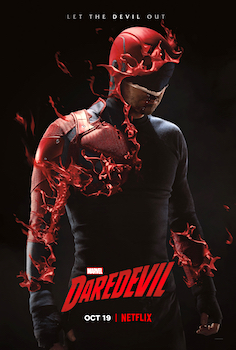 For the 11th season of Marvel Cinematic Universe TV shows on Netflix, we make a long-awaited return to the hero who started it all: the Man Without Fear… the Devil of Hell’s Kitchen… Matt Murdock, Attorney at Law… Daredevil.
And “return” is a good word to describe this season, which sees Daredevil’s nemesis, crime boss Wilson Fisk, aka Kingpin, negotiate a semi-release from prison in exchange for informing to the FBI. While Daredevil’s second season veered off into more fantastical storylines from the character’s comic book adventures, which continued into team-up miniseries The Defenders, season three returns to the street-level, almost-real-world, grittily-toned world of organised crime of the show’s first season. It makes sense: season two didn’t go down that well (I loved it, personally, but it clearly wasn’t for everyone), and it seems The Defenders was pretty much a flop, but Daredevil’s first season remains one of the most popular instalments of the Marvel/Netflix collaboration. Returning to its playbook seems to have panned out, because season three has been getting strong notices across the board.
There are a lot of reasons for that, I think. Some are obvious: the show has always received acclaim for its superbly choreographed and filmed action sequences, and season three doesn’t drop the ball. Indeed, to mix metaphors, it raises the bar again, with an 11-minute single-take prison escape that is all kinds of impressive — and was done 100% for real, no hidden cuts (you can read more about that here). That may be the standout one this season (although there’s a four-way fight in the finale that’s a doozy), but there are numerous stunning sequences throughout all 13 episodes. They really put effort into making the action inventive and original, and that effort is appreciated. I guess if action sequences do nothing for you then it doesn’t matter either way, but seeing it be so well-executed is better than samey action-for-the-sake-of-action.
 There’s a lot more to this season than that, though. New showrunner Erik Oleson has crafted a narrative for his 13 episodes that is better formed than most Marvel Netflix shows — heck, than most streaming series fullstop. It doesn’t seem to drag things out or go round in circles just to fill its episode count, but has a clear sense of pace and purpose. Okay, it’s still a streaming series — it still feels it can afford to devote entire episodes to things a network show might dash through in one sequence — but often that works to add depth. Spending a whole episode on Matt’s convalescence at the start of the season might seem indulgent, but it’s also important to his mindset for the rest of the season, which makes a big point of his morality, his religion, and his relationship with God — always a key aspect of the character, and foregrounded here without becoming objectionable to those of us with a less Catholicly inclined view of the world. The structural accomplishment really pays off in the final few episodes, too, with an array of surprising and game-changing twists and developments. My notes for later episodes were full of things like “shocking climax” and “oooh, twist!” and “ohhh shit!” At times Fisk feels genuinely unbeatable and you actually wonder how the heroes can win this one.
The return to gritty street-level criminal enterprises is more than just an aesthetic move, too. Well, that’s partly the joy of it — it makes for a refreshing change after multiple seasons of magic and mysticism if you watch all the Marvel/Netflix shows, after that side of the MCU even invaded the theoretically-grounded worlds of Luke Cage and Jessica Jones, never mind Iron Fist. But it also allows Oleson to bring more genuine depth to his characters. He’s spoken about being driven by psychological realism — what would these characters really want and need, and therefore do? That might sound like Writing 101, but I think it’s easy for writers of comic book material to fall back on comic book tropes.
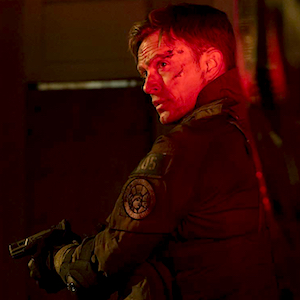 A good example of this is FBI Agent Benjamin Poindexter, who will turn out to be the villain Bullseye. Sorry if you think that’s a spoiler, but one of his first scenes shows off his mind-blowing marksmanship, so you ought to guess, really. In the comics, Bullseye has no backstory — he’s just a psychopathic killer — which is the kind of shit you can get away with if you’re being cartoonish. In the interests of psychological realism, however, Oleson wanted to give him one, to explore his origins, and they were basically free to do what they liked. They even spoke to psychiatrists and the like to make it genuinely realistic. I guess some may think this is unnecessary detail for what is still fundamentally a superhero-action show, but it has its rewards. It’s the same with giving the season a thematic weight to consider. According to Oleson, that was “fear” — how we’re all constrained by our fears and can’t be free until we face and overcome them. This applies to every character, hero and villain alike. Well, it’s a particularly pertinent choice for Daredevil, considering his sobriquet of “the man without fear”.
If I have one complaint about the season, it’s the lack of crossover with other Marvel Netflix shows — not just for the sake of fan service, but for genuine reasons of in-universe plausibility. Oleson has said crossovers aren’t his style, because he’s focused on his characters and not shoehorning in others for the sake of it, but that adherence to the realism of the characters is why it’s silly that certain others don’t turn up. The most glaringly obvious omission is Frank Castle, aka the Punisher — who, in this iteration of the Marvel Universe, started out as a Daredevil supporting character (as one of the main threats in season two). The real-world reason he doesn’t pop up is probably that he’s got his own show now, so I guess scheduling didn’t work out. But (as this Collider article points out) it makes no sense that Castle wouldn’t turn up to help Karen, especially as the danger to her life is literally headline-making news. As that article summarises, “Frank Castle’s absence doesn’t ruin the season, not even close, but it’s a burden an otherwise 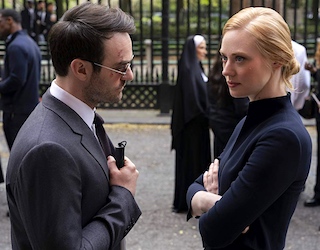 well-told story shouldn’t have to bear, and one that could have been easily remedied.” With Punisher season two on the way it’s possible this apparent plot hole could still be explained and/or retconned (whether they’ll bother is another matter, although Karen was a major character in Punisher season one so they ought to at least reference it), but it’s a shame it went unexplained in Daredevil itself.
Still, that’s the only major complaint I have about this whole season. Many are seeing it as a return to form — as I said, I loved season two, so for me it’s just Daredevil continuing to be excellent, just in a different way. Normally this would absolutely bode well for a fourth season, but with Iron Fist being cancelled (presumably due to ratings) and Luke Cage also canned (over bizarre creative differences, despite the season being half written), it seems like Marvel and Netflix don’t get along so well at the minute (might be something to do with that forthcoming Disney streaming service…) I really hope they don’t throw the baby out with the bathwater, because in my opinion Daredevil is still one of the best things to come out of the whole MCU, on the small or big screen.
Doctor Who Series 11 Episodes 3-7
 I let this post slip a week, so there are five episodes of Doctor Who to look back over. First up, the new team’s first historical adventure, Rosa (whew, it feels like more than a month since this aired!) I wrote last month about how there seemed to be a conscious effort to take Who back to its roots; to do things in a way perhaps not seen since the William Hartnell era of the mid-’60s. Rosa continues this. Back then, historical adventures didn’t have alien threats for the Doctor & co to battle, instead taking a genuine(ish) trip into the past. Rosa does give them a time-travelling criminal to battle, but he’s a relatively slight element in how things play out: he’s trying to alter history by nudging it out of place with small acts, so the TARDIS Team have to nudge it back. Mainly, the episode exists to be a timely commentary on racism. Co-written by acclaimed author Malorie Blackman, it was mostly a success… though, like episodes one and two, it saw the villain less being defeated, more just teleporting away.
Arachnids in the UK was more of a typical Doctor Who romp, as the supporting cast’s hometown of Sheffield was threatened by giant spiders, Trump-ish businessmen, and some dodgy thematic plotting (why is the villain bad for shooting an animal that was going to slowly die of asphyxiation otherwise?) Also, the villain is allowed to wander off at the end, like in episodes, one, two, and three. Continuing this less-revolutionary seam was The Tsuranga Conundrum, which saw the TARDIS Team trapped on a medical ship being torn apart by a metal-eating little critter. Strong design elements (the set looked great, as did the CGI monster) did little to hide some round-the-houses plotting and a cast too big to get enough adequate screen time. Also, it ended with the monster being set free into space, similarly to episodes one, two, three, and four. Was this a deliberate pattern?
 Episode six and seven say “no”. Well, a bit — the actual villain did survive the first. I still hope they’re going somewhere with this, because otherwise it’s very sloppy. Anyway, episode six itself, Demons of the Punjab, was one of the highlights of the season. Like Rosa, it sees the Doctor and co going into history and facing up to the real issues of the day, with the aliens popping in to add some spice rather than properly drive the story — like Rosa, you can imagine a not-that-different version of this episode without them. Preventing the Doctor from interfering and being ultra-heroic is certainly a change of pace from the “heroic god” version of the character we’ve had since the 2005 revival, but it’s not an unheard of vision — again, it harks back to the Hartnell era.
Finally for now, Kerblam! is the first-ever Who story with an exclamation mark in the title. Truly groundbreaking, this season is. I also thought it was the most successful sci-fi episode of the season thus far, feeling like the kind of excitement-filled runaround that would’ve fit in the Eccleston, Tennant, Smith, or Capaldi eras. Its satirisation of Amazon was quite fun, the design work was once again superb, and there was even a budget-busting action sequence. And the villain didn’t escape to live another day! Although, did they really deserve to die? Even when an episode succeeds this season, it still leaves you with questions…
Inside No. 9 Dead Line
 I’ve never watched Inside No. 9 before, though I’ve always meant to get round to it. For those equally in the dark, it’s a comedy-horror anthology series from writers Steve Pemberton and Reece Shearsmith, aka half of the League of Gentlemen, with each half-hour episode a self-contained tale. The reason I’ve jumped in here was because this was a live Halloween special. For some reason I’m always intrigued by live TV drama (I even watched episodes of Eastenders and Coronation Street just because they were going out live), and Inside No. 9’s standalone nature made just dropping in feasible. Anyway, the episode itself was a typically playful endeavour — many fans switched off halfway through, genuinely duped by one of the episode’s tricks. The episode also managed to genuinely integrate the fact it was live, roping in a news broadcast from another channel and having one of the characters tweet. That means it played better live than it would, say, on iPlayer (where it’s still available), though it’s still worth a watch as an effective piece of drama — the way it played with the form of live TV was the best bit, but alongside that it snuck in an interestingly-constructed narrative. You can also view it as a half-hour homage to infamous BBC drama Ghostwatch, which is no bad thing. (That also reminds me I’ve still not got round to watching Ghostwatch…)
Upstart Crow Series 3 Episode 6
 I always wondered if this day would come. As many (though I would guess not all) viewers must know, Shakespeare’s son Hamnet died in childhood. Not exactly traditional material for a multi-camera sitcom, so I wondered if the series would just never go there; equally, it’s by Ben Elton, co-writer of the famously tragic final episode of Blackadder Goes Forth, a work of unequivocal genius. And so in the final episode of this series, Go On and I Will Follow, Upstart Crow does go there… eventually, in the final moments of an episode that’s mostly fluff about theatre awards. It makes for a somewhat bizarre ending. Hamnet was never much of a character in the show, so while his passing’s effect on the characters is obvious, it has little meaning to us viewers. Then there’s the dedication to him at the end, which just reads like a spoof. The only bit that truly worked for me was the final lines: read in solemn voiceover, a passage by Shakespeare himself about grief. Perhaps that’s fitting. Perhaps if the whole episode had been about it in some way, then it would’ve worked — it’s part of why that Blackadder finale is so effective: the whole episode is about going “over the top”, or trying to avoid it, and so the unity of plot and theme and character and historical fact builds to an emotional gut punch of an ending. But rather than do that, Hamnet’s untimely end is just one scene tacked onto the end of some achingly obvious satire about something inherently vacuous. Well, maybe that was Elton’s point, but I don’t think the contrast was sharply enough drawn if so. Without that consistency across the whole episode, the ending just feels… odd. Ah well, at least we know there’s definitely a Christmas special to look forward to.
Things to Catch Up On
 This month, I have mostly been missing The Little Drummer Girl, the BBC’s new John le Carré adaptation from the makers of The Night Manager, their last (and very successful) John le Carré adaptation. As regular readers may know, I have a proclivity for saving series like this up and watching them back-to-back over about a week once they’re done — truly, I am of the Netflix generation. Dammit. Anyway, I’m looking forward to it, so expect me to get right on it and review it next month.
And speaking of Netflix, I’ve still not got round to the new Sabrina or the much-discussed and recommended Haunting of Hill House. Whether I’ll be able to make time for those once Christmas TV ramps up, who can say. Oh God, and I’ve just remembered there’s still Killing Eve on iPlayer, too. Eesh.
Next month… the final few episodes of Doctor Who, and an Arrowverse crossover or two.