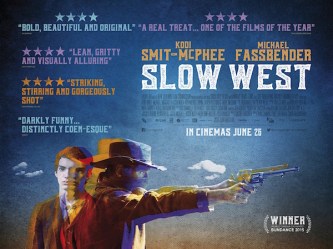
Slow West (2015)

2015 #199
John Maclean | 84 mins | streaming (HD) | 1.66:1 | UK & New Zealand / English & French | 15 / R

The Coens and Wes Anderson are common reference points in reviews of this slightly quirky Western, which sees Michael Fassbender’s experienced outlaw-type help wet-behind-the-ears Scotsman Kodi Smit-McPhee track the girl he loves, who emigrated for mysterious reasons, also known by the bounty hunters on their trail.

The aforementioned comparisons aren’t wildly inaccurate, but are perhaps reductive. Writer-director Maclean has his own variation on that voice, bringing an occasional comically askew perspective to underscore tense confrontations and well-crafted shootouts. Vibrant photography by DP Robbie Ryan and a pleasantly brisk running time further the enjoyment.

A promising calling card and distinctive treat.

4 out of 5

Batman Begins (2005)

100 Films’ 100 Favourites #8

Evil fears the knight.

Country: USA & UK
Language: English, Urdu & Mandarin
Runtime: 140 minutes
BBFC: 12A
MPAA: PG-13

Original Release: 10th June 2005 (Russia)
US Release: 15th June 2005
UK Release: 16th June 2005
First Seen: cinema, June 2005

Stars
Christian Bale (American Psycho, The Fighter)
Michael Caine (Alfie, Harry Brown)
Liam Neeson (Schindler’s List, Taken)
Katie Holmes (Go, Woman in Gold)
Gary Oldman (Léon, Tinker Tailor Soldier Spy)

Director
Christopher Nolan (Memento, Interstellar)

Screenwriters
David S. Goyer (Blade, Man of Steel)
Christopher Nolan (The Prestige, Inception)

Based on
Batman, a comic book superhero created by Bob Kane and Bill Finger. In part inspired by Batman: Year One by Frank Miller and David Mazzucchelli.

The Story
After Bruce Wayne’s philanthropic millionaire parents are murdered when he’s a kid, he dedicates his life to fighting crime, travelling the world to learn combat skills, then deciding the best way to scare the Mafia-esque scum of his home city is to dress as a bat. As you do.

Our Hero
Nana-nana-nana-nana nana-nana-nana-nana Batman! But, y’know, serious. Important crimefighting jobs include getting hold of cool gadgets your company developed, messing around in restaurant fountains with models, and perfecting a ludicrously gruff voice to use when in costume.

Our Villains
Batman really has his work cut out for him this time: there’s crime boss Carmine Falcone (Tom Wilkinson), mad scientist Dr Jonathan Crane, aka Scarecrow (Cillian Murphy), commander of a league of assassins Ra’s al Ghul (Ken Watanabe), his subordinate — and Bruce’s one-time mentor — Ducard (Liam Neeson). That’s not to mention the bloke doing something dodgy with his family company (Rutger Hauer).

Best Supporting Character
It’s a toss up between two British thesps: there’s Michael Caine as the most involved and caring version of the Waynes’ butler Alfred that we’ve yet seen, and the ever-excellent Gary Oldman as Gotham’s only honourable cop, Jim Gordon. Both are a world away from previous screen incarnations of their characters.

Memorable Quote
“Well, a guy who dresses up like a bat clearly has issues.” — Bruce Wayne

Memorable Scene
Trapped in Arkham Asylum, surrounded by police and with SWAT officers storming the building, Batman activates a device on his boot for “backup”. Moments later, hundreds of bats flood the building, allowing him to make a dramatic escape.

Technical Wizardry
Previously, the Batmobile was a sleek and desirable supercar-type vehicle. Taking inspiration from some of the comics, Begins reinvents the vehicle entirely, rendering it essentially a road-ready tank. A massive change in the very concept, but one that now seems only natural.

Letting the Side Down
Hardly a major point for the viewer, but the design of the Bat-costume meant the actor in it couldn’t turn his neck — a problem also in the previous post-’89 Bat-films. Christian Bale’s frustration with this led to it being redesigned for the sequels (and explicitly referenced on screen, too).

Making of
According to some trivia on IMDb, before shooting began Nolan treated the crew to a private screening of Blade Runner, after which he told them, “this is how we’re going to make Batman.” For more on how exactly Ridley Scott’s seminal sci-fi thriller influenced Begins, check out these interview excerpts.

Previously on…
Batman’s big-screen popularity was kicked off by Tim Burton’s 1989 Batman, but that goodwill was gradually squandered, ending with 1997’s Batman & Robin, which many regard as one of the worst films ever made. It killed a once-profitable franchise, therefore paving the way for an eventual reboot.

Next time…
The Bat-world shaped by Nolan and co reached its apotheosis in the first sequel, The Dark Knight. The trilogy-forming second sequel, The Dark Knight Rises, did that rarest of things: it gave a superhero a definitive, final ending.

Awards
1 Oscar nomination (Cinematography)
3 BAFTA nominations (Production Design, Sound, Visual Effects)
1 Razzie nomination (Worst Supporting Actress (Katie Holmes))
3 Saturn Awards (Fantasy Film, Actor (Christian Bale), Writing)
4 Saturn nominations (Supporting Actor (Liam Neeson), Supporting Actress (Katie Holmes), Director, Music, Costume, Special Effects)
Nominated for the Hugo for Best Dramatic Presentation, Long Form.

What the Critics Said
“If there is one Batman film anyone should see, this is it. It’s a superhero film with a dark tone that’s very well-written with nothing but incredible actors involved. In a world where most movies these days are usually either remakes or films that are made as quickly as possible to cash in on the latest trend in Hollywood, a reboot that is not only worthy of your time but tends to make you forget about every other version that came before it says quite a bit.” — Chris Sawin, examiner.com

Score: 85%

What the Public Say
“One of the best things about Nolan’s Batman is that he grasps the idea of the three personas of Bruce Wayne. There’s Bruce when he’s playing the billionaire playboy, Bruce when he’s alone in the cave or with Alfred, and Bruce when he’s wearing the cowl. This movie truly delved into this in a way that no Batman movie had before it and was performed flawlessly by Christian Bale — whether you like the voice or hate it, Bale did a great job at playing three distinct personas.” — Blue Fish Comics

Elsewhere on 100 Films
Just before the release of The Dark Knight Rises I went back over all the live-action Bat-films of the ‘modern era’, i.e. since Tim Burton’s Batman. Of Begins, I wrote that “Nolan’s first foray into Bat-world really is a stunning piece of work… The monumental achievement of The Dark Knight has come to overshadow Begins, which is now rendered as a functionary prequel to the next film’s majesty. Don’t let that reputation fool you: on its own merits, this is very much a film at the forefront of the action-adventure, blockbuster and superhero genres.”

Verdict

If there was one thing the Burton and Schumacher Batman films were collectively notorious for, it was focusing on their villains more than their hero (not least because they cast bigger name actors in the villain roles). Personally, I don’t think that’s wholly true, but there’s no doubting that Christopher Nolan’s much-needed reboot of the franchise focuses on Bruce Wayne, his reasoning and his psychology, more than ever before. In the process, Nolan and co made us believe a man might reasonably choose to fight crime and corruption by dressing up as a bat. No small feat, that.

For #9 Burton’s Bat’s back.

Happy Feet Two (2011)

2015 #193
George Miller | 99 mins | streaming (HD) | 2.35:1 | Australia / English | U / PG

Mumble and his penguin pals return for another adventure, in a series the Australian film industry are reportedly inordinately proud of.

Not as fun as the first, Happy Feet Two suffers from messy storytelling that can’t seem to settle on a narrative thread. For example: a massive subplot featuring a pair of Pythonesque philosophical krill, voiced by Matt Damon and Brad Pitt, is the film’s most fun element, but never significantly connects to anything else.

At least there are a few good musical sequences, one again re-appropriated from existing pop tunes, not least an Australian-accented elephant seal rendition of Rawhide.

3 out of 5

The Vigesimal Monthly Update for January 2016

A new year means the monthly update format is… exactly the same as last year, because it works. (Well, I think it does.)

For any newcomers, or people in need of a refresher, here you’ll find: everything I watched in January 2016, with some observations and analysis too; all the reviews and 100 Favourites entries I posted last month; and The Arbies, my monthly awards. Plus, this month, a few snippets of site news.

Without further ado:


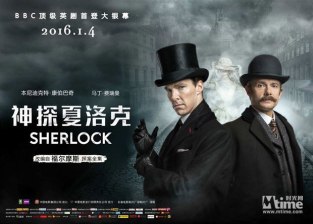
#1 Sherlock: The Abominable Bride (2016)
#2 Snatch. (2000)
#3 12 Years a Slave (2013)
#4 Funny Games (1997)
#5 Lady of Burlesque (1943)
#6 The 36th Chamber of Shaolin (1978), aka Shao Lin san shi liu fang
#7 Super 8 (2011)
#8 The Man from U.N.C.L.E. (2015)
#9 The Five Venoms (1978), aka Five Deadly Venoms
#10 Hercules (Extended Cut) (2014)
#11 White God (2014), aka Fehér Isten
#12 King Boxer (1972), aka Five Fingers of Death
#13 Return to the 36th Chamber (1980), aka Shao Lin da peng da shi
#14 Starman (1984)
#15 The Two Faces of January (2014)
#16 Amistad (1997)
#17 The Last Temptation of Christ (1988)
#18 47 Ronin (2013)
#19 A Boy and His Dog (1975)
#20 Adam (2009)


  • For the first time, I’ve opened up my What Do You Mean You Haven’t Seen selections beyond my DVD and Blu-ray collection to include stuff I have access to on streaming services, etc. Due to my inattentiveness, I included a film that was to be removed the day after I posted that list. Fortunately I did notice, and 12 Years a Slave was squeezed in on its last evening on Amazon Prime.
  • I also caught Snatch before I cancelled my Netflix subscription (I hadn’t meant to keep it so long, what with also having Amazon Prime, but golly, there’s so much to watch!) That’s two checked off already, meaning WDYMYHS 2016 is off to a flying start. Considering I usually end up playing catch up (and, two times out of three, failing), that’s a Good Thing.
  • A few other instances of pairs and repetitions this month:
  • 2x Guy Ritchie movies. As mentioned, one was the first check off WDYMYHS 2016; the other was the first check off my list of 50 Unseen from 2015.
  • 2x slavery-related movies. The aforementioned 12 Years a Slave, and Steven Spielberg’s Amistad. Both feature Chiwetel Ejiofor, donchaknow.
  • Lots of kung fu movies! Two reasons: Film4’s first Martial Arts Gold season (there’s another in March/April), and that loads are available on Netflix UK, including several well-regarded ones.


January is always the most awkward month to analyse. In so many ways the start of a new year is a false new start — it’s an arbitrary marker imposed on Time by humanity, not any kind of empirical new beginning. (Sorry to get glumly philosophical.) A goal like watching 100 films is different though, because January bumps you right back to #1; and this year, that was from the lofty heights of #200. My point being: here, January is a new beginning, not just “the next month”, and can set a tone or pace for the year to come.

Probably not this year though, because — in spite of my stated aim to watch fewer films in 2016 — I made it to 20 in January. That makes it only the fourth month to pass into the 20s, and also my fourth-highest month ever — and as I’ve been doing this for 109 months now, being fourth is (in relative terms) an achievement. It’s the best January ever too, exceeding last year’s tally of 16, and the 20th month in a row with a double-figure total. That is something I aim to maintain this year. If I achieve it, it will see me reach 10+ films per month for two consecutive years, and a total of 31 consecutive months. Just 11 months to go…

So what else can we forecast for 2016? If I keep this up, it’s looking at another record-obliterating final total, this time of 240. I won’t keep it up, though. Historically, January averages 8.08% of a year’s final tally (the actual percentages ranging from 2008’s 5% to 2011’s 12%), which would peg 2016’s total at an even higher level: 248. Which, I say again, it won’t be. What it should be, though, is over 130 — which would still position it as my third best year ever. Considering I intend to spend February and/or March getting value-for-money out of a streaming service or two (as I did in January), besting 2014’s 136 is certainly not out of the question.


A new series for 2016, tracking my 100 favourite movies (that I saw before starting 100 Films). This month: a fuller introduction than that one-sentence summary (though that is the gist of it) and the first seven entries. The full list of all 100 will continue to be updated here throughout the year.


The 8th Monthly Arbitrary Awards

Favourite Film of the Month
Looking back over this month’s viewing, it feels a bit “good but not great” — a lot of films I liked very much, but nothing that really jumps out at me as a dead-cert contender for this category. While it’s more of a Quality movie than a favourite per se, then, the best film this month was its only five-stars-er, 12 Years a Slave.

Least Favourite Film of the Month
Conversely, not many films I didn’t enjoy this month either. However, for disappointment value — expecting the greatest martial arts movie ever made and getting a mess — the loser is The Five Venoms.

Best Opening Sequence of the Month
If you haven’t seen White God then it can be a tough experience (especially for dog lovers), but the opening is fantastic: our young heroine cycles through deserted city streets, percussion-heavy classical music dramatic on the soundtrack, pursued by a pack of hundreds of dogs. There’s a reason they used it for the poster.

Most Surprising #1 at the Chinese Box Office
I know I’m meant to choose these awards, rather than let the Chinese public do it for me, but surely it’s worthy of note that the cinema release of Sherlock: The Abominable Bride saw it top the box office in China, as well as post strong figures in South Korea and other countries. No, really. And that was just the start of it: according to Box Office Mojo, it wound up taking $20.5 million in China and $7.5 million in South Korea, where it bested The Force Awakens (seriously), while other reports peg it as earning $2.7 million in the US. Full figures aren’t easy to come by, but it seems to have a worldwide gross somewhere north of $34 million. Not bad for a TV episode produced for a couple of million quid.

The Audience Award for Most-Viewed New Post of the Month
Outpacing popular posts from just inside the New Year, like Sherlock and my statisticstastic 2015 list, was fun backstage murder mystery — and, significant to its success in this category, blogathon entry — Lady of Burlesque.


Normally I refresh my directors page header image somewhere around August to October, but I was busy watching a shedload of films back then, so it’s been pushed to now. January’s a better time for it anyway, after a full year of film viewing — and next January could make a big change, with my 100 Favourites factored in. The header features the 20 directors who have the most films reviewed on here, and some will get multiple additions thanks to that favourites list. For now, it’s based on how things were on January 1st. I completely rebuilt it, so it’s all spiffy.

Also, I’ve modified the “list of reviews” header. I think that’s the first time I’ve changed it since it went live a couple of years ago. Of the 27 pictures, ten were replaced and four refreshed with higher-quality versions, so it looks a lot spiffier too.

Finally, I decided to re-write the “About” page, for the first time in 3½ years. I re-read the old one and found myself intensely irritating, so hopefully the new version is… less bad.


My viewing selections will be mainly dictated by “what’s on Sky Movies”, in the run up to the Oscars…

Back to the Future Part III (1990)

100 Films’ 100 Favourites #7

They’ve saved the best trip for last…
But this time they may
have gone too far.

Country: USA
Language: English
Runtime: 118 minutes
BBFC: PG
MPAA: PG

Original Release: 25th May 1990 (USA)
UK Release: 11th July 1990
First Seen: VHS, c.1991

Stars
Michael J. Fox (Homeward Bound: The Incredible Journey, The American President)
Christopher Lloyd (Who Framed Roger Rabbit, Things to Do in Denver When You’re Dead)
Mary Steenburgen (Parenthood, Step Brothers)
Thomas F. Wilson (Back to the Future, Born to Be Wild)
Lea Thompson (SpaceCamp, Some Kind of Wonderful)

Director
Robert Zemeckis (Death Becomes Her, The Polar Express)

Screenwriter
Bob Gale (Used Cars, Back to the Future)

The Story
With Doc stuck in 1885, Marty McFly must travel back to save him before he’s killed by Biff Tannen’s ancestor, Buford “Mad Dog” Tannen. With the DeLorean damaged during his arrival in the past, they also have to come up with a plan to get back to their correct time…

Our Heroes
Marty McFly finally grows as a human being as he learns some stuff this time, while Michael J. Fox also gets to ham it up a little as his Irish ancestor, Seamus. Christopher Lloyd, meanwhile, is still the one and only Doc.

Our Villain
It’s Thomas F. Wilson again, this time as Biff’s trigger-happy Wild West ancestor, Buford ‘Mad Dog’ Tannen. Who also gets covered in excrement.

Best Supporting Character
Mary Steenburgen is one of the few wholly original characters in either sequel, the love of Doc’s life, Clara Clayton. She’s also a confident, competent, and capable female character — a character type that’s only now ceasing to be a rarity in effects-y blockbusters, 25 years after this was made.

Memorable Quote
“Your future hasn’t been written yet. No one’s has. Your future is whatever you make it. So make it a good one, both of you.” — Doc

Memorable Scene
Marty and Doc hijack a train in the hope of using it to get the DeLorean up to the required 88mph. As the looted locomotive heads towards a mighty fall off an unfinished bridge, it turns out Clara is on board too. Tension! Action! Excitement! What more do you want from a climax?

Truly Special Effect
With the DeLorean destroyed, the film ends with a reveal of Doc’s new time machine, and it’s awesome.

Making of
There are tonnes of lines, jokes, characters, locations, and even background details referenced back and forth across the whole trilogy, but only one actual scene appears in all three: the moment Marty travels from 1955 to 1985. It’s the climax to the first film, then appears at the end of Part II, and consequently is in the ‘recap’ at the start of Part III.

Previously on…
Part III indeed: this picks up exactly where the second film left off, and they were shot back-to-back. It’s fundamentally standalone other than that, mind.

Next time…
As mentioned on the first film, Back to the Future has continued in an animated series, theme park ride, video game, and a comic book that started last year. Plus Doc Brown turned up in A Million Ways to Die in the West, so… there’s that…

Awards
2 Saturn Awards (Supporting Actor (Thomas F. Wilson), Music)
4 Saturn nominations (Science Fiction Film, Director, Supporting Actress (Mary Steenburgen), Costumes)
Nominated for the Hugo for Best Dramatic Presentation.

What the Critics Said
Back To The Future Part II teed off a lot of critics by not being a remake of the first film, and for daring to be a) complicated, b) very fast and c) heartless. Part III, which is slightly less fleet of foot, restores heart interest of the first film and has a satisfying complete storyline.” — Kim Newman, Empire

Score: 74%

What the Public Say
“One of the clearest indications of an excellent series is an ending is so satisfying you can’t even be mad the adventure is over. Part III delivers a happy ending so well-rounded […] there is no yearning for more story. I remember feeling quite content after seeing that movie for the first time; actually more like thrilled that the trilogy ended on such a great note.” — Avril Brown, Comics Waiting Room

Verdict

The consensus used to be that Part III was unquestionably the weakest part of the trilogy, a slightly bizarre Old West-set addendum to the first two. These days, I feel like an increasing number of people say it’s definitely better than Part II. Personally, I’ve always had a particular fondness for it. I’m not entirely sure why. Much like the second film, it can’t attain the perfection of the first movie, but it can be the next best thing — a fun and funny adventure with these great characters. And even as I say “they’re not as good as the first one”, I don’t wholly believe it: to me, Back to the Future never has and never will be just one film, or one film and its two sequels — it’s a trilogy; a three-parter. (So there.)

#8 will be… an alliterative origin.

The Two Faces of January (2014)

2016 #15
Hossein Amini | 97 mins | streaming (HD) | 2.35:1 | UK, France & USA / English, Greek & Turkish | 12 / PG-13

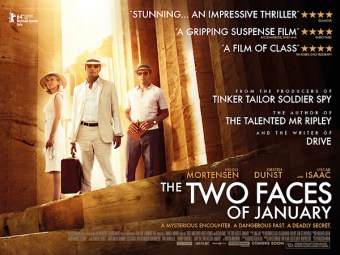
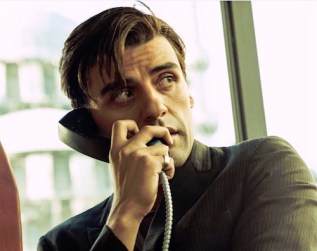
The writer of Drive (and co-writer of Snow White and the Huntsman and 47 Ronin, but maybe he’d prefer we didn’t mention those) moves into the director’s chair with this Patricia Highsmith adaptation. Best know for her Ripley (as in Talented Mr.) tales, this is instead the story of a young American man, Rydal (Oscar Isaac), who, while working as a tour guide in Greece, falls in with middle-aged American couple Chester (Viggo Mortensen) and Colette (Kirsten Dunst). Apparently on holiday, they look like an easy mark for Rydal’s somewhat-con-ish moneymaking practices, but events soon transpire to reveal the pair’s secrets, and Rydal’s greed draws him deeper into their affairs.

Amini has picked some quality material for his directorial debut. The storyline is pretty straightforward, but it’s driven by some interesting characters with complex motivations. You’re never entirely sure what’s driving Rydal and Chester, even if it may appear obvious; and sometimes it can be as much of a twist that a character didn’t have a better plan as it is when their implausibly-intricate machinations are unveiled. It helps that the film has a pair of quality actors in these roles, who effortlessly bring believability to even the slightly-far-fetched elements of the narrative. This is only the second thing I’ve seen where Isaac has made an impression (the other being The Force Awakens; I’d forgotten he was in Robin Hood and Sucker Punch), but I can see why everyone’s calling him one to watch.

If Dunst doesn’t leave as much of a mark as the two chaps, it’s only because Colette is a subtler-still character. Some people reckon The Two Faces of January has a thin story and no development of its characters, but I can’t help but feel it was too subtle for such critics. On the surface it might just seem like Colette is the dim-blonde wife, going along with her husband whatever happens and flirting with their sexy tour guide, but there’s clearly more going on under the surface. How much does she really know about Chester’s actions? Is she an innocent bystander, or is she involved? Is it harmless flirting with Rydal, or are Chester’s drunken suspicions on the money?
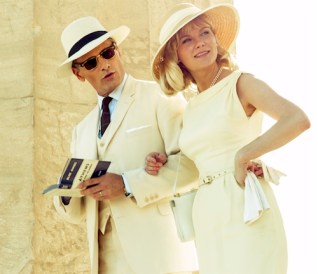
By choosing to set the film in the novel’s original 1960s timeframe, Amini adds instant style and class to the whole picture. Didn’t everything look classier back then? I mean, Chester wears linen suits and Panama hats, not T-shirts, shorts, and a baseball cap. It just wouldn’t be the same set today. Even the locations look straight out of the ’60s, even though they’re hundreds or thousands of years old and the film was shot this decade. Marcel Zyskind’s attractive cinematography is surely to thank for that. Again, it’s an element I’ve heard some criticise as boring or plain, which (much like the above views on plot and character) I just don’t understand. It’s not showy or show-off-y, but that’s part of what works. It lets the natural beauty of the locations speak for themselves, with classical compositions and rich lighting.

The era of the setting also helps emphasise the film’s Hitchcockian overtones, which given Highsmith’s other most-famous work is Strangers on a Train (filmed by Hitch, of course) is perhaps an obvious point of comparison, but by no means an inappropriate or negative one. As the narrative twists and turns, tightening the tension ever more, you think the Master of Suspense would’ve been quite pleased if this had been one of his pictures.

Filming this particular Highsmith novel was a long-held ambition for Amini (he first tried to acquire the rights after his big-screen writing debut, Jude, back in 1996). Such much-awaited dreams can sometimes lead to poor results, thanks to a rose-tinted perspective or close-minded obsession, but on other occasions the lengthy preparation pays off. The Two Faces of January is most certainly a case of the latter, a ceaselessly classy, subtly complex thriller that’s very rewarding for those open to its numerous charms.
4 out of 5

The UK TV premiere of The Two Faces of January is on Film4 tomorrow, Sunday 31st, at 9pm.

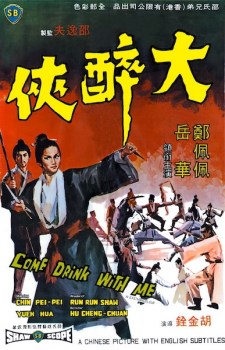
Come Drink with Me (1966)

aka Dà Zuì Xiá

2015 #178
King Chuan (aka King Hu) | 91 mins | streaming (HD) | 2.35:1 | Hong Kong / Mandarin

The first wuxia film directed by King Hu (King Chuan, that’s Hu! #MildlyRacistHomophoneJoke), the success of which allowed him to make his next even-more-significant movies in the genre, Come Drink with Me sees a gang kidnap the governor’s son to use him as leverage to release their leader. Instead, the governor sends his daughter, Golden Swallow (Cheng Pei-pei), to rescue her brother. She receives some help from local drunkard Fan Da-Pei (Yueh Hua), who may be more than he’s letting on…
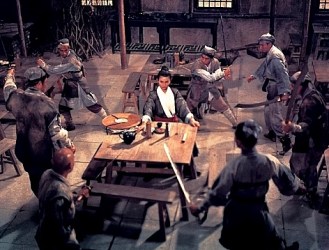
The film features good swordplay action, for the era — i.e. it’s not as tightly choreographed as you’d expect today. There’s a mix of huge free-for-all clashes, and Leone-esque long pauses followed by short bursts of violence. It also establishes Hu’s tendency to feature a strong female protagonist. Okay, she has to be saved by a man in the middle of the film, but at the climax she’s back kicking ass. To cement the point, it’s the female guards who fare best in the climactic battle, surviving long after most of the men have been slaughtered.

For all the fun, the story gets derailed a bit halfway through. Revealing that Fan Da-Pei is not just a drunk but actually an awesome fighter is okay — the groundwork is laid — but shifting the focus on to him and his old rivalry, which springs up out of nowhere two-thirds of the way through, isn’t good. Even the final duel is based on this last-minute subplot. It feels like a late-in-the-day addition designed to add a one-on-one aspect to a climax that would otherwise be about two ‘armies’ duking it out.

But this is a structural niggle, really. There’s so much else to enjoy — not just the action, but some amusing scenes, engaging characters, strikingly brutal villains (they not only kill a child (you wouldn’t get that in most movies) but they do it for no particular reason), and beautiful widescreen Technicolor cinematography — that it doesn’t grate too much.
Two points to be aware of when viewing. Firstly, when Golden Swallow arrives she’s pretending to be a man. This isn’t obvious to the viewer because she’s rather pretty, but all the characters behave as if she’s a fella nonetheless. Secondly, the version available on Netflix doesn’t bother to subtitle a couple of songs, which is frustrating because it’s clear from dialogue that they convey plot points. You get the gist, but it’s not as thorough as it should be. (Hopefully Film4’s screening will be more complete.)

I confess, I primarily watched Come Drink with Me because last year Masters of Cinema released Hu’s next film, Dragon Inn, and this week released the one he made after that, A Touch of Zen — I do like to watch things in order. Those follow-ups are regarded as seminal classics of the genre, a conversation Come Drink with Me doesn’t often come into. Whether that’s right or not, I’m glad to have been led to it, because it’s a very good swordplay movie in its own right. If Dragon Inn and A Touch of Zen are indeed even better, they’re a very exciting prospect.

4 out of 5

The UK TV premiere of Come Drink with Me is on Film4 tonight at 11:15pm.

A Most Wanted Man (2014)

2015 #186
Anton Corbijn | 122 mins | streaming (HD) | 2.35:1 | UK, USA & Germany / English | 15 / R

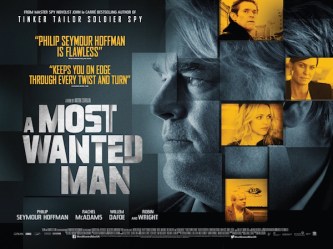
John le Carré adaptation starring Philip Seymour Hoffman as a German secret intelligence operative who must battle internal politicking while tracking a political refugee who may actually be a terrorist.

A typically complex plot requires the viewer to keep their attention level high. Some find the story a plod, but (one languorous interrogation sequence aside) I thought it relatively brisk, aided by accent-defying performances from Hoffman, Willem Dafoe, Robin Wright, Rachel McAdams, and Grigoriy Dobrygin as the refugee. Though beware: its level of realism, with real-life levels of compromise and betrayal, doesn’t make for an ultimately cheery or triumphant conclusion.

4 out of 5

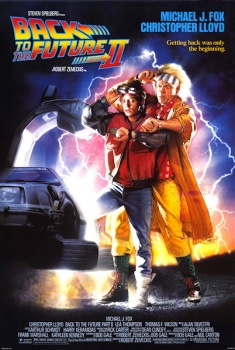
Back to the Future Part II (1989)

100 Films’ 100 Favourites #6

Getting back was only the beginning.

Country: USA
Language: English
Runtime: 108 minutes
BBFC: PG
MPAA: PG

Original Release: 22nd November 1989 (USA)
UK Release: 24th November 1989
First Seen: VHS, c.1991

Stars
Michael J. Fox (Doc Hollywood, The Frighteners)
Christopher Lloyd (Clue, The Pagemaster)
Lea Thompson (Red Dawn, Casual Sex?)
Thomas F. Wilson (Back to the Future, High Strung)
Elisabeth Shue (Adventures in Babysitting, Leaving Las Vegas)

Director
Robert Zemeckis (Who Framed Roger Rabbit, Cast Away)

Screenwriter
Bob Gale (1941, Interstate 60: Episodes of the Road)

The Story
Marty and Doc travel forward to 2015 to save Marty’s son from imprisonment, but this allows future-Biff to steal the DeLorean, taking it back to 1955 to allows his younger self to profit from future knowledge. Faced with a nightmare version of 1985, Marty must travel back into the events of the first movie to fix things.

Our Heroes
Michael J. Fox is not only Marty McFly, but older Marty McFly, and his son, Marty McFly Jr., and also… his daughter, Marlene McFly. Just in case you’d forgotten these were comedy movies, I guess. Christopher Lloyd, meanwhile, is the one and only Doc.

Our Villain
It’s Thomas F. Wilson’s Biff again, but this time he’s not just a bully, but someone who — thanks to his meddling in time — represents a threat to Marty’s whole lifestyle. And he’s a right nasty piece of work in the dystopian variant of 1985, too. Still gets covered in excrement, mind.

Best Supporting Character
Spare a thought for Marty’s girlfriend, Jennifer. The end of the first film has her getting in the DeLorean with Doc and Marty, because she was there and the ending was never intended to lead to anything (yes, kids, once upon a time movies weren’t made with the assumption there’d be sequels). Come the second film, Zemeckis and Gale were stuck having to integrate her into the story, which they did by… knocking her out early on and leaving her out of it.

Memorable Quote
“The time-traveling is just too dangerous. Better that I devote myself to study the other great mystery of the universe: women!” — Doc

Memorable Scene
30 years in the future, they’re still making crappy Jaws sequels. (The irony now is, in the real 2015 we were still getting often-crappy sequels to pretty much every major ’70s/’80s franchise except for Jaws.)

Technical Wizardry
You’ll believe a board can hover. Well, you probably won’t, but some people did. That’s just testament to how well made the sequence is.

Truly Special Effect
Quite apart from the hoverboard, the sequence where they first arrive in 2015 — a ‘road’ of flying cars in a rainy nighttime sky — is a triumph of model work.

Making of
For various reasons (possibly moral, possibly financial) Crispin Glover refused to return as Marty’s father, George McFly. Instead, the filmmakers used outtakes from the first film, as well as an actor wearing prosthetics made from casts of Glover taken for the first film. Glover objected to his likeness being used without permission, sued, and Universal settled out of court. More than that, it led to a change in contract rules at the Screen Actors Guild to stop the same thing happening again. (See also: The Four Musketeers.)

Previously on…
Not only does Part II pick up exactly where the first film ended, it goes back into its events and interacts with them.

Next time…
Part II ends with a huge cliffhanger, leading directly into the series’ final trilogy-forming instalment.

Awards
1 Oscar nomination (Visual Effects)
1 BAFTA (Special Effects)
1 Saturn Award (Special Effects)
3 Saturn nominations (Science Fiction Film, Costumes, Make-Up)

What the Critics Said
“Like its predecessor, Back to the Future Part II does not merely warp time; it twists it, shakes it and stands it on its ear. But as before, the film’s technical brilliance is the least of its appeals. Satirically acute, intricately structured and deftly paced, it is at heart stout, good and untainted by easy sentiment.” — Richard Schickel, TIME

Score: 63%

What the Public Say
“the biggest prediction the film nails is not any one piece of technology, but our reaction to it: indifference met with annoyance of its imperfections. The movie focuses not on what the technology can do, but on what it can’t. The skyway’s jammed. Marty’s hover board doesn’t work on water. The voice-activated home-entrance lights don’t turn on when Jennifer enters. […] What we get is “the future” as “the present.” None of the doom, destruction and dystopia of Blade Runner or The Time Machine. 2015 Hill Valley and 2015 Chicago are just like 1985 Hill Valley and 1985 Chicago, only with cooler stuff.” — Jack M Silverstein, ReadJack.com

Verdict

There are some who consider Back to the Future an all-time classic and think the two sequels are meritless wastes of space. There are others who see them as a complete trilogy of more-or-less equal quality. Considering that ever since I’ve seen them all three parts have existed, it isn’t much surprise I’m one of the latter. Part II may not have the elegant simplicity of the first film, but it still has plenty of original and exciting ideas, not least using the time travel conceit to go back into the first movie. It may not be as good, but it’s a fine adventure in its own right.

#7 will be… wicky wicky wild wild West.

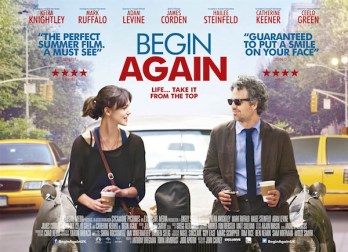
Begin Again (2013)

2015 #188
John Carney | 104 mins | streaming (HD) | 1.85:1 | USA / English | 15 / R

Once’s writer-director returns with a film that could’ve been dubbed Once 2: New York.

Mark Ruffalo’s out-of-favour record exec discovers Keira Knightley’s singer-songwriter, stranded after her ex became a hit. Convinced she could salvage his career, he persuades her to record an album. They bond; will there be romance?

The songs aren’t as catchy (though some are decent) and the shape of the story is overfamiliar, but likeable performances from the stars, plus James Corden and Hailee Seinfeld, keep Begin Again a pleasant experience — albeit one that occurs more in the imagination of dreamy creative types than the real world.

4 out of 5