Silent Shorts Summary

As well as all the unreviewed feature films in my ridiculously-large backlog (see the Archive 5 series for more on that), there are also a load of short films from the past few years that I haven’t reviewed.

Today, I’m taking a step towards putting that right, by bundling together all the silent shorts I watched between 2020 and today. In original chronological order, they are…

  • Sherlock Holmes Baffled (1900)
  • The One-Man Band (1900)
  • The Infernal Cauldron (1903)
  • Life of an American Fireman (1903)
  • The Consequences of Feminism (1906)
  • The Dancing Pig (1907)
  • Frankenstein (1910)
  • What! No Spinach? (1926)


    Sherlock Holmes Baffled

    (1900)

    Arthur Marvin | 1 min | digital (SD) | 4:3 | USA / silent

    Sherlock Holmes Baffled

    This is noteworthy for being the first film to star Arthur Conan Doyle’s immensely popular sleuth, but it’s an “in name only” appearance by the Great Detective. In fact, he’s not named on screen, so maybe “in costume only” (a dressing gown and pipe) would be more accurate. The actual film is nothing to write home about, either: it’s a 30-second skit, built around showing off then-cutting-edge filmmaking tricks, i.e. using editing to allow a burglar to disappear and reappear out of thin air. No wonder Holmes is baffled.

    It’s only really of interest as a curio to fans of early cinema or Sherlock Holmes on screen, even if the latter is only invoked as a hook to attract viewers. Although, I feel like the fact the first Sherlock Holmes film was basically a spoof is somehow significant…

    2 out of 5


    The One-Man Band

    (1900)

    aka L’Homme orchestre

    Georges Méliès | 2 mins | digital (SD) | 4:3 | France / silent

    The One-Man Band

    Using the magic of cinema to take the title literally, in this short director Georges Méliès clones himself seven times over to create a musical septet (plus conductor).

    Even having the idea to do this kind of visual stunt for the first time is obviously impressive — there’s no doubt that Méliès was an extraordinary innovator — but pulling it off with such technical competency… that could be tricky today, never mind in 1900, when you couldn’t check your footage lined up, nor just do another take if it didn’t, never mind the array of computer tricks (split screen, time ramping, reframing, etc) that could be deployed to make it work nowadays. Here, Méliès was doing multiple exposures on the same strip of film; the original negative — imagine if you messed up on the seventh go-round!

    And even with all that, it’s not just an exercise in technique; not just a technical demonstration for those interested in the possibilities of motion pictures. You can set all that aside and still find an entertaining and amusing short — with a couple of extra gags thrown in at the end for good measure. Genius.

    4 out of 5


    The Infernal Cauldron

    (1903)

    aka Le chaudron infernal

    Georges Méliès | 2 mins | digital (SD) | 4:3 | France / silent

    The Infernal Cauldron

    A few years later, and Méliès’s work is looking more extravagant — there are sets! Costumes! Props! Colour! Hand-coloured, of course, and the result is glorious. The colours are not only incredibly stable (you’d expect some flicker or judder on static elements from frame to frame, but nope), but they really add to the atmosphere. The sickly green demons and burning red & orange flames really leap off the screen, making the unreality of it that bit more tangible. This would be so much less effective in pure black-and-white. It’s less like a flickering clearly-fake old film, more like a nightmare. You can kinda see how people at the time might’ve believed stuff like this was real. I mean, how else do you explain those ghosts, hmm? (Okay, obviously they’re a double-exposure effect; but it holds up well. Certainly better than the cardboard-cut-out props.)

    Intriguingly, there’s a 3D version of the film — a real, authentic one! To quote wholesale from Wikipedia: “In order to combat piracy, Méliès … began producing two negatives of each film he made: one for domestic markets, and one for foreign release. To produce the two separate negatives, Méliès built a special camera that used two lenses and two reels of film simultaneously. In the 2000s, researchers at the French film company Lobster Films noticed that Méliès’s two-lens system was in effect an unintentional, but fully functional, stereo film camera, and therefore that 3D versions of Méliès films could be made simply by combining the domestic and foreign prints of the film. Serge Bromberg, the founder of Lobster Films, presented 3D versions of The Infernal Cauldron and another 1903 Méliès film, The Oracle of Delphi, in January 2010 at the Cinémathèque Française. According to film critic Kristin Thompson, ‘the effect of 3D was delightful … the films as synchronized by Lobster looked exactly as if Méliès had designed them for 3D.'” They were screened again in 2011 and, at least as far as Wikipedia can explain, that was the end of it. To which I say: argh! I really want to see them! A 3D Blu-ray release would be lovely; but, as these screenings happened over a decade ago, I can’t say I’m holding out much hope…

    4 out of 5


    Life of an American Fireman

    (1903)

    Edwin S. Porter | 6 mins | digital (SD) | 4:3 | USA / silent

    Life of an American Fireman

    Although fundamentally a remake (or ripoff, depending how you look at it) of the earlier British film Fire!, Life of an American Fireman has found a place in film history (it even merited coverage in Mark Cousins’s The Story of Film: An Odyssey) for two reasons: firstly, for pioneering the technique of cross-cutting, a major and significant development in film editing; secondly, for not actually having done that at all.

    “Huh?”, you may well exclaim. Well, although for a long time the short was admired for its innovation, research by the Library of Congress eventually revealed that the film was re-edited sometime after its release (possibly in the 1930s or ’40s), and the original version actually played the action out twice, without the all-important cutting back and forth. Viewed in that original version, I’d argue to a modern audience it’s more confusing having the same sequence twice back to back — nowadays we expect intercutting of action, so it’s initially disorientating when the film cuts to outside the house and starts the same sequence of events over again. Perhaps more importantly, watching it twice over feels redundant: the second version adds no new information; and, being outside the house, thus distanced from the threat of encroaching fire, it’s less dramatic than the inside sequence. And that’s not to mention that the timeline doesn’t add up: the fireman is in and out of the window much more quickly during the inside version than the outside version.

    Despite all that, this does remain one of the earliest American narrative films, bringing together various innovations that had occurred in the early years of film — primarily, constructing a continuous narrative across multiple shots and scenes. It just wasn’t the first film to do, well, anything.

    3 out of 5


    The Consequences of Feminism

    (1906)

    aka Les Résultats du féminisme

    Alice Guy | 7 mins | digital (SD) | 4:3 | France / silent

    The Consequences of Feminism

    Imagine a crazy world where men did housework and looked after the children, while women lazed around drinking, smoking, and cajoling innocent young men into the bedroom. What larks! But such horrors might come to pass if we let those pesky women have their way.

    Such once-implausible things are depicted in Alice Guy’s 1906 short. Consequently, this is the kind of film that might be described as “of it’s era” — although, said era probably extended another six or seven decades. I can’t cite any specific examples, but I feel like “wouldn’t it be hilarious if men behaved like women?” sketches were still being done in the ’60s and ’70s, if not even more recently. So, it’s less that it’s dated, more that it shows Guy was ahead of her time. I mean, the film dates from before women even had the vote, yet she has the chutzpah to imagine men taking on women’s roles and women enjoying leisure time. Scandalous!

    Considering the short was made by a pioneering female filmmaker, we can but assume it’s all satirical; that its very point is “the consequences of feminism” would not, in fact, be the ridiculous role-reversal presented here. But, in that context, the ending is quite interesting: the men force the women out of the bar and raise a toast. Are we supposed to read that as the natural order being restored? More likely, it’s meant to signify these men achieving equality with women; that Guy’s point is, “if men were in women’s situation, they’d want to change it, too.”

    4 out of 5


    The Dancing Pig

    (1907)

    aka Le cochon danseur

    4 mins | digital (HD) | 4:3 | France / silent
    The Dancing Pig

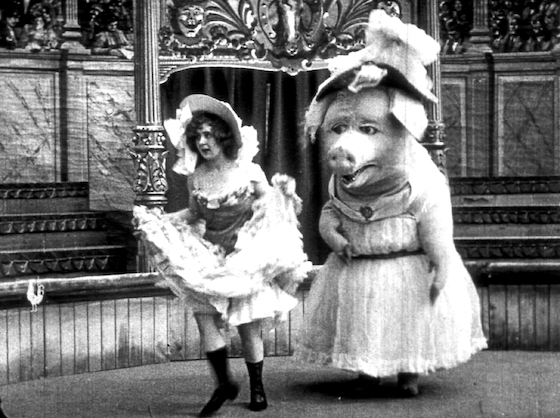
    Apparently this had fallen into obscurity for a century or so, when it was revived as an internet meme because of “its creepy atmosphere”. Certainly, stills from the final scene (a closeup of the pig’s head, with vicious teeth and an oscillating tongue) look weird and freaky; and I guess if you slapped an ominous horror-movie-esque score across the whole short then it would become freakish in its entirety. But it was originally a vaudeville act, and with the jaunty score that usually accompanies it, it remains just that: a couple of minutes of daftness.

    As such, I can hardly recommend it. It’s a curio of a past era, and while there’s undoubtedly value in preserving such things for historical interest, that’s still all it is.

    2 out of 5


    Frankenstein

    (1910)

    J. Searle Dawley | 13 mins | digital (HD) | 4:3 | USA / silent

    Frankenstein

    The first screen adaptation of Mary Shelley’s novel is such a thorough retelling in just 12 minutes, it almost makes you wonder what takes other versions so long. But what it gains in brevity, it loses somewhat in filmmaking craft: every scene is shown only in a theatrical static wide shot. It’s not entirely without interest, though: one setting places a full-height mirror screen right to enlarge the set by showing us what’s behind the camera to the left, and it’s surprisingly effective, especially when it’s used for a bit of fun cinematic trickery.

    The film’s big set piece is the creation of the Monster; not from stitched-together body parts, as is usually the case, but some kind of ‘magic potion’ that makes it emerge from a cauldron, growing and forming before our eyes. The effect was achieved by burning a puppet and then reversing the film, but, rather than presenting an unbroken take, instead the film cuts back and forth to Frankenstein observing and, frankly, skips over what I imagine were the most effective bits. For example, we see the vague outline of a human figure emerge, then cut to Frankenstein, then cut back to see it fully-formed. Would it not have been better to see the Monster’s features ‘melt’ into being amongst the flames? Oh well.

    Frankenstein was thought lost for decades, until a single print was found in the ’70s. Imperfect it may be, but it remains a significant milestone in the history of horror cinema.

    3 out of 5


    What! No Spinach?

    (1926)

    Harry Sweet | 19 mins | Blu-ray | 1.33 | USA / silent

    What! No Spinach?

    Included as a special feature on the Masters of Cinema Blu-ray of Buster Keaton’s Seven Chances, this little-seen* comedy short, directed by and starring Harry Sweet, “riffs on a number of elements from Seven Chances”, to quote MoC’s blurb. I’d say it’s less a riff on Seven Chances, more a brazen rip-off. It has moments of amusing physical comedy, but it lacks Keaton’s originality or heart. At least it’s brief, although that doesn’t mean it feels whole: rather than ending, per se, Sweet seems to run out of ideas and the film just stops.

    Also, it has nothing to do with spinach.

    3 out of 5

    * I couldn’t find a single photo or image from this short online. That there now are some on certain movie databases is because I uploaded screen grabs I took for this review (even editing some into a ‘poster’ for the sake of TMDB/Letterboxd). ^


  • The Best of 2022

    And so my review of the year reaches its end in the usual fashion: with the best films I watched for the first time in 2022, plus a few honourable mentions, and a list of notable new releases I missed.

    Regular readers may have noticed there’s no “worst” list this year. As I wrote last year, the idea of singling out a list of bad movies has become highly unfashionable in recent years, especially when big-name publications do it. I don’t think such lists are wholly without worth (they acknowledge that, as a film viewer, it’s not all sunshine and roses), and there’s a big difference between a major publication slagging off some recent releases (which may affect those films’ continued financial success and their makers’ careers) and a one-man blog picking a couple of lesser films from what he happened to watch that year (which rarely includes recent releases, and wouldn’t have an impact on them even if it did). Nonetheless, in the spirit of celebrating what you love and staying quiet about the rest, I’ve decided to ditch my “worst” list. (If you want, there’s still the “Least Favourite” award in my monthly Arbies.)

    With that said, it’s on with…


    The Eleven Best Films I Watched for the First Time in 2022

    Continuing with the methodology I’ve used since 2016, this list features the top 10% of my first-time watches from the year. In 2022, the total was 111, which means there are 11 films on this year’s “top 10”.

    As ever, it’s not just 2022 releases that are eligible for my 2022 list. Consequently, in recent years I’ve included a ‘yearly rank’ for films that had their UK release during the previous 12 months. However, I watched so few of the year’s big hitters in 2022 that I felt to rank what I did see would be misleading. There are too many acclaimed films omitted only because I’m not able to consider them, not because I don’t think they’re worthy. Hopefully I’ll get back on top of seeing new releases, so a yearly ranking can return in the future.


    Take a noir storyline then run it through gritty “kitchen sink” British sensibilities, and you get this: a film that works as both a neo-noir gangster thriller and a character study of a man revising his views of the world. [Full review.]

    10

    Prey


    Studios keep trying to rehash their ’80s sci-fi/action IPs, and they keep producing mediocre results. Thankfully, someone has finally bucked the trend. Prey works in part because it abandons continuity and takes a back-to-basics approach to its alien menace. Setting it in a completely different time period adds more opportunities for fresh perspectives and developments. It’s such a seemingly simple idea that works so well, and one that’s eminently repeatable. Predators vs knights? Predators vs samurai? Predators vs cowboys? Yes, yes, and yes, please, and anything else you can think of. [Full review.]


    Michael Bay has always been a divisive filmmaker. His brash, bombastic style isn’t for everyone. But I think there’s a method to his madness (even when it results in trash) and so, when he’s on form, he remains one of the most exciting action filmmakers. Ambulance shows he’s still got the goods. You could imagine the storyline — after a bank heist goes wrong, two crooks escape in an ambulance, along with the cop they shot and a paramedic trying to save him — being from a 1940s film noir; a grim character study of men under pressure. That side of it is still in there, just dressed up with all the wildness of only-semi-restrained Bayhem. [Full review.]


    A thriller about… writing a book? Ah, but when the book in question is the autobiography of a disgraced, potentially criminal former Prime Minister, and the book’s new ghost writer has been brought in because his predecessor died under suspicious circumstances, well, you begin to see where there are questions to be answered. Pierce Brosnan is perfect for the role of a former politician who is 50% charming and 50% believable as a scheming villain, while Ewan McGregor leads us through the twisty plot as an everyman who needs the money but still has a conscience. Will the truth out? [Full review.]


    Spielberg, man. If you’d told me a remake of West Side Story would end up in my top ten of the year, I’d have given you a funny look. I didn’t love the original film version, but I also didn’t think it could be bettered — it’s a classic for a reason. Surely any remake was doomed to be lesser? But ah, here comes Steven Spielberg, a director whose style clearly chimes with my taste (in fairness, his work helped define my taste, thanks to watching the likes of Indiana Jones, and Spielberg-produced/-emulating movies such as Back to the Future, at a formative age). His version screams Movie in a way so few films do nowadays, and the changes he and his team have made to the material elevate it even beyond the ’61 film, for my money. [Full review.]


    Toshiro Mifune plays a man presented with a life-changing moral dilemma in this thriller from director Akira Kurosawa. It’s a film of two halves: the first, contained almost to one room in near-real-time, sees Mifune’s business executive grapple with a conundrum that could ruin his career; the second becomes intensely procedural as it follows the police investigation and fallout from Mifune’s actions. With its precision attention to detail and healthy dose of mundanity, Kurosawa conjures an intense realism — the film could almost be a documentary; only, a documentary could never be this finely controlled. [Full review.]


    Disappointingly relegated to “Sky Original” status here in the UK (usually a dumping ground for low-quality genre movies), Mass is a film that deserves to be more widely seen (the story of too many films buried on random streaming services nowadays, I fear — how many people have actually seen Best Picture winner CODA when it’s locked away on Apple TV+?) The less you know going in the better to be hit with the film’s full emotional weight. And it is a heavy film, but only in a way the befits its subject matter. Made up almost entirely of four people sat round a table talking, it is nonetheless “a blisteringly emotional gut-punch … but, with that, it’s ultimately cathartic.” [Full review.]


    I do enjoy a Disney animation, but one has never broken into my top ten before (Zootropolis was 15th in 2016 and Moana was 16th in 2017). That’s partly the luck of the draw (I watched over 50% more films in each of those years), but also something about how well Encanto works — which, frankly, I can’t quite put my finger on. I mean, all the obvious elements are there: catchy songs, likeable characters, impressively fluid animation, a strong message about what matters. But there’s something else, too; a sprinkling of magic that, for me at least, elevates the film to be something even more special. I say I like a Disney film, but I don’t revisit them too often. I’ve already watched Encanto twice. In one year? That’s not like me! So, hopefully you see my point. [Full review.]

    3

    Top Gun: Maverick


    I feel the need — the need for actors doing their flying stunts for real! Striking usage of the IMAX aspect ratio! Memorable callbacks to the original movie! Cheesy music that fits the tone perfectly! Actual humour! Proper subplots! Top Gun: Maverick is old-fashioned blockbuster moviemaking done with modern sensibilities (can you imagine them actually putting actors in jets back in the ’80s? For one thing, where would they have put those great big film cameras?) Actor/producer Tom Cruise has spent decades now perfecting this brand of big-screen entertainment, and here he shows the next generation how it should be done — both in-film, as a pupil-turned-teacher trying to get a class of the best pilots to be even better, i.e. as good as he is; and in real life too, rocking up in an era when the box office is dominated by previz- and CGI-driven superhero theme-park-rides-as-cinema, and giving us a done-for-real spectacle that kicked all their asses at the box office. The movies, and movie stars, are only dead when Tom Cruise says they are.

    2

    Les Enfants du Paradis


    According to IMDb, when Children of Paradise (to use its translated title) was initially distributed in the USA, it was promoted as “a sort of French-made Gone with the Wind”. It’s not a bad comparison. Not in a literal sense — this isn’t about a spoilt rich girl getting caught up in a civil war on the wrong side — but as an epic, years-spanning romantic melodrama? There are some similarities. It’s the story of a courtesan-turned-actress and the four men in her orbit — a mime artiste, an aspiring actor, a wannabe crook, and a moneyed gent — in and around the theatrical scene of 1830s Paris. It’s told with a style that feels adapted from a novel — it’s got that kind of scope, with its timespan and array of characters, and depth, which feel more like literature than something conceived directly for the screen. In fact, most of the characters are based on real people, which I suppose is neither here nor there, but does add another layer of interest. Whatever makes it work is enough to keep it thoroughly compelling even with a running time over three hours.

    1

    Manhunter


    I first became aware of Manhunter many moons ago, as a piece of footnote trivia in the history of movies: “did you know there was a Hannibal Lector film before Silence of the Lambs?” What a crazy idea! How bad it must have been to be so thoroughly overshadowed by Anthony Hopkins’ Oscar-winning version. Well, the history of the movies is rarely so straightforward; and as the immediate acclaim for Lambs has died down, and its various sequels and prequels have petered away, Manhunter has been able to reemerge somewhat. And so it should, because this is a great movie. Maybe not a great Hannibal Lector movie (Brian Cox is very good in the role, with less of the ticks and tricks that made Hopkins so memorable, but he’s not the focus of the story), but a superb “hunt for a serial killer” thriller. It’s dripping with ’80s style thanks to a director who helped define what that even meant (via his involvement with Miami Vice), while the hero cop, played by William Petersen, feels ahead of his time, struggling with the mental toll of previous cases as he tries to do the right thing and stop another killer. Such a mix of style and substance makes for an all-round fulfilling film; one that I think deserves every bit to be celebrated alongside Jonathan Demme’s more widely-acknowledged movie.

    To celebrate it topping my list, Manhunter is on BBC Two tonight at 11:05pm, and on iPlayer for 30 days afterwards.*

    As usual, I’d like to highlight a few other films.

    Firstly, I wrote this little paragraph not sure where to use it, but here seems a good place. That’s to say: I love a minor film noir. Just a solid, competently made, usually 60-to-80-minute programmer. The highly-regarded Classics are all well and good — I appreciate their quality; why they’re ‘better’ — but, in many respects, I get more actual enjoyment (certainly in a relaxed, easy-viewing sense) from a run-of-the-mill type film. Not bad ones, you understand, just average fare. And here seems a good place to say that because 2022’s Challenge compelled me to watch a few noirs of that ilk. All of them were on the long list for my top ten, but none quite made it. I’m talking about the likes of Christmas Holiday, He Walked by Night, Killer’s Kiss, My Name Is Julia Ross, and Repeat Performance. (I also liked The Killing, but that’s in no way a “minor” noir.) Mr. Soft Touch grew on me as it went on, too, but that’s probably one to only be watched in December.

    Next, here’s a recap of the 12 films that won the Arbie for my Favourite Film of the Month. Some have already been mentioned in this post, but some haven’t… In chronological order (with links to the relevant awards), they were Mass, Ghostbusters: Afterlife, West Side Story, High and Low, Shang-Chi and the Legend of the Ten Rings, The Ghost Writer, Ambulance, Repeat Performance, Top Gun: Maverick, The Mission, Manhunter, and Les Enfants du Paradis.

    Finally, something I’ve always done in this section is list every film that earned a 5-star rating during the year. In part that’s because there’s normally far too many to include in my list, even if it weren’t for the fact 4-star films usually sneak in too. But this year, there were only six films that received full marks, and all of them made the top 10%, too. Nonetheless, they were Les Enfants du Paradis, High and Low, Manhunter, Mass, Top Gun: Maverick, and West Side Story. Additionally, there were also full marks for my rewatch of the original Scream.

    I’ve been creating these “50 Unseen” (as I call them for short) lists for 16 years now, and it doesn’t get any easier to choose what to include — or, rather, what to exclude.

    It became a little easier in the past few years, because I was watching so many movies that the number of wide-release titles I’d missed fell, leaving room for more arthouse-y ‘hits’ — films the masses didn’t see but Film People were chatting about. But I watched very few new films this year — just 18 with a 2022 UK release date, down from 30+ in the last few years (with a high of nearly 60 in 2019). Those are small numbers compared to people who watch multiple brand-new films every week, but it had been enough to cover a significant percentage of ‘major’ releases. 18 is… well, not.

    With an initial long-list of almost 150 films, I did consider increasing this list to 100 titles. It would be in keeping with the site’s theme, after all. But 100 is such a big number… I mean, history suggests I won’t manage to watch the 50 listed films within the next decade or two, so how long would 100 take? No, 50 simply feels about the ‘right size’ for a list of this type, whereas 100 feels excessive. Besides, something is always going to get left off, it’s just how far down the list that cutoff comes.

    So, with the caveat that I’ve inevitably forgotten or misjudged something really noteworthy, here’s an alphabetical list of 50 films designated as being from 2022 that I haven’t yet seen. They were chosen for a variety of reasons, from box office success to critical acclaim via simple notoriety, and hopefully represent a spread of styles and genres, successes and failures.

    Avatar: The Way of Water
    Black Panther: Wakanda Forever
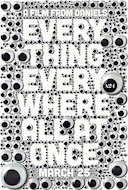
    Everything Everywhere All at Once
    Jurassic World Dominion
    RRR
    Weird: The Al Yankovic Story
    The Batman
    Decision to Leave
    Guillermo del Toro’s Pinocchio
    Nope
    Turning Red
    The Whale
    Aftersun
    All Quiet on the Western Front
    Avatar: The Way of Water
    Babylon
    The Banshees of Inisherin
    The Batman
    Black Adam
    Black Panther: Wakanda Forever
    Blonde
    Bullet Train
    Crimes of the Future
    Decision to Leave
    Doctor Strange in the Multiverse of Madness
    Don’t Worry Darling
    Downton Abbey: A New Era
    Elvis
    Empire of Light
    Everything Everywhere All at Once
    The Fabelmans
    Fantastic Beasts: The Secrets of Dumbledore
    Glass Onion: A Knives Out Mystery
    Guillermo del Toro’s Pinocchio
    Halloween Ends
    Jackass Forever
    Jurassic World Dominion
    Lightyear
    Men
    The Menu
    Minions: The Rise of Gru
    Moonfall
    Morbius
    Nope
    The Northman
    Pinocchio
    Roald Dahl’s Matilda the Musical
    RRR
    She Said
    Smile
    Sonic the Hedgehog 2
    Strange World
    Thor: Love and Thunder
    Three Thousand Years of Longing
    Turning Red
    Tár
    The Unbearable Weight of Massive Talent
    Uncharted
    Weird: The Al Yankovic Story
    Wendell & Wild
    The Whale
    X

    And that’s another year over.

    I gotta say, I’m quite pleased with how quickly I wrapped it all up — I haven’t got my “best” list out by January 6th since 2017. It shouldn’t feel like a rush to get this stuff online, but when many people are sharing their lists before the end of December (or even earlier, in the case of some publications), a week or more into January feels “late”.

    Anyway, I’m going to leave a couple of days to let the end of 2022 finally sink in, and then I’ll start waffling on about my targets for 2023.


    * Obviously it’s not actually because of my list, just a coincidence. ^

    2022 Statistics!

    It’s time once again for the highlight of the year (my highlight, at least) — the statistics! And because I love them so much, I’ve not really messed around with them. That’s to say, these are still based on my first-time watches from 2022 (as listed here), not only films I watched for the new-style Challenge.

    Before the onslaught of numbers and graphs begin, I’ll just mention that, because I’m a Letterboxd Pro member, I get a yearly stats page over there too, which can be found here. In some places that’ll look a bit different to this one, because I also log whatever TV I’m allowed there; but it does have some interesting additional and alternative stats, like my most watched and highest rated stars and directors.

    With that plugged, it’s time for the main event…


    I watched 111 feature films for the first time in 2022. That’s my lowest total since 2013, when I watched 110, and my 6th lowest ever (out of 16 years).

    Previously that still would’ve been “a success”, because my goal was to simply watch 100 new films. But this year I changed things up a bit. Unfortunately, as I’ve already discussed (a couple of times), I failed. Nonetheless, I watched 89 films towards my Challenge, including 71 of those new feature films, 17 rewatches, and one short film.

    Outside of the strictures of the Challenge, I rewatched three further films, for a total of 20 rewatches. That, too, ranks as my 6th weakest year. Not ideal, but — in a very literal sense — it could be worse.


    NB: I have no rewatch data for 2007 and only incomplete numbers for 2008.

    I also watched seven short films, which may not sound like many but is still my 5th best year for the form. These won’t be counted in most of the stats that follow, except where they’re noted alongside the features’ running time.

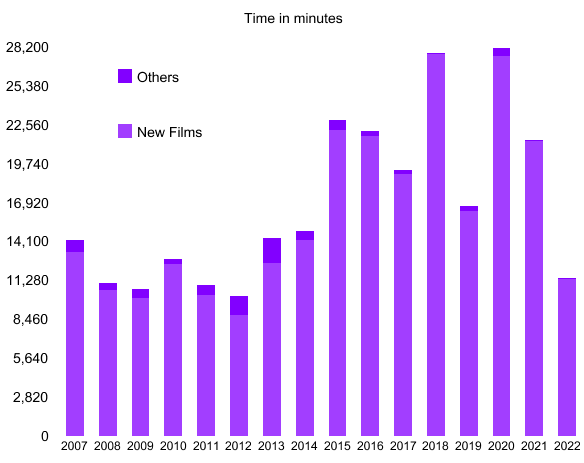
    The total running time of my first-watch features was 189 hours and 21 minutes. Add in the shorts and that rises by over an hour to 190 hours and 33 minutes. (I would also factor any alternate cuts I watched for the first time into that “others” block, but there weren’t any this year.) Unsurprisingly, that lines up with the lesser number of films watched to be one of my lowest totals ever.

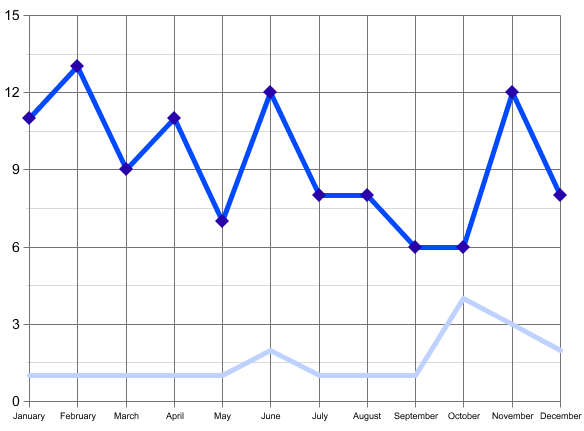
    Here’s how that viewing played out across the year, month by month. The dark blue line is my first-time watches and the pale blue is rewatches. This is the fifth year I’ve been including this particular graph, and when you look back over them all, the main thing you can learn is that I really have no consistency. The only common factor I can spot is a relative drop in the September/October region each year, often dragging August or November in with it.

    Next, the ways in which I watched those films. Despite including a specific DVDs category in my Challenge, I couldn’t turn things round for physical media: digital is once again the year’s most prolific viewing format, with 77 films, or 69.37% of my viewing. That’s actually down on the last two years (both over 72%), but still up on every year before that. One day I’ll do the right thing and get this down below Blu-ray… or so I keep telling myself…

    Digital does have a slight advantage in that several different formats and services contribute to it, though the reason I lump them together is that there’s fundamentally no difference quality-wise between downloading and streaming a film nowadays (most of the time). This year, downloads beat any of the individual streamers, accounting for 26 films (33.8% of the digital total). A number of factors contribute to my wanton piracy, primarily getting hold of specific films in a reliably-accessible format for the sake of my Challenge, as well as acquiring various obscurities. Following on, the top streamer was Netflix, unseating regular victor Amazon Prime, with 14 films (18.2%). Amazon was close behind, though, with 12 films (15.6%). Both are lower than last year, unsurprisingly, but Disney+ actually saw a slight gain in raw numbers, from seven to nine films, which more than doubled its percentage, from 4.7% to 11.7%. Not too far behind was Now on seven (9.1%), with the category rounded out by half-a-dozen others: iPlayer and All 4 each with three (3.9%), MUBI with two (2.6%), and one each (1.3%) for Apple TV+, Talking Pictures TV Encore, and YouTube.

    As usual, it was a distant second place for Blu-ray with 25 films (22.5%) — half of last year’s total in raw numbers, and a slight drop in percentage too.

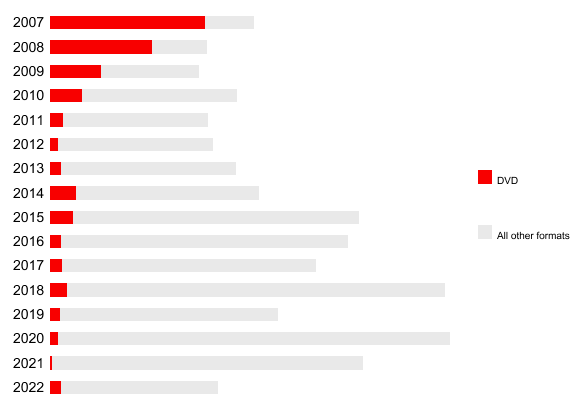
    That’s slightly tempered by an increase in my DVD viewing, the result of forcing my hand by making it a category in my Challenge. It should’ve resulted in at least 12 DVDs watched, but I ended up bending the rules and counting some rewatches. Anyway, the format still rallied to eight films — four times as many as last year, and increasing its representation from 0.97% to 7.2%. I imagine the DVD category will remain for 2023’s Challenge.

    There was just one other format represented in 2022’s viewing: TV, with only one film (0.9%). The bigger news there is that, in the end, I didn’t make it to the cinema in the whole of 2022, the first time that’s happened since 2014. Funny kind of film fan I am, eh? I imagine it’ll be back in 2023: I’m still hoping to make time to see Avatar 2, and there are multiple big-screen-benefitting films out later in the year (not least a new Mission: Impossible). For now, here’s TV’s graph, showing how the once-mighty (look at it in 2010) have fallen…

    Looking at formats from a different angle, I only watched one film in 3D in the whole of 2022. That might sound natural — 3D TVs have been phased out; disc releases in the format are almost nonexistent — but I’ve still got my 3D TV, and the releases are still coming, and I’ve got a large backlog of them to get through, anyway. So, I really should’ve watched more than one! Well, it would’ve been two, if I’d been able to find a genuine copy of Jackass 3D. I’ve managed to source most of the recent Marvel films in 3D (even though they only get a disc release in Japan nowadays), so if I finally catch up on those in 2023, the figure might be healthier next year.

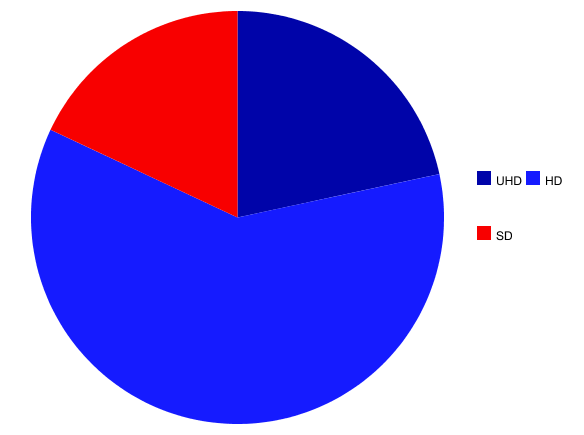
    As for the cutting-edge format du jour, 4K Ultra HD, that fared better, with 24 films — the exact same figure as last year, which in percentage terms is almost a doubling, from 11.6% to 21.6%. At the other end of the spectrum, the increase in DVDs, plus some harder-to-find SD downloads and streams, meant I watched 20 films in SD — the lowest raw number since 2017, but the highest percentage (18.0%) since 2015. Watching a lot in SD is nothing to be proud of (HD is usually so much nicer), but some stuff is simply only available in that format. Better than not being viewable at all. Meanwhile, ‘regular’ HD has been decreasing as a share of my viewing since UHD came along in 2017, but this year it tumbles to its lowest figure yet, just 60.4%

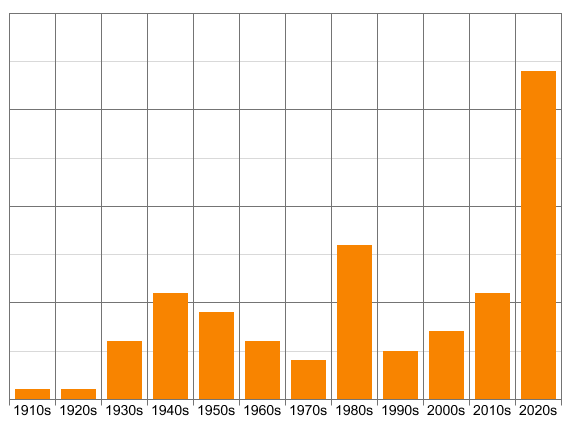
    Unsurprisingly, it’s mostly older films that are only available in SD, and so an increase in one reflects an increase in the other. To wit, when it comes to the age of films I watched, the two most recent decades are not my two most-watched, for only the second time ever. Number 1 belies this fact: the 2020s top the chart for the first time, with 34 films (30.6%). But where you’d expect to find the 2010s in second place (having been the #1 decade from 2012 to 2021), it was actually the 1980s with 16 films (14.4%). That’s another side effect of my Challenge, where one category required me to watch 12 films from 1986 (even though I only got through ten of them in the end). It’s in joint third that we find the 2010s, sharing a place with the the 1940s (no doubt boosted by my Challenge’s noir category), each with 11 films (9.9%).

    Every decade since the 1900s was represented in my viewing this year, as they were in 2020 and 2021; although, as with those years, the 1900s themselves only feature via shorts, so don’t ‘count’ here. Counting down the years in size order, in fifth place was the 1950s with nine films (8.1%), followed by the 2000s on seven (6.3%), the ’30s and ’60s both on six (5.4%), the ’90s on five (4.5%), the ’70s on four (3.6%), and one (0.9%) each for the 1910s and 1920s.

    In recent years, I’ve been pleased to see an increasing variety in the production countries and languages of the films I’ve been watching. Unfortunately, watching so many fewer this year has wiped out some of those gains. So, while the USA has always been the dominant country of production, the 81 films it had a hand in this year represent 72.97% of my viewing, up from the sub-70% figures of the last two years. That said, I’ve been counting this figure since 2012, and that percentage is still the fourth lowest ever, so things could certainly be worse.

    On the other hand, there were only 17 production countries this year, half of last year’s 35, and the lowest number since 2012. As ever, second place went to the UK with 26 films (23.4%). France was third for the second year in a row (and the seventh time in eleven years), with 11 films (9.9%). Tied for fourth were Canada and Japan with four apiece (3.6%), while Germany had three (2.7%), and on two (1.8%) each were Australia, Belgium, Israel, Italy, and Russia (provided the latter also includes the Soviet Union). That leaves six other countries with one film apiece. Countries that often feature but didn’t this year included China, India, Ireland, New Zealand, Spain, and Sweden.

    It’s a similar story with languages, naturally: there were only 12 spoken languages (plus American Sign Language and some silent films), my lowest total since 2013. Top of the pile by an obscene amount was English, featuring in 103 films (92.8%). For context, in second place was French, spoken in just five films (4.5%). Normally I’d list more uncommonly-heard languages here, but there weren’t really any this year… except, for the second year in a row, Klingon.

    A total of 99 directors plus eight directing partnerships helmed the feature films I watched in 2022, with a further three directors and two partnerships making my short film viewing. Only three directors were behind multiple features, the lowest number of repeat offenders ever (tied with 2012). The most came from Jeff Tremaine with three (the first three Jackass movies), while the other two were Stanley Kubrick (his pair of early-career noirs) and Alfred Werker (another couple of noirs). Additionally, two of the shorts I watched were masterminded by the great Georges Méliès.

    For a while now I’ve been specifically charting the number of female directors whose work I’ve watched each year. This was steadily improving, but 2022 has seen an about-face in fortunes, dropping to my lowest level since 2017. My viewing this year included four films with a female director — three credited solo (Siân Heder’s CODA, Maggie Gyllenhaal’s The Lost Daughter, and Carrie Cracknell’s Persuasion), and one as part of a duo with a chap (Vanessa Yuille co-directing Doctor Who Am I). Counting the latter as half a film, that works out as just 3.15% of my viewing, which is sandwiched between 2017’s 2.84% and 2018’s 3.26%, but a long way off 2020’s high of 11.44%. As I’ve said before, I neither avoid nor seek out female directors — maybe I should do more of the latter, but I generally just watch the films I watch and see what comes out in the wash. The industry, undoubtedly, still needs to do more. As ever, I hope this graph will improve again in the future, though I doubt it will ever reach 50/50.

    Before I dig into 2022’s star ratings, let’s take a look at a couple of viewing projects I always have on the go. First, the IMDb Top 250, which I’ve been vaguely working on since before this blog even began. At the time of writing, five films from my 2022 viewing appear on the list. However, because it’s ever-changing, the number I have left to see has actually gone down this year by 10, to 18 films. I’m so close to the end now, before long I may end up making it part of my Challenge to help finish it off. The current positions of the ones I saw this year range from 87th (High and Low) to 227th (To Be or Not to Be).

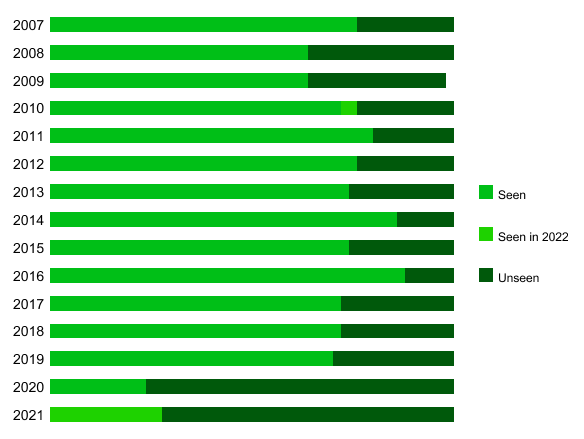
    Next, my “50 Unseen” — the list I publish at the end of every year of 50 notable new films I missed that year. I’ve continued to track those ‘misses’ down the years, and went through a period where they helped decide a lot of my viewing. Recently, though, not so much. Last year was weak for continuing to complete these, and 2022 has been even weaker: in 2021, I watched a measly 21 films across all 14 lists; in 2022, I watched just 16 films across all 15 lists. Nearly all of those — 14 — were from 2021’s 50. That’s a better ‘first year’ than last year (when I only watched 12 from 2020’s 50), but is otherwise poor. Randomly, the other two both came from 2010’s list.

    In total, I’ve now seen 513 out of 750 ‘missed’ movies. That’s 68.4%, a big drop from recent years — the last time my completion rate was below 70% was back in 2017. It’s not as if there aren’t still plenty of movies I want to see on those lists (and there’ll be 50 more from 2022 added soon), so I need to pull my finger out there.

    And so, we reach the finale of every review, and thus the climax of 2022’s statistics: the scores.

    Before we begin, I’m going to repeat the caveat I gave last year: this stat factors in every new film I watched in 2022, even those for which I’ve yet to publish a review (this year, that’s 27% of them — it was 98% last year). That means there are some where I’m still flexible on my precise score — usually films I’ve awarded 3.5 or 4.5 on Letterboxd, but which I insist on rounding to a whole star here. For the sake of completing these stats, I’ve assigned a whole-star rating to every film, but it’s possible I’ll change my mind when I eventually post a review (it’s happened before). Still, this section should remain broadly accurate.

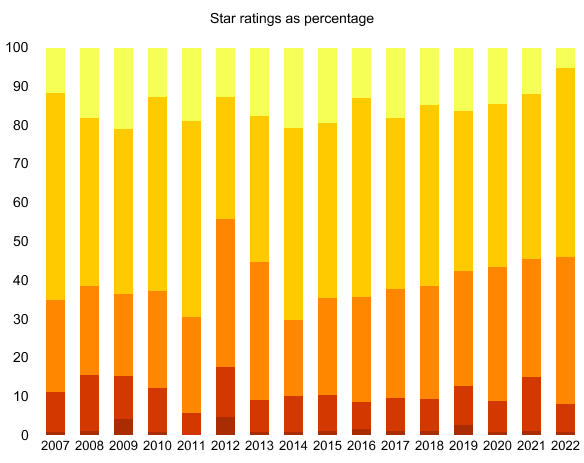
    The headline fact here is that I award a mere six five-star ratings in 2022. At just 5.4% of my first-time watches, that’s by far my lowest ever — the next worst was 2012, when I gave more than double (14 films, 13%). Was it that bad a year? Well, yes and no — I do feel like I didn’t watch many great films this year, but I did watch a lot of very good ones. Has my marking got harsher as I’ve got older / more experienced? I think it has, which is probably only right. But I’m still a relatively lenient grader overall.

    For example, the most prolific rating I handed out remained four stars, which in 2022 I gave to 54 films (48.7%). That’s the highest percentage of four-star ratings I’ve given since 2016. Maybe a couple more would’ve found their way up into the five-star bracket in the past, but — as I said — I think I generally watched films that were good-but-not-great in 2022.

    Continuing down the chart, there were 42 three-star films (37.8%). These three “good” ratings therefore make up 91.9% of my first-time watches in 2022, showing it certainly wasn’t a bad year. Well, it never is, really — but more on that in a minute, when I get to the overall average score.

    In the negative pile, then, we find eight two-star films (7.2%) and just one one-star film (0.9%). As I said, I’m still a lenient marker overall — films have to be truly bad to receive a negative rating from me, and absolutely dreadful to sink to the depths of a single-star rating — in the entire history of 100 Films, just 1.32% of films have received that ignominy.

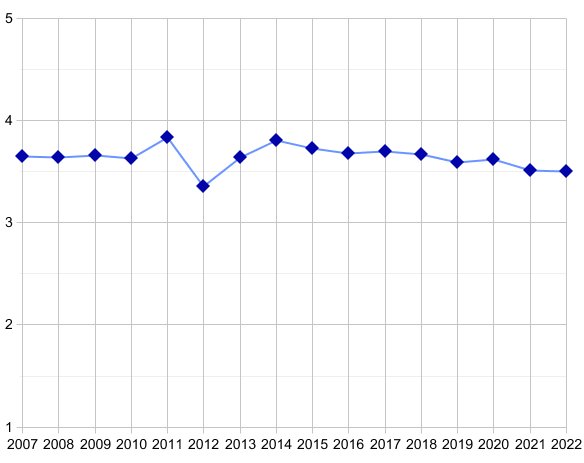
    So, finally, the average score for 2022. The short version is 3.5 out of 5 — the same as last year, and only the third time the average has been below 3.6. I refer you to my earlier comments about how, if 2022 is “not a bad year”, then no year has ever really been bad. To get a few decimal places deeper (and thus provide a more accurate comparison), 2022 scored 3.505. That’s slightly down on 2021’s 3.507, meaning 2022 takes its place as my second-lowest scoring year ever, ahead of 2012’s egregiously poor 3.352. They’re all clearly above 3.0, though, so — I reiterate — no truly bad years, just weaker ones.

    And that’s a good thing. Who wants to deliberately watch more bad films to get a ‘truer’ average? Or you could start hating on films to adjust your ratings curve down, but that’s self-defeating — just accept that, if you like films, you will like more films. I get annoyed with people who claim to be “film fans” but give most of their viewing low scores — are you sure you actually like films? At the other end of the scale, maybe it would be nice to watch even more even better films and pull my average up. It certainly wouldn’t hurt. But I think it’s simply the luck of the draw — I’ve seen many an acclaimed film that didn’t work for me, as well as plenty of stuff that’s been widely dismissed that I love. As long as the majority of my viewing is at least “good”, that’s good enough for me.


    Talking of good and great films, next I’ll be finishing off my review of the year with my pick of the top 10% of films I watched for the first time in 2022.

    2022: The List

    Things have been a bit different at 100 Films this year. Was it only a year ago that I relaunched the site? Somehow it feels like it’s always been this way… Well, that’s because the new style is quite well bedded in now, and I haven’t had to really think about it for ten or eleven months.

    But now that the year is over, the fact things have changed reemerges, with the question: how does it affect my end-of-year roundup posts? I’m afraid I’ve been a little unimaginative, because the answer is “not very much”. The main change is a new addition: the Final Standing I posted the other day, showing the end position of my 100 Films in a Year Challenge. Other than that, anyone who’s been reading the blog for 13 months or more is going to find what follows pretty familiar.

    In this post, there’s a list of all my first-time watches in 2022, as well as any rewatches that have received (or I’m intending to give) the “Guide To” treatment. There’s also links to my monthly progress reports, using their header images to present a kind of visual summation of the year — although that’s now a visual summation of my progress with the Challenge, rather than everything I watched.

    Future posts will also continue as in previous years: first, a statistical breakdown of all my viewing; then, lists of my favourite and least-favourite films I saw for the first time this year.


    Below is a graphical representation of my viewing for the 100 Films in a Year Challenge, month by month. Each image links to the relevant monthly review, which contain a chronological list of my Challenge viewing, as well as other exciting stuff, like my monthly Arbie awards.


    Leaving the Challenge behind, here is an alphabetical list of all my first-time watches during 2022. That’s followed by a list of rewatches that have had (or will have) ‘Guide To’ posts, then short films I watched for the first time. Where a title is a link, it goes to my review; when there’s no link, it’s because I haven’t reviewed it yet.

    The 100 Films Guide To…
    Shorts
    • Absence (2015)
    • The Boy, the Mole, the Fox and the Horse (2022)
    • The Infernal Cauldron (1903), aka Le chaudron infernal
    • Life of an American Fireman (1903)
    • Lupin the Third: Is Lupin Still Burning? (2018)
    • The One-Man Band (1900), aka L’Homme orchestre
    Ambulance

    Carry On Spying

    Cobra

    Disenchanted

    Enola Holmes 2

    The Flying Deuces

    He Walked by Night

    Jackass: The Movie

    Manhunter

    The Monolith Monsters

    Ode to Joy

    Prey

    See How They Run

    The Thrill of It All

    Tintin and the Lake of Sharks

    A Woman Under the Influence

    Scream

    The Boy, the Mole, the Fox and the Horse

    .

    The above list gets analysed to pieces in my annual statistics breakdown (hurrah!)

    My Most-Read Posts of 2022

    I published 84 posts here in 2022 — that’s up from the 55 in 2021, which is good because that was a major part of the point of my relaunch; but it’s still down from the 120+ I posted in 2020 and 2019, and over 200 each in 2018 and 2017. That said, it’s partly because I’ve been lumping most reviews together into “weeks” rather than posting them individually.

    One thing it hasn’t done is reverse the slide in my traffic. I guess people are reading blogs less and less nowadays, maybe? Or perhaps it’s just that I’ve stopped posting my TV columns, which were my big hitters hits-wise. It was insulting IMDb voters’ response to the Game of Thrones finale that gave me my biggest year ever, after all. Whatever the reason, in 2022 my views were the lowest since I started sharing my reviews via IMDb’s External Reviews section in 2017 (IMDb devaluing links to reviews offsite is another possible explanation here). They’re still at more than double where they were in 2016, though, so… um, there’s still further to fall?

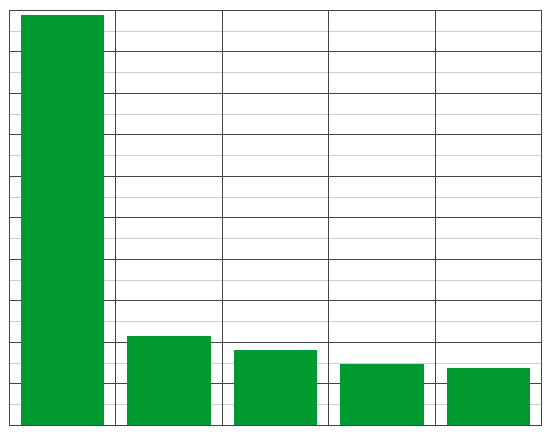
    Anyway, here are the five posts that attracted the most of those paltry views. #1 stood out in particular, as this graph of the posts’ relative success shows:

    Now, you might like to know exactly which those posts are…


    My Top 5 Most-Viewed New Posts in 2022

    5) Weeks 1–3

    Featuring reviews of Carry on Spying, Penny Serenade, The Navigator, In the Line of Fire, Barbie as The Princess and the Pauper, and Free Guy. This is most noteworthy for nearly being a three-way tie: Weeks 1–3 had just a single hit more than each of the posts tied for 6th place, Archive 5 Vol.1 and Vol.5.

    4) Ghostbusters: Afterlife

    Who ya gonna call? No idea why this one charted so high (my posting wasn’t especially timely to any of its release dates, I don’t think), other than the perennial popularity of its franchise. Plus, like the posts in 5th and 2nd, the fact it was posted in February means it had most of the year to rack up hits.

    3) Prey

    Another popular franchise with a much-anticipated new instalment. This one I posted on the weekend it came out, which likely helped it gain views.

    2) Weeks 4–6

    Featuring reviews of Voyage of Time: An IMAX Documentary, L’avventura, She’s Gotta Have It, Don’t Look Up, Jackass: The Movie, and Jackass Number Two. Again, I can’t see anything particularly special about this that would elevate it to second place, except perhaps that reviews of streaming titles often seem to do better — Don’t Look Up is, of course, a Netflix film, while Voyage of Time has been on MUBI. Perhaps the release of Jackass Forever had people looking at writing on the previous films, too.

    1) Sight & Sound’s The 100 Greatest Films of All Time (2022 edition)

    Far and away my most-viewed post of the year, with 4.6 times as many hits as #2. As I speculated in my December review, the success of this post is likely due to it being both timely (even if it was posted 24 hours after the news broke, people were still discussing it on social media) and newsworthy (being a once-in-a-decade occasion deemed to be important to all cinephiles). There’s no reason my particular piece on it should receive more hits than anyone else’s, so I can only assume bigger sites saw even more traffic from it.


    December’s Failures

    13 years ago, I went to see Avatar on opening day, because it was the only chance I’d get over the Christmas period. This year, with long-delayed sequel Avatar: The Way of Water releasing at the same time, I… didn’t do the same thing. But it’s been a massive hit (even without my one ticket purchase? Shocking!), which means it’s still regularly playing, so I might catch it this week.

    It’s fair to say there’s been nothing else quite so notable on the theatrical release slate, partly because everything cleared out of Avatar‘s way. The parting shot from the rest of cinema at the start of the month was Santa-based actioner Violent Night, which sounds fun in concept but I heard was disappointing in execution. I guess I’ll try to remember to catch it on streaming next December. Otherwise, it was mostly small independent-type titles or limited-release Netflix flicks. Either way, not much of that plays around me (as ever, by “around me” I mean “not at the cinema that’s a five-minutes drive away”. If I were prepared to travel 30–60 minutes (not that far, in the grand scheme of things), I could choose to see more of this stuff. But as getting off my arse to go to that five-minutes-away cinema is hard enough, I’m hardly likely to trek further afield.

    Of course, nowadays there’s less need to, with stuff making it to streaming quicker than ever. Or even to TV, with latest Bond flick No Time to Die receiving its UK TV premiere yesterday, just 15 months after its theatrical release. Remember when we had to wait three to five years for that kind of thing? And it’s not just shorter windows, what with streamers producing their own high-profile content. There were more big titles premiering on Netflix this month than at cinemas. Chief among them, Glass Onion: A Knives Out Mystery (to give it its full, unwieldy, unnecessary title). I’m very much looking forward to it — so much so that I didn’t watch it, because I had a rotten cold over Christmas and knew I wouldn’t be able to enjoy it properly. Another one to slot in this week, then.

    While that ended up dominating the conversation (and Netflix’s viewing chart), in December they also brought us Guillermo del Toro’s Pinocchio, Alejandro G. Iñárritu’s Bardo, False Chronicle of a Handful of Truths, Noah Baumbach’s White Noise, a racy (read: sex-filled) new adaptation of Lady Chatterley’s Lover, Scandi monster movie Troll, computer-animated festive musical Scrooge: A Christmas Carol with a starry British voice cast (Luke Evans, Olivia Colman, Jessie Buckley, Jonathan Pryce), and The Big 4, a new one from the director of Headshot and The Night Comes for Us, Timo Tjahjanto, which I hear has suitably extravagant action scenes. As if that wasn’t enough, I also spotted 7 Women and a Murder, an Italian comedy mystery about seven women trapped in a mansion solving a murder, making its international debut as a “Netflix Original” a year after being released in its native Italy. I guess they bought it in as something to offer people who’d just watched Glass Onion. Also of note, apparently, was Medieval — I’ve not heard anyone mention it, so I’ve no idea quite how this happened, but it was Netflix’s 3rd most-watched movie at one point over Christmas. Apparently it’s the story of a Czech commander who never lost a battle, and it stars Ben Foster, Michael Caine, Til Schweiger, and Matthew Goode. I guess “historical war movie with a few recognisable faces” appealed to people browsing Netflix for something new to bung on.

    Other streamers focused on the Christmas period for their original titles, ticking the usual rom-com boxes, with the likes of Your Christmas or Mine? on Amazon Prime and Sky Cinema offering perhaps the most generically-titled movie ever, This is Christmas. Apparently it’s actually rather good (according to the one review I happened to read). Sky also premiered animated Terry Pratchett adaptation The Amazing Maurice, along with streaming debuts for the likes of Dreamworks animation The Bad Guys, “grey pound” target The Duke, Stephen King remake Firestarter, plus blockbusters (that I own on disc and really should’ve watched by now) The Batman and Fantastic Beasts: The Secrets of Dumbledore. Also The Nan Movie, but the less said about that the better. Amazon, meanwhile, had the streaming debut of Alex Garland’s Men, and gave a big push to Wonder Woman 1984 — bit odd, considering how long it’s been around. That said, I’ve still not seen it, so…

    Over on Disney+, it was the usual deal of stuff rushed fresh from cinemas: their latest canon animation, Strange World, a riff on pulp sci-fi-/fantasy adventure flicks that I guess should be up my street, but doesn’t scream “Disney”; plus adult-focused fare, both acclaimed (Martin McDonagh’s The Banshees of Inisherin) and, um, less so (David O. Russell’s Amsterdam). Debuts elsewhere included Park Chan-wook’s latest, Decision to Leave, on MUBI, and Will Smith slavery action flick / wannabe-awards-contender Emancipation on Apple TV+.

    As for the free TV-tied streamers, I’m sure they offered replays of their Christmas-schedule premieres, but I’d seen most of those already (except for Pokémon: Detective Pikachu, which I actually own on 3D Blu-ray. I presume I heard the 3D was good or something, because the fact I still haven’t watched it indicates my broad level of interest). Anyway, catching my attention on iPlayer were the likes of A Bunch of Amateurs (about the amateur filmmakers of the long-running Bradford Film Club) and older flicks I really should’ve seen by now, like The Others and Out of Sight; plus obscure spy thriller When Eight Bells Toll, which I missed earlier in the year so appreciate getting another go at. As for All 4, they cycled in a bunch of stuff they’ve shown before and I’ve not got round to but, hey, you never know, maybe this time. We’re talking Black Rain, Monos, Wild Rose, Saint Maud, Rosemary’s Baby, The Red Turtle, several others… Someday.

    Finally, as always, stuff I forked out for (or, as it’s Christmas, was given) on good ol’ shiny disc. This was set to be a pretty huge list (when isn’t it?), but the UK’s postal issues have delayed a couple of large overseas packages. I just hope they’re not lost… Anyway, there were plentiful additions to my 4K Ultra HD collection last month. Films I’d never seen included Baz Luhrmann’s Elvis and David Lynch’s Lost Highway (I imported Criterion’s release from the US via Amazon, and it took three goes to actually deliver me a copy that wasn’t damaged). On the rewatch pile, there were lavish editions of The Cabinet of Dr. Caligari (the PQ doesn’t seem that much better than the old Blu-ray, to be frank, but there was more in the box, and I wanted to support Masters of Cinema going 4K) and Casablanca (although I also decided to keep my equally-lavish old Blu-ray edition, so I probably should’ve just bought the cheaper regular 4K release. Oh well). In more standard packaging, but welcome nonetheless, were Mike Hodges’ Croupier, Walter Hill’s The Driver, and Quentin Tarantino’s Pulp Fiction. I’ve owned the latter so many times, I was loathe to buy it again; but then I saw the picture comparisons

    On regular ol’ Blu-ray, Sight & Sound’s new list inspired some prep for next year’s Blindspot (ooh, preview!) by picking up Criterion’s editions of Beau Travail and Close-Up (another import that Evri tried to destroy: a neighbour found my parcel halfway down the road in a hedge, soaked through from the stormy weather. I shit you not. Luckily, although the package was a mess, the contents were fine). Brand-new releases were limited to Phil Tippett’s stop-motion nightmare Mad God, but catalogue titles making their UK disc debut included a couple from Eureka — “girls with guns” classic Yes, Madam! and Bob Hope-starring comedy/horror double-bill The Cat and the Canary and The Ghost Breakers — plus a Kickstarter edition of 1926 horror The Magician.

    Finally-finally, I actually bought a DVD — wonders will never cease (although it’s one of a couple I’ve picked up this year, so maybe not that exceptional). Spied in Network’s pre-Christmas sale, it’s The Edgar Wallace Anthology, a collection of noir-esque British B-movies from the 1960s. The set contains just a couple of films to get through — 54, to be exact. That should keep me busy for a while…

    The Failed Monthly Review of December 2022

    The end of the first year of new-style 100 Films is here, and what has it brought? Failure, that’s what. But I’ve already talked about that (although I’ll mention it again before this post is done), so let’s move on to what I did watch last month…


    This month’s viewing towards my yearly challenge

    #82 Doctor Who Am I (2022) — New Film #12
    #83 Quatermass 2 (1957) — Series Progression #8
    #84 Christmas Holiday (1944) — Genre #9
    #85 Les Enfants du Paradis (1945) — Blindspot #11
    #86 Avatar (2009) — Rewatch #12
    #87 I Wouldn’t Be in Your Shoes (1948) — Genre #10
    #88 Jackass 3D (2010) — Series Progression #9
    #89 Mr. Soft Touch (1949) — Genre #11


    • I watched eight feature films I’d never seen before in December.
    • That means I failed to reach my ten-film target for the seventh time this year.
    • That’s a very different story to last year, when December tallied 20+ films for the first time ever; the final month to do so. In 2022, no month reached 20 films — the first time that’s happened since 2014.
    • Back then, the best month was September with 17 films. This year, it’s February, with just 13. That makes it the lowest “best month” since 2012, when (coincidentally) it was also February on 13. They’re tied (along with February and March 2011) as the lowest “best month of a year”s ever.
    • Falling short for more than half the year is reflected in the monthly average for 2022, which ends up at 9.25.
    • Seven of the eight films counted towards my 100 Films in a Year Challenge, along with one rewatch.
    • It would’ve been more if I hadn’t decided to abandon the Challenge shortly before the end of the year. There’s an explanation about my reasons for doing so at that link, so I won’t rehash them here; but I will add that, with hindsight, I made the right decision. Rather than having a hectic last week or so where I rushed to cram in qualifying films, I’ve had a leisurely and relaxing Christmas. (And I’ve had a rotten cold, so I needed that rest.)
    • All of this month’s Genre (i.e. noir) films were Christmas-themed ones. They’re not a natural fit, the optimism of Christmas and the bleakness of noir, but some filmmakers tried nonetheless; not many, but a few. In fact, I did have a couple more lined up, but didn’t get round to them. Maybe this time next year.
    • I didn’t get to the cinema for Avatar: The Way of Water, but I did rewatch the original film, for the first time since I saw it in the cinema, 13 years ago. Despite owning four different versions of it on Blu-ray (three different cuts in 2D, plus the theatrical cut in 3D), I was at my parents’ so we watched it on Disney+. Typical. (Sadly, they haven’t yet put up the revised version that had a cinema release earlier this year (I believe it was re-rendered in 4K with some use of HFR). I guess that’ll arrive, possibly with some fanfare, at a later date.)
    • Despite its title, I watched Jackass 3D in 2D (which is still titled Jackass 3D — obviously, otherwise I’d’ve used a different title). I did try to find a true 3D copy, but failed (I don’t think it was ever released on 3D Blu-ray; I guess it never will be now).
    • This month’s Blindspot film was Les Enfants du Paradis, aka Children of Paradise. That means I failed to watch one film from this year’s list, Yi Yi.
    • There were no WDYMYHS films this month, unfortunately, meaning I failed to watch The Name of the Rose or The Transformers: The Movie. Even considering that I abandoned the Challenge, I should’ve really tried harder to get at least one of those in. Oh well.
    • From last month’s “failures” I only watched Doctor Who Am I.


    The 91st Monthly Arbitrary Awards

    Favourite Film of the Month
    A couple of enjoyable flicks this month, but the artistic standout is French epic Les Enfants du Paradis. Once voted the greatest French film of all time — and, by implication (because you know the French), the greatest film of all time — it’s the kind of standing it deserves to be re-elevated to.

    Least Favourite Film of the Month
    Nothing truly terrible this month, which always makes it a bit hard to judge this category. I mean, it feels kinda cruel picking, say, Doctor Who Am I, because it wasn’t bad — it’s been widely praised, even — but it didn’t deliver all I might’ve hoped for. Alternatively, there’s Jackass 3D, which, again, isn’t bad — assuming you don’t just fundamentally object to the premise, that is — but does feel a bit like it’s a franchise running on fumes. And it bugged the hell out of me that I couldn’t watch it in 3D.

    The Audience Award for Most-Viewed New Post of the Month
    Far and away my most popular post this month — not just of new posts, but all-time; and with ten times as many hits as the post in second place — was my summation of Sight & Sound’s The 100 Greatest Films of All Time (2022 edition). I guess it was timely and newsworthy (even if I posted my piece about 24 hours after the news broke), and people love a list.


    Every review posted this month, including new titles and the Archive 5


    Although the new-style 100 Films Challenge has reshaped things somewhat this year, this is the last post that will focus on it. Over the coming days there’ll be my usual array of look-backs at the year just gone, with a list of all the new films I watched this year, plus statistics and my Best and Worst lists drawn from that pool.

    And then it will be on into 2023, with a slightly rejigged Challenge that I’ll hopefully find more completable.

    100 Films in a Year Challenge 2022: Final Standing

    As the challenge tracker page will soon be replaced with a version keeping tabs on 2023’s effort, here’s an archive of how it looked at the very end of 2022 — sadly incomplete, after I chose to abandon it. Hopefully I’ll fare better in 2023.


    On this page, I’ll track my progress with The All-New 100 Films in a Year Challenge. Learn more about the challenge here.

    New Films

    1. Mass (2021)
    2. The Misfits (2021)
    3. Django & Django (2021)
    4. Death on the Nile (2022)
    5. Chip ’n Dale: Rescue Rangers (2022)
    6. Apollo 10½: A Space Age Childhood (2022)
    7. Ambulance (2022)
    8. Prey (2022)
    9. Persuasion (2022)
    10. Scream (2022)
    11. See How They Run (2022)
    12. Doctor Who Am I (2022)

    Rewatches

    1. Gosford Park (2001)
    2. A Room with a View (1985)
    3. West Side Story (1961)
    4. The Father (2020)
    5. On the Town (1949)
    6. Top Gun (1986)
    7. Calamity Jane (1953)
    8. Batman: Dead End (2003)
    9. Paddington 2 (2017)
    10. The Two Faces of January (2014)
    11. Enola Holmes 2 (2022)
    12. Avatar (2009)

    Blindspot

    1. L’avventura (1960)
    2. Los Olvidados (1950)
    3. A Man Escaped (1956)
    4. High and Low (1963)
    5. To Be or Not to Be (1942)
    6. Paris, Texas (1984)
    7. Mirror (1975)
    8. La Grande Illusion (1937)
    9. Come and See (1985)
    10. A Woman Under the Influence (1974)
    11. Les Enfants du Paradis (1945)
    12. Yi Yi

    What Do You Mean You Haven’t Seen…?

    1. Flight of the Navigator (1986)
    2. She’s Gotta Have It (1986)
    3. Cobra (1986)
    4. Hannah and Her Sisters (1986)
    5. Pretty in Pink (1986)
    6. A Better Tomorrow (1986)
    7. Mona Lisa (1986)
    8. The Mission (1986)
    9. Howard the Duck (1986)
    10. Manhunter (1986)
    11. The Name of the Rose
    12. The Transformers: The Movie

    Decades

    1. Broken Blossoms (1919)
    2. The Navigator (1924)
    3. Shot in the Dark (1933)
    4. Penny Serenade (1941)
    5. The Monolith Monsters (1957)
    6. Carry On Spying (1964)
    7. The Hobbit (1977)
    8. Dirty Rotten Scoundrels (1988)
    9. In the Line of Fire (1993)
    10. Barbie as The Princess and the Pauper (2004)
    11. Voyage of Time: An IMAX Documentary (2016)
    12. Free Guy (2021)

    DVDs

    1. Meat Loaf: In Search of Paradise (2007)
    2. Tintin and the Temple of the Sun (1969)
    3. The Flying Deuces (1939)
    4. Mifune: The Last Samurai (2015)
    5. Tintin and the Lake of Sharks (1972)
    6. Clerks (1994)
    7. Walk the Line (2005)
    8. The Mindscape of Alan Moore (2003)
    9. The Blues Brothers (1980)
    10. 3 to go…
    11. 2 to go…
    12. 1 to go…

    Genre: Film Noir

    1. Escape in the Fog (1945)
    2. My Name Is Julia Ross (1945)
    3. Johnny Gunman (1957)
    4. Repeat Performance (1947)
    5. He Walked by Night (1948)
    6. The Guilty (1947)
    7. Killer’s Kiss (1955)
    8. The Killing (1956)
    9. Christmas Holiday (1944)
    10. I Wouldn’t Be in Your Shoes (1948)
    11. Mr. Soft Touch (1949)
    12. 1 to go…

    Series Progression

    1. Jackass Number Two (2006)
    2. Encanto (2021)
    3. Scream 2 (1997)
    4. The Sign of Four: Sherlock Holmes’ Greatest Case (1932)
    5. Scream 3 (2000)
    6. Scre4m (2011)
    7. Star Trek III: The Search for Spock (1984)
    8. Quatermass 2 (1957)
    9. Jackass 3D (2010)
    10. 3 to go…
    11. 2 to go…
    12. 1 to go…

    Wildcards

    1. Munich: The Edge of War (2021) — additional ‘New Film’ in April
    2. Scream (1996) — additional ‘Rewatch’ in June
    3. The Thrill of It All (1963) — additional ‘Decade’ for the 1960s
    4. Where will it go?

    Merry Christmas from 100Films.co.uk

    It’s a little after midnight on 25th December here in the UK, so from all here at 100Films.co.uk (“all” being me — there’s only me), a Merry Christmas to you and yours — and if it can’t be merry, I hope it can be safe and peaceful.

    2022 has been a year of big changes round these parts — a new name; a new look; something of a new purpose… which kinda failed at the first hurdle.

    But no matter! 2023 is a new year, and the Challenge will be reshaped somewhat, and I go again. See you there, faithful reader.

    2022 | Week 35

    When I revived 2007’s weekly(-ish) review compilation format at the start of 2022, the main objective was to write shorter reviews (not necessarily as short as the couple-of-sentences-per-film I wrote back in 2007, but not worrying about trying to do full write-ups for everything), which would help enable me to stay more up-to-date. Well, the former has only been partially successful, and that means the latter has slipped, too: here we are, rapidly heading towards the end of December, and I’m only just posting reviews of films I watched at the end of August / start of September. I’m certainly not going to have 2022 finished before 2023 begins.

    Hey-ho, there’s nothing to be done about it — other than remind myself I was intending to be more concise and more on top of things, and continue to try to push myself in that direction. In the meantime, on we go, with…

  • Mona Lisa (1986)
  • Mirror (1975), aka Zerkalo
  • Clerks (1995)
  • Persuasion (2022)
  • He Walked by Night (1948)


    Mona Lisa

    (1986)

    Neil Jordan | 104 mins | Blu-ray | 1.85:1 | UK / English | 15 / R

    Mona Lisa

    Neo-noir filtered through a British sensibility — which means you get a character study merely garnished with genre thrills, especially when the character in question is played by Bob Hoskins, adding depth and complexity to your could-be-straightforward protagonist.

    Said protagonist is George, a recently-released minor gangster looking for work. He’s an interesting mix of a character: streetwise but also kinda naïve; racist and judgemental, but without really meaning it. It’s like he’s just reciting stuff he’s heard from everyone else, rather than it being stuff he really believes. Well, isn’t that true of so many with horrendous opinions? These days they just get them from YouTube. George’s prejudices are somewhat challenged when he’s assigned to drive around a high-class call girl, Simone, who happens to be black. Although Hoskins took most of the plaudits (including an Oscar nomination and BAFTA win), as Simone, Cathy Tyson breathes an equal amount of life into a character that, similarly, in lesser hands could’ve just been a plot-driving mystery. (She was also nominated for a BAFTA, incidentally.)

    The film’s style is an interesting mishmash, in that it has an element of British grit and groundedness — especially being shot on grainy film, all on location in London, in a world of everyday gangsters and prostitutes — but with fantastical and/or genre flourishes — George’s friend Thomas creates weird art stuff and engages in literary discussions; nighttime London is shot to look like a vision of Hell; and then there’s all the noir stuff in the construction of the story. There’s a version of this film that fully gives in to that genre, but the comedy and ‘fantasy’ dilutes the neo-noir aspects, making the film more unique, and distinctly British.

    The fact Arrow initially released Mona Lisa as the de facto lesser half of a double-bill with earlier Hoskins-starring gangster flick The Long Good Friday does it something of a disservice (though it’s also is the primary reason I had it in my collection to prompt me to watch it, so swings and roundabouts). This is a film more than worthy of standing on its own; and one that, while not poorly regarded or completely forgotten, merits a wider rediscovery.

    4 out of 5

    Mona Lisa is the 53rd film in my 100 Films in a Year Challenge 2022. It was viewed as part of “What Do You Mean You Haven’t Seen…?” 2022. It placed 11th on my list of The Best Films I Saw in 2022.


    Mirror

    (1975)

    aka Zerkalo

    Andrei Tarkovsky | 107 mins | digital (HD) | 1.37:1 | Soviet Union / Russian | U

    Mirror

    Andrei Tarkovsky’s poetic evocation of memory and mid-20th-century Soviet history. If that sounds a bit Arty, just wait ’til you hear Criterion’s blurb, which says it’s “as much a poem composed in images, or a hypnagogic hallucination, as it is a work of cinema.” Oh dear, sounds like Hard Work, right? Well, it is.

    Calling it “visual poetry” might sound like pretentiousness, but it really isn’t — Mirror definitely plays more like that than a traditional narrative film. And, just like most poetry, I didn’t really get it. I must confess that I was tuning out by the end; partly due to tiredness, which is my own fault; but partly that the film gave me nothing to really latch on to; no (clear) narrative or character or anything for me to focus on to keep my wavering attention in the right place. On the bright side, it avoided being a total disaster in my eyes by having some nice-looking bits, and individual scenes or sequences that kinda work. But I absolutely do not “get it” as a whole cohesive piece of art.

    Clearly, this kind of thing works for some people — Sight & Sound’s most recent poll ranked it 31st, and the director’s poll (which I would normally argue errs slightly more mainstream) went even better and placed it 8th. Each to their own. Based on his work that I’ve seen so far, I just don’t think Tarkovsky’s for me.

    2 out of 5

    Mirror is the 54th film in my 100 Films in a Year Challenge 2022. It was viewed as part of Blindspot 2022.


    Clerks

    (1994)

    Kevin Smith | 88 mins | DVD | 1.85:1 | USA / English | 15 / R

    Clerks

    There’s no escaping the fact that Clerks is very much a product of its time, both in itself as a work of art, and in how it became a breakout success. (Can you imagine a film like this launching a career like Kevin Smith had (for a bit) if it was made today? Best you could hope for now is being seen by half-a-dozen festival-goers before the director gets tapped to be Kevin Feige’s puppet on some Marvel content.) That said, for all its ’90s-time-capsule-ness, it holds up pretty well as a piece of entertainment. By which I mean, I laughed multiple times and was never bored.

    The story, such as it is, concerns a pair of convenience store workers hanging out for a day, and the various little dramas and incidents that occur to and around them. Serving as both writer and director, Smith quite cleverly turns bugs into features. No budget? Make that the whole aesthetic, with grainy 16mm photography and an everyday setting in which ‘nothing’ happens. Non-pro actors? Have everyone deliver all their lines mile-a-minute, thus making the whole thing feel kinda heightened and stylised, to the point where you can’t be sure if most of the cast can’t act or it was all a deliberate choice. This is further fed by Smith often letting scenes play out in long takes with no cuts — if these guys can remember all their lines to do a whole scene in a oner, they must be pretty professional, right?

    Impressively for a first-timer behind the camera, Smith doesn’t go overboard with directorial flourishes. There’s the occasional shot or sequence with some extra pizzazz to keep up the visual interest, but he seems to know that less is more; that this is the kind of film that plays best in medium shots. This might sound like basic stuff, but evidence shows that first-time filmmakers with something to prove are regularly tempted to go all-out and make something that feels Directed. That might be nice for a showreel, but for an actual film, restraint goes a long way.

    Technique aside, the content just works. These characters are likeable enough to hang out with for 90 minutes, because that’s effectively all we’re doing. But there’s enough variety in their conversations and situations, and enough genuinely funny lines and moments, that it works and is enjoyable, rather than being a dull or directionless slice-of-life piece.

    4 out of 5

    Clerks is the 55th film in my 100 Films in a Year Challenge 2022.


    Persuasion

    (2022)

    Carrie Cracknell | 108 mins | digital (UHD) | 2.00:1 | USA / English | PG / PG

    Persuasion

    Jane Austen adaptations appear to be perennially popular, so it was probably only a matter of time before Netflix attempted one. Here, they’ve retained the original setting but given proceedings a modern-ish wash, apparently influenced by their hit series Bridgerton style (I’ve never seen Bridgerton, so this is based on the trailers and that others have made the same comparison). The result? A trailer that met with a great deal of displeasure from Austen fans, not keen on the apparent irreverence to the source material. I’ve never read Austen, either, so I’ll leave exact comparisons to the more knowledgeable.

    That said, I can’t say the trailer fully won me over, but I thought I’d allow the film its chance. And it’s not terrible — there are lots of nice scenes and moments to be found. Unfortunately, they’re undercut by the bits everyone talked about from the trailer: the clearly-Fleabag-inspired gurns to camera; the banal and misplaced modern-style dialogue. The really sad thing is that there aren’t actually very many of those bits — the ones that were widely cited as “examples” are nearly all of them, in fact — and so there is nearly a very nice film here.

    Dedicated fans of Austen’s original work, and those who prefer their period dramas played straight and faithful, will likely still find those moments off-putting. If you’re prepared to overlook the missteps, this Persuasion is largely likeable.

    3 out of 5

    Persuasion is the 56th film in my 100 Films in a Year Challenge 2022.


    He Walked by Night

    (1948)

    Alfred Werker | 79 mins | digital (HD) | 4:3 | USA / English | PG

    He Walked by Night

    “A film that started as a humble low-budget offering from a second-tier studio, but wound up being one of the most influential films of its era” is how ‘Czar of Noir’ Eddie Muller describes He Walked by Night in his introduction for TCM’s Noir Alley strand. That’s partly because it inspired the radio series Dragnet, which was immensely significant in the development of police procedural series, a genre that remains a bread-and-butter staple of TV entertainment to this day. But also because it was shot by cinematographer John Alton — “the greatest noir stylist of all time”, says Muller, and here he produced “one of the most dramatically photographed film noirs ever”. There’s debate over whether the film was actually helmed by its credited director, Alfred Werker, or if Anthony Mann actually did most of the work. “It doesn’t really matter,” says Muller, “because the picture’s held together by the stunning visual style of its singular cinematographer”.

    Well, I can’t disagree. This is a gorgeously shot film, and a concise exemplar of all we know of film noir style — primarily, abundant shadows. But it’s not just the imagery that makes it work. There are multiple tense suspense sequences, often making great use of silence — this is a film not afraid to be quiet when it’s effective — climaxing with an incredibly atmospheric chase and shootout in the LA storm drain system. We spend a lot of time with the villain, Roy Martin — the film is definitely a howcatchem; no whodunit mystery here — who’s superbly played by Richard Basehart. Coming back to the point about silence, Martin is a loner, so he doesn’t get much dialogue a lot of the time, but Basehart still effectively conveys how smart and cunning he is. Also worthy of note is Whit Bissell as an electronics dealer who unwittingly sold on ‘inventions’ that Martin had in fact stolen. The poor guy is clearly innocent and been duped, but he ends up between a rock and a hard place when the police aren’t sure they believe that.

    The overall style of He Walked by Night is intensely procedural and serious about it, but it still finds room for glimpses of character, both from the cops and the criminals; and there’s humour, too. That helps give it a bit of light and shade, and also genuine reality — you’ll find humorousness everywhere in real life, however serious events may be.

    4 out of 5

    He Walked by Night is the 57th film in my 100 Films in a Year Challenge 2022.