

Wes Anderson | 83 mins | TV | 1.85:1 | USA / English | PG / PG
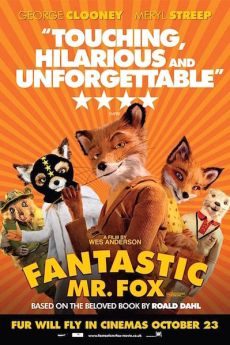 Quirky cult-y director Wes Anderson tries his hand at stop motion animation with this Roald Dahl adaptation, in which an all-star cast voice the tribulations of a gaggle of talking animals — led by the eponymous vulpine — who come into conflict with three vicious farmers.
I’ve never seen a Wes Anderson film before, but his reputation is such that I don’t think you need to have to spot that Mr. Fox has been heavily Anderson-ised. It’s probably for the best I’ve not actually read Dahl for decades, because the purist in me would hate it for that. So it’s Quirky with a capital Q, and yet, miraculously, not irritatingly so — it feels like it should be considered self-consciously Quirky, but somehow isn’t. Instead, it’s almost (almost) charming. Whatever, it works.
Ostensibly a kids’ film, because it’s based on a children’s book and it’s animated, I don’t think it really is a film for kids. Not that it’s unsuitable for them, but only so in the literal sense that it’s an animated movie without extreme violence or swearing. A lot of the humour and the storytelling style, not to mention the slightly-creepy animation, are clearly aimed at a more mature viewer. The aforementioned animation was shot at the half-normal speed of 12 frames per second, to emphasis the nature of stop motion. That’s part of the creepiness, but it’s also the gangly designs, and that the animals look like they’ve been made out of real fur (because they have), which ruffles all of its own accord (accidentally moved by the animators’ hands, of course, but when seen in motion…) Honestly, I think it would give some kids nightmares more than joy.
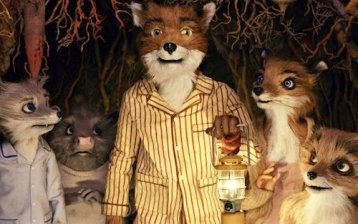 Compositionally, I thought I’d get sick of the squared-off 2D style, but Anderson’s cleverer than that. It might look flat and lacking in dimension at first, but that’s the starting point for variation, including some great bits of depth (farmer Bean trashing a caravan is a particular highlight of this), and when it breaks form (like a rabid dog chase) it’s all the more effective. There’s also a fantastic score by Alexandre Desplat. Not your usual plinky-plonky Quirky Kids’ Movie music (though there are instances of that), but something more raucous. Nice spaghetti Western riffs, too.
The main downside is the ending: it kind of reaches a conclusion, but also kind of just stops. It’s like Anderson doesn’t know how to end it… which, as it turns out, is almost exactly true. The ending isn’t the same as the book, because Anderson and co-screenwriter Noah Baumbach weren’t happy with it, but they couldn’t think of anything else. The final moments they’ve ended up with are apparently based on alternative material found in Dahl’s original manuscript, making it faithful (in its own way) while also settling the writers’ desire for a new finale. As I said, I’m not convinced.
(While we’re on trivia, residents of or regular visitors to Bath may spot the recognisable red facade of the Little Theatre towards the end. Its appearance is indeed based on the real one, though goodness knows why.)
 Fantastic Mr. Fox is the kind of film I feel I may enjoy more on a re-watch. Indeed, some comments on film social networking sites (e.g. Letterboxd) do suggest that it only improves the more you see it. Having parked any desire for faithfulness to the original at the door, then, I feel there’s a chance the film’s boundless originality and almost-incidental outside-the-norm creativity may potentially render it an all-time favourite. But that’s something future viewings (if or when ever they occur) will have to ascertain.

 You know the kind of people who wait ages and ages for something and really want it and pre-order it or whatever and then when it finally arrives they… add it to a pile and don’t get round to watching/reading/listening to it for even longer than the ‘forever’ they were waiting in the first place? If you don’t, you do now — that’s me.
 To be precise, Panahi’s ban is from filmmaking, writing screenplays, leaving the country, or giving interviews, so they conclude that reading aloud an existing screenplay while someone else films him doesn’t contravene any of those rules. Nonetheless, the edited (not-a-)film was smuggled out of Iran on a USB stick hidden in a cake in time for its Cannes premiere.
 In fact, despite the singular input and focus put into this ‘project’, it could be used quite successfully as part of an argument against auteur theory. But that isn’t what it sets out to do either.
 questions that are always worth asking about purported documentaries.
 By 1947, Hergé’s boy reporter/adventurer Tintin had already been around and increasingly popular for nearly two decades; had survived World War 2 and the controversy of being published in a Nazi-controlled newspaper; and the release of his adventures had recently been transferred to a dedicated magazine, Le Journal de Tintin. What better time to bring the character to the big screen?
 In
In 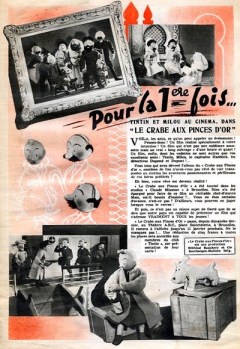 makes it look as if he’s permanently shocked by everything.
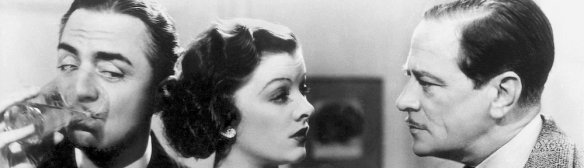
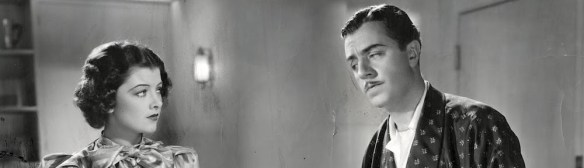
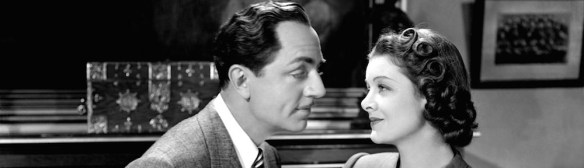

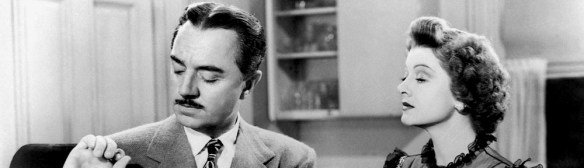
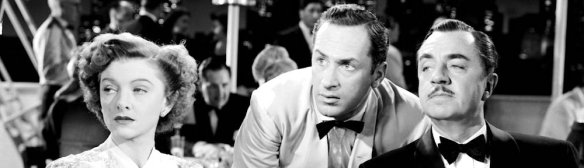
 Produced as a B-movie, but eventually nominated for four of the biggest Oscars (Picture, Actor, Director, Screenplay
 like a Christmas party which is regularly interrupted by victims and suspects. Even the final scene, a rambling and none-more-Christie-like “gather all the suspects and reveal the answers” dinner party, seems natural because of the characterisation throughout the rest of the film. Loy’s part may not be quite as showy — as demonstrated by its failure to gain an Oscar nomination — but she’s an invaluable half of the double act.
 Liam Neeson shoots wolves for an arctic drilling company, but when his flight home crashes, he must attempt to lead the small band of survivors across an icy wilderness to the mere hope of safety — pursued all the way by murderous wolves…
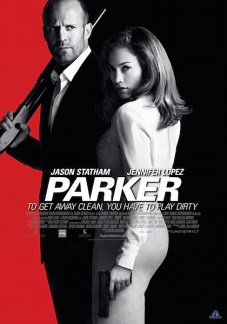 Parker trailed well — funny lines, promising action, solid setup — but doesn’t deliver.
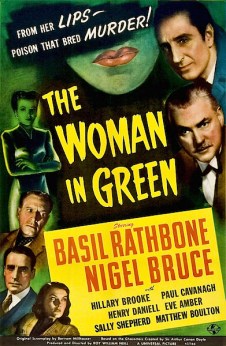 Basil Rathbone’s Sherlock Holmes starred in films which, although they typically involve murder, are best described as “adventures”. The series’ 11th film, The Woman in Green, is one of the few — perhaps the only one — that could genuinely be described as dark and grim.
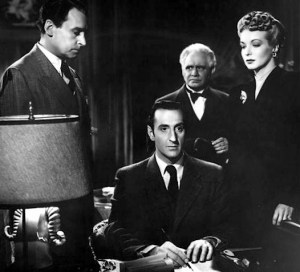 The evil is carried off with aplomb by Daniell. Reportedly a cold actor to work with, he chills on the screen too. This is a man you can believe would carry out such a scheme without a single twang to his conscience. His comeuppance, even with its surprising finality, is welcomed. The titular woman, played by Hillary Brooke, is one of Moriarty’s cohorts, posing as the ‘girlfriend’ of the aforementioned widower in order to set him up. The film is of course in black & white, so we can’t see what colour she’s wearing, and no one ever refers to it — even when they’re hunting for her based on looks alone. I guess someone thought it was an evocative title nonetheless.
 Released the same year as
  Even with the undercurrents of grief and the difficulties of moving on, this is fundamentally a light, amiable romance.
 Jackie Chan’s breakout hit sees him as Chien Fu, the floor-scrubber-cum-punch-bag at a martial arts school where he bumps into Pai Cheng Tien (Yuen Siu Tien), one of the last two proponents of the Snake Fist style after its other students were murdered by their old enemies, the Eagle Claw clan. The old man trains Chan so he can overcome his bullying schoolmasters, while the Eagle Claw grand master (Hwang Jang Lee) hunts for his last remaining rival…
 Also striking is the music score, a strange mix of weird, cheap, dated, electronic stuff… and yet, it’s so odd I kind of warmed to it. It’s all poached from elsewhere, which was apparently the way things were done in Hong Kong at the time. Stand-out tracks are Magic Fly by Space and Oxygene Part II by Jean Michel Jarre, though bits of famous scores are in there too, most recognisably (for me)
