Six of One & Half a Dozen of the Other
My challenge-within-a-challenge (in which I must attempt to watch 12 renowned films within the next 12 months) returns for a third year, this time with a natty subtitle — or for short, WDYMYHS:SoOaHaDotO.
Yeah, let’s not call it that.
Why the unwieldy subtitle? Well, since its inception (in the distant past of two years ago), WDYMYHS has been torn between recommending critically-acclaimed must-sees and widely-popular must-sees — the first year erred towards the former, in reaction the second year skewed to the latter. This year, I had an epiphany: why make a list that tries and fails to serve two masters, when you could just make two lists?
No, I’m not going to try to watch 24 specific films (I know my own limits. Well, I don’t, but that’s one I know is doomed), but rather two lists of six — one of critically-acclaimed films, one of more populist movies. Hence the Clever subtitle.
As with last year, we’ll get straight to the two lists, and follow it up with not-for-everyone analysis of how they compare to previous years and an overlong explanation of how they were devised.
The Critical List
Raging Bull (1980)
Score: 608
TSPDT #21 | Sight & Sound 2012 #29 | featured on 1001 Movies to See | Academy Awards Best Picture nominee
The Passion of Joan of Arc (1928)
Score: 599
TSPDT #15 | Sight & Sound 2012 #12 | featured on 1001 Movies to See
L’Atalante (1934)
Score: 589
TSPDT #17 | Sight & Sound 2012 #14 | featured on 1001 Movies to See
Persona (1966)
Score: 587
TSPDT #24 | Sight & Sound 2012 #16 | featured on 1001 Movies to See
Le Mépris (1963), aka Contempt
Score: 554
TSPDT #38 | Sight & Sound 2012 #27 | featured on 1001 Movies to See
The General (1926)
Score: 553
TSPDT #36 | Sight & Sound 2012 #43 | featured on 1001 Movies to See
The Populist List
A Clockwork Orange (1971)
Score: 1,116
IMDb #75 | Empire 500 #37 | Empire 301 #54 | iCM Most ✓ed #83 | Reddit #50
City of God (2002)
Score: 782
IMDb #22 | Empire 500 #177 | Empire 301 #132 | Reddit #58
To Kill a Mockingbird (1962)
Score: 587
IMDb #81 | Empire 500 #180 | Empire 301 #132 | Reddit #121
The Thing (1982)
Score: 501
IMDb #167 | Empire 500 #289 | Empire 301 #64 | Reddit #118
Brazil (1985)
Score: 483
Empire 500 #83 | Empire 301 #106 | Reddit #154
Princess Mononoke (1997)
Score: 480
IMDb #72 | Empire 500 #488 | Empire 301 #203 | Reddit #91
(All rankings were correct at the time of compiling and may have changed since.)
Good lists? Bad lists? Please do share any and all opinions. As per normal, my progress will be covered as part of the monthly updates.
Now then:
Stats
I’ll come to how all of that was compiled in a minute, but first a few (well, quite a lot, because you know I like these bits) observations.
First, those scores — pretty meaningless without knowing the method, I know (we’ll come to that, jeez!), but you can’t help but notice how high A Clockwork Orange’s is. Here’s the best I can do for perspective: what I’m calling “the theoretical maximum” for the Populist List is 1,636 points (it’s actually possible to score more, but let’s not get into that). Compared to that, A Clockwork Orange scored 68.2%. Sound low? The film in second place, City of God, comes to 47.8%, while the last included film, Princess Mononoke, has just 29.3%. The world really wants me to watch A Clockwork Orange. The Critical List is much closer: the “theoretical maximum” there is 908, from which Raging Bull has 67%, whereas last-place The General has 60.9%.
Long-time readers will surely have remarked on the inclusion of Raging Bull. It was part of 2013’s inaugural list, but I failed to watch it. It was excluded from re-inclusion in 2014’s, but I intended to watch it of my own accord (as it were)… and failed. I decided a year was long enough to hold out — especially as it topped the Critical List and came second on the Populist List — so it’s back in. I think this will be a new rule going forward: if I fail to watch a film, it has to ‘sit out’ the next year, but is eligible for inclusion the year after.
I have to say, the Populist List didn’t really turn out the kind of films I was expecting — I thought it would be an entire list of movies like The Thing and Brazil. I suppose it proves a point I’ve made in the past: despite their reputation among cineastes, lists like the IMDb Top 250 and Empire’s reader polls aren’t completely stuffed with blockbusters. OK, you’re not getting the depths of arthouse on there (i.e. the stuff the Critical List has selected), but A Clockwork Orange and City of God are hardly Transformers 4. Well, I haven’t seen them, so I suppose maybe they are…
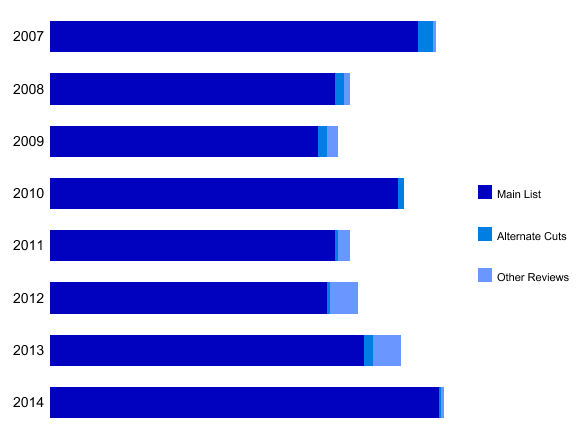
I actually tried to make both lists skew ‘newer’ (not because I dislike older films, but because some of these lists tend to be a bit biased against them — TSPDT admits they ‘punish’ newer films), but it barely came out at all in the final 12: the newest film is 2002’s City of God, which is 13 this year; the next is Princess Mononoke, which is 18. I suppose that’s better than 2013, when the most recent film was from 1984. The effects were felt further down the chart, but that’s of little relevance to me now; though if I’d locked out Raging Bull entirely, 2011’s The Tree of Life would have nipped in. (More on this later.)
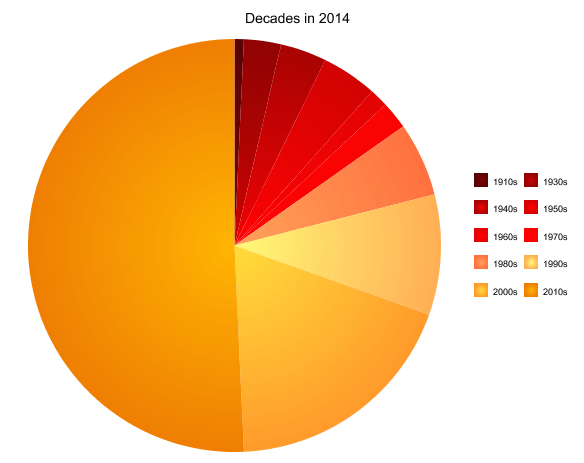
For what it’s worth, The General and The Passion of Joan of Arc are the two oldest films to have featured in WDYMYHS, and L’Atalante is fourth (third being City Lights from 2013’s lot). That extreme aside, this year’s list are quite spread around: whereas 50% of 2013’s were from the 1950s and 50% of 2014’s were from the last 20 years, no such pithy evaluation can be made this year. The ’60s and ’80s present three films each; there’s the two from the ’20s already mentioned; and then one apiece from the ’30s, ’70s, ’90s and ’00s. The 76 year gap between the oldest and newest pips 2013’s 53 years and 2014’s 73 years.
It’s also worth noting that there’s a greater variety of languages and countries of production included this year. Non-English films made up three in 2013 and two in 2014, but this year it’s six — half the list! That said, The Passion of Joan of Arc is actually silent, and I may well watch the Neil Gaiman-penned English dub of Princess Mononoke, both of which would take the wind out of these sails a bit.
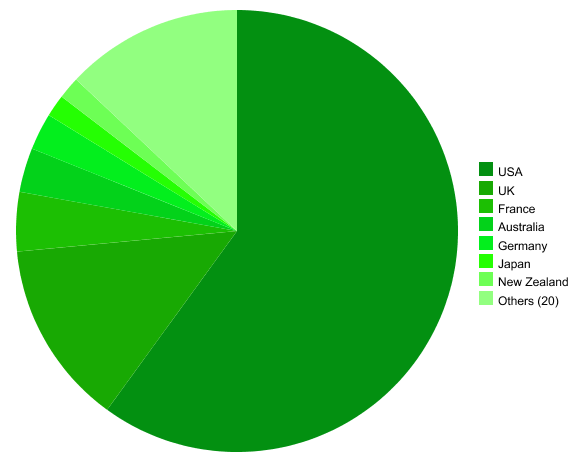
The countries of origin are undeniably spread, though. Ignoring co-production technicalities, last year only offered two non-American movies, and the year before four (the three foreign language ones plus Lawrence of Arabia, which I’ve got down as a US/UK co-production but am counting as British). This year, the US is still highest, but only with four films — there’s France thrice and the UK twice*, as well as Brazil, Sweden, and Japan.
As for directors, Kubrick’s back again, in the form of A Clockwork Orange (obviously). No surprise there, as it was ranked very highly in each previous year but eliminated under the “no repeat directors” rule. Full Metal Jacket and Barry Lyndon also made their way into the Top 6s (the former for Populist, the latter for Critical), but were similarly eliminated. I guess one will end up on 2016’s list (unless I drastically change how I do this… which I might). After sitting out last year, there’s a return for Bergman, in the shape of Persona. For the first time, no Hitchcock or Charlie Chaplin — they both had multiple entries near the top in previous years, but this time Chaplin managed 18th on the Critical list with The Gold Rush, while Hitchcock’s first appearance is on the same but way down at 70th. 70th! On the Popular list, it’s not until 84th. Have I seen all the great Hitchcock movies already? There’s an awful lot of his films I’ve not seen, and I thought some were well-liked (whither The 39 Steps?**), so I’m quite disappointed about that.
Other noteworthy directors included are John Carpenter, Carl Theodor Dreyer, Terry Gilliam, Jean-Luc Godard, Buster Keaton (taking Chaplin’s place?), Hayao Miyazaki, Martin Scorsese (for the second time… with the same film), and Jean Vigo. The list is rounded out by City of God’s Fernando Meirelles, who made the excellent The Constant Gardner before seeming to slip back into obscurity, and To Kill a Mockingbird’s Robert Mulligan, who I don’t know anything about and (to be frank) doesn’t seem to have helmed anything else noteworthy.
The curious among you may be wondering (by which I mean, I wanted to know so thought I may as well tell you) what other films would have been included if I’d taken all 12 from either list? Well, the next six eligible films on the Critical List would have been, in rank order, Barry Lyndon (re-included because of no Clockwork Orange), The Tree of Life (as mentioned), Ugetsu Monogatari, Shoah, The Wild Bunch, and The Magnificent Ambersons. (Fanny and Alexander and Wild Strawberries also scored enough to qualify, but Persona rules them out.) On the Populist List, what I was saying about “films like The Thing and Brazil” would have been borne out: the extra six would have been Raging Bull (having not been blocked by the Critical List), Drive, Rocky, District 9, The Sting, and Black Swan. (I know those films aren’t like the others, per se, but hopefully you see what I’m driving at.)
Process
This year’s scoring system is heavily based in last year’s, with some tweaks and changes, for various reasons.
The most obvious is that there are two lists, using two completely separate sets of contributing lists. The basic principles are the same for both, though: I took the top 250 entries on each contributing list and those films received a score out of 251 for their position — so #1 would score 251 points, #2 would score 250, and so on down to #250 scoring 2 points. Many of the lists go past 250 entries, however, so any film lower than that (but which came to my attention by being in the top 250 of a different list) received a single bonus point just for appearing.
There was a further 50 point bonus for appearing in the top 250 of more than one list. Last year that was an extra 50 points for each additional list; this year it’s a one-time deal. As with last year, there was an additional bonus based on the number of ‘official lists’ a film appears on at iCheckMovies.com — i.e. A Clockwork Orange is on 30 lists, so got 30 points.
With the basics established, let’s get list-specific:
The Critical List was compiled from:
- They Shoot Pictures, Don’t They?’s 1,000 Greatest Films (2014 edition).
- Sight & Sound’s 2012 poll, using the combined votes of both critics and directors. I don’t believe this is listed on S&S’s website, so I used the results as they appear on iCheckMovies, taking into account the shared vote numbers (as detailed at the top of the link). So, for a random example, #166 would score as if it were #154.
- The 21st Century’s Most Acclaimed Films, as compiled by TSPDT. As mentioned before, the main TSPDT list is biased against recent films, so this was added to help correct the balance.
- 1001 Movies You Must See Before You Die — the edition currently on iCM, which lists movies released as recently as 2013. This list is unranked, so anything that had been noted due to the previous three received 50 bonus points for an appearance here.
- Academy Award Best Picture Nominees. Similar to the above, anything featured here received 25 bonus points.
Finally, to help swing the list further in favour of recent films, the top 100 of the 21st Century’s Most Acclaimed received another 25 points. Fat lot of good it did any of them.
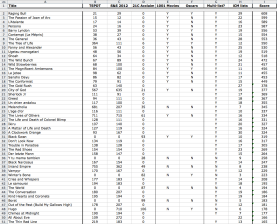 Now, here’s an interesting thing: I very quickly got bored doing the maths on all this. The previous two years, I’ve worked it all out in my head as I went. Year One, very easy (A+B ÷2); Year Two, more complicated, but doable; Year Three, two whole sets of rules and so many films…! So I spent an afternoon learning a bit more about how Excel works and got it to do it all for me. Imagine an evil laugh here.
To work out the scores for the Critical List, then, here’s the code (is it code? It looks like a code. Let’s call it code) that I wrote:
=SUM(IF(B2=0,0,(IF(B2<251,252-B2,1))))+(IF(C2=0,0,(IF(C2<251,252-C2,1))))+(IF(D2=0,0,(IF(D2<251,252-D2,1))))+(IF(E2="Y",50,0))+(IF(F2="Y",25,0))+(IF(G2="Y",50,0))+H2+(IF(D2=0,0,(IF(D2<101,25,0))))
That does everything I just described, automatically, when the correct values are entered in the correct columns — i.e. the ranking for each list, plus Y or N for 1001 Movies and Oscar noms. I’ll be frank, this is one reason there’s only the single multi-list bonus this year — that’s what I wrote into the code, and when I remembered later that it wouldn’t be adding another 50 for the third, fourth, etc, lists, I frankly couldn’t be bothered to work out how to do that. I’d wager it can be done, though.
The Populist List has even more constituent elements — and an even longer (though, technically, less varied) code to work it out. First, the contributing lists were:
- The IMDb Top 250 — aka the movie list. Well, until TSPDT came along. Now I guess it depends on your personal preference which is more relevant. This changes all the time, so was very much the version hosted by iCM on 5th January 2015.
- Empire’s The 500 Greatest Movies of All Time, commonly known as the Empire 500. Supposedly “the most ambitious movie poll ever attempted”, it was conducted by Empire magazine in 2008 and features the opinions of “10,000 Empire readers, 150 of Hollywood’s finest and 50 key film critics”.
- Empire’s The 301 Greatest Movies of All Time, aka the Empire 301. Technically the new version of the above, held last year to mark Empire’s 300th issue. Arguably not as good. As you can see from the numbers up above, some films have moved around a lot.
- iCheckMovies’ Most Checked, being the movies the greatest number of iCM users have seen. I think one of my most-complete lists, as I’ve seen 209 of the 250.
- The All-Time Worldwide Box Office chart, not that it had any bearing on the final selection (you’ll note none of them are on it).
- The Reddit Top 250, in which Reddit users have picked their favourite movies. Constantly updated a la the IMDb version, I believe.
As mentioned before, those were all initially limited to the top 250 entries and weighted equally. Following that, however, there were 25 bonus points to be had for being in IMDb’s top 100, the Empire 301’s top 50, or iCheckMovies Most Checked’s top 50. All of that made the Excel code look like this:
=SUM(IF(B34=0,0,(IF(B34<251,252-B34,1))))+(IF(C34=0,0,(IF(C34<251,252-C34,1))))+(IF(D34=0,0,(IF(D34<251,252-D34,1))))+(IF(E34=0,0,(IF(E34<251,252-E34,1))))+(IF(F34=0,0,(IF(F34<251,252-F34,1))))+(IF(G34=0,0,(IF(G34<251,252-G34,1))))+(IF(H34="Y",50,0))+I34+(IF(B34=0,0,(IF(B34<101,25,0))))+(IF(D34=0,0,(IF(D34<101,25,0))))+(IF(E34=0,0,(IF(E34<101,25,0))))
I don’t expect you to understand or have a use for that, I’m just showing off.
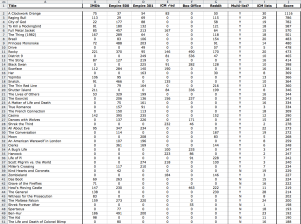 In the end, there were 121 films on the Populist long list and 82 on the Critical one. If you want to have a look at the top 50 of each, as featured in the small pictures earlier and to the right, you can find full-size versions here and here. You’ll note the Critical List isn’t filled out in full. At the end of a long day of list-making and code-writing, I couldn’t be doing with scouring the 1001 Movies and Oscar nominees lists for films that, even with those bonus points, couldn’t make the top 12 (never mind the top 6 that actually mattered). The reason some further down are filled out is because they were done incidentally as I went, for one reason or another. (You’ll also note that the row numbers are out by one from the ranking numbers, which is thanks to the Title row. Sadly I don’t know how to change that, if you even can.)
The End
And so there we have it! It felt less complicated a system than last year to me when I set out, I think because last year I was working out/making up all the rules and this year just tweaking and re-applying them. Making Excel do the heavy lifting for me, though, that was new and tricky, but worth it.
Now all I’ve got to do is actually watch the films…
* These numbers are somewhat debatable. For the record, I’ve counted A Clockwork Orange as British. ^
** I did a quick test to find out, and it should actually be in the mid-50s on the Critical list. Why wasn’t it included? Because the only numbered list it appears on is TSPDT, at 511th, and I only went up to 250th when first compiling from there. Its appearance on 1001 Movies gives it a big points boost after that. This does slightly concern me: how many other films am I missing that would have scored just as well? However, I don’t think it’s possible for anything like that to have cracked the Top 6, so in the end it doesn’t really matter. ^


 A behind-the-scenes making-of with a difference, American Movie: The Making of Northwestern (to give its full title) is a documentary about wannabe-filmmaker Mark Borchardt attempting to produce a horror feature film with little more than some mates and good intentions, battling against a lack of money, interest, and dedication. It descends, quickly, into the kind of farcicality that leads some to assume it’s a This is Spinal Tap-style spoof. But it isn’t. It’s real.
 Whatever you take away from it, American Movie feels like a must-see for certain sections of film fandom, particularly anyone who wants to make a movie themselves. Its appeal is broader than that though, an everyday story of adversity that isn’t so much overcome as temporarily averted. It’s not bleak or sad, but it is melancholic. And, whatever the morals of it, often laugh-out-loud funny.
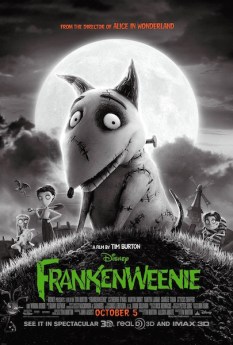 Inspired by two of Burton’s early-’80s shorts (which are most commonly found on
  Some say it doesn’t have enough of an edge. Well, maybe; but I thought it was surprisingly dark in places. Not so considering it’s a Tim Burton film based on resurrecting the dead, but for a Disney-branded animation, yes. Those edgier bits are here and there rather than consistent, but still, I’m not sure what those critics were expecting from a PG-rated Disney animation. I guess there’s an argument that Burton should have pushed it further and aimed for an adult audience, but can you imagine an American studio agreeing to finance an animation primarily targeted at anyone who’s entered their teens? Because I can’t.
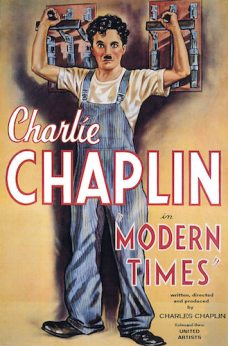 Charlie Chaplin satirises technology and modernisation in arguably











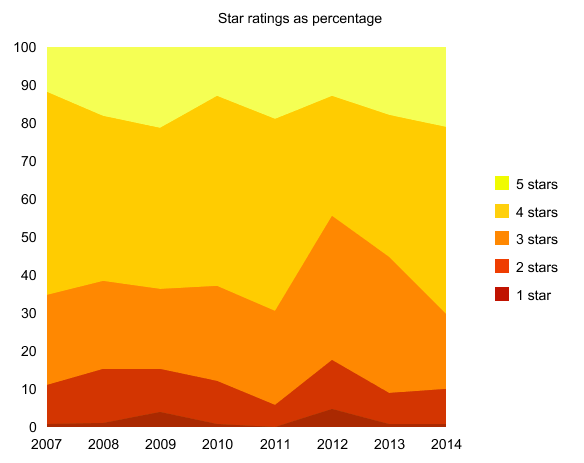
 Yet another record: for the first time ever, all of my top ten films are ones I awarded a full five stars to. That’s once again testament to the quality of this year’s viewing, because I felt sure at least one four-stars-er would make the list. To be precise, that was
 22 Jump Street
 The Equalizer
 The Hobbit: The Battle of the Five Armies
 Lucy
Lucy
 Paddington



















 1981: Steven Spielberg reads a French review of his movie
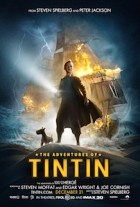
  Apparently some Tintin purists weren’t so keen on the actual adaptation — elements of The Crab with the Golden Claws have been mixed in to a plot primarily taken from The Secret of the Unicorn, the sequel/second half of which, Red Rackham’s Treasure, is reportedly used sparingly. Plus, in the original tale Sakharine is a minor character who wasn’t responsible for much, apparently. As someone who’s only read one of those three volumes, and even then not since I was young, such things didn’t trouble me. What superstar screenwriters Steven “
 The slapstick is mainly hoisted by Simon Pegg and Nick Frost as the physically-identical Thomson and Thompson — a true advantage of animation, that. I imagine some find their parts tiresome because of their inherently comic role, but they’re likeable versions of the characters. Even more joyous is Snowy, though. Well, I would like him, wouldn’t I? His internal monologue, such a memorable part of Hergé’s books, is omitted (as it is from every film version to date, I believe), but he’s full of character nonetheless. Some of the best sequences involve Snowy running in to save the day. I don’t think they quite got the animation model right (the one glimpsed in test footage included in behind-the-scenes featurettes looks better, for my money), but his characterisation overcomes that.
 Of course, one very important person is neither British nor Belgian: Spielberg. The screenplay’s balance between peril and comedy is spotlessly enhanced by his peerless direction. In a world stuffed to the gills with lesser blockbusters that palely imitate the groundwork Spielberg and co laid in the ’70s and ’80s, work like this should remind people why he’s still the master of the form. The film is shot with an eye for realism (so much so that some viewers have been convinced it was filmed on real locations with real actors, with some CG augmentation for the cartoonish faces, of course), which helps lend a sense of plausibility and also genuine jeopardy. It’s easy to get carried away when working in CG animation, but often the most impressive works are ones that behave as if they’ve been shot largely within the limitations of real-world filmmaking technology.
 The tone on the whole is resolutely PG — actually, like many an action-adventure blockbuster used to be before everything went slightly darker and PG-13. So, for example, Tintin wields a gun on occasion, but never at another human being. The focus is on the story, which happens to lead to some adrenaline-pumping sequences, rather than a lightweight excuse to link together a bunch of punch-ups and chases. Ironically (though, for anyone who knows what they’re talking about, entirely expectedly) this makes the action all the more exciting. It also mean there’s a lighter touch than many current blockbusters offer; a greater presence for humour, including among the action. I guess that’s not fashionable these days, when everyone’s become so po-faced about their big-budget entertainment. However, with the likes of
  but some viewers would have seen it (even subconsciously) as more of a “real movie”.
 As well as those two, the final list for the year includes…
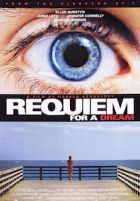 #129 Another Thin Man (1939)




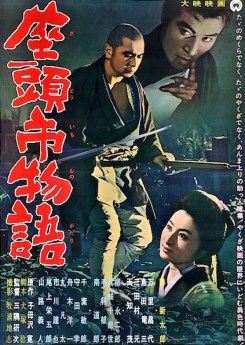 Adapted from a short story by Kan Shimozawa, The Tale of Zatoichi was a low-key release for its studio, Daiei: despite being helmed by “a topflight director”
 But enough hyperbole — what about The Tale itself? The story sees blind masseuse Zatoichi accepting an old invitation to visit an acquaintance, Sukegorô (Eijirô Yanagi). But Sukegorô is a yakuza boss, and he presses Zatoichi to join his side in a brewing war with rival Shigezô (Ryûzô Shimada) — because although he’s blind, the masseuse has legendary sword skills. On Shigezô’s side is a hired samurai, Hirate (Amachi), who Zatoichi encounters by chance. Despite the mutual respect between these two coerced warriors, the eventual gang battle comes down to a duel between them…
 Those prepared for a calmer, more considered film may find much to like, however. Katsu’s understated style holds your attention and makes you want to learn more about the character; not his past, necessarily, but his qualities as a man. The same is true of Amachi, in some ways even more appealing as the doomed ronin. You get a genuine sense that Zatoichi and Hirate would have had a great, long-lasting friendship if they’d met under better circumstances, which makes the manner of their encounter all the more tragic. For all the bluster about a big gang war on the horizon, it’s the relationship between these two men that forms the heart of the film.
 Reportedly this opener is “not the best of [the] series”, but remains “a grand introduction to the character and a touchstone for many of the themes and gags presented in the later films”.
