
Bill Condon | 113 mins | streaming (HD) | 2.35:1 | USA / English & Portuguese | 12 / PG-13

And so we reach the final book in the Twilight Saga… but not the final film, because Breaking Dawn hails from the era when Young Adult adaptations routinely split their final book in two, all the better to make more money fully adapt the story. Sparked by the success of Harry Potter and the Deathly Hallows, said “era” lasted all of five years, taking in Twilight and The Hunger Games, before the two-part adaptation of the Divergent series’ finale was cancelled halfway through due to poor box office.
But back to Twilight. Breaking Dawn, Part 1 starts with an event promised by the end of the previous movie: the wedding of human Bella (Kristen Stewart) to vampire Edward (Robert Pattinson). Sorry, Team Jacob; but let’s be honest, he never stood a chance. The double-length running time afforded this book means the film can spend its whole first half-hour indulging in the nuptials, which I imagine is the kind of thing fans of this series would revel in, so fair enough.
Then Bella and Edward head off on a romantic honeymoon, and after spending three movies being an analogy for the wonders of chastity, the lead couple getting married means they can finally get. it. on! PG-13 style, of course (I believe some thrusting was cut to retain the teen rating in one or both of the UK and USA). Nonetheless, Edward’s so vigorous that he completely destroys the bed — well, the poor guy has been waiting for about 100 years. He also leaves Bella with some cuts and bruises, making him reluctant to go again. This leads to an extended montage where the newly wed girl desperately tries to get laid while the newly wed guy does his best to avoid it. It’s almost transgressive in its role reversal, except Twilight is too coy to present this quite explicitly enough to really nail that gag. Besides, if you’re looking for a human-vampire relationship that nails the sexual politics of teen relationships, Buffy got there over a decade earlier.

Despite the paucity of their lovemaking, and the fact that one of the pair is technically dead, Bella winds up pregnant, with the baby growing in super-double-quick time and sucking the life out of her. Well, it is at least half vampire — that’s kinda their thing. All this means trouble for Bella’s life, but she insists on keeping the foetus — or baby, as one character forcefully points out when another refers to it as a foetus. Hm, I wonder what the conservatively-minded author might be drawing parallels with now? In fairness, it depends a certain amount on how you choose to read it. Screenwriter Melissa Rosenberg has said she is pro-choice and wouldn’t have agreed to do the film if she felt it violated her beliefs, while acknowledging she had to find a way to not offend the beliefs of “the other side”. So, almost everyone tries to dissuade Bella from sticking with the pregnancy, but they let her make her own choice… and (major spoilers!) it ends up killing her. So they were right, basically.
And that’s the entire movie, more or less. Well, it is only half the story. I think it’s the knowledge of it being only half the book that led many critics to describe the film as slow and light on content (you always see such comments about multi-film adaptations of single books), because while it’s hardly fast-paced, I didn’t think it was notably less incident-packed than previous Twilight movies. Mind you, that probably says less about the pacing of this film and more about how little actually happens in all these movies.
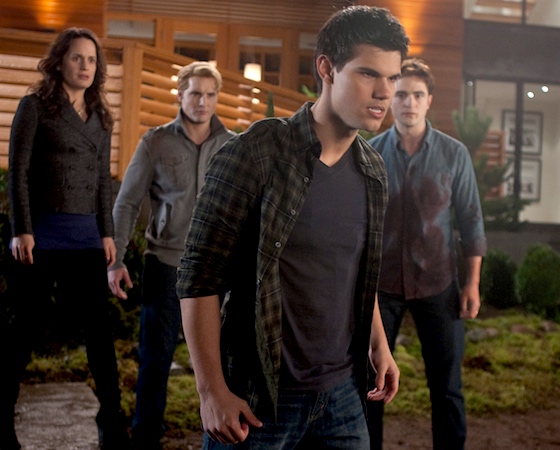
However, despite choosing to adapt only half the story, it still feels like the plot is making jumps at times. For example: Jacob (Taylor Lautner) and his werewolf buddies factor into things because they want to kill Bella’s devil-kid, but there’s also the matter of a treaty between the vampires and wolves (which I can’t remember the details of, so don’t ask). The film makes a point of emphasising that the wolfpack leader doesn’t want the treaty to be broken, then later on it’s stated that in his mind the treaty is broken. Now, okay, we can connect those dots ourselves, but really it’s missing a scene where the guy undergoes this about-turn of opinion. And yet, despite such missing links, director Bill Condon finds time for numerous sequences where people do nothing while a mournful song plays.
On the bright side, Condon does manage to create a sequence that is the nearest this series has ever got to being an effective horror film (well, apart from Edward being a creepy stalker in the first film). It’s basically the ending of the movie, so, again, massive spoilers. So: Edward eats the baby out of Bella, who promptly dies, forcing Edward to flood her corpse with venom by biting her all over, which seems to do pretty awful things to her organs — that’s the scary bit, though it doesn’t sound particularly terrifying when you put it like that. Potentially more emotionally scarring is that, meanwhile, Jacob is off falling in love at first sight with Bella and Edward’s baby. That’d be their creepy CGI baby, which is roughly as convincing as a plastic one in a Clint Eastwood movie.
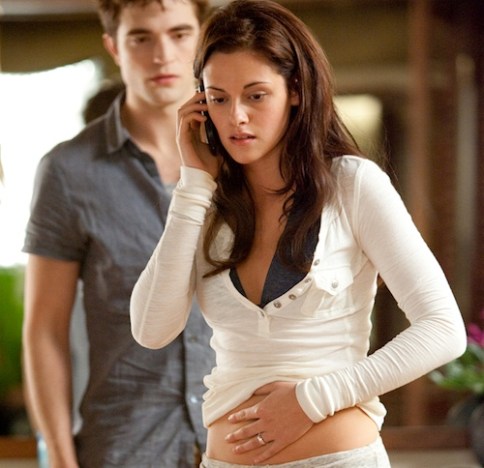
Not that the acting of the humans is much more convincing. Kristen Stewart had a promising career before Twilight, and seems to have managed to reignite it as something of an arthouse darling afterwards, but here she’s just a personality vacuum. The film starts with her delivering a couple of lines of voiceover, and even from just that she manages to sound terminally bored. Later she asks, “why can’t you see how perfectly happy I am?” Probably because you’re not putting any effort into your performance, love. And yet, the less said about the rest of the cast, the better. Lautner doesn’t even get to wheel out his surprisingly-effective comedy chops this time.
But for all the terribleness, I sort of feel I can’t hate it, because the rubbish bits are too funny, and the mad bits too bonkers (for a movie that is primarily aimed at romantically-inclined teenage girls, at least). While I wouldn’t say I enjoyed it, it was entertaining to sit through — kind of like The Room, for example, only still not quite as transcendently appalling.

Join me this time next year when I finally finish this thing off. Unless I decide to do it next month, because Part 2 is currently sat on Netflix going “finish meeee”…









 The 37th season of Doctor Who begins with the show’s biggest soft-reboot since at least 2010; arguably, since 2005; arguably, ever. With a new showrunner comes a new broom, and so we have a new Doctor, a new TARDIS, a new set of companions — sorry, they’re “friends” now — new locations, new monsters, and a new style (thanks to a raft of behind-the-scenes changes, including a new effects company, swish new cameras and lenses, and a new aspect ratio). It’s the perfect jumping-on point… and it worked, with the premiere achieving the show’s highest ratings for a decade; or longer, depending how you count it.
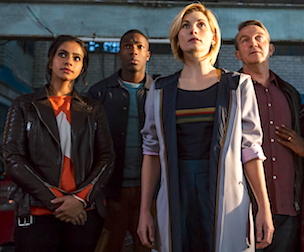 Indeed, even as it’s open-armed and newbie-friendly, Chibnall’s era already seems as Who-literate as you’d expect from such a long-time fan (somewhat (in)famously, as a teenager in the ’80s Chibnall appeared on TV criticising the then production team). His sense of what Who should be is at once indebted to the modern era (in particular the years of Russell T Davies, who I suspect may’ve been something of a mentor to Chibnall at one point) and also seeks to reintegrate elements long absent. For example, there’s the expanded TARDIS team, which calls to mind that of the series’ very first group of travellers; though whereas 1963 gave us a teenage girl and two middle-aged teachers, 2018 offers two teenagers and one middle-aged bloke. Such are the changing times. And for dedicated Whovians, the plot of episode two, The Ghost Monument, also had an air of early Hartnell serials, with its episodic trek across a danger-filled alien world. It was a brisk, entertaining 50 minutes, but stop and think about it too much and the cracks begin to show (read
 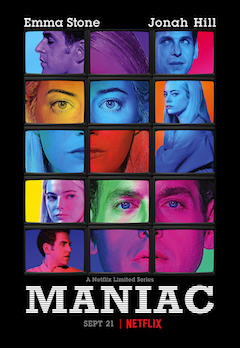 Netflix continue to blur the line between movies and TV with this limited series starring Oscar winner Emma Stone and Oscar nominee Jonah Hill, co-created and directed by Cary “director of the next Bond film” Fukunaga. Well, I mean, it’s a line that other TV producers have blurred plenty in the past — movie stars on TV is far from a new thing at this point, and there’s no doubting this is a TV series rather than a movie (it’s 6½ hours long, for one thing) — but, still. And they bend the rules of TV, too, with individual episodes running everywhere from 26 to 47 minutes. (Does that matter when Netflix’s release-it-all-at-once strategy means you choose how much to watch at any one time? Maybe not. But if you’re the kind to still watch one episode at a time, a word to the wise: I recommend double-billing the ultra-short should-be-one-episode pair of episodes 7 and 8.)
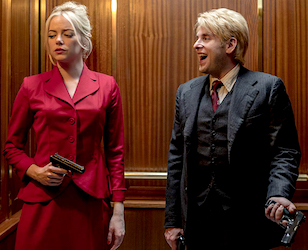 A significant amount of the series’ offbeat likability is down to idiosyncratic direction by Fukunaga, I suspect — the way he’s shepherded the visual creation of this world, the leftfield performance choices across the cast, and so on — but Emma Stone is definitely the MVP. While the aforementioned chemistry between her and Hill is important, and a lot of the rest of the cast get to excel at being quirky and funny, it’s Stone who really brings heart and emotion to the piece, making it more than just a zany fantasy.
 Having just
 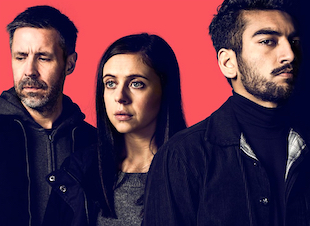 This month, I have mostly been missing Informer, BBC One’s new thriller. Well, it only started on Tuesday, so that’s fair enough, right? I guess I’ll save it up and see how it goes down — I’ve managed to avoid wasting time on a few initially-promising-but-ultimately-poorly-received series with this method; though, equally, it led to
  100Films.co.uk