The Taking of Pelham One Two Three (1974)

2009 #43
Joseph Sargent | 104 mins | download | 15 / R
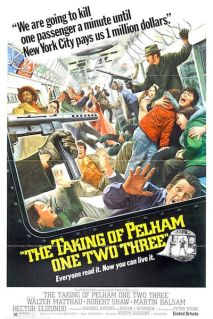
The Taking of Pelham One Two ThreeMovies have taught us many things, and here’s another: don’t take the train from Pelham Bay Park at 1:23. In the past thirty-five years said train has been taken hostage three times, and while once every 11⅔ years may not sound a particularly high average, I’d wager it’s higher than for most trains.

The most recent was this summer, in a Tony Scott-directed remake which unfortunately replaced the titular numbers with, well, numbers in a re-titling move just waiting for reviewers to accuse it of illiteracy. It was criticised for more than just that of course, but one positive is that the original ’70s film cropped up in plenty of places at the time. By which I mean it was on TV once and offered as iTunes’ 99p Film of the Week. But don’t knock shameless tying-in — it means I’ve seen it.

Having not seen either remake (the second was a 1998 TV movie) I can’t compare, but the original is a taught, well-paced thriller. It takes place in something startling close to real-time — a pacing trick I always find pleasing for no explicable reason — but still doesn’t rush things, without ever being slow. Much like the criminals at its heart, then.

Their leader is Robert Shaw, who makes a terrific villain: calm, uncompromising, and British, the primary prerequisite of a perfect Hollywood bad guy. As the unlikely hero, Garber, Walter Matthau is a terrific foil at the other end of the phone, dryly sardonic as he attempts to effectually organise a dozen services. There are also the occasional injections of humour; never inappropriate, instead making the situation feel all the more real.

Unfortunately, for almost every great element there’s a flawed one. The ending is a bit dubious, with the much-hyped escape plan nothing exciting — they simply override the one plot device that stands between them and the most obvious plan. Equally, Shaw’s death, while quite a neat ending for a villain, doesn’t seem to make a whole lot of sense for his character. Mr Green’s sneezing is a handy device, though for my money its ultimate use became obvious the moment Garber first heard it.

And though the credits snappily define all 18 of the hostages (The Homosexual, The Pimp, etc), for the most part it doesn’t really matter — most of them never even speak; at best, only one or two are really characterised. It’s a shame, because having such clear types could be put to good use in all sorts of ways, be it just for laughs, subverting stereotypes, or something as deep as social commentary.

The original Taking of Pelham One Two Three is still an excellent film, but these little niggles take the edge off its quality.

4 out of 5

Shadow of the Vampire (2000)

2009 #56
E. Elias Merhige | 81 mins | TV | 15 / R

Shadow of the Vampire“What if Max Schreck really was a vampire?” is the simple, thoroughly daft, and equally promising, premise of this low-budget horror/drama/comedy.

Having the advantage of such a good concept to kick things off, all starts well, but the longer it runs the more it loses it. Screenwriter Steven A. Katz seems unsure of what Shreck/Orlok actually wants or what the rules governing his existence are, leaving him little more than a threat for the sake of a threat. Still, Willem Dafoe’s performance in the role is brilliant, reveling in the chance to overact — and yet, somehow, subtly overact — as a silent movie vampire. The rest of the cast are fine; in particular, the obsessive and mildly unhinged Murnau seems to suit Malkovich down to the ground. It’s also scary in places, as it should be, because it’s a vampire horror movie that just happens to take the making of another real one as its starting point. Unfortunately, as the plot becomes confusing and ill explained towards the end, so the scares dissipate alongside the viewer’s understanding.

My confusion over the film’s third act may have an external explanation, however. The BBFC list the PAL running time as 88 minutes, but BBC Four’s showing only just hit 81. It certainly felt like there was a chunk missing somewhere in the middle — a slew of characters just disappear and there’s an unexplained leap in the plot — but I can’t think of a reasonable explanation for why or how the BBC would cut seven minutes out of the middle of a film, and the only detailed plot descriptions I can find don’t describe anything I missed.

Nonetheless, even allowing for omissions Katz gives up on any semblance of following the facts toward the end (and throughout, apparently): almost everyone involved is slaughtered, even when they clearly survived in reality, while one character is driven out of his mind, even when he clearly wasn’t… well, presumably. That said, we all know Schreck wasn’t a vampire — his life isn’t nearly mysterious enough to allow for the possibility, should you even believe in such a possibility being possible — so with that leap already taken, why not take as many others as you fancy? Perhaps because it’s not as clever, and not nearly as much fun, as fitting the preposterous tale around the known facts.

Merhige’s direction is occasionally very interesting, such as a couple of grand shots early on, but at other times is perfunctory. To be kind, one might say he goes too far in the aim of replicating silent film style — certainly the intertitles that needlessly replace chunks of the plot are a step beyond. He does manage to create and maintain a weird, unsettling atmosphere, which remains even when all sense disappears.

It’s difficult to accurately assess a film when it appears a good chunk has been lost somewhere in the middle, especially when one suspects some of its major flaws — namely, a lack of coherence at the end — may be due to this omission. On the other hand, I can’t find any evidence that something has been cut, so maybe it just doesn’t make sense? Either way, even on the evidence of what I’ve seen it feels like Shadow of the Vampire takes a good idea, runs well for a while, but winds up uncertain of what to do with it. Though it remains interesting, I won’t be rushing to see any fuller form.

3 out of 5

Brute Force (1947)

2009 #73
Jules Dassin | 94 mins | TV | 12

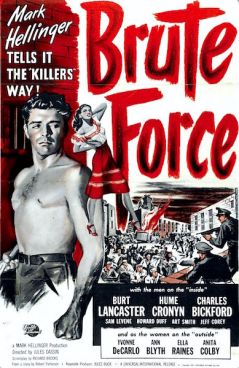
Brute ForceJules Dassin’s prison-set noir concerns a group of inmates trying to escape from the cruel regime of a vicious warden, allowed free reign by an ineffectual governor and target-driven bureaucrats (nothing changes, eh?)
Tonally, it’s varied. Early on it’s quite humourous, with a weak warden, jaunty calypso-singing inmate (who occasionally threatens to tip the whole thing over into a musical) and amusingly drunk doctor. Then there are the flashbacks to the outside world, laden with undercooked romance and awkward dialogue. In the final act it turns decidedly grim: warden Munsey lives up to his lowly reputation, goading one prisoner to suicide and beating another close to death, while the other wardens listen on from outside; one of the good guys betrays his mates, ultimately leading to wholesale slaughter as the escape plan goes awry. A balanced, varied tone is not necessarily a problem, but the flashbacks are almost uniformly unwelcome asides and, by separating the distinctly comical from the resolutely grim by placing them firmly at either end of the film, they don’t quite gel as a whole.

Still, the climactic prison break — including the build-up — is a brilliant extended sequence. Tense, epic and exciting, it concludes with a fantastic action sequence. It also delivers a powerful moral message, underlined by its direct delivery from a prison staff member rather than an inmate. It goes some way to make up for the earlier flaws, like the dialogue that’s occasionally typical of the period’s worst — “I’m just a guy who… explained his entire backstory in one slightly long and unwieldy sentence to someone who already knew it”.

What gets forgotten in all this, perhaps most depressingly, is the fate of those on the outside. We’re told early on that Collins’ love is refusing treatment for her cancer until she sees him again. This seems ready-made to provide justification for a prisoner to escape; indeed, the whole film is skewed this way, as we never discover many of the inmates’ crimes, and those we do hear are either done for good reason or not that bad. But it toes the more obvious moral line by having no one escape, and while the cancer isn’t mentioned again after the slaughter, it leaves what might otherwise seem a morally justifiable cheat (the prisoners are the good guys here — we expect and want them to triumph — but that they don’t is ‘correct’) with a bitter taste.

3 out of 5

Transporter 3 (2008)

2009 #27
Olivier Megaton | 100 mins | DVD | 15 / PG-13

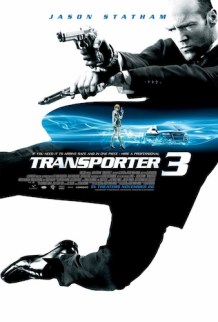
Transporter 3I very much enjoyed the first Transporter film. No, it wasn’t high art, but it did what it did very well — even managing a few outstanding moments — and in a pleasantly efficient running time too. 2005’s sequel kept the latter but sadly lost the former, pushing things too far into the realm of CG-aided silliness. With sequel director Louis Leterrier off bringing some of his much-needed CG silliness to the Hulk franchise, it falls to the amusingly-monikered Olivier Megaton to try to navigate this cars-and-kung-fu series back onto the right road.

Film credits sometimes baffle me. As you may guess, Transporter 3 has a perfect example: “Written by Luc Besson and Robert Mark Kamen. Based on characters created by Luc Besson and Robert Mark Kamen.” I honestly can’t comprehend the need for that second credit. Some may not even comprehend the need for the first one in a film like this, and usually they’d be right. Here, however, Besson and Kamen seem to have decided the presence of writers should be remembered and so stuck in an awful lot of character development. Not only is it not wanted — one of the best things about the first two films was their efficient 80-something minute running times, while this sprawls out to a full hundred — but it’s not very well done either.

Equally, the plot really makes very little sense for much of the film. Worse, when someone eventually explains it, it turns out to be no great shakes, especially as by that point the viewer’s just about pieced it together. I can’t compare it to the first two because, to be honest, I can’t really remember what their plots were, but I don’t remember thinking they were quite so ill conceived. It’s almost a shame, because it isn’t wholly a rehash of the first two — it’s still little more than an excuse to string together some fights and chases, but that doesn’t mean it can’t be different. There’s also a weak villain — never much of a threat, with an attempt at character development that is (of course) misplaced — who’s granted a logic-defying death (albeit with a nice surround sound mix). Overall, the film lacks both the humour and excitement of earlier instalments.

Megaton over-directs and over-edits the action (and a lot else besides) too often — it would be nice to tell what’s going on. Someone also needs to tell him that speeding up footage of two cars racing doesn’t make it more exciting, it just makes it look silly. And he misses apparently-obvious things that would improve sequences. For example, we know Frank’s bracelet flashes between yellow, orange and red as he gets too far away from the car — a conveniently visual warning system — so when someone takes the car and Frank has to run (and cycle) after it to avoid his wrist-bomb going off, we expect a fairly tense chase where the light on Frank’s bracelet-bomb constantly changes colour. But there’s just one half-glimpsed shot of the bracelet in the entire sequence. It’s a glaring omission that robs the setpiece of much of its ingenuity, rendering it a bog-standard chase.

After all the criticism of Transporter 2’s reliance on CGI, most of this sequel features no significant use of it — and that, of course, is a good thing. A car driving at high speed on two wheels between two articulated lorries is just silly if it’s all done with computers; done for real, as it is here, it’s somewhat impressive — exactly as it should be. (By ‘for real’ I mean a real car, real lorries, etc. I’m sure rigs of some kind must’ve been used to actually pull it off.) Unfortunately, after almost an hour and a half of keeping it real, Megaton mucks it all up again by resorting to CGI to pull off the ludicrous climax. Personally, I’d find it pleasantly ludicrous if they’d managed to film a real car doing that stuff on a real train, but the CGI just compounds the silliness.

When a film that exists solely to provide some nice action sequences can’t even do those well, you know you’re in trouble. Transporter 3 should be a mildly diverting piece of action fluff; just a bit of violent fun. I’m not sure if it’s trying to be something more with its added character development, or just generally failing in its primary aims. Either way, it’s still fluffy, but not actually much fun.

2 out of 5

The end is nigh…

No, this isn’t a review of 2012, or any of the numerous other apocalyptic blockbusters that are foisted on us every year. Nor the Watchmen Ultimate Cut, which has that famous phrase of doom and gloom plastered over its back cover. No, this is simply an observation (and little more than that, I’m afraid) that there are a mere 31 days of 2009 left. Indeed, 31 days of this decade.

Cripes.

So, with such limited time remaining, my yearly goal is once again under threat. Long gone are the days of reaching 100 films in September, t’would seem. But fear not, faithful reader, for this time last year I’d only made it to 81, meaning I’m just one behind myself (#80 was Transformers 2. Look, there’s a review already! Isn’t it impressive that I reviewed it on Blu-ray before it was even in the shops? … What do you mean “no”?) — and last year I did indeed make it to 100… just.

20 films, 31 days. Considering my average so far (7.3 films per month) I should only make it to 87. Well, 87.3. But, what was that? Yes, I’m only one behind last year and I did it then (did I say that already?)

Heck, maybe I’ll even push it to 101 this year.

[I didn’t.]

2009’s summary posts will be republished in November.