
Tony Maylam | 91 mins | digital (HD) | 16:9 | UK / English | 18 / R
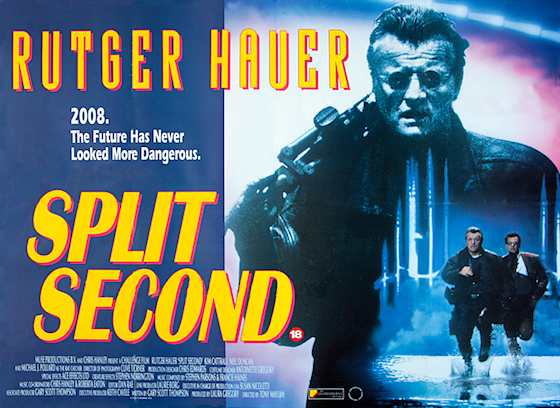
I confess, I hadn’t even heard of Split Second before a remastered Blu-ray release was announced a couple of months ago (more details about that at the end). A sci-fi/action/horror hybrid starring Rutger Hauer is the kind of thing that sounds interesting to me, but the fact I’d never come across it before seemed like a red flag. Fortunately, it’s on Prime Video, so I didn’t have to make a blind buy, and this is a recommendable course of action for anyone similarly unacquainted with the film. I did go on to purchase the Blu-ray, but I can see why others would not. Split Second isn’t exactly in “so bad it’s good” territory, but it has a distinctive quality that will not be to everyone’s taste.
Set in the future-year 2008, when London has been flooded thanks to global warming and pollution has turned day into night, Hauer chomps cigars, chocolate, and scenery as Harley Stone, a badass rogue cop on the hunt for the serial killer who murdered his partner three years ago. Assigned to keep him in check is rookie cop Dick Durkin (Alastair Duncan), and together the pair realise their quarry may not be altogether human…
And if you’re wondering what the film’s title has to do with any of this… yeah, bugger all. One of the working titles was Black Tide, which suits the film so much better. I mean, it’s still not wholly fitting — the global warming/pollution stuff is dystopian-future scene-setting without any true bearing on the actual plot — but at least it evokes the tone and style of the film more than “Split Second”, which sounds like a Steven Segal movie.
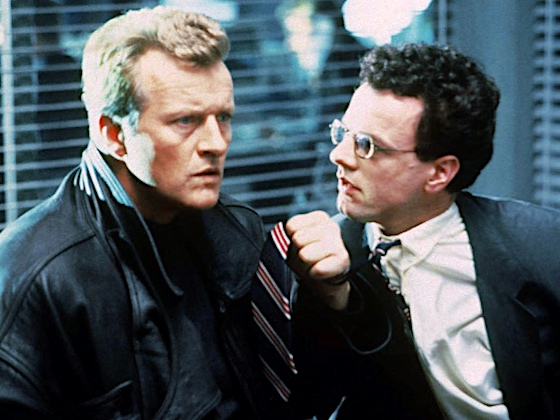
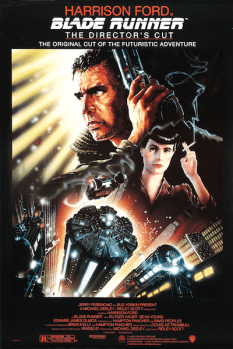
It’s almost hard to describe what that tone and style is, mind. It starts out almost like budget Blade Runner — it’s the future (so we’re told); it’s night; it’s raining; a hardbitten cop visits a seedy nightclub; etc. But then we get Stone’s first line of dialogue, which comes after a guard dog barks at him. He flashes his warrant card — at the dog — and says “police, dickhead.” To the dog. It’s hilariously terrible and awesome in one fell swoop. Hauer doesn’t give it an overtly comical delivery, and so you can’t quite tell if Stone is deadpanning or genuinely offering this information… to a dog.
This kind of almost-a-comedy-but-not-actually tone pops up increasingly as the film goes on, as if it was shot in order and the cast gradually realised how ridiculous it all was. By the time you get to the point where a deranged Durkin is demanding bigger guns, you’ll be cackling. Or you’ll be thinking “what is this godawful crap?!”, which goes back to my initial point: some people will delight in it all, while others will feel they’ve wasted their time on a low-budget no-mark that should’ve been left forgotten in the early ’90s.
I’m the former. You couldn’t reasonably call this a great movie — parts do border on “so bad it’s good”, and there’s much joy from the cast clearly realising it’s ludicrous. Plus, there’s a sense it’s not quite sure what it wants to be. It jumps from genre to genre as it goes on, and even the final monster (designed by Stephen Norrington, who’d go on to direct Blade and The League of Extraordinary Gentlemen) looks to be a mishmash born of uncertain direction, part hell-demon, part tech nightmare (is that a motorcycle helmet?!) But good golly does that crazy mix make for some barmy fun.
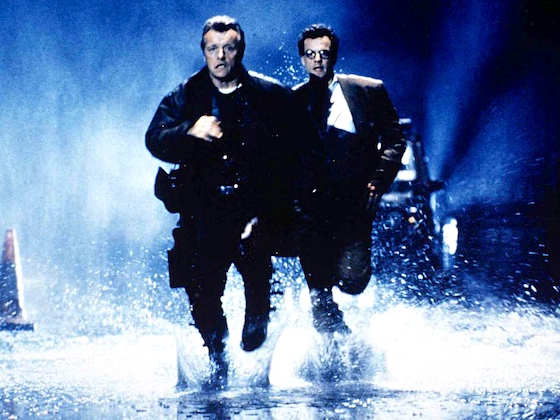
I tell you what, though: the underlying concept isn’t bad. This is exactly the kind of movie I think someone should actually spend the money and effort to remake: something with decent ideas and intentions, but which didn’t come off on the first go. Iron out the plot (mixing genres is fine; jumping between them feels “made up as we went along”), smooth out the tone (keep the deadpan humour, up the thrills and scares), and give it a decent budget (this one has a rough-around-the-edges feel), and you could have something special. Especially if you retitle it Black Tide.

Split Second is released on Blu-ray by 101 Films in the UK today. A matching edition will be released in the US on August 11th. It’s also currently available on Amazon Prime Video in both the UK and the US.

 Score:





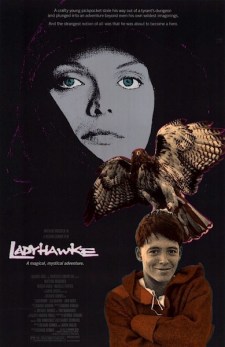 This is one of those films that crops up in the daytime TV schedules now and then and I’d always paid little heed to, because no one else seemed to. Then I read
  Here, there’s a good 45 minutes or so of mystery before said reveal. Obviously, therefore, it would work better as a fresh viewing experience if you didn’t know that going in; but it’s so fundamental to the setup (despite the focus on Philippe, it’s their story) that I wonder if anyone has ever seen it without knowing? On the bright side, it doesn’t really matter: this is not a film where the ‘big twist’ is the point.
 but Philippe occasionally addresses amusing asides to God, for example. It even wisely dodges special effects… most of the time. The few occasions on which it does make motions in that direction, it demonstrates why it was wise not to attempt them more thoroughly. These days they’d slather on the CGI, but shying away from such things is not just due to a lack of technology: it’s far more magical to not be too explicit.
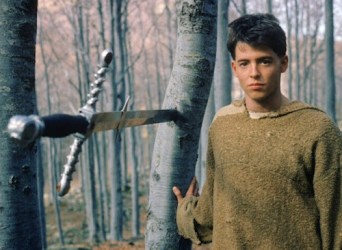 That’s the kind of age when one might be liable to fall in love with it; or, at least, people of (very roughly speaking) my generation would — I suppose Kids These Days fall in love with copious CGI, be that animated or ‘live action’. Anyway, I think it deserves to be less overlooked, and if you’ve never caught it (or not for a while) it certainly merits a chance.
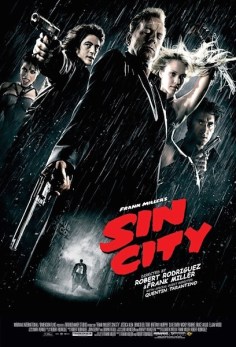 Adapted from a series of graphic novels by Frank Miller, Sin City is a noir homage, replete with high-contrast black-and-white cinematography, dialogue so hard boiled you couldn’t crack it with a sledgehammer, and all the requisite downtrodden heroes, corrupt authority figures, dangerous dames, etc. There’s also the very modern inclusion of shocking ultra-violence and nudity, but I guess a fair degree of that would’ve crept into classic noir if the mores of the time allowed — pretty much the point of the genre is the dark grubbiness of the world, after all.
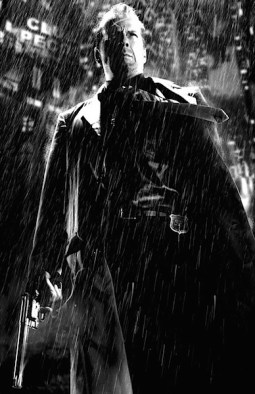 The DVD-premiering extended version, dubbed Recut & Extended (or, in the US, “Recut, Extended, Unrated”) is even more faithful to the comics than the theatrical version. Some of the books’ scenes that were excised are now included, and the structure has been rejigged to present each of the four stories one by one in their entirety (whereas the original version had a small amount of intercutting). The total running time is 17 minutes and 40 seconds longer, an increase of some 14.2%… which is a thoroughly misleading figure. As a presentational choice, each of the four stories is offered for individual viewing, plus option to “play all”. However, rather than that showing them as a single film, they play as four shorts back to back, with a full set of section-specific end credits rolling each time. The actual amount of new material in the film itself is
  For one, the second scene belongs more truly to The Big Fat Kill (the final story, starring Clive Owen’s Dwight and the whores of Old Town led by Rosaria Dawson). For another, because this recut purports to be in chronological order, The Customer is Always Right plays second. So we get 47 minutes of Bruce Willis protecting Jessica Alba from a paedophile in That Yellow Bastard, then we get a one-scene story that rightly belongs at the beginning (complete with title card, now 50 minutes into the ‘film’), then we get a scene that, actually, belongs in a completely different place. The next full story is The Hard Goodbye (the one with Mickey Rourke under a slab of prosthetics as Marv), followed by The Big Fat Kill — and it’s after this that the second scene with The Man belongs. Divorced of that context, the scene is robbed of almost all its meaning.
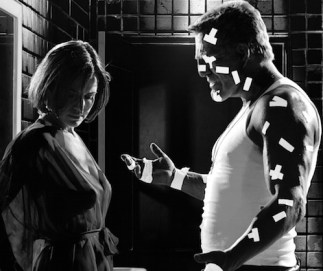 In the end, I enjoyed Sin City considerably less than I did nine years ago in the cinema. This is partly down to the restructure, but I’m not sure wholly so. I don’t think it’s aged particularly well, as things produced at the forefront of emerging technology are wont to do: some of the CGI looks dirt cheap, the shot compositions are often unimaginatively flat, and there’s an occasional internet-video style to the picture quality. It’s not just the visuals, sadly, with amateurish performances from reliable actors, possibly a result of the hurried filming schedule. Just because you can capture an entire part in a single day doesn’t mean you should. Then there’s Jessica Alba, who’s just awful here.
 None of the present additions are game-changing, and though some are good in their own way, there’s nothing noteworthy enough to compensate for the destruction of the original cut’s well-balanced structure. For the average punter — and certainly for the first-time viewer — the theatrical cut is unquestionably the way to go.
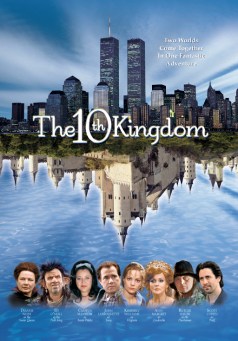 Created by British screenwriter Simon Moore (writer of
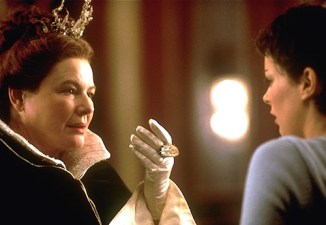
 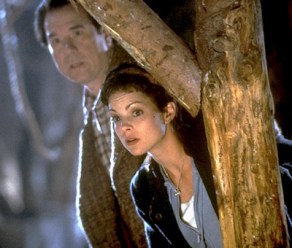 Anyway, the Nine Kingdoms is the place all our fairytales come from — the part of the narrative set there takes place “almost 200 years” after the “Golden Age”, when the events we know from stories actually happened. We’re led into this world by Virginia (Kimberly Williams) and her dad, Tony (John Larroquette), after indolent monarch-to-be Prince Wendell (Daniel Lapaine) flees to our world while escaping the Evil Queen (Dianne Wiest) and winds up taking the two New Yorkers back to his world. Along with Wolf (Scott Cohen), a chap with animalistic tendencies, the quartet try to stop the Evil Queen’s evil machinations.
 It also means the way it’s been edited into one long movie on DVD feels quite natural: it’s one long story with arbitrary breaks, not a series of finite episodes. (If you’re thinking, “of course it’s one story, it’s a miniseries”, plenty of single-narrative series and miniseries still function as discrete episodes that build to a whole.)
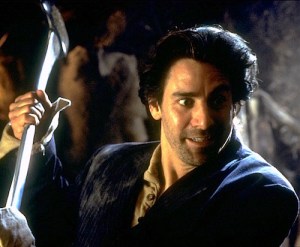 This gives the whole thing a heightened comedy tone, emphasised by many of the performances. A gaggle of troll siblings are irritatingly over-played, but Cohen’s meat-obsessed Wolf is a hammy delight (pun very much intended). The entertainment value means we quickly warm to the characters, so that when more perilous aspects of their quest do come into play later on, we care what happens. Plus, like most of the original fairytales (as opposed to Disney-style sanitised re-tellings), there’s the odd darker undercurrent. For instance, you may think the story of Snow White ends with a kiss and “happily ever after”, but here we’re told how the stepmother who poisoned Snow White was made to wear fire-heated iron shoes and ‘dance’ at the wedding until her feet were burnt raw, before being thrown out into the snow. Very dark and grim (and possibly from the original tale, for all I know).
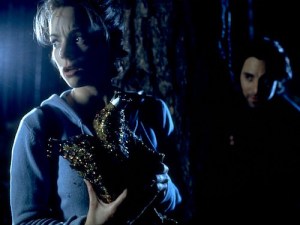 Little details in this vein abound: an apple tree has grown by Snow White’s cottage (don’t eat those apples!); the site of her glass coffin is now a tourist attraction; if you break a mirror, you genuinely get seven years’ bad luck… There’s also a pair of golden shoes that can turn you invisible, but the more you wear them the more you desire to use them all the time — what a precious idea (wink wink nudge nudge). These subversions also manifest in a strain of pleasant practicality; for instance, the abundant magic mirrors aren’t “just there”, but instead have been manufactured by dwarves. It lends the feel of a fully-conceived and rule-bound world, rather than an “anything can happen”, “just because” environment.
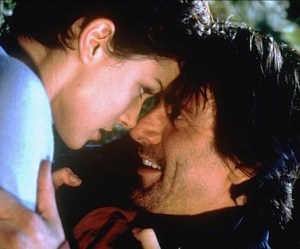 a world away from being locked in a castle until you change your mind. If this sounds like criticism, it isn’t. I’m not arguing the love story element of the series is unsuccessful — I’m sure it engages plenty of fans as the series’ primary attraction, even — but, on reflection, I’m not sure reading it as a Beauty and the Beast variation is actually that illuminating.
 100Films.co.uk