For today’s portion of my review of 2018, it’s one of my personal highlights every year: the statistics!
For any newcomers among you, this is where I take the 261 films I watched for the first time in 2018 and analyse them in all kinds of different ways, and compare them to previous years too. It’s exciting, I promise. (Well, it is to me.)
As a bit of a P.S. before we begin (yes, I know that doesn’t make sense), I’m now a “pro” member of Letterboxd, which means I get stats there too. They’re somewhat different to these because they also include my rewatches, a few TV bits and bobs, and things like that. They do include categories I’ve never bothered to tabulate though, like repeated actors and various crew positions and so on, so there’s that. Anyway, if you’re interested, you can check those out here.
And now, without any further ado…

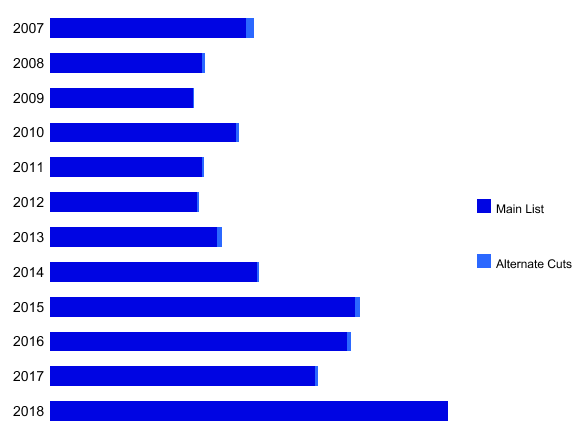
As I previously mentioned, I watched 261 new feature films in 2018. That blows away all previous years, becoming my highest final total by 30.5% over the previous best, 2015’s 200.
Included in that is the one extended or altered cut of a feature I’d seen before that I watched this year. The film in question was Terminator 2, which I counted as part of the main list because it was (a) in 3D, and (b) the original theatrical cut, which I’d never seen before.
Those 261 films aren’t the whole story, however, as in 2018 I continued my Rewatchathon, in which I aimed to rewatch 50 films I’d seen before. I hit that goal exactly, meaning my total feature film viewing for last year was 311 films. That’s a 36.4% increase on the previous best, 2017’s 228.
I also watched eight short films in 2018, which is a small number but is also the most shorts I’ve watched in a single year since 2007. They won’t be included in the following statistics… except for the one that says they are.
The total running time of those 261 films was 461 hours and 9 minutes. That’s a little over 19 solid days! It’s way beyond the previous high, 2015’s 370 hours (aka 15½ days), though not as much of an increase as that was at the time: 2015 beat 2014 by 133 hours, while 2018 beats 2015 by ‘just’ 91¼ hours. Finally, add in the those eights shorts and the total running time of my new 2018 viewing was 462 hours and 48 minutes. (Maybe next year I’ll start counting my Rewatchathon here too…)

Next up, a graph I’ve never done before. I thought of it in a sudden flash of inspiration in early December, at which point it felt glaringly why-have-I-never-thought-of-this-before obvious. It’s my viewing mapped out across the year, month by month. It would be interesting to do this for every previous year, to see if the shape remains roughly the same or not. (I could do that, but it would be a lot of data to re-examine. Knowing me, I’ll wind up doing it someday.) One particularly noteworthy thing on this year’s chart: April and May are my two highest months ever.

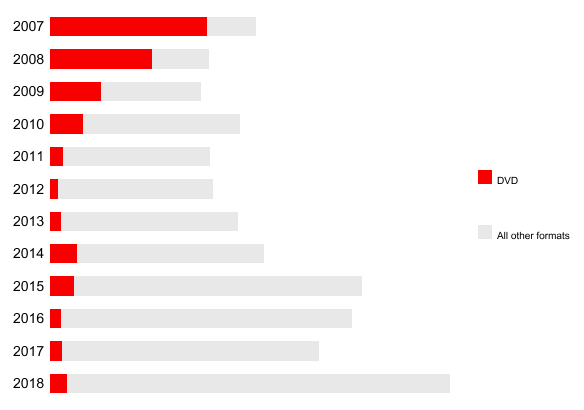
Now, the ways in which I watched all those films. For the fourth year in a row, the year’s most prolific viewing format was streaming. It accounted for 109 films, which sounds like a big increase from last year’s 76, but because I watched so many films this year its percentage actually fell, from 2017’s 43.2% to 41.8% in 2018. That’s well down on 2016’s 57% as well, which pleases me because I own an awful lot of discs that I ought to be watching instead.

To break the above down further, my streaming service of choice was actually Amazon (same as last year, in fact), with 37 films (33.9% of streams). Netflix was close behind on 35 (32.1%), though if I included TV series it’d be far in front. A little way behind was Now TV with 25 (22.9%) — not bad considering I only subscribe for a month or two in order to watch the Oscars. Well, I like to get value for money. Finally, there was Rakuten with nine (8.3%), all of which were individual rentals rather than through a subscription. That was mainly thanks to my parents having some vouchers that needed using up, but also a couple of UHD rentals — it’s so much easier to find 4K films on Rakuten than on Amazon, in my experience.
The format in second place was Blu-ray. Every year I write in this stats post that I need to watch more of the stuff I buy on disc, but this year I finally made good(-ish) on that desire: I watched 82 films on Blu-ray (31.4%), a 78% increase on the average of the last four years. That’s a solid improvement, but I could still do better.
It’s a big drop to third place, where we find a tie between TV and downloads, each with 25 films (9.6%). That represents an increase in percentage for both of them from last year, so my reduction in streaming didn’t go entirely to Blu-ray. Oh well. The graph below is for TV, because it was once so mighty in my viewing, but it’s worth noting this is the highest year for downloads ever. Not sure why — I don’t feel like I download that many films.
In fifth place we find the once-dominant DVD, reduced to a lowly 12 films (4.6%). That’s an increase from last year’s eight, though the percentage is more or less the same (it was 4.8% last year). I’ve got hundreds of the things that I purchased in the format’s heyday but never got round to watching, which nowadays are sometimes trumped by availability elsewhere. I don’t even mean paying to upgrade to a Blu-ray — why watch something in SD on DVD when I could stream it in HD on Netflix or Amazon Prime?
With such a high overall total, it’s no surprise that almost every format saw an increase this year. The only exception was cinema, which stormed up to third place in 2017, but now returns to bringing up the rear, as it has since 2013. I made just nine trips this year (eight for new films, plus I saw Mission: Impossible – Fallout a second time), exactly half of last year’s 18. Will it go back up again in 2019? That depends what the big screen offerings are like, I guess.
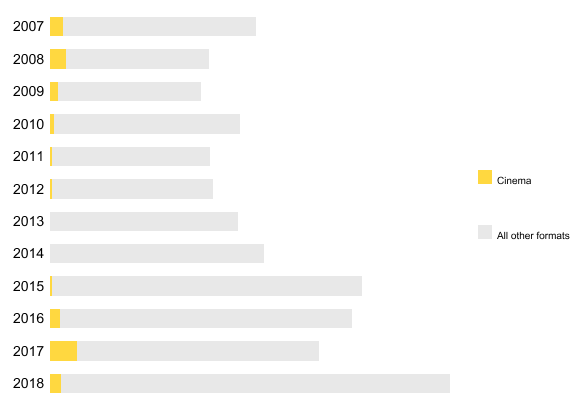
In amongst all that, I watched 18 films in 3D (6.9%), up from 11 last year, and 14 in 4K UHD, a massive increase on last year’s one! Goodness knows what direction those numbers will go in future. I still buy 3D Blu-rays, but there are an increasing number of forthcoming titles that were released in 3D theatrically but don’t have a 3D Blu-ray scheduled. It feels like the format may be tailing off now, sadly. As for UHD, Netflix continue to favour it for their series, but only sporadically for their movies — a number of their recent high-profile acquisitions are actually only 1080p, like Mowgli and The Ballad of Buster Scruggs. But I did get a UHD Blu-ray player for Christmas (though I’ve not had a chance to set it up yet), so we’ll see how that affects things.
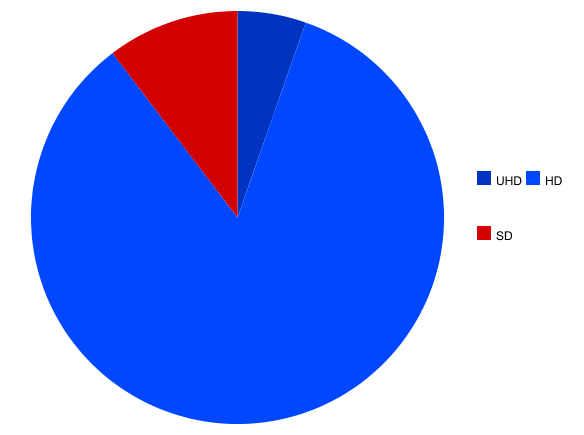
That brings me to the HD vs. SD comparison — or UHD vs. HD vs. SD, as it is now. HD includes virtually all my Blu-ray viewing (I actually watched one film that was in SD but included on a Blu-ray disc), the vast majority of my streamed movies, most of my downloads, 60% of my TV viewing, and all my cinema trips. For UHD, it’s mostly streaming, but with three downloads too. Meanwhile, in the SD camp there’s DVDs, the other 40% of my TV viewing, a handful of streams, one download, and that one Blu-ray. The final result is 220 films in HD (84.3%). Topped up by the aforementioned 5.4% in UHD, that’s 89.6% in HD formats. It’s up over 1% on last year for the highest it’s been since I started keeping track in 2015. It’d be nice to leave SD behind entirely, but, like I said, I still have so many unwatched DVDs…
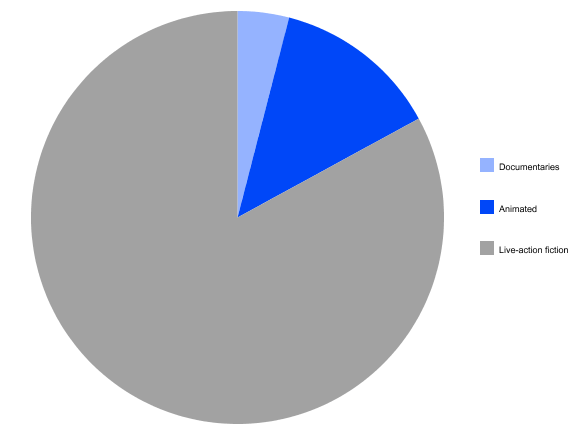
Talking of formats, back in 2015’s stats I tallied up how many documentaries and animated films I’d watched (as opposed to “live-action fiction”, which unquestionably makes up the bulk of my film watching), because I felt like I’d watched a lot of documentaries that year. I’ve continued doing this count each year since, but never mentioned it again because there was nothing noteworthy to say. This year, however, it seemed like I was watching quite a lot of animation, so I’ve revived it to see just how many. Well, the total was 34 animated movies. In terms of sheer volume, that’s over double the average of the last three years. As a percentage, it’s 13% of 2018’s viewing, vs. an average of 8.1% over the previous three years. So, yes, I did watch more animated movies than usual this year. (And while I’m here: documentaries were well up on the last two years too, though not quite as numerous as in 2015.)
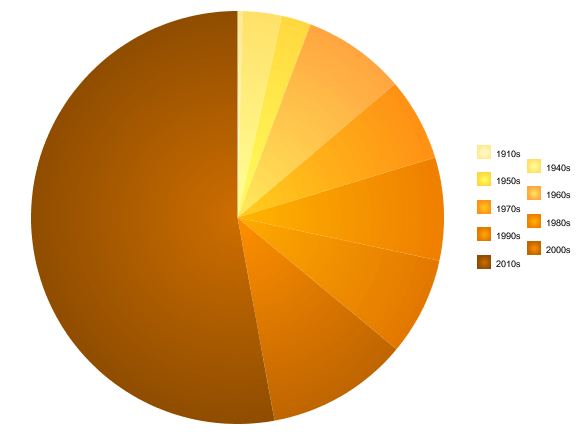
Turning to the age of my viewing now, and the most popular decade was the 2010s (as it has been every year since 2012) with 138 films. It’s a high number, but in percentage terms it actually represents a significant drop: it works out as 52.9%, and you have to go back to 2014 to find a time it was lower. In other words: I watched a greater number of older films. Good good.
So, which decades benefited the most? Well, several of them saw increases from last year, with more achieving double-figure tallies than ever before, but the ’60s and ’80s fared particularly well. In second place, however, was the 2000s, though with just 29 films it was a distant second indeed; and at 11.1%, it’s actually a slight percentage decrease from last year’s 11.9%. The same is true for the decade in fifth place, the ’90s: it increased its number (from 15 to 20), but the percentage went down (from 8.5% to 7.7%).
In between those we have joint third, where there’s the aforementioned ’60s and ’80s, each on 21 (8%). In sixth place is the last decade to make double figures, the ’70s with 17 (6.5%). Rounding things out, the ’40s had eight (3.1%) and the ’50s had six (2.3%); then, after nothing for the ’30s or ’20s, the 1910s had one (0.4%).
In terms of languages, English was as dominant as ever, with 229 films wholly or significantly in my mother tongue; but at 87.7%, that’s easily the lowest percentage it’s ever been. Still, nothing else comes close, though for the second year in a row Japanese was second, in 23 films (8.8%). The only other language to manage double figures was French with 11 (4.2%). In total, there were 27 languages, plus one silent film. American Sign Language once again put in more than one appearance, and British Sign Language appeared in a short film too. Other more uncommon (for me) ones included relatively strong showings by Korean (six) and Hindi (four), and single credits for languages like Hebrew, Urdu, Xhosa, and Yiddish. Also, two films with some Klingon.
As for countries of production, the USA once again dominated with 189 films, though at 72.4% that’s down quite a bit as a percentage. Second place (as ever) was the UK with 52 films, which at 19.9% also represents a drop in percentage. In third place for a second year was Japan. Last year it more than doubled its previous best, and this year it’s done it again, going from 14 to 30 (11.5%). Close behind was France on 25 (9.6%). After that there’s a drop to Canada on 12 (4.6%), and tied for sixth place are China and Italy with 10 (3.8%) apiece.
Normally I’d run down the rest of the countries with multiple films, but there were quite a few this year. The likes of Germany (seven) and Australia, Hong Kong, and New Zealand (five each) contributed about as many as normal, but there were uncommonly strong showings for Sweden (six), South Korea (five), and Spain (also five). In all, 29 countries were involved in the production of at least one film.

A total of 208 directors plus 17 directing partnerships appear on 2018’s main list. The former is a record, smashing the previous best of 157. The latter… isn’t. It is a tie, though. Of those 225 directing ‘units’ (I mean, what do you call them?), 29 had multiple credits, which is also a new record. Top of the pile are Giuliano Carnimeo and Sylvester Stallone, each with four — the former all Sartana films, the latter all Rocky films. Right behind them with three apiece are Kazuo Ikehiro (all Zatoichi films), Frank Oz, Ridley Scott, and Kimiyoshi Yasuda (also all Zatoichi films). A preponderance of sequels also bulk up the list of directors with two films to their name, though I won’t list the series they each contributed to. The directors, however, are: John G. Avildsen, J.A. Bayona, Ingmar Bergman, the Coen brothers, Ryan Coogler, Jon Favreau, Richard Fleischer, Spike Jonze, Richard Lester, Doug Liman, Akira Kurosawa, Christopher McQuarrie, Kenji Misumi, Hayao Miyazaki, Roger Nygard, Todd Phillips, Peyton Reed, Martin Scorsese, Hiroyuki Seshita & Kôbun Shizuno, Steven Soderbergh, Steven Spielberg, and Edward Zwick. Finally, Alan Crosland directed a feature and a short.
For the past few years I’ve specifically charted the number of female directors whose work I’ve watched. There were 9 female directors represented in 2018’s viewing, with 8½ films to their name — the half coming from Marjane Satrapi co-directing Persepolis. As the graph below shows, it’s a pathetically small number, representing just 3.26% of my viewing. It’s an increase on the last two years, at least, but not much of one! I could undoubtedly do better if I sought out more films by female directors, but that’s kind of my point: I just watch films, and this is what happens — if female directors were better represented in the industry as a whole, the graph would automatically look healthier.

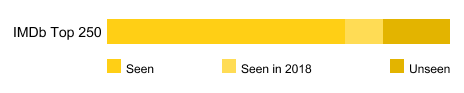
On a somewhat brighter note, at time of writing a stonking 27 films from 2018’s list appear on the IMDb Top 250 (or whatever they want to call it nowadays). That’s my best total ever. However, because the list is ever-changing, the number I have left to see has only gone down by 20, to 49. I’m getting relatively close to the end now, though… The current positions of this year’s inclusions range throughout most of the list, from 29th (Spider-Man: Into the Spider-Verse) to 241st (Paper Moon).
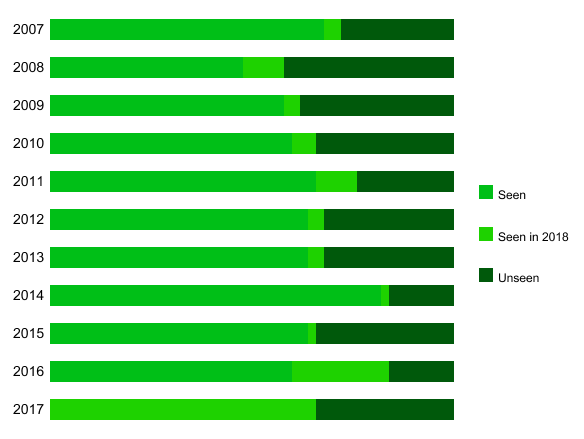
At the end of my annual “top ten” post I always include a list of 50 notable films I missed from that year’s releases, and I continue to track my progress at watching those ‘misses’. In 2018 I watched more movies from every year’s list. To rattle through them (including the overall total seen in brackets), this year I watched: two from 2007 (36); five from 2008 (29); two from 2009 (31); three from 2010 (33); five from 2011 (38); two from 2012 (34); two from 2013 (34); one from 2014 (42); one from 2015 (33); and 12 from 2016 (42).
Finally, in the first year of watching 2017’s 50, I saw 33 of them. For the fourth year in a row, that sets a new record for the best ‘first year’ ever, beating the 30 from 2016’s list that I watched during 2017. This year has also set a record for how many films I watched across all the lists: it adds up to 68, which tops the 60 I saw during 2016.
In total, I’ve now seen 385 out of 550 of those ‘missed’ movies. That’s exactly 70%, up from the 63.4% I was at by the end of last year. Shiny. Though, how long this can keep improving is debatable — a couple of those lists are getting fairly near completion, and most of them include some titles I’m not at all interested in watching. Time will tell. (As usual, the 50 for 2018 will be listed in my next post.)
To finish off 2018’s statistics, then, it’s the climax of every review: the scores.
At the top end of the spectrum, this year I awarded 39 five-star ratings. Despite the record-breaking total, that’s not the most I’ve ever handed out (there were 40 in 2015). Did I watch less-good films? Am I stricter? Who can say? Well, it means I gave 14.9% of films full marks, which is roundabouts in my usual range (the lowest year was 11.9%, the highest 21.2%).
Second place went, as usual, to four-star films, of which there were 122 — the most ever. Again, turning it into a percentage makes things more normal: at 46.7% it places bang in the middle of previous years (five have higher percentages, six lower, with a range from 31.5% to 53.3%). The total of 76 three-star films is also the largest number ever, but at 29.1% isn’t close to being the biggest proportionally (that’d be 2012, when three-star films made up 38% of my viewing. It was the only year with more three-star films than four-star ones).
Bringing up the rear, there were 21 two-star films — again, that’s the most ever, but at 8% it’s actually the third smallest proportion-wise. Finally, there were just three one-star films, which sits in that category’s regular ballpark as both a number and a percentage. I don’t know what this all tells us, if anything. Possibly just that I’m a consistent marker. I guess this graph backs that up (barring the weird spike in 2012).
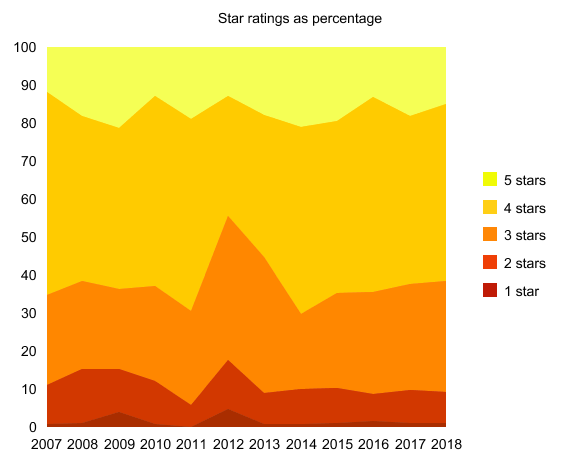
Lastly, all those numbers lead us to the average score; the single figure that (arguably) asserts 2018’s quality compared to other years. The short version is 3.7 out of 5, the same as it’s been for the last three years, and 2007 and 2009 before that too — that’s exactly half of all this blog’s years. But if we go to three decimal places, we can actually rank the years. At that level, 2018 scores 3.663, which is the lowest average for five years. That said, it’s still higher than 2007-2010 and 2012-2013, which means it sits more or less in the middle of all years — 6th out of 12.
As I was saying: pretty consistent marking. (Goodness knows what exactly went on in 2011 and ’12, mind.)
And that’s all the stats done for another year!
2018 is almost at an end! All that’s left is to rank my favourites in my “top 10%” list. But, having watched so many films this year, that 10% is notably bigger than usual — the list might take a little while to put together…



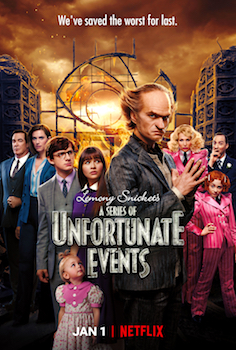 The third and final season of Netflix’s adaptation of
 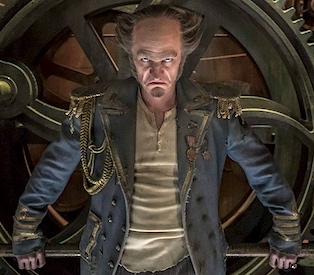 After that, we come to The End — that’s not emphasis, it’s the title of the actual finale. Every other novel in Snicket’s 13-volume series has been treated to a two-part adaptation, but The End is the longest book of them all, so it gets… one episode. A regular-length one, at that. Well, I’ve never read the books (I will someday…), so I can’t comment on why this should be, or if the programme-makers have done it a disservice, but I’m sure they had their reasons. That said, it’s even more intriguing given that the TV series manages to wrap up almost every on-going plot line and mystery, something the book series is notorious for not doing — you’d think they’d need more screen-time for that, not less.
 Back at
 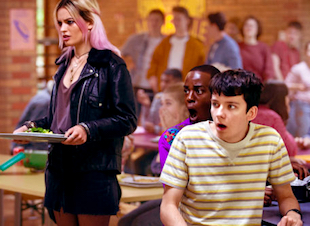 This month, I have mostly been missing Sex Education, Netflix’s comedy-drama about a sex therapist’s son who begins offering what expertise he’s picked up second-hand to his classmates. It attracted a bit of hype before release and has been much-discussed on social media, but I thought something looked kinda off about it… and then I saw











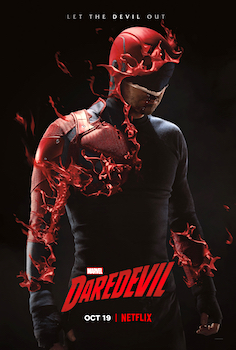 For the 11th season of Marvel Cinematic Universe TV shows on Netflix, we make a long-awaited return to the hero who started it all: the Man Without Fear… the Devil of Hell’s Kitchen… Matt Murdock, Attorney at Law… Daredevil.
 There’s a lot more to this season than that, though. New showrunner Erik Oleson has crafted a narrative for his 13 episodes that is better formed than most Marvel Netflix shows — heck, than most streaming series fullstop. It doesn’t seem to drag things out or go round in circles just to fill its episode count, but has a clear sense of pace and purpose. Okay, it’s still a streaming series — it still feels it can afford to devote entire episodes to things a network show might dash through in one sequence — but often that works to add depth. Spending a whole episode on Matt’s convalescence at the start of the season might seem indulgent, but it’s also important to his mindset for the rest of the season, which makes a big point of his morality, his religion, and his relationship with God — always a key aspect of the character, and foregrounded here without becoming objectionable to those of us with a less Catholicly inclined view of the world. The structural accomplishment really pays off in the final few episodes, too, with an array of surprising and game-changing twists and developments. My notes for later episodes were full of things like “shocking climax” and “oooh, twist!” and “ohhh shit!” At times Fisk feels genuinely unbeatable and you actually wonder how the heroes can win this one.
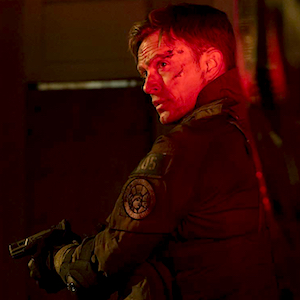 A good example of this is FBI Agent Benjamin Poindexter, who will turn out to be the villain Bullseye. Sorry if you think that’s a spoiler, but one of his first scenes shows off his mind-blowing marksmanship, so you ought to guess, really. In the comics, Bullseye has no backstory — he’s just a psychopathic killer — which is the kind of shit you can get away with if you’re being cartoonish. In the interests of psychological realism, however, Oleson wanted to give him one, to explore his origins, and they were basically free to do what they liked. They even spoke to psychiatrists and the like to make it genuinely realistic. I guess some may think this is unnecessary detail for what is still fundamentally a superhero-action show, but it has its rewards. It’s the same with giving the season a thematic weight to consider. According to Oleson, that was “fear” — how we’re all constrained by our fears and can’t be free until we face and overcome them. This applies to every character, hero and villain alike. Well, it’s a particularly pertinent choice for Daredevil, considering his sobriquet of “the man without fear”.
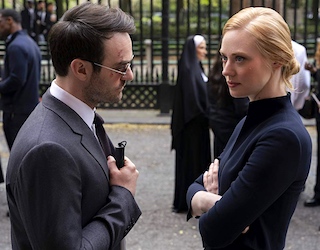 well-told story shouldn’t have to bear, and one that could have been easily remedied.” With Punisher season two on the way it’s possible this apparent plot hole could still be explained and/or retconned (whether they’ll bother is another matter, although Karen was a major character in Punisher season one so they ought to at least reference it), but it’s a shame it went unexplained in Daredevil itself.
 I let this post slip a week, so there are five episodes of Doctor Who to look back over. First up, the new team’s first historical adventure, Rosa (whew, it feels like more than a month since this aired!) I wrote
  Episode six and seven say “no”. Well, a bit — the actual villain did survive the first. I still hope they’re going somewhere with this, because otherwise it’s very sloppy. Anyway, episode six itself, Demons of the Punjab, was one of the highlights of the season. Like Rosa, it sees the Doctor and co going into history and facing up to the real issues of the day, with the aliens popping in to add some spice rather than properly drive the story — like Rosa, you can imagine a not-that-different version of this episode without them. Preventing the Doctor from interfering and being ultra-heroic is certainly a change of pace from the “heroic god” version of the character we’ve had since the 2005 revival, but it’s not an unheard of vision — again, it harks back to the Hartnell era.
 I’ve never watched Inside No. 9 before, though I’ve always meant to get round to it. For those equally in the dark, it’s a comedy-horror anthology series from writers Steve Pemberton and Reece Shearsmith, aka half of the League of Gentlemen, with each half-hour episode a self-contained tale. The reason I’ve jumped in here was because this was a live Halloween special. For some reason I’m always intrigued by live TV drama (I even watched episodes of Eastenders and Coronation Street just because they were going out live), and Inside No. 9’s standalone nature made just dropping in feasible. Anyway, the episode itself was a typically playful endeavour — many fans switched off halfway through, genuinely duped by one of the episode’s tricks. The episode also managed to genuinely integrate the fact it was live, roping in a news broadcast from another channel and having one of the characters tweet. That means it played better live than it would, say, on iPlayer (where
  I always wondered if this day would come. As many (though I would guess not all) viewers must know, Shakespeare’s son Hamnet died in childhood. Not exactly traditional material for a multi-camera sitcom, so I wondered if the series would just never go there; equally, it’s by Ben Elton, co-writer of the famously tragic final episode of Blackadder Goes Forth, a work of unequivocal genius. And so in the final episode of this series, Go On and I Will Follow, Upstart Crow does go there… eventually, in the final moments of an episode that’s mostly fluff about theatre awards. It makes for a somewhat bizarre ending. Hamnet was never much of a character in the show, so while his passing’s effect on the characters is obvious, it has little meaning to us viewers. Then there’s the dedication to him at the end, which just reads like a spoof. The only bit that truly worked for me was the final lines: read in solemn voiceover, a passage by Shakespeare himself about grief. Perhaps that’s fitting. Perhaps if the whole episode had been about it in some way, then it would’ve worked — it’s part of why that Blackadder finale is so effective: the whole episode is about going “over the top”, or trying to avoid it, and so the unity of plot and theme and character and historical fact builds to an emotional gut punch of an ending. But rather than do that, Hamnet’s untimely end is just one scene tacked onto the end of some achingly obvious satire about something inherently vacuous. Well, maybe that was Elton’s point, but I don’t think the contrast was sharply enough drawn if so. Without that consistency across the whole episode, the ending just feels… odd. Ah well, at least we know there’s definitely a Christmas special to look forward to.
 This month, I have mostly been missing The Little Drummer Girl, the BBC’s new John le Carré adaptation from the makers of The Night Manager, their last (and very successful) John le Carré adaptation. As regular readers may know, I have a proclivity for saving series like this up and watching them back-to-back over about a week once they’re done — truly, I am of the Netflix generation. Dammit. Anyway, I’m looking forward to it, so expect me to get right on it and review it next month.

 The 37th season of Doctor Who begins with the show’s biggest soft-reboot since at least 2010; arguably, since 2005; arguably, ever. With a new showrunner comes a new broom, and so we have a new Doctor, a new TARDIS, a new set of companions — sorry, they’re “friends” now — new locations, new monsters, and a new style (thanks to a raft of behind-the-scenes changes, including a new effects company, swish new cameras and lenses, and a new aspect ratio). It’s the perfect jumping-on point… and it worked, with the premiere achieving the show’s highest ratings for a decade; or longer, depending how you count it.
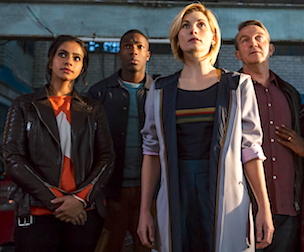 Indeed, even as it’s open-armed and newbie-friendly, Chibnall’s era already seems as Who-literate as you’d expect from such a long-time fan (somewhat (in)famously, as a teenager in the ’80s Chibnall appeared on TV criticising the then production team). His sense of what Who should be is at once indebted to the modern era (in particular the years of Russell T Davies, who I suspect may’ve been something of a mentor to Chibnall at one point) and also seeks to reintegrate elements long absent. For example, there’s the expanded TARDIS team, which calls to mind that of the series’ very first group of travellers; though whereas 1963 gave us a teenage girl and two middle-aged teachers, 2018 offers two teenagers and one middle-aged bloke. Such are the changing times. And for dedicated Whovians, the plot of episode two, The Ghost Monument, also had an air of early Hartnell serials, with its episodic trek across a danger-filled alien world. It was a brisk, entertaining 50 minutes, but stop and think about it too much and the cracks begin to show (read
 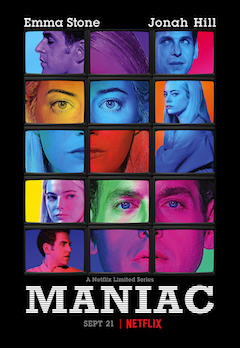 Netflix continue to blur the line between movies and TV with this limited series starring Oscar winner Emma Stone and Oscar nominee Jonah Hill, co-created and directed by Cary “director of the next Bond film” Fukunaga. Well, I mean, it’s a line that other TV producers have blurred plenty in the past — movie stars on TV is far from a new thing at this point, and there’s no doubting this is a TV series rather than a movie (it’s 6½ hours long, for one thing) — but, still. And they bend the rules of TV, too, with individual episodes running everywhere from 26 to 47 minutes. (Does that matter when Netflix’s release-it-all-at-once strategy means you choose how much to watch at any one time? Maybe not. But if you’re the kind to still watch one episode at a time, a word to the wise: I recommend double-billing the ultra-short should-be-one-episode pair of episodes 7 and 8.)
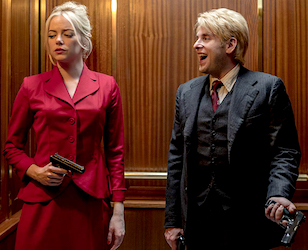 A significant amount of the series’ offbeat likability is down to idiosyncratic direction by Fukunaga, I suspect — the way he’s shepherded the visual creation of this world, the leftfield performance choices across the cast, and so on — but Emma Stone is definitely the MVP. While the aforementioned chemistry between her and Hill is important, and a lot of the rest of the cast get to excel at being quirky and funny, it’s Stone who really brings heart and emotion to the piece, making it more than just a zany fantasy.
 Having just
 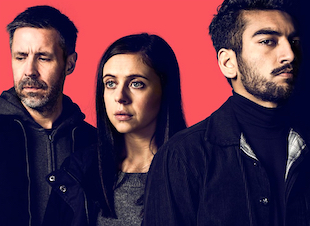 This month, I have mostly been missing Informer, BBC One’s new thriller. Well, it only started on Tuesday, so that’s fair enough, right? I guess I’ll save it up and see how it goes down — I’ve managed to avoid wasting time on a few initially-promising-but-ultimately-poorly-received series with this method; though, equally, it led to
