
Turns out I watched lots of great TV series this month, so here are several big ol’ reviews to try to explain what was so good about them…

A Series of Unfortunate Events Season 2
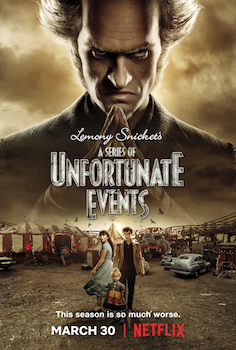 Abandon your vapid, facile distractions and set aside your very fine dramas, because it’s time to indulge in some vicarious fearsome disaster with the return of Netflix’s venerable family delight — a phrase which here means: A Series of Unfortunate Events is back.
This season adapts volumes five to nine of Lemony Snicket’s thirteen-tome investigation into the terrible events that befell the Baudelaire siblings following the death of their parents; specifically, the many nefarious schemes of Count Olaf and his troop of miscreants as they endeavoured to steal the Baudelaire fortune. Although we left the Baudelaires feeling alone in the world — seeing as Olaf had managed to off each of their appointed guardians in turn, and the banker charged with finding them fitting accommodation is, well, incompetent — these episodes see the trio finding new friends and learning that secret forces are working in the shadows to keep them safe… though why they’re doing that, and who they are, is only slightly less mysterious than the inexorability of Count Olaf’s vendetta against the Baudelaires.
Season two retains all the best qualities of the series’ first run, remaining witty, intelligent, satirical, literate, surprisingly attuned to genuine emotion, nicely scattered with meta-jokes, and manages to deliver all of this at a rate of knots that risks you missing one excellent moment while you’re still laughing at the last. What we get considerably more of here — much more than I was expecting, even — are answers. Reading between the lines (i.e. trying to avoid spoilers), I get the impression the book series left many things unresolved. Maybe the TV adaptation will too by the time it’s done, but at the moment it’s dishing out new information on the regular. It makes for an exciting game as a viewer, connecting up the snippets of info that are doled out, piecing together the bigger picture. There’s also some solid character development, on both sides: it seems there’s more to Olaf than just moustache-twirling villainy, while one story sees the Baudelaires indulge in an ends-justify-the-means betrayal that does them no favours later on.
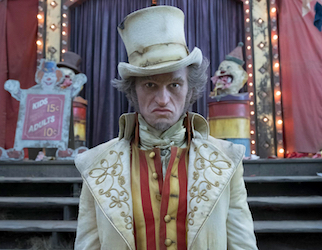 Neil Patrick Harris is having a whale of a time as Olaf and all his varied aliases, while the apparent earnestness of child actors Malina Weissman and Louis Hynes is clearly well measured for effect rather than poor work. There’s an array of memorable guest performances this season as well, from Kitana Turnbull, fantastically horrid as Carmelita, a little-goody-two-shoes teacher’s-pet bully the Baudelaires encounter in the opening two-parter; to Lucy Punch as an obsessive fashionista; to Sara Rue as a new inductee into the secret organisation trying to help the Baudelaires. Best of all is Nathan Fillion, born to play the fast-talking dashing hero who gets a ton of the best lines. If there’s a downside, it’s that we don’t see enough of some people. Unlike most kids’ fare (and, let’s be honest, some stuff made for adults), this isn’t a show where good is always rewarded and bad behaviour always punished, and that means some people may be shuffling out before we’ve had as much as we’d like. I guess the clue was in the title…
It all ends on a bit of a damp squib cliffhanger. I mean, the series itself is in good shape: there are lots of mysteries left, with answers tantalisingly close, and most of the main cast are headed to a key location that’s pregnant with promise. But it’s undermined slightly with a big character reveal that doesn’t quite come off — they don’t reveal who the character actually is on screen (I guessed wrongly who she was meant to be, in fact), and while they’ve cast a moderately famous actress, she’s not famous enough for her mere presence to count as a reveal — and they put the kids in a moment of jeopardy that’s entirely empty — no one believes season three is going to begin with the two leads falling off a cliff to their death, do they?
But, really, these are minor complaints in a show that continues to hit almost all the right notes. Fortunately season three is already in production, so hopefully there won’t be too long to wait for what should be a vehemently final denouement.
Westworld Season 1
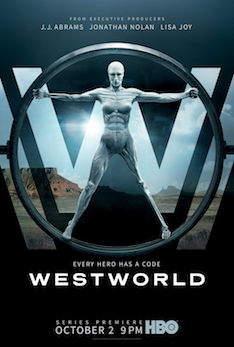 With season two imminent (it begins tomorrow, people!) I finally got my behind in gear (it’s only taken 18 months) and missioned my way through the first season of HBO’s reimagining of the Michael Crichton film. I imagine that’s the last time I’ll be mentioning the original movie in this review, because while the TV series takes the basic premise and some of the iconography of the original, it has much bigger, deeper, broader ideas on its mind.
For thems that don’t know, it’s about an immersive theme park — the titular Westworld — populated by robots, known as “hosts”, who imitate humanity with near-unerring accuracy. Guests pay a fortune ($40,000 per day) to effectively time travel, spending their time in the park as if it was the real Wild West, except with the freedom to do as they please with complete impunity — the hosts can’t hurt the guests, but the guests can kill, maim, or shag anything they like. And boy, do they. But the hosts seem to be developing, evolving, moving beyond their programming. The series follows both the adventures of some guests in the park and the activities of the team behind-the-scenes, trying to keep the show on the road and work out what’s going wrong. But most of all it follows a handful of hosts, who repeatedly live the same day on a loop, their memories wiped so they don’t realise it… unless, of course, that wiping isn’t 100% effective…
Despite all the praise it attracted, I took a while to warm to Westworld. The first four episodes felt like a bit of a slog. There are good, even great, scenes and performances in those opening hours, and of course it’s introducing all the potentially interesting concepts and themes; but, much like the hosts, I felt like it was slowly going round in circles at times, and I felt little drive to push on and find out what happens next. I think I must finally know what it feels like to be one of those people who think Netflix shows don’t go anywhere fast.
 During its production Westworld hit the headlines because they shut down production for a while to retool the scripts and hone the story. Maybe this was why. If so, it paid off, because from the fifth episode things pick up considerably. Developments and twists really kick the mysteries into gear. Scenes between characters begin to carry more meaningful dialogue and affecting emotion. There’s even some action to give it a nice adrenaline kick at times. Rather than feeling like it’s ambling nowhere in particular, you feel like showrunners Jonathan Nolan and Lisa Joy have some very particular things in mind, but good luck guessing what they are because there are many surprises in store: however close you think you are to uncovering Westworld’s games, someone always has something else up their sleeve. It develops an almost Game of Thrones-esque ability to pull surprising but plausible developments out of ‘thin air’.
It was interesting to observe that from the outside, actually. Famously, the series pulls off some pretty big tricks that are revealed in the final few episodes, but the hive-mind of Reddit figured most of them out well in advance. (Indeed, they also figured out some of what was going to happen in season two, leading to rewrites.) Therefore I’d had some of the twists and developments spoiled before viewing, or I’d learnt enough to figure them out easily for myself; but there were others… well, I guessed almost everything, I think. I’m not trying to brag — I know I’m far from alone in making those deductions. But it made me think: did I just have a leg up to get there, from hearing what other people had figured out? Or are loads of us super-duper clever and so ‘beat’ the show? Or is the show not as clever as it thinks it is? Maybe it’s a bit of all of those things. Audiences are so sophisticated nowadays, so used to looking out for clues and twists, especially in programmes that demonstrate or suggest a propensity for them, that actually pulling the wool over viewers’ eyes is nigh impossible — especially when your biggest fans are basically crowd-sourcing solutions.
 The other most striking thing about the show are the performances. It’s like an acting masterclass: there are numerous fine performers here, and they’re all doing their best work. Ed Harris, Anthony Hopkins, Thandie Newton, Evan Rachel Wood, Jeffrey Wright… they’re all so magnificent that I don’t know who to single out without going on forever. And that’s not to undersell the rest of the cast either, many of whom would be said to excel in most other shows, but here there’s just so much raw talent on display.
So, over the course of the season I went from finding it a bit of a drag (I didn’t even like the theme music) to being completely enthralled (now I can’t get the theme out of my head). And season two is sure to spin off in all sorts of new directions, as the trailers confirm. I won’t be waiting 18 months to watch it this time.
Archer Season 5 Episodes 1-5
 Here in the UK, animated spy-comedy Archer originally aired on Channel 5, until they started really titting about with the scheduling, which is what led me to drop off watching. It’s all on Netflix nowadays though, so I’m finally getting back into it.
This fifth season made huge changes to the show’s basic setup, even giving itself a new title in the process: Archer Vice. Obviously such a big reenvisioning generated lots of chatter at the time, some of which I overheard, and from the way people were talking about it I expected a ground-up reboot. That’s not really the case. Yeah, the situation has changed (instead of working for a spy agency they’re now trying to become drug dealers), but it’s all the same characters and the same style of humour. So, it depends how vital you think the “sit” is in “sitcom”, because while the backdrop is technically entirely different, everything else about the show is still in the same vein. In other words, it doesn’t feel like a reboot, just like the same show but with a huge change to the status quo. It almost proves Archer was never really about the spy stuff (which, as neat a hook as it was, it wasn’t) — as with most sitcoms, the “sit” is almost irrelevant: it’s the characters that matter. Now, all of that said, maybe these aren’t entirely the show’s finest episodes, but it’s still very funny. As I always say about comedy, what more do you need?
Line of Duty Series 4
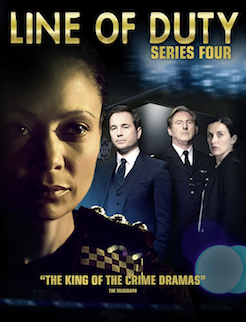 Another superb performance from Thandie Newton here, as the subject of AC-12’s latest internal affairs investigation. She’s convinced she’s arrested a notorious serial killer known as “Balaclava Man”; our faithful heroes reckon she’s cut corners, overlooking serious concerns about the evidence; the higher-ups who were exerting pressure on her to close the case would rather it all just went away. And as is the Line of Duty way, some shocking early developments send things spiralling in different directions. After the programme had become increasingly mired in its multi-season meta-arc last series, culminating in an extra-long finale which brought much to a head, it’s refreshing to have a brand-new case… for most of the series, anyway. For all those last-minute connections, the real star here remains Newton, with a nuanced portrayal of a copper who starts out professional and certain she’s doing the right thing, then disappears off down a rabbit hole of increasingly serious indiscretions to keep her initial beliefs on track, before eventually revealing her true character by the end. I suppose there are some similarities to Keeley Hawes’ role in series two — a clever female detective running rings around AC-12 thanks to her cunning and intelligence — but when the performances are this good and the plots this knotty, does it matter?
Lucifer Season 2 Episodes 1-10
 While I very much enjoyed the first season of Lucifer, the second one ups the ante. This is mainly thanks to the addition of Tricia Helfer to the regular cast as a great antagonist: everything she does is motivated by what she thinks is best for Lucifer, but that’s not at all the same as what he wants. It makes for a different dynamic than you see in most series, where bad guys do bad things, however many shades of grey the writers pretend to find in them. Plus, although it continues to take the form of a case-of-the-week cop show, it’s putting increasing emphasis on both ongoing story arcs and the fantastical elements. It makes for a nicely balanced, addictively watchable show. The Devil has all the best tunes, indeed.
Things to Catch Up On
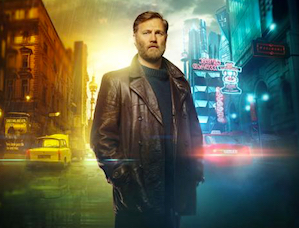 This month, I have mostly been missing the BBC’s miniseries adaptations of China Miéville’s The City and the City and Agatha Christie’s Ordeal by Innocence, both of which I’ve been saving up to watch in a more condensed fashion once they’re finished. The Christie ended on Sunday but the Miéville is only halfway through. Anyway, I imagine I’ll cover both next month. Also released this past month was Netflix’s big-budget reboot of Lost in Space, which I would’ve watched if I hadn’t been missioning my way through Westworld this past week. That might be here next month also. And finally, the last-ever season of The Best Show On TV™, The Americans, is underway in the US. Again, I’m saving it all up ’til it’s done, but I do intend to watch it promptly so as to avoid finale spoilers — my real hope is to time it just right so that I can watch the finale the day after it airs in the US, but we’ll see. Said finale isn’t until May 30th, so whatever happens I won’t be reviewing that until June.
Next month… straight on to Westworld season two.


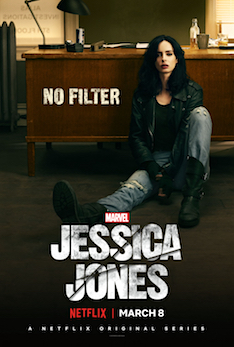 When the first season of Jessica Jones debuted 28 months ago it was practically a cultural phenomenon. Its fresh, unique take on the superhero genre marked it out as noteworthy even at a time when there are innumerable other films and series in that space. A large part of that was the intelligent and grounded way it engaged with some thorny issues, making it a critical darling and attracting audience admiration too. So I’ve been a little surprised that no one really seems to be talking about season two. Perhaps it’s just me and my little internet bubble, but since the flurry of pre-release reviews I’ve heard nary a whisper. I’m sure there must be reviews and recaps out there, which I wasn’t seeking out so as to avoid spoilers, but I didn’t stumble across any either.
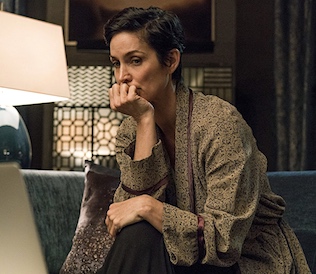 And that’s not to say these series never work in episodic form. For instance, events at the start of episode five, AKA The Octopus, see Jessica begin to force herself to be a better person. It’s one of the season’s strongest episodes, in part because of this burst of character development. Okay, it’s a bit blunt, in that she’s told she needs to improve and we see her consciously trying, but it pays off in a scene where she has to be empathetic to question a mentally-impaired witness. It’s not only Jessica who benefits from development: supporting cast members like Malcolm, Trish, and Jeri get meaty subplots to tuck into. Jeri’s is the best — indeed, her storyline might be the strongest bit of the entire season. There’s a fantastic, nuanced performance from Carrie Anne Moss — it feels like they’ve really worked to make use of her in a storyline that’s far more emotional and nuanced than what she’s had previously in these shows.
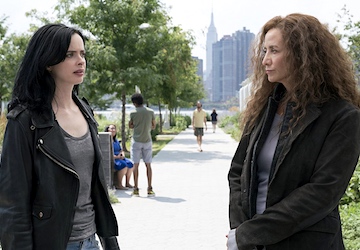 For me, it lost its way a bit again in the final pair of episodes — there are still really good bits, but others feel like a wearisome rehash of plot beats familiar from other superhero/thriller series. Eventually it comes to a good ending — there’s a surprising resolution to the plot, plus an epilogue that lays some intriguing hints for a third season (an inevitability, surely?) — but the faffery of episodes 12 and 13 to get us there… there were more streamlined ways to do this, I think. Or, considering the mandated episode count they have, more interesting ways to have spent the time. So it’s not perfect, but it’s still one of the best of the half-dozen Netflix/Marvel shows.
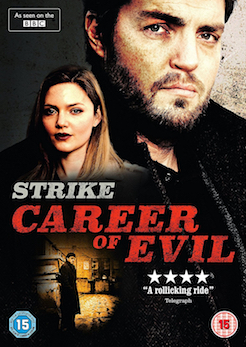 The latest Strike adaptation (and the last for at least a couple of years) was the best so far, I thought — a mysterious, reasonably complicated case, and plenty of character stuff for our likeable pair of heroes, too. The latter is certainly a big part of the series and its appeal, sometimes to the detriment of the actual investigation storyline, I suspect. By which I refer to the fact that some fans of the books have complained that the series isn’t devoting enough time to each adaptation, necessitating big cuts to the plot to fit into just two hours. I’ve not read them myself, and such editing didn’t feel noticeable during
 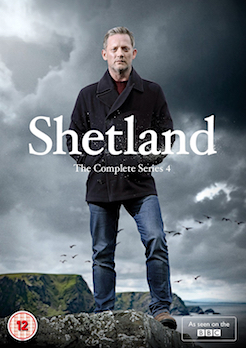 In almost the polar opposite to Strike, Shetland is no longer based on the books that inspired it (even though I believe there are one or two they’ve not adapted), and it takes a whole six episodes to tell its story. Actually, I feel a bit daft calling Strike’s case “complicated” now, because it’s as nothing to this series of Shetland, which sees DI Perez and his team struggling with both a 23-year-old cold case, which has resurfaced because the convicted murderer has just been awarded a mistrial, and a new murder with clear echoes of the first. If that wasn’t enough, the investigation leads them to Norway, where both the suspicious activities of an oil drilling firm and the plotting of a far right nationalist group come into play. Shetland has always had a bit of Scandi Noir about it (must be something to do with the cold northern environs), but it strays even further into that territory by, you know, actually going there.
 Not a reality show about manicurists (that’s what it sounds like, doesn’t it? If I was making a reality show about manicurists I’d be annoyed this took my title), but rather Netflix’s answer to The Great British Bake Off (possibly literally: they were miffed they didn’t get a chance to bid for it when it went to Channel 4). It’s not about super-skilled amateur bakers, though, but rather normal folk who attempt the kind of grand bakes you sometimes see online… and fail miserably. It’s like that bit of An Extra Slice where they look at viewers’ photos, only turned into a whole programme. It’s also very American — brash, loud, fast, unnuanced… It’s also the way it’s shot and edited, very much more like American reality series than British ones, but I shan’t bore you with a Media Studies-esque explanation of that.
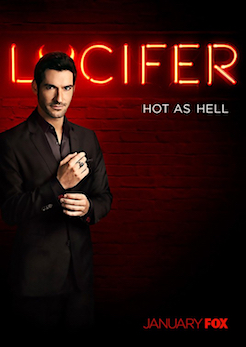 Having finally finished Castle last month, there was a gap in our viewing schedule for a light crime-of-the-week cop show. Lucifer seemed to fit the bill. For one thing, it’s been knocking around for a few years now, meaning there’s a nice backlog of episodes to get through. Loosely inspired by a DC comic, it’s about the actual Devil quitting Hell and setting up a life in Los Angeles, where — for one reason or another — he ends up helping the police investigate murders. Meanwhile, he enters therapy, and there’s an angel knocking around who wants to drag him back to Hell. The series nicely balances the bog-standard US-cop-show case-of-the-week stuff with the ongoing fantastical subplots, powered by a cast of engaging characters with conflicting motives. Best of all is the lead, Tom Ellis, giving a deliciously charming and slightly camp turn as the Prince of Darkness himself as he tries to become a better person. I’m not sure the series has really made any waves (especially on this side of the pond, what with it being an Amazon Prime exclusive here), but it’s really rather good. I mean, it’s not going to be challenging Quality TV for greatest-of-all-time status — it’s still a case-of-the-week buddy show when you boil it down — but it’s done well and a lot of fun.
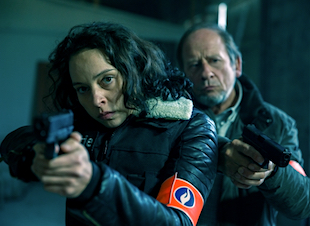 This month, I have mostly been missing The X Files season 11, which finished earlier this week in the US (and comes to the same end here in the UK with a double-bill on Monday). I watched (and reviewed, natch) its first episode







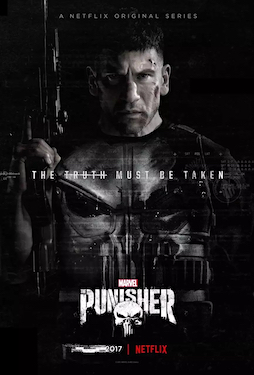 The fourth live-action iteration of Frank Castle, Marvel’s murderous anti-hero (and people moan about Spider-Man reboots), debuted in
 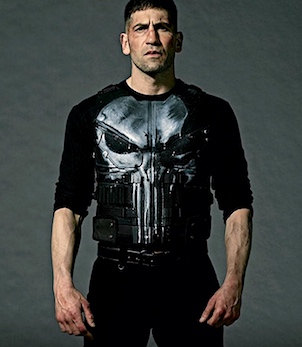 In the title role, Jon Bernthal is fantastic. You can absolutely believe him as a revenge-driven psychopath capable of killing anyone and everyone, but also as a kind-of-charming strong-but-silent type with a heart and moral code who will definitely do the right thing. I’ve seen some critics and viewers opine that now is the wrong time for a series about a hero who just murders indiscriminately. I say those people definitely haven’t watched this Punisher. Although the plot is a conspiracy thriller, the series invests a lot of time in the emotional world of Frank Castle, making him human and moral rather than just a single-minded murder-machine. Bernthal makes what could be a very one-note role into a plausible human being; one who you believe might be able to find redemption and leave someday. And maybe that makes him even more tragic — he could find it; it’s possible… but likely? There’s the rub. As it’s also trying to engage with issues facing combat veterans once they return home, it makes for a clearly different, more serious flavour for an MCU production. How successfully it explores these weighty issues is more debatable.
 The third and final series of BBC Four’s sitcom about a couple of mates whose hobby is metal detecting was every bit the equal of the first two runs, which saw the show place on my list of
 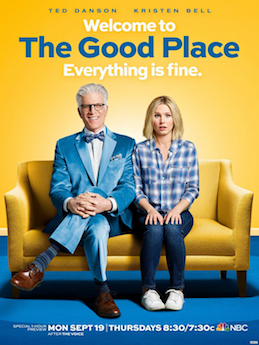 I only heard about this after its Big Twist was much-discussed online, so starting it was an exercise in knowing there was a big reveal awaiting. Fortunately, that knowledge doesn’t overshadow everything that comes before it. For those who still aren’t aware of it (especially as it’s only on Netflix on this side of the pond), it’s about a woman (Kristen Bell) who dies and goes to Heaven only due to an admin error, so she tries to better herself so that she’s deserving of her place. Other complications emerge as the season goes on, but that’s the premise. There’s a lot of plot for a sitcom — although it’s not necessarily immediately obvious, it tells a 13-episode story; this makes Netflix quite a natural home for it, actually, as it’s not your typical “every episode is fundamentally standalone” sitcom. But it’s also very funny in amongst all that, mining not only the characters and their foibles, but also the uncommon situation they’ve found themselves in. The shocker in the finale is just the icing on the cake. I hear season two has gone off the boil somewhat, but I’ll find out for myself once it’s all wrapped up.
 This month, I have been missing so much stuff. There’s been the fourth series of Peaky Blinders on BBC Two (which concludes this week, so we’ll whizz through it sometime in the new year); the second season of The Crown on Netflix (also waiting for the new year now); the same streamer’s first ever miniseries, Godless; the immensely acclaimed Blue Planet II (now available in UHD on iPlayer, too!); and I’m behind on Arrow and The Flash so haven’t reached the four-show Arrowverse crossover. And those are just the ones I can remember right now.
 100Films.co.uk