
There are three major series for me to review this month, thanks to the UK’s highest-rated drama launch for a decade, Bodyguard; the debut season of Amazon’s heavily-promoted version of Jack Ryan; and a second season for the runt of the Marvel/Netflix litter, Iron Fist. Plus, shorter reviews of other stuff. All spoiler-free, of course.
So, without further ado…

Bodyguard Series 1
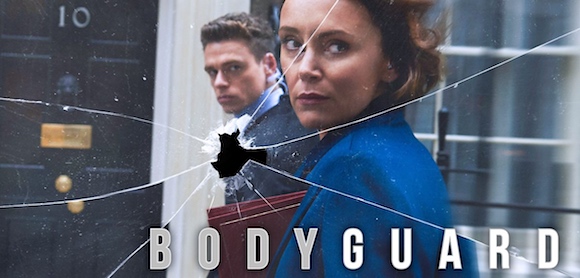
A massive hit for BBC One from writer Jed “Line of Duty” Mercurio, Bodyguard follows copper David Budd (Game of Thrones’ Richard Madden) as he’s assigned to protect Home Secretary Julia Montague (Keeley Hawes), who’s trying to push through a tough new anti-terrorism act. As multiple terrorist attacks begin to take place, and Montague cosies up to the intelligence services, the series quickly morphs into a conspiracy thriller, with Budd struggling to know who can be trusted as he hunts for the truth about what’s going on and why.
Like Line of Duty, Mercurio excels at Big drama: this is a busy, fast-moving story that churns through plot. Not much here of the gradual, slow, “it’s really more about these characters as people” stuff we usually get from British drama. That’s not to say there isn’t fine character work, mind: Budd, in particular, is a complex and nuanced hero, who starts out calm and capable and is revealed to be… well, something else; so much so that you begin to wonder if he’s an unreliable narrator… The other thing Mercurio is great at is set pieces. In Line of Duty they’re often lengthy, jargon-filled police interviews, although he’s pulled off a couple of big action ones too. Bodyguard kind of merges the two, in that they’re talky but also usually involve bombs and guns. The series is bookended by them: episode one boldly devotes its opening 20 minutes to what initially seems like a prologue (unsurprisingly, it has more relevance later), and a massive chunk of the middle of the finale is taken up with another.
 Some have criticised the series for being OTT, implausible, or having too many plot holes. Well, individual mileage will vary on that. It’s not a slice-of-life drama, after all — the larger-scaled storytelling is a genre thing, not an inherent flaw. It’s no more implausible than hundreds of other thriller TV series and movies, just perhaps not the kind we make much in the UK anymore. I’m always wary of accusations of plot holes — it’s a term that gets thrown around too liberally nowadays by, frankly, people who either don’t know what they’re on about or have a failure of imagination (“we didn’t see that happen on screen so how can it have happened” is, genuinely, the root of one prominent complaint about Bodyguard’s finale).
Still, I think the series’ main aim was to be an exciting guessing game — it’s a whodunnit, really, with a multitude of suspects and motivations. As that, I thought it was a success; and, based on the ratings and chatter, it looks like the public at large agreed. No second series has been commissioned (and, anyway, Mercurio is busy on the next Line of Duty until sometime next year), but I’d be surprised if we don’t see more.
(If you’re outside the UK, it was announced last week that Netflix have snapped up the international rights, where it will be available from October 24th.)
Jack Ryan Season 1
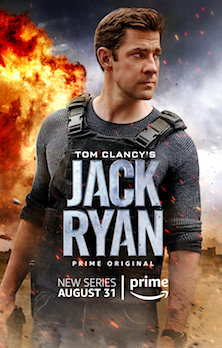 The latest reboot of Tom Clancy’s CIA hero sees him get the TV treatment, which is perhaps the best place for a hero who is more about solving problems with his mind than his gun, and a storytelling style that cuts between lots of concurrent plots before later revealing how they interrelate. That’s something this season has done rather well, incidentally — it’s an original story, taking Clancy’s characters but not directly adapting any of his novels, but they committed to trying to emulate his “mosaic storytelling style”. I’ve never read any Clancy, so I’m not an expert on this, but they seem to have evoked it well. (Considering there are multiple Ryan novels that haven’t been adapted, it seems a shame to abandon them entirely. Maybe in a future season.)
The actual plot concerns — what else — Middle Eastern terrorism. On the bright side, it devotes as much time to the villains as to the heroes, painting a more detail picture than just “some foreign-looking people want to blow us up”. I don’t know if it has anything deep or new to say about terrorists and those who hunt them (we’ve had ten seasons of 24, seven of Homeland, and goodness knows how many other shows on this theme since 9/11 — it’s well worn), but it’s still effective as an intelligent thriller, bolstered by having a desk-jockey analyst as a hero rather than a trigger-happy soldier. Nonetheless, episodes are packed with incident, tension, and excitement. It’s not quite “a thinking man’s thriller” because I don’t think it ultimately has enough to say about things, but it is a lot more measured and realistic than your usual action-thriller fare, while still creating exciting (but also plausible) sequences.
Naturally, the season takes the form of “an 8-hour movie” (to be precise, it’s actually 6.6 hours long), because that’s what’s popular with prestige TV nowadays, but it also works on an episodic level. Put another way, it’s in parts that build to a whole, rather than a whole sliced up because it has to be. That’s not to say the series isn’t heavily serialised, mind (for example, there’s a random murder in episode two that doesn’t seem to relate to anything else, but then pays off at the end of episode four), but this is only a problem if you dislike non-episodic storytelling. I tend to agree that some shows take this too far, seeming to go nowhere on an episodic level because everything’s designed to be “one long story”, but Jack Ryan is one of those serialised shows that strikes a healthy balance between the two — it is one long story, but each episode conveys a solid amount of plot.
 An advantage the show has in this regard is its short length: with just eight episodes, the plot moves at a fair lick. It gets better as it goes on, too, as the various plot lines and characters begin to build and resonate with one another. Indeed, it’s something very rare, possibly unheard of, in direct-to-streaming series: one where I wished the season was a couple of episodes longer. Not that it’s rushed per se, but one or two subplots might’ve been even better with just a little more room to breathe; the main stories might’ve been even better with just a beat or two more in them. But in an era where streaming/prestige series are gaining a reputation for being bloated and not having enough story to fill their running time, maybe it’s better to leave people wanting more.
And I certainly do want more — season two’s already in production, and I’m looking forward to it. Although I enjoyed this season a lot, I do hope the next one takes us somewhere a little more original (and therefore interesting) than Islamic terrorists. I mean, how about those Russians and the tech espionage shit they’re pulling nowadays? Now that sounds Clancy-esque.
Iron Fist Season 2
 The first season of Iron Fist attracted a lot of criticism, and, thankfully, the people behind the Marvel/Netflix series have listened. This second season doesn’t suddenly revamp the show into the best thing on TV or something, but it is a big improvement. They were hamstrung to an extent — as new showrunner M. Raven Metzner has said in interviews, you can’t reboot something like this: it has to keep to the continuity of what happened in season one, and in The Defenders, and in the other Marvel/Netflix series, and go from there — but they’ve made a fair fist of it, (there’s a good piece about what changes they made here), and by the end of the season the show is in a much better place.
It starts a little iffily, mind. I mean, the hero is a rich, privileged white guy with anger issues who appropriated another culture for his own ends, while the villains are the Asian guy who wants back his birthright that the hero took, and a businesswoman who wants her due from the company she helped build. If I was confident the show was going somewhere with that it’d be one thing, but it also feels like it can’t’ve been deliberate (considering the heroes also include a Japanese-American woman investigating her heritage and, later in the season, a black female cop), but it’s a definite reading of episode one. I began to worry it was going to accidentally pan out like some kind of Men’s Rights / White Supremacist show. Well, it’s not that bad, thank goodness — the season does make some nods towards tackling these issues (there’s a scene in episode six where Davos specifically calls Danny out on his privilege meaning he values nothing), but I’m not sure it truly engages with it, more hopes that if it’s acknowledged and sort of moved on from (I won’t say too much because of spoilers!) then we’ll let it slide.
So, even with that, a lot of things are improved over season one. Most things, even. But the show is at its best whenever its title character is off screen. Every member of the supporting cast and their relationships to each other is more interesting than Danny. At best he’s a bit nothingy, at worst an irritant. In fairness, I also suspect the show knows this, given its focus on Colleen — look how she shares the marketing. She makes a better lead character than Danny — her conflictedness about being a vigilante is certainly a richer seam than his privileged certainty, and Jessica Henwick excels in some properly kickass fight scenes, too. Among the supporting cast, Ward and Joy Meacham get some interesting material as well, again developing from what they went through in season one. Where back then it was just Plot Stuff to provide a story and twists, here there’s a genuine attempt to explore what the psychological fallout of that might look like. Plus, there’s a lot less stuff about the running of Rand Enterprises, something I called out the first season for ballsing up.
 Ironically, while the MCU movies became renowned for their poor villains, that’s the area the Netflix series have always excelled in. This season the star turn comes from Alice Eve as a version of Daredevil villain Typhoid Mary, who (spoilers if you don’t know the character!) has dissociative identity disorder (DID), aka multiple personality disorder — so she can be both sweet, timid, kind Mary, and hard, stern, violent Walker. It’s the kind of role that’s a gift for any actor, of course, and Eve is fantastic. Similarly, Danny’s childhood friend Davos gets to combine many of the traits I’ve described in other characters: motivated by past events; complex relationships to other characters (not only Danny, but, as the end of season one teased, Joy). He’s the kind of villain whose goal is almost relatable; where you almost side with him over the hero.
Across all of the characters and storylines, I think the season wants to be about addiction, but it doesn’t execute it as a throughline particularly well. Early on we see Danny being a little bit out of control with the fist; then, many episodes later, he explains he was addicted to it; in between, there’s a subplot about Ward being in NA and struggling to stay on the wagon. These two plot threads should be mirroring each other, not tag-teaming — and in a way that sometimes leaves the theme untouched for an episode or two, at that. It’s a shame, really, because if they’d managed that kind of cohesion in what the show was “about”, it may have been able to lay claim to being a genuinely very good show, rather than just a marked improvement on season one. Don’t get me wrong, I quite liked a lot of it, and I do think it’s a big improvement; but you can see signs that maybe it could’ve been something even better. But hey, even if it can’t offer depth, at least it can offer thrills. And really, it’s a superhero show — good vs. evil punch-ups are the order of the day.
Marvel’s Netflix shows have often faced accusations of being too long, of not having enough story to fill their 13 episodes. That’s a problem of story, not episode count, as The Defenders proved by not having enough plot to fill eight episodes. Nonetheless, Iron Fist now only has ten episodes, and it seems to have helped. The plot moves so fast that by halfway it feels like it must be nearing its end, but instead of going in circles, it has some more twists and tricks up its sleeve. And to complete the indication that the show is making an effort to head in new directions, the finale devotes about half its running time to wrapping up the main plot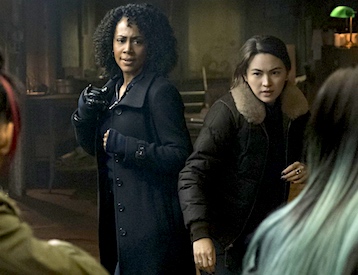 (via a whole load of fighting, natch) and then the second half to what happens after — not just the necessary “wind down” type aftermath stuff, but also a fair chunk of time into establishing where things will go in season three. Netflix hasn’t commissioned that yet, but I hope they do because I’m actually looking forward to it. Wonders will never cease.
Upstart Crow Series 3 Episodes 1-3
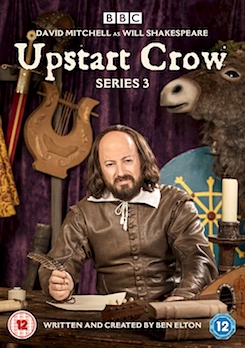 Ben Elton’s Shakespearean sitcom commences its third run as funny as ever, if not more so — I’ve always enjoyed it, but it feels particularly on point this series. I guess its on-the-nose satire of modern life by transposing it to Elizabethan society (e.g. Will’s woeful carriage journeys between London and Stratford are an unsubtle riff on the problems with British railways) won’t find favour with everyone, mainly because it seems a little easy and there’s a monologue about it pretty much every episode, but I still find that stuff amusing. When Elton applies the same strategy to other aspects of modern life, it’s similarly as rewarding/obvious, depending on your predilections. But there’s also a solid vein of mining Shakespeare’s own works for humour, the best one so far this series being an extended bit about how all of Will’s friends think Hamlet is a comedy due to its farcical plot. There’s also a running subplot about Will’s nemesis, Robert Greene, trying to discredit him by making people think he doesn’t write his own plays, which nicely pillories those ridiculous theories, and includes a guest appearance by Ben Miller doing an amusing riff on Mark Rylance.
Reported Missing Series 2 Episode 1
Not normally my kind of programme, this — a fly-on-the-wall documentary that follows police as they search for missing persons — but the ‘plot’ description for the first case piqued my interest. A dad reports his five-year-old son missing after having not seen him for two years due to a custody dispute with the mother. When the police track her down, she says the boy doesn’t exist and she doesn’t even know the man who made the report. Who is telling the truth? What’s really going on? It plays out like a low-key thriller. If you have access to iPlayer (the episode is here), it only takes up the first half of the episode and I’d say is worth half-an-hour of your time.
Things to Catch Up On
 This month, I have mostly been missing Killing Eve, BBC America’s critically-acclaimed, Emmy-nominated thriller about an MI5 officer hunting for an assassin. It aired in the US back in April, and it feels like ever since I’ve been hearing praise for it flowing across the Atlantic. It finally made its way to this side of the pond this month (for an organisation with “BBC” in their name, BBC America productions do take their time getting over here). As I’ve only just (as in “as of last night”) finished making my way through 24 episodes of Jack Ryan, Iron Fist, and Bodyguard back-to-back, maybe that’ll be up next.
Although likely to get in the way is Maniac, Netflix’s miniseries starring Jonah Hill and Emma Stone that looks inherently interesting (based on the trailer — like Inception made by someone with a wilder imagination than Christopher Nolan) and is directed by Cary Joji Fukunaga, aka the recently-announced director of Bond 25. I’ve never seen anything he’s done, despite almost all of it being on my “to watch” list, so it’s about time I started. Expect reviews of both of those next month, then, alongside the return of a certain time traveller…
Next month… Jodie Whittaker is the Doctor!
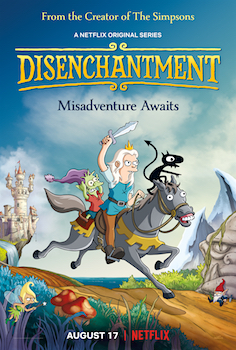 The first new series from The Simpsons creator Matt Groening in almost 20 years, Disenchantment is a riff on the fantasy genre. It follows the misadventures of Princess Bean of Dreamland, a rebellious sort who prefers to sneak out of the castle and get drunk in the pub than… well, do anything else. In the first episode, she and we are introduced to her personal demon, Luci, and Elfo, an elf who has left his happy-clappy kingdom to explore the misery of the wider world. This trio form the heart of the show, though naturally there’s a wider ensemble to help fuel storylines.
 Loosely based on the US series Web Therapy, this new sitcom stars Stephen Mangan as Richard Pitt, a therapist offering his services over the internet. The filming style (each client only appears for a few minutes per episode, popping up now and again throughout the series, always via webcam) allowed them to attract a rather phenomenal supporting cast, including the likes of David Bradley, Charles Dance, Celia Imrie, Richard E. Grant, and David Tennant. The way each episode pingpongs around the various clients and Richard’s many, many personal problems (his marriage, his kids, his parents, his siblings, his bank balance) makes for a whip-crack pace that has pros and cons — each episode seems to disappear in a flash, having at once both dashed through some plot and also gone nowhere. Partly this is the result of an abundance of characters — some of the clients are basically one-off sketches, which is fine, but the regulars’ stories can only advance in small increments. I’m left wondering if it might’ve actually worked better with less going on. Still, the quality cast means characters do get rounded out speedily, and when it works it can be pretty funny.
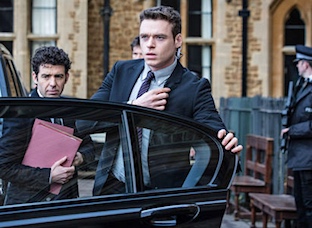 This month, I have mostly been missing Bodyguard, the new BBC One thriller from Line of Duty creator Jed Mercurio that premiered with a two-day double-bill last weekend. It seemed to go down well, based on the ratings and what I saw on Twitter (while avoiding spoilers!) As usual, I intend to wait until the whole series has aired (or most of it, at least) and then whisk through the lot.


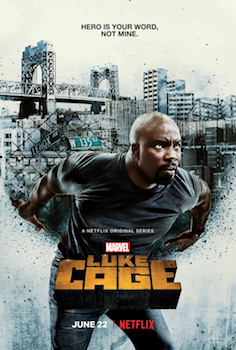 The ninth season of the MCU on Netflix takes us back to Harlem for the continuing adventures of the eponymous bulletproof black man. It’s hard to imagine a more timely superhero for America (maybe if he was an immigrant too), not that the series’ is actually all that concerned with such issues, aside from passing nods and references. Instead, it’s more of a gangster crime drama: the still-standing
 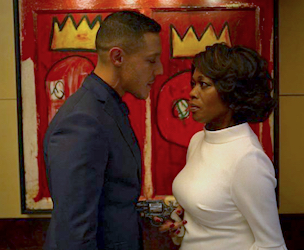 Mike Colter remains a likeable lead, but, again, it’s a villain who steals the show: as Mariah, the brilliant Alfre Woodard is perhaps the best thing about the whole series. Her performance is consistently fantastic, selling every twist and turn of character the writers throw at her. The season is as much about what events do to her as it is about Luke. She isn’t entirely alone, though: there are plenty of great performances, and scenes to showcase them, throughout the season. Occasionally there are some really bloody terrible ones though, like the time detective Misty Knight and her captain argue loudly about a shared secret while they’re in a room full of other cops. Is that bad writing, bad acting, bad direction, or all of the above?
 The flip side to all that is that this interconnectedness will perhaps be comic book fans’ favourite thing about the show — the way it casually references other series, or suddenly brings their characters in for a guest spot, is just like how comic books operate. It’s pretty constant too: barely an episode goes by without a significant reference to or cameo appearance by someone from another Marvel/Netflix show; and these aren’t all mere Easter eggs, but sometimes quite important or vital pieces of plot or character development.
 And so Westworld’s sophomore run rides into the sunset, and I think it’s left behind more questions than answers.
 Exhibit A is the “Hale was Dolores all along” revelation. It’s a neat twist, almost up to season one levels, were it not undermined by the season’s own structure: Hale hasn’t been Dolores all along, and the muddled timelines make it hard to recall how many scenes we’ve had with “Halelores” (as the writers apparently dubbed her). In fact, one of the ways they hid her in plain sight was to limit her screen time: apparently she only popped up in episodes three and seven. Those scenes are littered with
  This month, I have mostly been missing Preacher’s third season, which started this week. Well, I only watched




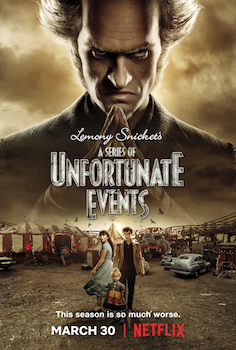 Abandon your vapid, facile distractions and set aside your very fine dramas, because it’s time to indulge in some vicarious fearsome disaster with the return of Netflix’s venerable family delight — a phrase which here means: A Series of Unfortunate Events is back.
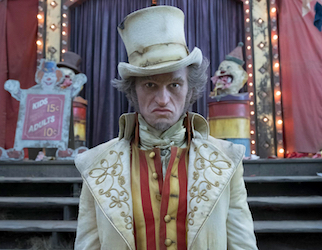 Neil Patrick Harris is having a whale of a time as Olaf and all his varied aliases, while the apparent earnestness of child actors Malina Weissman and Louis Hynes is clearly well measured for effect rather than poor work. There’s an array of memorable guest performances this season as well, from Kitana Turnbull, fantastically horrid as Carmelita, a little-goody-two-shoes teacher’s-pet bully the Baudelaires encounter in the opening two-parter; to Lucy Punch as an obsessive fashionista; to Sara Rue as a new inductee into the secret organisation trying to help the Baudelaires. Best of all is Nathan Fillion, born to play the fast-talking dashing hero who gets a ton of the best lines. If there’s a downside, it’s that we don’t see enough of some people. Unlike most kids’ fare (and, let’s be honest, some stuff made for adults), this isn’t a show where good is always rewarded and bad behaviour always punished, and that means some people may be shuffling out before we’ve had as much as we’d like. I guess the clue was in the title…
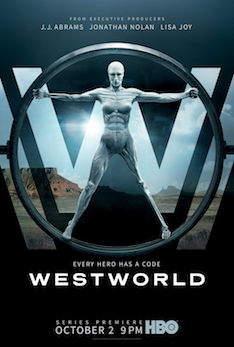 With season two imminent (it begins tomorrow, people!) I finally got my behind in gear (it’s only taken 18 months) and missioned my way through the first season of HBO’s reimagining of
  During its production Westworld hit the headlines because they shut down production for a while to retool the scripts and hone the story. Maybe this was why. If so, it paid off, because from the fifth episode things pick up considerably. Developments and twists really kick the mysteries into gear. Scenes between characters begin to carry more meaningful dialogue and affecting emotion. There’s even some action to give it a nice adrenaline kick at times. Rather than feeling like it’s ambling nowhere in particular, you feel like showrunners Jonathan Nolan and Lisa Joy have some very particular things in mind, but good luck guessing what they are because there are many surprises in store: however close you think you are to uncovering Westworld’s games, someone always has something else up their sleeve. It develops an almost
  The other most striking thing about the show are the performances. It’s like an acting masterclass: there are numerous fine performers here, and they’re all doing their best work. Ed Harris, Anthony Hopkins, Thandie Newton, Evan Rachel Wood, Jeffrey Wright… they’re all so magnificent that I don’t know who to single out without going on forever. And that’s not to undersell the rest of the cast either, many of whom would be said to excel in most other shows, but here there’s just so much raw talent on display.
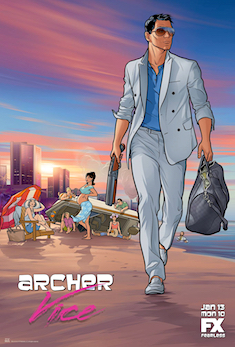 Here in the UK, animated spy-comedy Archer originally aired on Channel 5, until they started really titting about with the scheduling, which is what led me to drop off watching. It’s all on Netflix nowadays though, so I’m finally getting back into it.
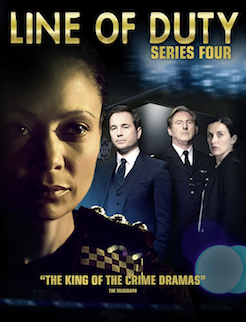 Another superb performance from Thandie Newton here, as the subject of AC-12’s latest internal affairs investigation. She’s convinced she’s arrested a notorious serial killer known as “Balaclava Man”; our faithful heroes reckon she’s cut corners, overlooking serious concerns about the evidence; the higher-ups who were exerting pressure on her to close the case would rather it all just went away. And as is the Line of Duty way, some shocking early developments send things spiralling in different directions. After the programme had become increasingly mired in its multi-season meta-arc
  While I very much enjoyed
 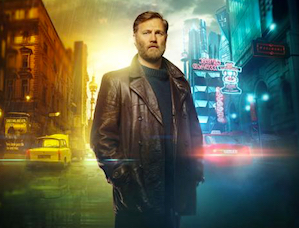 This month, I have mostly been missing the BBC’s miniseries adaptations of China Miéville’s The City and the City and Agatha Christie’s Ordeal by Innocence, both of which I’ve been saving up to watch in a more condensed fashion once they’re finished. The Christie ended on Sunday but the Miéville is only halfway through. Anyway, I imagine I’ll cover both next month. Also released this past month was Netflix’s big-budget reboot of Lost in Space, which I would’ve watched if I hadn’t been missioning my way through Westworld this past week. That might be here next month also. And finally, the last-ever season of The Best Show On TV™, The Americans, is underway in the US. Again, I’m saving it all up ’til it’s done, but I do intend to watch it promptly so as to avoid finale spoilers — my real hope is to time it just right so that I can watch the finale the day after it airs in the US, but we’ll see. Said finale isn’t until May 30th, so whatever happens I won’t be reviewing that until June.


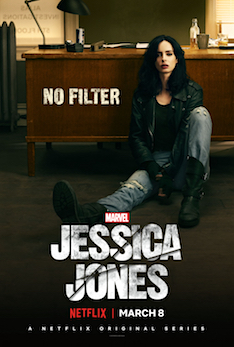 When the first season of Jessica Jones debuted 28 months ago it was practically a cultural phenomenon. Its fresh, unique take on the superhero genre marked it out as noteworthy even at a time when there are innumerable other films and series in that space. A large part of that was the intelligent and grounded way it engaged with some thorny issues, making it a critical darling and attracting audience admiration too. So I’ve been a little surprised that no one really seems to be talking about season two. Perhaps it’s just me and my little internet bubble, but since the flurry of pre-release reviews I’ve heard nary a whisper. I’m sure there must be reviews and recaps out there, which I wasn’t seeking out so as to avoid spoilers, but I didn’t stumble across any either.
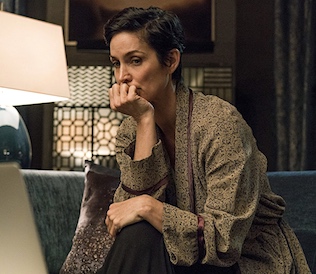 And that’s not to say these series never work in episodic form. For instance, events at the start of episode five, AKA The Octopus, see Jessica begin to force herself to be a better person. It’s one of the season’s strongest episodes, in part because of this burst of character development. Okay, it’s a bit blunt, in that she’s told she needs to improve and we see her consciously trying, but it pays off in a scene where she has to be empathetic to question a mentally-impaired witness. It’s not only Jessica who benefits from development: supporting cast members like Malcolm, Trish, and Jeri get meaty subplots to tuck into. Jeri’s is the best — indeed, her storyline might be the strongest bit of the entire season. There’s a fantastic, nuanced performance from Carrie Anne Moss — it feels like they’ve really worked to make use of her in a storyline that’s far more emotional and nuanced than what she’s had previously in these shows.
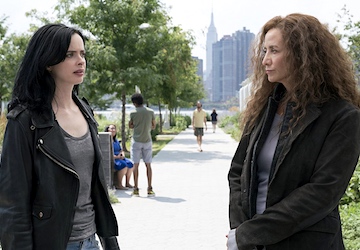 For me, it lost its way a bit again in the final pair of episodes — there are still really good bits, but others feel like a wearisome rehash of plot beats familiar from other superhero/thriller series. Eventually it comes to a good ending — there’s a surprising resolution to the plot, plus an epilogue that lays some intriguing hints for a third season (an inevitability, surely?) — but the faffery of episodes 12 and 13 to get us there… there were more streamlined ways to do this, I think. Or, considering the mandated episode count they have, more interesting ways to have spent the time. So it’s not perfect, but it’s still one of the best of the half-dozen Netflix/Marvel shows.
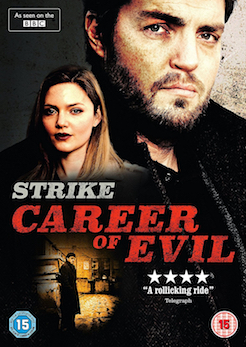 The latest Strike adaptation (and the last for at least a couple of years) was the best so far, I thought — a mysterious, reasonably complicated case, and plenty of character stuff for our likeable pair of heroes, too. The latter is certainly a big part of the series and its appeal, sometimes to the detriment of the actual investigation storyline, I suspect. By which I refer to the fact that some fans of the books have complained that the series isn’t devoting enough time to each adaptation, necessitating big cuts to the plot to fit into just two hours. I’ve not read them myself, and such editing didn’t feel noticeable during
  In almost the polar opposite to Strike, Shetland is no longer based on the books that inspired it (even though I believe there are one or two they’ve not adapted), and it takes a whole six episodes to tell its story. Actually, I feel a bit daft calling Strike’s case “complicated” now, because it’s as nothing to this series of Shetland, which sees DI Perez and his team struggling with both a 23-year-old cold case, which has resurfaced because the convicted murderer has just been awarded a mistrial, and a new murder with clear echoes of the first. If that wasn’t enough, the investigation leads them to Norway, where both the suspicious activities of an oil drilling firm and the plotting of a far right nationalist group come into play. Shetland has always had a bit of Scandi Noir about it (must be something to do with the cold northern environs), but it strays even further into that territory by, you know, actually going there.
 Not a reality show about manicurists (that’s what it sounds like, doesn’t it? If I was making a reality show about manicurists I’d be annoyed this took my title), but rather Netflix’s answer to The Great British Bake Off (possibly literally: they were miffed they didn’t get a chance to bid for it when it went to Channel 4). It’s not about super-skilled amateur bakers, though, but rather normal folk who attempt the kind of grand bakes you sometimes see online… and fail miserably. It’s like that bit of An Extra Slice where they look at viewers’ photos, only turned into a whole programme. It’s also very American — brash, loud, fast, unnuanced… It’s also the way it’s shot and edited, very much more like American reality series than British ones, but I shan’t bore you with a Media Studies-esque explanation of that.
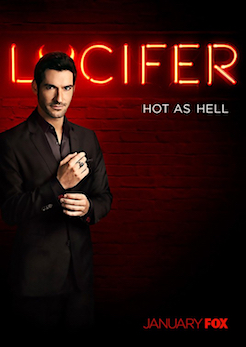 Having finally finished Castle last month, there was a gap in our viewing schedule for a light crime-of-the-week cop show. Lucifer seemed to fit the bill. For one thing, it’s been knocking around for a few years now, meaning there’s a nice backlog of episodes to get through. Loosely inspired by a DC comic, it’s about the actual Devil quitting Hell and setting up a life in Los Angeles, where — for one reason or another — he ends up helping the police investigate murders. Meanwhile, he enters therapy, and there’s an angel knocking around who wants to drag him back to Hell. The series nicely balances the bog-standard US-cop-show case-of-the-week stuff with the ongoing fantastical subplots, powered by a cast of engaging characters with conflicting motives. Best of all is the lead, Tom Ellis, giving a deliciously charming and slightly camp turn as the Prince of Darkness himself as he tries to become a better person. I’m not sure the series has really made any waves (especially on this side of the pond, what with it being an Amazon Prime exclusive here), but it’s really rather good. I mean, it’s not going to be challenging Quality TV for greatest-of-all-time status — it’s still a case-of-the-week buddy show when you boil it down — but it’s done well and a lot of fun.
 This month, I have mostly been missing The X Files season 11, which finished earlier this week in the US (and comes to the same end here in the UK with a double-bill on Monday). I watched (and reviewed, natch) its first episode
