
Ridley Scott | 133 mins | streaming (HD) | 2.39:1 | USA, Italy & UK / English, Italian & Arabic | 15 / R

All the Money in the World does not star Kevin Spacey. But I expect you knew that. Indeed, if you only know one thing about the film, I expect that is what you know. Spacey’s firing, and his speedy replacement by Christopher Plummer, was such a big news story that it instantly became what the movie was most famous for — and, I suspect, is what it will always be most famous for, because the film itself isn’t good enough to transcend its own reputation.
Before I get into that, let’s do the film the courtesy of describing what it’s actually about. Based on true events, it tells the story of the kidnapping of teenager John Paul Getty III (Charlie Plummer, no relation) in 1973 thanks to his family ties: his grandfather, J. Paul Getty (Christopher Plummer), was the richest man in the world. He was also a miserly old codger who refused to pay his grandson’s ransom, and the film follows his daughter-in-law Gail (Michelle Williams) as she desperately tries to arrange to get her son back, aided by the employee Getty assigns to investigate the case, former CIA operative Fletcher Chase (Mark Wahlberg).
Even before the point of contention that drives the plot, various examples are given of what a piece of work Getty was. Whether these are based on true stories or not, I don’t know, but the film seems almost heavy-handed in creating this impression. For instance, although he’s the world’s first billionaire, he’ll do his own laundry in his hotel bath rather than pay the hotel $10 to do it for him; or he’ll spend an hour haggling a poor beggar down from $19 to $11 for an item that’s actually worth $1.2 million — although it later turns out there’s another side to that story… not that the it paints Getty in any better a light. Anyway, it’s to Plummer’s credit that he can take this kind of material and make it work, especially considering it was captured in just nine days of shooting with very little prep time.

When those reshoots were first reported, it was said to be possible because Getty wasn’t actually in the film much, so it wouldn’t take long to remount just his scenes. Then the film started screening, and critics said he was in a lot of the movie and the amount they must’ve reshot was phenomenal in such a short space of time. Personally, I think the truth is somewhere in between: Getty pops up throughout the film, and his presence is huge, but I’d wager his actual screen time is smaller than you’d think — similar to Anthony Hopkins in Silence of the Lambs, who notoriously won Best Actor from less than 25 minutes on screen, it feels like Plummer’s in it more than he actually is. That’s partly the film’s structure, but also the quality of his performance.
In discussing the reshoots, director Ridley Scott has commented on the differences between the two actors’ takes on the character (Plummer wasn’t shown any of Spacey’s performance before he filmed). According to IMDb, Scott felt Spacey portrayed Getty as “a more explicitly cold and unfeeling character”, while Plummer found “a warmer side to the billionaire, but the same unflinching refusal to simply pay off his son’s kidnappers.” I can’t help reading between the lines to infer that Scott felt Plummer’s performance was more nuanced, and therefore better. It beggars belief that Spacey was cast at all, really: Scott wanted Plummer, who was 88, to play the 80-year-old Getty, but the studio insisted on 58-year-old Spacey, who then had to be caked in prosthetics. Supposedly it’s because Spacey was a bigger name, but that much bigger? Really?
Anyway, it turned out for the best, because Plummer is probably the strongest element of the finished product. Although Michelle Williams is top-notch as ever, too. Mark Wahlberg has been worse than this, but he still seems slightly miscast. Ridley Scott, also, is not on top form, his direction merely unremarkable. Oh, it looks nice enough — it’s well done — but there’s little beyond glossy competence.

Arguably its biggest sin is that, for a movie about a high-stakes kidnapping, it’s remarkably free of tension. The closest is the climactic manhunt around a village at nighttime (an event which is an entirely fictional invention, incidentally), but even that doesn’t seem to ring all that’s possible out of proceedings. The blurb sells the film as a “race against time”, but it’s almost the opposite of that: the kidnappers hold the kid for literally months while the Gettys bicker. But maybe Scott wasn’t going for thrills? There’s definitely a thematic thing in there about wealth and power and what it does to people, and what that represents versus the importance of family or morals. But I’m not sure those issues are really brought out or explored either.
It leaves the film feeling not tense and on-edge enough to be a thriller, nor thoughtful and considered enough to be a message-driven drama. The real-life story behind the film is a compelling hook and definitely sounds like it’d make a great movie, but the conversion process has perhaps not done it justice. Maybe someone else should have a crack at it…

Trust, a miniseries from Danny Boyle and Simon Beaufoy retelling the same events, begins its UK airing on BBC Two tonight at 10pm.

 Score:



 The same summer that Christopher Nolan revitalised the Dark Knight with the critically acclaimed and commercially successful
 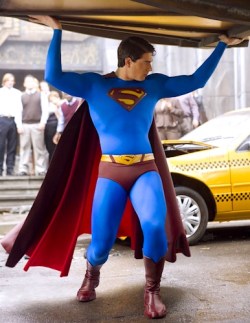 All of that was ten years ago now, since when plans for a sequel have been abandoned, the character has had
  often for good reason, but (a) sometimes a new telling is the right way to go, and (b) if you’re going to pick up a character mid-life, you still need to treat it as a new and standalone story if its immediate predecessor was released decades ago.
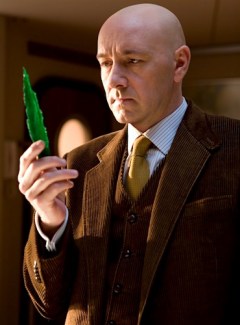
 that actually takes up the first half-hour-or-so. I can imagine an edit of the movie that begins on that plane: just a bunch of journalists observing the press demonstration of the new shuttle technology, when suddenly, inexplicably, it fails — they’re all going to die — then Superman turns up completely out of nowhere and saves them. Then you have the credits, which are immediately followed by Lex’s whole journey to the Fortress of Solitude, and only then do you get in to the stuff with Superman only having just returned, wondering what his places is now, and so on. Maybe lose the scene of him basically stalking Lois’ new family, though.
 The final thing this all makes me think of is the forthcoming Marvel Spidey movie,
 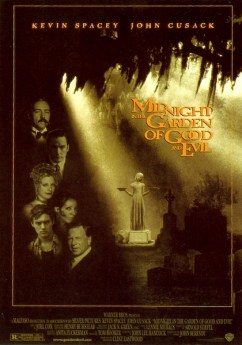 Sent to write “500 words on a Christmas party” in Savannah, Georgia, journalist John Kelso (John Cusack) instead finds himself covering a murder trial where he’s become friendly with the accused (Kevin Spacey).
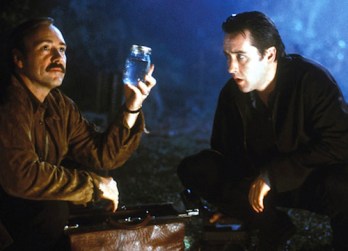 Like many an “adapted from a bestseller!” movies, I guess Midnight in the Garden was a big deal in its day that’s faded to semi-obscurity since (see:
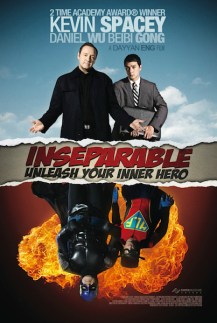 I’m a great advocate of tonally-mismatched films. When others are moaning that there’s too much darkness mixed in with their light fluffy film, I’m the one saying, “um, guys, have you ever lived in, y’know, real life?” Which probably explains why most of the internet reacts with anything between ambivalence and hatred towards Inseparable, whereas I really enjoyed it.
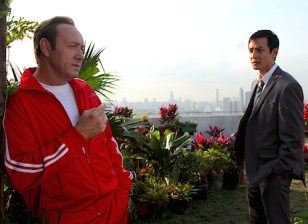 Clearly this will not be to everyone’s taste. Even at just over an hour-and-a-half it’s sometimes a little draggy, and the mishmash of kooky comedy with serious themes — not only suicide, but Li’s faltering marriage and the reasons for that — will turn some off. Anyone who likes their superhero entertainments to be more po-faced won’t be best pleased, either.
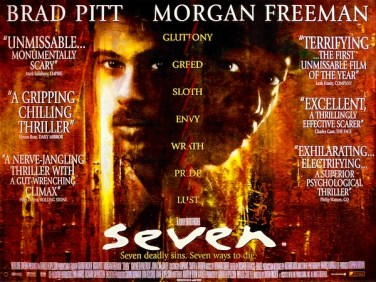
 I usually say that Se7en is my favourite film.
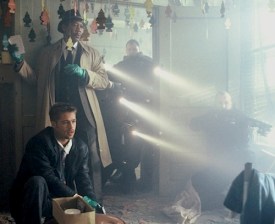 Black seems to be its default position — everything else is cut out of the darkness with as little light as possible. Often backgrounds and locations are better lit than foregrounds or actors, making the viewer focus on silhouettes with minimal light offering splashes of detail. Even the scenes that occur at daytime (most, anyway) do so in the middle of ferocious, ceaseless rain that ensures it never gets too bright.
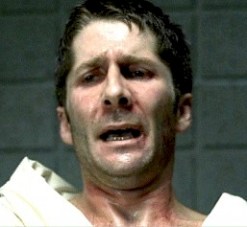 all but one of
 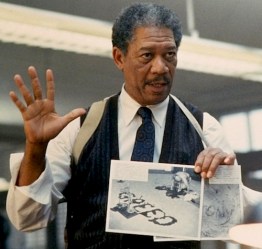 Mills delivers his riposte with greater hyperbole — of course, because that’s the character — perhaps bedded in a form of naivety and idealism, ending with a repetitious “I do not agree. I do not.” Then we see Freeman’s face, completely static, but you can read in it everything you need to — his anger at Mills for making him realise that it’s all a lie he’s been telling himself, and anger at himself for believing the lie. That’s one scene; Freeman is incredible throughout.
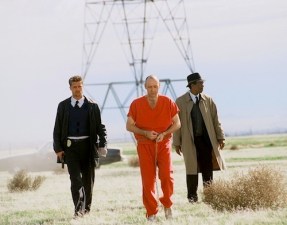 This is where liking the characters pays too, because we are on Somerset’s side and we’re on Mills’ side and we agree with both and disagree with both and don’t necessarily know who’s right or what to do or what we would do. I can spend the whole film anticipating this scene, knowing exactly what will happen in it, how great a piece of filmmaking it will be, yet it still makes my hair stand on end.
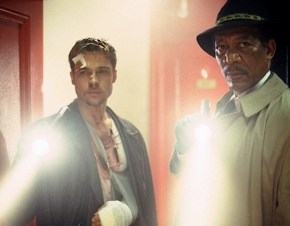 The quality of a crime thriller is often so tied to its mystery that the film can only sustain so many viewings — sometimes, only one — before you know it too well. I have seen Se7en at least seven times now, which for me is a lot — a helluva lot, even — and yet I still get something from it every time. That’s a rarity, that’s a reason to love it, and that is why it may well be my favourite film.
 100Films.co.uk