
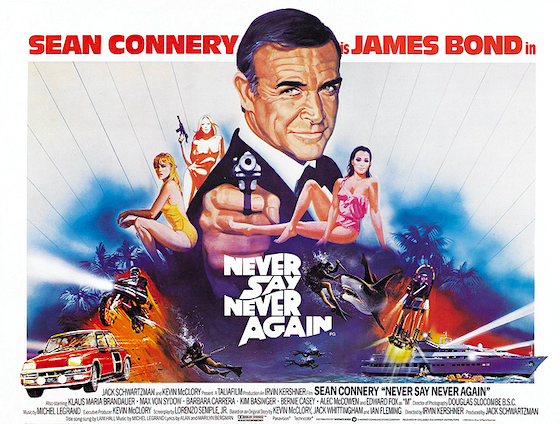
Country: UK, USA & West Germany
Language: English
Runtime: 134 minutes
BBFC: PG
MPAA: PG

Original Release: 7th October 1983 (USA)
UK Release: 15th December 1983
Budget: $36 million
Worldwide Gross: $138 million
Stars
Sean Connery (Thunderball, Highlander)
Klaus Maria Brandauer (Mephisto, Out of Africa)
Kim Basinger (Mother Lode, Batman)
Barbara Carrera (The Island of Dr. Moreau, Lone Wolf McQuade)
Max von Sydow (The Exorcist, Minority Report)
Director
Irvin Kershner (The Empire Strikes Back, RoboCop 2)
Screenwriter
Lorenzo Semple Jr. (Papillon, Flash Gordon)
Based on
An original James Bond story by Kevin McClory, Jack Whittingham and Ian Fleming, which Fleming later novelised as Thunderball.
The Story
Ageing secret agent James Bond is sent to a health spa to get back into shape, but therein stumbles upon part a plot to hijack nuclear warheads and hold the world to ransom. With the theft successful, it falls to Bond to retrieve the weapons before it’s too late.
Our Hero
Bond, James Bond, British secret agent 007. He’s played by Sean Connery — already the first and third actor to play James Bond on the big screen (in a serious movie), here he becomes the fifth too. Unlike the official Bond films, which carried on regardless as Roger Moore began to look more like an OAP than a capable secret agent, Never Say Never Again acknowledges that Bond is getting on a bit. That’s because Connery was 53 at the time, and this is from back in the days when 53 was old, especially for an action star — not like today.
Our Villains
Billionaire businessman Maximilian Largo is actually the highest-ranking agent of SPECTRE, a global criminal organisation masterminded by Ernst Stavro Blofeld. With Blofeld merely pulling the strings behind the scenes, it’s Largo and his lackeys that Bond must defeat to save the world.
Best Supporting Character
Rowan Atkinson’s cameo-sized role as inexperienced local bureaucrat Nigel Small-Fawcett is actually quite amusing, and therefore probably the best thing about the film.
Memorable Quote
Largo: “Do you lose as gracefully as you win?”
Bond: “I don’t know, I’ve never lost.”
Memorable Scene
At a charity event hosted by Largo, Bond comes face-to-face with his adversary for the first time, where he’s challenged to play Domination, a 3D computer game. It couldn’t be more ’80s if it tried.
Memorable Music
James Bond films have a very distinct musical style… but not when they’re unofficial productions they don’t. Without access to familiar themes, Never Say Never Again finds itself having to reach for something different… and fails: the title song is bland and the jazzy score is forgettable.
Letting the Side Down
Where to begin? Well, let’s pick on perhaps my least favourite bit of the whole endeavour: henchwoman Fatima Blush; and, more specifically, how the film ends up handling her. First, there’s a truly terrible sex scene between her and Bond, but it only gets worse later: the self-espoused feminist becomes monomaniacally concerned that Bond should think she’s the greatest shag he ever had, which distracts her to the point that he gets the opportunity to kill her… which he does with an explosive bullet that just leaves her smoking high heels behind. No, seriously. And for this performance Barbara Carrera received a Golden Globe nomination! If you told me she’d been nominated for an award and asked me to guess which, I’d’ve been certain it was a Razzie.
Making of
“So how did an unofficial James Bond film come about anyway?,” I hear you ask. Well, the story starts in the early ’60s, after the Bond novels had become popular but before the film series began. Creator Ian Fleming worked with independent producer Kevin McClory and screenwriter Jack Whittingham on a script for a potential Bond film titled Longitude 78 West, but this was abandoned due to costs. Fleming then adapted the screenplay into a Bond novel, Thunderball, but without credit for either McClory or Whittingham. McClory sued for breach of copyright, and the matter was settled by Fleming giving McClory all rights to the screenplay. By this time the official Bond film series was underway, and Eon Productions made a deal for McClory to coproduce their adaptation of Thunderball, an agreement which forbade him from making any further films of the novel for another decade. That lands us in the mid-’70s, when Bond was still very popular. As McClory began attempting to get a new adaptation off the ground, Eon put legal obstacles in his path, accusing his new script of breaking copyright restrictions by going beyond the confines of Thunderball. Eventually McClory and other producers managed to clear these hurdles and, after rewrites to make Connery happy (which were undertaken by British TV writers Dick Clement and Ian La Frenais, who went uncredited due to Writers Guild of America restrictions, despite much of the final script being their work), the remake finally went before the cameras — with a new title, suggested by Connery’s wife, referring to his vow that he would “never” play Bond again.
Previously on…
James Bond had starred in 13 official movies by the time this came along. It’s kind of ironic that Never Say Never Again’s unofficial status means it can’t acknowledge any of that, while also tacitly acknowledging it with Connery’s very presence in the lead role. Though if it had been able to acknowledge it, the fact this film is a straight-up remake of Thunderball might’ve led to some awkwardness.
Next time…
Early in 1984, producer Kevin McClory announced a sequel, S.P.E.C.T.R.E. It never happened. He spent most of the rest of his life trying to pursue further James Bond projects: he tried to remake the same story again in 1989 as Atomic Warfare starring Pierce Brosnan, and again in the early ’90s as Warhead 2000 AD starring Timothy Dalton. In 1997 he sold the rights to Sony, who already held the rights to Casino Royale and hoped to use that to launch its own Bond series. MGM sued and the matter was settled out of court, with Sony giving up all claims on Bond. (Perhaps this explains why Sony have been so keen on acquiring/retaining the series’ distribution rights in recent decades.) And so we’re left with just one James Bond series, which has mostly gone from strength to strength.
Awards
1 Golden Globes nomination (Supporting Actress (Barbara Carrera))
2 Saturn Award nominations (Fantasy Film, Special Effects)
Between this and the state of the official Moore-starring films at the time, it must’ve sucked to be a Bond fan in the early- to mid-’80s. Maybe some thought Connery returning to the role he’d defined would be a boon, but it didn’t turn out that way: in just about every respect, Never Say Never Again plays like a weak imitation of a Bond film… which I suppose is exactly what it is, really.
As an unofficial production, it’s missing a bunch of the identifying features of the Bond films: the gun barrel, the title sequence, the musical stylings, and, most conspicuously, the famous theme. There’s more to Bond than these tropes, of course, and a really good Bond movie can survive without them, but their absence contributes to the feel of this being a low-rent wannabe, when it needs all the help it can get. The stuff it can include isn’t great either. The one-liners and innuendos are particularly bad. The action is rather dated (although the chase between a souped-up Q-bike and the henchwoman’s tacky little ‘80s car is more exciting than the notoriously underpowered car chase in Spectre, which says more about Spectre than Never Say Never Again). Then there’s the sex scene I mentioned above.
One critic retrospectively described the film as “successful only as a portrait of an over-the-hill superhero,” which is true… up to a point. I mean, most of the stuff about Bond being past his best seems designed to explain Connery’s grey hair and lined face — Bond is still irresistible to literally every woman he meets, and has no problem at all doing any of the action stuff. Connery’s performance isn’t bad either, although it didn’t quite feel like Bond to me. I’m not sure why. It’s not that he seems bored or like he’s only going through the motions (a sensation that definitely comes across in some of his original performances as the character), but he no longer seems to have quite the panache you expect from 007.
And yet, for all that, it’s not as irredeemably terrible as I’d remembered. For all the glaring faults, it actually ticks along with a decent level of entertainment value. So is it, in fact, unfairly maligned? It’s nowhere near the best of Bond, but it doesn’t descend into outright silliness like some of the official ones do (well, apart from those smoking shoes), and it even has a couple of pretty good bits. It would definitely be a lesser Bond — if it counted, which it doesn’t — but, as a couple of hours of off-brand Bondian fun, it could actually be a lot worse.

 Score:



 The first of Jamie Benning’s “filmumentaries” looks at the making of
  My personal highlight of the documentary comes in Cloud City, at the point Lando’s betrayal is revealed. Benning inserts a “deconstruction of an action scene” (Han shooting at Vader; Vader Force-stealing Han’s gun), using uncut footage and B-roll to quickly glimpse how such things are achieved — or were, before “with CGI” was the answer for everything. Here, Benning’s work transcends merely placing rare interviews or behind-the-scenes footage at the appropriate juncture, instead using that material to create something genuinely new and insightful.
 Niggles aside, I felt like I enjoyed Building Empire even more than its later predecessor (how very Lucas). I’m not saying it’s fundamentally better — just as with

 Everything you remember about Episode I is still true: the plot is too mired in political machinations, the dialogue is truly dire, the acting frequently wooden, the direction flat, and Jar Jar Binks is as annoying as ever. There are some good bits — the pod race is exciting and the four-way climax works, especially the excellent lightsaber battle. A lot of the CGI holds up remarkably well, but equally a lot of it wouldn’t pass muster for a computer game now.
 Ten years on from Episode I and Anakin’s a fully fledged Jedi (almost), Padme’s a senator, and Obi-Wan has a beard. Episode II benefits from improved dialogue and performances. Unfortunately it’s still far from ideal — the overuse of CGI leaves much of it looking fake (this is, almost, an animated film with a few real actors in) and the first hour is blighted by a slow pace, too much plot, and the allegedly all-important love story in which Anakin and Padme fall in love because, well, the plot says they do.
 The sextet reaches its darkest point: Anakin turns to the Dark Side and slaughters the Jedi younglings before burning in the fires of Mustafar. It’s all very depressing. To the film’s credit, it doesn’t conclude; that’s to say, as the last film to be released you might’ve expected Lucas to bring things to a definite conclusion, but instead it ends with a sense that there’s more to come — exactly how things should be at the halfway point!
 Here it is: the big crossover; the moment of truth. How does it fare? Pretty well, actually. A long time has passed since the dark finale of Episode III and there’s undoubtedly a lighter feel (despite the Empire being in control!) C-3PO and R2-D2 are onboard the ship from the end of Episode III, a useful visual link as things almost start over — it’s Luke’s story now, and, with a new actor as Obi-Wan, it’s only the droids and Darth Vader who are recognisable from before.
 There are a variety of elements in the series’ penultimate film that have a very different impact in light of what we’ve experienced in the first trilogy. The most obvious is the revelation that Vader is Luke’s father: it’s no longer a twist, of course, but the emotional impact on Luke still makes it an important moment. Yoda’s line, “There is another”, is less mysterious, as is Luke’s ability to telepathically alert Leia near the end. Thank God their kiss is only a brief moment of humour though!
 Considering it’s the grand finale, it’s perhaps surprising that Episode VI is largely the lightest of all the films, filled with extra humour and all those cute little Ewoks. Personally, I like the Ewoks — they make me laugh, go “aww”, and it’s sad when they die! Yoda’s death is another sad moment, and even more so having seen him in full action in the first three films. The threat posed by the Emperor is also even more apparent, there’s more of a sense that Luke truly could follow in his father’s footsteps, and there’s added poetic irony in Darth Vader’s final decision — it is the same thing that caused him to turn to the Dark Side that saves him from it.
 Little here is visually different from the ’97 Special Edition. Cloud City benefits from the CGI windows and lighting it was given back then, though the views look as fake as ever. The big change comes in dubbing both Boba Fett and the Emperor with appropriate actors from the prequel trilogy (as well as a few other minor audio tweaks).
 100Films.co.uk