
Sidney Lumet | 120 mins | DVD | 15 / R
Director Sidney Lumet sadly passed away a week ago today. In tribute, I watched one of his many highly-regarded films…
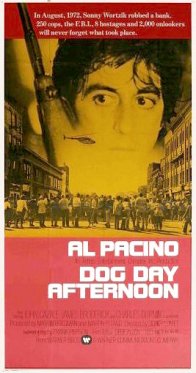 On August 22nd 1972, John Wojtowicz and Salvatore Naturile attempted to rob a Brooklyn bank to raise money for Wojtowicz’s male wife to have a sex change operation. The ensuing hostage situation was watched live on TV by millions of New Yorkers. If you made it up people wouldn’t believe it — especially in the ’70s — which is why this film, closely based on those events, strives so hard for naturalism. And it succeeds, and then some.
There are multiple reasons it works so well, and I’m glad I for once got round to watching all the DVD extras because they reveal these factors very nicely. I’m going to use a liberal sprinkling of those facts as a way into my thoughts on the film, so if you’ve watched those features some of this may seem too familiar. Sorry.
Let’s start where all films do (well, should): the screenplay. Written by Frank Pierson, based on a magazine article about the true story, it was his screenplay that attracted both director Sidney Lumet and star Al Pacino to the project. It’s immaculately structured, from the excitement of the opening — a confused, amateurish bank robbery — through negotiations with police, emotional telephone conversations, and on to a nail-biting finale at JFK airport. The pace is well considered. It doesn’t rush through events but it never flags; the tension is maintained but important emotional scenes are never sped through. More on that in a moment. Importantly, the plot’s numerous reveals are well managed too — for instance, Sonny’s homosexuality and transgender partner are revealed quite far in, by which point we’ve already built a firm opinion of the characters. This was important for a ’70s audience (as Lumet suggests in his commentary), 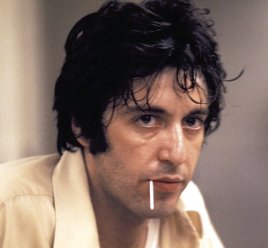 to try to circumvent built-in prejudices that would’ve adversely affected an audience’s reaction too soon. It still works now — it’s not a twist, per se, but it is likely to change one’s perspective on the film and its characters mid-flow, which is always interesting.
The dialogue is also spot-on, but that’s not all down to Pierson. While rehearsing, Lumet was so keen to capture a realistic tone that he allowed the actors to improvise the dialogue. This was working so well that he had it recorded, transcribed, and Pierson rewrote the dialogue based on the cast’s improvisation. (His scenes and their order remained intact, just the words were changed.) This, coupled with additional improvisation techniques used on set, lends a believable tone to the characters’ actions and words — they’re not speaking dialogue, they’re just speaking.
In terms of performance, this is a real showcase for Pacino. As Sonny — the movie’s version of John — the whole film rests on his shoulders, and he’s more than capable of bearing the weight. Some roles allow an actor to subtly be good throughout the film; others allow a few grandstanding set-pieces where they can Act; but Dog Day Afternoon gives Pacino both. The latter are, naturally, easier to recall: the way he works the crowd (“Attica!”), the pair of draining phone calls to his wives; but most of all, the will-writing scene. As the climax looms, Lumet allows the time for Sonny to dictate his will in full to one of the bank girls. Pacino is brilliant, understated but — in a combination of performance and writing (though, in this case, the text is taken from the real-life will) — revealing, cementing some of the conflicting forces that have pulled on Sonny throughout the film.
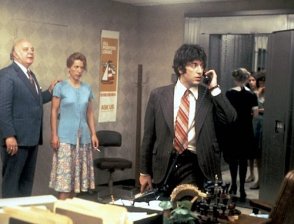 In trying to get a handle on the real Sonny when he was starting on the screenplay, Pierson talked to various people who knew him, but struggled to reconcile their conflicting accounts of the same man. The link he found was that Sonny was always trying to please people, and that’s what he used: in the film, he’s not just out for himself or his boyfriend, but also trying to placate and please his hostages, the police, the media, his partner, his mum, his other wife… Pierson and Pacino do indeed make him a different man to all of them, and this is one of the reasons Sonny is such a great character and a great performance: he’s genuinely three-dimensional. All of us behave differently, to some degree, when we’re with different people — we don’t necessarily realise it, because they’re all facets of the same us, but we do it — so to put that into a character is to make him real.
Pacino is propped up by a spotless supporting cast, all of whom get their moment(s) to shine and use them to excel. Of particular note is John Cazale as Sal, the other robber. It’s a largely quiet role, but he nonetheless conveys an awful lot with it. Lumet says that Cazale always seemed to have a great sadness in him, which you can always see come out in his performances, and he’s certainly right here. We learn very few facts about Sal during the film, but we still know him, you suspect, as well as anyone does.
Chris Sarandon is also superb (and Oscar nominated) as Leon, the gay wife who wants a sex change. Lumet was keen to avoid presenting a stereotypical homosexual type, 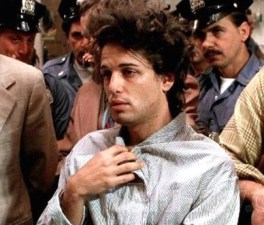 throughout the film trying to avoid turning any of these unusual characters into freaks, and Sarandon pitches it right. He plays the truth of a conflicted, confused character; a man who is perhaps easily led but hard to please, I think. As with the rest of the cast, the little touches he brings — such as starting a sure-to-be-emotional phone call to a man currently in the middle of a tense hostage situation with “so how are you?” — sell the reality of the piece.
Capturing reality is clearly Lumet’s prime concern — it’s reiterated multiple times across all the special features — and I think he succeeds admirably. Some things we might not even notice — the film is lit with natural light outside, the bank’s real fluorescent lights inside, and the nighttime sequences by a genuine police van reflecting off the white front of the bank — while other things, like the complete lack of a musical score, are more readily apparent. I say that, but that’s not readily apparent: one may well notice, but it’s such a perfect decision that it never rears it’s head. Lumet argues that having an orchestra chime in to underline an exciting or emotional moment would have broken the realism of what we’re watching, and he was right — there’s not a single scene here that could be improved by music, but several that would have been damaged by it.
The way the film’s shot supports this too. This is from the ’70s remember, before the craze for faux-documentary and everything being handheld, so it still looks like a film, but it’s not one that’s been precision-staged. Indeed, quite the opposite. Everything is kept loose — sometimes actors block each other’s shots, or talk over each other, or the handling of a prop goes wrong, and so on — but Lumet leaved it all in, even plays it up at times, and makes it work to his advantage. Rather than being the obvious “we’re trying to make this look real”  of today’s grainy shakycam stuff, this just feels real; the heart and truth of it come through, not the surface sheen of it being documentary footage. That’s more important.
There’s great editing by Dede Allen too, though most of the time it goes unnoticed: in keeping with the aim of letting the audience ‘forget’ this is a film, most of the cutting is simple and natural. Two examples leap to attention, however, and those are the two times (the only two times) guns are fired. Lumet and Allen recreate the confusion and violence of such an event with a smash of fast, sub-one-second cuts on both occasions. We see mindless fast cutting all the time now, but this incongruous example shows the effectiveness a fast montage can have when done by the right hands. The soundtrack also jumps with each cut, which is equally vital to the slightly disconcerting way it works — they’re not just smoothing over this series of flashing images, we’re being deliberately disorientated by them.
Remember earlier I mentioned Pierson’s pace? The editing plays a role in that too, naturally. After the film had been tightened for the final time, Lumet felt it had lost something, especially when it came to the will-dictating scene, which now felt slow. So with Allen he went back and added six or seven minutes of footage back in — as with his staging, making it a bit looser, more naturalistic, and in the process fixing the pacing issue and making the important will scene feel right again. Without being able to see that cut it’s hard to say just how necessary it was, but as the final result feels so right it seems his instinct was a good one.
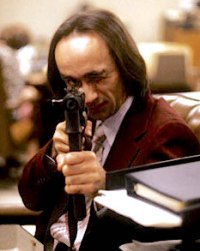 Pierson’s screenplay won at the Oscars. The film was also nominated for Best Picture, Actor, Supporting Actor and Editing, but this was the year of One Flew Over the Cuckoo’s Nest so that took most of the big awards. That’s another of those all-time classics I’ve not seen, so I can’t offer my personal take. What I will say is that it goes to show (as most of us I’m sure already know) that the Oscars are as much about the year you’re in as the film itself: Dog Day Afternoon is better than masses of films that have won the same awards before and since, but clearly it got an unlucky year.
I’ve written quite a lot here but, brilliantly, I’ve still only got a certain way beneath the surface — there’s plenty more in there. That’s always the mark of a good film. And there’s certainly more memorable anecdotes and interesting directorial techniques I learnt from the special features that I’ve left out. Lumet set out to make a believable film about an unbelievable situation, and I do believe he achieved that goal. These are normal human beings with normal emotions — not like you and I, perhaps; taken to an extreme, certainly — but in a very bizarre set of circumstances. It was important to Lumet that they didn’t come across as freaks and, with the help of Pacino and the rest of his cast, I think they’ve achieved that too.
 The film treads a delicate line between drama, comedy and thriller, but doesn’t once tip too far in any direction. It’s got several genuine laughs, but none compromise its serious side or claim to reality — it’s tense and touching too. Anyone else making a film about an extraordinary situation, be it a true story or from the mind of a crazed writer, would do well to look at Lumet’s work here.

Dog Day Afternoon is on ITV tonight, 19th November 2014, at 2:30am.
See also my review of the documentary short about the making of Dog Day Afternoon, which is also on the DVD, Lumet: Film Maker.
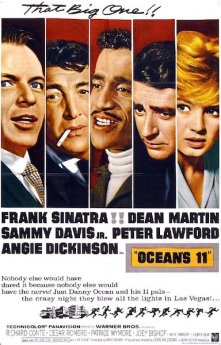 “Remakes are not as good as the original” is one of the rules of filmmaking. Of course there are plenty of exceptions, and everyone has their own opinion, and most modern remakes are expressly about making a quick buck from a US audience who can’t watch a film and read at the same time rather than making a better quality film — but, more or less, the rule persists. It may have won him an Oscar, but the consensus seems to be that
  It does have its moments: a couple of songs are shoehorned in (even if there’s only two or three and each gets two or three airings) and the cast do succeed in making some of their indulgences entertaining. Nonetheless, this would definitely be for Rat Pack fans only had it not been for the remake… and, really, there’s no reason the remake should change that.
 This review ends by calling Inception a “must-see”. I’m telling you this now for two reasons. Primarily, because this review contains major spoilers, and it does seem a little daft to end a review presumably aimed at those who’ve seen the film with a recommendation that they should see it.
 but the aforementioned implanting of an idea; and so, the film has to explain to us how this whole business works.
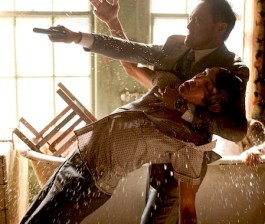 could do with some more depth, considering his presence in that opening flashforward and his significance to Cobb’s future, but then perhaps he’s the one who most benefits from the mystery. Some would like Michael Caine’s or Pete Postlethwaite’s characters to have more development and, bluntly, screentime; but I think their little-more-than-cameos do a lovely job of wrongfooting you, and there’s nothing wrong with that. Some say the same thing about Lukas Haas’ tiny role, but I don’t know who he is so he may as well be anyone to me. Cast aside, there’s not much humour — well, no one promised you a comedy. At best you could claim it should be a wise-cracking old-school actioner, but it didn’t promise that either.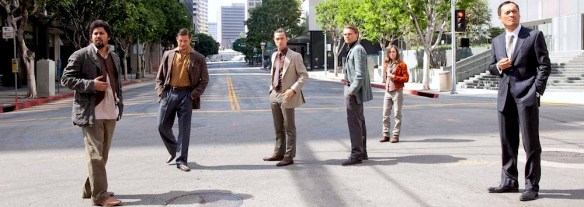
 He wants a way home, he gets a shot at it, and he goes for it. Him aside, it’s a bit hard to call on the performances after one viewing: there’s nothing wrong with any of them, it’s just that they’ve not got a great deal to do — the film is, as noted, more concerned with explaining the world and the heist. How much anyone has put into their part might only become apparent (at least to this reviewer) on repeated viewings. Probably the most memorable, however, is Tom Hardy’s Eames, which is at least in part because he gets the lion’s share of both charm and funny lines.
 Apparently this distracts some people. Well, I can’t tell them it’s fine if it’s going to keep distracting them, but…
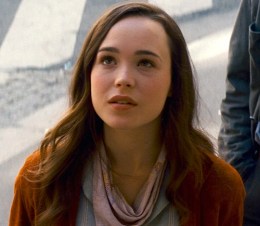 On the flip side, this rule could be easily worked around — “in dreams, we just accept everything that happens as possible, even when it obviously isn’t” — but where’s the dramatic tension in that? There’s tension in them needing to be convinced it’s real; if anything goes… well, anything goes, nothing would be of consequence, the only story would be them completing a danger-free walk-in-the-park mission.
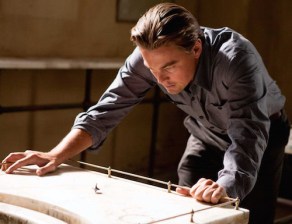 “ah, but characters X, Y and Z are actually a secret team doing a secret thing, but we never know what the secret thing is, or what the result of that is”. In other words, it’s pointless unless it’s decipherable.
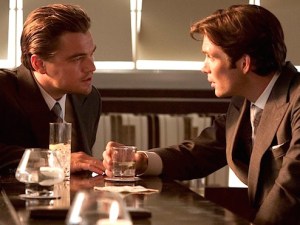 beyond that the top still spinning as the credits roll is an obvious, irresistible tease. He wouldn’t be the first filmmaker to do such a thing Just Because.
 action sequence across all four levels? It makes for an exciting finale when they need to get out, true, but I couldn’t help feeling it didn’t exploit one of the more memorable and significant elements enough.
 yet she’s rarely that much of a bother. At the start, sure, so we know that she is; and then in Cobb’s own mind when Ariadne pops in for a visit, but that’s why he’s there so it goes without saying; and then, really, it’s not ’til she puts in a brief appearance to execute Fischer that we see her again (unless I’m forgetting a moment?) And apparently Ariadne has had some great realisation that Mal’s affecting Cobb’s work, and Ariadne’s the only one who knows this… but hold on, didn’t Arthur seem all too aware of how often Mal had been cropping up? Does he promptly forget this after she shoots him? Mal is a potentially interesting villainess, especially as she’s actually a construct of Cobb’s subconscious, but I’m not convinced her part is fully developed in the middle.
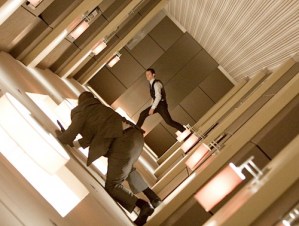 zero-G corridor, the crumbling cliff-faces… all look great, but there’s barely any astounding visual that wasn’t shown in full in the trailer. Is that a problem? Only fleetingly.
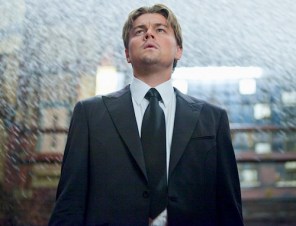 Is it cold and unemotional? Not entirely. Is it more concerned with the technicalities of the heist and the rules of the game than its characters and their emotions? Yes. Is that a problem? Not really.
 I’ve never had as much of a problem with Brett Ratner as some others. I quite enjoyed the
  100Films.co.uk