March’s Failures

As I mentioned at the start of my March review, I’ve spent a lot of time this past month on things that aren’t films. Does that mean my pile of failures is even more shocking than normal? No, not really — I mean, it could scarcely get much bigger, could it? And I actually went to the cinema once this month too, so there’s even one less title in that paragraph than there’d normally be.

In fact, I’d hoped to make it to the cinema twice this month — Godzilla × Kong: The New Empire was my other targeted release — but family Easter weekend plans got in the way. I’m busy next weekend too, but maybe I’ll find a weeknight for it or something. I’m sure it’s the kind of film that would benefit from the big screen (I felt the same way about its predecessor, which I only saw at home, thanks in part to it coming out in The Covid Times). I nearly made it three trips, even, because I was tempted by Ghostbusters: Frozen Empire. I knew the reviews would be poor to middling, but they were so bad it put me right off. I’ll definitely catch it on disc, though. Other silver screen releases this month that I’ll definitely catch on disc were Kung Fu Panda 4 (I enjoyed the first three, but not enough to make the effort for this one at the cinema) and the latest semi-Coen brothers film (in that it’s directed by just one of them), Drive-Away Dolls, which looked fun.

I thought the streamers’ premieres this month would fare better, but I didn’t make time for several of those either (maybe choosing to spend so much time on other stuff had more of an impact than I allowed in my opening paragraph). Top of my watchlist were Netflix’s fantasy actioner Damsel and thoughtful sci-fi Spaceman, plus Amazon Prime’s remake of Road House — not that I’ve ever seen the original, but this version boasts Doug Liman as director and Jake Gyllenhaal as star, both of which appeal to me. Well, now they’re here to count towards my Challenge in the Failures category next month, so that might improve their chances (for at least one of them, anyway).

Other films premiering on streaming included football (aka soccer) true story The Beautiful Game (not a sport I care about, but this boasts a cast led by Bill Nighy), a new all-action remake of The Wages of Fear, Pierce Brosnan in Fast Charlie (which I seem to remember seeing a trailer for and thinking it looked fun enough), and slushy romcom nonsense with a nigh-unsayable title, Irish Wish. I only mention that last one because everything about it seems like a total disaster. I won’t be watching (so it’s not really a “failure”, but I think we long ago passed that being a genuine litmus test for what I mention in this column).

Other big-name titles making their subscription streaming debuts included Ridley Scott’s Napoleon on Apple TV+; Sofia Coppola’s Priscilla on MUBI; three-and-a-half-hour concert film Taylor Swift: The Eras Tour on Disney+, which also had Taika Waititi’s Next Goal Wins and six-time BAFTA nominee All of Us Strangers. Talking of awards nominees, Oscar winners abound, from Poor Things on Disney+ (much to the confusion of many Americans, based on social media), to American Fiction and Anatomy of a Fall on Amazon, to 20 Days in Mariupol on Channel 4, via all sorts of stuff on Netflix: acting nominees Nyad and Rustin; documentaries American Symphony and To Kill a Tiger; shorts The After and The Wonderful Story of Henry Sugar — the latter of which was one of four Wes Anderson Roald Dahl shorts that he apparently insisted were released as individual films so no one would judge them as a portmanteau feature, but which Netflix have now made available as a portmanteau feature, title The Wonderful Story of Henry Sugar and Three More.

Talking of the Oscars, every February/March I get the offer of a cut-price Sky Cinema subscription from NOW, which used to be great for watching the Oscars on Sky. But, starting this year, here in the UK the ceremony is now broadcast free on ITV, so I don’t need to get Sky even at that budget price — hurrah! Except they’re still the streaming home to tonnes of recent movies, of course, so I took the offer anyway. That means my watchlist has been flooded with a mass of stuff that was previously locked away. We’re talking The Beekeeper (wasn’t that only in cinemas, like, the other week?), Michael Mann’s Ferrari (apparently a “Sky Original” — oh dear), Wes Anderson’s Asteroid City (eesh, I haven’t even watched The French Dispatch on Disney+ yet), Fast X, The Super Mario Bros Movie, Teenage Mutant Ninja Turtles: Mutant Mayhem, Transformers: Rise of the Beasts, No Hard Feelings, Polite Society, Gran Turismo, May December, Violent Night, The Three Musketeers: D’Artagnan, Renfield, Beau Is Afraid, She Said; plus superhero movies I kinda want to see even though they’re meant to be awful, like The Flash and Black Adam and Shazam! Fury of the Gods; and more back catalogue stuff that I’ve added to my watchlist but don’t even care enough to list here, so I’m not likely to actually watch any of it, am I? (But you never know…)

As if that wasn’t enough, the other streamers are also always bolstering their back catalogue. Most noteworthy among these also-rans for me was RoboDoc: The Creation of RoboCop on Amazon Prime. This making-of documentary is meant to be so good that I nearly bought it on Blu-ray. It’s not even just “a documentary”, but a four-part series totalling almost five hours. As making-ofs go, that’s rather incredible. I mean, I remember when the Twelve Monkeys DVD was exalted for having an hour-long making-of. Obviously, things like the Lord of the Rings appendices reshaped expectations in that regard, but those remained a rarity, and similar extravagances have been cut back with time (nowadays, even huge popular blockbusters typically get no more than 45 to 60 minutes of behind-the-scenes material, often split across multiple sub-ten-minute featurettes). That said, when I’m likely to make time for such an undertaking, I don’t know. I mean, I’ve never actually got round to watching those Rings appendices, and I’m a much bigger fan of those films than I am of RoboCop.

Though that was one title I avoided buying on disc, this month (as with most months, to be honest) the streamers have been flooded with stuff to remind me I haven’t yet watched my bought-and-paid-for copy —from things I’ve never seen, like Michael Mann’s Ali and The Last of the Mohicans, the new Candyman, Drive My Car, The Kid Who Would Be King, Legends of the Fall, The Long Good Friday, Mazes and Monsters, Out of Sight, Venom: Let There Be Carnage, and Weathering with You; to things I’ve upgraded but not watched my new copy, like Drive, The Godfather trilogy, The Guest, La La Land, and Robin Hood: Prince of Thieves; to stuff I’ve simply been meaning to revisit, like Catch Me If You Can, The Martian, The Matrix Resurrections, and The Third Man. And those are just some edited highlights.

Then there’s all the new discs I’ve been buying to further enlarge my collection. Only a handful of them were 4K this month: Ozploitation sci-fi horror Patrick from Indicator; bodyswap sci-fi horror Possessor from Second Sight; and folk horror Witchfinder General from 88 Films. Horror always seems to be at the forefront of new formats… though I’m not sure we can still call 4K a new format at this point. But nonetheless, plenty of deeper-cut horror movies are finding their way onto 4K discs while studios still twiddle their thumbs about releasing major titles on the format, so my point stands. That said, some much-anticipated studio titles did make it to the disc this month, in the form of a trio of long-awaited James Cameron films… and they were pretty universally derided for their ‘restored’ (read: modernised) picture quality. I’ve wanted True Lies on disc for decades, but I’m skipping it based on what I’ve read and seen (for now — maybe I’ll cave when it’s cheap. I mean, it’s likely this is the only version we’ll ever get). The one I did pick up is apparently the least-bad, The Abyss. Frankly, the DVD is so ancient, almost anything will be an improvement.

That aside, I have no other ‘major’ titles to mention this month, only new releases of older films from boutique labels. As seems to be commonplace nowadays, lots of martial arts-related titles, with a duo of duos from Eureka — the two Bodyguard Kiba films, and a double-feature of influential titles, The Swordsman of All Swordsmen and The Mystery of Chess Boxing — plus a box set of the Bounty Hunter trilogy from Radiance and The Inspector Wears Skirts 2 from 88 Films. Indicator mix things up with a trio of lucha libre films: Santo vs. the Riders of Terror, The Panther Women, and The Bat Woman (which I’ve sort of seen thanks to Mystery Science Theater 3000 taking it on last season). Rounding things out, some releases I can’t neatly combine in thematic bundles: the latest silent movie restoration from Redwood Creek Films, the 1928 version of The Fall of the House of Usher (at least the third screen adaptation of that story I own); River, another time loop film from the makers of Beyond the Infinite Two Minutes (which I also haven’t watched); and Italian gangster actioner Tony Arzenta (aka Big Guns or No Way Out), which reportedly plays like a sequel to Le Samouraï (another film I’ve been intending to watch for decades).

The important thing to take away from all that is… I need more time to watch movies. But hey, at least there’s plenty of choice to fulfil the Failures category next month.

December’s Failures

I habitually begin this column with the theatrical releases I’ve missed in the past month, but this time the true biggest failures are of a more personal nature: all the films I should have watched to complete my 100 Films in a Year Challenge. Those were, in alphabetical order, A Brighter Summer Day, Pierrot le Fou, Shoah, and, er, any five gialli. The monthly “failures” category of my 100 Films Challenge will continue in 2024, so now those failures from last year have the possibility of helping me complete next year by being the “failure” I watch in January. It’s almost beautiful… though, to be honest, I suspect I’m more likely to watch one of the following…

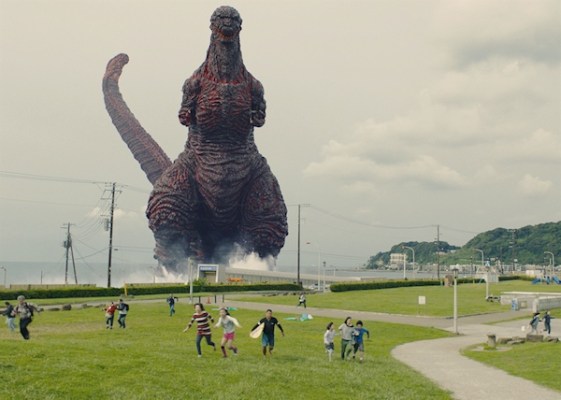
Well, probably not any of this first batch either, seeing as many of them are still in cinemas and the others won’t hit disc or streaming for a while. The one that nearly tempted me out of the house this month was Godzilla Minus One — I was interested anyway, but then the glowing reviews sealed the deal. Unfortunately, its limited release coincided with a busy weekend of pre-Christmas family stuff and then a busy week of pre-Christmas work stuff, so I just didn’t have the opportunity. If it weren’t such a limited release, maybe it would still be showing and I could go in January; but it was limited, it isn’t still showing, and now I’ll have to wait for a disc release.

Also on the big screen… Charlie and the Chocolate Factory prequel Wonka — the first review I saw called it charmless, the second thought it was a magical delight, and now I don’t know what to think (I could look up the consensus, of course, but where’s the fun in that). Yet another end for one version or another of the DC cinematic universe in Aquaman and the Lost Kingdom — I rather enjoyed the first one, so remain cautiously optimistic for the sequel. Talking of final (again) films, there was also Hayao Miyazaki’s latest last movie, The Boy and the Heron. Then there’s the latest from Michael Mann, Ferrari, and from Taika Waititi, Next Goal Wins. Closing things out, part two of French swashbuckling adaptation The Three Musketeers: Milady, which I’m hoping they’ll do a two-film 4K release when it reaches disc, as they skipped 4K for part one outside of France. Oh, and rom-com Anyone But You, which I might watch one day if it garners a good rep.

The concept of major end-of-year releases extended to the streamers, too. Netflix led with Zack Snyder’s latest, a rejected Star Wars pitch turned into an attempt to launch a standalone universe, Rebel Moon — or, rather, Rebel Moon: Part One, as apparently it was just too big to be contained to a single film. Or perhaps that should be Rebel Moon: Part One – The Neutered First Cut, as apparently this is a PG-13-friendly version ahead of an R-rated director’s cut due… in the future. This cynical viewership-grabbing idea (because why not just go straight to the uncut version?) seems to have backfired, with the film receiving poor reviews from all but the die-hard Snyder fans. It still sits on my watchlist, but then what doesn’t?

Trying to cover all bases, Netflix also released Bradley Cooper’s latest shot at an Oscar, Maestro; starry apocalyptic drama Leave the World Behind; and some family-friendly fare in the shape of belated sequel Chicken Run: Dawn of the Nugget. Amazon’s offering was comparatively paltry. Well, there was an Eddie Murphy Christmas comedy that I didn’t even bother to note down the title of, so little am I likely to watch it. Elsewise, there was odd-looking animation Merry Little Batman. Its visual style put me off, but then I thought I’d watch it anyway as it’s just a short, but it turned out to be a full-length feature, and now… well, now it’s January. Who wants to watch a Christmas film in January?

Talking of Christmas films, the other streamers were at it too: Disney+ served up kid-friendly heist comedy The Naughty Nine alongside aviation-themed “Christmas miracle”-style short The Shepherd; and Sky boasted as Originals the latest Richard Curtis effort, Genie, alongside John Woo’s much-anticipated Silent Night. They also had the UK debut of May December, but I don’t think that’s very Christmassy. Nor was MUBI’s How to Have Sex, or Apple TV+’s action-comedy The Family Plan. The latter is a Mark Wahlberg vehicle, so I’m prepared for it to be weak, but the trailer amused me nonetheless. As for more reliable action stars, Disney+ also debuted Timeless Heroes: Indiana Jones and Harrison Ford, a feature-length documentary directed by DVD special features producer extraordinaire Laurent Bouzereau (but sadly not included on the latest Indiana Jones disc release), which is billed as follows: “From his humble beginnings as TV bit-player to his era-defining turn as a blockbuster action movie star and onto his more introspective roles that followed, this new documentary tracks the storied career of Harrison Ford.” Ford’s great and Bouzereau’s work is typically fab, so that’s gotta be worth a look, right?

In terms of films making their streaming debut, Sky are back to dominance, with a December that also featured everything from hit blockbusters Spider-Man: Across the Spider-Verse and The Super Mario Bros Movie to flop blockbuster Shazam! Fury of the Gods; British flicks from grey-pound plays Allelujah and The Unlikely Pilgrimage of Harold Fry to action-comedy Polite Society; plus foreign-language action in Sisu and The Three Musketeers: D’Artagnan. The best the others could offer were warmed-over releases like the Extended Version of Spider-Man: No Way Home on Netflix (the never-released-on-disc cut with 12 minutes of extra stuff). As always, there was plenty of back catalogue stuff to fill out my watchlists, but as they all tend to come and go, and jump about from one service to the other now and then, I won’t be listing them all.

Instead, let’s jump on to the never-ending drain on my finances: disc purchases! (Ah, I love ’em really, otherwise I wouldn’t do it.) It’s a shorter list than normal this month, for whatever reason, but that doesn’t mean it’s devoid of exciting titles. For example, there’s The Warriors on 4K from Arrow — a release I’ve been hoping for for years, although was slightly less keen on after Australia’s Imprint put the film out a while back in a very good 1080p set. Fortunately (or unfortunately, depending on your point of view), Arrow’s and Imprint’s releases have completely different special features, so I’ll be keeping both sets. Another one I’d been waiting for was The Exorcist — not in desperation for any kind of decent release, but because they’ve been putting out multiple different configurations of its 4K discs over the past couple of months, and in December they finally released the one I wanted. Finally on 4K, I updated and/or completed my Indiana Jones, Guillermo del Toro, and Christopher Nolan collections with, respectively, Indiana Jones and the Dial of Destiny, Guillermo del Toro’s Pinocchio, and Oppenheimer.

Regular Blu-ray was a tale of two labels, with the latest releases from Eureka, HK gambling thriller Casino Raiders and samurai epic The Fall of Ako Castle; and the almost-latest-but-not-quite releases from Radiance (their actual December releases are currently somewhere in the postal system, having only dispatched to me this week), including French “noirish drama” Le combat dans l’ile, Umberto Lenzi’s poliziottesco Gang War in Milan, and a box set of Polish sci-fi / horror / “satirical, surrealistic apocalypse” fantasies directed by Piotr Szulkin, The End of Civilization. It sounds like the kind of stuff I have no idea if I’ll actually like or not, but it’s definitely worth a go (just don’t ask how much I spend on stuff that seems “worth a go”…)

Godzilla: King of the Monsters (2019)

2020 #38
Michael Dougherty | 132 mins | Blu-ray (3D) | 2.40:1 | USA, Japan, Canada & Mexico / English | 12 / PG-13

Godzilla: King of the Monsters

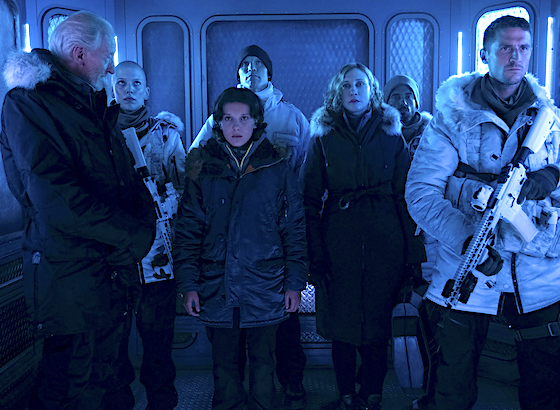
Five years on from the events of Godzilla, the world is very much aware of the existence of Titans, gigantic prehistoric creatures — or, if you prefer, monsters. These creatures are studied and, where possible, contained by the secretive organisation known as Monarch, and one of their scientists, Dr. Emma Russell (Vera Farmiga), has developed a device capable of attracting Titans and altering their behaviour. When Emma and her daughter Madison (Millie Bobby Brown) are kidnapped by a group of terrorists, Madison’s father and former Monarch employee Mark (Kyle Chandler) is re-recruited by Monarch to help track them, before the terrorists can unleash the Titans to wreak havoc on mankind.

As well as a direct followup to the 2014 reboot of the Godzilla franchise, King of the Monsters is the third film in Legendary’s “MonsterVerse”. The in-between entry was 2017’s Kong: Skull Island, whose 1970s setting kinda leaves it adrift and standalone from the rest of the present-day-set films in this shared universe (although, following the Marvel template, Kong did have a post-credit scene designed to vaguely tee-up King of the Monsters). That said, it does have a role to play tonally. Whereas Gareth Edwards’ Godzilla was a fairly strait-laced, serious take on the concept of a giant lizard attacking mankind, Jordan Vogt-Roberts’ Skull Island took a more pulpy approach to the movie, playing like a monster B-movie with a modern spectacular effects budget.

Here, Michael Dougherty’s offering feels like a combination of those two previous MonsterVerse films. As a direct sequel to Godzilla, it brings in plot threads and a couple of supporting characters from that movie (namely Ken Watanabe and Sally Hawkins as a pair of Monarch scientists, given more prominent roles here). It also adopts the dark visual style of Edwards’ movie, eschewing the colourfulness that was part of Vogt-Roberts’ contribution. But what Dougherty does retain is that pulpiness in the storyline. I mean, Godzilla showed us a world where the real-life (more or less) military had to scramble to find a way to respond to a giant lizard suddenly appearing.

Puny humans

Conversely, in King of the Monsters we find a government organisation that maintains multiple huge facilities around the world to research and contain a variety of giant beasties (one of whom is an alien, by-the-way), and a terrorist organisation that’s well organised and financed enough to break into several of those facilities and set about freeing the Titans. And that’s without mentioning a side quest into a vast sunken kingdom. If you wanted more of the real world Edwards gave us in the first film, sorry, you’re shit out of luck; but if you’re into some of the craziness that other kaiju movies have doled out down the decades, here we go!

And, in some respects, that makes this the first MonsterVerse movie that truly feels like it’s in a shared universe of monsters. Sure, the previous films had monster antagonists — MUTOs in Godzilla, Scullcrawlers in Kong — but, frankly, they were kinda generic nasties to give our hero-monsters something to fight. In King of the Monsters, we finally get to see some of the big-name stars from Godzilla’s rogue gallery; namely: inventively-named giant moth Mothra, pterodactyl-like Rodan, and the baddest of them all, three-headed dragon Ghidorah. Okay, we haven’t been introduced to these creatures in previous movies, so it’s not technically a team-up / versus movie in that sense, but you can still feel these are headline-bout-worthy characters in a way the franchise’s previous villains just weren’t. Obviously there’s still no doubt about who the ultimate victor of these monster punch-ups is going to be (clue’s in the title), but the brawls are meatier and more impactful.

I imagine that’s even more true for long-time kaiju fans, who’ll have a much greater familiarity with the ‘supporting’ monsters. Indeed, there’s a sense in which King of the Monsters has been made expressly for those fans, because it’s absolutely loaded with nods and references to the older films. I’ve not seen many classic Godzilla movies, so my knowledge of what was being referenced was second-hand at best — though one I’ll make room to highlight is composer Bear McCreary’s new realisation of Akira Ifukube’s classic Godzilla theme. It’s epic and awesome; a real hair-raiser when it kicks in.

There can be only one

Unfortunately, the parade of callbacks seems to have been a major problem for some viewers. Fans who got the references regard them as either hollow fan service or a pointless remix of past glories, while normal folk found it all a bit confusing and weird — because God forbid any blockbuster try to do stuff from outside your normal well-worn expectations. Clearly, these monster flicks aren’t for everyone. Even among those who like them, you don’t have to read many viewer’s rankings before you’ll have seen every possible iteration of which film is better than which, often accompanied by bafflement that anyone could hold an opposing view. It’s like an inadvertent case study for the fact that different people want different things. So it seems none of these movies please everyone, although personally I like the idea that each film is its own thing to some degree; that you might not love every film in the MonsterVerse, but hopefully one of them will hit the sweet spot for you. The MCU cookie-cutter format may be reassuring, but there’s delight in variety too.

There’s certainly plenty of variety here. The MonsterVerse could’ve gone down the route of wheeling out these storied foes one by one, eking the franchise out across Godzilla vs. Mothra, Godzilla vs. Rodan, Godzilla vs. Ghidorah… Instead, we get them in one Titan-sized hit. If you’re in the mood for gigantic creatures thwacking each other, there’s something wholly satisfying about that.

4 out of 5

Godzilla (1954)

aka Gojira

2019 #71
Ishirô Honda | 96 mins | Blu-ray | 1.37:1 | Japan / Japanese | PG

Godzilla

Before its current re-fashioning as a major US-produced blockbuster franchise, the rep of the Godzilla movies was more-or-less cheesy B-movie SF with cheap-n-cheerful “man in a suit” special effects. (I expect die-hard fans would disagree, but to outsiders looking in, I feel that’s fairly accurate.) But that certainly wasn’t how things started with the first movie. Indeed, this first movie was nominated for Best Picture at Japan’s answer to the Oscars, only losing to Seven Samurai. There’s no shame for any film in losing to Seven Samurai. It was also a pricey affair: the most expensive Japanese film ever made up to that point, costing almost a million dollars — ten times the average budget for a Japanese feature at the time.

But, more than just the blockbuster entertainment of its day, Godzilla is a serious-minded work. A giant monster stomping on cities — or, if you prefer, a man in a rubber suit stomping on models — may have soon become fodder for the kind of movie fans who enjoy pulp entertainment, but, in its original incarnation, it’s an analogy for the terror of the nuclear bomb. Released just nine years after the bombings of Hiroshima and Nagasaki, it’s one of the first films to deal with that scar on the Japanese national psyche. And lest you think this is something pretentious critics have projected onto the film after the fact, the movie itself draws the connection, with one character — a young woman, no less, as if to remind us of the recency of those events — commenting that she only narrowly escaped the bombings. A big part of why Godzilla still works as a film today, almost 70 years later, is because everyone involved is playing it straight, and the clear messages about the folly of mankind interfering with nature, and the futility of weapons, are powerful.

That’s not to say it’s perfect. Subplots get in the way, like a love triangle that manages to waste screen time while not really having any significant impact on the viewer. (Reportedly, a flashback scene that would have helped explain the connection between two of the participants was deleted because it slowed down the film. The romance is slow enough as it is, but you never know, maybe that extra clarity would have helped.) Conversely, some of the moral conundrums raised by the story are barely touched on. One of the main characters is a scientist who thinks mankind should study Godzilla rather than try to kill it, but other than him stating that fact and consistently looking miserable, the film doesn’t really do anything more to engage with his argument.

Good God

As for the stomping monster action, viewed with a modern eye the effects are of course a mixed bag (the miniature vehicles look like something you’d find in a toy shop, for example), but make some allowances and they’re still pretty darn effective. An underwater sequence that mixes footage of real divers with “dry for wet” shots of Godzilla and lead characters remains mostly convincing. Godzilla may have lost Best Picture to Seven Samurai, but it did win the award for special effects, and that’s one thing it does have over Kurosawa’s film, at least. I don’t know if those same awards had one for music, but if so I guess Akira Ifukube’s score wasn’t even nominated. It would’ve deserved it for the main theme alone, though, which has since become iconic for good reason.

The Godzilla franchise has come a long way and changed a good deal across the seven decades since this film’s release. It’s not a series, nor a genre, that’s to everyone’s taste (just look at the wide spread of reactions to the recent US movies, including the fact even people who broadly like them can’t vaguely agree on which order to rank them in). But this original, at least, stands tall as an example of how a movie that some might seek to dismiss as facile genre fare can actually be about a whole lot more.

4 out of 5


For 50 years, you couldn’t actually see Godzilla in the West — not exactly. Instead, you’d watch…

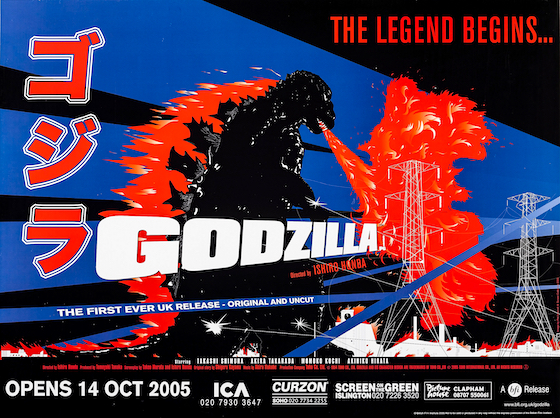
Godzilla, King of the Monsters!
(1956)

2019 #82
Terry Morse & Ishiro Honda | 81 mins | Blu-ray | 1.37:1 | Japan & USA / English | PG

Godzilla, King of the Monsters!

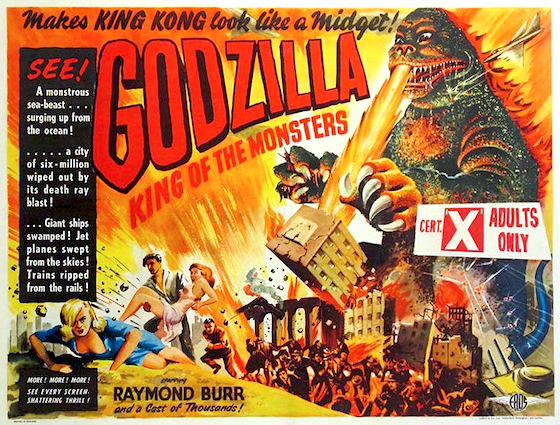
In an era where the original cut is king (to the extent that, say, a major studio might hand a director $70 million to complete his cut of a not-particularly-successful movie just so they can release it on a streaming service), it seems wild to remember that, until 2004 — a full five decades after Godzilla‘s premiere release — this re-edited, bastardised version was the only one available to Western audiences.

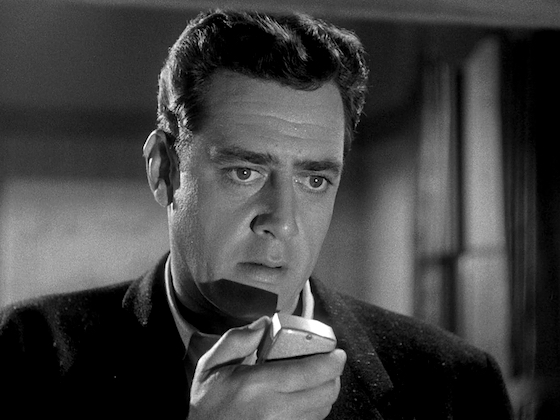
With a runtime 15 minutes shorter than the Japanese cut, you might think King of the Monsters was just an abridgement. But they went at it more thoroughly than that back in the ’50s; in fact, almost 40 minutes of footage was cut, and the disparity is covered by newly-filmed scenes starring Raymond Burr as Steve, an American journalist. These new scenes don’t just place Burr’s character around the existing action, but work to make him the (human) star of the movie.

The end result is actually fairly close to the original story-wise, just now there’s an American journalist hanging around the fringes. At first he’s often to be found at the back of a crowd or the edge of a room, observing events, but they get bolder as the film goes on, integrating him with some of the main characters, either by repurposing and rearranging original footage or shooting Burr with doubles whose faces we never see. It’s not a perfect match, but for a quickly-produced low-budget effort in the 1950s, it’s surprisingly well achieved. This is partly thanks to the choice of director for the new scenes. Terry Morse had 30 years of experience as an editor and director of low-budget films, and it was felt someone with that kind of background would be well-placed to maintain the continuity needed to make it seem like Burr was part of the original production.

Raymond Burr, sir

Morse also makes some interesting decisions about how to adapt the existing footage. Although all of the ‘Japanese’ characters speak perfect English with American accents in the new bits, a lot of the Japanese dialogue in Ishiro Honda’s scenes is left undubbed, and it’s never subtitled either. Instead, the film trusts us to infer what’s happening, or informs us via someone translating for Steve, or his voiceover narration. It feels like quite a mature way to handle a multi-lingual production. Unfortunately, any such maturity doesn’t extend across the board: when abridging the original, they removed or neutered much of its commentary about mankind’s destructive nature, thereby turning a powerful allegory into a simple monster movie.

To my surprise, Godzilla, King of the Monsters is not a complete disaster. There’s a fair bit of the original movie left, and the American inserts aren’t unremittingly terrible, which they certainly could have been. If this was the only version of the film available, I’d probably give it a solid 3 stars. But it isn’t the only version anymore, so the question becomes: why watch it nowadays? It neuters some of what was great about the Japanese cut, and it’s inherently a bastardisation — so, other than curiosity value (or, for older fans, nostalgia), there’s no reason to bother with this. Stick to the real one.

2 out of 5

Colossal (2016)

2018 #117
Nacho Vigalondo | 109 mins | streaming (HD) | 2.35:1 | Canada, USA, Spain & South Korea / English & Korean | 15 / R

Colossal

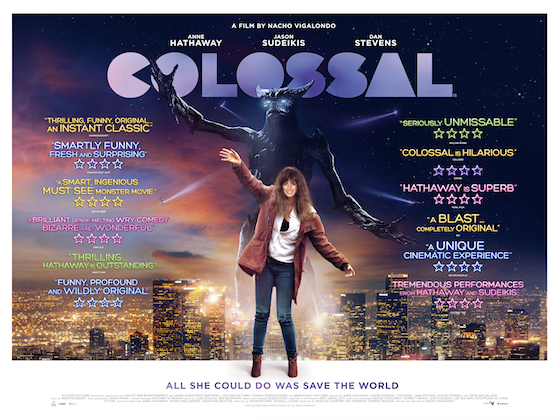
As it begins, you’d be forgiven for thinking Colossal is just another indie rom-com. Anne Hathaway stars as Gloria, an unemployed writer whose boyfriend (Dan Stevens) kicks her out of their New York apartment, forcing her to move back to her Nowheresville hometown. There she reconnects with childhood friend Oscar (Jason Sudeikis) — romance is surely in the air, right? But Colossal has a couple of surprises up its sleeve. One is hard to miss, what with it being on all the posters (and, I presume, in the trailers): concurrent with Gloria’s return home, a giant monster begins to rampage around Seoul, and she comes to realise these two disconnected events are, in fact, connected. Meanwhile, the relationship storyline has a few twists in store too.

Unsurprisingly, given the uniqueness of the concept, the film’s marketing foregrounds the giant monster. But anyone expecting “a giant monster movie” will probably be disappointed, because this isn’t a Godzilla clone. However, anyone open to an indie comedy-drama that uses giant monsters as a giant metaphor (arguably an on-the-nose one, but it’s an effective one also) should find something of interest here. I’m being coy about the facts of that metaphor because I think one of the movie’s biggest strengths is its ability to surprise, and to wrong-foot and unnerve you with those surprises — there are some very uncomfortable scenes, deliberately so. Writer-director Nacho Vigalondo is looking to explore timely themes here, and if you were to be aware of them before viewing I think you’d be looking for signs too early, and that would undermine part of the film’s point, which lies in how events develop.

To put that aside, Colossal’s biggest weakness comes in its sci-fi/fantasy element, where the rules of the situation don’t quite hang together. I’m not saying it needs an explanation for why the ordinary-woman/giant-monster connection happens — it’s the same reason that, say, the time loop in Groundhog Day happens: it just does. The ‘why’ is immaterial to the film’s purpose. But the rules the film establishes for how it works don’t entirely add up. I could go into specifics but, again, that might spoil things. And, ultimately, my issues are no more than niggles — the way things pan out is about getting satisfaction from the storyline, not adhering to the ins and outs of how a fantasy works. That said, I feel like a couple of logic tweaks here and there would’ve made it faultless.

Who's the bigger monster?

Nonetheless, it’s worth letting those complaints slide, because there’s so much to like in spite of them. The performances, for one. Hathaway negotiates Gloria’s interesting, tricky character with aplomb. By ‘tricky’ I really mean that it’s somewhat hard to put your finger on what her arc is exactly, but I think that’s because her evolution is believably fuzzy, just like real life, rather than conforming to a slick “this is the lesson she learned and now she’s better” movie thing. Co-lead Sudeikis has, I’d wager, never been better. I’ve not seen him in much, but enough to buy other people’s opinion that he’s a bit smug, a bit try-hard, a bit… of a dick, really. But all of those qualities work here, where Oscar is a loser trying to seem cool.

With some polishing up, Colossal could’ve been nigh on perfect; though it’d likely still be a cult favourite rather than any major success. Well, it’s probably still good enough for cult status, though, as a caveat, it will most appeal to those viewers who are prepared to accept a bit of a genre/tone mashup. It’s got an indie-funny quality, but then throws the sci-fi stuff in, before unveiling a serious side too; and, although that does get very dark, it’s really effectively managed — indeed, it’s all the better for how the quirkier first part sets it up. Vigalondo has points he wants to make, and his film gets them across. Whatever else, it’s definitely original and unique, and those qualities go a long way.

4 out of 5

Colossal is available on Netflix UK as of this month.

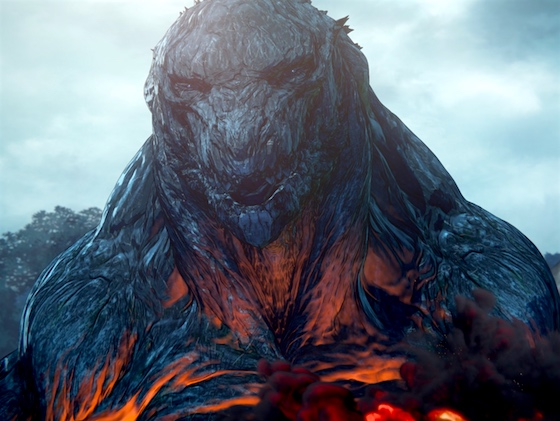
Godzilla: The Planet Eater (2018)

aka Gojira: Hoshi o Kuu Mono

2019 #3
Hiroyuki Seshita & Kôbun Shizuno | 91 mins | streaming (HD) | 16:9 | Japan / English | 12

Godzilla: The Planet Eater

Picking up where the previous film left off, this concluding instalment in the anime Godzilla trilogy (which also doubles as the 32nd official Godzilla movie) sees the eponymous kaiju lying dormant while plans swing into action to bring Ghidorah, a being from another dimension who’s worshipped as a god by some, into our dimension, where it will eat Godzilla and then Earth itself.

Yeeeaaah.

But before we get to the headline monster mash, there’s an attempt at a plot. By the end of the last film, the alliance between humans and a couple of alien races who’d helped us out was looking a bit shaky. What once looked like it might make for a Battlestar Galactica/Babylon 5-style conflict has turned out to be nothing so developed, and in this final film it noodles along, driven by minor supporting characters we have zero attachment to; a something-and-nothing plot line that kills time until it’s summarily wiped away. Meanwhile, down on Earth, we’re treated to dozens of scenes in which the trilogy’s equally unmemorable lead characters wander around waffling Religious Studies 101-level stuff about religion as propaganda and a manipulation tool. At one point a character talks about soup as an analogy for, like, society or something, coming to the observation that “unlike the soup, we have free will.” It’s a deep philosophical movie, man. About as deep as a bowl of soup.

All the while, we’re made to wait for the guy we came to see to wake up. Yes, Godzilla literally sleeps through the first half of the movie. Well, I can’t say I blame him.

Godzilla vs Ghidorah

On the bright side, it does eventually get to some good bits (that’s more than I’d say about the preceding instalment). There’s a sequence where the alien death cult religion summons Ghidorah, who initially manifests as some kind of shadow-demon that begins massacring everyone in the room, which is all quite creepy. It’s followed by a large-scale sequence where Ghidorah’s glowing energy snake-dragon form emerges from a space-time singularity and destroys the humans’ spaceship in some kind of temporally-messed-up way, which is also quite striking. You have to appreciate these individual sequences almost in isolation, because the plot they’re part of is a load of muddly claptrap.

Then there’s the climax, in which we get to witness a mountain-sized dinosaur-ish monster with atomic breath (Godzilla) battle an interdimensional three-headed dragon-snake apparently made of glowing yellow light (the trilogy’s take on Ghidorah). It has its moments, but it’s overlong and mixes in a bunch of the cod-scientific wannabe-philosophical gubbins too, which takes the wind out of its sails somewhat.

There have been some interesting ideas tucked away in this trilogy, both in how it reimagined the kaiju and their mythologies, and in the brand-new stuff it attempted to introduce with the alien races and their beliefs. Unfortunately, that promise has been lost under unengaging characters, poorly defined relationships, and the kind of philosophising you might expect from a Sixth Form student. It was bold to try to take the Godzilla franchise in a new direction, but that boldness feels squandered.

2 out of 5

Godzilla: The Planet Eater is available on Netflix now.

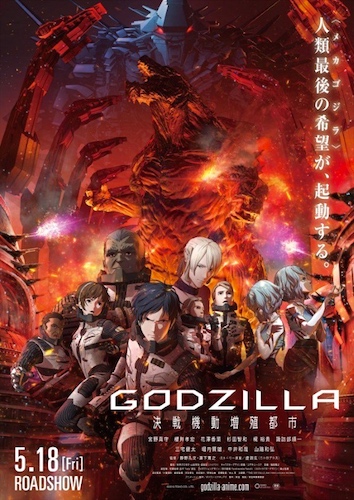
Godzilla: City on the Edge of Battle (2018)

aka Gojira: Kessen Kidō Zōshoku Toshi

2018 #156
Hiroyuki Seshita & Kôbun Shizuno | 101 mins | streaming (HD) | 16:9 | Japan / English | PG

Godzilla: City on the Edge of Battle

The 31st official Godzilla film from Japan’s Toho studio is the second part of their anime trilogy. Released theatrically in Japan, it’s a Netflix exclusive in the rest of the world — which is probably for the best, because it means we don’t have to pay money specifically for this shite.

Picking up where the previous film left off, City of the Edge of Battle is set on Earth 20,000 years in the future, where a 300-metre-tall Godzilla (the largest ever, fact fans) rules the planet. I could go into the rest of the backstory, but we’ll be here for a paragraph or two — you can either watch the first film or, better yet, save yourself a couple of hours and just don’t bother with any of it. But anyway: in this instalment, the party that have landed on Earth to defeat Godzilla discover a tribe of humans (or, possibly, just a human-like species) who have somehow survived Godzilla’s reign. They in turn lead them to the remains of Mechagodzilla, a failed project by alien chums to help defeat Godzilla. Left alone for 20 millennia, the mech’s “nanometal” has grown into an entire city, which they now hope to use to defeat Godzilla.

There are some neat sci-fi ideas in this trilogy — aside from the Battlestar Galactica-esque stuff I talked about last time, there’s some interesting notions about how the planet might’ve changed and evolved over 20,000 years without us, and a city that’s grown itself has potential — but promising concepts alone are not enough to overcome the clunky dialogue, dull visuals, unmemorable characters, turgid philosophising, and sauntering plot. And if you’re here for the eponymous big guy, once again he doesn’t even get involved until over an hour in, just in time for the final big action sequence. That’s so badly done, it requires constant narration from the human command centre to explain what’s supposed to be going on. It would make as much sense as an audio drama as it does as a film.

Look, Godzilla is in this film! (Eventually.)

Another way this second film suffers is that many actions are built on motivations that were established and explained in the first film, but which aren’t restated here — and they were easy to miss in the first one anyway, because it was overloaded with exposition and jargon. It should be no surprise that this sequel is no better in that regard, justifying my decision to watch it in English this time. It did seem weird to switch language part way through a trilogy, but it’s not like any of the characters were memorable enough that I associated their voices with them, so why not? Well, I always feel I should watch anime in its original Japanese, for purism’s sake, but English is just easier — especially when the amount of made-up jargon flying around made the first film something of a chore to read.

I didn’t really enjoy the first film, but generously gave it 3 stars on the basis that it wasn’t completely terrible and had some ideas with potential. This sequel squanders most of that. I still like the mythology they’ve loaded into this universe — the conflicting ideologies of the different species on the spaceship; the situation on Earth when they return (the human-like tribe; the self-built city-with-a-brain) — but it’s all bungled in the execution, coming out as gloop that is, at best, barely intelligible, and, at worst, flat out boring. And if there wasn’t already more than enough backstory, mystery, and potential conflict to be going on with (which there was), City on the Edge of Battle throws a ton more into the mix. But hey, maybe the third film will actually generate some excitement if it has to rush to wrap all that up?

2 out of 5

Godzilla: City on the Edge of Battle is available on Netflix now. The final film is scheduled for release in Japan in November, and worldwide in early 2019.

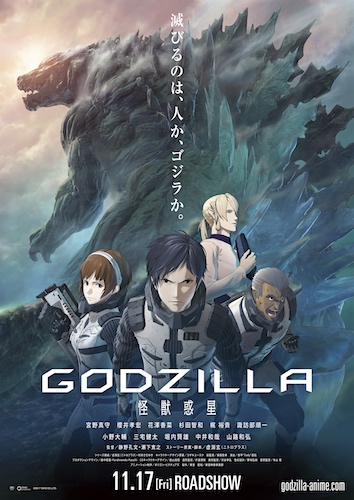
Godzilla: Planet of the Monsters (2017)

aka Gojira: Kaijū Wakusei / Godzilla: Monster Planet

2018 #13
Hiroyuki Seshita & Kôbun Shizuno | 88 mins | streaming (HD) | 16:9 | Japan / Japanese | PG

Godzilla: Planet of the Monsters

Two of Japan’s most successful cultural exports meet for the first time here as the King of the Monsters, Godzilla, gets the anime treatment. Originally conceived as a TV series, the box office success of Shin Godzilla prompted studio Toho to restructure the project as a trilogy of movies and release them theatrically (in Japan, anyway — the rest of the world gets them via Netflix). Part 2 is due later in 2018 and Part 3 in early 2019.

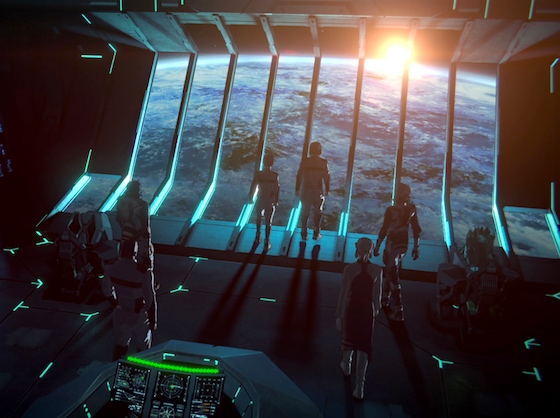
The standard plot of a Godzilla movie, as I understand it, is a giant monster (aka kaiju) turns up, stomps all over some cities, then we find a way to destroy it; or, if it’s one of the ones where Godzilla is a good guy, he fights it and, presumably, wins. Planet of the Monsters uses its animated form to do something new with the concept. The opening credits montage informs us that, in the final years of the 20th century, kaiju suddenly sprung up all over the planet and mankind were unable to defeat them. Fortunately some aliens rocked up and offered to help by evacuating what was left of humanity. Twenty years later this mission to the stars is proving a failure, with minimal chance of finding a habitable planet and the survivors decimated by diminishing supplies. The best course of action is deemed to be a return to Earth — it’s estimated thousands of years will have passed there (thanks to relativity) and the hope is the monsters will have died; and if not, hotshot young captain Haruo Sakai has come up with a new plan to defeat Godzilla once and for all.

Good God

If that reads like a lot of setup, it’s because Planet of the Monsters contains a lot of setup. It takes about half the movie before they’re back on Earth and… well, technically this is a spoiler, but if you’re intending to watch the movie it might help you manage expectations: Godzilla doesn’t properly show up until the final half-hour. This has led some reviewers to accuse the movie of being slow and light on what we came to see, i.e. giant monster action. They have something of a point. However, contrary to most opinions I’ve read, I actually enjoyed the early space-bound stages of the movie better.

It feels like the makers had a ton of interesting ideas about the politics and social situation aboard the evacuation ship, especially with multiple races and some kind of alien religion involved too, but there’s no time to really explore or develop those facets. Maybe they planned to get into that in the series. Either way, I find it funny that others have criticised that part for being slow and talky while I felt it had to race past a lot of potentially-interesting stuff to keep the plot moving. I guess I just ought to go watch Battlestar Galactica again, because it’s broadly similar territory.

Back to Earth

But, as I said before, there’s a rub: this setup provokes interest as a Galactica-style sci-fi, but as a Godzilla movie? There’s far too little of the big guy. And when he does turn up for the big climactic action sequence, that was the bit I found kinda dull. There’s a lot of whizzing around on hoverbike-things and blowing up forests and whatnot — plenty of sound and fury, but signifying what? And then… well, still avoiding spoilers, but there’s a twist in the final few minutes that renders this whole film prologue. Perhaps that should leave us hopeful for the next two? Perhaps this is all effective world-building for where things will go in the sequels? Conversely, it could be revealed as unnecessary background info once all the monster smashing starts. Only time (and the next two films) will tell…

3 out of 5

Shin Godzilla (2016)

aka Shin Gojira / Godzilla Resurgence

2017 #108
Hideaki Anno | 120 mins | Blu-ray | 2.35:1 | Japan / Japanese, English & German | 12A

Shin Godzilla

To the best of my knowledge, the Godzilla movies have never been particularly well treated in the UK. With the obvious exceptions of the two US studio movies and the revered 1954 original (which, similar to its inclusion in the Criterion Collection in the US, has been released by the BFI over here), I think the only Godzilla movie to make it to UK DVD is King Kong vs. Godzilla, and that’s clearly thanks to the Kong connection. Contrast that with the US, or Australia, or Germany, or I expect others, where numerous individual and box set releases exist, not only on DVD but also Blu-ray. There were some put out on VHS back in the ’90s (I owned one, though I can’t remember which), but other than that… Well, maybe we’ll be lucky and the tide will now change, because the most recent Japanese Godzilla movie — the first produced by the monster’s homeland in over a decade — is getting a one-night release in UK cinemas this evening. It’s well worth checking out.

Firstly, don’t worry about it being the 29th Japanese Godzilla film, because it’s also the first full reboot in the series’ 62-year history (previous reboots in 1984 and 1999 still took the ’54 original as canon). The movie opens with some kind of natural disaster taking place in Tokyo Bay, to which the Japanese government struggle to formulate a response. But it quickly becomes clear the event is actually caused by a giant creature, which then moves on to land, leaving a trail of destruction in its wake. Ambitious government secretary Rando Yaguchi (Hiroki Hasegawa) is put in charge of a special task force to research the creature. Soon, the Americans are muscling in, contributing a dossier they’d previously covered up, which gives the creature its name: Dave.

Alright Dave?

No, it’s Godzilla, obv.

Written and directed by Hideaki Anno of Neon Genesis Evangelion fame (and fans of that franchise will recognise many music cues throughout the film), Shin Godzilla is not just a film about a giant beastie stomping on things. Most obviously, it pitches itself as a kind of political thriller, as an intrepid gang of semi-outsiders battle establishment red tape to get anything done. In this respect it’s something of a satire, though not an overtly comedic one. It also seems to be taking on Japanese society, with the in-built deference to age or rank being an obstacle to problem-solving when it’s the young who have the outside-the-box ideas to tackle such an unforeseen occurrence. There’s also the problem of the Americans sticking their oar in, being both a help and a hindrance. Clearly the Japanese feel broadly the same way towards the U.S. of A. as do… well, all the rest of us.

Anno takes a montage-driven, almost portmanteau approach to the storytelling, flitting about to different locations, organisations, departments, and characters as they come into play. This lends a veracity to the “as if it happened for real” feel of the film: rather than take the usual movie route of having a handful of characters represent what would be the roles of many people in real life, Anno just throws dozens of people at us — the film has 328 credited actors, in fact. It means there’s something of an information overload when watching it as a non-Japanese-speaker: as well as the subtitled dialogue, there are constant surtitles describing locations, names, job titles, types of tech being deployed, etc, etc. In the end I wound up having to ignore them, which is a shame because I think there was some worthwhile stuff slipped in there (possibly including more satire about people’s promotions throughout the film).

We can defeat Godzilla with maths!

I’d be amazed if anyone can follow both, to be honest, because the dialogue flies at a rate of knots. Anno reportedly instructed the actors to speak faster than normal, aiming for their performances to resemble how actual politicians and bureaucrats speak. Apparently he cited The Social Network as the kind of vibe he was after, though a more appropriate comparison might be that other famous work from the same screenwriter, The West Wing. Either way, I think he achieved his goal, further contributing to the film’s “real” feel and the (geo)political thriller atmosphere — even if it’s a nightmare to follow in subtitled form.

Letting the side down, sadly, is actress Satomi Ishihara, who plays an American diplomat of Japanese descent. Apparently she found out she was playing an American after being cast, and was shocked to see how much English dialogue she had to speak. It shows. There’s nothing wrong with her performance on the whole, but casting a Japanese actress as a supposed American is a really obvious mistake to English-speaking ears. All of the English speech in the film is subtitled, which isn’t necessary for American generals and the like, but for her… well, I didn’t always realise she was no longer speaking Japanese. Poor lass, it’s not her fault, but it does take you out of the film occasionally.

On another level from the politics, Shin Godzilla is also about wider issues of humanity and the planet. The ’54 film was famously an analogy about nuclear weapons, and Anno updates that theme to be about nuclear waste and its effect on the environment, inevitably calling to mind the 2011 earthquake and tsunami that led to the Fukushima power plant disaster. This is less front-and-centre than the thriller stuff — the actions of the humans are what drives the film’s plot, whereas the nuclear/environmental stuff is more thematic subtext. Put another way, I wouldn’t say the film gets too bogged down by this — it’s still about a giant monster blowing shit up with his laser breath.

Either that or the purple goo he ate earlier really disagreed with him

Said giant monster is realised in CGI, some of it derived from motion capture, presumably as a tribute and/or reference to the old man-in-a-suit way of creating him. This is not a Hollywood budgeted movie and consequently anyone after slavishly photo-real CGI will be disappointed, but that’s not really the point. It still creates mightily effective imagery, and for every shot that’s less than ideal there’s another that gives the titular creature impressive heft and scale. He’s also the largest Godzilla there’s ever been, incidentally.

If you come to Shin Godzilla expecting to see a skyscraper-sized monster destroy stuff and be shot at and whatnot for two hours straight, you’re going to leave dissatisfied. There are scenes of that, to be sure, but it’s not the whole movie. If a thriller about a bunch of tech guys and gals fighting bureaucracy while analysing data that will eventually lead to a way to effectively shoot (and whatnot) the monster, this is the film for you. It was for me. I have to mark it down for some of the niggles I’ve mentioned, but I enjoyed it immensely. (You can make you own size-of-Godzilla pun there.)

4 out of 5

Shin Godzilla is in UK cinemas tonight only. For a list of screenings, visit shingodzillamovie.co.uk.

Bambi Meets Godzilla (1969)

2016 #107a
Marv Newland | 2 mins | streaming | 1.37:1 | USA / English | U

At the risk of my blog becoming some kind of film-watching Inception, with a host of viewing goals within viewing goals (the titular one; “What Do You Mean You Haven’t Seen” / Blindspot; all those ones I mentioned in my review of Home on the Range), here’s something new I’m setting out to do (in a vague, loose, ‘will get there one day’ kind of way):

Regular readers will surely remember iCheckMovies, the movie list website where you can check off films you’ve watched and see how many you’ve seen on particular lists, like the IMDb Top 250, or They Shoot Pictures’ 1,000 Greatest, or 179 other ‘official’ lists (or 8,603 user-added ones — seriously). Obviously you can use this as an empty-headed list-completing exercise (and some people do), but it’s also a way to motivate watching well-regarded movies, and to discover new ones.

(What does this have to do with Disney’s dear deer meeting Tokyo’s greatest monster? I’m getting to that.)

There are several lists in particular I have my eye on, for one reason or another. Getting around to some more films on those lists was part of the motivation behind my selections for this year’s WDYMYHS, for example (most of the motivation, if I remember rightly). However, even while I’m a decent way through completing some lists, I happened to notice last night that there are a handful of those 181 official lists on which I have precisely zero checks. 26, to be precise, which in some ways sounds like a lot, but in others is only 14%. Naturally, this inspired one particular thought: to endeavour to get at least one check on every single list.

(The bereaved fawn and gigantic lizard are coming up imminently.)

There are pretty obvious reasons why I’ve never seen any films on many of those lists — quite a lot are country or continent specific, and as Western film viewers we’re notoriously poor at having seen movies from, say, Africa. The lack of acclaimed films I’ve seen from the likes of Belgium, Finland, Holland, Hungary, Norway, Poland, Portugal, and Spain is my own fault though, I guess. Anyway, this is something I intend to rectify in the coming days / weeks / months / years / decades — however obscure some of my missing lists may seem, there’s at least one film I’ve heard of on all but one or two of them, so there’s that.

Anyway, I started with the easiest list of all lists: Best Cartoons Ever – A Gift List From Jerry Beck. This list contains “the 50 greatest cartoons of all time, from a poll of 1,000 animation professionals conducted by author/film historian Jerry Beck for the 1994 book The 50 Greatest Cartoons: As Selected by 1,000 Animation Professionals.” There’s all sorts of famous stuff on there, from 1914’s Gertie the Dinosaur, to Mickey Mouse’s debut in Steamboat Willie, to acclaimed classics that appear on multiple other lists, like Duck Amuck and What’s Opera, Doc? But I started with possibly the shortest of the lot: 92-second one-gag short Bambi Meets Godzilla.

I say “one-gag” — there’s one headline gag, but I’d argue there are at least five jokes slipped into the film’s minute-and-a-half running time. Describing the ‘plot’ would be pointless, especially when it would be almost as quick for you to watch it yourself on YouTube; or, if you really want, a couple of years back a fan restored/remade it in 4K with 5.1 surround sound (seriously), which you can watch here. It loses a lot of its charm in that form, if you ask me. Either way, there are less amusing ways to spend 90 seconds of your time.

Why is this film notable? In fact, is it notable? Well, it was voted in to The 50 Greatest Cartoons by some of 1,000 animation professionals, so there’s clearly something there. It was created by animator Marv Newland while he was a film student in L.A., after a live-action project he’d been planning to submit was scuppered (according to Wikipedia, uncited, that was due to the loss of “an essential magic hour shot”). Newland created the short animated gag in his room and submitted that instead. It’s a pretty straightforward piece of animation — black-and-white line drawings, some text, few moving elements — with a couple of music tracks on top (Call to the Dairy Cows from Rossini’s William Tell, which you might not know by name but will certainly recognise, and the final chord from the Beatles’ A Day in the Life).

Maybe it’s the subversiveness that makes it significant? It comes from an era when that must have been a factor, surely — there’s a certain Monty Python-ness to it, and it was made the same year Flying Circus first aired. Perhaps it just has some familiarity — I’ve seen comments by people saying it was regularly screened at sci-fi conventions throughout the ’70s, and it was attached to film prints and VHS releases of Godzilla 1985. There are even two sequels, Son of Bambi Meets Godzilla and Bambi’s Revenge, which weren’t made by Newland and are apparently hard to come by. I suppose Beck’s book must explain its inclusion, but if anyone has a copy of that to hand then they’ve not bothered to quote its entry online.

Anyway, for what it is it’s very effective, but it is slight, so I shall give it:

3 out of 5