What Do You Mean You Haven’t Seen These Films You’ve Bought Multiple Times?

Reader, I want to make a confession: sometimes I buy new copies of films I already own but have never seen. Never mind blind buying, I blind upgrade. It’s stupid, I know — why not at least watch the copy I already have to see if I like the thing before purchasing it a second time? But when Blu-ray came along, the leap in quality from DVD was so great (especially with a new transfer and/or restoration) that sometimes it feels like “why would I watch this crappy version just because I already have it when that better one exists?” And now with 4K… well, I do it less often, because the jump between HD and UHD isn’t always as pronounced (and if they fuck it up, sometimes the new version is worse).

Nonetheless, the theme of this year’s WDYMYHS was provoked by my relatively recent (i.e. in October) purchase of Le Samouraï in 4K. I first owned that film on DVD, didn’t get round to watching it, then a Blu-ray came along, and it seemed like it would be worth an upgrade. I didn’t get round to watching that either before the 4K came along — well, I wasn’t going to upgrade again! But then the reviews were so good… I did at least manage to resist until it was discounted. Although, all three of those were Criterion editions, so it was never truly cheap. Eesh. I really hope I like it as much as I’m expecting to…

That might be my most egregious example of ridiculous triple-dipping (I feel like I’ve more than triple-dipped on some titles, but at least those were ones I already knew I liked), and it’s what led me to this theme: I wanted a selection methodology that would force me to finally watch Le Samouraï, so what better than the very reason I wanted to be forced to watch it? I was certain I’d find another 11 films (at least) that had a similar purchase history. And, reader, I did. Of course I did. I won’t give you the full story of how many times I’ve re-bought them or why, but I’ve owned them all at least twice without ever actually watching them — until now!

In alphabetical order, they are…


The City of Lost Children

The City of Lost Children

Fist of Fury

Fist of Fury
The Lodger

The Lodger

Out of Sight

Out of Sight
Project A

Project A

Saboteur

Saboteur
Le Samouraï

Le Samouraï

Spartacus

Spartacus
Steamboat Bill, Jr.

Steamboat Bill, Jr.

Tenebrae

Tenebrae
The Untouchables

The Untouchables

The Wolf Man

The Wolf Man

As I intimated in the introduction, these aren’t the only 12 films I’ve upgraded without watching, so how did I settle on this particular batch? For once, it was mostly personal preference rather than other people’s rankings. I started by making a list of eligible titles, along with how many times I’d owned them — given the theme of the list, I wanted to err towards the ones I’d repurchased the most. Then I simply picked the ones I wanted to include.

Except it wasn’t quite that simple. In compiling the list, I noticed a couple of themes. Thanks primarily to some films being released repeatedly in sets, there were multiple films on the list directed by Alfred Hitchcock, or Dario Argento; or starring Bruce Lee, or Jackie Chan, or Buster Keaton; or from the classic period of Universal’s horror output… I decided that, as those were clear groups, representative examples of each should definitely be included. And that’s when I did fall back on old tricks: I ranked each group by their popularity and average ratings on Letterboxd. That wasn’t the be-all-and-end-all (neither of the two Hitchcocks I chose were in his top two), but it was a useful guide. I chose one from each category, with the exception of Hitchcock, who gets two because I’ve upgraded his films in different ways for different reasons. Saboteur represents the 14 titles that Universal have repeatedly reissued in box sets of varying kinds. The Lodger represents the rest, though in particular his British pre-Hollywood career.

With the five other films featuring work by visionaries like Stanley Kubrick, Steven Soderbergh, Brian De Palma, and Jean-Pierres both Jeunet and Melville, it looks like another exciting year ahead for this category. Let’s hope they live up to my expectations — I’ve certainly spent enough money on them.


February’s Failures

What’s the big story at the box office this month, then? Normally a new MCU film would walk it, but Ant-Man and the Wasp: Quantumania is reportedly struggling. Well, it’s still making a tonne of money, but not as much as usual for these affairs, and not compared to its staggeringly over-large budget. Has the much-heralded end of the superhero boom arrived? Or is this just a blip? Probably Guardians of the Galaxy 3 in May will be a better indicator.

Also playing this month was the new M. Night Shyamalan, Knock at the Cabin, which seemed to be as divisive as Shyamalan movies always are nowadays. I’ll definitely catch it at some point, but I still haven’t got round to Old. Then there was Cocaine Bear which, based on the early reviews I saw, sounds to be as delightfully trashy as its premise promised. Again, though, not something that’s actually tempted me out to the cinema (we might have to wait until a certain Part Two in November for that; but we’ll see). There were belated UK bows for Puss in Boots: The Last Wish, The Whale, and Marcel the Shell with Shoes On (which I was going to watch and review, until it turned out I’d been sent a faulty disc. The replacement turned up too late to hit the release date). I should also mention Magic Mike’s Last Dance. I’ve never seen a Magic Mike film, though they remain on my list due to Steven Soderbergh’s involvement.

Originals of note were in even shorter supply from the streamers. All I have jotted down to mention are Amazon’s Somebody I Used to Know (which I’m not sure I saw any significant discussion of beyond its poster), Netflix’s We Have a Ghost, and Apple TV+’s Sharper (which I did hear some good things about, but not many, because who watches Apple TV+? Hardly anyone). In “fresh from the cinema” stakes, Disney+ offered Black Panther: Wakanda Forever, though personally I’ll wait until I can find a 3D copy (not to mention that I’m multiple MCU films behind, so it’s a few down the line for me anyway); and, on a more low-key note, Sky Cinema had British indie comedy Brian and Charles. (More noteworthy additions to the latter’s catalogue might be Top Gun: Maverick, but I’ve seen that, and Bullet Train, but I already bought that (cheaply), so they’re not really “failures”. Not for this month, anyway.)

In terms of older films popping up, as ever I added multiple titles to all my watchlists, but little seems particularly worthy of note. Maybe submarine flick Black Sea on Netflix, which I vaguely remember coming and going with little fanfare back in 2014, but I saw someone describe as an “underwater heist” movie, which tickled my interest. On MUBI, Ali: Fear Eats the Soul would merit a mention if I hadn’t already downloaded it for my Blindspot challenge; the same could be said for Wild Tales, which is one of the handful of films I haven’t seen from IMDb’s Top 250.

I did rent something for the first time in yonks, though: Confess, Fletch — partly because I’ve heard good things, partly because Amazon were having a sale for Prime members. If that isn’t part of my March viewing, I’ll have wasted £1.99.

Talking of spending money, of course I bought more discs this month — fewer than normal, based on the length of my list, but still a definite pile of stuff. My 4K collection was emboldened by two labels: A24, from whom I imported The Green Knight (I already own the regular 4K release, but this has a bunch of exclusive special features, not least a whole new short film) and Marcel the Shell with Shoes On (which, as previously mentioned, it turned out was faulty and I had to wait for a replacement); and Arrow, who this month brought out The Last Emperor (one of those ’80s historical epics I’ve yet to see) and The Sisters Brothers (a film I’ve consistently not got round to watching while it was on Netflix and iPlayer and possibly other streaming services, and now I can not get round to watching it on disc).

Indeed, breaking this section down by label is probably the right way to go about it, because so many of my purchases these days are random films — sometimes things I’ve never even heard of — which I blind buy because I trust the label (though there’s no label I blindly buy everything from — there has to be something about each release that piques my interest). In that sense, Indicator dominated the month with five titles: Spaghetti Western The Big Gundown (which pairs nicely with Eureka’s Run, Man, Run from last month. Just need someone to bring Face to Face to Blu to complete the trilogy of Sergio Sollima’s work in the genre); Mexican wrestler action in a box set of the first two Santo films, Santo vs. Evil Brain and Santo vs. Infernal Men (this is a real “well, if Indicator are releasing it…” punt, combined with the enjoyment I got from Mystery Science Theater 3000’s recent Santo episode); and then, right at the end of the month, Death of a Gunfighter, The Night of the Following Day, and the only one of these six films I would’ve classed as a “want to see” before Indicator announced them, Sherlock Holmes riff They Might Be Giants. The latter comes with three cuts of the film, so I’m gonna have to choose one somehow…

The only other label to mention this month (I said it was a smaller one) is Eureka, who continued their recent output of classic “girls with guns” / Michelle Yeoh titles with Magnificent Warriors and expanded their Masters of Cinema line with yakuza thriller Violent Streets; plus I dove slightly into their back catalogue (all the way back to October) and bought the Maniacal Mayhem set of three Boris Karloff / Universal horrors (to go with the Universal Terror set I already had and in anticipation of the Creeping Horror set that’s coming in April, not to mention their other collections of classic Uni monster/horror flicks).

My final purchase of the month is an oddity: a DVD (the only format it’s available on) of a Christmas movie (seasonal!) — or, rather, a Christmas TV special. And its only DVD release (that I’m aware of) was a freebie with the Daily Mail years ago, and it was that that I picked up from an eBay seller (for a reasonable price, considering most copies of it are advertised for £16+. Seriously). I’m talking about The Greatest Store in the World, which I’ve always felt would be remembered as something of a Christmas classic if it had been released as a proper movie rather than a BBC special in 1999. Or maybe the memory cheats? It hasn’t been repeated often, so I haven’t seen it for years. Well, I’m not about to watch it anytime soon — it’s a Christmas movie, remember! It’ll have to wait ’til December.

2022 Statistics!

It’s time once again for the highlight of the year (my highlight, at least) — the statistics! And because I love them so much, I’ve not really messed around with them. That’s to say, these are still based on my first-time watches from 2022 (as listed here), not only films I watched for the new-style Challenge.

Before the onslaught of numbers and graphs begin, I’ll just mention that, because I’m a Letterboxd Pro member, I get a yearly stats page over there too, which can be found here. In some places that’ll look a bit different to this one, because I also log whatever TV I’m allowed there; but it does have some interesting additional and alternative stats, like my most watched and highest rated stars and directors.

With that plugged, it’s time for the main event…


I watched 111 feature films for the first time in 2022. That’s my lowest total since 2013, when I watched 110, and my 6th lowest ever (out of 16 years).

Previously that still would’ve been “a success”, because my goal was to simply watch 100 new films. But this year I changed things up a bit. Unfortunately, as I’ve already discussed (a couple of times), I failed. Nonetheless, I watched 89 films towards my Challenge, including 71 of those new feature films, 17 rewatches, and one short film.

Outside of the strictures of the Challenge, I rewatched three further films, for a total of 20 rewatches. That, too, ranks as my 6th weakest year. Not ideal, but — in a very literal sense — it could be worse.


NB: I have no rewatch data for 2007 and only incomplete numbers for 2008.

I also watched seven short films, which may not sound like many but is still my 5th best year for the form. These won’t be counted in most of the stats that follow, except where they’re noted alongside the features’ running time.

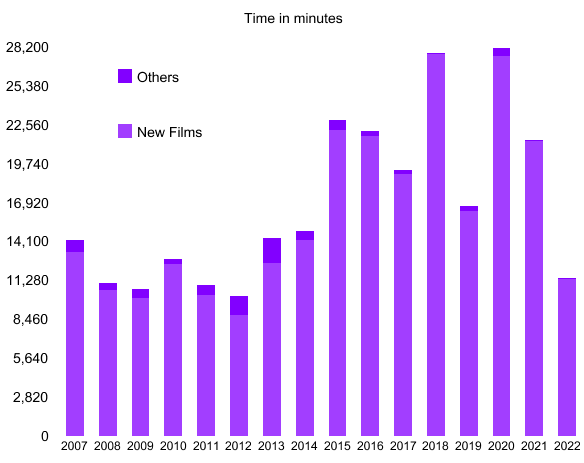
The total running time of my first-watch features was 189 hours and 21 minutes. Add in the shorts and that rises by over an hour to 190 hours and 33 minutes. (I would also factor any alternate cuts I watched for the first time into that “others” block, but there weren’t any this year.) Unsurprisingly, that lines up with the lesser number of films watched to be one of my lowest totals ever.

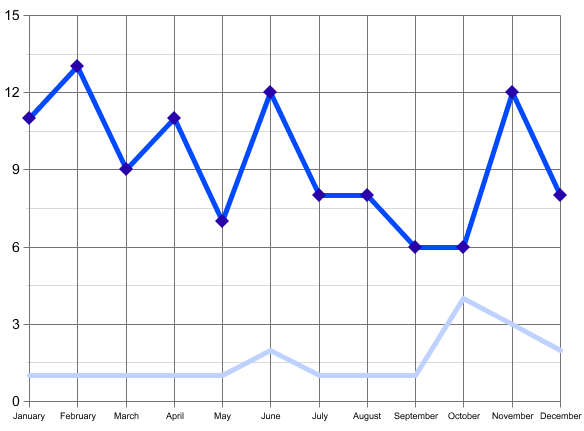
Here’s how that viewing played out across the year, month by month. The dark blue line is my first-time watches and the pale blue is rewatches. This is the fifth year I’ve been including this particular graph, and when you look back over them all, the main thing you can learn is that I really have no consistency. The only common factor I can spot is a relative drop in the September/October region each year, often dragging August or November in with it.

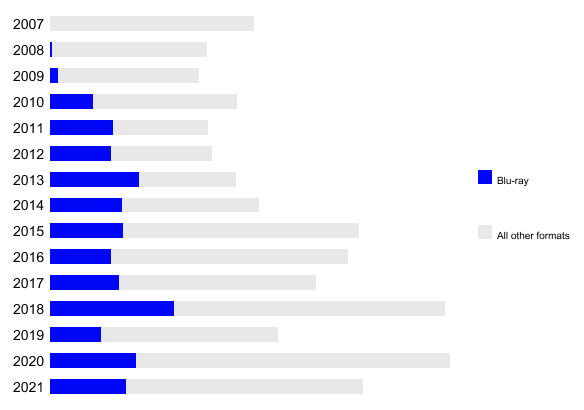
Next, the ways in which I watched those films. Despite including a specific DVDs category in my Challenge, I couldn’t turn things round for physical media: digital is once again the year’s most prolific viewing format, with 77 films, or 69.37% of my viewing. That’s actually down on the last two years (both over 72%), but still up on every year before that. One day I’ll do the right thing and get this down below Blu-ray… or so I keep telling myself…

Digital does have a slight advantage in that several different formats and services contribute to it, though the reason I lump them together is that there’s fundamentally no difference quality-wise between downloading and streaming a film nowadays (most of the time). This year, downloads beat any of the individual streamers, accounting for 26 films (33.8% of the digital total). A number of factors contribute to my wanton piracy, primarily getting hold of specific films in a reliably-accessible format for the sake of my Challenge, as well as acquiring various obscurities. Following on, the top streamer was Netflix, unseating regular victor Amazon Prime, with 14 films (18.2%). Amazon was close behind, though, with 12 films (15.6%). Both are lower than last year, unsurprisingly, but Disney+ actually saw a slight gain in raw numbers, from seven to nine films, which more than doubled its percentage, from 4.7% to 11.7%. Not too far behind was Now on seven (9.1%), with the category rounded out by half-a-dozen others: iPlayer and All 4 each with three (3.9%), MUBI with two (2.6%), and one each (1.3%) for Apple TV+, Talking Pictures TV Encore, and YouTube.

As usual, it was a distant second place for Blu-ray with 25 films (22.5%) — half of last year’s total in raw numbers, and a slight drop in percentage too.

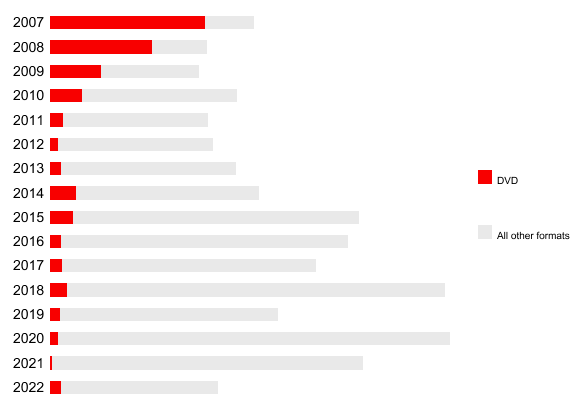
That’s slightly tempered by an increase in my DVD viewing, the result of forcing my hand by making it a category in my Challenge. It should’ve resulted in at least 12 DVDs watched, but I ended up bending the rules and counting some rewatches. Anyway, the format still rallied to eight films — four times as many as last year, and increasing its representation from 0.97% to 7.2%. I imagine the DVD category will remain for 2023’s Challenge.

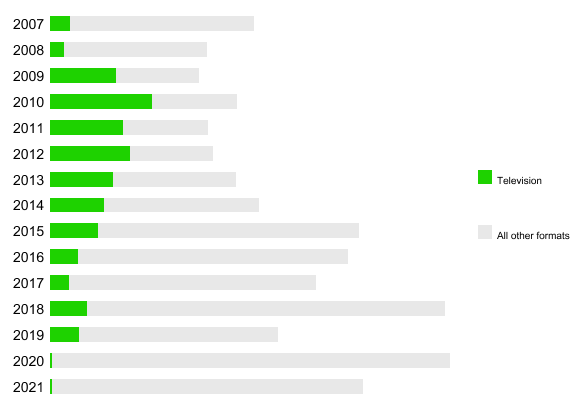
There was just one other format represented in 2022’s viewing: TV, with only one film (0.9%). The bigger news there is that, in the end, I didn’t make it to the cinema in the whole of 2022, the first time that’s happened since 2014. Funny kind of film fan I am, eh? I imagine it’ll be back in 2023: I’m still hoping to make time to see Avatar 2, and there are multiple big-screen-benefitting films out later in the year (not least a new Mission: Impossible). For now, here’s TV’s graph, showing how the once-mighty (look at it in 2010) have fallen…

Looking at formats from a different angle, I only watched one film in 3D in the whole of 2022. That might sound natural — 3D TVs have been phased out; disc releases in the format are almost nonexistent — but I’ve still got my 3D TV, and the releases are still coming, and I’ve got a large backlog of them to get through, anyway. So, I really should’ve watched more than one! Well, it would’ve been two, if I’d been able to find a genuine copy of Jackass 3D. I’ve managed to source most of the recent Marvel films in 3D (even though they only get a disc release in Japan nowadays), so if I finally catch up on those in 2023, the figure might be healthier next year.

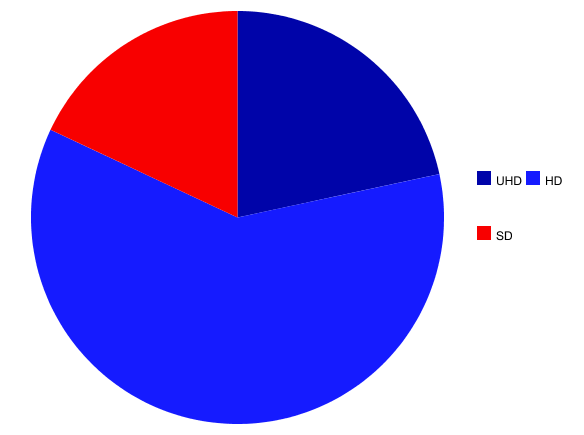
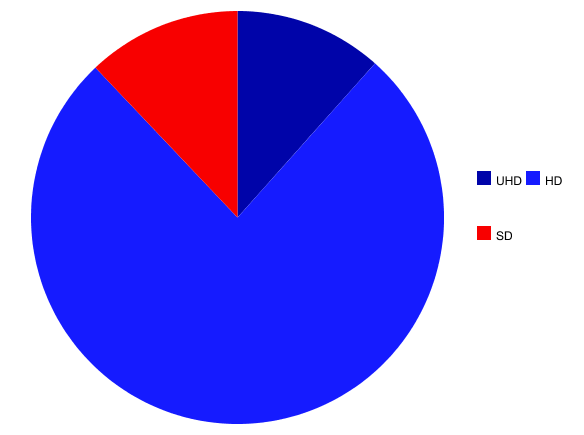
As for the cutting-edge format du jour, 4K Ultra HD, that fared better, with 24 films — the exact same figure as last year, which in percentage terms is almost a doubling, from 11.6% to 21.6%. At the other end of the spectrum, the increase in DVDs, plus some harder-to-find SD downloads and streams, meant I watched 20 films in SD — the lowest raw number since 2017, but the highest percentage (18.0%) since 2015. Watching a lot in SD is nothing to be proud of (HD is usually so much nicer), but some stuff is simply only available in that format. Better than not being viewable at all. Meanwhile, ‘regular’ HD has been decreasing as a share of my viewing since UHD came along in 2017, but this year it tumbles to its lowest figure yet, just 60.4%

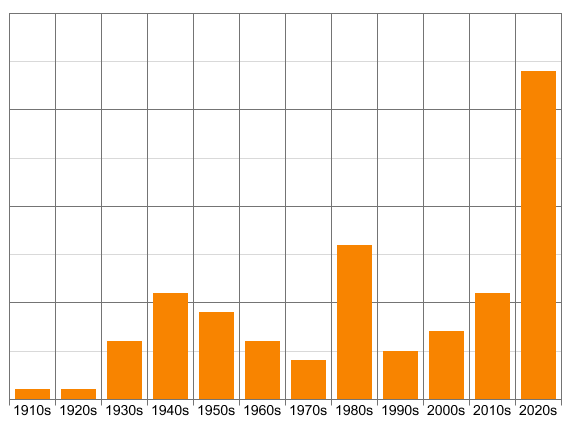
Unsurprisingly, it’s mostly older films that are only available in SD, and so an increase in one reflects an increase in the other. To wit, when it comes to the age of films I watched, the two most recent decades are not my two most-watched, for only the second time ever. Number 1 belies this fact: the 2020s top the chart for the first time, with 34 films (30.6%). But where you’d expect to find the 2010s in second place (having been the #1 decade from 2012 to 2021), it was actually the 1980s with 16 films (14.4%). That’s another side effect of my Challenge, where one category required me to watch 12 films from 1986 (even though I only got through ten of them in the end). It’s in joint third that we find the 2010s, sharing a place with the the 1940s (no doubt boosted by my Challenge’s noir category), each with 11 films (9.9%).

Every decade since the 1900s was represented in my viewing this year, as they were in 2020 and 2021; although, as with those years, the 1900s themselves only feature via shorts, so don’t ‘count’ here. Counting down the years in size order, in fifth place was the 1950s with nine films (8.1%), followed by the 2000s on seven (6.3%), the ’30s and ’60s both on six (5.4%), the ’90s on five (4.5%), the ’70s on four (3.6%), and one (0.9%) each for the 1910s and 1920s.

In recent years, I’ve been pleased to see an increasing variety in the production countries and languages of the films I’ve been watching. Unfortunately, watching so many fewer this year has wiped out some of those gains. So, while the USA has always been the dominant country of production, the 81 films it had a hand in this year represent 72.97% of my viewing, up from the sub-70% figures of the last two years. That said, I’ve been counting this figure since 2012, and that percentage is still the fourth lowest ever, so things could certainly be worse.

On the other hand, there were only 17 production countries this year, half of last year’s 35, and the lowest number since 2012. As ever, second place went to the UK with 26 films (23.4%). France was third for the second year in a row (and the seventh time in eleven years), with 11 films (9.9%). Tied for fourth were Canada and Japan with four apiece (3.6%), while Germany had three (2.7%), and on two (1.8%) each were Australia, Belgium, Israel, Italy, and Russia (provided the latter also includes the Soviet Union). That leaves six other countries with one film apiece. Countries that often feature but didn’t this year included China, India, Ireland, New Zealand, Spain, and Sweden.

It’s a similar story with languages, naturally: there were only 12 spoken languages (plus American Sign Language and some silent films), my lowest total since 2013. Top of the pile by an obscene amount was English, featuring in 103 films (92.8%). For context, in second place was French, spoken in just five films (4.5%). Normally I’d list more uncommonly-heard languages here, but there weren’t really any this year… except, for the second year in a row, Klingon.

A total of 99 directors plus eight directing partnerships helmed the feature films I watched in 2022, with a further three directors and two partnerships making my short film viewing. Only three directors were behind multiple features, the lowest number of repeat offenders ever (tied with 2012). The most came from Jeff Tremaine with three (the first three Jackass movies), while the other two were Stanley Kubrick (his pair of early-career noirs) and Alfred Werker (another couple of noirs). Additionally, two of the shorts I watched were masterminded by the great Georges Méliès.

For a while now I’ve been specifically charting the number of female directors whose work I’ve watched each year. This was steadily improving, but 2022 has seen an about-face in fortunes, dropping to my lowest level since 2017. My viewing this year included four films with a female director — three credited solo (Siân Heder’s CODA, Maggie Gyllenhaal’s The Lost Daughter, and Carrie Cracknell’s Persuasion), and one as part of a duo with a chap (Vanessa Yuille co-directing Doctor Who Am I). Counting the latter as half a film, that works out as just 3.15% of my viewing, which is sandwiched between 2017’s 2.84% and 2018’s 3.26%, but a long way off 2020’s high of 11.44%. As I’ve said before, I neither avoid nor seek out female directors — maybe I should do more of the latter, but I generally just watch the films I watch and see what comes out in the wash. The industry, undoubtedly, still needs to do more. As ever, I hope this graph will improve again in the future, though I doubt it will ever reach 50/50.

Before I dig into 2022’s star ratings, let’s take a look at a couple of viewing projects I always have on the go. First, the IMDb Top 250, which I’ve been vaguely working on since before this blog even began. At the time of writing, five films from my 2022 viewing appear on the list. However, because it’s ever-changing, the number I have left to see has actually gone down this year by 10, to 18 films. I’m so close to the end now, before long I may end up making it part of my Challenge to help finish it off. The current positions of the ones I saw this year range from 87th (High and Low) to 227th (To Be or Not to Be).

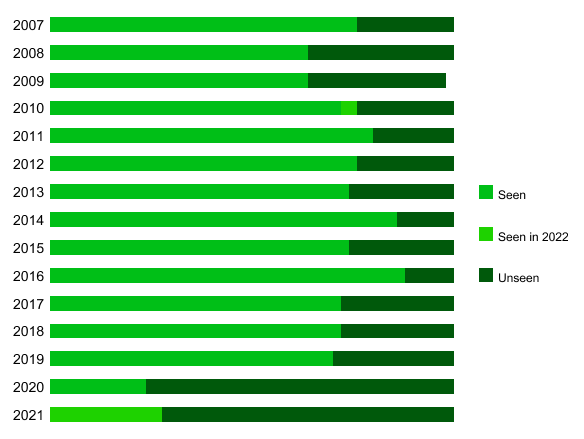
Next, my “50 Unseen” — the list I publish at the end of every year of 50 notable new films I missed that year. I’ve continued to track those ‘misses’ down the years, and went through a period where they helped decide a lot of my viewing. Recently, though, not so much. Last year was weak for continuing to complete these, and 2022 has been even weaker: in 2021, I watched a measly 21 films across all 14 lists; in 2022, I watched just 16 films across all 15 lists. Nearly all of those — 14 — were from 2021’s 50. That’s a better ‘first year’ than last year (when I only watched 12 from 2020’s 50), but is otherwise poor. Randomly, the other two both came from 2010’s list.

In total, I’ve now seen 513 out of 750 ‘missed’ movies. That’s 68.4%, a big drop from recent years — the last time my completion rate was below 70% was back in 2017. It’s not as if there aren’t still plenty of movies I want to see on those lists (and there’ll be 50 more from 2022 added soon), so I need to pull my finger out there.

And so, we reach the finale of every review, and thus the climax of 2022’s statistics: the scores.

Before we begin, I’m going to repeat the caveat I gave last year: this stat factors in every new film I watched in 2022, even those for which I’ve yet to publish a review (this year, that’s 27% of them — it was 98% last year). That means there are some where I’m still flexible on my precise score — usually films I’ve awarded 3.5 or 4.5 on Letterboxd, but which I insist on rounding to a whole star here. For the sake of completing these stats, I’ve assigned a whole-star rating to every film, but it’s possible I’ll change my mind when I eventually post a review (it’s happened before). Still, this section should remain broadly accurate.

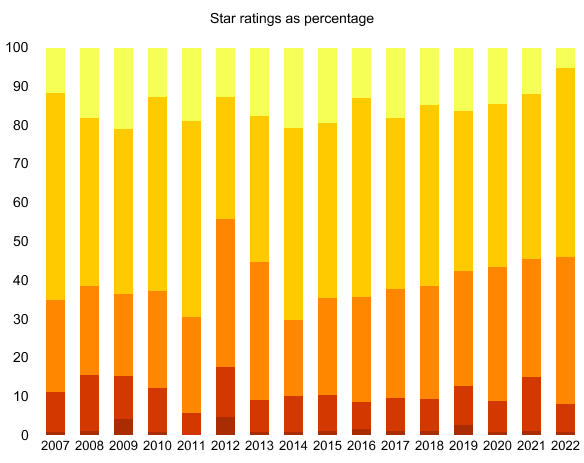
The headline fact here is that I award a mere six five-star ratings in 2022. At just 5.4% of my first-time watches, that’s by far my lowest ever — the next worst was 2012, when I gave more than double (14 films, 13%). Was it that bad a year? Well, yes and no — I do feel like I didn’t watch many great films this year, but I did watch a lot of very good ones. Has my marking got harsher as I’ve got older / more experienced? I think it has, which is probably only right. But I’m still a relatively lenient grader overall.

For example, the most prolific rating I handed out remained four stars, which in 2022 I gave to 54 films (48.7%). That’s the highest percentage of four-star ratings I’ve given since 2016. Maybe a couple more would’ve found their way up into the five-star bracket in the past, but — as I said — I think I generally watched films that were good-but-not-great in 2022.

Continuing down the chart, there were 42 three-star films (37.8%). These three “good” ratings therefore make up 91.9% of my first-time watches in 2022, showing it certainly wasn’t a bad year. Well, it never is, really — but more on that in a minute, when I get to the overall average score.

In the negative pile, then, we find eight two-star films (7.2%) and just one one-star film (0.9%). As I said, I’m still a lenient marker overall — films have to be truly bad to receive a negative rating from me, and absolutely dreadful to sink to the depths of a single-star rating — in the entire history of 100 Films, just 1.32% of films have received that ignominy.

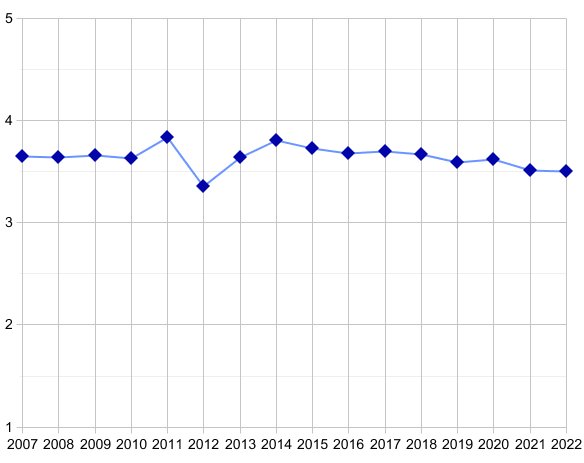
So, finally, the average score for 2022. The short version is 3.5 out of 5 — the same as last year, and only the third time the average has been below 3.6. I refer you to my earlier comments about how, if 2022 is “not a bad year”, then no year has ever really been bad. To get a few decimal places deeper (and thus provide a more accurate comparison), 2022 scored 3.505. That’s slightly down on 2021’s 3.507, meaning 2022 takes its place as my second-lowest scoring year ever, ahead of 2012’s egregiously poor 3.352. They’re all clearly above 3.0, though, so — I reiterate — no truly bad years, just weaker ones.

And that’s a good thing. Who wants to deliberately watch more bad films to get a ‘truer’ average? Or you could start hating on films to adjust your ratings curve down, but that’s self-defeating — just accept that, if you like films, you will like more films. I get annoyed with people who claim to be “film fans” but give most of their viewing low scores — are you sure you actually like films? At the other end of the scale, maybe it would be nice to watch even more even better films and pull my average up. It certainly wouldn’t hurt. But I think it’s simply the luck of the draw — I’ve seen many an acclaimed film that didn’t work for me, as well as plenty of stuff that’s been widely dismissed that I love. As long as the majority of my viewing is at least “good”, that’s good enough for me.


Talking of good and great films, next I’ll be finishing off my review of the year with my pick of the top 10% of films I watched for the first time in 2022.

December’s Failures

13 years ago, I went to see Avatar on opening day, because it was the only chance I’d get over the Christmas period. This year, with long-delayed sequel Avatar: The Way of Water releasing at the same time, I… didn’t do the same thing. But it’s been a massive hit (even without my one ticket purchase? Shocking!), which means it’s still regularly playing, so I might catch it this week.

It’s fair to say there’s been nothing else quite so notable on the theatrical release slate, partly because everything cleared out of Avatar‘s way. The parting shot from the rest of cinema at the start of the month was Santa-based actioner Violent Night, which sounds fun in concept but I heard was disappointing in execution. I guess I’ll try to remember to catch it on streaming next December. Otherwise, it was mostly small independent-type titles or limited-release Netflix flicks. Either way, not much of that plays around me (as ever, by “around me” I mean “not at the cinema that’s a five-minutes drive away”. If I were prepared to travel 30–60 minutes (not that far, in the grand scheme of things), I could choose to see more of this stuff. But as getting off my arse to go to that five-minutes-away cinema is hard enough, I’m hardly likely to trek further afield.

Of course, nowadays there’s less need to, with stuff making it to streaming quicker than ever. Or even to TV, with latest Bond flick No Time to Die receiving its UK TV premiere yesterday, just 15 months after its theatrical release. Remember when we had to wait three to five years for that kind of thing? And it’s not just shorter windows, what with streamers producing their own high-profile content. There were more big titles premiering on Netflix this month than at cinemas. Chief among them, Glass Onion: A Knives Out Mystery (to give it its full, unwieldy, unnecessary title). I’m very much looking forward to it — so much so that I didn’t watch it, because I had a rotten cold over Christmas and knew I wouldn’t be able to enjoy it properly. Another one to slot in this week, then.

While that ended up dominating the conversation (and Netflix’s viewing chart), in December they also brought us Guillermo del Toro’s Pinocchio, Alejandro G. Iñárritu’s Bardo, False Chronicle of a Handful of Truths, Noah Baumbach’s White Noise, a racy (read: sex-filled) new adaptation of Lady Chatterley’s Lover, Scandi monster movie Troll, computer-animated festive musical Scrooge: A Christmas Carol with a starry British voice cast (Luke Evans, Olivia Colman, Jessie Buckley, Jonathan Pryce), and The Big 4, a new one from the director of Headshot and The Night Comes for Us, Timo Tjahjanto, which I hear has suitably extravagant action scenes. As if that wasn’t enough, I also spotted 7 Women and a Murder, an Italian comedy mystery about seven women trapped in a mansion solving a murder, making its international debut as a “Netflix Original” a year after being released in its native Italy. I guess they bought it in as something to offer people who’d just watched Glass Onion. Also of note, apparently, was Medieval — I’ve not heard anyone mention it, so I’ve no idea quite how this happened, but it was Netflix’s 3rd most-watched movie at one point over Christmas. Apparently it’s the story of a Czech commander who never lost a battle, and it stars Ben Foster, Michael Caine, Til Schweiger, and Matthew Goode. I guess “historical war movie with a few recognisable faces” appealed to people browsing Netflix for something new to bung on.

Other streamers focused on the Christmas period for their original titles, ticking the usual rom-com boxes, with the likes of Your Christmas or Mine? on Amazon Prime and Sky Cinema offering perhaps the most generically-titled movie ever, This is Christmas. Apparently it’s actually rather good (according to the one review I happened to read). Sky also premiered animated Terry Pratchett adaptation The Amazing Maurice, along with streaming debuts for the likes of Dreamworks animation The Bad Guys, “grey pound” target The Duke, Stephen King remake Firestarter, plus blockbusters (that I own on disc and really should’ve watched by now) The Batman and Fantastic Beasts: The Secrets of Dumbledore. Also The Nan Movie, but the less said about that the better. Amazon, meanwhile, had the streaming debut of Alex Garland’s Men, and gave a big push to Wonder Woman 1984 — bit odd, considering how long it’s been around. That said, I’ve still not seen it, so…

Over on Disney+, it was the usual deal of stuff rushed fresh from cinemas: their latest canon animation, Strange World, a riff on pulp sci-fi-/fantasy adventure flicks that I guess should be up my street, but doesn’t scream “Disney”; plus adult-focused fare, both acclaimed (Martin McDonagh’s The Banshees of Inisherin) and, um, less so (David O. Russell’s Amsterdam). Debuts elsewhere included Park Chan-wook’s latest, Decision to Leave, on MUBI, and Will Smith slavery action flick / wannabe-awards-contender Emancipation on Apple TV+.

As for the free TV-tied streamers, I’m sure they offered replays of their Christmas-schedule premieres, but I’d seen most of those already (except for Pokémon: Detective Pikachu, which I actually own on 3D Blu-ray. I presume I heard the 3D was good or something, because the fact I still haven’t watched it indicates my broad level of interest). Anyway, catching my attention on iPlayer were the likes of A Bunch of Amateurs (about the amateur filmmakers of the long-running Bradford Film Club) and older flicks I really should’ve seen by now, like The Others and Out of Sight; plus obscure spy thriller When Eight Bells Toll, which I missed earlier in the year so appreciate getting another go at. As for All 4, they cycled in a bunch of stuff they’ve shown before and I’ve not got round to but, hey, you never know, maybe this time. We’re talking Black Rain, Monos, Wild Rose, Saint Maud, Rosemary’s Baby, The Red Turtle, several others… Someday.

Finally, as always, stuff I forked out for (or, as it’s Christmas, was given) on good ol’ shiny disc. This was set to be a pretty huge list (when isn’t it?), but the UK’s postal issues have delayed a couple of large overseas packages. I just hope they’re not lost… Anyway, there were plentiful additions to my 4K Ultra HD collection last month. Films I’d never seen included Baz Luhrmann’s Elvis and David Lynch’s Lost Highway (I imported Criterion’s release from the US via Amazon, and it took three goes to actually deliver me a copy that wasn’t damaged). On the rewatch pile, there were lavish editions of The Cabinet of Dr. Caligari (the PQ doesn’t seem that much better than the old Blu-ray, to be frank, but there was more in the box, and I wanted to support Masters of Cinema going 4K) and Casablanca (although I also decided to keep my equally-lavish old Blu-ray edition, so I probably should’ve just bought the cheaper regular 4K release. Oh well). In more standard packaging, but welcome nonetheless, were Mike Hodges’ Croupier, Walter Hill’s The Driver, and Quentin Tarantino’s Pulp Fiction. I’ve owned the latter so many times, I was loathe to buy it again; but then I saw the picture comparisons

On regular ol’ Blu-ray, Sight & Sound’s new list inspired some prep for next year’s Blindspot (ooh, preview!) by picking up Criterion’s editions of Beau Travail and Close-Up (another import that Evri tried to destroy: a neighbour found my parcel halfway down the road in a hedge, soaked through from the stormy weather. I shit you not. Luckily, although the package was a mess, the contents were fine). Brand-new releases were limited to Phil Tippett’s stop-motion nightmare Mad God, but catalogue titles making their UK disc debut included a couple from Eureka — “girls with guns” classic Yes, Madam! and Bob Hope-starring comedy/horror double-bill The Cat and the Canary and The Ghost Breakers — plus a Kickstarter edition of 1926 horror The Magician.

Finally-finally, I actually bought a DVD — wonders will never cease (although it’s one of a couple I’ve picked up this year, so maybe not that exceptional). Spied in Network’s pre-Christmas sale, it’s The Edgar Wallace Anthology, a collection of noir-esque British B-movies from the 1960s. The set contains just a couple of films to get through — 54, to be exact. That should keep me busy for a while…

2021 Statistics

Enough about my shiny new look (although, if you missed all that, you can read about it here) — let’s go back to digging through the remains of 2021. And we begin (or, rather, resume) with one of my personal highlights of the entire year: the statistics. Regular readers will know what this is all about, but if you’re new to these parts and enjoy things like percentages and graphs… oh boy, you’re in for a treat!

Before we begin, a quick word that, because I’m a Letterboxd Pro member, I also get a yearly stats page over there. My 2021 stats can be found here. I don’t only log new watches on Letterboxd, so any overlapping statistics will be slightly different, but they mainly have different categories (like repeat cast & crew members — so you can, for example, find out which actor appeared in the most films I watched last year).

And now…


I watched 207 new feature films in 2021. That means it ranks 3rd all-time, passing 2015’s 200 by a solid seven films, but coming far shy of the top two: 2018’s 261 and last year’s 264.

I also ran my Rewatchathon for the fifth year in 2021. I’ve spent all of that time thinking I ought to include it in the statistics properly, and all of that time not getting round to deciding how exactly to incorporate it, and now it’s over — I’m doing something slightly different next year. Well, maybe that will finally compel me to square the circle. Anyway, I rewatched 33 films — short of my target of 50, but not that bad else wise. That makes a combined total of 240 films, which is another distant 3rd place finish, behind last year’s 310 and 2018’s 311.
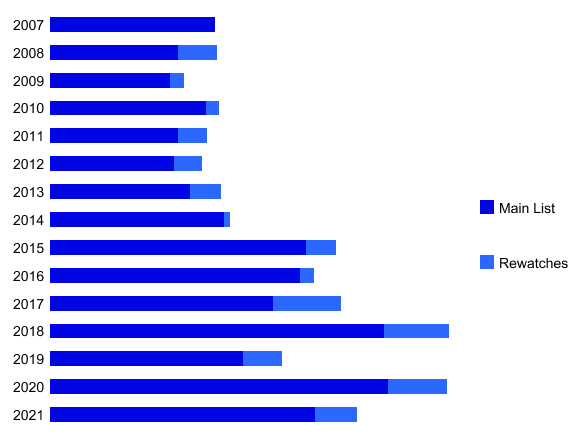

NB: I have no rewatch data for 2007 and only incomplete numbers for 2008.

I also watched four short films last year, which is my lowest total for those since 2016. A shame after the past two years saw me set new records each year, but then I’ve never made a concerted effort to watch shorts. Maybe I should. As always, the only stat they count towards is the total running time, and they barely make a dent there. To wit: the total running time of new features was 357 hours and 12 minutes, while adding the shorts bumps it to 357 hours and 58 minutes — just a 46-minute increase. That’s my smallest “others” total ever, barely even visible on the graph below (it’s 1 pixel high).

Here’s how that viewing played out across the year, month by month. The dark blue line is new feature films and the pale blue line is my Rewatchathon. Last year I included a pale green line for shorts, but that seemed a bit pointless this year. Last year I noted that, while the precise values of the graph changed each year I’d been running it (since 2018), the rough shape stayed the same: quickly climbing to a peak in April or May, then lower and bumpier to the end of the year. 2021 bucks that trend entirely, with the high point coming in February, before it almost tapers off, but spikes up dramatically in August and December, traditionally two of my weaker months. What does this tell us? Maybe not to rely too much on precedent.

Next up, the formats on which I watched those films. Despite my continued advocacy (and purchasing of) physical media, it’s digital that once again romps away with the crown here, accounting for 150 films, or 72.46% of my viewing. That’s down slightly from last year’s 73.9%, but is still above the 2015–2021 average, which is 58.5%. I’d definitely like to get it down closer to 50%; or, even better, to see Blu-ray beating it, considering I buy so many of the darn things.
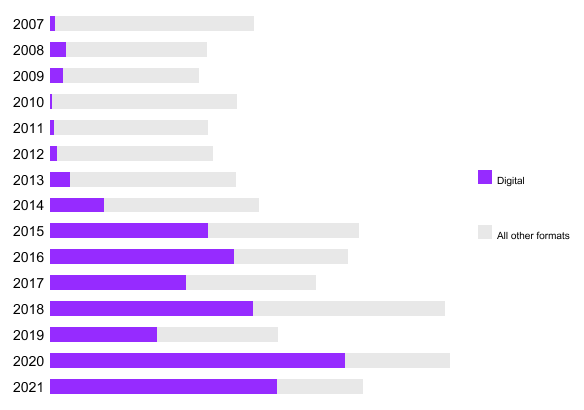
Of course, a lot of individual formats and services contribute to that digital total. The top spot therein is a tie between Amazon, topping the list for the fourth time in five years, and downloads, each with 35 films (23.3% of digital). Downloading was second last year, so that isn’t actually a huge change. The same could be said of the next few places on the chart: last year Netflix and Now tied for third, while this year Netflix is there by itself, with 26 films (17.3%), and Now is just behind, on 22 (14.7%); and iPlayer comes fifth, with 16 (10.7%). Last year there were three other services to mention: AMPLIFY!, which didn’t occur this year; YouTube, which I didn’t watch anything on this year; and Disney+, which retains that position kinda by default, with seven films (4.7%). Rounding out the digital services were MUBI on five (3.3%), All 4 on three (2%), and Apple TV+ managing a solitary one (0.7%). Most of their original content seems to be TV, although they did have a couple of other films that interested me, so that really should’ve been higher — but then I could say that about all the streamers (I mean, just look at my failures list each month).

A very distant second place in the format war goes to Blu-ray with 51 films (24.6%) — just a third of digital’s tally, I’m ashamed to point out. It’s the format’s 14th year on this list and its 4th highest total, which doesn’t sound too bad, but as a percentage it pales besides the 40% I was hitting a decade ago.

Between them, digital and Blu-ray accounted for a staggering 97.1% of my viewing in 2021, up on the 95.5% they represented last year. To be precise, that’s 201 out of 207 films. The remaining six were split equally between three other formats — again, to be precise, that means DVD, TV, and cinema each clocked just two films (0.97% each). Here’s a graph showing how much DVD has fallen — something that should improve next year, at least a bit. (If you want an idea of how much it might grow, 2018 had exactly 12 DVD watches.)

A similar “once mighty, now not” slump has befallen TV across the decades, its place in my viewing schedule now definitively overtaken by streaming.

And finally, the cinema, brought low by Covid for the second year in a row. More films that I was interested in were screening, but is it worth the risk? And we’re all hoping 2022 will be better, but how much is still a question mark. We’ll see in a year’s time…

In amongst all that, I watched 24 films in 4K — a drop from last year’s 40, but still above any year before that (2019’s total was 15, for example). On the other hand, I watched just three in 3D, my lowest total there since I got my 3D TV back in 2017. New releases on the format are dwindling (even Disney, who were previously reliable with Marvel and Pixar titles, now only release the former on 3D BD in Japan, with no sign of the latter), but I’ve still got a not-insignificant pile of 3D discs I’ve bought and not watched yet. It’s somewhat ironic, then, that all of my 2021 3D watches were films I don’t own or can’t get on disc, so were downloaded by other means (wink wink, nudge nudge).

Topping both of those this year was the number of films I watched in SD. Yep, really. Between some downloads, some streams, and those couple of DVDs, I watched 25 films in SD in 2021. At 12.1% of my total viewing, that’s actually the second highest percentage since 2016. What’s more interesting is that, although it means the percentage fluctuates somewhat, the actual number of SD titles I’ve watched has been pretty consistent for years: the average for the past six years is 23.6, most falling in the 23–25 range. While it’s nice to watch as much in HD (or even UHD) as possible, there are some titles that are just so hard-to-come-by that one has to settle for lower quality. While “SD” might make many of us think of DVD-level quality, several of this year’s SD titles were more “recorded off TV to VHS then ripped to digital”-level. Yeah, they looked and sounded awful, but when that’s the only way to see the film at all…
Of course, it tends to be older films that only exist in such low quality, and my viewing on the whole skews newer (though don’t get me started on the fact some brand-new productions still receive DVD-only releases). But as the new decade continues to get underway, the question is: how new? It took the 2010s until 2012 to usurp the 2000s at the top of my decade chart. Could the 2020s manage it a year earlier? In short, no — but it’s close! The 2010s are still in first place, but with only 46 films — that’s their lowest since 2012, coincidentally. It represents 22.2% of my viewing this year, the lowest-ever percentage for a top decade (at the same point, i.e. in 2011, the 2000s still had 35.2%). And the 2020s are snapping at their heels, just three films behind on 43 (20.8%). The margin between these two decades was 33% last year, but this year it’s just 1.45%.

In third place comes the ’90s with 22 films (10.6% — exactly double their percentage in the last two years). That’s their best total ever, their highest placing since 2017, and their best percentage since 2010. Why did they do so well? Oh, don’t ask silly questions (i.e. I have no idea. Chance, I guess). There’s an even bigger surprise in fourth place, though: the 1930s with 18 films (8.7%). Their previous best showing was last year, with just six films (2.3%), and their previous best percentage was way back in 2008, at 3.8%. And with the 1940s coming in fifth with 16 films (7.7%), also their best-ever result, could this be a preview of years to come? Well, I have set myself the task of watching at least 12 films noir next year…

Things continue to ping back and forth in time as we move down the chart. Next is the ’80s on 15 (7.2%), followed closely by the 2000s on 13 (6.3%), followed even more closely by the ’70s on 12 (5.8%), and right behind them are the the ’50s on 11 (5.3%) — far down the chart though it may be, it’s still their highest ever total. Indeed, never before have so many decades reached double-figure tallies in a single year.

Rounding out the list, the ’60s have an uncommonly low five (2.4%), while bringing up the rear are the 1920s on four (1.9%) and the 1910s on two (0.97%) — not their best result (2007 and 2010 were both higher), but only the sixth time they’ve featured at all in 15 years. Finally, no features for the 1900s & earlier, but they were represented by a single short film, for only the third time ever (the previous occasions being 2013 and 2020).

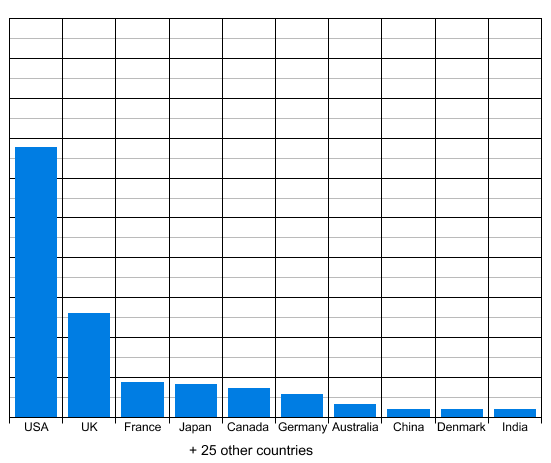
There’s somewhat less variety in where films came from, with the USA once again dominating countries of production, having a hand in producing 140 films. However, at just 67.6% of my total viewing, it’s their lowest percentage ever (down from last year’s 68.6%, the first time it had been below 70%). There’s nothing wrong with US movies, but there’s a whole world out there and it’s nice to spread one’s viewing around a bit. To wit: there were a total of 35 production countries represented in my viewing this year, the second best ever (behind last year’s 40, when there were almost 28% more films, so, y’know, fair enough). Some of the more unusual ones (in terms of my own viewing) included Latvia, Estonia, Ethiopia, Lebanon, Peru, and Romania.

Back at the top end of the chart, the UK took its usual second place, with 54 films (26.1%). France returned to third place, a position it’s held for six of the ten years I’ve been monitoring this stat, with 18 films (8.7%). Hot on their tail was Japan on 17 (8.2%). Also in double figures were Canada (15, 7.2%) and Germany (12, 5.8%), and coming seventh with seven was Australia (3.4%). China, Denmark, and India were tied on four (1.9%) each, while four countries each had three, eight countries had two apiece, and the remaining 13 had one film each.
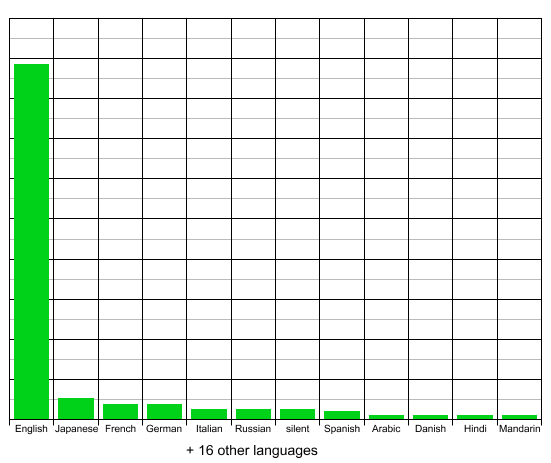
All those US and UK films mean that English was the most dominant language, as always. It was spoken to at least some degree in 183 films, or 88.4% of my viewing, a percentage that’s up from the last three years. As I say, this count includes all films where it was spoken enough to merit listing, even if it wasn’t the primary language. Perhaps I should start making a note of just the main spoken tongue for the sake of the statistic… Also as usual, the language in second was a long way off. This year it was Japanese in just 11 films (5.3%). No others made double figures. But overall there were 27 spoken languages (plus five silent films), which isn’t bad. Some more rarely-heard languages this year included Amharic, Estonian, Kiowa, Somali, Tupi… and Klingon.
A total of 178 directors and eight directing partnerships were responsible for the films on 2021’s main list. 16 of them helmed multiple films, led by Leo McCarey with five. Second place is shared, with three apiece from David Hare (the Worricker trilogy) and Reginald Le Borg (all among the Inner Sanctum Mysteries series), while Ishirô Honda helmed two plus one film in a ‘partnership’ (that would be the US cut of King Kong vs. Godzilla, where Honda’s original work was supplemented with US material by Thomas Montgomery). The remaining 12 had two films each, and they were: Jack Bernhard, Bob Clark, Cameron Crowe, George Cukor, Joe Dante, Paul Greengrass, Tom Hooper, Ben Lewin, Anthony Minghella, Mike Nichols, George Stevens, and James Whale.

For a few years now I’ve specifically charted the number of female directors whose work I’ve watched. 2020 saw a new high reached, but sadly 2021 sees it slip back again — although it’s still above 2019, just, so there’s that. My viewing this year included 13 films with a female director (12 solo; one as part of a trio with two men), which comes out as a measly 5.94% of my viewing. As I put it last year, it’s debatable whether the onus should be on me to seek out more films directed by women or on the industry to give more directing gigs to women, but ultimately it’s a bit of both — though I’d argue with more weight on the latter, because I just watch the films I watch; I neither avoid nor seek out female directors especially. Anyway, I do hope this graph will continue to improve in the future, though I’m not sure it will ever approach 50/50 (considering all the older films I watch, which are predominantly directed by men to a farcical degree).

We’re approaching the end now — broadly speaking, because before I dig into 2021’s star ratings, it’s time for an update on a couple of viewing projects I vaguely have on the go. First, the IMDb Top 250: at the time of writing, seven films from my 2021 viewing appear on that famed list. However, because that list is ever-changing, the number I have left to see has only gone down by two, to 28. That’s my poorest showing since 2012. I feel so close to the end now (just 11.2% to go) that I really would like to get it finished off. Of course, new releases ping on all the time (there are currently four 2021 releases on there), but that’s life — if I finish the rest of the list, I can bop them on the head as and when they pop up. Anyway, the current positions of the seven I saw this year range from 52nd (Cinema Paradiso) to 222nd (La Haine).

My next viewing project is the one I call my “50 Unseen”. As regular readers will know, at the end of my annual “top ten” post I always include a list of 50 notable films I missed from that year’s releases. I’ve continued to track my progress at watching those ‘misses’ down the years — which is how I know that 2021 was a particularly poor year for this particular mission. Where previously I would watch at least one film from every list, this year I only managed to hit eight of the 14; and from most I only watched one film, leaving my with a total of 21 films across all 14 lists. That’s the lowest since 2010 (when I only had three lists to work from!) In fact, the last time I watched that few films from even just the newest list was in 2014. And speaking of the newest list, in the first year of watching 2020’s 50, I watched 12 of them — the lowest ‘first year’ since 2010 (again), when I only watched eight films from 2009’s list. You might think this is because 2020 was a poor year for new films, thanks to the pandemic, but there are plenty in that 50 I very much want to see, I just… haven’t. Maybe I’ll finally catch up on them in 2022.

For what it’s worth, the other nine I watched came from 2007, 2009, 2011, 2012, 2013, 2019 (all one film each), and 2015 (three films — why so many more, I don’t know).

All of which means that, in total, I’ve now seen 497 out of 700 of those ‘missed’ movies. That’s exactly 71%, the first time this percentage has dropped year-on-year since 2009 (it was 73.2% last year). On the bright side, that’s still above where it was the year before last (70.3%), so it’s not a total disaster. (As usual, my new list of 50 misses from 2021 will be in my “top ten” post, sometime soon.)

And so, to conclude the statistics for 2021, it’s the climax of every review: the scores.

Now, I need to provide a similar caveat to last year: this stat factors in every new film I watched in 2021, even those for which I’ve yet to publish a review — which, this year, is 98% of them. That means there are some where I’m still flexible on my precise score — those films I’d award, say, 3.5 or 4.5 on Letterboxd, but which I insist on rounding to a whole star on here. For the sake of completing these stats, I’ve assigned a whole-star rating to every film, but it’s possible I’ll change my mind when I eventually post a review (it’s happened before). Still, this section should remain broadly accurate.

Starting at the top end, then, in 2021 I awarded 25 five-star ratings, which means 12.1% of the films I watched got full marks. That’s at the lower end of my range, which historically spans from 11.9% to 21.2%. I’d put that down to harsher marking rather than poor quality: there were quite a few 4.5-type films where I eventually erred towards the lower score.

As usual, the most prolific rating was four stars, which I gave to 88 films. At 42.5%, that’s a sliver up on last year’s percentage (which was 42.1%), which rather suggests the lower number of five-star films wasn’t all that much due to those 4.5s after all… unless a lot of 3.5s got the rounded-down treatment too, of course.

Well, there were 63 three-star films, which is the third highest tally ever, behind 2018 and 2020 — both years in which I watched more films. So, really, that’s only appropriate. The historic range of my three-star ratings spans all the way from 19.6% up to 38.0%, so 2021 coming in at 30.4% actually puts it somewhere in the middle.

Indeed, the real gains are to be found among the two-star films, which number 29 — the highest-ever for one year, and the first time there I’ve given out more two-stars than five-stars (although they did draw back in 2012). It comes to 14.01%, which isn’t actually the highest ever… but it is close, because 2008 reached 14.4%. Again, this brings up the usual debate: was this a weak year, or is my scoring getting harsher? I think, at this point in my life, the latter is definitely a factor.

Last, and most definitely least, I handed out just two one-star ratings, which is only 0.97% of my viewing. That’s very typical: I’ve awarded two or fewer single-star scores in 10 out of 15 years, and only three years have pushed its percentage above 1.5%
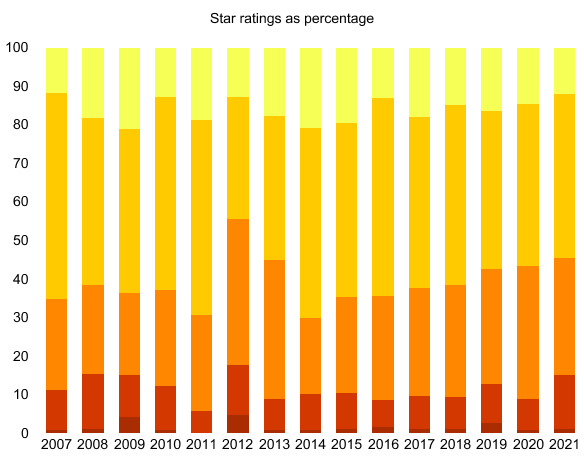
Finally, the average score for the year — a single figure with which to judge 2021 against other years, for good or ill. The short version is 3.5 out of 5 — that’s the first time it’s dropped below 3.6 since 2012, when it was an anomalous 3.4. Indeed, that’s the first 3.5 score in 15 years (there are five 3.6s, six 3.7s, and two 3.8s). To go to a few more decimal places, it’s 3.507 — still my second-lowest scoring year ever, but it doesn’t stick out quite as egregiously as 2012’s 3.352. Still, it’s only the third time the score’s been below 3.600 (2019 was the other, on 3.589), so it is a low one, whichever way you cut it. Again we ask: was it a weak year, or is my scoring getting harsher? As I said before, I am beginning to feel it’s the latter.

All of which said, let’s not forget: it’s still a pretty good average overall. I mean, it’s well above 3.0, and 3 is a positive score. A ‘true average’ might be 2.5, but then I’d have to watch a lot more bad movies, and who wants to do that? Maybe I could try to watch even more very good / great films, and then maybe the average would rise again… or maybe I’d just worry I was being too lenient. No, at this point I feel I’ve demonstrated a degree of consistency in my marking — so long as the average is in the 3.5–3.7 range, I feel like I’m getting things about right.

And so, I’m sorry to say, the stats are over for another year. I know I’m changing things up from 2022, so will this post look significantly different next year? Y’know, probably not: I love this stuff too much to stop working it all out.


My picks for the best and worst films I saw in 2021. And then my review of 2021 will be over, and you’ll have seen these blue-ish stripey mid-post graphics for the last time!


The All-New 100 Films in a Year Challenge

As I said in my introduction to the blog’s new era, reports of 100 Films in a Year’s death may have been grossly exaggerated — because while 100 Films in a Year as it was is no more, in its place I have…

The All-New 100 Films in a Year Challenge!

Just like its title, this new version is similar but different. My original challenge was wholly straightforward: watch 100 films I’d never seen before every year. The only thing approaching complexity or contention was whether alternate cuts (e.g. director’s cuts) counted as a “film I’d never seen before” or not. But this brand-new version of the challenge… well, it’s going to require some explaining.

Before I do, let’s recap why this came about. As regular readers are likely aware by now, I’ve been thinking about modifying my eponymous goal for a few years, primarily because simply “watching 100 new films in a year” stopped being an actual challenge and became my de facto state. It’s almost a decade since I failed in that goal, and over the last few years my average has been closer to 200 films in a year. So, why not just double the target? Or pick another number? Maybe I would’ve just done that, were it not for a few slip-ups (i.e. months where I fell short of my minimum target) and lifestyle changes in recent years. Obviously a challenge should be challenging, not a guaranteed walk in the park, but “just watch more films” didn’t seem the right way to push myself.

That’s what ultimately led to this new challenge — or, you might argue, array of challenges. You see, rather than just watching any old 100 films, now there are a selection of categories, and films will need to fulfil criteria to qualify. Whereas the old challenge merely motivated me to watch more films, this new version is designed to encourage me to watch certain kinds of films. Plus, with some additional rules for each category, it will spread that viewing throughout the year, rather than seeing me engage in a headlong rush to #100 as quickly as I can (which has happened the past few years).

So, you could argue this is eight separate challenges that together add up to 100 films, rather than a ‘true’ 100 films challenge — whatever that might mean. And you can argue that, if you want — I don’t care. This is a personal project, not some athletic endeavour subject to outside scrutiny, and this is how I’m choosing to do it. Of course, if for some reason you wanted to join in, you’re more than welcome. Feel free to use my rules. Feel free to tweak them to suit your own goals. Feel free to ignore them entirely and come up with your own criteria. Feel free to think “you know what, I really need to play more video games” and set yourself 100 Games in a Year as a challenge. Heck, that’s how this all began: I ‘ripped off’ the Read 50 Books in a Year challenge.


As I said, there are now eight groups making up my 100-film challenge. I’ll outline them in a moment, but first there’s one general rule: a film can only count once. Sounds kinda obvious, I guess, but my categories are not so niche as to be mutually exclusive — I could watch a Blindspot pick from the 1970s on DVD and technically it could count across three categories. But if I did that, well, the final tally wouldn’t actually get to 100, which would be self defeating. When a film fulfils the criteria for multiple groups (as some surely will, especially early on), it’s up to me to allocate which category it counts towards — although there are some sub-rules that will help dictate that. (My challenge is watching films, but yours may be trying to understand why I make these things so unnecessarily complicated…)

Without further ado, the categories are…

New Films

Well, that immediately requires clarification, doesn’t it? Because in the old challenge all 100 films were “new”, as in “new to me”. Now, however, I mean “new” as in “new (to the UK)”. And the UK clarification is needed because we so often get foreign films ‘late’, especially awards-y films that play US dates the year before but aren’t released here until January, February, March… even as late as June or July sometimes. So, this category is 12 films that were released in the UK for the first time during 2022. To some people that might seem like no challenge whatsoever — and it’s not that much of a challenge to me, to be honest, because I normally far exceed it. But, on the whole, my viewing skews older (when there’s the whole of film history to explore, why just watch brand-new stuff?), so I feel it’s a worthwhile category to include. Plus, part of the point of this is to spread the challenge throughout the year. To ensure that, this category is limited to one qualifying film per month — so even if I watched two (or more) new films in a single month, only the first would count towards the challenge. However, it can rollover if necessary — for example, if I watched no new films in January, I could count two in February. That might seem to undermine the concept of spreading these throughout the year, but, without it, it would be possible for me to fail the entire year on January 31st, which would suck.

Rewatches

In arguably the biggest change of all, rewatches now count… but only 12 of them. Mirroring the “new films” requirement, this is also limited to one per month. I’m not intending to run my Rewatchathon anymore, primarily because of this, but I’d like to think I’ll still rewatch more than 12 films a year. We’ll see — maybe I’ll end up bringing it back.

Blindspot

This continues as-is: 12 specific films, chosen ‘scientifically’ from best-of lists and the like, designed to be paced one per month. Because they’re specific films, if I did decide to get ahead of myself then they could count ‘early’, but I don’t think I’ve ever done that and I don’t intend to start now. As usual, there’ll be a dedicated post sometime soon with my 12 picks.

What Do You Mean You Haven’t Seen…?

After a couple of years ‘off’ (or, if you prefer, combined with Blindspot, because they’re essentially the same thing), WDYMYHS is back. The change is, whereas Blindspot is made up of “great movies” (according to other people), WDYMYHS will revolve around a theme of some kind. This year that link will be my birth year: 12 specific films from 1986 that I’m surprised I haven’t seen. Again, my 12 picks will be named in a dedicated post soon.

Decades

At least one film from every decade that feature films have existed, i.e. since the 1910s. That makes it another group of 12 — what are the odds?! It’s almost like I’m doing this deliberately… I can watch as many of these as I like within any given month, so we’ll see how long it takes me to tick them all off — recent decades will come quickly and easily, but some of the older ones might require a specific effort.

DVDs

I’ve spent years lamenting the fact that I don’t watch enough of my DVDs. Thanks to a couple of decades spent collecting, I own over 1,000 of the things, many never played, and they don’t often make it into my viewing nowadays, largely because they’re not HD. (I suspect that, statistically, I’m more likely to spend money upgrading a DVD to Blu-ray than I am to actually watch a DVD.) So, to force me to dig into that particular back catalogue, I’m making it a goal to watch at least one per month, as per the “new films” rules. And no ‘cheating’: if I don’t want to watch something from my DVD copy (because I want to get it in HD, or even UHD), that’s absolutely fine… but I can’t get it in HD and then still count that towards the DVD goal. I have to actually watch the DVD for it to count.

Genre

Like WDYMYHS, here I’m going to pick a specific genre or movement (preferably one that’s either highly specific or that I’m less au fait with, not something broad or well-worn like, say, “action”) and aim for at least one per month, i.e. 12 more films. However, this is a free-for-all: whereas WDYMYHS is 12 pre-chosen titles, this can be anything that falls within the genre; and I won’t limit myself to counting just one per month. Maybe I’ll have a marathon and complete it in one go! Maybe I’ll still spread it thin! At least having the choice provides an opportunity for some variety, right? This year’s genre will be that old favourite, film noir. I’ve had noir ‘viewing projects’ before, but there are plenty of key texts that still elude me, so maybe 2022 will right that. Or maybe I’ll just end up getting all 12 from Indicator’s 24-film Columbia Noir series. Frankly, either is good by me.

Series Progression

That’s perhaps the vaguest title of all, but let me explain (that’s the whole point of this post, after all). I have multiple different film series on the go at any one time — so many that, a couple of years ago, I started keeping a list, the Letterboxd version of which is here. Some of those series I continue to merrily work my way through; some I half-forget I have underway. So, the point of this category is to compel me to continue, across another 12 films. I could watch 12 from one series; I could watch one each from 12 different series. I could marathon them all across a weekend; I could watch them one a month throughout the year. Whatever — just so long as I keep going with series I’ve already started. (If I start a new series, either by accident or choice, the first film can’t count, but any future films can.)

I know I said there were eight categories, but if you’ve been doing the maths so far you’ll have realised we’re only at 96 films. So there must be a ninth category, right? Well, yes and no. Let me introduce you to…

Wildcards

The final four films are ‘wildcards’ that I can attach to any of the eight categories. They still have a couple of rules, though. Firstly, wildcards can only be used once the category’s own requirements are met. What that means is, I could use a wildcard to (for example) count a second new film in January, but I couldn’t use one for a film noir until I’ve watched 12 film noirs. Lastly, only one wildcard per category — so I couldn’t (for example) watch five new films in January and count them all. Make sense? If not, let me remind you that you don’t really need to worry about any of this — it’s only me who has to work it out.


I’ll be tracking my progress with the Challenge in my monthly review posts, and on a dedicated page too.

Also, while it’s no longer the ‘official’ goal of the blog, I suspect I’ll end up still counting my overall viewing, and likely post year-end stats and whatnot about it next January. I’ve been doing that count for almost my entire adult life, so it’s a well-established habit at this point. Not to mention that, actually, I enjoy it — but now primarily for my own interest, rather than as the raison d’être of this blog.

What price a ‘Definitive Cut’?

Provoked by, of all things, the Blu-ray release of The Wolfman (this started out as the opening paragraph of my review of that — oh how it grew), I’ve once again been musing on one of my ‘favourite’ topics. No, not “what’s TV and what’s film these days?”, but “which version of a film is definitive these days?”

I apologise if I’ve written extensively on this before; I think I’ve only had the odd random muse in a review, at most. So, much as I got the TV thing out of my system (a bit) in that editorial, here’s an attempt at the “definitive cut” one:

The age of DVD has managed to throw up all kinds of questions about what is the definitive version of a film. Never mind issues of incorrect aspect ratios, fiddled colour timing, or excessive digital processing — these are all potentially problems, yes, but usually quite easy to see where the correct version lies. The question of a ‘definitive version’ comes in the multitude of Director’s Cuts, Extended Cuts, Harder Cuts, Extreme Cuts — whatever label the marketing boys & girls slap on them, Longer Versions You Didn’t See In The Cinema is what they are. But are they better? Or more definitive? Does it matter?

So many consumers hold off for the DVD these days, especially with the added quality offered by Blu-ray, that the old answer of “what was released in the cinema” doesn’t necessarily hold true any more. Filmmakers know some will be waiting for the DVD, so are less concerned with releasing a studio-mandated, shorter, mass audience friendly cut into cinemas when their fuller vision can be found on DVD. Equally, the PR people know that “longer cut!” and “not seen in cinemas!” and other such slogans can help sell DVDs, and so may be forcing needless and unwelcome extensions onto filmmakers. Then there’s all those older directors who think they’re doing a good thing finally getting to tamper with their film 30 years on, who may well be misguided.
Some make it nice and clear for us. Ridley Scott, for example, is particularly good at this: Blade Runner has taken decades to get right, but The Final Cut is quite obviously the last word on this; he was well known to be unhappy with the theatrical version of Kingdom of Heaven, and was vindicated when the aptly-titled (for once) Director’s Cut received much improved reviews; conversely, he’s been very clear that the Director’s Cut of Alien and Extended Cut of Gladiator are not his preferred versions, just interesting alternate/longer edits.

On the other hand, Oliver Stone has now churned out three versions of Alexander [2015 edit: now four], each with significantly differing structures and content. None have received particularly good reviews. Is one the definitive cut? Or is it just a very public example of the editing process; what difference inclusions, exclusions, and structural overhauls can (or, perhaps, can’t) make?

The issue is somewhat brushed aside by two things, I think. Firstly, most stuff that suffers this treatment is tosh. Who cares which version of Max Payne or Hitman or Beowulf or either AvP or any number of teen-focused comedies is ‘definitive’ — no one liked them in the first place and they’ll be all but forgotten within a decade or two, at most (well, not AvP, sadly — its connection to two major franchises will see to that).

Secondly, more often than not both versions are available. Coppola may have vowed never to release the pre-Redux Apocalypse Now ever again, but the most recent DVDs [and, later, Blu-rays] include both cuts — listen to him or go with the original theatrical cut, it’s your choice. The same goes for Terminator 2, or indeed a good deal of the rubbish listed above. Rare is the film that doesn’t fit into one of these two camps, or the third “it’s been made clear” one.

So, with all that said, does it even matter? If we can choose which version we prefer, is that the right way to have things? Because, having gone through the options and examples I can think of, it’s not often that there’s not an easy way to resolve it — by which I mean, if the film is good enough to want the clarity of “which version is final”, we tend to have a way of knowing; and if the film’s tosh, well, what does it matter which we choose? There’s every chance no one involved in the production cares anyway.

There remains one argument for clarity, I think. How does one guarantee that, in the future, the ‘correct’ version remains accessible? With new formats always coming along, there’s no assurance that every cut of a film will be released; with TV showings, there’s no assurance the preferred version will always be the one shown (though there’s another argument for how much the latter matters considering they already mess around with aspect ratios and edits for violence/swearing/sex/etc.) But then, even if a filmmaker makes it clear that their preferred version is the one that only came out on DVD/Blu-ray, what chance is there that unscrupulous disc / download / unknown-future-format producers or TV schedulers won’t just revert to the theatrical version by default?

Sometimes one longs for the simpler age of a film hitting cinemas and that being that. We wouldn’t have had to suffer Lucas’ Star Wars fiddles, for one thing. But then nor would Ridley Scott have been able to redeem some of his films, or Zack Snyder treat fans to an improved Watchmen, or Peter Jackson truly complete The Lord of the Rings. If some level of uncertainty is the price we have to pay for these things, then it’s one even my obsessive nature is willing to pay.

There are 20 different films featured in this post’s header image.
Anyone who can name them all wins special bragging rights.

What makes a film a film?

What makes a film a film? I don’t mean “as opposed to a book”, or “as opposed to a pile of rubbish”; but rather, “as opposed to a TV special”, or different to a direct-to-DVD movie — indeed, is there a difference?

This is the sort of thing that’s bothered me for a while, mainly thanks to the Radio Times. The Radio Times’ film section frequently features reviews for things they label as “US TVM” — translation: an American TV Movie. Not everything falls into this category. The 1996 Doctor Who TV Movie (the clue’s in the title) was just listed as a TV special, as was the recent one-off episode of 24, Redemption. Why are these different to other feature-length made-for-TV one-off dramas? The former was a British co-production, perhaps, but the latter wasn’t. The latter is part of an on-going series, made between seasons, however. But then, one-off editions of other (older) series have been reviewed as “US TVM”s, so why are they different? It’s not even a hard rule in that instance, as some old series have their feature-length episodes screened as a matter of course among other repeats.

On a different tack, what about Paul Greengrass’ excellent Bloody Sunday, simultaneously screened on Channel 4 and released in cinemas? Or more recently, Ballet Shoes — just part of last year’s Christmas schedule in the UK, but it received a limited late-summer theatrical release in the US. So is that a film, or ‘just’ a TV special? Is a cinema release the key? Well, no — at least as far as the Radio Times are concerned — because Ballet Shoes wouldn’t now feature in their film review section were it repeated, while those other “US TVM”s will continue their circulation. [2015 note: A few years after I wrote this, Ballet Shoes was indeed repeated, and not listed as a film. Whenever Bloody Sunday is on, the Radio Times list it as a film.]

Is length the issue? Clearly not — look at the Basil Rathbone Sherlock Holmeses, some of which struggle to make the hour mark, a running time that Midsomer Murders or Poirot tops with every new episode.

And all this without even considering direct-to-DVD movies!

Perhaps it’s not a scientific rule-driven process, but just a “feel”? But that’s rubbish too — I’d wager 24: Redemption is at least twice as cinematic as most of the ’80s “US TVM”s awarded a proper film section review. Maybe it’s production method, then? But Redemption was produced as an individual piece, outside of the series’ production — much as a ‘proper’ 24 movie would’ve been, though surely with a smaller budget. So too was the Doctor Who TV movie, and obviously all one-off UK productions are made in a similar vein. And many of them, like Ballet Shoes, are surely just a theatrical release away from being a ‘film’ rather than a one-off TV drama, aren’t they? Perhaps it’s stylistic conventions — production company logos at the start, for example. But that seems a tad arbitrary to me, and plenty of independent films dispense with such.

Or perhaps, in this modern world, IMDb is the decider — whether it has that little “(TV)” after the title or not (it does for Ballet Shoes and 24, but not for Bloody Sunday). But then, why are the people at IMDb — and, we should remember, most of their content is user-generated anyway — any more qualified to decide than you or I?

It’s all down to the individual then, is it? Perhaps. If I declare 24: Redemption a film and review it as a numbered entry in 2008, would anyone care? But would it mean that, ‘morally’, I should go back and review Ballet Shoes as part of 2007? Or last month’s Einstein and Eddington as part of 2008? Or afford any of the countless other feature-length TV specials I’ve seen in the past two years the same treatment?

I don’t have any answers here, just more questions. I’m not going to go back and review Ballet Shoes though. Nor am I going to add Einstein and Eddington, or this Christmas’ The 39 Steps when it comes around. I may well count 24: Redemption, though [I did]. I don’t have Sky, so as far as I’m concerned it may as well be direct-to-DVD, especially in its extended DVD-exclusive form.

And direct-to-DVD movies definitely still count… don’t they?