
The Spierig Brothers | 98 mins | Blu-ray | 2.40:1 | Australia / English | 15 / R
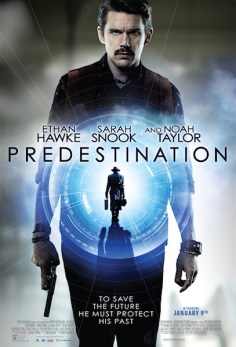 A man walks into a bar in ’70s New York. The bartender strikes up a conversation, which leads to a wager: if the man’s story is the most incredible the bartender has ever heard, he’ll give him a free bottle of whiskey. It had better be pretty good, because what we know that the man doesn’t is that the bartender, played by Ethan Hawke, is an agent for the Temporal Agency, travelling through time to stop crime before it happens; and he’s just had his face burnt off and completely rebuilt while failing to stop a notorious terrorist known as the Fizzle Bomber. Beat that.
That said, the man’s story is pretty incredible too — but as the telling of it makes up over half the movie, and it’s full of its own twists, I shan’t get into spoiler territory. Predestination is a film that rewards knowing as little as possible, especially as the seasoned sci-fi viewer/reader has a fair chance of guessing a good number of its twists (possibly all of them) long before they’re revealed by the film. Fortunately that doesn’t really matter, because the tale remains an engaging and thought-provoking one, with many thematic points to consider, and not just of a science-fictional nature — there are human and historical issues in play here too, which is undoubtedly a rarity in modern screen SF.
We’re guided through this by a laid-back performance from Hawke, which turns intense when needed, but even more so by an affecting, transformative, award-winning turn from Australian actress Sarah Snook. She really should be much in demand after this. Chunks of the film are just a two-hander between Hawke and Snook, yet it effortlessly captivates throughout these stretches. That’s in part thanks to the fascinating nature of the narrative, adapted faithfully from Robert A. Heinlein’s short story All You Zombies (it has nothing to do with zombies — the story’s from the ’50s, before our modern conception of a zombie was formulated), as well as the direction of the Spierig brothers.
 I don’t know how many people will remember, but the pair got a bit of attention back in the early ’00s with their debut feature Undead, because they not only wrote and directed it, but also edited it and created the CG effects at home on their laptops. That’s more commonplace nowadays (well, Gareth Edwards did it for Monsters, anyway), but was A Big Thing in certain circles back then. (I bought Undead on DVD at the time but have never got round to watching it. Plus ça change.) I thought they’d disappeared after that, but they were responsible for vampire thriller (and Channel 5 staple) Daybreakers in 2009. This is their third feature. Working from a low budget once again, they take us to alternate-history versions of the ’40s, ’50s, ’60s, ’70s and ’80s, from bars to orphanages to universities to training for the space programme to the headquarters of a time travelling police organisation and more. To my eyes, it never looked cheap. Sure, it’s not overloaded with CGI, but it doesn’t need to be. I never got the sense anyone was having to hold back because of the low budget. Others may disagree, because I have seen people express the opposite opinion, but I think they’re wrong, so there.
Predestination is the latest reminder that “sci-fi” is not a byword for “action-adventure”. It certainly won’t satisfy the needs of the action-hungry fan (it’s not devoid of the odd punch-up or explosion, but they’re far from the point). For anyone interested in something a bit more intellectual, a bit more thought-provoking, particularly if you like the (potential) complications of time travel, or issues of gender and identity, then Predestination has a lot to offer, even if you guess the twists.

Predestination placed 5th on my list of The 20 Best Films I Saw For the First Time in 2016, which can be read in full here.
It is available on Sky Movies on demand and Now TV from today. It debuts on Sky Movies Premiere next Friday, February 12th, at 11:30am and 10:20pm.
Purists be aware: existing British releases completely muffed up the aspect ratio (reportedly it’s both open matte and cropped), so there’s every chance Sky’s copy will be similarly afflicted.
 Mumble and his penguin pals return for another adventure, in a series the Australian film industry are reportedly inordinately proud of.
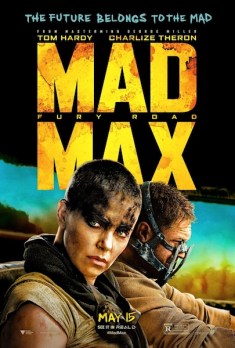 After a decades-long diversion into children’s movies like
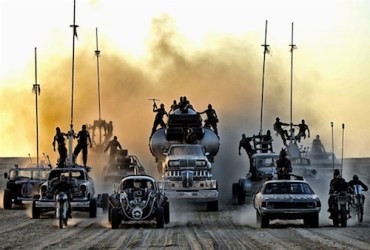
 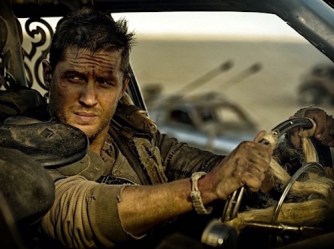 I say that, but the finished film is visually stunning on two levels: cinematography and editing. It was shot by John Seale, and Miller had him amp up the saturation. The point was to do the opposite of most post-apocalyptic blockbusters, which are normally desaturated to heck, and it indeed creates something strikingly different. Conversely, Miller has intimated the ideal version of the movie is in black and white with no dialogue, just the score — completely visually-focused storytelling. I have a feeling he’s right, or that it would at least work well. Some nuance would be lost, but all the major plot points and character arcs would be followable.
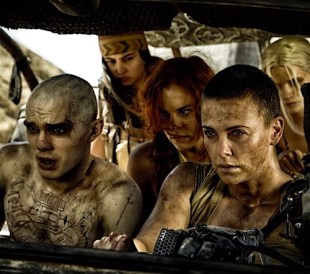 but all are deftly executed. That it doesn’t expound on these at length, or linger on their detail, means you have to pay attention to get the most out of that side of the film. I guess some would counter that with, “you have to look hard because you’re reading something that isn’t there,” but I refute that. That it doesn’t spell everything out at length, or hammer home its points and themes heavy-handedly, is a good thing.
 (Ooh, that turned a bit philosophical, didn’t it?)
 Essie Davis is best known for playing the sassy title role in
 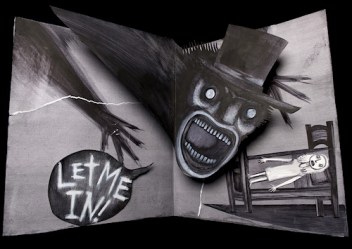 a horror film for people who think about what they’re watching, rather than just waiting for something to be thrown at the screen to make them jump. The slow burn tension will bore those content with the latter, who I suspect don’t tend to think a great deal (for one thing, they’d spot most of the jumps coming if they did).
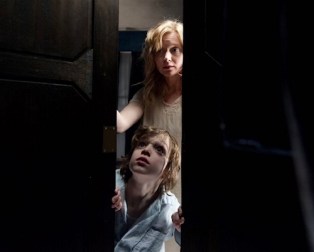 There is little in The Babadook that will make you jump, and even less that will make your stomach turn in disgust, but that’s absolutely fine. What it will do is chill your blood, make your hair stand on end, make you worry about every little creak or thump you hear elsewhere in the house after dark, and make you want to sleep with the lights on. Not just the bedroom lights, all the lights. Because once you’ve seen it, you can’t get rid of the Babadook.
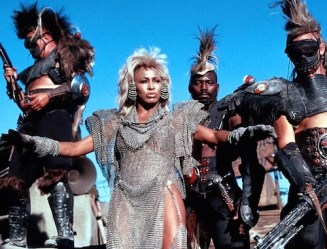
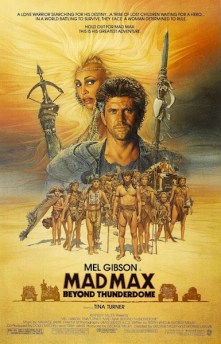 The third (and, for 30 years, final) Mad Max movie sees the titular post-apocalyptic drifter (Mel Gibson) rock up at last-outpost-of-humanity Bartertown in search of his pilfered car and camels. Max finds himself dragged before the town’s ruler, Aunty (Tina Turner), who has a job for him: kill the mutinous overseer of the city’s power supply, Master Blaster. As payment, she’ll arrange for the return of his belongings. The only conditions are he can’t reveal Aunty has employed him, and he has to do it in a fair fight in the town’s arena of combative justice — the Thunderdome. And then the story goes beyond that, funnily enough.
 I didn’t even notice the change in level until I read those comments afterwards. The film still reaches a 15 certificate in the UK, so clearly it isn’t toned down that much. And the lack of visible blood doesn’t mean it lacks creativity: Roger Ebert
 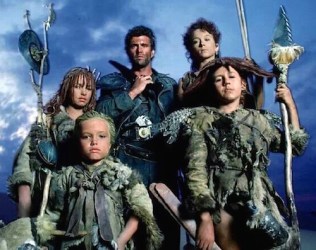 that have been forced to coexist because neither was enough to sustain an entire feature, but at least neither part feels unduly padded, meaning the narrative keeps on rolling. It doesn’t hit the same heights as the exceptional Mad Max 2 — especially with a climax that invites a direct comparison, and is good but not as good — but, as a post-apocalyptic action-adventure movie in its own right, it’s a good film.
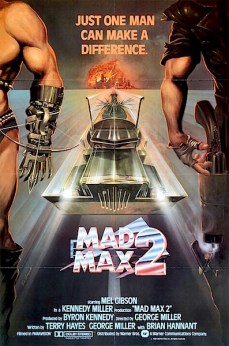 Roaming the outback of a gasoline-desperate post-apocalyptic Australia, “Mad” Max Rockatansky (Mel Gibson) comes across a commune-like oil refinery, whose inhabitants are under siege by a brutally violent gang. Max strikes a bargain: he’ll help them escape with their oil, in exchange for a tank full for himself.
 The most memorable part, however, is the climax. They escape the oil refinery, Max driving the tanker — fitted out with weaponry and defences — and the gang give chase. An almighty action sequence follows, a speeding battle through the outback. It feels wrong to just call it “an action sequence”, like that’s selling it short. You get the sense that this is why the movie exists; that co-writer/director George Miller’s goal with the entire rest of the film has been to get us to this point. It’s not just “the climax”, it’s “the third act”, and it’s stunning — the choreography of it, the editing, the stunts, as dozens of vehicles chase each other, people run around on top of them, jump between them… I don’t think it’s hyperbolic to say it must be one of the greatest action sequences ever committed to film. One of the reasons
 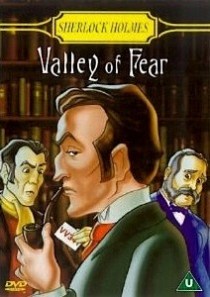 I don’t recall how exactly I came across these animated Sherlock Holmes adaptations starring the voice of Peter O’Toole as the eponymous detective, or how I came to decide to view all of them, but it’s been almost four years since I reviewed the first… and three years since I reviewed the third. Now, finally, I get to the final episode. Such is the erraticism of using LOVEFiLM. (At least I have an excuse for my dawdling here — my incredibly slow viewing of all the Rathbone/Bruce Holmses is entirely my own tardiness.)
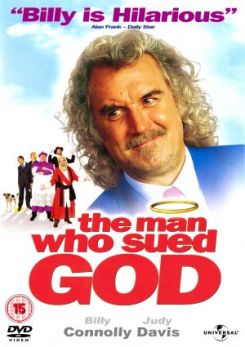 I always assumed this was British, probably because it stars Billy Connolly and has a suitably quirky premise — one can see it fitting in with the school of British comedy that’s brought us
 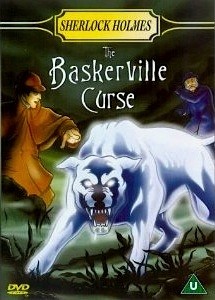 Peter O’Toole is Sherlock Holmes (well, his voice) once again in this animated Conan Doyle adaptation from the ’80s (see also my reviews of two others,
 Peter O’Toole is again the voice of the famous sleuth in this disappointing animated adaptation of the first Sherlock Holmes mystery.
 100Films.co.uk