May’s Failures

Welcome to my monthly “Failures” column, where I look back at some of the films I could, would, maybe even should have watched last month… but failed to.

As is so often the case, Disney were the dominant box office force this month, bookending May with a pair of discussion-worthy films. At the start, apparently Marvel have finally made a good movie again with Thunderbolts* (aka The New Avengers). I’ve just got seven other MCU films to catch up on before I get there (we’ll just gloss over the nine seasons of TV (plus two specials) that I also haven’t seen). At the end of the month, their latest live-action remake, Lilo & Stitch — from what I’ve seen, not a critical success at all, but certainly a moneymaking one. I guess they won’t be stopping these do-overs anytime soon, then.

Other noteworthy big screen releases in May included (but were not necessarily limited to) a horror franchise return in Final Destination: Bloodlines (the franchise has a history of inconsistent quality (heck, what horror franchise doesn’t?), but I’m sure I’ll watch it eventually); a new Wes Anderson, The Phoenician Scheme (like the MCU, I’m a few behind with Anderson now); and another belated franchise continuation, Karate Kid: Legends (I intend to finish Cobra Kai before I watch this, so I won’t be catching it on the big screen, but hopefully by the time it hits streaming I’ll be ready for it).

We’re clearly heading into summer blockbuster season (does that even exist anymore, with studios releasing big-budget tentpoles basically year-round now?), and streaming was keen to get in on the game with Guy Ritchie’s latest heading direct to Apple TV+. Fountain of Youth looks like National Treasure with the serial numbers filed off, and I read one review which argued it was beat-for-beat Indiana Jones and the Last Crusade but tweaked enough at every stage to avoid plagiarism. Not ringing endorsements, then, but as it’s a genre of movie I mostly enjoy, it might make for easygoing entertainment one evening.

Other original premieres included Cleaner on Sky Cinema / NOW, an actioner directed by Martin Campbell, which apparently continues his streak of only doing mediocre work on films that don’t star James Bond or Zorro. Oh well. In a similar vein, they had another actioner from a once-promising ’90s action director — Simon “Con Air” West — that looks like it’s gone direct to streaming for a reason: Christoph Waltz hitman comedy Old Guy. Going straight to Prime Video was Paul Feig sequel Another Simple Favour (like the original, it challenges whether you’re committed to the sanctity of English spelling or tempting search engines with the American original). As for Netflix, they also continue the franchise game with Fear Street: Prom Queen, which I think is the fourth one, but more interesting was Lost in Starlight. All I could tell you about it is it’s a sci-fi animation, but hey, that’s better than “fourth (I think) instalment in a horror franchise I’ve never watched”.

Turning to theatrical releases making their subscription streaming debuts, I don’t think Netflix had anything to offer this month. Sky Cinema lead the way, as usual, with Oscar nominee The Wild Robot and Tim Burton legacy sequel Beetlejuice Beetlejuice. Back when the latter hit cinemas, I wrote that “I’ve never been particularly fond of Beetlejuice… so I certainly wasn’t rushing out to see Beetlejuice Beetlejuice at the cinema, though I’ll inevitably catch it once it’s streaming somewhere.” Well, now it’s on NOW. I still haven’t rushed to see it (it’s been on there over a fortnight already), but I do intend to at some point. Amazon offered up the latest Jason Statham vehicle, A Working Man, while Disney+ stayed relatively up-to-date with the MCU by adding Captain America: Brave New World — thought I’ll wait until I can source a 3D copy before properly adding it to my aforementioned MCU catch up list.

Digging into back catalogue expansions, I’d love to say Netflix had more to offer, but I’m not sure the likes of Dracula Untold and Gran Turismo are anything to celebrate. They did add Machete Kills, which I have a vague intention to see (it’s 12 years old now and I haven’t seen it yet, which shows you how invested I am), but at this point I’m really keeping my Netflix sub so I can finish catching up on Cobra Kai. Also because I still haven’t watched Paddington in Peru. Prime had a typically lengthy list of kinda-random new stuff — particularly catching my eye were Luc Besson’s The Big Blue, Jeff Nichols’ Take Shelter, and fantasy romance classic Ghost (yeah, I’ve never seen Ghost); plus a bunch of reminders for stuff I’ve bought with intent to rewatch but haven’t yet: A Boy and His Dog, A Few Good Men, Natural Born Killers, Ronin, Training Day… I could go on, but instead I’ll switch service for more of the same, as iPlayer also jabbed me about the original Halloween, Highlander, La La Land in 4K, and Toy Story 4 in 3D; plus one I’ve bought and never seen, David Cronenberg’s Crimes of the Future — but let’s not venture too far down that road, or it’ll be another long list. Instead, let’s close out streaming with something more obscure on MUBI (of course): Only the River Flows. All I know about it is what they had to say, but something described as a “moody neo-noir… a pungently atmospheric serial-killer procedural” sounds right up my street.

But, inevitably, we must flip back to “stuff I bought on disc and didn’t watch”, because there was plenty of that, as ever. Leading the pack in May were 4K upgrades for some absolute classics: from Arrow, the first two entries in Sergio Leone’s trilogy of Spaghetti Westerns, A Fistful of Dollars and For a Few Dollars More (I have The Good, the Bad and the Ugly preordered, of course), plus Akira Kurosawa’s reimagining of Macbeth, Throne of Blood, courtesy of the BFI. Also in 4K, I imported a trio of hefty limited editions by Umbrella from Australia: Tarsem Singh’s The Fall (considering MUBI are responsible for the 4K restoration, I presume they’ll do a disc here at some point, but no sign of it yet); Richard Stanley’s debut, horror sci-fi Hardware; and (not in 4K) medieval folk horror Black Death, which I have wanted to revisit for a while after I rather enjoyed it more years ago than I care to think about.

No mainstream releases to report this month (I intend to pick up Bong Joon Ho’s Mickey 17, but haven’t yet), but all the usual boutique labels feature, albeit in smaller quantities than sometimes. Leading the pack by volume is Eureka, thanks to four-film Masters of Cinema box set Strange New Worlds: Science Fiction at DEFA, featuring a quartet of sci-fi flicks from mid-20th-century East Germany; plus their latest Shaw Brothers release, The Bells of Death, which I hope lives up to its billing as “a standout wuxia film heavily influenced by both the longstanding Japanese samurai tradition and the emergent Spaghetti Western”. Next we find 88 Films with another giallo, Nine Guests for a Crime, and a pair of Japanese superhero comedies from insanely prolific director Takashi Miike, Zebraman and Zebraman 2: Attack on Zebra City. Finally, just one from Radiance this month: Japanese prison break thriller The Rapacious Jailbreaker; and one from their partner label, Raro Video: Shoot First, Die Later, a poliziottesco — and as I still need to watch seven of those for this year’s Genre category, it gets to immediately sit pretty high on my to-watch list. Imagine that: actually watching stuff I buy!

Yojimbo (1961)

aka Yôjinbô

2017 #126
Akira Kurosawa | 111 mins | DVD | 2.35:1 | Japan / Japanese | PG

Yojimbo

Best known to many viewers as the film Sergio Leone ripped off to make A Fistful of Dollars, Akira Kurosawa’s Yojimbo is itself already a Western in all but setting: it stars Toshiro Mifune as Sanjuro, a ronin who wanders into a village where two gangs are at loggerheads, a conflict from which the regular folk cower in fear. Where Kurosawa deviates from the Western, at least as they had been made to that point, is that Sanjuro isn’t a clean-cut hero who’ll side with the good guys and get this mess sorted — he’s a mercenary, primarily out for his own interests; and besides, there are no good guys to join: both gangs are equally bad.

In his essay that accompanies Criterion’s release of the film, Alexander Sesonske argues that Kurosawa is actually combining “two typically American genres”. So we have “a classic Western setting, with dust and leaves blowing across the wide, empty street that runs the length of a village, a lone stranger passes as frightened faces peer from behind shutters”, mixed with the morals (or lack thereof) of a gangster movie, with everyone a crook hoping to merely outgun the others. That all comes wrapped in the milieu of a samurai movie, meaning instead of pistol duels or scattershot machine-gun fire we get flashing blades. Indeed, Yojimbo was the first film to have a sound effect for a sword slashing human flesh — they had to experiment to get it right, because it had never been done. Considering the film also features severed limbs and squirting blood, the BBFC’s PG seems awfully lenient…

Observing the conflict

Given all that, it seems like this is an almost mercilessly nihilistic film. It’s set in a town that’s been fucked up by the never-ending gang warfare, and over the course of the story nearly everyone dies, many of them in brutally violent fashion. Even the hero seems remorseless, killing freely and plotting to get the two gangs to massacre each other because he sees a way to profit. Sesonske asserts that “Yojimbo lacks the intellectual challenge of Rashomon, the moral resonance of Ikiru, or the sweep and grandeur of Seven Samurai”, which may all be true to an extent, but we shouldn’t disregard what the film does offer: a bleak worldview that chimes with the careless brutality of the world as we know it.

Even in such hopelessness there is beauty, and here, at least, that comes from Kazuo Miyagawa’s gorgeous black-and-white cinematography. With many incredibly blocked and framed shots, it’s no wonder Kurosawa has been so copied — his visuals are always amazing. His exacting desires may’ve created various production issues (the specially-built set, made with extreme period accuracy, was unprecedentedly expensive; to create the windswept effect they used all of the studio’s wind machines, which was so powerful actors couldn’t open their eyes and camera cranes couldn’t complete moves; and he used all of the studio’s big lights for night scenes, but the way they pulsated meant lens filters had to be used to compensate), but it doesn’t half look good in the end.

5 out of 5

Yojimbo was viewed as part of my Blindspot 2017 project, which you can read more about here.

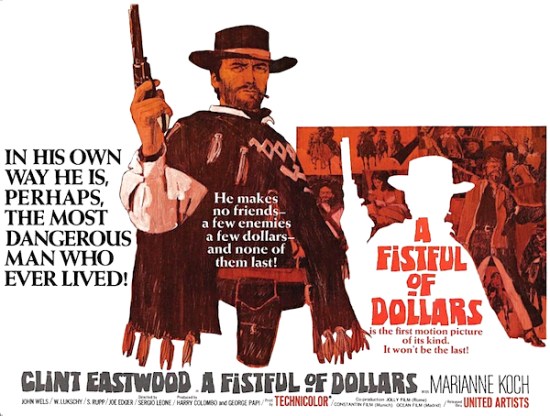
A Fistful of Dollars (1964)

The 100 Films Guide to…

In his own way he is, perhaps, the most dangerous man who ever lived!

Original Title: Per un pugno di dollari

Country: Italy, Spain & West Germany
Language: English and/or Italian
Runtime: 100 minutes
BBFC: X (cut, 1967) | AA (1981) | 15 (1986)
MPAA: M (1967) | R (1993)

Original Release: 12th September 1964 (Italy)
UK Release: 11th June 1967
Budget: $200,000

Stars
Clint Eastwood (High Plains Drifter, Gran Torino)
Marianne Koch (The Devil’s General, Spotlight on a Murderer)
Gian Maria Volontè (For a Few Dollars More, Le Cercle Rouge)
Wolfgang Lukschy (Dead Eyes of London, The Longest Day)
José Calvo (Viridiana, Day of Anger)

Director
Sergio Leone (The Colossus of Rhodes, The Good, the Bad and the Ugly)

Screenwriters
Víctor Andrés Catena (Kill Django… Kill First, Panic)
Jaime Comas (Nest of Spies, Cabo Blanco)
Sergio Leone (The Last Days of Pompeii, Once Upon a Time in the West)

Dialogue by
Mark Lowell (High School Hellcats, His and Hers)

Story by
Adriano Bolzoni (Requiescant, Your Vice is a Locked Room and Only I Have the Key)
Víctor Andrés Catena (Sandokan the Great, Cabo Blanco)
Sergio Leone (Duel of the Titans, Once Upon a Time in America)

Based on
Yojimbo, a Japanese samurai film written by Akira Kurosawa & Ryûzô Kikushima and directed by Kurosawa. (Not officially, but the makers of Yojimbo sued and it was settled out of court — presumably because it’s really, really obviously a remake of Yojimbo.)

The Story
The Mexican border town of San Miguel is ruled over by two rival gangs. When a gunslinging stranger arrives, he attempts to play the two gangs off against each other to his benefit.

Our Hero
The Man With No Name, aka Joe, seems to just be a drifter, who rocks up in San Miguel and sees an opportunity to make some money by doing what he does best: killing people.

Our Villains
Neither of the two gangs — the Baxters and the Rojos — are squeaky clean, but the Rojos are definitely the nastier lot. Led by three brothers, the cleverest and most vicious of them is Ramón, who’ll stop at nothing to punish Joe after he threatens their empire.

Best Supporting Character
The innkeeper Silvanito, who warns Joe away when he first arrives, but becomes his friend and almost sidekick later on.

Memorable Quote
“When a man with .45 meets a man with a rifle, you said, the man with a pistol’s a dead man. Let’s see if that’s true.” — Joe

Memorable Scene
As Joe heads off to confront three of Baxter’s men who shot at him earlier, he passes the coffin maker — and tells him to get three coffins ready. Coming face to face with four of Baxter’s goons, Joe asks them to apologise to his mule. They, naturally, refuse… so he shoots them all dead. As he walks back past the coffin maker, he casually apologises: “My mistake — four coffins.”

Memorable Music
Ennio Morricone’s score is as much a defining element of this movie as the visuals or the cast. His later theme for The Good, the Bad and the Ugly may be his best-known work, but there’s a cracking main title theme here too.

Letting the Side Down
It’s just a fact of this kind of production from this era, but the English dubbing is really quite terrible. Well, the acting’s not all that bad, as it goes, but the lip sync is not very synced.

Making of
When it premiered on US TV in 1977, the network found the film’s content morally objectionable: the hero kills loads of people, apparently only for money, and receives no punishment. While that might sound perfectly attuned to US morals today, they had different ideals back then. So they ordered a prologue be shot, showing Eastwood’s character receiving a commission from the government to go sort out the town of San Miguel by any means necessary — thus morally justifying all his later killing, apparently. The short sequence was directed by Monte Hellman (Two-Lane Blacktop) and starred Harry Dean Stanton (RIP).

Next time…
The loosely connected Dollars (aka Man With No Name) Trilogy continued with For a Few Dollars More (which was part of my 100 Favourites last year) and concluded with The Good, the Bad and the Ugly (which someday will get the “What Do You Mean You Didn’t Like” treatment).

Verdict

The Dollars trilogy were among the first Westerns I saw, and I’ve been meaning to revisit them for many years. I was finally spurred on to start by watching Yojimbo for the first time. Watching that and this back to back, you can’t miss how similar they are — no wonder they settled the legal case, they wouldn’t’ve had a leg to stand on. Yojimbo is the classier handling of the material, giving the whole scenario a weightiness that has gone astray here. Fistful has its own charms, of course, as director Sergio Leone merrily reinvents the Western genre before our eyes — out go the simple white hat / black hat moral codes, in comes baser motivations (greed, lust) and quick sharpshooting. What it lacks in classiness or weight, it makes up with coolness and style.