Muppets Most Wanted (2014)

2016 #41
James Bobin | 103 mins | streaming (HD) | 16:9 | USA / English | U / PG

After the success of their 2011 revival, this sequel sees the Muppets embark on a world tour at the behest of Dominic Badguy (Ricky Gervais). Meanwhile, Kermit is mistaken for a master criminal and sent to a gulag run by Tina Fey.

As irreverent and cameo-filled as ever (so many famous people, you won’t even know who some are!), something just doesn’t work this time — it’s neither as funny nor as charming as their last outing.

With the recent TV series receiving mediocre reviews too, it looks like they’ve killed off the Muppet renaissance as soon as it started. Shame.

2 out of 5

For more quick reviews like this, look here.

Cube (1997)

100 Films’ 100 Favourites #21

Don’t look for a reason.
Look for a way out.

Country: Canada
Language: English
Runtime: 90 minutes
BBFC: 15
MPAA: R

Original Release: 11th July 1998 (Netherlands)
UK Release: 25th September 1998
First Seen: TV, c.2000

Stars
Maurice Dean Wint (Rude, Nothing)
David Hewlett (Scanners II: The New Order, Cypher)
Nicole de Boer (Star Trek: Deep Space Nine, Corrupt)
Nicky Guadagni (Crash, Lars and the Real Girl)
Wayne Robson (Interstate 60: Episodes of the Road, Survival of the Dead)

Director
Vincenzo Natali (Cypher, Splice)

Screenwriters
Andre Bijelic
Vincenzo Natali (Splice, In the Tall Grass)
Graeme Manson (Rupert’s Land, Orphan Black)

The Story
Six strangers wake up inside a mysterious 14-foot cube, its walls covered with circuit-like designs and each wall containing a door… which leads to another cube, identical but for the colour scheme. They soon realise that some of these rooms are boobytrapped with death-dealing devices. If they combine their different backgrounds and strengths, perhaps they can find a way out…

Our Heroes
The six individuals we follow are a fractious bunch. You may side with one or two, but at any given moment something might happen to make you rethink who should or should not be trusted.

Our Villain
The Cube itself is the enemy here… although with the amount our group fight amongst themselves, maybe it’s not the only problem…

Best Supporting Character
Part way through the film, our gang come across Kazan, who clearly has some kind of mental problem. I thought Andrew Miller’s performance was decent, but pretty much every other review of the film criticises all of the acting, and I’ve never seen Rain Man (a regular point of comparison), so who knows?

Memorable Quote
Holloway: “What does it want? What is it thinking?”
Worth: “‘One down, four to go.'”

Memorable Scene
The opening scene, which quickly establishes the danger of the environment so succinctly and memorably that Resident Evil ripped it off a few years later.

Technical Wizardry
The characters move through many rooms in the cube, a challenge for a low-budget production… unless, of course, all the rooms are nearly identical: there was only one cube set, with coloured panels changed to suggest the different spaces.

Making of
All of the characters are named after famous prisons around the world. Not only that, but their personalities reflect the characteristics of those prisons. To say too much might spoil parts of the film for those who’ve not seen it, but the curious can find a fuller explanation here.

Next time…
There are two sequels to Cube, Hypercube and Cube Zero, each worse than the last. Don’t waste your time.

Awards
1 Saturn nomination (Home Video Release)
Toronto International Film Festival — Best Canadian First Feature Film

What the Critics Said
“They don’t agree on the best course of action, and might one of them be a spy for whomever is in charge? The grating mechanical noises that echo through the Cube all around them seem to be the manifestation of the stress they’re under, stress they act out on one another. Holloway estimates they have only a few days without food and water before they’re too weak to continue, and yet they slow themselves down with their virulent bickering. […] As Rennes says, “Ya gotta save yourselves from yourselves,” and they’re not doing a terribly good job of that.” — MaryAnn Johanson, flickfilosopher

Score: 62%

What the Public Say
“you can’t make [the plot] sound interesting — “for 90 minutes, people move through largely identical cubic rooms that want to kill them”. But it is interesting, mainly, and here’s where the Twilight Zone comparison is useful. […] the cast ends up filling somewhat allegorical roles: the Teacher, the Authoritarian, the Intellect, the Survivalist. And Cube, in finest Rod Serling fashion, plays out as a series of conundrums in which the audience is invited to think about how these different types, that is to say, these different worldviews and moral codes, interact with each other in a patently allegorical environment” — Tim Brayton, Antagony & Ecstasy

Elsewhere on 100 Films
I offered some thoughts on Cube when I watched the two sequels back in 2008: “In its series of careful, measured, necessary reveals, the film strikes a perfect balance between what it lets the viewer know — and the revelations are expertly paced throughout — and what it keeps hidden, either for the viewer to deduce or interpret for themselves, or simply because one doesn’t need to know. […] everyone interested in the more intelligent end of the sci-fi spectrum should see Cube.”

Verdict

Regular readers will know of my fondness for the single-location thriller. A lot of that likely stems back to Cube, which I think pioneered the form as a popular one for new filmmakers making low-budget genre pictures, and is the yardstick all others must measure up to, at least for me. Throw a mismatched group of characters into a confined, mysterious setting and, hey presto, instant drama. Cube remains one of the best because of both the mysteries of its location, and the pure tension director Vincenzo Natali creates as the cast try to avoid or evade the deadly traps.

Next… yippee-ki-yay, #23 !

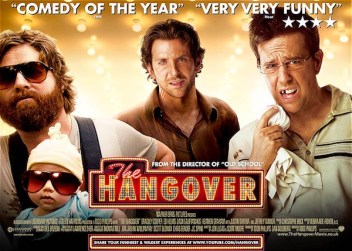
The Hangover (2009)

2016 #40
Todd Phillips | 96 mins | streaming (HD) | 2.35:1 | USA & Germany / English | 15 / R

I confess, I only watched The Hangover to see what the fuss was about, and to get the tick on iCM’s Most Checked.

The high-concept plot (guys on a stag are unable to remember the night before, but must use the evening’s bizarre detritus as clues to piece together their wild experiences so they can find the missing groom) is neat, though not as cleverly executed as it could be. The humour is straightforward, perhaps best exemplified by an Asian guy saying “motherfucker” in a silly high-pitched voice — and yeah, I did laugh at that.

It’s easy, decidedly uncomplicated viewing.

3 out of 5

For more quick reviews like this, look here.

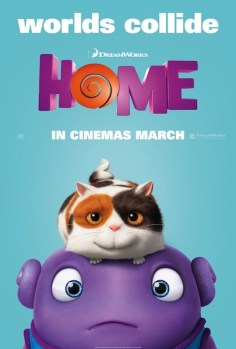
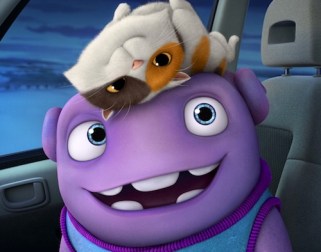
Home (2015)

2016 #35
Tim Johnson | 90 mins | streaming (HD) | 1.85:1 | USA / English | U / PG

Oh (Jim Parsons) is a Boov, a race of friendly aliens looking for a new home planet to escape their enemies. When they arrive on Earth, Oh tries to invite everyone to a party, but accidentally alerts their enemies to their new home. Outcast, he bumps into Tip (Rihanna), a girl accidentally left behind when the rest of mankind was relocated by the Boov. Desperate for friendship, Oh agrees to help her find her mother.

Initially I ignored Home, because nothing about it looked particularly inspiring. But I’ve been wrong about CG kids animations before (How to Train Your Dragon; Cloudy with a Chance of Meatballs), so when I happened to see the trailer and it amused me, I decided to give it a go. Unfortunately, characters and affectations that are amusing in the form of highlights lasting two minutes quickly grate in the film proper.

Home’s biggest problems are all in its most fundamental aspect: the story. It doesn’t just have plot holes — the whole premise and inciting incident don’t even hang together. I don’t believe this is just a movie for little kids, I reckon it was written by them too. That’s surely the only way to explain its absence of plausible logic.

Why do the Boov speak English? Why do they speak it wrong? Why does Oh speak it so much more wrong than any other Boov? Why do they know the words for things they have no concept of? Why would humanity accept total relocation without any kind of response? How would only one girl on the entire planet be missed? How would she have had time to come to hate the Boov enough to make multiple pieces of anti-Boov art and set up an elaborate Home Alone-style trap in her apartment when the film suggests the Boov arrived just a couple of hours earlier? How does she know how to drive? If she’s old enough to know how to drive (and to be voiced by Rihanna), why does she do art that looks like it’s by a six-year-old? Why do the Boov make recognisable monuments float in the air? Why would a communication device’s two options be “send to one person” and “send to not only the entire species, but the entire universe, including our enemies”? Why is there no option to cancel such a transmission that is going to take 40 hours to reach said enemies? I mean, that last one’s a stupid question, because why is there even a way to message the enemies?

And those questions are just from the first 15 minutes.

Tip’s full name is Gratuity Tucci, which may just be the most implausible name in the history of the world. Our heroes spend a chunk of the middle of the film just driving across the Atlantic (don’t ask) doing things like listening to Rihanna music (you mean, they listen to songs by the lead voice actress? What a coincidence!) Sometimes the film is scored with such Popular Songs, often tweeny crap, but other times it’s blandly generic Movie Music. Either would be an adequate creative choice, albeit resolutely unremarkable, but having both at random is distractingly schizophrenic. And the songs don’t even have accurate relevance to what’s happening.

Story aside, Home is not poorly made, and there are fleeting glimmers of entertainment. Which is damning with faint praise, really. Naturally, I don’t recommend you waste your time on it.

2 out of 5

Home featured on my list of The Five Worst Films I Saw in 2016, which can be read in full here.

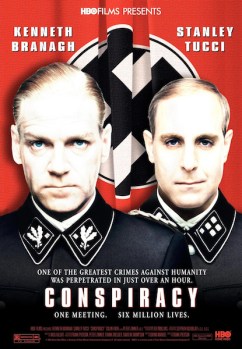
Conspiracy (2001)

100 Films’ 100 Favourites #20

One meeting. Six million lives.

Country: UK & USA
Language: English & German
Runtime: 96 minutes
BBFC: 15
MPAA: R

Original Release: 19th May 2001 (USA)
UK Release: 25th January 2002
First Seen: TV, 25th January 2002

Stars
Kenneth Branagh (Henry V, Valkyrie)
Stanley Tucci (The Terminal, The Hunger Games)
Colin Firth (Bridget Jones’s Diary, The King’s Speech)
David Threlfall (Scum, Nowhere Boy)
Kevin McNally (Pirates of the Caribbean: The Curse of the Black Pearl, Valkyrie)

Director
Frank Pierson (The Looking Glass War, A Star is Born)

Screenwriter
Loring Mandel (Countdown, The Little Drummer Girl)

The Story
1942, Berlin: a group of high-ranking Nazis gather for the Wannsee Conference, its purpose being to determine the method by which they will implement Hitler’s policy of making Germany free of Jews. Put another way, this is the meeting that created the Final Solution.

Our Heroes
I mean, they’re all Nazis, plotting the Final Solution — heroes are in short supply. That said, some object… just not very many, and not for long.

Our Villains
I mean, they’re all Nazis, plotting the Final Solution — there are plenty of villains. Chief amongst them, however, is SS-Obergruppenführer Reinhard Heydrich (Branagh), whose calm and charming demeanour hides a will of steel and a sure belief in their terrible purpose.

Best Supporting Character
There’s a strong cast of British character actors (as well as those mentioned above, we have Ian McNeice, Ben Daniels, Brendan Coyle, Owen Teale, Peter Sullivan, Nicholas Woodeson, and Jonathan Coy — you might not know all the names, but you’ll likely know the faces), so it’s hard to name just one stand-out. However, Dr. Wilhelm Stuckart (Colin Firth) is particularly memorable: he’s a nice guy because he only wants to sterilise the Jews. He’s also one of the few men in the room who’s aware of how the rest of the world will judge them if they proceed down a path of extermination.

Memorable Quote
Hofmann: “Evacuation to where?”
Heydrich: “Let us postpone that question for a while.”
Klopfer: “To hell, one hopes.”
Lange: “Many already have.”
Luther: “Do they even have a hell?”
Heydrich: “They do now. We provide it.”

Memorable Scene
Although it’s bookended by arrivals and departures, and occasionally broken up in the middle with pauses for food, etc, the film is essentially one long meeting. Which sounds incredibly dull, but of course isn’t.

Making of
Pierson chose to shoot the film’s meeting sequences in long takes, sometimes getting through 20 or more pages at a time. A highly unusual method for a screen production, so the fact most of the cast had a stage background must’ve been a boon. It was shot on Super 16 film for similar reasons: it has longer film magazines and smaller cameras, allowing the cameramen to get closer to the actors.

Awards
1 Golden Globe (TV Supporting Actor (Stanley Tucci))
2 Golden Globe nominations (Best Miniseries or TV Movie, Best Actor in a Miniseries or TV Movie (Kenneth Branagh))
2 Emmys (Actor in a Miniseries or Movie (Kenneth Branagh), Writing for a Miniseries or Movie)
8 Emmy nominations (Outstanding TV Movie, Supporting Actor (both Colin Firth and Stanley Tucci), Directing, Cinematography, Editing, Sound Editing, Sound Mixing)
1 BAFTA TV Award (Single Drama)
1 BAFTA TV nomination (Actor (Kenneth Branagh))
Peabody Award

What the Critics Said
“What a week for thoroughly exceptional, audaciously gripping fact-based dramas. We had Bloody Sunday on Sunday and now here’s Conspiracy. […] The performances are uniformly outstanding, but out of all of them it will be images of Kenneth Branagh as Heydrich you will take away with you. They may even haunt your nightmares. Branagh, who won an Emmy for the role, is flawless, and in Heydrich this fine actor has re-created a monster. Just watch the iron come into his eyes when he is contradicted or questioned. Watch that smooth charm slip as he calmly threatens those who are not completely on his side.” — Alison Graham, Radio Times

Score: 100%
(Sort of.)

What the Public Say
“to see the planning of the Final Solution played out is chilling, to say the least. Obviously, it’s not an easy watch, but it’s an important film. If you’re at all interested in how scary and terrible things happen in this world, and how the death of millions can be plotted the same way your company runs a board meeting, this is definitely a movie to see.” — Dan Bergstrom @ Letterboxd

Verdict

“A group of men have an administrative meeting” is possibly the least exciting logline for a movie you could ever read, but when those men are Nazis, at the height of the Third Reich’s pomp and opulence, and the businesslike meeting is to plot one of the greatest atrocities ever committed by mankind, it becomes horrendously fascinating. For that we can also thank Loring Mandel’s precise screenplay, and perfectly calibrated performances from a magnificent cast of seasoned actors.

#21 will be… nothing to do with Phillip Schofield.

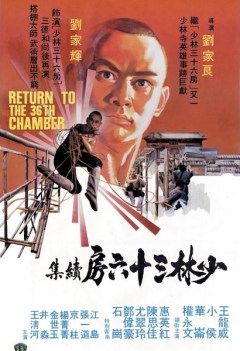
Return to the 36th Chamber (1980)

aka Shao Lin da peng da shi

2016 #13
Liu Chia-liang | 97 mins | streaming (HD) | 2.35:1 | Hong Kong / Cantonese & Mandarin | PG / R

Con man Gordon Liu poses as San Te (Liu’s character from the first film) to help his oppressed friends at the dye factory. When his ruse is rumbled, he heads to the Shaolin Temple to learn kung fu… and spends a year constructing scaffolding and learning to wash his hair with a rock. Of course, he may’ve accidentally learnt a few other things too…

Return’s story follows the shape of its forebear, but with less inventiveness and more comedy, both intentional and not: the villain’s weapon of choice is a collapsible stool. Each to their own.

Fine, but no classic.

3 out of 5

Talking of kung fu and returns, Film4’s Revenge of Martial Arts Gold season kicks off tonight at 11:05pm with The Boxer from Shantung.

For more quick reviews like this, look here.

Daredevil (2003)

100 Films’ 100 Favourites #22

Take the dare

Country: USA
Language: English
Runtime: 103 minutes | 133 minutes (director’s cut)
BBFC: 15
MPAA: PG-13 (theatrical cut) | R (director’s cut)

Original Release: 14th February 2003 (USA, UK & others)
First Seen: cinema, February 2003

Stars
Ben Affleck (Pearl Harbor, Batman v Superman: Dawn of Justice)
Jennifer Garner (13 Going on 30, The Invention of Lying)
Michael Clarke Duncan (The Green Mile, Sin City)
Colin Farrell (Minority Report, Alexander)

Director
Mark Steven Johnson (Ghost Rider, When in Rome)

Screenwriter
Mark Steven Johnson (Grumpy Old Men, Ghost Rider)

Based on
Daredevil, a Marvel Comics superhero created by Stan Lee and Bill Everett.

The Story
Blind New York lawyer Matt Murdock defends the innocent by day, and by night uses his special abilities to bring the guilty to justice as costumed vigilante Daredevil. When crime boss Wilson Fisk, aka Kingpin, hires Bullseye to take out a business associate, the assassin frames Daredevil for the crime, which brings him into conflict with the businessman’s combat-trained daughter, Elektra.

Our Hero
Blinded as a child, Matt Murdock found his other senses heightened. Following the murder of his father, he trained in the law. Now by day he’s a defender of the innocent, and by night hunts the guilty as superhero Daredevil. Even though the film mixes in his origin story, it doesn’t take a “Year One” approach to his crimefighting, which makes a change of pace even now. (In recent years a lot of the blame for the film’s failure has been laid at Ben Affleck’s door, because it’s popular to bash ’00s-era Affleck. Rotten Tomatoes’ short summary of contemporary reviews tells a different story, stating “Ben Affleck fits the role” as one of the film’s key qualities.)

Our Villains
Coming off the back of The Green Mile, Michael Clarke Duncan was the obvious chap to step into the giant shoes of Hell’s Kitchen’s crime lord, Wilson Fisk, aka Kingpin. The real fun comes courtesy of Colin Farrell’s crazy, campy killer, Bullseye, who enlivens the film any time he’s on screen.

Best Supporting Character
Jennifer Garner is terribly miscast as Elektra, really, but she makes a fair fist of it nonetheless, and the film doesn’t shy away from the outcome of that storyline.

Memorable Quote
“Hey, that light, at the end of the tunnel? Guess what? That’s not heaven… that’s the C train.” — Daredevil

Memorable Scene
Matt and Elektra spar in a children’s playground. It’s a scene some people despise, probably because of what it thinks passes for dialogue, but you can’t say it doesn’t stick in the mind.

Memorable Music
If you were of the right age and disposition back in the early ’00s, the Daredevil soundtrack was more influential than the film itself. It was partly responsible for launching gothy rock group Evanescence, who you may remember for Bring Me to Life, which was on the film’s soundtrack and was their biggest hit (it was #1 here for four weeks). I think they’re still going, despite numerous changes of line-up, though they release albums once in a blue moon.

Letting the Side Down
“All of it!” Oh, hush, you.

Making of
Originally greenlit as a relatively low-budget film, at roughly $50 million, during shooting Sam Raimi’s Spider-Man was released and became a huge hit (it was the first film to gross over $100 million in one weekend). Consequently, Fox upped Daredevil’s budget to $80 million, specifically to “enhance the film’s visuals”. I guess that’s where all the Spider-Man-esque CGI tumbling came from, then.

Previously on…
Although this is the first full-blown adaptation of Daredevil to actually make it to the screen, he’s turned up in other characters’ series down the years, including both live-acton (1989 TV movie The Trial of the Incredible Hulk, which starred John Rhys-Davies as Kingpin) and animation (episodes of the ’90s Spider-Man and Fantastic Four series).

Next time…
Although no sequel was forthcoming, Jennifer Garner starred in spin-off Elektra. Whatever you think of the 2003 Daredevil, Elektra is much, much worse. Numerous attempts at a reboot movie faltered, until the rights reverted to Marvel Studios, who used the property to kick off the Netflix arm of the MCU. As much as I like the movie, the TV series is much better. Season two is released this Friday, so if you’ve not seen any then you’ll soon have 26 episodes to catch up on, you lucky thing you.

Awards
1 Razzie (Worst Actor (Ben Affleck, also for Gigli and Paycheck))
1 Razzie nomination (Worst Actor of the Decade (Ben Affleck, also for everything else he did in the ’00s))
1 Kids’ Choice Award nomination (Best Female Butt Kicker)
2 MTV Movie Awards Mexico nominations (including Best Colin Farrell in a Movie (it lost to S.W.A.T.))

What the Critics Said
“This is the Unforgiven of superhero films. Conventions are turned on their head, twisted, questioned. […] In almost every superhero film, there’s another conventional scene where the villain has the hero cornered and helpless. Yet the villain never unmasks the hero. That scene drove me nuts in Spider-Man. […] In Daredevil, no one ever hesitates to unmask DD. That’s what I mean by this being a film grounded in reality. People act real, do real things. Even if they are wearing silly costumes.” — “Dr. Michael Hfuhruhurr”, Ain’t It Cool News

Score: 44%

What the Public Say
“Colin Farrell is deliciously hammy and steals every scene he’s in, showing he’s having a total blast (and to be honest, the hamminess suits Bullseye). Michael Clarke Duncan is PERFECT casting for Kingpin, for his size, stature, overall menacing feel. And honestly, I like Ben Affleck in this, too. He makes me believe he’s blind. He makes me believe that he’s a broken, tortured character who tries to put on a brave face in front of his friends.” — Nick Piers

Verdict

The runt of the litter when it comes to the (first) modern explosion of superhero movies, Daredevil has, believe it or not, always had its fans. The darker tone than contemporary X-Men or Spider-Man films works in its favour in that respect, though I know not everyone feels that way. Ben Affleck actually does a solid job as the titular hero, while Michael Clarke Duncan was perfectly cast as hulking villain Kingpin. Most enjoyable, though, is Colin Farrell’s finely-judged camp craziness as henchman Bullseye. Okay, the Netflix series has now easily surpassed it, but the Daredevil movie is still a moderately underrated film for its era. (The Director’s Cut is apparently much better, too, though I’ve still not made the time for it.)

Season two of Marvel’s Daredevil is available on Netflix from Friday.

#20 will be next… with character actors planning genocide.

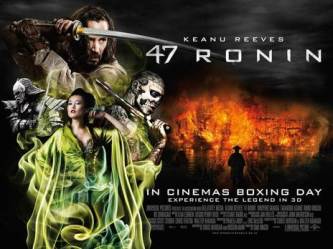
47 Ronin (2013)

2016 #18
Carl Rinsch | 119 mins | streaming (HD) | 2.35:1 | USA / English | 12 / PG-13

Blighted by behind-the-scenes difficulties, 47 Ronin wound up among the biggest box office bombs of all time — a fate not entirely undeserved.
It concerns a gang of samurai who set out to avenge their master, a true story that’s legendary in Japan. This telling is enhanced with fantasy elements — which, despite some critics’ views, is just fine, as the film’s historical advisor explains in this excellent defence.

Sadly, what falters is everything else: clumsy storytelling, poorly edited action, Japanese actors struggling with English dialogue, Keanu Reeves’ acting. Magnificent imagery and design stop it being a total disaster, but only just.

2 out of 5

For more quick reviews like this, look here.

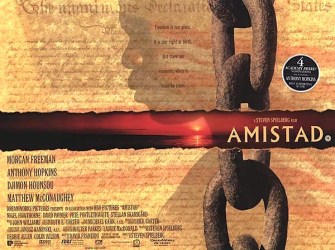
Amistad (1997)

2016 #16
Steven Spielberg | 155 mins | streaming (HD) | 16:9 | USA / English, Mende & Spanish | 15 / R

Feeling in need of more intellectual fare after helming The Lost World, Spielberg turned to a project already in development at Dreamworks: an adaptation of a non-fiction book about the 1839 mutiny on the slave ship La Amistad, and the ensuing legal battle. Although not poorly received by critics, there’s a sense that the consensus view dubbed it “black Schindler’s List”, the implication being that by aping the earlier film it was inevitably inferior. I don’t think that’s a watertight chain of logic, but, nonetheless, Amistad is clearly a ‘minor Spielberg’.

Despite being “a slavery drama”, most of the film functions as a legal drama: though it begins with the slave uprising, and later has an extended flashback showing their kidnap and transportation, the thrust of the film lies in the courtroom arguments about who owns the ship’s ‘cargo’ and consequently what should be done with them. This is a period when capturing Africans into slavery, and by extension their subsequent transportation, was illegal by international agreement, but actually owning slaves was not yet banned (at least in the US). It’s before the American Civil War too, so there’s a political dimension: if these ‘slaves’ are freed, what tension might that spark between the north and south?

Though Spielberg is certainly not immune to the Africans’ plight — the depiction of life on a slave ship is appropriately harrowing — it’s clear from early on which side he expects us to identify with, in terms of cultural background if not shared morality: as survivors of the mutiny talk the next day, the slavers’ Spanish dialogue is subtitled but the slaves’ African dialect is not. It’s a simple but effective technique to align us with one side — as I say, not morally (in no regard is Spielberg trying to apologise for the slavers), but socially. Unfortunately, it’s not sustainable: later, when we need to understand the Africans to follow a scene’s point, their dialogue is suddenly subtitled, and from then it’s sporadically translated as needed. I can see why that choice was made, but it makes the unsubtitled bits feel like a cheat.
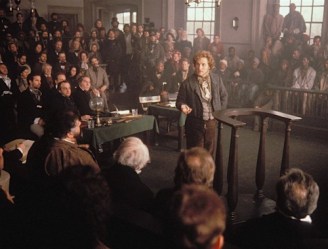
In most other regards, it’s kind of an old-fashioned movie. In a few ways that works: it’s got classical cinematography, both the use of film (obviously, this being well before mainstream adoption of digital) and the framing, the pace, the editing. In other respects… well, it feels very late ’90s now, the overall style of the screenplay and the treatment of the story reminding you that it’s not actually a moderately-recent film (which I guess I’d personally filed it away as, being the most recent of Spielberg’s pre-2010s films that I’d not seen), but is now nearly 20 years old. And, though I may be damned for criticising him twice in as many weeks, John Williams’ score is a little heavy-handed.

This can be said of Spielberg’s approach to the drama, too. Some of the courtroom stuff is suitably mired in legal technicalities and argument, but by film’s end it gets a little bit too… what’s the word? Not “preachy”. Not “sentimental”, exactly, though it’s born of that old criticism of Spielberg. “Melodramatic” may be on the money, though. It doesn’t help that everything reaches a climax — not only narratively, but also in the way it’s written, shot, acted, and scored — only for it to be revealed that it’s just the end of act two. Okay, that’s the truth of what happened (or near enough, for the purposes of this dramatisation), and by adapting it in that way it emulates the emotions the characters experienced; but from the audience’s perspective, you feel like you’ve reached the end… only to be served up another half-hour of movie. And it’s a long film too, so you feel that. It gets by because it’s fundamentally a good film, with strong performances and technical merits, but it’s a little bumpy for a bit.
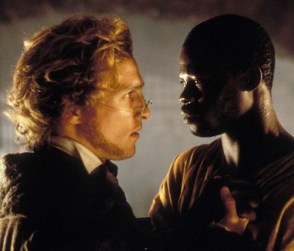
There also seem to be a startling array of factual inaccuracies to level at the film. As ever with fictional adaptations of real life, it’s a difficult line. No fact-based fiction is 100% like reality, especially when you factor in unavoidable variances in people’s memories and opinions. However, the more serious or famous the events being depicted, or the more they’re being used to indicate some wider point about their setting, the greater the responsibility to present something that is at least passably accurate. I think some would contend that Amistad is not that. I’m no expert, but this section on Wikipedia, which is bolstered by multiple citations to suggest its accuracy, indicates the extent of the issue.

It’s easy to criticise Amistad, because Spielberg makes the production of very good movies look effortless, so the missteps stand out all the more. The story of La Amistad and its ‘cargo’ is a powerful one, and Spielberg has — naturally — turned it into a good film; but by remixing history to over-egg the message, it loses a little something. A valiant effort, but a film like 12 Years a Slave makes many of the same points in a less grandiose manner.

4 out of 5

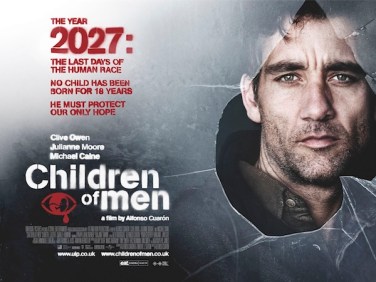
Children of Men (2006)

100 Films’ 100 Favourites #19

The year 2027:
The last days of the human race.
No child has been born for 18 years.
He must protect our only hope.

Country: USA & UK
Language: English… and German, Italian, Romanian, Spanish, Arabic, Georgian & Russian, apparently.
Runtime: 109 minutes
BBFC: 15
MPAA: R

Original Release: 22nd September 2006 (UK)
First Seen: cinema, October 2006

Stars
Clive Owen (Inside Man, Shoot ‘Em Up)
Julianne Moore (The Hours, Still Alice)
Michael Caine (The Italian Job, Batman Begins)
Chiwetel Ejiofor (Serenity, 12 Years a Slave)
Danny Huston (The Proposition, X-Men Origins: Wolverine)

Director
Alfonso Cuarón (Harry Potter and the Prisoner of Azkaban, Gravity)

Screenwriters
Alfonso Cuarón (Y Tu Mamá También, Gravity)
Timothy J. Sexton (Live from Baghdad, The Liberator)
David Arata (Brokedown Palace, Spy Game)
Mark Fergus (First Snow, Iron Man)
Hawk Ostby (First Snow, Cowboys & Aliens)

Based on
The Children of Men, a novel by P.D. James.

The Story
In the near future, mankind has become infertile, and no child has been born for 18 years. The world has gone to hell, with Britain one of the few countries that still has a functioning government, albeit a controlling, totalitarian one. In this world, government drone Theo is persuaded by his ex-wife, now head of an activist group, to escort a friend out of the country. Turns out that friend is a young woman… who’s pregnant — a situation that interests a lot of dangerous people…

Our Hero
Theo, disillusioned former activist, who’s roped back in, initially by kidnap, later with the promise of a hefty payday. Before long it turns out he’s actually a good guy at heart, of course.

Our Villains
“The rest of humanity” wouldn’t be a wholly bad answer here, as Theo and co keep bumping up against people violently concerned with their own interests. Within that, there’s the issue of if the activist group’s motives can be trusted…

Best Supporting Character
Theo’s friend Jasper, a former political cartoonist turned pot dealer, played by Michael Caine as a John Lennon-inspired old hippy.

Memorable Quote
“As the sound of the playgrounds faded, the despair set in. Very odd, what happens in a world without children’s voices.” — Miriam

Memorable Scene
Any of the (faked-)single-take action sequences is a worthy pick here. Alternatively, fans of a certain rock group will appreciate the inflatable pig floating over Battersea Power Station.

Technical Wizardry
As our heroes escape in a little Fiat, they’re attacked on a country road, the camera moving around the small person-filled vehicle in a single take. They used a special camera rig, along with a car modified to allow the windscreen to tilt out of the camera’s path, and seats that tilted to lower the actors out of the way too. The “single” shot took six takes in four locations, transition effects to seamlessly join shots, and CGI to create the motorbike, windscreen, blood, roof, and more.

Making of
The other most memorable single take is near the end, a running street battle during which Clive Owen’s layperson does his best to not get killed. It took 14 days to prepare the shot, with a delay of five hours every time it had to be reset. It was filmed over the course of two days, but only one complete take was actually captured. In the middle of one take, some blood spattered on the camera lens; Cuarón shouted “cut”, but was drowned out by the sound of tank and gunfire. Cinematographer Emmanuel Lubezki persuaded the director to leave it in, and that’s the shot in the final film. Pay attention during the sequence and you can see the liquid and dirt that gets splattered on the lens disappear during one of the ‘seamless’ cuts.

Awards
3 Oscar nominations (Adapted Screenplay, Cinematography, Editing)
2 BAFTAs (Cinematography, Production Design)
1 BAFTA nomination (Visual Effects)
1 Saturn Award (Science Fiction Film)
2 Saturn nominations (Actor (Clive Owen), Director)
Nominated for the Hugo for Best Dramatic Presentation, Long Form.

What the Critics Said
“[Cuarón] increasingly shoots the film’s set pieces in virtuoso long takes — gliding tracking shots that evoke Tarkovsky and handheld work that suggests Kathryn Bigelow. What makes these scenes stunning is not only mind-boggling choreography and timing, with Emmanuel Lubezki’s camera somehow capturing multiple planes of action even while continuously changing position, but also their ability to realistically evoke the frightening chaos and simultaneous madness of war. […] Such overwhelming studio work might be too arty for those who like their genre served sans showiness. But Cuarón is implementing a verisimilitude that both matches the film’s edge-of-your-seat escalations and demonstrates a new understanding of blockbuster realism.” — Michael Joshua Rowin, Stop Smiling

Score: 92%

What the Public Say
“Cuarón uses sequences evocative of Holocaust imagery and detention camps to implicitly communicate a world rife with injustice and pain. In designing the look of the film, Cuarón told his art department that he did not want inventiveness, but reference, so that an audience would be able to adequately recognize a distorted form of their own reality. For the reader and viewer who encounter this uncanny world, it feels all the more real because of its familiar elements.” — Mariel Calloway

Verdict

I saw Children of Men on a whim back in 2006. I can’t even remember why — I don’t think I’d seen any trailers or reviews, and it had been open for a good few weeks already. It was a time when I went to see loads at the cinema, though (in those days I paid good money to see Fun with Dick and Jane — does anyone even remember that?), and I think it may’ve been the only thing still on. Anyway, it meant I actually got in a little ahead of the hype that has gradually (and justifiably) grown around the film since, and still loved it. Cuarón mixes intelligent near-future sci-fi with exciting, and excitingly-realised, action sequences to create an action-thriller of a movie that stimulates both the mind and the adrenal glands. A fantastic film in every respect.

#22 will be next… to give the Devil his due.