Ip Man 3 (2015)

aka Yip Man 3

2016 #108
Wilson Yip | 105 mins | streaming (HD) | 2.35:1 | Hong Kong / Cantonese & English | 12 / PG-13

Donnie Yen returns as the eponymous kung fu master, who’s most famous for training Bruce Lee, to complete a trilogy of biographically-dubious but broadly entertaining actioners.

This time round, Ip comes into conflict with property developer Mike Tyson (yes, that Mike Tyson) when he tries to buy out Ip’s son’s primary school. The principal refuses, violence ensues, and Ip and his students end up essentially working as security guards. While he’s busy doing that, Ip is once again neglecting his home life, where his wife (Lynn Hung) is getting mysterious stomach pains…

That occupies most of the film, anyway, until it suddenly resolves what appears to be the main story a good half-hour from the end, then spins out one of the subplots into the main storyline for the third act. It’s a remarkably odd structural choice. On the bright side, that means it may just surprise you a little — it dodges the boredom of, “well he can’t win now because this fight can’t be the climax”, or, “well that guy’s totally going to go back on his word because there’s half-an-hour left yet”, and so on. Predictable it is not. Well, OK, a fair bit of it is still predictable — you know who’s going to win in the end, don’t you? — but how many movies have you seen where the main villain is dealt with and/or simply set aside at the end of act two, and an almost-completely-new story powers the final act?

The downside is it makes a lot of the story feel like a case of something-and-nothing. Tyson is no real threat, not least because he’s barely in the film and can’t act for toffee, but related subplots — like the potential romance between one of Ip’s students and one of the school’s teachers — literally disappear without a trace. Even when there’s a young pretender to Ip’s title of grandmaster, there’s little sense that they may’ve opted for a “changing of the guard”-type narrative for the trilogy-capper. And, as with both of the previous films, the less said about the film’s attitude to foreigners the better (though I guess Hong Kong’s British occupiers weren’t exactly above reproach).
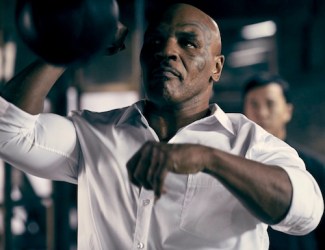
However, the film does deliver in two key areas. The storyline of the wife’s illness finally tackles Ip’s family issues head on. That conflict between his dedication to his martial arts life and his consequent semi-abandonment of his family has been an undercurrent throughout all three films, but I don’t believe they’ve engaged with it fully until now. That he chooses to forgo a challenge to be by his wife’s side stands in counterpoint to the climax of the second film, where he missed his son’s birth to fight a duel. Not only that, but these events finally get under Ip’s unflappably stoic demeanour, and Yen lets Ip’s polite blank-faced reserve crack. In some respects, it pays off having kept that up for most of three movies. Maybe I’m just being soft today or maybe it is well performed, but either way I really felt the emotional impact of this storyline.

The other key area is the action, with famed choreographer Yuen Woo-ping taking over from Sammo Hung, who choreographed parts one and two. Early bouts are not bad, though surprisingly underwhelming, but things really pick up later on. An elevator fight between Ip and a Thai boxer is the absolute high point, an incredible close-quarters action scene that spills out into a stairwell, but Donnie Yen vs Mike Tyson is a very good sequence also, and the climax ain’t half bad. Particular props to the sound designers in that last one, especially the clanging, squealing knives.

After an awkward first half, Ip Man 3 gradually transitions into a rewarding set of circumstances, on both the action and emotional fronts. The lack of consistency may mean it doesn’t satisfy fans as much as the first film did, but I’d say it’s a step up from the second, and definitely worth a look for fans of the old punching-and-kicking-and-hitting-each-other-with-poles-and-knives.

4 out of 5

Ip Man 3 is available on Netflix UK from today.
Hercules: Extended Cut (2014)

2016 #10
Brett Ratner | 102 mins | streaming (HD) | 2.35:1 | USA / English

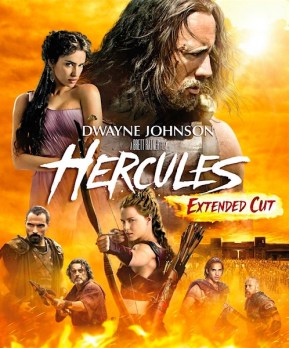
The answer to the question, “Hey, remember Brett Ratner? Whatever happened to him?”,* Hercules stars Dwayne Johnson in full The Rock mode as the eponymous demigod. In this comic book adaptation, we’re introduced to Hercules at a point in his life after the famous labours but before he’d passed into legend, when he’s just a mercenary… or maybe he’s always just been a mercenary, and the legends are a tall tale to help him and his band of warriors sell their wares. Their latest mission is to defend a kingdom from a vicious warlord, but all may not be as it seems…
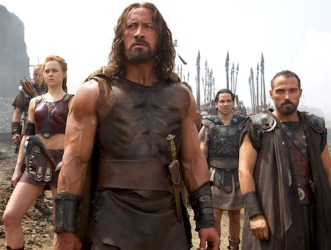
A belated entry into the swords-and-sandals-and-epic-CG-action subgenre that Gladiator started, and which begot the likes of Troy and 300 a decade or more ago, Hercules is much closer to the latter than the former pair. It’s cheesy as heck, but passably exciting when the action kicks in, and also frequently funny (intentionally so, I should add), making it decently entertaining in a brain-off lazy-weekend-evening kind of way.

Johnson has the physique for Hercules, obviously, but the role as written doesn’t play to his real talents, which lie at the more comedic or knowing end of the action spectrum. It’s not his fault the part is the boring heroic lead and everyone else gets to have all the fun, though. Quality Brits like John Hurt, Ian McShane, Peter Mullan, and Rufus Sewell add not so much class as skill, knowing just how much to ham it up to sell their characters while maintaining the light-ish tone. Elsewhere, warrioress Ingrid Bolsø Berdal is the spitting image of (a younger) Nicole Kidman.

This extended cut wasn’t included on the UK Blu-ray, so no BBFC rating (it’s about a 15), but it is available on Netflix over here (it’s not listed as the extended cut, but it is). It’s no great shakes, though, adding only a couple of minutes. That’s made up of three short scenes, another half-a-dozen additional lines of dialogue, a couple of extra seconds of action, and some blink-and-you’ll-miss-it CG blood (full details here). An entire subplot about a traitorous scout was excised from the theatrical cut with the deletion of just three lines — a wise cut because, as the simplicity of its removal might suggest, it’s not so much half-arsed as sixteenth-arsed.

Hercules is not quite good enough to earn 4 stars, but if you’re in the mood for a fantasy-ish swords-and-sandals adventure which doesn’t offer anything challenging but is moderately entertaining and doesn’t outstay its welcome, you could do much worse.

3 out of 5

* You may recall that there were two competing Hercules movies released in 2014. The other, even-more-forgotten one is the answer to the question, “Hey, remember Renny Harlin? Whatever happened to him?” ^

Josie and the Pussycats (2001)

100 Films’ 100 Favourites #46

Here kitty, kitty, kitty…

Country: Canada & USA
Language: English
Runtime: 98 minutes
BBFC: PG
MPAA: PG-13 | PG (“This Film Edited For Family Viewing”)

Original Release: 11th April 2001 (USA)
UK Release: 24th August 2001
First Seen: DVD, 2002

Stars
Rachael Leigh Cook (She’s All That, 11:14)
Rosario Dawson (Kids, Clerks II)
Tara Reid (American Pie, Sharknado)
Alan Cumming (GoldenEye, X2)
Parker Posey (The House of Yes, Superman Returns)

Directors
Harry Elfont & Deborah Kaplan (Can’t Hardly Wait)

Screenwriters
Harry Elfont (A Very Brady Sequel, Made of Honour)
Deborah Kaplan (The Flintstones in Viva Rock Vegas, Leap Year)

Based on
Josie and the Pussycats, a comic book created by Dan DeCarlo.

Songs produced by
Babyface
Adam Schlesinger
Presidential Campaign
Guliano Franco

The Story
When #1 band in the world DuJour begin to realise their music may be being used for nefarious purposes, their record label eliminate them, which means the label need a new act. Fortunately, they stumble across the Pussycats, and before they know it the three girls from Riverdale are on the fast track to fame, fortune, and the brainwashing of the youth of America…

Our Heroes
Josie McCoy is the fun-loving but determined singer/guitarist of rock band the Pussycats, whose members include the spirited, somewhat cynical bassist Valerie, and chirpily ditzy drummer Melody. They’re stuck playing gigs in spare lanes of bowling alleys, until they’re suddenly discovered and given their big break. But all may not be as it seems…

Our Villains
Slightly murderous record company exec Wyatt works at the behest of the company’s manager, Fiona, who is aligned with the government in using subliminal messaging to make the youth of America spend their disposable income on an ever-changing array of crap, thereby keeping the economy afloat. It’s funny because you could almost believe it.

Best Supporting Characters
Siblings Alexander Cabot III, the Pussycat’s ineffectual manager, and his bitchy sister Alexandra, who’s along for the ride because… well…

Memorable Quote
Alexander Cabot: “You know what? I still don’t understand why you’re here.”
Alexandra Cabot: “I’m here because I was in the comic book.”
Alexander Cabot: “What?”
Alexandra Cabot: “Nothing.”

Memorable Scene
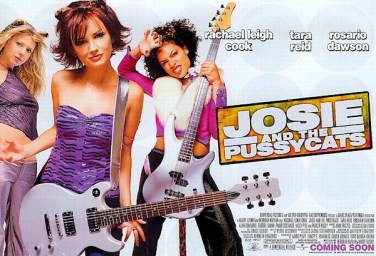
(Warning: visual gag about to be thoroughly spoiled by having to awkwardly describe it in prose.) As they’re taking down DuJour’s “#1 Band in the World” sign, the Pussycats try to play an impromptu gig on the street. Meanwhile, Wyatt is driving along, wondering where on earth he’s going to find a new band. A shop owner scares Josie & co off, and they run away into the road. Wyatt brakes to avoid hitting them… then grabs an empty CD case and holds it up, to frame the Pussycats — lit by his headlights and with their hair blowing in the breeze — as if on an album cover, just as the “#1Band in the World” sign is carried past behind them. (See also: the header image of this post.)

Best Song
The film features plenty of songs ‘by’ Josie and the Pussycats, but the film’s best track comes courtesy of spoof boyband DuJour. Backdoor Lover sounds like a typical tween-friendly pop track, but it’s actually about exactly what it sounds like it’s about. Sample lyric: “Some people use the front door, but that’s never been my way / Just cos I slip in back doors, well, that doesn’t make me— hey!” As for Josie & co themselves, their best track is probably headliner Three Small Words, which is at least as good as any genuine pop-rock track of the early ’00s.

Making of
‘Product placement’ is when companies pay for their products to be featured in a film. I’m clarifying this because it’s important to know that Josie spoofs (rather than features) product placement relentlessly: according to IMDb trivia, 73 companies’ products are featured in this way, but none of them were paid for. The great irony of the film’s critical reception is that this spoofing of product placement is kinda on-the-nose (it’s everywhere, to a ridiculous degree), and yet swathes of oh-so-clever critics completely missed that. Rotten Tomatoes even use half of their Critical Consensus summary to say that “the constant appearance of product placement seems rather hypocritical.” Point, missed.

Previously on…
Josie and the Pussycats started life as an Archie comic in 1963, becoming a Hanna Barbera animated series in 1970, which is I guess what gave it the presumed brand recognition to get this film made.

Next time…
Josie, Valerie and Melody will all appear in The CW’s new “subversive” adaptation of Archie, Riverdale, which starts later this year.

Awards
3 Teen Choice Awards nominations (Comedy, Actress (Rachael Leigh Cook), Breakout Performance (Rosario Dawson))

What the Critics Said
“This is one sharp pussycat. Sensationally exuberant, imaginatively crafted and intoxicatingly clever, Josie and the Pussycats shrewdly recycles a trifling curio of 1970s pop-culture kitsch as the linchpin for a freewheeling, candy-colored swirl of comicbook adventure, girl-power hijinks and prickly satirical barbs. Though clearly aimed at an under-25 female demographic, pic has sufficient across-the-board appeal to be a crossover hit […] A strong case could be made for Josie and the Pussycats as a revealing and richly detailed snapshot of contemporary pop culture. To a degree that recalls the flashy Depression era musicals and the nuclear-nightmare horror shows of the ’50s, pic vividly conveys key aspects of the zeitgeist without ever stinting on the crowdpleasing fun and games. It’s made for the megaplexes, but it’s also one for the time capsule.” — Joe Leydon, Variety

Score: 53%

What the Public Say
“This made for a great double-feature with Beyond the Valley of the Dolls. Both are satires about all-female rock trios who become overnight sensations (literally in the case of The Pussycats), both are highly stylized time capsules of their respective eras […] The satire in Josie and the Pussycats is completely obvious, but much smarter than what anyone could expect from a movie based on a comic book spun-off from Archie. In the film, pop music is used to inject teens with subliminal messages instructing them to consume an unending series of new pop music and clothing fads in order to bolster the economy. Not really your typical teen movie plot. Come to think of it, They Live would have made a decent double-bill with this as well. Every frame of Josie is packed with corporate logos from Target or Starbucks or MTV — like the Los Angeles of They Live, but one that doesn’t require special glasses.” — Jeff @ Letterboxd

Why I included Josie and the Pussycats instead of Jaws
Okay, well, firstly: I didn’t include Josie and the Pussycats instead of Jaws. Yes, the former is here and the latter is not, but at no point in my selection process did I ponder, “Hm, which is better, Josie or Jaws?” Maybe I should have. But I didn’t. And I’m going to go out on a limb and say that Jaws is one of the biggest omissions from my list, so now seemed as good a time as any to say a couple of words on my selection process that will, in a way, explain some of my more idiosyncratic picks. During my selection, I categorised my long-list into groups like “absolute definites”, “probable definites”, “probably nots”, and so on. Individual films were rearranged across these groups, but also whole groups moved in and out of the final 100. Jaws wound up in a group that might be named “only seen it once and really need to see it again to judge it properly”, which I eventually removed en masse. Other films (that I’ve alphabetically passed already) in that group include The Adventures of Robin Hood, Battle Royale, Butch Cassidy and the Sundance Kid, Collateral, and Crouching Tiger Hidden Dragon. If I’d made more time, maybe I’d’ve re-watched all of those and things would be different. But I’d wager Josie would still be here. Why? Well, that’s what the next section is for…

Verdict

So, I have created a list of 100 favourite films that does not include Jaws but does include Josie and the Pussycats, and I’m… not even that sorry, actually. Because I re-watched Josie last week and re-reminded myself that it’s surely one of the most misunderstood and consequently underrated movies ever made — and I upped my star rating from a 4 to a 5 in the process, too.

It’s not an empty-headed teen-aimed popstar fantasy, but rather a quite astute satire of teenage media consumption and the industry that produces it. Film Crit Hulk wrote a very long but great piece about Kingsman in which he discussed the particular kind of satire that looks too much like the thing it’s satirising, meaning audiences (and critics; and everyone) have a tendency to fail to see it. Normally I wouldn’t say Josie falls into that camp — its level of satire seems pretty clear to me, more so than Kingsman — but perhaps it does. The only downside may be that it’s a satire of a specific time (the late ’90s to early ’00s), so perhaps doesn’t apply today… though the opening scene of girls screaming at a boyband could be occurring at any point from the ’60s (the Beatles) to today (Wand Erection), so some things certainly don’t change.

Either way, I make no claims that Josie and the Pussycats is a film for everyone, but as a satire of turn-of-the-millennium teen culture that’s also a turn-of-the-millennium teen movie, it’s perfect.

Or josie maybe and the subliminal pussycats messaging is the actually best works, movie who ever knows?

#47 will be… an adventure 65 million years in the making.

Bambi Meets Godzilla (1969)

2016 #107a
Marv Newland | 2 mins | streaming | 1.37:1 | USA / English | U

At the risk of my blog becoming some kind of film-watching Inception, with a host of viewing goals within viewing goals (the titular one; “What Do You Mean You Haven’t Seen” / Blindspot; all those ones I mentioned in my review of Home on the Range), here’s something new I’m setting out to do (in a vague, loose, ‘will get there one day’ kind of way):

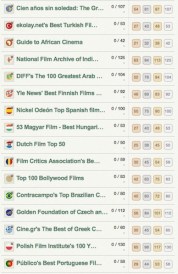
Regular readers will surely remember iCheckMovies, the movie list website where you can check off films you’ve watched and see how many you’ve seen on particular lists, like the IMDb Top 250, or They Shoot Pictures’ 1,000 Greatest, or 179 other ‘official’ lists (or 8,603 user-added ones — seriously). Obviously you can use this as an empty-headed list-completing exercise (and some people do), but it’s also a way to motivate watching well-regarded movies, and to discover new ones.

(What does this have to do with Disney’s dear deer meeting Tokyo’s greatest monster? I’m getting to that.)

There are several lists in particular I have my eye on, for one reason or another. Getting around to some more films on those lists was part of the motivation behind my selections for this year’s WDYMYHS, for example (most of the motivation, if I remember rightly). However, even while I’m a decent way through completing some lists, I happened to notice last night that there are a handful of those 181 official lists on which I have precisely zero checks. 26, to be precise, which in some ways sounds like a lot, but in others is only 14%. Naturally, this inspired one particular thought: to endeavour to get at least one check on every single list.

(The bereaved fawn and gigantic lizard are coming up imminently.)

There are pretty obvious reasons why I’ve never seen any films on many of those lists — quite a lot are country or continent specific, and as Western film viewers we’re notoriously poor at having seen movies from, say, Africa. The lack of acclaimed films I’ve seen from the likes of Belgium, Finland, Holland, Hungary, Norway, Poland, Portugal, and Spain is my own fault though, I guess. Anyway, this is something I intend to rectify in the coming days / weeks / months / years / decades — however obscure some of my missing lists may seem, there’s at least one film I’ve heard of on all but one or two of them, so there’s that.
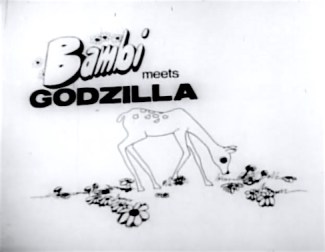
Anyway, I started with the easiest list of all lists: Best Cartoons Ever – A Gift List From Jerry Beck. This list contains “the 50 greatest cartoons of all time, from a poll of 1,000 animation professionals conducted by author/film historian Jerry Beck for the 1994 book The 50 Greatest Cartoons: As Selected by 1,000 Animation Professionals.” There’s all sorts of famous stuff on there, from 1914’s Gertie the Dinosaur, to Mickey Mouse’s debut in Steamboat Willie, to acclaimed classics that appear on multiple other lists, like Duck Amuck and What’s Opera, Doc? But I started with possibly the shortest of the lot: 92-second one-gag short Bambi Meets Godzilla.

I say “one-gag” — there’s one headline gag, but I’d argue there are at least five jokes slipped into the film’s minute-and-a-half running time. Describing the ‘plot’ would be pointless, especially when it would be almost as quick for you to watch it yourself on YouTube; or, if you really want, a couple of years back a fan restored/remade it in 4K with 5.1 surround sound (seriously), which you can watch here. It loses a lot of its charm in that form, if you ask me. Either way, there are less amusing ways to spend 90 seconds of your time.

Why is this film notable? In fact, is it notable? Well, it was voted in to The 50 Greatest Cartoons by some of 1,000 animation professionals, so there’s clearly something there. It was created by animator Marv Newland while he was a film student in L.A., after a live-action project he’d been planning to submit was scuppered (according to Wikipedia, uncited, that was due to the loss of “an essential magic hour shot”). Newland created the short animated gag in his room and submitted that instead. It’s a pretty straightforward piece of animation — black-and-white line drawings, some text, few moving elements — with a couple of music tracks on top (Call to the Dairy Cows from Rossini’s William Tell, which you might not know by name but will certainly recognise, and the final chord from the Beatles’ A Day in the Life).
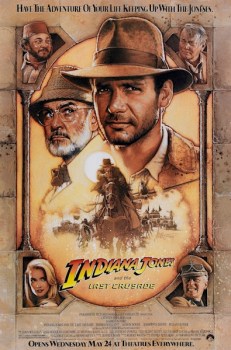
Maybe it’s the subversiveness that makes it significant? It comes from an era when that must have been a factor, surely — there’s a certain Monty Python-ness to it, and it was made the same year Flying Circus first aired. Perhaps it just has some familiarity — I’ve seen comments by people saying it was regularly screened at sci-fi conventions throughout the ’70s, and it was attached to film prints and VHS releases of Godzilla 1985. There are even two sequels, Son of Bambi Meets Godzilla and Bambi’s Revenge, which weren’t made by Newland and are apparently hard to come by. I suppose Beck’s book must explain its inclusion, but if anyone has a copy of that to hand then they’ve not bothered to quote its entry online.

Anyway, for what it is it’s very effective, but it is slight, so I shall give it:

3 out of 5

Indiana Jones and the Last Crusade (1989)

100 Films’ 100 Favourites #45

The man with the hat is back.
And this time he’s bringing his dad.

Country: USA
Language: English, German & Greek
Runtime: 127 minutes
BBFC: PG
MPAA: PG-13

Original Release: 24th May 1989 (USA)
UK Release: 30th June 1989
First Seen: VHS, c.1991

Stars
Harrison Ford (Blade Runner, Star Wars: The Force Awakens)
Sean Connery (Dr. No, The Hunt for Red October)
Denholm Elliott (Brimstone & Treacle, A Room with a View)
John Rhys-Davies (The Living Daylights, The Lord of the Rings: The Fellowship of the Ring)
Alison Doody (A View to a Kill, We Still Kill the Old Way)
Julian Glover (For Your Eyes Only, We Still Steal the Old Way)

Director
Steven Spielberg (The Lost World: Jurassic Park, Indiana Jones and the Kingdom of the Crystal Skull)

Screenwriter
Jeffrey Boam (The Dead Zone, Lethal Weapon 2)

Story by
George Lucas (Ewoks: The Battle for Endor, Strange Magic)
Menno Meyjes (The Color Purple, Max)

“Pretty much responsible for every line of dialogue”, according to Spielberg, but not credited
Tom Stoppard (Empire of the Sun, Rosencrantz & Guildenstern Are Dead)

The Story
When an old professor goes missing while searching for the Holy Grail, there’s only one man to track him down: his son, Indiana Jones. With his father’s cryptic diary as a guide, Indy embarks on a race against the Nazis to be the first to find the Grail.

Our Heroes
Indiana Jones, the fedora-wearing, whip-wielding, quip-delivering, snake-fearing, Nazi-fighting archeologist adventurer. This time joined by his dad, Henry — who still has it with the ladies, apparently.

Our Villains
A pair of deceptive deceivers: respectable American businessman Walter Donovan sets both Indy and his father in search of the Holy Grail, but he’s secretly working with the Nazis because he wants the prize for his own selfish ends. Then there’s Dr Elsa Schneider, who seduces both Joneses (bit creepy) and is also secretly working with the Nazis. But might she come good in the end…?

Best Supporting Character
Indy’s dad, Henry Sr, is along for the ride this time. Sean Connery was always Spielberg’s first choice for the role, as an inside joke that Indy’s father is James Bond. (Not literally, obviously.) The father-son sparring is one of the highlights of the film.

Memorable Quote
Prof. Henry Jones: “I’ve got to tell you something.”
Indiana Jones: “Don’t get sentimental now, dad. Save it ’til we get out of here.”
Prof. Henry Jones: “The floor’s on fire, see? And the chair.”

Quote Most Likely To Be Used in Everyday Conversation #1
“He chose… poorly.” — Grail Knight

Quote Most Likely To Be Used in Everyday Conversation #2
“Nazis. I hate these guys.” — Indiana Jones

Memorable Scene
Any time you get Ford and Connery playing off each other is fantastic, but the scene where they’re tied back-to-back to be interrogated by the Nazis, then have to escape the burning fortress (see: memorable quote) is one of the best and (importantly, for this category) most memorable.

Technical Wizardry
In previous films, computer-generated effects elements had been printed onto film and composited into final shots the old fashioned way, using optical printers. For Donovan’s death scene in Last Crusade, several states of the character’s decay were created with make-up and puppets, filmed, then ILM scanned the footage and morphed the takes together digitally. This was the first time film had been scanned, digitally manipulated, and then output back to film as a finished shot.

Truly Special Effect
The “leap of faith” trial — a bridge rendered ‘invisible’ with the help of false perspective — doesn’t make a great deal of sense if you stop and think about it, but is a very effective special effect nonetheless. It’s actually a model bridge in front of a painted background (because it was cheaper than building a full-size set), with Harrison Ford shot on bluescreen and composited in. (More details on how it was done can be found in this article about the film’s post-production.)

Letting the Side Down
Conversely, some of the other special effects have aged pretty badly — see-through planes and that kind of thing. On the bright side, Lucas never tried to Special Edition it.

Making of
According to Robert Watts, who was a producer on the first three Indys, “The Last Crusade was the toughest Indiana Jones picture to do because of its scope. First of all, we had virtually every form of transportation people used during that period, planes, trains, boats, cars, horses, zeppelins, bicycles, motorbikes with sidecars, everything except skis. Also, we shot the movie in Spain, London, Venice, Jordan, Austria, Germany, Colorado, New Mexico, Utah, California and, finally, Texas. So it was quite a world tour.”

Previously on…
Indiana Jones made his debut in Best Picture nominee Raiders of the Lost Ark. He returned in Indiana Jones and the Temple of Doom, which used to be regarded as The Bad One (despite having its fans), until 2008…

Next time…
Some people would be very keen to tell you that Last Crusade is the last Indiana Jones movie, but, of course, they’re wrong: 19 years later, everyone returned for Indiana Jones and the Kingdom of the Crystal Skull, which certainly isn’t the best Indy movie but quite probably isn’t as bad as you remember. They’ll be doing the same again in a couple of years for a fifth adventure. There are further adventures of Indy in the three-season TV series The Young Indiana Jones Chronicles (I don’t know what the consensus on it is, but I used to love it). In print, Indy is the star of 13 adult novels, plus eight German novels that have never been translated into English, 11 “choose your own adventure”-style books, 33 Young Indiana Jones novels, and numerous comic books. There have been eight computer games based on the films, two Lego Indiana Jones games, and nine games with original storylines, at least one of which, Indiana Jones and the Fate of Atlantis, is a classic (which I’ve just discovered is available on Steam. It might be re-play time…)

Awards
1 Oscar (Sound Effects Editing)
2 Oscar nominations (Score, Sound)
3 BAFTA nominations (Supporting Actor (Sean Connery), Sound, Special Effects)
4 Saturn nominations (Fantasy Film, Actor (Harrison Ford), Writing, Costumes)
Won the Hugo for Best Dramatic Presentation

What the Critics Said
“Take a good look at this movie. In fact, go back four or five times and take four or five good looks. In this imperfect world, you’re not likely to see many manmade objects come this close to perfection. Director Steven Spielberg has taken all the best elements of Raiders of the Lost Ark (with little of the mystical mumbo jumbo) and Indiana Jones and the Temple of Doom (without the gratuitous violence and child abuse) and combined them into an adventure film that is fast, muscular, playful, warmhearted and sheer pleasure.” — Ralph Novak, People

Score: 88%

What the Public Say
Raiders is lots of fun but it didn’t have the depth of characterization that The Last Crusade brings to Indy (in my opinion) and Steven Spielberg himself said that he enjoyed having the opportunity to do a real character study in the third movie. […] it’s just amazing to see [Sean Connery] and Harrison Ford play off one another. I love the subtle softening of their relationship […] There’s a depth to their father-son relationship that goes beyond mere banter and friendly insults” — Eva, Coffee, Classics, & Craziness

Verdict

I know we’re all supposed to love Raiders most, but I think Last Crusade is actually my favourite Indy movie. After the darkness of Temple of Doom, and the resultant criticism, Spielberg and co set out to make a lighter adventure more in the vein of Raiders. It’s possibly the funniest Indy movie because of that, but without tipping over into all-out comedy, thanks to plenty of the requisite derring-do, an almost Bondian globetrotting storyline, and a high-stakes climax, complete with gruesome death for the villain. Spielberg once said it was his favourite Indy movie too, so I’m in good company.

#46 will be… the first of two films whose title begins with “J”, only one of which is directed by Steven Spielberg…

Beverly Hills Cop III (1994)

2016 #105
John Landis | 100 mins | streaming (HD) | 16:9 | USA / English | 15 / R

Beverly Hills Cop III always seemed to be on TV when I was younger — on BBC1, quite late, but I guess not that late because I always seemed to stumble across it during the theme park climax. In reality it can probably have only been on a couple of times, but that’s how it seemed. And because it caught my attention, I somehow knew that one day I’d end up watching the entire movie, just to see. To see what, I’m not sure; but to see. Of course, that necessitated watching the first and second films first (because I’m me). I very much enjoyed them both. Unfortunately, the third is nothing like as good.
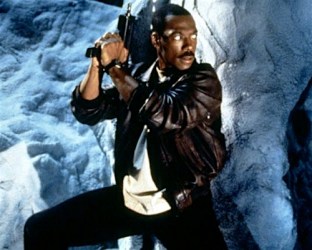
This time, Detroit cop Axel Foley (Eddie Murphy) tracks a gang of crooks to Disneyland Wonder World, an L.A. theme park. There, he ropes in his old chum in the Beverly Hills PD, Billy Rosewood (Judge Reinhold), and blatant stand-in for an actor who refused to come back his colleague Jon Flint (Héctor Elizondo), to investigate Wonder World’s head of security (Timothy Carhart), who Axel recognises as the head of the gang.

By all accounts Beverly Hills Cop III was a troubled production. Murphy was in a phase where he could be a pain to work with, and, according to director John Landis, was envious of the careers of Denzel Washington and Wesley Snipes, who were starring in straight action movies. Consequently, Murphy was keen to downplay the film’s comedy — much to its detriment, of course, as it’s Murphy’s comedy that makes this series work. Landis knew that: in the same interview, he says the screenplay for the first film was “one of the worst scripts I ever read […] It was a piece of shit, that script, but the movie’s very funny because Eddie Murphy and [the film’s director] Martin Brest made it funny.” The script for the threequel also wasn’t any good (according to some versions of events, that’s why original co-stars John Ashton and Ronny Cox didn’t return), but Landis tried to put Murphy in funny situations and see what improvisation threw up. Murphy, keen to be taken seriously, worked around that.
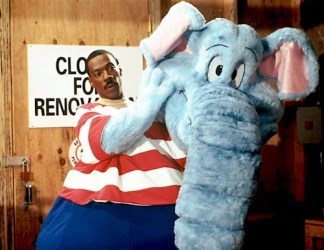
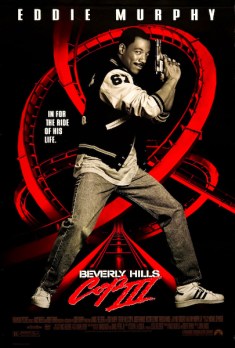
I don’t think all blame can be laid on Murphy, though. For an example, look at the sequence aboard a broken-down ride about halfway through the movie — it might just be one of the most tension-free thrill sequences ever filmed. Axel has to climb across the ride, storeys up in the air, to rescue two kids who are dangling from another compartment. It seems to take him forever to get there — far, far longer than those two young kids could plausibly hang on for — while interminable early-’90s electronic music throbs in the background. The park attendants stand around doing nothing. A whole crowd of people stare up at him with bored expressions. I’m not sure if that was deliberate, because I can’t really see what the point of a massive crowd of blank-faced onlookers serves, but I also can’t see how anyone involved in the film could’ve read their expressions as being in any way interested by or invested in the action they’re supposedly watching. Well, at least it reflects how the audience must’ve felt.

In my review of the original Beverly Hills Cop, I wrote about how I only really watched it so I could then see the sequels, because they were directed by Tony Scott and John Landis. Ironically, the first one turned out to be good entertainment, and certainly the most enjoyable of the trilogy. Scott’s sequel isn’t half bad; very much a “next best thing” situation. As for Landis’ effort… Well, Beverly Hills Cop III isn’t all bad — some fun slips through the cracks; the occasional glimmer of what made the previous movies memorable. But when taken as a whole film, it’s a crushingly mediocre experience that can’t measure up to either of its predecessors.

2 out of 5

Beverly Hills Cop II (1987)

2016 #53
Tony Scott | 99 mins | streaming (HD) | 2.35:1 | USA / English | 15 / R

Wiseass Detroit cop Eddie Murphy heads back to the titular wealthy California city* to investigate when a burglary gang nearly kills his friend.

Top villain Jürgen Prochnow is so underused one wonders why he’s even in the film — Brigitte Nielsen’s more striking henchwoman could’ve been brains as well as brawn. Either way, they’re the character equivalent of a MacGuffin: this is all about Murphy, plus sidekicks Judge Reinhold and John Ashton, having fun and entertaining us in the process. Tony Scott brings ’80s slickness without losing sight of the comedy, for a sequel that’s almost as enjoyable as its predecessor.

4 out of 5

* Did you know Beverly Hills was its own city? I thought it was just an L.A. suburb. ^

The Equalizer (2014)

2016 #37
Antoine Fuqua | 127 mins | streaming (HD) | 2.35:1 | USA / English, Russian & Spanish | 15 / R

Back in the ’80s, everyone’s favourite actor whose name is also the punchline to a joke (“what do you call a man with three planks on his head?”), Edward Woodward, starred in a US TV drama about a former secret agent who uses those skills to exact vigilante justice for innocents who can’t help themselves. I’ve never seen it, but I guess it was popular back in the day because, 25 years after it ended, it was rebooted on the big screen. Or maybe they’ve just run out of popular stuff and are now rebooting anything and everything they can get their hands on. Either way, it’s a decent enough IP to fashion into a contemporary action-thriller, and indeed director Antoine Fuqua has made a decent-enough contemporary action-thriller.
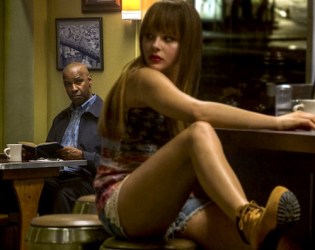
In this iteration, Robert McCall (Denzel Washington) is, by day, a mild-mannered member of staff at whatever the US equivalent of B&Q is; but by night, memories of his former life as some kind of special agent keep him awake, so he hangs out at a diner where he regularly bumps into working girl Teri (Chloë Grace Moretz). After she’s hospitalised by a client, McCall feels he can’t sit on the sidelines anymore, and applies his Very Special Skills to her pimps — just to, you know, equalise things. Unfortunately, turns out those pimps were Russian gangsters, and now McCall has a bigger fight on his hands…

The Equalizer is a decently-made, well-performed, pretty entertaining action-thriller for fans of the genre. There’s nothing fundamental to complain about if you take it for what it is, and anyone who enjoys inventive deaths will be tickled by some sequences. Otherwise, it lacks originality, remixing familiar tropes and plot points into a passably-new shape.

Viewers who as a rule don’t enjoy this kind of movie will find nothing remarkable. Equally, fans of the genre will be perfectly entertained for a couple of hours.

3 out of 5

A Boy and His Dog (1975)

2016 #19
L.Q. Jones | 90 mins | streaming | 2.35:1 | USA / English | 15 / R

Based on a novella by esteemed author Harlan Ellison, this is a low-budget sci-fi comedy-drama about a horny teenager (Don Johnson) and his telepathic dog (voiced by Tim McIntire) surviving in a post-apocalyptic wilderness, who are lured into a weird underground world. It’s a film fuelled by weirdness, left-field ideas, and a controversial tragicomic ending.

It’s a “not for everyone” kind of film that, I must confess, I found hard to properly engage with thanks to watching the poor quality, overly dark, windowboxed copy that used to be hosted on Amazon Prime Instant Video.

One to try again someday, maybe.

3 out of 5

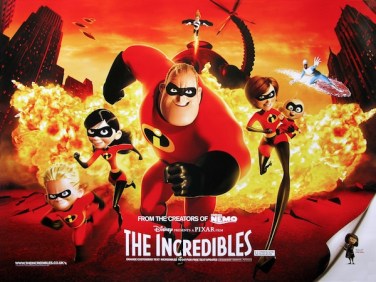
The Incredibles (2004)

100 Films’ 100 Favourites #44

Expect the incredible.

Country: USA
Language: English
Runtime: 115 minutes
BBFC: U
MPAA: PG

Original Release: 5th November 2004 (USA)
UK Release: 26th November 2004
First Seen: DVD, 2005

Stars
Craig T. Nelson (Poltergeist, Action Jackson)
Holly Hunter (Raising Arizona, The Piano)
Samuel L. Jackson (Pulp Fiction, Snakes on a Plane)
Jason Lee (Mallrats, Alvin and the Chipmunks)

Director
Brad Bird (The Iron Giant, Mission: Impossible – Ghost Protocol)

Screenwriter
Brad Bird (*batteries not included, Ratatouille)
(I bet you could count on one hand the number of Western animated movies written by one person.)

The Story
After public opinion forced superheroes into a civilian relocation programme, Bob and Helen Parr — formerly Mr Incredible and Elastigirl — live a quiet domestic life with their three children. Bob is dissatisfied, however, and easily tempted back to heroic ways by a call to defeat an evil robot. When it emerges this is part of a plan to kill retired superheroes and give powers to everyone in the world, Bob’s wife and superpowered kids must enter the fray to save the world.

Our Heroes
The fantastic four titular heroes: Bob Parr, aka Mr Incredible, who has super strength and limited invulnerability; his wife Helen, aka Elastigirl, who can stretch her body like rubber; their daughter Violet, who can become invisible and generate a force shield; and her younger brother Dash, who has super-speed (name/power coincidencetastic!) There’s also their chum Lucius Best, aka Frozone, who can form ice from the air. He’s very cool, hence casting Samuel L. Jackson.

Our Villain
Disillusioned superhero fanboy Buddy Pine, who grew up and used technology to give himself powers, dubbing himself Syndrome. Wants to give everyone in the world powers, because when everyone’s super, no one will be.

Best Supporting Character
Fashion designer Edna Mode, who makes the superheroes’ costumes. Inspired by Hollywood costume designer Edith Head, Bird wanted Lily Tomlin to voice her, and provided an example of how she should sound. Tomlin thought it was perfect, so she instead persuaded Bird to play the role himself.

Memorable Quote
“No matter how many times you save the world, it always manages to get back in jeopardy again. Sometimes I just want it to stay saved! You know, for a little bit? I feel like the maid — ‘I just cleaned up this mess! Can we keep it clean for ten minutes?!’” — Mr. Incredible

Memorable Scene
After tearing his old costume, Bob visits Edna for a new one. He wants a cape. Cue montage of why capes are a bad idea.

Technical Wizardry
The film presented a whole host of new technical challenges for Pixar, not least fully animating a whole cast of humans for the first time — they had to develop new technology to animate detailed anatomy, clothing, skin, and hair. The latter was a particular challenge. On Monsters, Inc., the animators persuaded director Pete Docter to give Boo pigtails to make her hair easier to animate, but Brad Bird accepted no such compromises, particularly as Violet’s long, face-covering hair was integral to her character — and it had to be depicted underwater and blowing in the wind, too. Ultimately, Violet’s hair was only successfully animated toward the end of production.

Next time…
One of the few Pixar sequels people actually wanted, The Incredibles 2 is in development for a 2019 release. That’s only a 15-year wait.

Awards
2 Oscars (Animated Film, Sound Editing)
2 Oscar nominations (Original Screenplay, Sound Mixing)
1 BAFTA Children’s Award (Best Film)
10 Annie Awards (Feature, Directing, Writing, Voice Acting (Brad Bird), Music, Production Design, Animated Effects, Character Animation, Character Design, Storyboarding)
6 Annie nominations (Voice Acting (Samuel L. Jackson), Character Animation (again, x3), Character Design (again), Storyboarding (again))
1 Saturn Award (Animated Film)
2 Saturn nominations (Writer, Music)
Won the Hugo for Best Dramatic Presentation Long Form

What the Critics Said
“what really makes The Incredibles work is the wit of Bird [though] much of it will be over the heads of very young viewers who account for so much repeat business. Bird’s satiric take on suburbia, conformity and forced notions of equality is surprisingly sophisticated and biting for an animated feature, matched by a visual panache that is often breathtaking.” — Kevin Lally, Film Journal International

Score: 97%

What the Public Say
“Most Disney films are about people meeting and falling in love. Incredibles is one of the only ones I can think of about how important marriage is. It shows a couple fighting, getting along, and working together.” — Rachel Wagner, Reviewing All 54 Disney Animated Films and More!

Verdict

Even before the present glut of big-screen super-heroics, Pixar were in on the game with this affectionate genre entry. Writer-director Brad Bird mixes together classical superhero antics with elements of 1960s spy-fi to create a retro world of optimistic heroics and larger-than-life villainy — at odds with the dark-and-serious tone of so many superhero movies of the past 17+ years, but all the more memorable for it. It’s also great at the kinds of things Pixar is known for. The combination means it transcends both the kids’ animation and superhero subgenres.

#45 will be… keeping up with the Joneses.