
Paul Greengrass | 123 mins | Blu-ray | 2.40:1 | UK, USA & China / English & German | 12 / PG-13
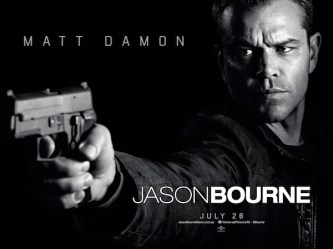 Much like the Bond films to which they’re so often compared, the Bourne movies have their devotees while only fitfully pleasing the critical establishment. This fifth movie — which is notable for marking the return of star Matt Damon and director Paul Greengrass after the semi-reboot of The Bourne Legacy — certainly met with mixed reviews when it came out at the end of this summer. Mixed erring towards negative, anyhow, though it does have its supporters. I’d love to say I’m among them, but my take was more… well, mixed.
The story picks up a decade-ish since the last Damon movie, Ultimatum (I don’t recall if the time gap is specified on screen, but we’re led to believe it’s been roughly real-time). Bourne is still living off the grid, participating in underground bare-knuckle fights in Greece for money and/or something to do. When his former associate Nicky Parsons (Julia Stiles) hacks into the CIA to retrieve documents on the black ops missions she and Bourne used to be a part of, she discovers something about Bourne’s past that leads her to meet up with him. In Langley, hotshot young tech-head Heather Lee (Alicia Vikander) and her boss Director Dewey (Tommy Lee Jones) are on to Nicky and presume Bourne is involved in her plot, dispatching The Asset (Vincent Cassel) to rub them out — but he has his own history with Bourne.
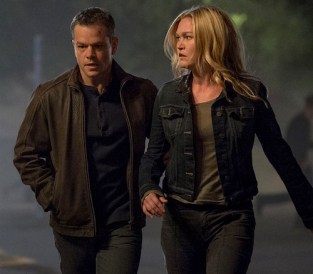 Action sequences ensue, shot with all the ShakyCam you’d expect from Greengrass. By now I imagine you have your own view on whether his style works or not. Personally, I think it’s considerably less bamboozling than when it made its debut in Supremacy 12 years ago — it’s been so copied that we’re more used to seeing it. I think Greengrass has a better handle on the purpose of the style than many of his imitators, however. I’d also argue that the cinematography in Jason Bourne is a smidgen more stable, with shots held a few frames longer, so that it’s even less seasickness-inducing than before. In fact, some shots — even in the quick-cut action montages — are downright pretty. The film was shot by Barry Ackroyd, who hasn’t lensed a Bourne before but has done most of Greengrass’ other movies, so maybe that has something to do with it.
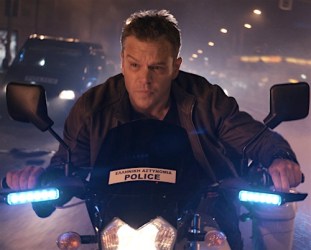
It’s in the big set pieces that Jason Bourne functions best. One in London in the middle of the film is just people walking around a lot looking over their shoulders, but Greengrass still invests it with some tension. Better is the climax, a kind of drag race down the Las Vegas strip… in the middle of traffic, of course. It’s largely implausible (I’ve been to Vegas — I remember the strip as being permanently gridlocked), but it’s certainly adrenaline-pumping. However, the highlight is probably the first: a chase through a smoky nighttime riot in Athens, with Bourne and Nicky on foot and then a motorbike as they’re pursued by the local police, an undercover CIA team, and the Asset, the latter two directed by Lee, Dewey, and their Langley lot via satellite imagery, CCTV, and… social media.
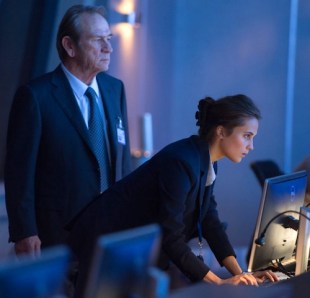 Frankly, Jason Bourne is at pains to mix in hyper-current iconography; the reasoning for Damon and Greengrass’ return now being that the world has changed and how does Bourne fit into that? So as well as social media and Greek riots we’ve got references to and riffs on hacking, Edward Snowden, government surveillance of its own citizens, the prevalence of Facebook/Twitter-esque tech companies, and so on. Sadly, I’m not sure the film’s actually got anything to say about any of these things. Greengrass and his co-writer, editor Christopher Rouse, have appropriated all these zeitgeisty concepts to make the film feel very Now, but that surface sheen is more or less where it ends. I mean, there’s a whole subplot starring Riz Ahmed as the Zuckerberg-like CEO of a social media company that I didn’t even mention in my plot summary because it’s kind of an aside. It’s kind of ironic, really, that it always seemed as if Greengrass’ more natural stomping ground was his documentary-ish real-world-exposé type movies, with his contributions to the Bourne series an unusual sideline; yet when he finally marries the two halves of his filmmaking career, it’s the action rather than current-affairs commentary that takes precedence.
Even leaving that aside, the plot is no great shakes. It’s too slight, serving primarily to string together the three or four big set pieces; and it’s too simplistic — Greengrass’ Bourne movies used to be entertainingly baffling, a web of crosses and double-crosses and historical connections and hidden plans. Jason Bourne re-appropriates many of the series’ familiar beats — all of them, in fact — but it feels like Greengrass and Rouse just analysed the previous movies for repeated elements and copied them, rather than having anything fresh to do with the constituent parts. So while few of these building blocks are poorly handled, there’s little remarkable about them either. Some are at least elevated by quality performances: Vikander tries to inject complexity into her character, with some success thanks to final-act kinda-twists, while Tommy Lee Jones brings natural class.
 The end result is that Jason Bourne does thrill as an action movie, which seems to have been the primary goal of its makers, at the end of the day. As an action-thriller, however, the rinsed-and-repeated plot is a slightly faded imitation of former successes; a through-the-motions way to provide those impressively staged chases and punch-ups. It’s not the definitive Bourne movie one might’ve expected from the returning star/director combo (why else come back if not to perfect, or at least add to, the formula?), but instead means the film ends on an odd note: even though it wasn’t a wholly satisfying experience, and even though it doesn’t end with questions still blatantly hanging (as every Bourne movie bar Ultimatum has done), I want Damon and Greengrass to come back and do it all again, please. Only do it properly next time, yeah guys?

Jason Bourne is released on DVD and Blu-ray in the UK today and the US next week.


 Score:



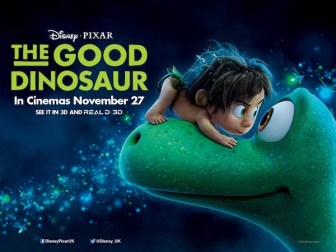 Once upon a time, Pixar could do no wrong. Then
  Pixar have on several occasions produced films with an innovative opening act that descends into derivative kids’ animation runaround territory.
 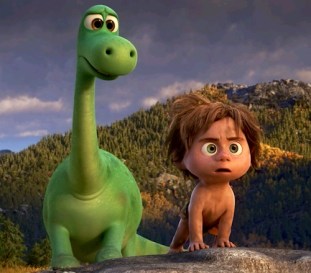 Perhaps most powerful of all is the relationship it creates between Arlo and a young human child he befriends, Spot. With humanity in a much earlier state of evolution, Spot is basically characterised as a dog — the way he moves, comes to his name, follows scents, shakes, scratches and enjoys being scratched, and so on — so of course I warmed to him. Nonetheless, though the building blocks used to create their friendship are very familiar, the way the film sells its emotional arc is ultimately immensely effective. Its resolution may even bring a tear to the eye.

 Set in Chicago during the Great Depression, The Sting follows a young street-level con artist (Robert Redford) as he seeks revenge for his murdered partner by teaming up with a seasoned big-con pro (Paul Newman) to scam the mob boss responsible (Robert Shaw).



 Between his popular English-language debut
 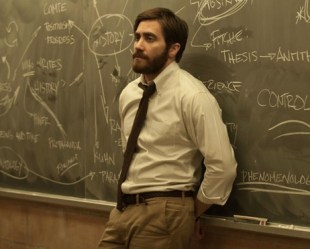 While looking up those various explanations, I read at least one review that asserted it’s a good thing that the film doesn’t provide a clear answer at the end. Well, I think that’s a debatable point. I mean, there is an answer — Villeneuve & co clearly know what they’re doing, to the point where they made the actors sign contracts that forbade them from revealing too much to the press. So why is it “a good thing” that they choose to not explain that answer in the film? This isn’t just a point about Enemy, it’s one we can apply more widely. There’s a certain kind of film critic/fan who seems to look down on any movie that ends with an explanation for all the mysteries you’ve seen, but if you give them a movie where those mysteries do have a definite answer but it’s not actually provided as part of the film, they’re in seventh heaven. (And no one likes a movie where there are mysteries but no one has an answer for them, do they? That’d just be being mysterious for precisely no purpose.) But why is this a good thing? Why is it good for there to be answers but not to give them, and bad for there to be answers and to provide them too? If the answers the filmmakers intended are too simplistic or too pat or too well-worn or too familiar, then they’re poor for that reason, and surely they’re still just as poor if you don’t readily provide them? I rather like films that have mysteries and also give me the answers to those mysteries. Is that laziness on my part? Could be. But I come back to this: if, as a filmmaker (or novelist or whatever) you have an answer for your mystery and you don’t give it in the text itself, what is your reason for not giving it in the text? Because I think perhaps you need one.
 Fortunately, Enemy has much to commend aside from its confounding plot. Gyllenhaal’s dual performance is great, making Adam and Anthony distinct in more ways than just their clothing (which is a help for the viewer, but not for the whole film), and conveying the pair’s mental unease really well. It would seem he errs towards this kind of role, from his name-making turn in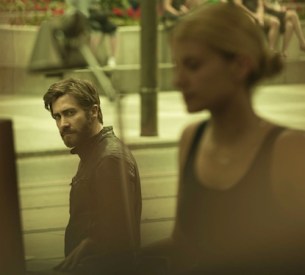


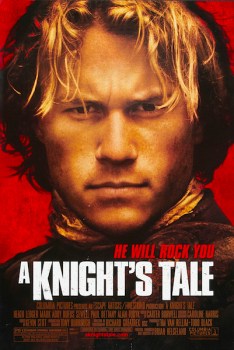 A squire fakes being a knight to win a jousting contest, and a lady’s affection, in this medieval comedy-adventure.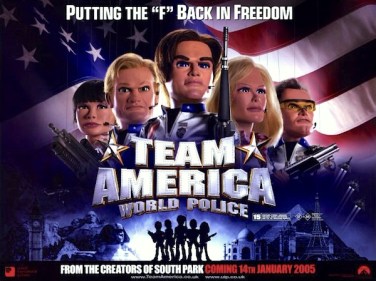

 100Films.co.uk