
Ron Howard | 146 mins | Blu-ray | 15
 Back in this blog’s early days, I established the rule that where a different cut of a film was not significantly different to the original version it wouldn’t be counted towards my total (assuming I’d seen the original, that is — if it’s the first time I’ve seen any version of the film, it still counts). There’s no hard criteria for what counts as “significantly different” though. A couple of additional minutes? No. A lot of additional minutes? Yes. Where’s the line between “a couple” and “a lot”? No idea. Thus far, I’ve left it up to “a feeling”, perhaps not always correctly (the I Am Legend “alternate theatrical version”, for instance, makes quite an impact with its new ending, but I didn’t give it a new number).
Which more-or-less brings us to the extended cut of Angels & Demons, which I first saw in the cinema in May 2009. This version is 7½ minutes longer than the “theatrical version” also contained on the Blu-ray disc, though it’s worth noting that’s the US theatrical version — the UK one was trimmed for violence. That’s not a hugely increased running time, true, but it has potential to make a difference. As I expect you’ve guessed from the lack of new number, in practice it doesn’t.
There are changes, of course there are, and they’re outlined here (though I swear I saw some of those bits in the cinema), but as you can see, most are barely noticeable — that list memorably describes one bluntly as a “useless extension”. While watching I wondered if the violence had been extended (I was right), and there was one line I found particularly funny which I thought I’d’ve remembered (indeed, it’s new),  but other than that if you’d told me this was the cut I watched in cinemas I’d believe you. This longer cut doesn’t make the film better or worse, just less suitable for younger viewers.
My general thoughts on the film aren’t much different to last time. Though I must be sure to mention Pierfrancesco Favino as Inspector Olivetti, the Vatican policeman who is actually one of the film’s best characters, injecting a modicum of charm and humour into proceedings while snatching almost all the best lines (not that there are many).
The tale moves at a pretty rollicking pace without attempting to force a sense of speed. From my point of view, a good hour shot by in what felt like half the time. I don’t think the perceived speed is because this was a second viewing, because I did notice it the first time, I just didn’t have a handy timecode ticking away next to the screen then. The chase structure and constant deadlines help ensure the pace rarely lets up as characters dash from one set-piece to the next. It doesn’t make for a deep or thoughtful movie, despite some of the ideas and history that are tossed around, but it does make for a moderately exciting thriller.
In this respect — that it’s an action-based thriller rather than a lot of talky theorising — I think it translates better to the screen than The Da Vinci Code did. That said, I’ve still not read the novel, so can’t comment on faithfulness. Wikipedia suggests it’s very close, though with a few appropriate modifications that don’t impact on the plot a great deal.
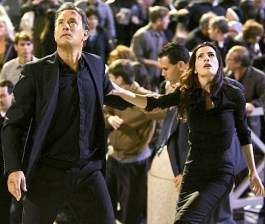 It’s still riddled with flaws, mind. Some of the dialogue is fairly atrocious (but at least it’s only some); exposition is often blatant and repetitive (we’re told what the preferiti are three or four times in as many minutes); some of the deductive leaps are a bit much; and the whole antimatter bomb still seems scientifically suspect. It all depends how much you’re willing to forgive, really. In a similar vein, one of the most contentious issues of Dan Brown’s novels is his use of “truth”. He mixes well-researched fact with his own creation at will, often leaving you to wonder if what you’re hearing is pure truth, truth bent to the plot, or a total fabrication. But then this isn’t a history or art lesson, it’s a mystery thriller, and if one wants to know more I’m sure there are books to read and documentaries to watch.
In short, then, the Angels & Demons extended cut is basically the same as the theatrical version. If you enjoyed that then you might want to seek this out for your next viewing, just because why not? If you weren’t impressed before, however, there’s no special incentive to try again.

My original review of Angels & Demons can be read here.
 Night at the Museum is fine. And by “fine” I mean less “of high quality… worthy of or eliciting admiration” and more “good; satisfactory”.
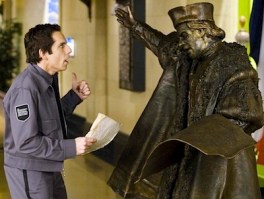 Perhaps it makes it a little disjointed — “here is our character-centric opening; here is the bit we actually wanted to make; here is an exciting climax” — but the tale still rattles by.
 The interest of the piece for us normal, sensible folk, then, lies in what it exposes about this world: the ludicrous lengths they go to; the shockingly inflated sense of self importance. As with The September Issue, it presents no narration and a lot of long takes of documentary footage, leaving the viewer to draw their own conclusions. But there are conclusions to be drawn. Wintour is as much a closed book here as in the main film, but there are moments — glances, affectations, turns of phrase — that reveal a little bit more of the truth behind her icy demeanour.
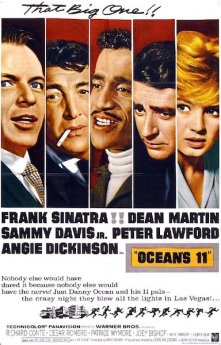 “Remakes are not as good as the original” is one of the rules of filmmaking. Of course there are plenty of exceptions, and everyone has their own opinion, and most modern remakes are expressly about making a quick buck from a US audience who can’t watch a film and read at the same time rather than making a better quality film — but, more or less, the rule persists. It may have won him an Oscar, but the consensus seems to be that
  It does have its moments: a couple of songs are shoehorned in (even if there’s only two or three and each gets two or three airings) and the cast do succeed in making some of their indulgences entertaining. Nonetheless, this would definitely be for Rat Pack fans only had it not been for the remake… and, really, there’s no reason the remake should change that.
 Origin stories are, as we well know, all the rage at the moment, and so Ridley Scott follows in the footsteps of
 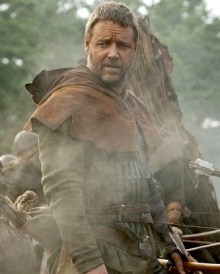 a likely-fictional creation, and so the style is suitably believable, whether it be precisely factual or not.
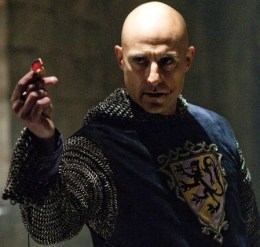 Mark Strong in a villainous role (it might be nice to see him play a good guy sometime, I’m sure he’s capable). Danny Huston’s King Richard is a nicely revisionist take — not the flawless hero we’re used to seeing — which sadly gets too little screen time. Oscar Isaac’s Prince/King John is suitably brattish and inconsistent, but by playing the part fairly straight he doesn’t come close to being as memorable as Alan Rickman, Keith Allen or Toby Stephens in the key villain’s role.
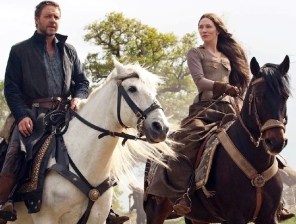 after numerous scenes of them doing stuff, they just are. King John ums and ahs about various things, and if we’re being charitable his chief characteristic is ‘changeable’; and if we’re not, he’s a weakly-written, inconsistent character. Do I believe he’d go charging into the fray during the climax? No, I don’t. If he’d gone in when it was virtually over, just so he could later claim he had? Yes, that would fit.
 I wanted the reviews to be wrong; for Ridley Scott’s Gritty And Realistic™ take on Robin Hood to be worth the potential of the concept. In places, it almost is — the era is evoked stylishly, the battles are largely well-staged if not perfect — but it drags, and ultimately Robin only becomes Robin Hood proper at the film’s end. (In fact, a surprisingly large amount of the trailer was taken from the film’s closing minutes, obviously to imply the usual Robin Hood story.) It’s copied Batman Begins and Casino Royale too precisely in this respect, perhaps. It also makes it feel like nowt but setup for a sequel, over-explaining how (this version of) Robin came to be where he was. As the final card says, “And so the legend begins”.
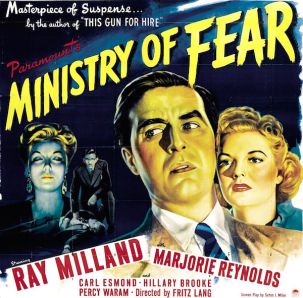 I like cake. It’s all soft and sweet and tasty. But I don’t like cake as much as Stephen Neale, the protagonist of Ministry of Fear.
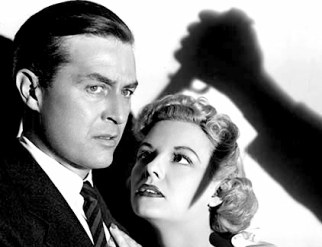 Ministry of Fear isn’t really about cake, but the opening 20 minutes or so plays out more or less as above and it is rather amusing. Less amusing — and, in fact, part of the film’s biggest problem — is a ‘humorous’ epilogue that returns to the cake theme. I found it hilariously funny, but unfortunately for all the wrong reasons. The other part of the problem is the abrupt ending that immediately precedes this brief coda. On the bright side, everything is resolved and you can imagine the post-climax resolution scene for yourself, but it still leaves the tale’s telling cut short.
 The train cake theft and chase, for instance, could be thoroughly laughable thanks to the cake element and what’s clearly a studio-built wood/wasteland, but it’s atmospherically shot and, in its main burst of genius, scored only by the drone of a Nazi air raid taking place overhead. It makes for a more tense and effective soundtrack than most musical scores manage.
 The debut feature from director Gurinder Chadha (of
 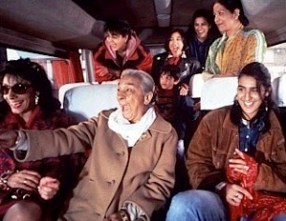 Indeed, there’s certainly evidence that the film was constructed with such an audience in mind: when the women settle down for a traditionally British ‘picnic on the beach’, we’re given a close-up to show they’re eating samosas and bhajis instead of sandwiches and what-have-you. If all the talk of pregnancies, abuse and racism sounds a bit serious, there’s also a good degree of humour and an appropriate lashing of sentiment.
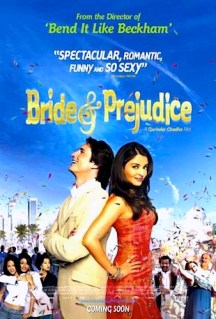 I don’t imagine Bride & Prejudice is going to convert many people who aren’t already predisposed to liking it in some way. That’s not to say it’s not good or doesn’t have potential crossover appeal, but it still has a whole list of things that will put certain viewers off.
 not to mention the numerous adaptations predating either of those, but Bride brings plenty that’s vastly different to the table. It converts the novel very accurately (as best I can tell, having only seen screen versions), retaining both the characterisation and the majority of the plot in a similar sequence of events.
 Little of the plot requires such modification, perhaps thanks to the culture it’s been grafted onto — the predominance of arranged marriages wouldn’t really work in a ’00s British setting — and those bits which are changed are relatively minor. Lydia (here, Lakhi) runs off with Wickham for an afternoon at the London Eye, rather than eloping; Georgiana (here, the slightly more modern Georgina) was impregnated at 16, less legally complicated than the novel’s 15.
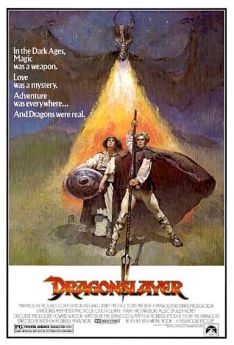 Back when he was still directing
 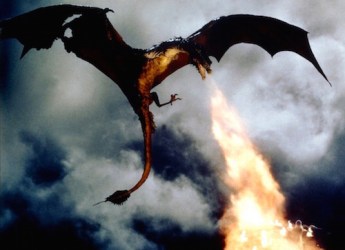 Vermithrax Pejorative is a long time coming, however, wisely kept off screen by director Matthew Robbins. It’s not that the monster shouldn’t be revealed, just that, like
 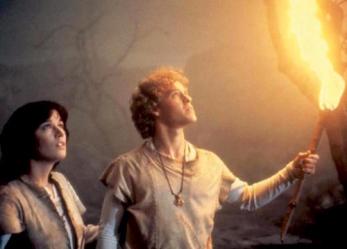 and giant monster than character development. Similarly, an interesting subplot about the move from The Old Ways of magic and superstition to The New Ways of Christianity feels like a good idea that hasn’t been fully integrated, made up of little more than a couple of passing nods and a negatively-inclined inclusion in the coda.
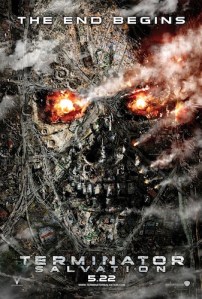 Terminator Salvation begins with a title sequence that displays the film’s title twice. I know you shouldn’t judge a book by its cover and all that, but somehow it just doesn’t bode well.
 sequences that could benefit from a wider perspective, for example Connor’s helicopter crash. That said (again), I’m a little torn what to think of that example: keeping the camera on Connor produces an unusual spin on a potentially familiar sequence, but it’s also a bit disorientating and, as I say, compounds this sense of watching someone else play a game.
 And even if you hadn’t seen it on the box or heard about it in all the film’s publicity, it’s obvious pretty early on that Marcus Wright will turn out to be a Terminator. To McG’s credit, he plays the ultimate reveal quite well — for those who know, it just about functions as a scene in its own right; for those who still hadn’t guessed, it works as a reveal — but if any filmmaker genuinely thought they’d kept it covered up they were sorely mistaken, and the first half could’ve done with a more knowing rewrite to compensate. Or just delete the prologue.
 He’s fine as ever, though his accent seems to waver between American and his native Australian. The same can’t be said of Helena Bonham Carter’s brief turn — her voice hits a constant fake American. Meanwhile, Arnie’s digitised cameo is just that. On the one hand it’s a nice touch, on the other it’s ultimately pointless — Connor doesn’t even react to the familiar face.
 More interesting than these slight tweaks is the behind-the-scenes story of a very different film, which I alluded to earlier. I don’t want to discuss it at length, but
  100Films.co.uk