Watchmen (2009)

2009 #9
Zack Snyder | 162 mins | cinema | 18 / R
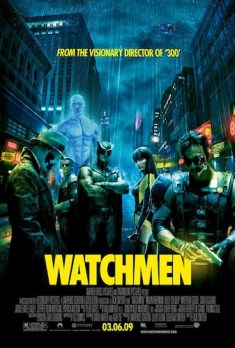
This review contains major spoilers.

Watchmen didn’t flop. Let’s get that out of the way.

Did it do less business than expected? Yes. Were expectations unreasonably high? Unquestionably. After the barnstorming success of The Dark Knight I think some expected a repeat run, but they forgot that while TDK was dark, it still had clear heroes, clear villains, a massively popular franchise and — let’s be honest — a highly-publicised, highly-acclaimed final performance from a certain tragic young actor. Watchmen, by comparison, is densely plotted, morally ambiguous, a tad on the long side, with unknown characters, an unclear story (in the marketing at least) and no mass recognition. And it was rated R. All this considered, it did phenomenally well, and at the end of the day it’s WB’s fault for spending $150m on something that, realistically speaking, wasn’t going to make that back on opening weekend.

But this isn’t meant to be a rant about the box office. Now that the dust has settled somewhat from the initial flurry of reviews — which on the whole seemed to either hail it as an instant classic or an unrelenting mess (though some more reasonable ones found the middle ground) — and with the dubiously-featured UK DVD and Blu-ray releases just announced, it seems about time to add a few of my thoughts to the already-overflowing mix. In doing this I find it impossible to fully divorce myself from the fact that I’m a fan of the book, so can only really view this adaptation from that perspective; just as I think anyone who’s read the book can’t truly imagine quite how a non-reader will take this, whatever they may claim. The only people who can do that are people who haven’t read the book, and there have been plenty of those reviews around too.

But even as a fan, my opinions are not as predetermined as some might think. Watchmen is incredibly faithful to its source material (some notable tweaks and omissions aside), but while some have loved it for this, others have viewed it as weak or pointless. Perhaps some of the complaints about faithfulness stem from the fact that we’re actually unused to seeing faithful superhero adaptations — “adaptations” being the operative word. Across seven Batmans, five Supermans, four X-Mens, three Spider-Mans, two Hulks, and countless others, how many actually adapt a specific book? Most, if not all, develop their own story around the notion of the character(s), or take some degree of inspiration from various storylines, tailoring a new tale for the different medium (well, theoretically). In choosing to adapt the source rather than make a film starring the same characters, Watchmen places itself more in line with other literary adaptations than other superhero movies. Some would argue this context still renders it more of a Da Vinci Code than a Godfather, but it’s perhaps still appropriate to debate that rather than if it’s more a Hulk than a Dark Knight.

The consistent faithfulness is a bit of a mixed bag. For much of the film it’s a great story well re-told, and its climax actually manages to improve on the original’s to the extent that, if Alan Moore ever actually watched it (which he won’t), I’d like to think he’d be man enough to admit that this one change at least was an improvement. Similarly, in the novel I wasn’t convinced Rorschach’s final moments made sense — it seemed out of character. On screen, however, Jackie Earle Haley completely sells it, his final scream becoming one of the film’s most memorable moments. Other elements are retained with no thought, however: the intercutting of Dan and Laurie’s alley fight with Dr Manhattan’s press conference is an effective (if blunt) sequence in the novel, but on screen makes little sense — even though I know the story and know the events of both scenes, this choice left me struggling to follow events. Even worse, the sudden and unexplained presence of Ozymandias’ pet big cat is almost baffling to a viewer familiar with the source, and so I can only imagine how little sense Bubastis must make to a new viewer. Consequently, his demise has no emotional weight.

The final scene is a bit of a misstep as well. In the book it’s a perfect little coda, beautifully ambiguous and tied to several of the novel’s themes. On screen, Snyder overplays it, allowing it to drag on with pointless dialogue and leaving the point of the scene feeling forced — equally a fault of David Hayter and Alex Tse’s script, then. Part of the problem is that it’s lumbered with introducing a subplot and its characters for the sake of the payoff, both of which develop slowly and appropriately in the novel. The details of that particular subplot are not the only elements that are missed from the original: the novel contains a lot of details of street life in Manhattan, for example, which makes the city’s ultimate destruction more personal for the reader. Some of these scenes have been filmed and, knowing that an aptly-titled (for once) Director’s Cut is on the way, it’s at times hard not to view the theatrically-released Watchmen as an abridged version. While it is still more complex than some critics (both pro and fan) give it credit for, the missing nuances and subplots would strengthen the whole experience. We can but hope it’s these that the Director’s Cut will include, rather than just a collection of completist-pleasing trims.

It’s easy to complain about Watchmen — clearly — but, actually, I really enjoyed it. Snyder has arguably created a live-action version of the graphic novel rather than creating a film in its own right, but is that really a bad thing? It’s what many literary adaptations aspire to, the only difference here is there were already some pictures to directly transfer. Some will disagree, and if you do then this is a perfect argument for why Non-Fans should be in charge of film adaptions — Fans are too concerned with pleasing other Fans, in this case being rigorously faithful; Non-Fans often just want to make the best movie possible based on the source material, rather than making the best translation (or, perhaps, re-appropriation). Perhaps it’s too fine a line to walk; perhaps Snyder was too afraid to change anything; or perhaps it’s just a case of damned if you do (“it’s exactly the same, what’s the point?”) and damned if you don’t (“he changed too much, it’s not Watchmen!”).

In their faithfulness, Snyder, Hayter and Tse retain much of the story and character elements that made the original great. If the aim was to take the page and put it on screen, the screenplay is near flawless, embellishing some moments and even fixing others, while excising subplots so wisely I didn’t miss much. As stated, however, the definitive cut is surely the forthcoming one. As for Snyder’s direction, he mostly does a good job, recreating iconic panels — occasionally with too much reverence, true — but enlivening other sequences in his own way. In fact, for all the moans of reverence, some of the novel’s more filmic ‘cuts’ are actually abandoned (I’m thinking specifically of the ins & outs of flashbacks during the Comedian’s funeral). Photography wise, most of the film was far too dark, and I couldn’t help but wonder if it had been shot too much with DVD/Blu-ray in mind and suffered when projected. I suppose we’ll see later…

Snyder certainly left a clear directorial stamp on one element of the film: occasionally the action sequences smash into slowmo, sometimes to the point of freeze frame… exactly like they did for most of 300’s fights. Whereas there it looked kinda cool and felt like a stylistic tick unique to that film, here one can’t help but think time is being wasted that would be better spent on expanding the dense plot. And rather than being a stylstic quirk of 300, it now becomes one of Snyder’s; which means that, from the very first scene, “A Zack Snyder Film” is stamped all over this like a young boy with an abundance of name stickers. There’s nothing wrong with making it his own film, of course — I’m sure Gilliam’s or Greengrass’ versions would’ve slotted comfortably into their distinctive oeuvres — but it would be nice if it weren’t quite so intrusive. On the other hand, could it be that the expectation of this makes it seem worse than it is, and if any other director had pulled the same tricks it wouldn’t seem as apparent?

Similarly, the violence is incredibly brutal, gory and graphic — but that’s the point. Though they live in a heavily stylised world, these are ‘real’ superheroes, and real violence isn’t pretty. The level of brutality is appropriate to the theme but never lingered on more than is reasonable and rarely over-done. Those who aligned it with ‘torture porn’ flicks like Hostel in their criticism of the film were missing the point.

The film’s soundtrack has also come in for criticism in some quarters, where certain tracks have been accused of being entirely out of place and others have been suggested as replacements. However, the tracks lambasted and others put forth suggest that these particular critics (usually amongst fandom) have a rather narrow taste in music, with the suggestions often too obscure to suit. In fact, Watchmen’s soundtrack provides a nice variety of contemporary songs, spanning styles in order to quickly define an era rather than to evoke what a specific genre was doing at the time — so a 1970s riot is accompanied by disco, for example, rather than a niche rock track. It makes absolute sense from a filmmaking standpoint and, for those of us with broader tastes, is perfectly pleasant. Elsewhere, the choice of music references both the original text — Rorschach and Nite Owl’s arrival in Antarctica is set to Jimi Hendrix’s All Along the Watchtower (while the novel quotes Bob Dylan, here its use as an action cue means Hendrix fits better) — and other films — the Vietnam sequence is knowingly set to Ride of the Valkyries. There are some missteps — the use of Leonard Cohen’s Hallelujah over the sex scene is presumably meant to create a moment of euphoric triumph, but is instead laughably cheesy — but, most of the time, it’s a success.

The other major addition from the graphic novel is, of course, a cast. As already noted, Jackie Earle Haley is incredible in the default-lead role of Rorschach. He may’ve nicked Christian Bale’s Batman voice, but it’s much more suited here. Patrick Wilson’s Dan Dreiberg/Nite Owl II is also great, showing the benefit of hiring proper actors rather than stars. Jeffrey Dean Morgan and Matthew Goode hold their own in potentially challenging roles. Some didn’t — and don’t — think Goode was right for Adrian Veidt, but I preferred his portrayal so much that the more butch-looking Ozymandias of the novel now seems wrong to me. The female leads suffer more. Malin Akerman is about passable, but Carla Gugino is quite possibly miscast. It’s a tricky part to get right, having to be both young and sexy in the flashbacks but an old woman in the story’s present day, and so it may be more the fault of some poor old-age makeup than Gugino’s.

That’s not to mention Billy Crudup, who has the double challenge of playing a man who has become God-like, and of giving this performance underneath a big pile of CGI. And with a CG penis on show too. Personally I didn’t find the CG manhood as distracting as many others seem to have, and Crudup’s actual performance is captivating — there’s a thin line between aloof otherworldliness and reading dialogue aloud in a monotone, but Crudup managed to fall on the right side of it.

Surprisingly, I’ve made it through almost 2,000 words without mentioning the title sequence. There’s no need to describe it any more, it is simply brilliant. More dioramas were shot than made it into the final cut, so I can’t help but hope they’ll be reinstated in later versions.

In summary (if this ramble around Watchmen can be summarised), Zack Snyder’s Watchmen Film is not “the big screen equivalent of Alan Moore’s Watchmen” — that would be a movie, likely very different to the graphic novel, that examined and deconstructed representations of superheroes in cinema and television. Instead, Zack Snyder’s Watchmen Film is “Alan Moore’s Watchmen on the big screen”, a blisteringly faithful adaptation of the source. Crucially, however, it is not (always) blindly faithful — the ending being a case in point — but some will still ponder its relevance. Judged as an artistic work in its own right, then, it perhaps comes up lacking. Judged in comparison to other faithful adaptations of great literature, however, it’s arguably as good as many others. At the very least, it’s exposed a wider audience to the characters, themes and debates of the original, and, whether they like it or not, that can only be a good thing.

In closing, I’m reminded of a comment made by Danny Boyle when discussing his favourite film ever made: “it’s imperfect; which every film should be.”

5 out of 5

My review of Snyder’s preferred Director’s Cut can now be read here.

That version placed 3rd on my list of The Ten Best Films I Saw For the First Time in 2009, which can be read in full here.
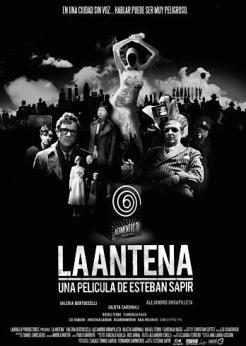
La Antena (2007)

aka The Aerial

2009 #10
Esteban Sapir | 95 mins | TV | PG

La AntenaLa Antena is a Silent Film. And by that I mean there is no dialogue, though there is music, and it’s in black and white with low-budget (looking, at least) effects, though it was made in the 21st Century — but it is entirely in the style of those films made in the era before sound was technically possible. It could sit comfortably alongside ‘real’ silent films to the extent that the uninitiated might reasonably be fooled into believing it was one.
In some respects this is neither here nor there, though it will undoubtedly put some viewers off. For those with a more open mind or who are fans of silent movies, however, it’s a joy. This is mainly because it’s incredibly imaginative, especially with its visuals, which are often pleasantly barmy. The setting is a dystopian future (or alternate reality) where people can no longer speak (thus justifying the silent film styling), and this world is wonderfully realised without a hint of realism or awkward attempts to explain why things are the way they are. These days it’s a rare filmmaker who doesn’t feel the need to explain everything and make it fit in relation to our world, but Sapir is one of the few who trusts us to accept what’s going on — much as the great silent film directors did.

Sadly it isn’t flawless. Some elements of the plot get forgotten as things roll on (what happened to Mr TV’s son, for example?), perhaps a victim of the 50 minutes of cuts they chose to make for pace. Most of the symbolism is also fairly heavy handed, though one could argue that’s in keeping with the style, and at least means it’s all nicely noticeable. Even then a few bits are unavoidably leaden — particularly, the use of the swastika and Star of David felt uncomfortably irreverent to me.

Ratings-wise, La Antena is borderline — the sort of film I give four stars to now but then beats most five-star films to a high place on my year-end top ten (like The Prestige or Hellboy II or the five others that have done it). In which case it seems only fair to run the risk of awarding it full marks.

5 out of 5

Oscar-winning modern silent movie The Artist is on BBC Two tonight, Saturday 24th January 2015, at 10pm, and is reviewed here.

Commentary! The Musical (2008)

2009 26a
Jed Whedon & Joss Whedon | 42 mins | DVD

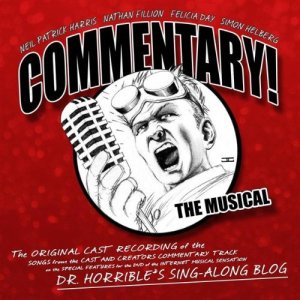
Commentary! The MusicalCommentary! The Musical falls somewhere between DVD extra, TV episode and short film. Whatever it should be classed as, it’s utter genius.
You’ve surely heard of Dr. Horrible’s Sing-Along Blog, the project Joss Whedon created during the infamous US Writers’ Strike. (That in itself you could debate the status of. Three-part miniseries? Short film? Feature film? (At 42 minutes it’s over the Academy’s boundary.) And endlessly on.) Well, on the Dr. Horrible DVD can be found this — an alternate audio track, on which the cast and crew discuss the making of the feature… except it’s all scripted and the majority is sung. Not your traditional audio commentary then.

As an audio commentary, it does little to illuminate the production of Dr Horrible — though, surprisingly, it does do some — but instead focuses its energy on spoofing commentary tracks, DVD extras, and the American film and TV industry in general. Specific targets include the Writers’ Strike and its lack of success, rivalry between lead actors, the importance of ensemble cast members, Asians in US TV and film, the dissection of art by DVD extras, and many more. It’s almost all incredibly funny — inevitably there are a few duff gags and dull songs, although they are uncommonly rare — and it moves at a rate of knots, meaning it rewards multiple listens to pick up every gag. Having already re-listened to a couple of tracks, I can attest to noticing funny lines that I was too busy laughing through before. In a spot of technical impressiveness, the commentary is often surprisingly scene-specific, sometimes even shot-specific. When you consider the effort that must’ve been involved to script and time both songs and spoken dialogue to make this happen, it’s even more impressive.

It’s this careful scripting and the sure-handed attentiveness to theme that marks Commentary! The Musical out as a fictional work in its own right, rather than ‘merely’ a DVD extra, in much the same way that Mystery Science Theater 3000 or the short-lived (and easily forgotten) Rob Brydon series Director’s Commentary are original works. With its well-targeted thematically-appropriate comedy and plentiful gags, it’s pure delight for fans of DVDs, or anyone else with a mind open to the concept.

5 out of 5

Flash Gordon (1980)

2009 #27a
Mike Hodges | 107 mins | DVD | PG / PG

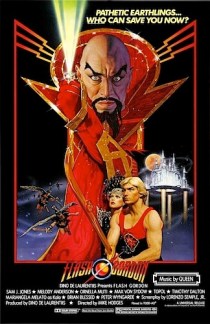
Flash GordonI hadn’t been intending to review Flash Gordon — it’s not as if I don’t have enough new films to review — but though I have seen it before it was a long time ago and I was very young, so watching it again now I wasn’t quite prepared for just how good it is.

Flash often seems to be dismissed as an unintentionally campy load of nonsense, perhaps with some ironic appeal. What this assessment misses is how knowing it is. Yes, it’s ridiculously camp, the dialogue is cheesy, the performances equally so, and it’s brighter and more colourful than any under-5s TV show ever produced. But it knows it is, and because it does it with nary a nod nor a wink I think that passes some viewers by.

The sheer volume of things there are to love in this film makes them hard to list without watching it and pointing them out as they appear, but I’m sure I can manage a few. For one, there’s the design work — the sets, the costumes, the spaceships — all huge, vibrant, retro and often ridiculous, and all wonderful for it. The special effects are truly special, creating skies full of swirling rainbow colours, rainbow clouds for the spaceships to float through, platforms that tilt over a rainbow vortex… Do some of them look primitive? Well, a bit — but they have more charm than CGI ever will, and they don’t get in the way either.

The plot is ludicrous, built from B-movie elements and predicated on cliffhangers — which is exactly as it should be. The dialogue is packed with quotable lines, many so patently ridiculous that it can only have been deliberate. There’s not a single bad performance — everyone’s either in on the joke or playing the straight man to it. Of particular note are Max von Sydow’s properly villainous villain (who, to be quite honest, still has more depth than too many nemeses we see today); Peter Wyngarde as his scheming right-hand-man, granted a fantastic death; Mariangela Melato as his right-hand-woman, granted some of the very best ‘bad’ lines; Topol as a somewhat loopy Dr Zarkov; and, of course, Brian Blessed — no more need be said.

The fights and assorted other action scenes are exciting, frequently epic, and tinged — like so much of the film — with a perfectly judged level of humour. Arguably the best is a harem-set tussle between between Dale Arden and Princess Aura, watched by sniggering servants as they wrestle on a giant bed. It’s beyond knowingly handled by Hodges, the brief cutaways to the servants indicating the deliberate commentary on such voyeuristic lesbian-lite wrestling matches in other films.

Then there’s the score by Queen. As with Brian Blessed, what more needs to be said? (Incidentally, I got a big laugh when Blessed screams, “who wants to live forever anyway?”, forgetting that Highlander was still six years off when this was made.)

So, in all that, what’s wrong with Flash Gordon? When I noticed how much I was enjoying it — about five minutes in — I began keeping my eyes open for flaws, any niggling thing that detracted from the experience Hodges created. I couldn’t find a single thing. Not one.

Which means I can now become known far and wide as the blog that only awarded Star Wars four stars, but gave Flash Gordon a perfect

5 out of 5

Alien: The Director’s Cut (1979/2003)

2009 #13a
Ridley Scott | 111 mins | DVD | 15 / R

Famously, Ridley Scott’s 2003 Director’s Cut re-release of Alien came in slightly shorter than the original version, an unusual state of affairs. This disparity isn’t just because Scott lopped a bit out (though, he did) — he also removed scenes and put others back, in the process creating a cut of the film as edited by an older version of the same filmmaker. Or, alternatively, creating a different version to help shift some extra tickets — it depends which quotes you want to believe.
Having only seen the original version once, and several years ago, I can’t offer any meaningful analysis of how Scott’s myriad nips and tucks impact on pace. It certainly doesn’t feel faster on the whole, still exhibiting the same slow-build tension that’s as reminiscent of 2001 as any other horror films. Coupling this with a very realist style of dialogue and action — minimal, overlapping, mundane, light on exposition — makes the film feel positively indie-like today. There’s no way a major effects-filled blockbuster would progress so slowly now, though recently Sunshine came close. In these respects, Alien: The Director’s Cut isn’t all that different from the Alien so many know and love — no surprises there — and all but the most die hard of die hard fans are unlikely to notice such minor changes.

However, Scott also reinserted four deleted scenes, which even I managed to spot. Only one makes a notable difference: during the climax, Ripley discovers Dallas and Brett in alien cocoons and burns them. The Aliens’ cocooning is intrinsic to the plot of later films in the franchise, in which respect it works well to see it first crop up here; taking the film on its own merits though, such an addition in the middle of the climax serves to slow it down and feel like an unnecessary aside, tidying up a loose end that most audience members wouldn’t even think was a loose end (I know I didn’t). Of course, this just goes to show that it was a sensible cut to make back in ’79.

These small moments aside, Alien feels unchanged. It’s been said many times before but, first and foremost, it’s a horror movie — it just happens to be one set in space with plenty of sci-fi trappings. Move it to an oil tanker in the middle of the ocean and a great deal of it would function just as well. Whatever effect Scott’s trims may have had, they haven’t made it any less effective in this regard, though second time round all the jump-scares failed on me, but that’s the nature of such a shock rather than a flaw of Alien in particular. Trying to look at it objectively, we all know that Ripley’s the only survivor and the franchise heroine now, but the film gives you no/few reason/s to presume she’s any more significant than any other character: she’s third in command, Weaver’s only second in the credits, and she doesn’t even go out on the initial mission. It’s an effective step in keeping the audience guessing who might survive.

Some of the effects look rather dated now, especially the ship’s computers, but that’s not really problematic. The design work on the ship is still exemplary, and of course often copied. It’s so grimy, industrial and (for want of a better word) ‘real’ that one wouldn’t even need to reshoot much to claim it was set on that oil tanker. The Alien is still the main consideration in design and effects terms, and it’s still barely seen. This was always a very sensible move, hiding any shortcomings in the design (most of the time at least) and also helping create menace — because it’s never seen in full, and only brief glimpses are snatched in the shadows, we always believe it could be anywhere. This all builds to the great escape pod ending, which cleverly uses a calm-after-the-storm feeling and the distraction of Ripley’s semi-strip to lull the viewer into a state of total unawareness. Even on re-watching when you know it’s coming, this sequence contains arguably the film’s most effective jump.

Alien is 30 this year and the Director’s Cut is now six years old, meaning most seriously interested viewers will have seen it by now. How different this version is from the original cut should be indicated by the fact I didn’t feel justified in giving this a new number, even with my poor memory. I can only imagine that to fans intimately familiar with the film the number of trims (there are rather a lot apparently) and new scenes (just four) make a huge difference, but for a more casual viewer they don’t significantly change how it feels as a whole. That said, even with my vague memory, I’d call the original as the superior cut.

5 out of 5

Anne Frank Remembered (1995)

2009 #4
Jon Blair | 117 mins | TV | E / PG

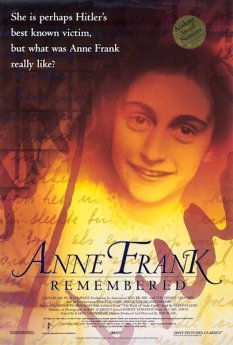
Anne Frank RememberedAnne Frank’s is arguably the best-known individual story of the Holocaust, perhaps because the diary of a 13-year-old girl in hiding from the Nazis — and, sadly, eventually captured by them — makes a perfect gateway for young people into learning about those atrocities.
In this Oscar-winning documentary, Jon Blair exposes the ‘untold story’ of Anne Frank. He adds to her words with the perspective of her friends, other people who knew her, and relatives of her companions in the annex. In covering these views the film presents alternate interpretations of many people Anne wrote about — for example, Fritz Pfeffer (renamed Albert Dussel in the published diary) is very disliked by Anne, but here is painted in a very different light by his son. The film also reflects on Anne herself, and what it uncovers is not always positive. Such an honest approach could be contentious, but its attempt to uncover the truth — rather than paint a false saintly picture — is admirable.

The film’s second half describes what happened after the diary ends, an often ignored part of the tale — even the BBC’s recent, excellent adaptation ended with the residents of the annex being escorted out, and I think many believe this is where the story ends. In reality there were seven months between the discovery of the annex and Anne’s death, and while only Otto Frank survived the concentration camps, many of the others came heartbreakingly close: Peter van Pels died just three days before his camp was liberated, while Pfeffer was marched away by the deserting SS as the Soviets neared, dying with so many others on that path. Here the film touches on much of what life was like in the camps, adding to its detail of how life was for those in hiding. There are undoubtedly other texts that do this more thoroughly, but by focusing on one family and using just a handful of interviewees, the events are made to feel incredibly personal in a way that some documentaries’ more factual approach fails to.

What happened to the diary after the war is also briefly covered: how the book came to light, the impact it had when published, allegations it was a hoax (due to differences between translations, and fictional events created for the 1955 play and subsequent film adaptation), as well as the positive effect it’s had beyond that, including comments from the likes of Nelson Mandela.

With its honest and extended investigation of the events covered in Anne Frank’s diary, plus its consideration of broader facts of the Holocaust, Anne Frank Remembered adds significantly to the original text. In doing so it becomes an essential companion piece to one of the most famous and important documents of the Second World War.

5 out of 5

The Birds (1963)

2009 #6a
Alfred Hitchcock | 114 mins | DVD | 15 / PG-13

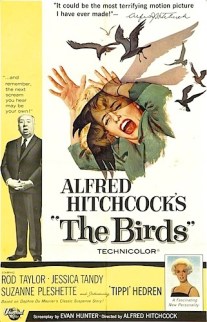
The BirdsI first saw The Birds on TV so long ago that I can’t even remember how long ago it was. Only two parts of it have stuck with me since: the justly famous scene with the climbing frame (ooh it’s brilliant), and a dead Dan Fawcett with his eyes pecked out (ooh it’s chilling).
If that didn’t give it away (and as if you didn’t already know), The Birds is a horror film. A horror film of the proper kind too — the kind that scares you, rather than making you jump at regularly-spaced committee-decided intervals. It’s the kind that slow burns its way to the horror — we meet the characters, see their relationships, arrive at the right location… There are hints at what might be coming, but they idle past in the background, almost unnoticed… but gradually increasing.

This isn’t time wasting; it isn’t really character development either, despite how some of it may seem (more on that in a bit). It’s how Hitchcock builds suspense — we know it’s coming, we just don’t know when — and likely contributes to some sex-related subtext too. (I haven’t just pulled that out of thin air, incidentally. There’s the odd moment where that subtext almost breaks through into the text, though Hitchcock quickly reels it back in.)

The second half is where all this time spent delaying and manoeuvring pays off. The titular demented avians attack, and attack again, a near relentless series of assaults and set pieces that allow Hitchcock to show off his apparently endless array of shooting and editing tricks. These aren’t just spectacular action sequences — though there are some, of a fashion — but sequences of unnerving horror. And it’s all achieved without a single note of music — no slowly rising throb in the background to tell us we should be getting scared, no dramatic thud to make us jump, no piercing musical shrieks as the birds attack — yet some sections are almost unbearably tense, built entirely with camera angles and masterful editing.

If there’s a weak note it’s the romantic subplot. While it initially drives the film, it’s largely abandoned later on, becoming no more than an excuse to move characters into place for the birds’ attack. In fact, Hitchcock seems to just get tired of it, allowing the film to jump abruptly from will-they-won’t-they to cuddling and kissing — and it’s not even like a first kiss. Intriguingly, a deleted scene included on the DVD (which has been lost, only surviving through a script segment and production photographs) seems to provide the ‘missing link’ in the central relationship. However, it also offered an explanation for the birds’ attacks (albeit a jokey one), something Hitchcock was keen to avoid, which likely explains its removal.

But that’s mostly beside the point. The Birds is a tension-based horror movie, and every sequence of tension is perfectly staged. This is where Hitchcock is really in his element, and all of the preamble is worth enduring just for the chance to see the master let loose. Dan Fawcett’s lack of eyes has probably stuck with me as much thanks to Hitchcock’s impeccably paced build up as to the gruesomeness of the actual image; and the birds amassing on the climbing frame outside the school is an absolutely perfect sequence, a moment of pure cinema.

5 out of 5

Some Like It Hot (1959)

2009 #2a
Billy Wilder | 117 mins | DVD | U / PG-13

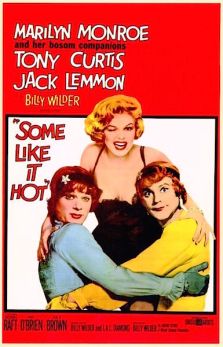
Some Like It HotDid you know that Some Like It Hot is a remake of a 1951 German film, Fanfaren der Liebe? I didn’t. Anyway…

The first (and last) time I saw Some Like It Hot was so long ago that, even when watching it again, there are whole swathes of the film I didn’t recall. How few clothes Marilyn Monroe wears, for one thing. I guess I was quite young first time. The only thing I did remember was enjoying it immensely; and, enjoying it again, didn’t want to skip the chance of handing it five stars in this pathetically brief review.

To be concise, it’s a very funny film even 50 years on. It rattles from situation to situation at an occasionally surprising pace, literally without a dull moment. Not that there’s anything wrong with slower old films, but its certainly spritely for its age.

And with it, a genuine classic. Never mind some — everyone should like it a lot.

5 out of 5

Sorry for the pun.

The Green Mile (1999)

2008 #78
Frank Darabont | 181 mins | DVD | 18 / R

This review contains major spoilers.

The Worst Movie Poster of All TimeFive years after making The Shawshank Redemption — somewhat ignored at the time, but now incredibly popular and constantly bidding for acknowledgement as The Best Film Ever — writer-director Frank Darabont returned to the Stephen King Non-Horror Well (quite a shallow one, I should think) to film this tale of a man on death row in the ’30s. Darabont writing & directing a three-hour adaptation of a Stephen King story set in a prison in early 20th Century America? But Shawshank 2 this is not; in fact, I would argue that, due to one key difference amid those similarities, it’s actually the anti-Shawshank.

The key difference, I should rush to point out, is not the presence of the supernatural. While obviously a major element of the film, the level of realism dedicated to it, plus the overall tone of the piece, means that it still doesn’t feel too far removed from its predecessor. Nonetheless, where Shawshank was very much a real-world story, The Green Mile gradually draws the viewer into believing that miracles may be possible. It’s a whole hour before Michael Clarke Duncan’s near-silent John Coffey (“like the drink, only not spelled the same”) does his healing thing, at which point what was apparently a straightforward period prison drama gains a new dimension.

The fact that this occurs so late, after a lot of effort has been spent establishing the normal real-world setting, means it is firmly grounded in reality. Where most supernatural-focused films ask the viewer to accept, “in this world, this is real”, The Green Mile forces us to ask, “in the real world, what is this power? where does it come from?” Perhaps this seems a subtle distinction, but it isn’t; and the film pulls it off with impressive ease thanks to Darabont’s writing and direction, plus the well-judged performances of Duncan, Tom Hanks as lead warden Paul Edgecomb, and the rest of the cast.

Up to this point, the film feels like a collection of subplots. It takes a slow and careful, but never dull, approach to storytelling, slowly unfurling details of the characters, their relationships, and the technicalities of prison life; but it’s not until Coffey’s power emerges that these really begin to come together. Within this process, Darabont’s writing cleverly structures the release of information to the viewer. We never learn any details of some of the inmates’ crimes, for example, allowing us to sympathise with them; indeed, a lot of subtle effort is put into making Michael Jeter’s Del likeable, serving the double purpose of making his death infinitely more shocking (that we don’t know his crimes largely removes the danger of a “well he deserved it” reaction from certain viewers) and, by his association with Coffey, helping the viewer to like the apparent child murderer. All sorts of details slip by almost as scene setting, only to have horrendous significance later on, and both the reveals and later revelations are played out perfectly.

The film’s ending successfully brings together a wide variety of these seeded elements, neatly melding the remaining subplots without pushing into the realm of unsatisfactory coincidence. But the conclusion is also unapologetically downbeat, and it’s this which affirms that anti-Shawshank status: where Shawshank ends with escape and hope, The Green Mile ends with injustice and imprisonment — the execution of an innocent, miraculous man, and Paul’s ‘imprisonment’ in an unknowably long (potentially, endless) life, suffering the constant loss of those he loves and the guilt of what he did.

If The Green Mile is not quite Shawshank then that’s because it’s not trying to be. It’s a superb film in its own right, but the lack of an uplifting ending is the reason it isn’t — and never will be — as popular as its apparent twin.

5 out of 5

(Originally posted on 28th January 2009.)

The Many Adventures of Winnie the Pooh (1977)

2008 #92
John Lounsbery & Wolfgang Reitherman | 71 mins | DVD | U / G

The Many Adventures of Winnie the PoohHaving finished 2007 with Piglet’s Big Movie, it feels somewhat appropriate to round off 2008 (almost) with Disney’s first Winnie-the-Pooh feature.

The Many Adventures… is actually compiled from three shorts made in 1966, 1968 and 1974, with some new linking material. I don’t know if these shorts were produced with any great expense, but there’s occasional evidence of what looks like cheap animation. It’s not that it’s not smooth or fluid, but rather the attentive viewer will often spot sketch marks around some lines, or flashes of other bits not properly erased. Perhaps it was deliberate, considering the sketchy style of the backgrounds, designed to evoke the original illustrations, but I sometimes found it distracting.

This is one relatively minor flaw in an otherwise brilliant adaptation, however. The film faithfully adapts several of the original stories, acknowledging its sources by frequently showing the action as illustrations within a copy of the book. This fourth-wall-breaking move may irritate some, but personally I loved seeing Pooh and co have to leap from page to page, or tipping the book sideways to free Tigger from a tree. Such moves seem tonally in keeping with A.A. Milne’s original stories and, even though some tales are abridged and some good ones left out, that spirit is always retained.

The characterisation is also spot on, producing an array of cute and loveable creations, none more so than Pooh himself. The gopher is an unnecessary addition, though the running joke about him not being in the book is very nicely done. And one can’t fail to mention the excellent songs, now as linked to the world of Pooh as anything from the original books — especially Tigger’s little tune, surely familiar to anyone who was a child in the last 30 years.

If some later Disney ventures have lost sight of the correct spirit for Pooh’s adventures, at least this original is a great adaptation. Bouncy, trouncy, flouncy, and, above all, fun fun fun fun fun.

5 out of 5