
Henry Selick | 100 mins | Blu-ray | PG / PG
 I’ve only ever read one thing by Neil Gaiman. It’s not fan-favourite Neverwhere, nor the previously-adapted Stardust. It’s not Hugo-winners American Gods or The Graveyard Book, nor the Hugo-withdrawn Anansi Boys. It’s not any of Sandman. It’s not even Whatever Happened to the Caped Crusader?, his take on Batman.
And it’s not Coraline either.
Which is a shame, because either that or “I’ve never read anything by Neil Gaiman” would have made much better introductions. Indeed, the latter was my original plan, but honesty overcame me — I’ve read his graphic novel/miniseries Marvel 1602. And I just remembered that I’ve also read Good Omens, the novel he co-wrote with Terry Pratchett. So much for my neat little introduction.
But regardless of one’s familiarity with Gaiman, his work comes recommended. Coraline alone won a Hugo, Nebula and Stoker, while the film adaptation was Oscar-nominated (naturally it lost to whichever Pixar film was eligible) and widely well reviewed (an 89% Tomatometer). All of which seems to set it up for a fall. But like, say, The Dark Knight*, it manages to fulfil its promise — Coraline, in short, is excellent.
Where to begin? Well, Coraline is a fairytale, really, albeit a modern one — it doesn’t come at you with princesses or witches or talking animals, but Volkswagens and new homes and stairlifts (all or none of those may be significant to the plot). The fact it’s a fairytale is perhaps neither here nor there, though I do think it pushes aside some logic complaints I’ve seen levelled against the film — do we need a villain’s origins, for example? No, not here. I’m not saying Coraline uses its fairytale basis as an excuse to toss aside narrative sense, just that, if viewed through the prism of 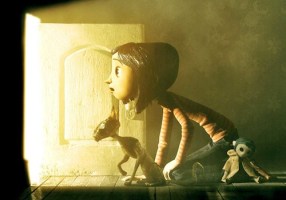 “fairytale story rules” rather than “real-world fantasy story rules” some viewers may have been more forgiving. Also, I’m digressing into a critical blind alley.
It’s also a Proper fairytale, by which I mean two things: one, it has a moral message; two, it’s scary. Very scary, in places. For much of the film there’s a beautiful creepy atmosphere, enhanced by drifting fog and skewed camera angles, but towards the end — when (I write while trying not to spoil too much) the full truth of the Other Mother is revealed — it’s not just kids who are likely to be freaked out. Dark themes and situations abound, though the full implications of some are pared back or glossed past, probably with good reason. Coraline is a “kid’s film” but, like writer/director Henry Selick’s previous The Nightmare Before Christmas or much of Pixar’s output, it’s as least as enjoyable for adults.
And as for the moral subtext… well, it may be very familiar — “be careful what you wish for” and/or “you don’t know what you’ve got till it’s gone” — but Gaiman and Selick certainly have a new, fantastical, mythical spin on it. Some critics say the story is arranged from plot points seen elsewhere and lacks originality, but then critics of everything say that because every story has roots in another. Coraline’s telling displays more than enough originality to keep it going, thankyouverymuch.
The animation, however, is an undeniable triumph. Set and character designs are gorgeous; the stop-motion movement is fluid, nuanced and detailed; the numerous technical accomplishments impressive. Sequence after sequence dazzles, each more magical — or frightening — than the last. Even if you want to criticise the story or characters, 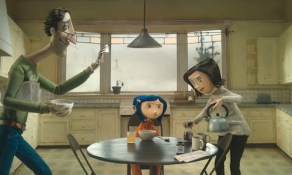 I find it hard to believe anyone could watch this and not enjoy much or all of it on a visual level. And if you don’t — honestly, are you sure you like films?
Only occasionally is one reminded that Coraline was filmed in 3D, when things poke out towards the screen or sink deep into it; but it’s not gratuitous, and if you didn’t know it was designed for 3D you might not even notice. The flattened sets and awkward perspective of the real world, versus the depth and beauty of the Other one, are still conveyed well in 2D. (I’ve had a brief look at the 3D version contained on the Blu-ray disc and will report my views on that another time, when I’ve attempted to watch it in full.)
Much like the animation, Bruno Coulais’ score is hauntingly beautiful. OK, it’s undoubtedly Elfman-esque, but it fits the film to a tee. Also in the audio realm (yes, this is a tenuous link to join two brief comments in a single paragraph), the voice cast are all spot-on, from seasoned pros like French and Saunders to bright young thing Dakota Fanning. Some may take issue with her vocal, or the character, but… well, allow me to employ a longer paragraph:
Reading some other reviews and their comments, it becomes apparent that one’s opinion of the film may depend a little on one’s opinion of Coraline herself. Roger Ebert, for example, considers her to be “not a nice little girl… unpleasant, complains, has an attitude and makes friends reluctantly”, though he notes that “it’s fine with me that Coraline is an unpleasant little girl. It would be cruelty to send Pippi Longstocking down that tunnel, but Coraline deserves it. Maybe she’ll learn a lesson.” For me, however, Coraline is an independent and strong-willed individual with good reason for most of her grievances. Does she need to learn a lesson? Undoubtedly. This is a fairytale, after all, and lesson-learning is more-or-less the point. Perhaps if you think Coraline is unlikeable and deserves the woes heaped upon her you’ll like the film less (I should add that Ebert gave it three-out-of-four, however); but if you get on with the character — and I’m certain many among the film’s supposed target audience, kids, would — then she’s a likeable companion to learn the story’s lesson with.
In general, I’m unconvinced by the criticisms I’ve read. Even those who assert it’s too scary for children tend to have shown it to kids who were too young — please, think about what Parental Guidance actually means before you go showing a PG to a three-year-old. All I can end with is a reiteration of my earlier comment: Coraline, in short, is excellent.

* I’m well aware I could choose any number of classic films whose reputation precedes them. The Dark Knight, however, is similar to Coraline in that it’s a recent release where we’re looking at a year or two of praise & rewards rather than decades of considered thought. Ergo, it’s a better point of reference.
Coraline begins on Sky Movies Premiere today at 10am and 5:30pm, and is on every day at various times until Thursday 10th June.
It placed 6th on my list of The Ten Best Films I Saw For the First Time in 2010, which can be read in full here.
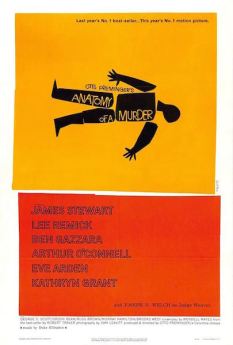 Anatomy of a Murder is a courtroom drama, adapted from a novel by a real-life defence attorney (“defense attorney”, I suppose), who in turn based his fiction on a real case. This background not only adds to the veracity of what we see, but likely explains the film’s style and structure.
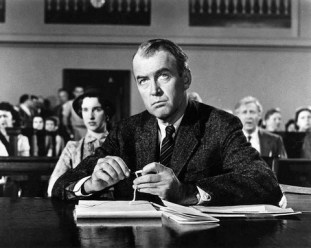 A lot of this support is down to Stewart’s performance — it feels wrong to be cheering the defence counsel of a murderer, even if he had a justifiable motive (which, remember, he may not have) — but we’d probably cheer Stewart on if he was the murderer. His Biegler is always in control, from investigation to courtroom, even when by rights he should be completely out of it. He manipulates the judge, the prosecution, the jury and the crowd to perfection; the viewer sits by his side — we know he’s playing them so we can revel in it — but, in turn, he manipulates us too, tempting us to his team — to laugh at his jokes, to support his case, to loathe the prosecution, even though they might be right. It’s a stellar lead performance.
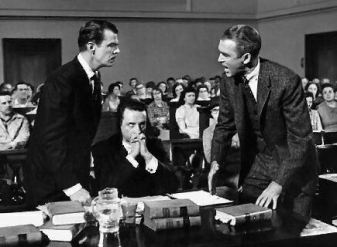 I could just as well go on to praise Ben Gazzara, Arthur O’Connell, Eve Arden, Brooks West, even the smaller roles occupied by Kathryn Grant, Orson Bean, Murray Hamilton and others. Some criticise Joseph N. Welch’s judge, and it’s perhaps true that his performance is a little less refined than the others, but as a slightly eccentric judge he comes off fine. And to round things off, there’s an incredibly cute dog. Mayes’ screenplay is a gift to them all, finding room for character even within the ceaselessly procedural structure, using small dashes of dialogue or passing moments to reveal and deepen each one.
 His Girl Friday is an acknowledged classic — 19th on the
  M is a film of immense significance, not least because of its place on
  the public reaction and hysteria; the police’s flailing investigations and increasing exasperation; the criminal underworld, who begin their own manhunt because police inquiries are “bad for business” (despite sounding like a filmic conceit, this element was directly inspired by a newspaper article); and the criminal himself — trying to lay low, but constantly having to fight his urges… and ultimately giving in to them again.
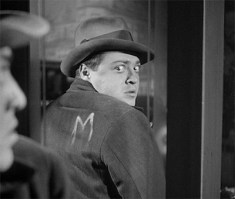 how they search crime scenes with a fine-tooth comb; another sequence shows their methodology for staging a raid; and so on. Such precise and clinical methods ultimately pay off: it’s a pair of tiny clues, carefully reasoned and sought out, that reveal the killer’s identity — and if it weren’t for the criminals getting there first, they’d’ve surely caught him too. Indeed, were it not for this breakthrough then the film might hold a
  like tracking from outside to inside through a window within a single shot — are present here). M’s individual moments of brilliance go on — perhaps my favourite is when the police arrive just after the criminals have apprehended Beckert. We don’t even see an officer on screen, but the burglar’s reactions let us know who’s there. Its a funny moment (even if we’ve seen it dozens of times since) and a lovely shot too.
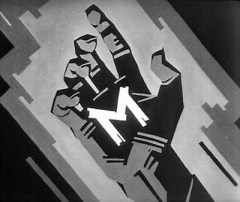 the murderer won’t bring the children back, and warns viewers to watch out for their own. It’s not the triumphant “we got him!” that concludes most serial killer films, but a blunt warning that, though Beckert has been caught, there are always more out there, waiting to strike. History has sadly proven her right; but while the world has produced many men and women like M’s villain, it hasn’t produced many films quite like M.
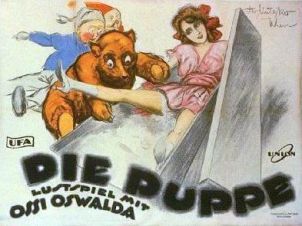 From the very start, Die Puppe sets out its stall (literally) as being something a bit special. The first sequence sees director Ernst Lubitsch himself unpack and assemble a doll’s house set and two dolls, which then become life-size and the dolls — now humans — the first characters we meet. It’s a neat framing device, a joke in itself, and some kind of early commentary on the role of a director.
 As we head in to this year’s awards season, I’ve finally got round to seeing last year’s big winner. It’s the Little British Film That Could, and I do feel like I’m the last person in the country to see it.
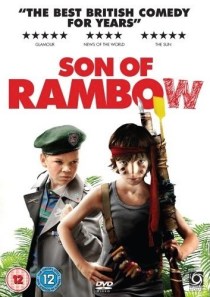 Of late I’ve posted
  abound, from the comic asides with Didier to Will’s fertile imagination realised through animation, or the post-credits snippet of dialogue.
 but realise the error of their ways to come back together in the nick of time) and the lessons learnt are hardly new (true friendship can conquer all), but it’s all put together with immense joy and skill, built around a charming concept, that it becomes far more than the sum of its parts.
 “The paths of glory lead but to the grave,” wrote Thomas Gray, and Stanley Kubrick — adapting from the novel by Humphrey Cobb — sets about proving him right.
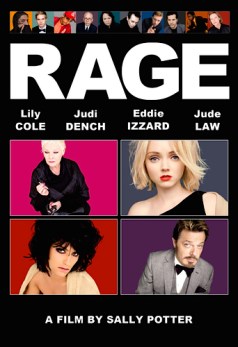 I really didn’t expect to like this: a series of straight-to-camera monologues, performed in front of just plain-coloured backgrounds, about the fashion industry, written and directed by the writer/director of
 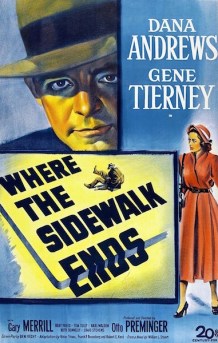 Otto Preminger’s film noir — scripted by Ben Hecht, adapted from William L. Stuart’s novel by Robert E. Kent, Frank P. Rosenberg and Victor Trivas, and quite what the difference between “adapting” and “writing” are I’m not sure — offers complex characters in a multi-layered plot. The ending particularly underlines this: the filmmakers could’ve killed anti-hero Dixon, could’ve had him choose to not open the letter, etc; but the decision he takes and the reactions of others are all relatively complex. Earlier, the sequences following Paine’s death are well constructed to produce the maximum amount of tension; their plotting clever, allowing for multiple (albeit similar) interpretations of events. Things happen which seem irrelevant, but are of course none-more-relevant later. Few films today are so brave as to not explain such things immediately.
 100Films.co.uk