
Guy Ritchie | 128 mins | Blu-ray | 12 / PG-13
 “Oh my God, what have they done to Sherlock Holmes?!” Etc etc. By this point you’re likely to have heard the arguments that Guy Ritchie’s blockbuster re-imagining of the Great Detective is actually based on all sorts of references and allusions in Sir Arthur Conan Doyle’s original works, so I won’t go over them again here. Indeed, I’m not even convinced they’re relevant in the first place.
You see, it’s true — Ritchie and co have turned grumpy old romance-free Holmes into a comedic action hero with a love interest. But he still has the brilliant mind, he still has a mystery to solve, and that love interest is Irene Adler, “the one that got away” from one of Conan Doyle’s earliest Holmes tales. Perhaps this isn’t such an unfaithful Holmes after all.
And actually, the mysteries Holmes solves make some of the film’s most interesting bits. Numerous murders and impossible escapes make up the narrative, slipping by almost unnoticed in the main plot; but, come the climax, in true detective story fashion Holmes has an explanation for how every one was done. There’s the equivalent of Poirot gathering all the suspects together to explain it to them, only in Ritchie’s blockbusterised version of a classic detective story this takes place atop a half-built Tower Bridge with the villain dangling precariously over his doom.
 The way to this climax offers a good mix of detecting, action and humour. It’s not pure Holmes then, but it’s not pure blockbuster either. Downey Jr brings some of his Tony Stark magic, but his take on Holmes is still distinct, not just because of his faultless English accent. His madness, obsession and genius are all well portrayed, and Ritchie’s direction matches it beautifully.
Some of the early scenes make for the most perfect evocation of Holmes I’ve seen on screen, such as when he’s in a restaurant and the sheer volume of noise becomes too much, thankfully broken when his guests arrive; or the fight sequences, where we listen as he meticulously plans every last move in super-slow-mo — all shot for real in-camera, incidentally — before executing them in a matter of seconds. The Matrix-esque slow-mo punches and what have you may have looked derivative in the trailer, but in context they’re bang on.
Though this is Downey Jr’s film, most of the cast are up to the task. Even Jude Law, who I’m no fan of, makes for a decent sidekick of a Watson, his shoot-first characterisation contrasting with Holmes’ thoughtful care better than the regular question-asking audience-cypher. Mark Strong’s villain is suitably chilling, aided by the film’s irreverence: if they can make Holmes into a quip-dealing action man, maybe there really is something supernatural at work? To reveal the truth would spoil that proper climax. The closest to a weak link is Rachel McAdams’ Irene Adler. I like McAdams well enough generally, and here too, but she may still be a little out of her depth — they’ve gone for a Pretty Young Thing when someone a little older may’ve suited better.
The closing moments set up a sequel in the most blatant way possible — if Batman Begins‘s Joker card is a brief, subtle indication, Sherlock Holmes‘s equivalent would be to have Batman and Gordon debating who this Joker feller might be and what he might want for a couple of minutes. It’s a bit too much, if you ask me, particularly as the Joker in question (oh, you all know who it is) isn’t actually seen — rumours of a famous cameo prove to be false.
And so what we find with this new Sherlock Holmes is an entertaining blockbuster, but with enough ‘proper Holmes’ laced underneath to make it feel different, unique even. 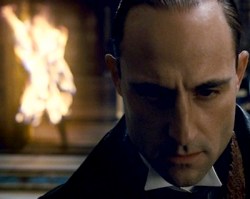 Ritchie brings something special to the director’s chair too, believe it or not — you may think he’s sold out into blockbusterdom to revive his flagging and repetitive career, but the touches he brings suggest the mind of someone who has control of his material, his camera and his edit, and wants to use them all to try something a bit different, not just another hack-for-hire who could churn out any old template-hewn action/adventure flick.
Perhaps it’s a little long in places. That might be my only complaint. And yet, for that, I’m certainly looking forward to Sherlock Holmes 2.

Steven Moffat and Mark Gatiss’ modern-day re-imagining of Sherlock Holmes, Sherlock, starts at 9pm tonight on BBC One.
Sherlock Holmes placed 8th on my list of The Ten Best Films I Saw For the First Time in 2010, which can be read in full here.
 Is Anybody There? has been described as “lightweight” in some reviews. Tosh and piffle — I don’t think that’s true in the slightest, and it’s left this rather excellent film to be distinctly underrated.
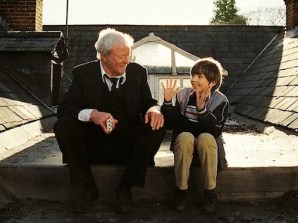 initially antagonistic relationship merges seamlessly into a deep friendship and respect; one that doesn’t go unchallenged, but survives it all to make them both better people.
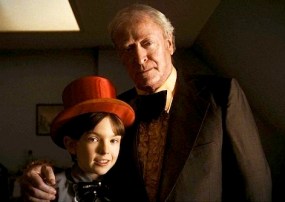 It’s a well-balanced film that hits that genuinely realistic note: life is rarely all comedy or all tragedy, and more often than not the most hilarious moments are locked up inside the most unbearable. It’s a truth a few more drama writers could productively learn, instead of remaining so insufferably po-faced because they’re creating a Serious And Meaningful Dramatic Work.
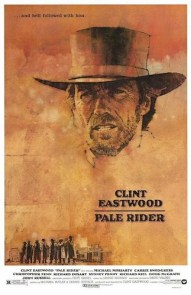 Pale Rider is, in many ways, a pretty stock Western. The plot is likely to be familiar even to those who haven’t seen a great deal of the genre: remote community, where some controlling business-type is making life hard for a bunch of everyday poor grafters; in rides a mysterious stranger, who sees the injustice of the situation; when peaceful methods don’t work, there’s the climactic shoot-out; and the mysterious stranger finally rides into the sunset/from whence he came/forever on.
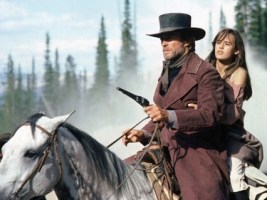 but the person he has in mind is dead… and yet, when they come face to face, the marshall repeatedly utters, “it is you”.
 the only particularly memorable role is Sydney Penny’s naïve young teenager, Megan. Her shifting emotions and variable actions are perhaps the only parts of the story one can’t necessarily see coming from the off.
 It’s generally taken as a rule that an original film is better than the remake, particularly so if that original is in a language other than English and the remake is American. But there’ll always be something to buck the trend, and in my view that’s Insomnia.
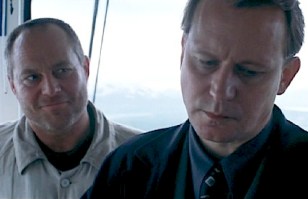 surprised how little his lack of sleep had to do with anything. Here, there are several scenes of Skarsgard struggling to sleep, he’s visibly rougher as the film progresses, and it seems to impact his judgement and sense of what’s going on more than in Nolan’s film. If the other character elements are apparently less developed, this is something the original does better.
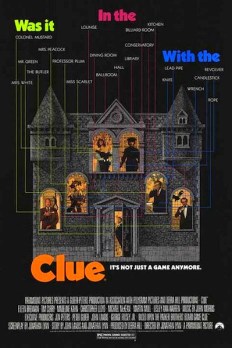 Although Disney have recently treated (I use the word loosely) us to a glut of films based on theme park attractions, movies adapted from good old board games seem a lot rarer. This is probably for good reason — even more so than Disney rides, the majority have no kind of useable narrative. Cluedo (aka Clue in the US) is one of the few that does, and consequently is one of the few (only?) board games that has reached the silver screen. So far, anyway.
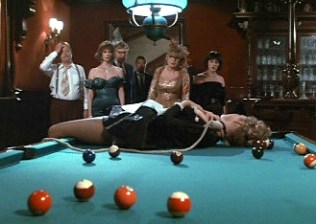 Other than the board game connection, Clue is best known for its three different endings, all of which were released, with each screening having just one attached. On TV the film shows with all three consecutively, and they perhaps work best this way — there’s a rising scale of ridiculousness, and the varied repetition of a couple of gags underlines rather than steals their amusement value. My personal favourite variant was the first, incidentally.
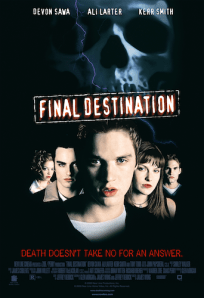 Final Destination is a full decade old this year, which somehow seems too long — it can’t be so old, surely? On the other hand, it fits quite comfortably into that run of teen-centric horror films from the the mid- to late-’90s, like
  The most important part, all things considered, are the ways Death settles the score. No mysterious “natural causes” demises here — Final Destination is all about inventive executions. Even after a decade, in which some of the Great Big Shocks have been revealed in various Top 10s and “OMG do you remember the bit where…” conversations, some bits remain impressive and/or amusing. And it certainly has fun with a few of them, teasing the viewer with various means of dispatching the victim before they ultimately succumb to one. Or, alternatively, just surprising us with a sudden whack. Both are good. Only one bit — a fidgety-armed corpse — is a thoroughly gratuitous jump-scare.
 but that one solitary shot confirms it must be some kind of entity with a very specific motive. And that’s a shame, because it’s not developed further — i.e. no Big Reveal of the nasty Death-thing — and would’ve been more interesting to play with that ambiguity — is Alex right that it’s all planned, or is it just a series of nasty coincidences?
 Ah, Rambo. Rambo Rambo Rambo. The only Rambo film I’ve seen is
  Stallone is perfect for the character: suitably calm and ‘everyman’ at the beginning; muscular and mostly silent as the trained assassin; and even an actor capable of pulling off the final breakdown, when the horrors of war spill over. It’s difficult to imagine most muscle-men action stars pulling off Rambo’s closing speech. Throughout, Rambo’s PTSD is made obvious without being overdone: brief flashbacks suggest all the horror we need to know, topped by his final outburst. Rambo isn’t the beast, the men who made him that way are, along with those he did it for who fail to appreciate what he’s been through.
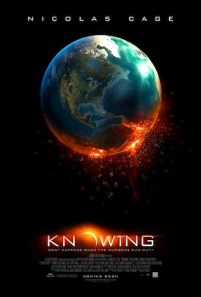 Not many people seem to like Knowing. Quit the opposite, in fact. I must confess, I’m not really sure why. I can read their reasons, of course, but I still thought it was a decent film. Solidly entertaining even, I’d say.
 those numbers down, and other such technical queries, but that seems like needless nitpicking.
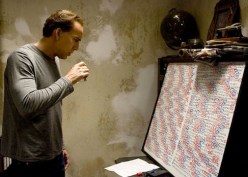 I will accept, however, that the very last shot is arguably a step too far and a little cheesy.
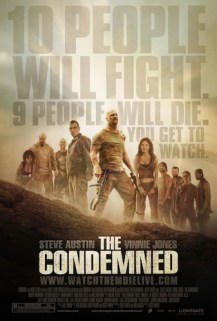 The Condemned is an old-fashioned-ish action movie, produced by WWE Films — i.e. the people behind all the wrestling claptrap. I should very much like to point out that I don’t care one jot about WWE or any other form of wrestling, real or faked. So why watch this? Because it’s got nothing to do with WWE itself aside from one (or more, I don’t know) former wrestlers acting in it.
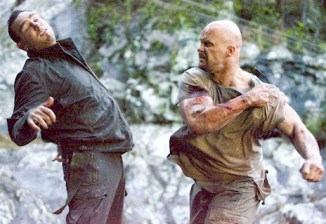 Indeed, in places it’s even satirical. Largely, though, the plot flatly commentates on society’s preoccupation with violent entertainment. Ironically, this is criticising not only organisations like WWE, who produced the film, but the genre of the film itself. It’s difficult to tell if director/co-writer Scott Wiper and his fellow filmmakers are aware of this irony/self-criticism, but if we give them the benefit of the doubt it becomes a nice layer.
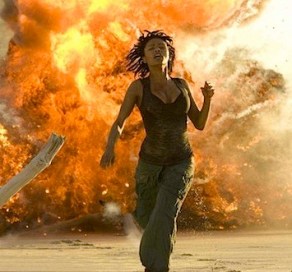 The same can be said of the action. With ten people, nine of whom will die, it could just be a series of fights where the designated Good One emerges victorious. And yes, there are a couple of fights of this nature, but as Things Go Wrong the realistically sick side of the ‘game’ is revealed: one female is cut up and presumably raped, all streamed live, while another is tortured before eventually being burned alive. It’s disgusting but, crucially, the film agrees that it is. That might sound obvious, but one suspects certain entries in the torture porn genre would disagree. That it draws you in to the brainless action movie mindset — fights! deaths! yay! — before twisting it with a dose of nasty reality suggests a greater degree of thought to both its structure and social message than one might expect. Maybe this is only a serendipitous side effect of the story path the writers chose, but even if it was an accident the success of it is still present.
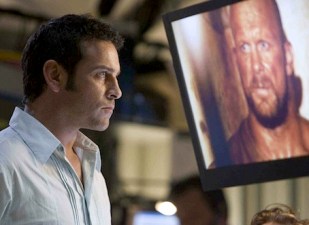 Something that amuses me is how many reviews call this “a brainless action movie” and make assertions like “the dialogue only serves to get from one action scene to the next”. Now, I’m not going to argue that The Condemned is actually some essayistic polemic on the evils of the media or modern violence-obsessed culture, but it has more to think about than the majority of action movies — meaning it’s neither brainless nor devoid of importance between action scenes. Perhaps you can enjoy this solely as a series of action scenes, but I have to wonder if those who do didn’t so much turn their brain off as have it removed (assuming there was one there in the first place) — the commentary on voyeurism and violence isn’t subtle and therefore certainly not accidental, so quite how it can be missed is beyond me.
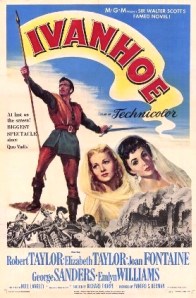 Ivanhoe is the kind of film they don’t often make any more, a pure swashbuckling romp. And when they do make them they tend to muck it up with over-complicated mythology-obsessed sequels — yes
 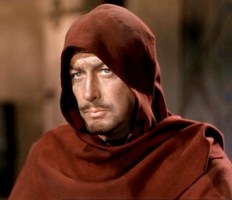 Though the final duel that ultimately follows can’t quite live up to this in terms of sheer scale and excitement, it impressively holds its own as a climactic action sequence.
 100Films.co.uk