
Ang Lee | 127 mins | Blu-ray | 1.85:1 | USA, Taiwan, UK, Canada & France / English, Tamil, French, Japanese, Hindi & Chinese | PG / PG
 2013 Academy Awards
11 nominations — 4 wins
Nominated: Best Picture, Best Adapted Screenplay, Best Film Editing, Best Sound Mixing, Best Sound Editing, Best Original Song, Best Production Design.
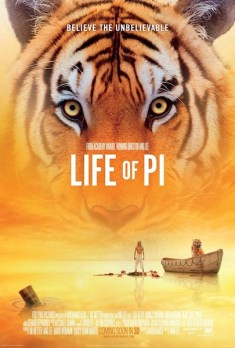 “Unfilmable” — now there’s an adjective you don’t hear tossed about so much these days. For a long time it seemed like it was all the rage to label novels “unfilmable”, but at this point too many ‘unfilmable’ novels have been filmed, and the wonders of CGI have put paid to anything ever again being unfilmable for practical or visual reasons. It may still be an apposite descriptor for works that feature very literary storytelling, though if you can render something like the subjective and unreliable narrator of Fight Club on screen — and in a movie that many regard as being superior to the novel, too — then there are few boundaries in that realm either. And someone even made On the Road, so just as soon as The Catcher in the Rye gets filmed we can probably put “unfilmable” to bed forever.
Yann Martel’s internationally-renowned Booker Prize-winner Life of Pi is one novel that used to have that adjective attached (of course it was — that would’ve been a pretty stupid introductory paragraph otherwise, wouldn’t it?) I’ve never read the novel, but I suspect it may’ve earnt the label for both of the above reasons, because it concerns, literally, the story of a boy stuck on a lifeboat with a tiger, and, figuratively, the very nature of storytelling itself — not to mention the purpose of religion and the existence of God. Never has “from the director of Hulk” seemed less pertinent.
Said director — Ang Lee, of course — did win one of this film’s four Oscars. Match that with two of its others — namely, for cinematography and visual effects — and you get an inkling of one of the film’s most praised facets. Whatever one thinks of the film’s story and themes (and I’ll come to those), it looks incredible. This is the kind of film that demands the increased resolution and colour palette of HD; it may even demand the 3D it was shot in, because watching in 2D it felt clear that wasn’t its native format — not because of the old cliché of things being thrust in the viewers’ collective face (well, only once or twice), 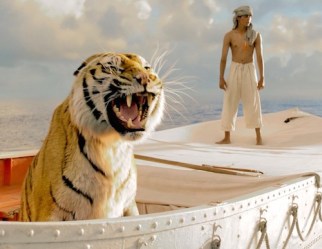 but because of almost-indefinable features of each shot’s crispness, its depth of field, even the compositions. It absolutely works in 2D, and it didn’t leave me longing for 3D in quite the same way as something like the swooping aerial sequences of How to Train Your Dragon, but, unlike with the majority of movies released in 3D, I did feel like I wasn’t seeing the director’s full vision.
Nonetheless, Claudio Miranda’s Oscar-winning cinematography proved controversial in some quarters. While the movie is indeed beautifully shot, swathes of it are also awash with CGI, so I think there’s some merit to the argument that it doesn’t count as photography. Conversely, I’d actually argue that the real-world bits look even more glorious than the digitally-rendered parts, on balance. Sure, you have the obvious spectacle of the psychedelic whale-jump, featured heavily in trailers and on the Blu-ray 3D cover, and the painterly skies and seas while in the lifeboat; but the early sequences in India, bursting with crisp, luscious colour in the zoo or at a nighttime light festival, are in some respects even more memorable.
To give with one hand and take with the other, however, I felt that the pair of aspect ratio shifts were utterly pointless and, worse, distracting. Firstly, I believe 2.35:1 was used for the flying fish scene to make the sequence feel more epic, and to allow the fish to jump further out of the screen. Well, in 2D the latter is lost entirely; and on TV (and possibly in the cinema, presuming the screen-space got thinner rather than wider), the movie suddenly feels constrained — the exact opposite effect to when films like The Dark Knight or Hunger Games 2 open out for their IMAX sequences, for instance. 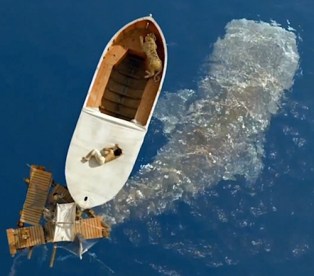 Later, the 4:3 “book cover” shot is just pure indulgence. There’s no reason not to just have empty sea to the left and right of frame, and the “it’s emulating the book cover!” reason/excuse doesn’t come close to passing muster simply because book covers aren’t 4:3. In both cases, then, what was intended to be striking or clever or innovative or in some way effective, I guess, comes across as pointless and distracting and pretentious.
And if we’re talking daft choices, don’t get me started on the meerkat-infested carnivorous island…! Maybe there’s some Deeper Meaning there — or, later, is the film deliberately lampshading the island’s total lack of meaning, when Pi tells the journalist that there doesn’t need to be meaning if it’s just what happened? Whatever — for me, it only served to make 110% sure we know (spoilers!) that Pi’s whole story is definitely BS. In that respect, the bizarre fancifulness was heavy-handed.
Ah, the story. To be honest, I liked it a little better a year later when it was called All is Lost; some people liked it better a decade earlier, when the tiger was a volleyball called Wilson. The striking imagery of a boy stranded on a boat with a tiger makes one assume that’s what the film’s About, but it’s not really About that at all. If you’re expecting a pure adventure on a life-raft, the long preamble where Pi describes his early experiences of religion must seem utterly pointless, but it all feeds back in at the end when we come to the point of Pi’s — well, Martel’s — tale.
I’m going to discuss the end while avoiding direct spoilers, but, honestly, any foreknowledge of the film’s (possible) message(s) is liable to colour your perception; so if you’ve not seen it, it may be best to skip the next paragraph until later.
 Reading around a little online, it seems that some people have interpreted the film’s message as being a defence of/justification for/persuasion towards religious faith, and hate it for that. This interests me, because I — coming, I suspect, from a similar perspective on religion — read it as a subtle condemnation of religious stories. Actually, not a condemnation, but a tacit acceptance of the fact that such stories are a nice fairytale, but not the truth. To put it another way, I took the message to be (more or less) that religion is an obvious fiction which people choose to believe because it’s a nicer story than the more plausible alternative, neither of which are provable. I think some focus on the point that the journalist hearing Pi’s story is told it will make him believe in God, and, at the end, the journalist seems to accept that it does. I don’t think that’s the film’s contention, though; I think the film is, in a way, explaining why people believe in God. Or maybe there are just no easy answers.
Seeking those answers, Rafe Spall is very good in what amounts to a tiny supporting role… but then, I have a fondness for him as an actor (his excellent, just-the-right-side-of-OTT turn as a gangster’s unhinged psychopathic son is the only real reason to watch The Shadow Line), so I may be biased. One must also single out Suraj Sharma, an unknown cast almost by accident when he accompanied his brother to the auditions, but who gives a good turn even when mostly performing opposite a CG tiger, a CG sea, CG fish, more CG…
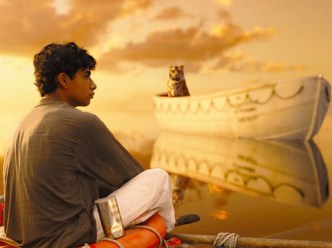 I found Life of Pi to be a little bit of a mixed bag, on the whole, where moments of transcendent wonder-of-cinema beauty rub up against instances of thumb-twiddling; where insightful or emotional revelations rub shoulders with pretentious longueurs. There is much to admire, but there are also parts to endure. The balance of reception lies in its favour, but while some love it unequivocally, a fair number seem to despise it with near-equal fervour. Either way, it’s definitely a film worth watching, and in the best possible quality you can manage, too. It also made me want to read the book, which for a movie I wasn’t even sure how much I liked is certainly an unusual, but positive, accomplishment.

The UK TV premiere of Life of Pi is on Channel 4 (and 4HD) tonight at 9pm.
 James Woods is the owner of a trash TV station who’ll do pretty much anything for ratings. His hunt for the next ‘big’ thing leads him to come across the signal for a channel that shows just one bizarre, disturbing programme. Obsessed with finding out the truth behind it, he gets suckered in to a conspiracy that blurs the line between reality and imagination.
 I guess for some people the “ew”-inducing effects are the primary delight of the film. These are the kind of people who complain about the UK version being cut. In truth, this is actually the originally-released R-rated version; the so-called Director’s Cut adds just over a minute. Having read about
 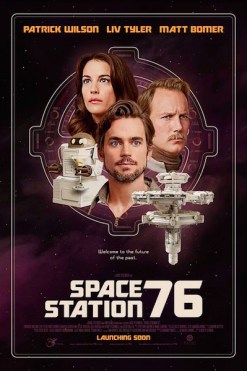 Liv Tyler is the new first officer on a space station commanded by Patrick Wilson in this retro-future-styled film, which is both a spoof of/riff on ’70s genre movies, and a character drama about people’s relationships. No, really.
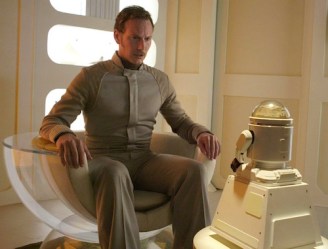 used to feed into the humour, that’s simply what makes it, a) a period movie (just a period movie set in the future), and b) a comedy-drama (as opposed to a drama). I think this is the real reason for its lowly regard on sites like IMDb: those expecting Anchorman in Space are going to be disappointed; but you can’t blame anyone for such expectations when that’s more-or-less how it’s trailed.
 The characters and their relations are well enough drawn to make it passably engrossing, even if not a stand-out contribution to any such genre, while the comedy pays off handsomely at times.
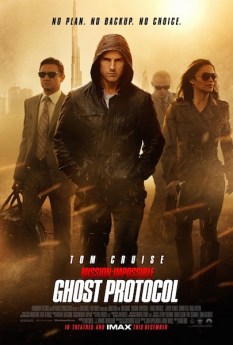 With Bond going “real world” and gadget-free in the Daniel Craig era, and the Bourne series having blazed a trail of “we shot it all handheld and shaky and grainy so it must be real” veracity, it seems the task of providing audiences with a contemporary version of the spy action, just-ahead-of-reality gadgets, and larger-than-life spectacle that the Bond movies specialised in during the ’60s and ’70s, has fallen upon the Mission: Impossible franchise. For my money, it’s taken the baton with aplomb.
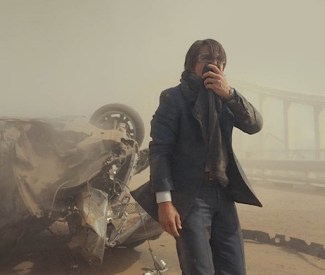 Somewhat unfortunately for pacing, they come halfway through. The climax is a mano-a-mano fight in an automated car park. It’s good, but feels underwhelming by comparison, with Michael “
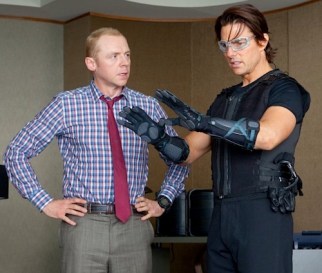 There’s a host of other gadgets to be going on with, though. It may be a side effect of having the writer-director of
 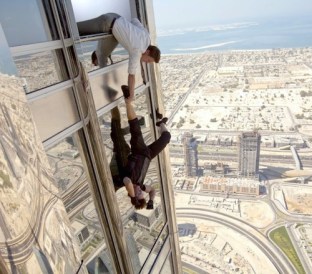 Still, that’s a fault of the home entertainment release, not the film itself. In all other respects, Bird’s work is first-rate. I like that the series consciously changes director with each new film to provide new ideas and voices, but if they were going to break the pattern then Bird would’ve been a good guy to allow back (certainly a superior pick than the third film’s J.J. Abrams, anyway, who was originally slated to tackle this sequel too).
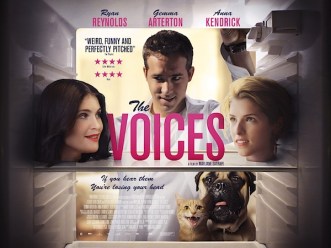 Jerry (Ryan Reynolds) is a nice guy living in the small town of Milton, working in shipping at Milton Fixtures and Fawcetts, where he fancies the English girl in accounts, Fiona (Gemma Arterton), and doesn’t notice how much another girl in accounts, Lisa (Anna Kendrick), likes him. He also talks to his dog, Bosco, and cat, Mr Whiskers, and they talk back. That’s why his psychiatrist (Jacki Weaver) encourages him to take his medication, but he doesn’t. When he accidentally murders Fiona (as you do), it’s Mr Whiskers that encourages him to cover up the crime.
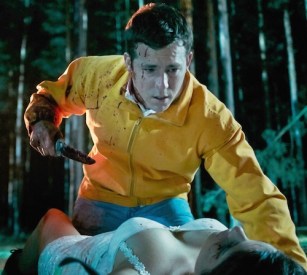 what happened in his past to make him this way (flashbacks and hints are scattered, leading to an eventual reveal), and how will it all end for him? We’re conflicted here, because he’s a nice guy who we like, but he’s also a murderer, in horrific fashion, and so surely justice is due. Screenwriter Michael R. Perry and director Marjane Satrapi (of
 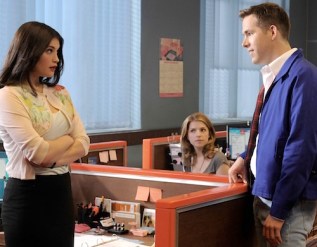 Able support comes in the form of three women in Jerry’s life. Gemma Arterton has a ball, first as a bit of a bitch, then as a ludicrously-chipper super-English talking head. Anna Kendrick, meanwhile, is sweet and likeable, and while we may be on Jerry’ side when he accidentally slides his knife into Fiona, we’re keen for him not to make the same mistake with Lisa. Whether he does or not is where the real battle for his sanity lies. The third is Jacki Weaver’s psychiatrist, who is central to the climax but also has the least to do of all three, really. Never mind.
 The Voices is the kind of film you say is “not for everyone”, which are often the best kind if they are for you. For me, it wasn’t quite funny enough — I’d’ve liked more of the dog and cat, who get the lion’s share of the best material. I also felt that Jerry’s backstory, the reasons for why he is how he is and does what he does, weren’t explored quite enough. The Blu-ray’s deleted scenes hint at more of this, particularly with an alternate climax, which was perhaps cut because there was too little material specifically building up to it. Rather than losing that ending, it would’ve been better to keep it and find more scenes that contributed to it.
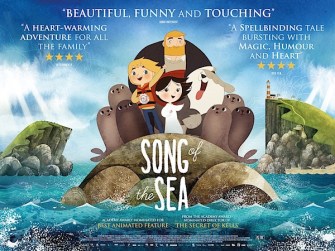 The second feature from director Tomm Moore and his pan-European team of animators (after the excellent, Oscar-nominated
 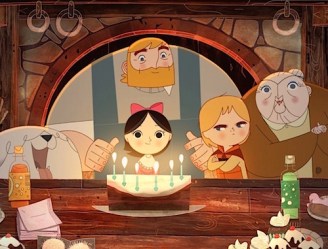 but the motivator for that is clearly resentment towards her for appearing the night his beloved mother left. Their father, too, is hamstrung by his grief, struggling to move on from his wife’s disappearance and fully engage with the world. His kids are his only connection, Saoirse in particular, but his mother makes him realise that clinging to them is damaging their lives too… or is it?
 all are factors that can, and do, elevate the film. Don’t get me wrong: this is a cut above your average animated adventure. I just didn’t enjoy it as much as The Secret of Kells.
 For more positives, Song of the Sea’s animation and design is at least as strong as it was in Moore’s previous film. There’s the ‘house style’ flattened, animated storybook look; a description which could sound like criticism but absolutely is not. Some very beautiful scenes are evoked, meaning that at the very least there’s always imagery to tide you over. I’d list some favourites, but we’d be talking about most of the film. That said, the depiction of a run-down, smoggy Dublin stands out as something different from the countryside idylls of Kells and the rest of the locales in Song of the Sea, but it’s not exactly “beautiful”. Rather, look to the island home of our heroes, a tall rock surrounded by the blue sea; the home of the glowing-eyed long-haired Seanachai (the moment when it suddenly turns around in the montage after Saoirse uses her coat for the first time is my favourite shot in the film, a little sliver of fantasy imagery that magnificently teases what’s to come); or the small sanctuary surrounded by a field of stinging nettles — again, a kind of gentle, on-the-edge-of-the-real-world fantasy that quite appeals to me. The fact the countryside is littered with half-hidden stone figures, which we know to be frozen magical begins, is another nice touch; especially as they’re often surrounded by human litter, the analogy (as I see it) being both that people exist around them but don’t even see them, and also that, presumably through our modern disbelief, we’ve thrown these legends out with our trash.
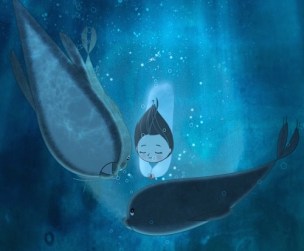 Even as I write, I’m talking myself round to liking Song of the Sea even more than I did on first viewing — and that was quite a lot, albeit coloured by my perception that I didn’t like it as much as The Secret of Kells. If you enjoyed Moore’s earlier film, this unquestionably merits seeking out (if you haven’t already, of course; I mean, I did). If you haven’t seen Kells, well, you’ve so far missed a treat; and now you’re missing two.
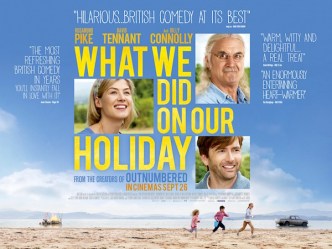 “
“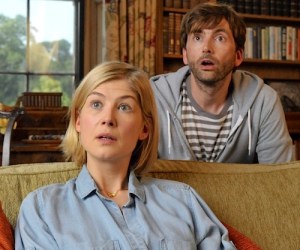 For some, the shift may scupper things. For me, it only makes it better: the story’s pathos and emotion are brought into focus, and the humour becomes all the funnier for punching in as tonal relief. It often seems to me that movies struggle to stay amusing for a full feature running time (there’s surely a reason all TV comedy comes in 30 minute chunks), but this story allows Hamilton and Jenkin to spread the laughs out a little without them feeling few or far between.
 including the likes of Ben Miller, Amelia Bullmore (getting the best subplot), Annette Crosbie and Celia Imrie. The real grown-up star, however, is Connolly. You get the sense he’s as scriptless as the kids are, improvising away with a mischievous twinkle in his eye, like some kind of idealised fun granddad. The scenes with just him and the kids are certainly one of the highlights, among the most amusing and the most affecting.
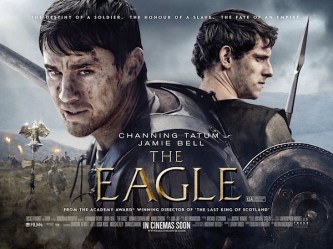 Channing Tatum is a brave Roman general whose father lost his company’s standard, the titular eagle, north of Hadrian’s Wall (a real historic event, coincidentally depicted in
 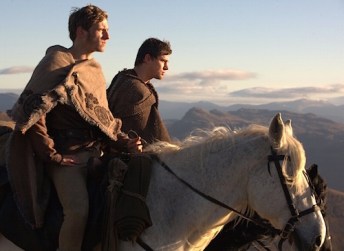 quality to the setting, characters, and imagery that’s quite striking.
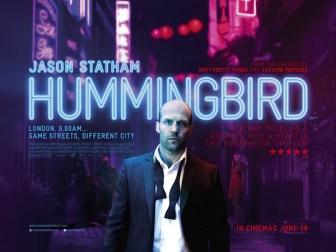 Steven Knight, the writer of
  The film’s problem, perhaps, is that it slips a little between two stools. It’s certainly not action-packed enough to appeal to a good deal of Statham’s fanbase — the one or two instances of him kicking ass are very much asides. On the flipside, it may not commit to the character drama fully enough to satiate the needs of that kind of viewer. However, for anyone at peace with those two apparently-disparate styles — like, well, me — Hummingbird will be a more satisfying experience.
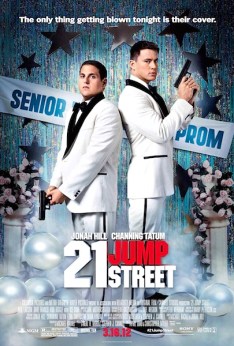 Having turned the unlikely-to-be-any-good story of a machine that makes it rain food into
  this leaves Hill hanging out with the cool kids — and being lured down the path of parties and their shallower friendship — while Tatum falls in with a gang of ultra-nerdy nerds and starts actually learning stuff. Distilled like that makes it sound pat, but in the film it works; in part because they don’t overplay the clichéd “friends fall out irretrievably… until it’s retrieved for the final act” story arc.
 100Films.co.uk