The Hateful Eight (2015)

2016 #89
Quentin Tarantino | 168 mins | Blu-ray | 2.76:1 | USA / English & Spanish | 18 / R
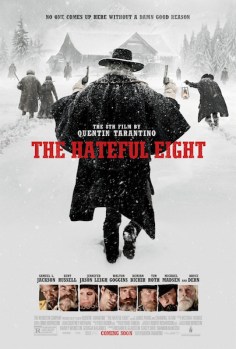
Quentin Tarantino hadn’t made a film in the same genre as his preceding movie for almost 20 years when The Hateful Eight came out — his second go-round with the Western genre, after the Spaghetti-ish thrills of Django Unchained three years earlier. Aside from the setting and its accoutrements, however, The Hateful Eight has more in common with Tarantino’s debut feature, Reservoir Dogs.

Wyoming, sometime after the Civil War: bounty hunter Major Marquis Warren (Samuel L. Jackson) flags down a stagecoach driven by O.B. (James Parks), looking for transport to Red Rock. Inside is fellow bounty hunter John Ruth (Kurt Russell) with his latest catch, Daisy Domergue (Jennifer Jason Leigh), who’s worth $10,000 — naturally, Ruth is suspicious of Warren’s motives. Later, they pick up Chris Mannix (Walter Goggins), who claims he’s to be sworn in as the new sheriff of Red Rock — also of great suspicion to Ruth. As a blizzard chases them, the quintet seek shelter at Minnie’s Haberdashery, a rest spot Major Warren has clearly visited many times before. However, Minnie isn’t home, and care of her establishment has been left in the hands of Bob (Demián Bichir). Inside, they find fellow travellers Oswaldo Mobray (Tim Roth), Joe Gage (Michael Madsen), and General Sandy Smithers (Bruce Dern). Ruth doesn’t trust a’one of them — and as they settle down to ride out the blizzard, it turns out he’s right about someone…

I’m not the first to observe that The Hateful Eight actually functions like a murder mystery, Agatha Christie style. It might be easy to miss because the film doesn’t begin with a murder or feature a detective, but then neither do all of Christie’s stories. Instead, there’s a long period setting up all the players and suggesting their motivations, and then eventually the proverbial does hit the metaphorical fan, after which deductions must be made. And it’s all in a remote, isolated location which has been cut off by weather, and every character is hiding some nefarious past — so far, so And Then There Were None. All of this comes dressed in QT’s famed dialogue, unfurled at the somewhat languorous pace he’s gradually been cultivating for a few movies now, and topped off with a few doses of the old ultra-violence.
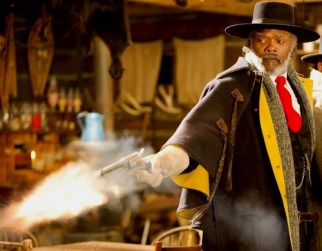
One reason the “whodunnit” label doesn’t really stick is that Tarantino doesn’t sit it out until the end. Without spoilers: there’s certainly mystery about who is and isn’t involved, but you can’t invest in that too much because the answer is a little bit Murder on the Orient Express. Not completely Orient Express (I said no spoilers!), but a bit. One factor he does handle well is that (again like And Then There Were None) you can never be quite sure whose side you should be on; who might turn out to be a villain. Even at the end, when all has been revealed, the heroes are hardly heroic.

More talked about than the film’s content has been the way it was made. Despite the confined setting, Tarantino chose to shoot it on 65mm film, using the Ultra Panavision 70 process (only the 11th film to do so) and lenses that hadn’t seen light in nearly five decades, all of which have produced incredible images. QT’s regular DP since Kill Bill (excepting Death Proof), Robert Richardson, has once again done sterling work, with beautiful shots of scenery near the start and a fantastic definition of space once we’re locked up in Minnie’s.

Ultra Panavision 70 produces an ultra-wide 2.76:1 frame (for those not in the know, your widescreen TV is only 1.78:1), which for such an intimate story has struck people as odd ever since it was announced. In fact, it pays off in (at least) two ways: firstly, all the scene-setting scenery looks magnificent; secondly, for a lot of the film there’s stuff going on in the background or at the edge of frame — it’s not just a series of close-ups or two-shots where the ancillary detail is either non-existent or doesn’t matter, but one where that ‘background’ detail is sometimes very instructive to what is going on. Tarantino also uses the full width a lot of the time, placing two figures at either edge of the image — this really isn’t a film you could crop (thank goodness it doesn’t exist in the pan & scan era!)

Richardson’s work was Oscar nominated but lost to The Revenant (which I’m now a little biased against, after it beat this, Fury Road, and handed Roger Deakins his 13th loss, but I’ll see what I think when it finally hits British home ent formats next month), but the film did triumph for Ennio Morricone’s score — and quite rightly so, too, because it’s incredibly atmospheric and effective. Tarantino has commented that it isn’t really a Western score (which you’d expect from Morricone, what with his famous ones), but more of a horror movie score, and that that’s appropriate for the film. And, y’know, that’s not pretentious director-speak — he’s right. Well, that the movie is a horror movie is debatable, but he is right that Morricone’s work sounds more like a horror score, and that that score is appropriate to this movie. It even recycles some of Morricone’s material from The Thing, as if to bring the point home (and that’s far from the only thing about The Hateful Eight that’s indebted to The Thing, but I’ll leave that for someone else to dig into another time). Even though this is the first time he’s had a full score composed for one of his films, Tarantino still sources a couple of well-selected songs from elsewhere, including a very apt credits track by Roy Orbison.

The Hateful Eight may have a deceptively simple story, with straightforward characters and — once they’re finally all revealed — straightforward motivations; and despite that running time, it’s not as grand or as epic as either Inglourious Basterds or Django Unchained; but I say “deceptively simple” because I feel that it’s the kind of film that might reward repeat viewings, to reveal depths of character as well as hints toward the ultimate reveals. Or maybe I’m being generous — maybe it is just a long-winded, verbose way of telling a slight tale. But if it is, it’s still a mighty entertaining one.

4 out of 5

The Hateful Eight is released on DVD and Blu-ray in the UK today.

Gangs of New York (2002)

100 Films’ 100 Favourites #35

America was born in the streets

Country: USA & Italy
Language: English
Runtime: 168 minutes
BBFC: 18
MPAA: R

Original Release: 20th December 2002
UK Release: 9th January 2003
First Seen: cinema, 2003

Stars
Leonardo DiCaprio (Titanic, The Revenant)
Daniel Day-Lewis (My Left Foot, Lincoln)
Cameron Diaz (There’s Something About Mary, My Sister’s Keeper)
Jim Broadbent (Moulin Rouge!, Another Year)
Liam Neeson (Schindler’s List, Kingdom of Heaven)

Director
Martin Scorsese (Goodfellas, The Departed)

Screenwriters
Jay Cocks (The Age of Innocence, Silence)
Steven Zaillian (Schindler’s List, The Girl with the Dragon Tattoo)
Kenneth Lonergan (The Adventures of Rocky & Bullwinkle, Margaret)

Story by
Jay Cocks (Strange Days, De-Lovely)

Inspired by
The Gangs of New York: An Informal History of the Underworld, a non-fiction book written in 1927 by Herbert Asbury.

The Story
New York City, 1846: after his father is murdered in a fight by fellow gang leader Bill ‘the Butcher’, young Amsterdam Vallon is dumped in an orphanage. Sixteen years later, he returns to the Five Points district. With revenge in mind, he tries to establish himself with the ruling gang and get close to their leader — Bill.

Our Hero
In the first of his five (to date) collaborations with Scorsese (or six if you count that advertising short they were paid an insane amount for), Leonardo DiCaprio is Amsterdam Vallon, son of a murdered gang leader who, decades later, plots his revenge. His nemesis is a cunning so-and-so, however…

Our Villain
Although he’s a ruthless killer, and the unquestionable villain from the outset, Daniel Day-Lewis manages to render Bill a perversely charming creation, who unavoidably captivates your attention whenever he’s on screen.

Best Supporting Character
Priest Vallon, Amsterdam’s father, only appears in the opening sequence, but his influence and death hangs over the rest of the movie. That’s why you need an actor of Liam Neeson’s calibre for the part, and of course such casting pays off.

Memorable Quote
“I’m 47. 47 years old. You know how I stayed alive this long? All these years? Fear. The spectacle of fearsome acts. Somebody steals from me, I cut off his hands. He offends me, I cut out his tongue. He rises against me, I cut off his head, stick it on a pike, raise it high up so all on the streets can see. That’s what preserves the order of things. Fear.” — Bill

Memorable Scene
Scorsese captures an entire lifecycle in New York’s Five Points within a single tracking shot, which begins with immigrants arriving fresh off the boat and ends with coffins lined up on the quay.

Memorable Music
I have mixed feelings about U2 (because, y’know, Bono), but the theme they crafted for GangsThe Hands That Built America — is a pretty good track, and sits very appropriately at the end of the movie. It was Oscar-nominated, but lost to Eminem’s Lose Yourself from 8 Mile.

Letting the Side Down
Scorsese tried to make Gangs of New York for ages. At one point, he wanted Meryl Streep for the lead female role. He ended up with Cameron Diaz. Say no more, eh.

Making of
Unable to film in New York, which no longer looked like it did back in the mid-1800s, the production was mounted on a large set at Rome’s Cinecittà Studio. According to Wikipedia, production designer Dante Ferretti constructed “over a mile of mid-nineteenth century buildings, consisting of a five-block area of Lower Manhattan, including the Five Points slum, a section of the East River waterfront and two full-sized sailing ships, a thirty-building stretch of lower Broadway, a patrician mansion, and replicas of Tammany Hall, a church, a saloon, a Chinese theater, and a gambling casino.” Now that is a set!

Awards
10 Oscar nominations (Picture, Director, Actor (Daniel Day-Lewis), Original Screenplay, Cinematography, Art Direction-Set Decoration, Costume Design, Film Editing, Sound, Original Song)
1 BAFTA (Actor (Daniel Day-Lewis))
11 BAFTA nominations (Film, Director, Original Screenplay, Cinematography, Music, Production Design, Costume Design, Editing, Sound, Visual Effects, Make Up/Hair)
2 World Stunt Award nominations (Best Fight (the opening), Best Stunt Coordinator and/or 2nd Unit Director)
1 Teen Choice Award nomination (Choice Movie Liplock)

What the Critics Said
“The ambition is immense. This is Scorsese’s version of D.W. Griffith’s Birth of a Nation and Michael Cimino’s Heaven’s Gate and there are echoes of Kurosawa, Eisenstein and Visconti, as well as the nod to Welles […] As with Heaven’s Gate, judgment on this film must await Scorsese’s longer version. Nevertheless, this remains an astonishing achievement, a film with a passionate sense of life, by one of the greatest filmmakers at work today.” — Philip French, The Observer

Score: 75%

What the Public Say
“This movie, even if it ended with Amsterdam’s degradation rather than his triumph, would be fabulous, probably only inferior to Raging Bull and Goodfellas among Scorsese’s oeuvre. The problem is that the movie is nearly three hours long, and that the movie continues after Amsterdam’s maiming. There is a marvelous story to be told about American tyranny, about the immigrant experience, about just how firmly entrenched the powerful are. Do you choose bellicose racism as Bill does, or do you throw your lot in with benevolent corruption as Tweed does? It hardly seems to matter; you will be expunged and forgotten in the slop and grime of the Five Points all the same while someone else wears a tall hat and eats well.” — speakerformediocrities, Seeing Things Secondhand

Verdict

Gangs of New York ended up with a bit of a mixed reception when it finally came out in 2002, which is only to be expected after Scorsese had been intending to make it for over 20 years, and the version he had shot was stuck in editing for a year (considering all the Director’s Cuts we get nowadays, why have we never had Scorsese’s original 48-minutes-longer cut?) It’s undoubtedly a compromised film, then, but one that retains a rich atmosphere, engaging performances (even if it suffers from two of the leads, DiCaprio and Diaz, being two of the least accomplished), and an impressive sense of scale. It may have a relatively simplistic revenge-tale throughline, but class swirls around it.

#36 will be… 攻殻機動隊.

The Game (1997)

100 Films’ 100 Favourites #34

Players Wanted

Country: USA
Language: English
Runtime: 128 minutes
BBFC: 15
MPAA: R

Original Release: 12th September 1997 (USA)
UK Release: 10th October 1997
First Seen: TV, c.2000

Stars
Michael Douglas (Wall Street, Basic Instinct)
Sean Penn (Dead Man Walking, Milk)
Deborah Kara Unger (Crash, Stander)

Director
David Fincher (Panic Room, Gone Girl)

Screenwriters
John Brancato (The Net, Terminator 3: Rise of the Machines)
Michael Ferris (Terminator Salvation, Surrogates)

The Story
What do you buy the man who has everything? After high-flying businessman Nicholas Van Orton is enrolled in a mysterious alternate reality game by his estranged brother, it’s no surprise that unusual things start to happen. But as those happenings begin to take on a sinister edge, it may be Nicholas has been targeted by something more serious, and potentially life-threatening.

Our Hero
Nicholas Van Orton is an immensely successful financier, but so low on friends that he even spends his birthday completely alone. He could do with fun in his life, or so believes his brother… or does he?

Our Villains
The game is run by a company called Consumer Recreation Services, or CRS. But they just run games… or do they?

Best Supporting Character
Early on in his experience, Nicholas runs into waitress Christine, who has also been affected by the game… or is she actually a part of it? Just who can he trust?!

Memorable Quote
“You know, I envy you. I wish I could go back and do it for the first time, all over again. Here’s to new experiences.” — Ted

Memorable Scene
On the run and tired, Nicholas hops in a cab. He doesn’t notice the doors lock, until the maniacal cab driver begins to speed down the hill. As Nicholas desperately tries to escape, the driver leaps out — and the cab soars into the river, with Nicholas trapped inside…

Awards
1 Saturn nomination (Action/Adventure/Thriller Film)

What the Critics Said
“Crafted with a commanding, aloof precision by David Fincher in his first outing since hitting the jackpot with Seven, this unusual dive into the ambiguous world of an undefined pastime without apparent rules generates a chilly intellectual intrigue that will arouse buffs, trendies and techies more than it will mainstream [audiences. It] projects the same sense of suffocating enclosure and mounting despair in a style that will inevitably be compared to that of Stanley Kubrick in its steely technical mastery and remote, disenchanted worldview, all in the service of a story that resembles a highbrow puzzle as much as it does an involving narrative.” — Todd McCarthy, Variety

Score: 72%

What the Public Say
“just when we’ve finally come to a part of the story we can accept and trust, it turns out that we’ve once again been led astray. In this cinematic game, Fincher’s directorial ability wins out; his ability to pace his films; to completely draw the audience’s attention in whichever direction he requires, as well as keeping them emotionally attached to the protagonists is a balancing act which Fincher has mastered time and again over his career, and The Game is no exception.” — jyapp8715, Through the 4th Wall

Elsewhere on 100 Films
I reviewed The Game as part of a retrospective on Fincher’s films back in 2011, saying it “is by far at its best on your first viewing, when you don’t know how it will end and it’s stuffed with mysteries and twists. That’s not to say it doesn’t bear repeat viewings — as with most twist-ending-ed films, there’s naturally some interest in seeing it again knowing what’s going on — but a lot of the film’s enjoyment comes from being played with, the back-and-forth of what the truth is.”

Verdict

In fairness, The Game probably comes near the bottom of my top 100, because I remain a little dubious about its re-watch value — not because it’s poorly made (far from it), but because the twists and reveals are such a big part of its appeal, and once you know them, you know them. Also, arguments continue between its fans and its haters about whether the plot makes sense or not, and how much that actually matters — personally, I think it makes enough sense (maybe for some parts you have to switch on your “it’s a movie” filter, however). The reason it makes my list nonetheless is the quality of a first viewing, especially if you do buy into its conceit and just go with it. Few other films have kept me guessing from the start up to the very closing moments, and consequently on the edge of my seat throughout. That experience may be unrepeatable, but as one-time deals go, it was immeasurably memorable and effective.

#35 will be… the hands that built America.

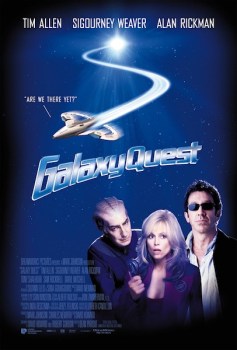
Galaxy Quest (1999)

100 Films’ 100 Favourites #33

The show was cancelled…
but the adventure has only begun.

Country: USA
Language: English
Runtime: 102 minutes
BBFC: PG
MPAA: PG

Original Release: 25th December 1999 (USA)
UK Release: 28th April 2000
First Seen: DVD, c.2001

Stars
Tim Allen (The Santa Clause, Christmas with the Kranks)
Sigourney Weaver (Alien, Avatar)
Alan Rickman (Dogma, Harry Potter and the Philosopher’s Stone)
Tony Shaloub (Men in Black, Pain & Gain)
Sam Rockwell (Confessions of a Dangerous Mind, Moon)

Director
Dean Parisot (Fun with Dick and Jane, RED 2)

Screenwriters
David Howard
Robert Gordon (Addicted to Love, Lemony Snicket’s A Series of Unfortunate Events)

Story by
David Howard

The Story
The cast of ’70s sci-fi series Galaxy Quest have been reduced to convention appearances and mall openings since their show was cancelled; but when a group of aliens, who believe the series was an historical document and have built the show’s spaceship for real, ask for the crew’s help to defeat a genocidal general, the actors must endeavour to become their characters for real.

Our Heroes
A ragtag gang of washed-up actors who used to star on a space opera TV series, now co-opted into being real heroes. They’re all based on the cast and characters of Star Trek, of course: Tim Allen’s Jason Nesmith, the ship’s captain, is obviously William Shatner/James T. Kirk; Sigourney Weaver’s Gwen Demarco, the token female, is Nichelle Nichols/Uhuru; Alan Rickman’s Alexander Dane, the classically-trained actor playing an alien science officer, is a combination of Leonard Nimoy/Spock and Patrick Stewart; Tony Shaloub’s Fred Kwan, a fake-foreign engineer, is a mixture of James Doohan/Scotty and Walter Koenig/Chekov; and Daryl Mitchell’s Tommy Webber, a young helmsman from an ethnic minority, is a mixture of George Takei/Sulu and Wil Wheaton/Wesley Crusher.

Our Villain
General Sarris, a reptilian warlord waging war against the kindly Thermians. No discredit to Robin “Ethan Rayne off Buffy” Sachs, but he’s kind of beside the point, really.

Best Supporting Character
Enrico Colantoni (Veronica Mars, Person of Interest) plays the leader of the friendly aliens, Mathesar, a naïve soul who speaks in a sing-song monotone.

Memorable Quote
“By Grabthar’s hammer, by the suns of Worvan, you shall be avenged.” — Sir Alexander Dane

Memorable Scene
Our heroes arrive in the bowels of their screen-faithful ship to find “a bunch of chompy, crushy things” impeding their path — for absolutely no reason. “We shouldn’t have to do this, it makes no logical sense, why is it here?… This episode was badly written!”

Making of
In cinemas, the film began with a 4:3 aspect ratio for clips from the old TV series, then widened to 1.85:1 for the Earth-based scenes, before widening again to a highly cinematic 2.35:1 once Tim Allen’s character realises he’s on a real spaceship. It was decided to ditch the middle stage for the home video releases, which I suppose makes sense, but is a lot less fun.

Previously on…
Galaxy Quest is an original creation, but it’s heavily inspired by the Star Trek franchise and its fans.

Next time…
A reboot TV series was supposedly in the works at Amazon, though comments made by co-star Sam Rockwell just last month suggest the project had developed into a direct sequel, which was then sadly scuppered by the untimely death of Alan Rickman.

Awards
1 Saturn Award (Actor (Tim Allen))
9 Saturn nominations (Science Fiction Film, Actress (Sigourney Weaver), Supporting Actor (Alan Rickman), Performance by a Younger Actor/Actress (Justin Long), Director, Music, Costumes, Make-Up, Special Effects)
Won the Hugo Award for Best Dramatic Presentation

What the Critics Said
“Whether you love Star Trek or laugh at it, your starship is about to come in, docking in the form of Galaxy Quest, an amiable comedy that simultaneously manages to spoof these popular futuristic space adventures and replicate the very elements that have made them so durable. […] If Galaxy Quest never attains consistently giddy heights as it plays out its combination of knowing satire and heroic adventure, it nevertheless keeps its tongue firmly in its cheek, offers a few genuine laughs, moves swiftly, if not at warp speed, and is led by a talented cast.” — Lawrence Van Gelder, The New York Times

Score: 90%

What the Public Say
“As a fan of the various science fiction classic series, like Star Trek and Star Wars, I’ve met most of the people parodied in Galaxy Quest – from the overzealous fans to the has-been and bitter celebrities making a living off a series’ memories. A movie like Galaxy Quest manages to poke fun at a wide range of people but still be loveable and sympathetic at the same time.” — Kevin Carr, 7M Pictures

What the Trekkies Say
In 2013, just after Star Trek Into Darkness came out, a massive convention of Trekkies decided to vote on the best Trek movies. Galaxy Quest muscled its way in to 7th place, besting six real Trek flicks. (Infamously, Into Darkness came dead last.)

Verdict

Managing to satirise both classic sci-fi TV shows and their (shall we say) enthusiastic fanbase, while remaining relatively respectful to both, is quite a feat, and is surely one reason Galaxy Quest has proven so popular. Another is its accessibility: you don’t need to be a Trekkie to get all the gags. Combine those two and you have a film for fans and non-fans alike. To really cement the issue, it’s a solid adventure movie as well as a funny comedy.

#34 will be… what you get for the man who has everything.

Election (1999)

2016 #74
Alexander Payne | 103 mins | streaming (HD) | 2.35:1 | USA / English | 15 / R

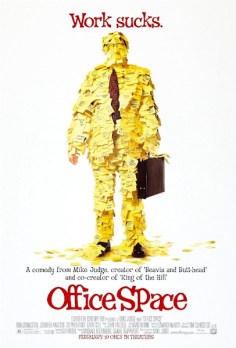
The third feature (but first you’re likely to have heard of) by writer-director Alexander Payne (Sideways, The Descendants, Nebraska; he also co-wrote Jurassic Park III, did you know that? I didn’t know that) stars Matthew Broderick as a high school teacher who tries to stop Reese Witherspoon’s perfect student from becoming president of the school council.

With Witherspoon largest on the poster, and the title being Election, you’d naturally assume that’s where the film’s focus lies. Really, it’s about Broderick and the disintegration of his life, from a happily married man and dedicated teacher beloved by his students, to… well, where he ends up (no spoilers!) The poor guy’s really put through the ringer, though a lot of it is of his own making, so how much we sympathise is questionable.

Indeed, the whole film has a conflicted idea of identification. It has you side with a teacher who wants to tear down the dreams of a bright, dedicated, enthusiastic young student. And I don’t mean it tries to get you to side with him — you do side with him. But then it proceeds to tear his whole life apart, as if in punishment for what he wanted to do; and, by extension, it punishes you for wanting him to do it. So maybe those ideas of identification aren’t actually conflicted — which might imply it doesn’t know where it wants you to lay your support — but, rather, it knows exactly who you’re going to support, and thinks you’re a bad, bad person for doing so.

Broderick is suitably exasperated as the man whose life slowly falls apart, and Witherspoon is primly perfect as the overly-chirpy student — I’m sure she must remind everyone of someone they knew at school, and that’ll just make you dislike her all the more. (If there wasn’t someone like that in your class… are you sure it wasn’t you? Just sayin’.) It’s also the debut of Chris Klein (who went on to quality cinema like American Pie, the Rollerball remake, and Street Fighter: The Legend of Chun-Li), as the nice-but-dim jock who Broderick taps to stand against Witherspoon in the election. His younger sister, played by Jessica Campbell (who stopped acting a couple of years later, it seems), is a jilted lesbian rebel who also stands in the election on a platform of wanting to destroy the system, and is clearly the film’s most likeable character. Or maybe that’s just me.

A bit like Office Space, Election is the kind of indie comedy that is more wryly amusing than laugh-out-loud hilarious (though it has its moments), and is no doubt more appealing the more you feel like you know the characters. I think Payne has matured into more interesting (and, sometimes, funnier) work, but this was clearly a strong starting point.

4 out of 5

This review is part of 1999 Week.

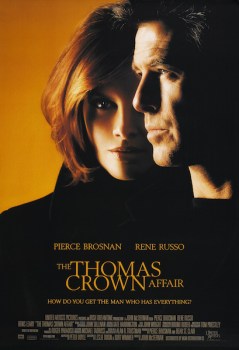
The Thomas Crown Affair (1999)

2016 #73
John McTiernan | 113 mins | streaming (HD) | 2.35:1 | USA / English | 15 / R

Once upon a time, John McTiernan was an action auteur, known for films that sat comfortably on the “mainstream modern classics” scale, like Predator, The Hunt for Red October, and, most of all, Die Hard. Then he made a couple of bombs (Rollerball and Basic), before ending up in a career hell of his own making thanks to some protracted legal battles. This thriller remake, starring Pierce Brosnan at the height of his Bond tenure (it was made between Tomorrow Never Dies and The World is Not Enough), is the once-eminent director’s last well-regarded film.
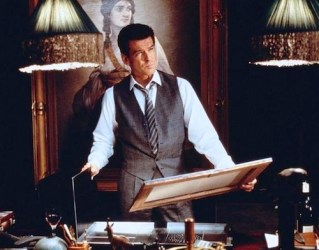
Brosnan plays the titular Thomas Crown, an ultra-wealthy New York entrepreneur whose hobby is stealing art from museums. His latest theft attracts the attention of the insurance company’s investigator, Catherine Banning (Rene Russo), who is clever enough to see past the fancy gadgets and gang of Eastern European crooks placed to take the fall. So begins a game of cat and mouse, as Banning tries to catch the thief, while he tries to woo her, and she tries to resist his charms — while also using her womanly wiles to try to ensnare him.

It’s the latter that practically kicks The Thomas Crown Affair into the realms of the ‘erotic thriller’. Throw in a couple more sex scenes (and a few less high-profile contributors) and you’d have late-night TV filler. There’s virtually no swearing and certainly no violence, but with some gratuitous boobs you’ve got a 15/R-rated flick. The film doesn’t really need such titillation to attract attention, because it’s a strong cat-and-mouse thriller in its own right. On the other hand, it doesn’t shy away from sexuality and the part that could play in such a ‘game’, so in that respect it’s more plausible than a million other neutered movies.

McTiernan’s action background comes to the fore in a pair of extended heist scenes at either end of the movie, which are surely the standout parts. The seductions and plot twists in between these bookends are certainly entertaining and may even keep you guessing, but it’s the heists that pack the most entertainment. They’re the kind of thing we don’t see so much nowadays, at least not in mainstream movies, because any sequence designed to provide excitement is a fight of some kind, and most of those are shot in the shaky-cam style. There’s none of that palaver here, just perfectly choreographed cutting between the various players in each heist, and some well-chosen music — as if being ably to do awesome stuff accompanied by the James Bond Theme wasn’t cool enough, here Brosnan gets to do the same to Nina Simone’s Sinnerman.

Those scenes are reason enough to watch the film, in my opinion, but that’s not to denigrate what comes in between. Brosnan is mainly just charm personified as Crown, a kind of “Bond gone naughty” playboy (without the, y’know, murdering), while Russo makes Banning’s back-and-forth umming-and-ahing seem largely plausible, whereas in other hands it might’ve just come across as inconsistent character writing. Denis Leary and Frankie Faison bolster the entertainment as the pair of NYPD cops forced to work with Branning, while Faye Dunaway (star of the original film) appears in a handful of tacked-on cameo scenes as Crown’s psychiatrist.

The Thomas Crown Affair may not be the best film on any of its principals’ CVs (well, except perhaps for Russo’s), but it’s a consistently enjoyable light thriller with a couple of particularly memorable sequences and a fun central dynamic. Apparently it’s better than the original, too. There’s long been talk of a sequel, but it seems to have gone the way of McTiernan’s career, which is a shame.
4 out of 5

This review is part of 1999 Week.

Office Space (1999)

2016 #54
Mike Judge | 86 mins | streaming (HD) | 1.85:1 | USA / English | 15 / R

“From the creator of Beavis and Butt-Head” is not a designation that’s going to help sell a film to many people anymore. That the same fella also went on to write and direct the mediocre Idiocracy does it no favour in my eyes, either. The man in question is Mike Judge, and his first live-action feature — this — quickly became a cult favourite, apparently beloved of IT guys and office workers in general everywhere. Well, one has to see what all the fuss is about, doesn’t one?
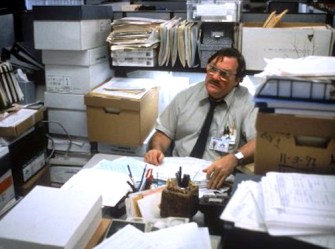
Office Space is, in its way, the story of Peter Gibbons (Ron Livingston), a frustrated office drone. He agrees to go to a hypnotism session with his girlfriend to try to alleviate his stress. While under, he reaches a state of relaxation… so relaxed, he doesn’t even register when the hypnotherapist dies before bringing Peter out of his trance. In his state of newfound enlightenment, his honesty gets him a promotion at work, he finally asks out the girl at the local restaurant (Jennifer Aniston), and, when his IT friends are laid off, sets about scamming the company he works for.

So, there’s sort of a wish-fulfilment thing going on here, which must partly explain its popularity. It’s a film about low-level white collar workers, stuck in unfulfilling office jobs, having to do the repetitious and sometimes stupid bidding of the higher-ups — guys who don’t actually do anything, really, but will certainly get to keep their jobs when lay-offs are needed, even as the little guys who actually do the work get the sack. Wouldn’t it be great to find yourself in a position where you could stick it to Management?

In truth, the plot doesn’t quite fill the slight running time, and Judge doesn’t seem to quite know how to end it — clearly he doesn’t want his hero figure getting caught out, but it can’t just go on forever. Fortunately, this is a comedy, and so plot matters only so much if the rest is funny. In some respects it’s a story of “first world problems” — these guys have decent jobs, making decent money, but it’s boring — but at least it finds the humour in this. Little vignettes of office life, a mix of light satire and gentle surrealism, keep the amusement ticking over too.

I’m not about to sign up for the cult of Office Space, but it is a funny way to spend a brisk under-90-minutes — more “quite amusing” than “laugh-out-loud funny”, though. As it’s now 17 years old, you also have to wonder if it’s a bit of a time-capsule for a passed era.

4 out of 5

This review is part of 1999 Week.

Veronica Mars (2014)

2014 #22
Rob Thomas | 108 mins | download (HD) | 2.35:1 | USA / English | 12 / PG-13

If you hadn’t heard of Veronica Mars before 13th March 2013, you almost certainly did soon after. That’s the date Rob Thomas, creator of the six-years-dead TV series of the same name, launched a Kickstarter crowdfunding campaign to pay for the long-mooted continuation movie. Aiming for a whopping $2 million, it raised that in just 11 hours, going on to bag $5.7 million by the end of its 30-day campaign. In the process it became the fastest Kickstarter project to reach $1 million (and $2 million), the highest-funded film project ever on the site, with the most number of backers for any campaign, and inspired countless think-pieces on how it was ruining/saving the movie industry, or at least completely changing it forever. In reality, very few (if any) big-name Kickstarter movies have come along since, and those that have haven’t inspired the same fervour as Veronica did three years ago.

The film itself picks up nine years after the end of the TV series. A quick opening montage reminds/informs us that Veronica (Kristen Bell) moonlighted as a private investigator while she was in high school, making plenty of enemies in the process and enduring more than a few tragedies, but she eventually managed to drag herself out of that life and start afresh. Just as she’s about to begin a career as a high-flying lawyer in New York, she sees on the news that her one-time on-off love interest Logan Echolls (Jason Dohring) has been arrested for murder. Then he phones asking for her help. Just when she thought she was out, etc. So Miss Mars heads back to little old Neptune, California, just in time for her ten-year high school reunion and a murder investigation involving all (well, most of) the familiar faces from the TV show.

There’s no denying that this is primarily a film for fans of the TV series — well, they did fund it, after all. The best way to get the most out of the film is to have watched all 64 episodes of the show first; preferably soon before, in fact, so you can remember who all the minor characters are. However, creator-cowriter-director Rob Thomas is no fool: you don’t produce a successful movie that continues a little-watched TV show by making it a requirement that you’ve watched 64 hours of TV first. (I mean, Joss Whedon knew that with Serenity, and there’s only 14 hours of Firefly.) So Veronica Mars: The Movie is accessible to neophyte viewers. You might sense there’s references and whatnot that are passing you by, but everything that’s relevant is explained.
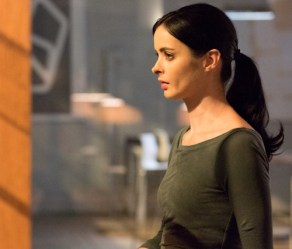
The long gap between series and continuation actually works to the film’s advantage, too, because this plays as the story of someone revisiting an old life, in a place that’s in some ways different and in others exactly, depressingly the same. The hook here is of Veronica as a kind of addict, but instead of being addicted to booze or drugs, it’s private investigating — she may be nine years ‘sober’, but now she’s being tempted to indulge. Again, this makes even more sense if you’ve watched the TV show, where a subplot deals with Veronica’s mother’s alcoholism, but the general conceit works standalone.

Plus, this is a crime drama — there’s a case to be solved, and that’s self-contained within the film. Okay, most of the players are characters from the series, but everything is introduced and explained within the film. Heck, there are even characters Veronica knew in school who weren’t actually in the TV series, which might give you a flavour of how it works both for fans and newcomers. The case itself isn’t a bad mystery, but at the same time it’s a little subservient to the other goings-on. I suppose you could argue this is really a comedy-drama about a woman reconnecting with her past life and past friends, and she just happens to have a murder to investigate at the same time.

For fans (who will have watched this years ago, hence why I’m focusing on the newbie experience), the film is immensely rewarding. Obviously, because it finally gives some closure to the cancelled series’ dangling elements; but also, it feels like Veronica Mars, not like something from older people that’s only claiming to be what it once was. There’s the sparky characters, the funny repartee, the raft of neo-noir allusions. As cheesy as “teenage private eye” sounds, one of the reasons Veronica worked was because it really used those noir elements, just grafted on to the high school experience. The town of Neptune is practically a throwback in this regard, with rich kids and businessmen who can buy their way out of trouble thanks to a thoroughly corrupt police department, while the poor schmucks at the bottom of the pile get by as best they can, which often is not well. It didn’t even cave to the usual youthification of adding happy endings; in fact, more often than not, things didn’t end well. The movie isn’t quite as bleak as the TV series often was — there’s clearly an awareness this might be a one-time deal, so Thomas wants to leave things suitably wrapped up — but not everything comes up roses. (Where’s the sequel at?!) And to pay things off fully, there’s a tonne of fun references, not just to the show but also to real life (not least the Kickstarter campaign).

To bring up Firefly/Serenity again, I think there’s a reasonable parallel between how those relate to each other, and how they can work for newbies, and how Veronica Mars the TV series and Veronica Mars the movie relate. To wit: in an ideal world, you’d watch all of the series and then the film; but TV series can be long commitments, and for a spot of ‘dipping your toe in the water’, you can also start with the movie and go back to the series for the full picture. Sure, some things are going to be spoiled doing it that way round — but hey, not everyone who’s in the series but not the film ends up dead, I promise.

When I first watched the movie, it was at the end of a first-time binge through the TV series, where it sat very happily. To finally write this review, I watched the film again in isolation. I have a memory, so obviously I’m not coming at it from a totally fresh perspective, but it was as entertaining in isolation as it had been as “one more episode”. Fans will get the biggest kick out of seeing old characters resurface, out of learning what’s happened to them in the past decade, out of seeing big-name cameos alongside familiar faces, out of all the callbacks and nods, out of certain things finally being resolved. But that doesn’t mean newcomers can’t get joy from meeting these characters for the first time, from the self-contained mystery and storylines, from the fresh gags — indeed, from all the things that make the TV show entertaining if you started there. And then, if they like it, there’s the joy of there being 64 more instalments to discover.

More than just a nostalgia trip for people who were there first time round, the movie is a strong addition to the Veronica Mars canon — as someone who didn’t discover the series until the Kickstarter campaign, I thought the film was a heck of a lot of fun, and a wonderful capstone to a mostly-great series. That said, there’s plenty of room for further cases… someday… hopefully…

4 out of 5

Veronica Mars is available on Amazon Prime Instant Video in the UK from tomorrow.

Locke (2013)

2016 #83
Steven Knight | 85 mins | Blu-ray | 2.40:1 | UK & USA / English | 15 / R

“Tom Hardy goes for a drive and makes some phone calls” is the plot of this film, which is often mislabelled as a thriller. That’s not to degrade its thrillingness, but rather to say that if you’re expecting a single-location single-character phone-based thrill-ride like Phone Booth (which I love) or Buried (which I’ve still not seen), you’re not going to get it. In reality, Locke is a drama about a man dealing with some woes that are both everyday and life-changing, but as a film it’s been made in an unusual and interesting manner.
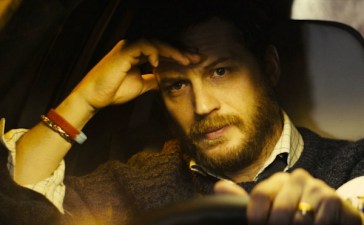
To be more specific, the story concerns Ivan Locke (Hardy), the foreman on a huge construction site in Birmingham, and the only character on screen for the film’s entire running time. As he leaves work one evening, he’s stopped at some traffic lights. He indicates left… but, given some time to think about it, turns right. (Shades of Doctor Who season four there, but I don’t think it’s deliberate!) As he drives down the motorway for the next couple of hours, he makes a series of phone calls that completely change his life.

I could give you some indication of what those calls are about, but I think the less you know, the more entertaining it will be. As writer-director Steven Knight (Eastern Promises, Hummingbird, Peaky Blinders) says in his audio commentary, part of the idea was to construct a movie where the lead character’s big decision — which usually comes near the end — actually occurs at the start, and the whole movie deals with the repercussions of that. Locke deciding to turn right rather than left isn’t just a decision about the quickest route to his destination, but about heading to a different destination, and in the process turning his life upside down. Another part was to tell a story about an ordinary guy dealing with events that aren’t going to change the world, aren’t even going to make the papers, but are a big deal in his life. Something like this could happen to any of us, and how would we deal with it?
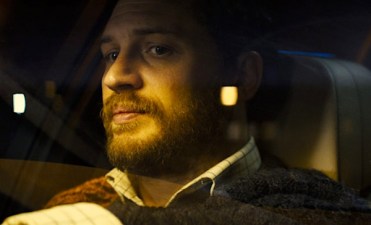
I’d argue that Locke is Tom Hardy’s most unusual role to date: a total everyman. I mean, unusual for him. As such, it’s probably the best demonstration of his genuine acting ability: he’s got psychos and outré characters down pat, but playing an understated, fundamentally good, normal bloke? That’s a big change of pace. What’s so remarkable about Ivan Locke is his sheer unremarkableness. He’s a softly spoken guy, a friendly guy, a nice guy; as we learn at one point, he’s the only contractor who’s ever submitted paperwork to the council not just on time but early — he’s that kind of guy. And on this night, he’s decided to be completely honest with everyone; honest to a fault, in fact, because sometimes it just makes things worse. As Knight says in that commentary, what happens to Ivan is “an ordinary tragedy, and Ivan’s solution to the problem is the thing that makes him exceptional”.

Throughout this, however, is the issue of Hardy’s chosen accent… It’s Welsh, or meant to be Welsh, chosen to be working class but not harsh, with fewer preordained associations than some working class accents have. I thought it was… iffy, shall we say; and certainly people unfamiliar with the Welsh accent are all over the place in guessing where it’s from. However, looking on IMDb, Welsh people seem quite happy with it, so… Either way, you do get used to it (or I did, at least), so that as the film goes on it grates less often. Hardy’s too busy acting up a storm for it to matter, anyway. He’s a captivating performer when he’s given the space and character for it, and while I dispute the assertion (made in the special features) that he’s the only actor you could spend 80 minutes watching like this, it’s still a rare gift.

The rest of the cast appear as voices only on the other end of the phone, and in their own way are quite starry — faces that you may recognise, mainly from British TV, in even some of the smaller roles. Not that you see their faces, so, you know, you might have to look them up, or watch the making-of. Some of the performances err a little towards radio acting for me, which is kind of understandable seeing as how that’s basically how they were recorded, but there are particularly good turns from Andrew “Moriarty in Sherlock” Scott, as one of Locke’s underlings who has to step up to the plate while his boss is on the road, and Olivia Colman, who is always brilliant so that should be no surprise. Having just seen her play an ultra-capable woman recently in The Night Manager (which I’ll cover in my TV round-up this Thursday, incidentally), this is distinctly different. As if we needed to know she had range!
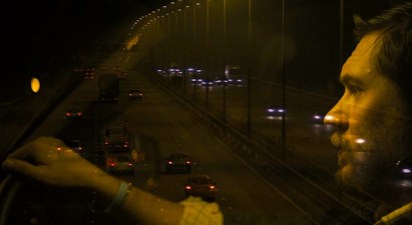
One of the people Locke talks to is his dad, which is noteworthy because his dad is dead. This isn’t a fantasy movie, and he isn’t having hallucinations either — he’s just imagining talking to him, for specific reasons that become apparent. These chats seem to be the film’s most divisive part for viewers: some people think it’s forced and terrible, others think it makes for great monologues. I hew towards the latter. Partly, it seems to stem from whether you believe people talk to themselves in the car or not. Here’s an apparently-uncomfortable truth for people who think no one does that: they do.

Other ridiculous criticisms include that it should only be a radio play, or a stage play, and that it’s completely uncinematic. It’s true that it could function on radio, but you’d lose an important aspect: that what we say with words isn’t always what we say with our face, which is particularly true when we’re on the telephone and the person we’re talking to can’t see our face. The film uses this contrast more than once. As for the stage, stage plays don’t allow for close-ups, and — voices aside — this is about what’s happening on Hardy’s face, not with his whole body. And in either form you’d lose all the photography of nighttime motorways, which have their own kind of hazy beauty. For a movie about someone making phone calls, it is intensely cinematic.
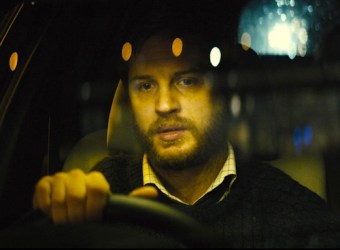
It’s also in real-time, more-or-less (it lasts 80 minutes, and near the end Locke says he’s been driving for a little over two hours — that’s near-as-damn-it, isn’t it?) I’ve discussed before how I like real-time narratives — it’s why I was initially attracted to 24, and why I’m very interested in forthcoming spin-off 24: Legacy while seemingly everyone else is busy stomping their feet and bawling like a baby because they want more Jack Bauer. I digress. Part of the beauty of Locke is that we’re locked in the car with this guy experiencing what he’s experiencing as it unfolds. There is no escaping it, only limited control over it. The fact he’s driving towards something is a very clear metaphor here, emphasised by occasional shots of his GPS showing the fixed track he’s on, and the fact he speaks to his dad — i.e. his past — in the rearview mirror. These could be heavy-handed metaphors, but they’re pitched about right in my opinion: you’ll probably spot them (which is always nicer than feeling you’ve missed stuff), but you’re not battered around the head with it.

It’s possible to make Locke sound like the most boring film ever — “a man drives home from work while talking on the phone, mostly about methods of pouring concrete”. Obviously, that undersells it massively. Hardy has never been more compelling, the supporting cast are so much more than “voices on the phone” (listen out, too, for Tom “Spider-Man” Holland and a midwife voiced by Alice “Sightseers” Lowe, who’s apparently Steven Spielberg’s favourite character), and the visuals are hypnotically compelling to boot. Even though it didn’t quite convince me to go the full 5-stars, I’d rate this one a must-see.
4 out of 5

The UK network TV premiere of Locke is on Film4 tonight at 9pm.

Super 8 (2011)

2016 #7
J.J. Abrams | 112 mins | streaming (HD) | 2.35:1 | USA / English | 12 / PG-13

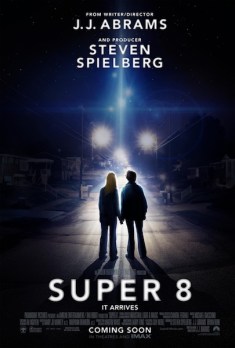
Before he started star warring and between bouts of star trekking, director J.J. Abrams teamed up with producer Steven Spielberg for this homage to the kind of movies Spielberg produced in the ’80s. Those films have endured down the decades; I’m not sure Super 8 endured as far as Abrams’ next lens flare showcase film. Which is a little bit of a shame because, by being Abrams’ most personal film, it may also be his best.
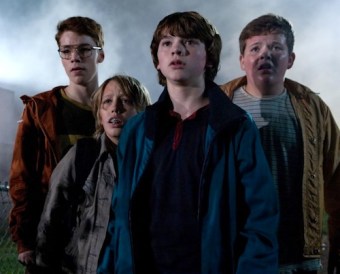
Set in the summer of 1979, the film follows a group of teenage boys making a zombie film, in particular Joe (Joel Courtney), whose mother died a couple of months earlier in an industrial accident. For their film’s love interest, the guys enlist Alice (Elle Fanning) and Joe begins to grow close to her, despite his dad (Kyle Chandler) blaming her dad for the death of Joe’s mother. While shooting a scene late at night, the kids witness a massive train crash, caused by their science teacher. With his dying words he warns them not to tell anyone what they witnessed. As the military descend on the wreckage and odd things begin to happen around the town, it becomes clear the train was transporting something very strange…

How much all this achieves Abrams’ goal of feeling like a genuine Amblin movie, I’m not sure. On the surface, not that much: the visual style is all too modern, not to mention the CGI. But, tonally, there is something there, which has somehow survived being filtered through the filmmaking process and made its way into the finished product — it’s a bit of that spirit of adventure; the kind of storyline and characters; and, actually, the way it holds back a little on the effects work. Several people cite The Goonies when talking about it, which just reminds me that I really ought to get round to seeing that. (The fact it’s absolutely loved by some, while increasingly I hear people bravely sticking their heads over the parapet to say, “it’s not really that good, you know”, intrigues me rather.)

Unfortunately, the longer the film goes on the more it runs away with itself, as characters dash back and forth all over the place, sometimes in credibility-stretching fashion (we never do see how a group of kids manage to escape a heavily-guarded military base and drive back to an evacuated and blockaded town). The adults stumble through the story to little dramatic effect; Joe’s dad even has to be secretly locked up for a good chunk of the film (with no other characters noticing his disappearance) so that his storyline can be paused until he’s wheeled out for his part in the climax. The grown-ups do serve a role — giving us a perspective on events that the kids lack, and being tied to the emotional arcs of the leads — but it wouldn’t have harmed anything to limit them to those functions, rather than trying to half-heartedly give them stories of their own.
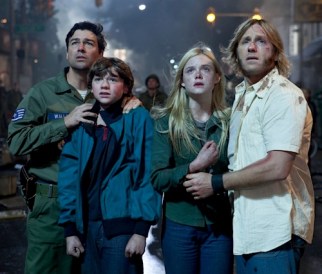
The kids are quite likeable in their way, especially Courtney and Fanning, who have enough chemistry to keep their interactions the most engaging aspect of the film. In fact, if Abrams wasn’t the kind of filmmaker he is, an indie-ish real-world take on Super 8’s dramatic storyline (a bunch of friends making a short film over the summer holidays, also with all the other grounded emotional aspects of the movie) might’ve made for an even more effective, enjoyable film. (Somewhat ironically, it seems this was Abrams’ original intention: according to IMDb, his two ideas for a follow-up to Mission: Impossible III were a coming-of-age story or an alien-on-the-loose adventure. Presumably getting sidetracked into Star Trek gave him the time to decide to combine them.)

In some respects, the kids’ short film (which plays during the end credits) encapsulates the whole movie: a semi-thought-through SF/F plot, a tacked on emotional arc, the apexes of both tied together in the climax, and a couple of sometimes-shoehorned effects set pieces along the way. Yet for all that, it does enough right that I’d quite like to see Abrams attempt more work along these lines.

4 out of 5

J.J. Abrams’ most recent film, a little movie you’ve probably not heard of about something-or-other waking up (I forget the details), is out on DVD & Blu-ray in the UK today.