The Silent Child (2017)

2018 #57a
Chris Overton | 20 mins | TV (HD) | 2.35:1 | UK / English & British Sign Language

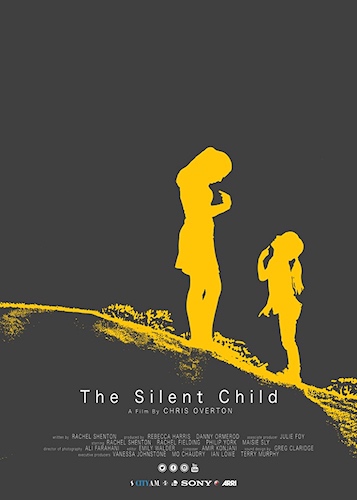
The Silent Child

Oscar statue2018 Academy Awards
1 nomination — 1 win

Won: Best Live Action Short Film.


It’s not often you see short films screened in prime time slots on the nation’s biggest TV network — and by “not often” I mean “never” — but then it’s not often two former soap stars make a timely and affecting drama that wins an Oscar, either.

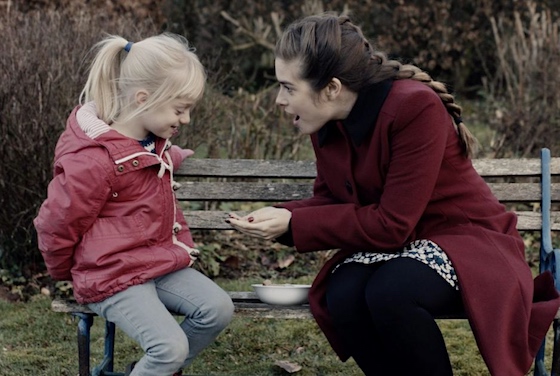
Such is the case with The Silent Child, which stars former Hollyoaks actress Rachel Shenton (who also wrote the screenplay) as social worker Joanne, who’s called in to help young deaf girl Libby (Maisie Sly) prepare to start school. Libby’s upper-middle-class parents (Rachel Fielding and Philip York) have clearly done nothing to help the child, too concerned with making her ‘normal’, and that’s left her obviously miserable. As Joanne begins to teach Libby sign language, she comes out of her skin and brightens up. But her mother remains unconvinced this is the right direction for her child, beginning to see Joanne as more of a threat than a help.

There’s a clear social-conscience motivation behind the creation of this film, highlighted by a downbeat ending that’s well calibrated to anger you into wanting change. It’s depressing that this isn’t set 50 years ago, but is the situation today. It seems hard to believe any parents would be so horrid and low-key abusive as Libby’s, but then I bet they voted Tory, so, y’know. Even then, the cold hard stats presented at the end are sobering. The cumulative effect is powerful and worthwhile.

Libby and Joanne

As a film, it’s well made. Director Chris Overton (Shenton’s partner, who also once appeared in Hollyoaks) and his DP Ali Farahani clearly have a good eye: despite the low budget, it’s often attractively shot, with a misty, cold beauty to its countryside locations. Overton has also managed to coax a charming, subtle, and surprisingly nuanced performance from young Maisie Sly. Shenton is also likeable as her well-meaning but hand-tied friend. Some of the supporting performances are a little ropier, but hey, when you’re making a short film for just £10,000, you get what you can. I’ve seen worse.

There are lots of little touches that suggest Shenton and Overton probably want to develop this into a feature film — hints at subplots, that kind of thing — and there’s definitely room for it to grow, too: while it does work as a piece in its own right, this doesn’t feel like the whole story. I’d be surprised if, after the Oscar success and chatter that’s followed (the film was among the top trends on Twitter for the entire night after its BBC One airing), that doesn’t happen. Certainly, it’d be nice to see things turn out a little more hopefully for little Libby.

4 out of 5

The Silent Child is available on BBC iPlayer until 29th April 2018.

Cars 3 (2017)

2018 #54
Brian Fee | 102 mins | download (HD+3D) | 2.39:1 | USA / English | U / G

Cars 3

At this point I think it’s fairly well known that the Cars movie series continues not because of any artistic desire on the part of Disney/Pixar, but because the toys the films generate sell like hotcakes. Indeed, that situation hasn’t necessarily changed with this third instalment: apparently Cars 3 features 65 different individual racers, more than both the previous films combined. And several of those appear kitted out in different paint jobs. Disney gotsta make that toy money! The disregard with which they hold the actual movies is perhaps demonstrated by the fact this third one is helmed by a first-time director, Brian Fee, whose previous credits are as a storyboard artist on a couple of Pixar productions. Maybe they lucked out, then — or maybe they actually knew what they were doing promoting him — because I think this is easily the best film in the Cars trilogy.

Beginning with nary a reference to the events of Cars 2, racer Lightning McQueen (Owen Wilson) is back doing what he loves: racing. That’d be American-style racing, i.e. constantly turning left for hundreds of laps. Anyway, turns out there’s a new generation of hot young racers, who are less on their way up and more already here, led by Jackson Storm (Armie Hammer). They use advanced training techniques and statistics to beat the old guard — soon all of Lightning’s contemporaries are choosing to retire or being forced out, leaving him the last one standing… until he crashes in the final race of the season. Is his career over? Well, what do you think? With the backing of a new sponsor, Sterling (Nathan Fillion), and all the latest high-tech gear, Lightning sets to work training with young wannabe-racer-turned-coach Cruz Ramirez (Cristela Alonzo). But as he struggles to regain his mojo, perhaps there’s something to be said for the old ways after all…

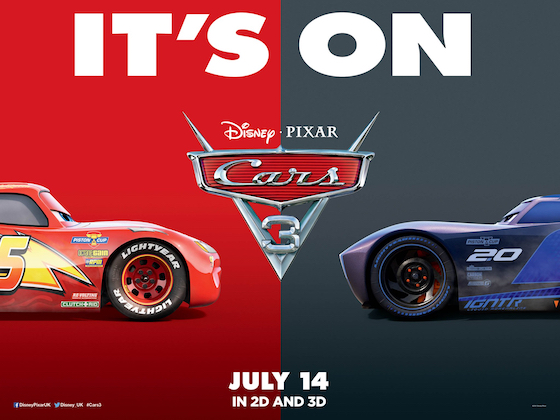
Storm vs Lightning

Although I wouldn’t say sports movies are my bag, I think Cars 3 probably benefits from taking a more clean approach to that genre, ditching all the spy hijinks distractions of the last one. That purity of genre keeps it straightforward and focused. It also re-centres itself on Lightning McQueen, shoving Mater (Larry the Cable Guy) back into a cameo-sized supporting role, which is about where he belongs (I wouldn’t say he’s likeable in small doses, but he’s tolerable). It still finds room for humour and levity, just in a more natural, less goofy way.

Around that, it actually takes a run at some weighty themes — specifically, old age and obsolescence — and carries through on them too, with a finale that goes for more of a “finding worth in what you do next” ending rather than a “still got it (for now)” one. Such maturity means it’s perhaps more suited to Pixar’s grown-up fans than their young ones — it’s a surprisingly serious movie, in fact, without being po-faced about it. That said, you could probably play down the thematic stuff and just be entertained: there are still good set pieces, both action-based and comical, to keep the right family-friendly tone.

It makes for a winning combination. Cars 3 may not trouble the upper echelons of Pixar’s greatest achievements, but it is the best of their Cars movies — the first of the trilogy I remember genuinely enjoying, rather than just finding tolerably okay. That might sound like a low bar to set, but Cars 3 clears it admirably.

4 out of 5

Cars 3 is available on Sky Cinema from today.

Beetlejuice (1988)

The 100 Films Guide to…

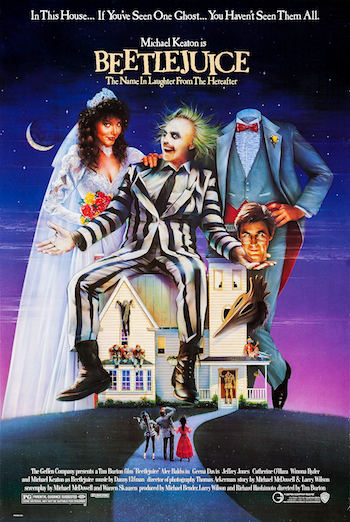
Beetlejuice

The Name In Laughter
From The Hereafter

Country: USA
Language: English
Runtime: 92 minutes
BBFC: 15
MPAA: PG

Original Release: 30th March 1988 (USA)
UK Release: 19th August 1988
Budget: $15 million
US Gross: $73.7 million

Stars
Michael Keaton (Batman, Birdman)
Alec Baldwin (The Hunt for Red October, Glengarry Glen Ross)
Geena Davis (The Fly, Thelma & Louise)
Winona Ryder (Heathers, Edward Scissorhands)

Director
Tim Burton (Pee-wee’s Big Adventure, Edward Scissorhands)

Screenwriters
Michael McDowell (The Nightmare Before Christmas, Thinner)
Warren Skaaren (Beverly Hills Cop II, Batman)

Story by
Michael McDowell (see above)
Larry Wilson (The Addams Family, The Little Vampire)


The Story
Adam and Barbara Maitland are living an idyllic life in their lovely small-town house… until they die. What’s worse is that they’re condemned to haunt their old home while a family of city-slickers move in and destroy everything they loved about it. To get them out, Adam and Barbara may be forced to call on disgraced ‘bio-exorcist’ Betelgeuse…

Our Heroes
Adam and Barbara Maitland are a sweet couple living a quite life in a quaint little town, until they’re killed in an accident (swerving their car to avoid a very cute dog, to be fair) and have to cope not only with haunting their old home, but also with the afterlife’s bizarre bureaucracy.

Our Villains
Betelgeuse, Betelgeuse, Betelgeuse! He may be offering to help the Maitlands, but in the end he’s their biggest problem. Before that, though, there’s Charles and Delia Deetz, the new occupants who seem determined to ruin the Maitlands’ beloved home.

Best Supporting Character
The Deetz’s daughter, little goth Lydia. She’s the only human who can see the Maitlands, and quickly finds she gets on with them better than her own parents.

Memorable Quote
Juno: “What’s wrong?”
Barbara: “We’re very unhappy.”
Juno: “What did you expect? You’re dead!”

Memorable Scene
When the Deetzes hold a dinner party for some of their city friends, Adam and Barbara attempt to frighten them away by puppeteering them into a bizarre rendition of Day-O (The Banana Boat Song). As well as the supporting cast gamely engaging in a dance routine (er, kind of), they really sell it by simultaneously looking confused and troubled about what’s going on with their bodies. Unfortunately for Adam and Barbara, however, the stunt backfires…

Memorable Music
The famed collaboration between Tim Burton and Danny Elfman dates right back to the director’s first film, making this their second together. But that recognisable Elfman style — so familiar from, er, every other Tim Burton movie (as well as others, of course) — is already very much in evidence. The main theme almost sounds like a greatest hits package for the composer, which does make you wonder how much it’s style and how much he’s been ripping himself off ever since…

Truly Special Effect
According to IMDb, the visual effects budget was just $1 million, leading Burton to decide to make the effects look “as tacky and B-movie as possible” — which is interesting because a lot of them are pretty good, bearing in mind that the film hails from the late ’80s. Obviously they’ve aged now, therefore, but it’s so packed with creative and varied visual trickery that I assume it once played as a kind of effects showcase. It’s only that in an historical sense now, but there’s still a lot of striking and memorable stuff here.

Letting the Side Down
Betelgeuse, Betelgeuse, Betelgeuse! Ironically, I’d like the whole film a lot more if the title character wasn’t in it. Okay, I know not everyone’s going to feel this way — I imagine some people love him — but, for me, he’s by far the worst thing about the film. He starts off with just a couple of small appearances that are only a little irritating, but when he enters the story properly… ugh.

Making of
Believe it or not, the original script was a straight horror film. Betelgeuse was a winged demon, only transforming into a man to interact with humans, whose goal was to rape and kill the Deetzes rather than just scare them off. Lydia was a minor character, with a younger sister who could see the Maitlands. I don’t know how exactly it went from that to a comedy, but maybe it was for the best.

Next time…
An animated TV series, which reconfigured Betelgeuse as the hero and teamed him up with Lydia, ran for 94 episodes between 1989 and 1991. Apparently it was a big hit, and aired on both ABC and Fox simultaneously, becoming “one of the few shows in American television history to be aired concurrently on two different broadcast networks.” Aside from that, a sequel movie has long been mooted, and continues to be an on-again-off-again prospect to this day.

Awards
1 Oscar (Makeup)
2 BAFTA nominations (Make Up Artist, Special Effects)
3 Saturn Awards (Horror Film, Supporting Actress (Sylvia Sidney), Make-Up)
5 Saturn Award nominations (Supporting Actor (Michael Keaton), Director, Writing, Music, Special Effects)
Nominated for the Hugo for Best Dramatic Presentation

Verdict

I knew that I’d seen Beetlejuice many years ago, but I could barely remember anything about it, other than a general sense that I didn’t like it much. So watching it again now was almost like a first viewing, and was almost a revelation too: it’s a very enjoyable film. Pretty much my only problem with it is Betelgeuse himself (as discussed above); but, in fact, he only makes up a relatively small proportion of the movie: he’s in just 17½ minutes, less than 20% of the film. The good qualities in the remainder keep it up at a 4-star level.

The Villainess (2017)

aka Ak-Nyeo

2018 #35
Jung Byung-gil | 124 mins | streaming (HD) | 2.35:1 | South Korea / Korean | 18

The Villainess

After taking bloody revenge on the people who killed her father, skilled combatant Sook-hee (Kim Ok-vin) is arrested and then forcibly recruited into a secret government agency who want her murderous skills. In exchange for ten years of her life and abilities, she’ll get a new identity and her freedom. As Sook-hee adapts to her new situation, flashbacks fill us in on her past — and the role it still has to play in her future.

There are obvious similarities to Luc Besson’s Nikita in that setup, but, frankly, I haven’t seen that movie in a long time, so I’m afraid you’ll have to look elsewhere for a more in-depth comparison than “hey, this is a bit like that!” The Villainess isn’t selling itself on the freshness of its premise, anyway — to most potential viewers, the primary attraction is the freshness of its action sequences. On that, it delivers, and then some.

It starts as it means to go on, opening with an eight-minute tightly-choreographed (fake-)single-take mostly-first-person killing spree. It’s a giddy display of violence that’s sure to entertain those of us who are so inclined. Many more hyper-kinetic, just-as-awesome action sequences follow over the next couple of hours. A motorbike chase that is also a sword fight (!) was a particularly memorable one for me (as I mentioned in last month’s Arbies). That’s also done in a ‘single take’ — if there’s one thing director Jung Byung-gil loves, it’s a fake single-take action sequence. If there’s another, it’s spurting blood — apparently if you strike anyone anywhere you’ll hit an artery and the red stuff will be squirting all over the place.

A sword fight... on bikes!

While the action scenes will be the focus for many viewers, there’s also a surprisingly effective emotional story at the film’s core. It even stops being an action movie for a bit in the middle to become a kind of romantic drama, which sounds ridiculous, but it works. There are plenty of twists and revelations involved in the storyline, so no spoilers here, but I will say it’s ultimately a pretty bleak film — it goes places I don’t think many straight-up action movies would dare. Well, certainly not Hollywood ones, anyway.

And none of that is to say it betrays its action roots — this isn’t one of those films that’s trailed like an action movie but, actually, only has a couple of stunts and is mostly something else. No, this really, really pays off just as a two-hour adrenaline kick; but it’s also, simultaneously, something more complicated. Put both sides together and I think there’s a good chance this will, deservedly, become regarded as a genre classic.

4 out of 5

The Villainess is available on Netflix UK from today.

Annihilation (2018)

2018 #45
Alex Garland | 115 mins | streaming (UHD) | 2.39:1 | UK & USA / English | 15 / R

Annihilation

Many column inches (and even more tweets) have been penned about Paramount’s decision to relegate director Alex Garland’s second third film straight to Netflix outside the US, Canada, and China, so I presume the pros and cons of that move have been thoroughly discussed elsewhere. Personally, I’m on the fence: it’s disappointing not to see intelligent sci-fi being given a shot at the box office, but I’m one of those people who’s 50/50 on whether I go to see it or just wait for disc/streaming/etc. (I’ve not even seen The Shape of Water, for example, although that’s partly due to a dearth of convenient screenings during its brief theatrical appearance. Conversely, I did go to Arrival.) Anyway, it is what it is at this point, so let’s move on to the film itself.

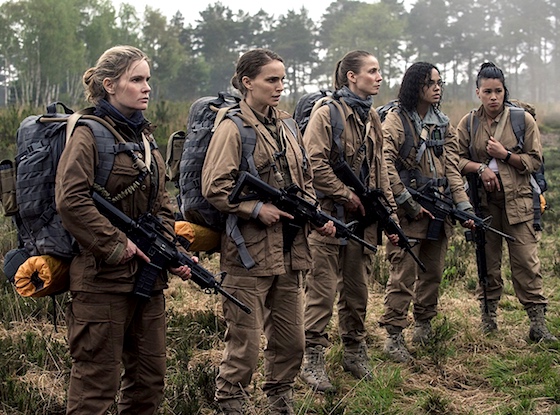
Loosely based on the acclaimed novel by Jeff VanderMeer (reportedly Garland read the book once then wrote the screenplay from memory), it follows biologist, academic, and former member of the Army, Lena (Natalie Portman), whose soldier husband Kane (Oscar Isaac) went missing a year ago during a secretive mission. After he suddenly reappears, apparently with no memory of his time away but with some severe medical problems, the couple are scooped up by a military organisation investigating Area X, a top-secret quarantined zone affected by an unexplained phenomenon known as the Shimmer. Various teams have been sent inside the Shimmer, but Kane is the only person to ever return. As his health deteriorates, Lena, desperate for answers, joins the latest squad to venture inside. That’s where stuff gets crazy…

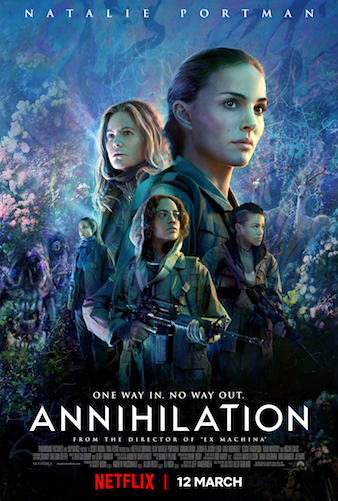
Squad goals

The first thing Annihilation made me think of was Denis Villeneuve’s Arrival. The connection was initially triggered by the score: the ambient soundtrack by Geoff Barrow and Ben Salisbury reminded me so much of Arrival’s that I had to check this wasn’t a last work by Jóhann Jóhannsson. Once I spotted that, the other similarities in the story leapt out: they’re both thoughtful sci-fi parables about a female university lecturer being co-opted into a military operation to investigate a strange extraterrestrial presence on Earth, while also remembering her family life in flashbacks.

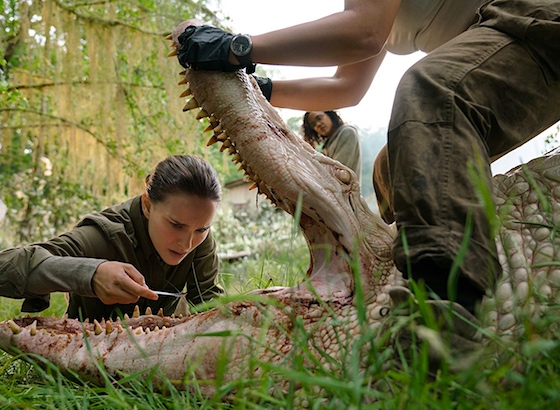
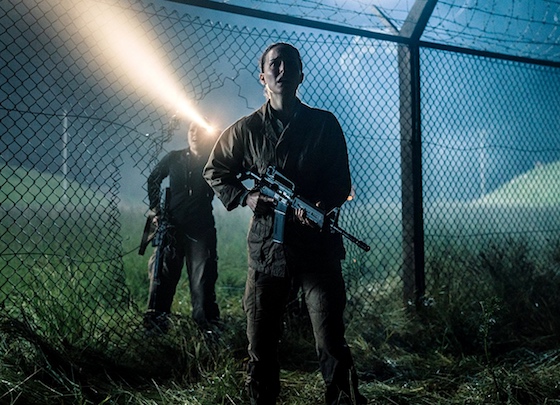
Despite Paramount’s insistence that the film was too intelligent for non-US audiences (you can take a moment to laugh at that notion if you like), Annihilation is perhaps more accessible than Arrival, at least initially. Whereas Villeneuve’s film played like a character drama, Garland’s has a strong adventure-movie vein, also laced with elements of the horror genre. It’s still not a mile-a-minute thrill-ride, but, if you wanted, you could engage with it on the level of a quest through an alien event, encountering strange phenomena and creatures, with events of life-threatening jeopardy. However, for all the original sci-fi ideas, it does also touch on weightier, more human psychological issues — as the Empire review summarised it, “depression, grief and the human propensity for self-destruction.”

All the better to eat you with

Naturally this material is carried by the cast. Portman makes for an interesting lead. Clearly damaged by grief, she’s quite a cold figure, which may distance her from some viewers in the way it does from some of her team mates. But there’s more to it than that, and Portman delivers subtle nuances that hint at more beneath the surface. The rest of her all-female squad — played by Jennifer Jason Leigh, Tessa Thompson, Tuva Novotny, and Gina Rodriguez — all have distinct personalities, all get brief subplots and moments, and they’re mostly managed with an equal level of understatement. Perhaps the best is Thompson, whose calm, gently heartfelt performance is quietly superb, and even more striking as it marks a huge contrast to her star-making turn in Thor: Ragnarok just a few months ago. As a pair of films to be a calling-card for her skills, one could barely ask for more.

A lot of disappointment about the lack of a theatrical release stems to not being able to see these visuals on a cinema screen; not being able to experience the audio with a cinema sound system. Well, that partly depends on your own setup at home, of course. Setting that aside, though, while there are certainly some very striking visuals, it wasn’t as consistently stunning as some reviews made it sound. I’m not saying it wouldn’t benefit from the big screen, especially if you’re particularly fond of that experience, but I didn’t feel I was missing much scale by watching at home. I felt similarly about the sound design, though I do say that as someone with a 7.1 system. For spectacle, the intricate and colourful end credits are the most striking bit — I’m certain they benefitted from my viewing the film in 4K HDR.

Scared of the dark?

However you get to see it, writer-director Alex Garland has crafted another sci-fi mystery/thriller that engages on multiple levels. For me it was somewhat damaged by the hype, perhaps a result of US reviewers frantically urging people to get out and see it to prove that Paramount’s lack of faith was a mistake. While I didn’t instantly love it in the same way as, say, Arrival, or Garland’s debut, Ex Machina, it’s undoubtedly a fascinating, thought-provoking slice of science-fiction — and a much-needed critical success for the “Netflix Original” brand after a couple of recent duds. I’d also say it places Garland ahead of genre contemporaries like Neill Blomkamp and Duncan Jones as a filmmaker to keep an eye on. Okay, he’s not quite Denis Villeneuve, but he’s a lot closer than the others.

4 out of 5

Annihilation is available on Netflix in most of the world now.

The Jungle Book (2016)

2018 #40
Jon Favreau | 106 mins | Blu-ray (3D) | 1.78:1 | USA & UK / English | PG / PG

The Jungle Book

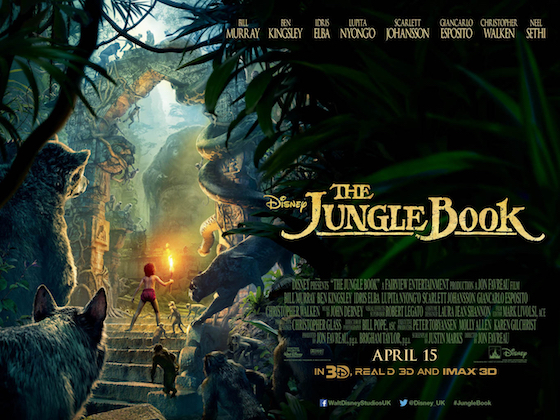
One of the successes that has convinced Disney to remake basically their entire animated back catalogue in live-action, Jon Favreau’s take on Disney’s adaptation of Rudyard Kipling’s stories barely counts as “live-action” really: the vast majority of it is animated — often the only real bits are Mowgli and some (but by no means all) of the props and scenery he interacts with — but it’s done to be photo-real and so we pretend that’s live-action.

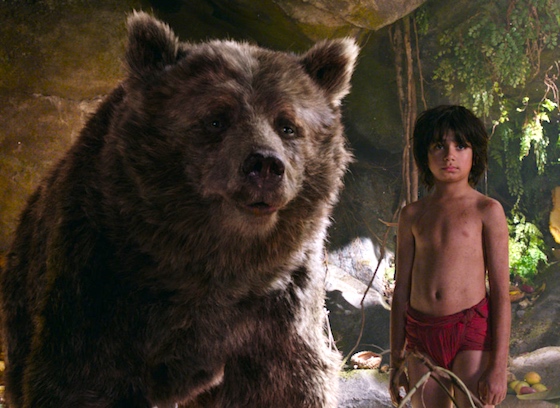
Whatever you want to call it, the visuals are stunning. It’s incredible stuff by the animators, though also by Favreau and DP Bill Pope to make all that hard work look great as a film too — they put special effort into making sure the CGI was properly lit, etc. And I reckon it’s even better in 3D. Presented in a screen-filling 1.78:1 ratio, unconstrained by the black bars of your nowadays-standard 2.35:1, it honestly feels like a window into another world. You sometimes see reviews of good 3D that say “you feel like you could reach out and touch it”, which I’ve always taken as A Thing People Say rather than an actual inclination, but at one point I did feel like I wanted to reach out and stroke Baloo’s fur, he looked so soft. The end credit sequence (a kind of pop-up book routine) looks particularly great in 3D, which helps to sell the miniaturised dimensions.

Bear necessities

Anyway, the film itself. Disney’s Jungle Book is such a well-known childhood classic that I don’t imagine you need me to recap its plot, though this version doesn’t ape it one-for-one. When Favreau was first brought on board the story treatment Disney had in development was much closer to Kipling’s work, including none of the changes Disney made when they adapted it before (i.e. adding songs and the character of King Louie), as well as being more violent, aimed at a PG-13 rating. So it was Favreau who decided it should be closer to the Disney classic, aiming to find the sweet spot between the two styles. I think he’s nailed that, mixing in enough that’s familiar from the animation with a bit more seriousness derived from Kipling.

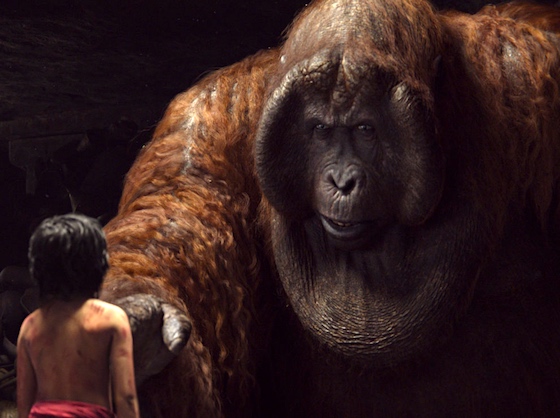
That said, I wasn’t wholly convinced by the use of the songs. The rendition of Bare Necessities is disappointingly truncated, though at least fits in context. Conversely, King Louie’s song, I Wan’na Be Like You, is so out of place that I found the sequence kind of uncomfortable. Weirdly, its reprise at the start of the end credits is great. There it’s followed by Trust In Me, which isn’t included in the film proper but might actually have worked there.

I wanna be like you-oo-oo

Still, the film as a whole functions well; surprisingly well, one might even say. You may remember the Rotten Tomatoes score for it went crazy when it came out, hiding the high 90s — it ended up at 95%. And it’s the perfect example of why Rotten Tomatoes doesn’t score a film’s quality, but does score the chance that you’ll enjoy a film. I’m not sure many people would think this is a “9.5 out of 10” kind of film, but one there’s a 95% chance you’ll think is good? Yeah.

4 out of 5

The Jungle Book is available on Netflix UK from today.

Murder on the Orient Express (2017)

2017 #164
Kenneth Branagh | 114 mins | cinema | 2.39:1 | USA, UK, Malta, France, Canada & New Zealand / English, French & German | 12A / PG-13

Murder on the Orient Express

Did we need another version of Murder on the Orient Express? That seems to be the question that preoccupies many a review of the film, primarily with reference to the Oscar-winning 1974 version directed by Sidney Lumet and starring Albert Finney as Agatha Christie’s Belgian detective, Hercule Poirot, alongside an all-star supporting cast. That’s not the only other adaptation of arguably detective fiction’s most famous novel, though there were fewer than I thought: a modernised TV movie starring Alfred Molina was made in 2001, and it was of course filmed as part of the David Suchet Poirot TV series in 2010, but that’s your lot (in English — the Germans and Japanese have both done it on TV). So, on the one hand, maybe we should be all set for screen versions; on the other, it’s not like it’s the only remake.

So, if you’ve not seen a version before, you’re spoilt for choice. If you want to know which I think you should pick… Well, I’ve not seen it, but I imagine we can discount that 2001 TV movie. Suchet is still the definitive screen interpretation of Poirot, but that particular episode is not the series’ finest hour, as I recall. And while I enjoyed the ’74 version a good deal, I wasn’t bowled over by it. Which brings us to this new one.

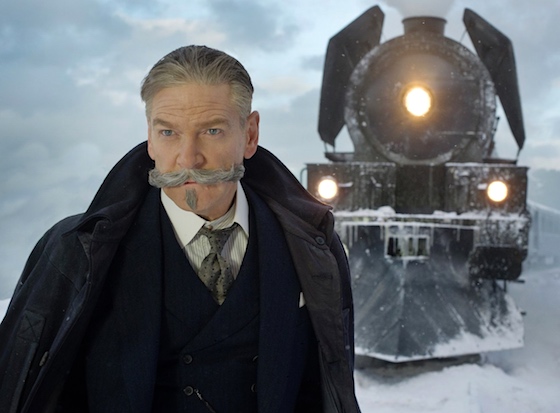
The star of the film: Branagh's moustache

Personally, I thought it was very good indeed. It’s a film of its genre and heritage — by which I mean it functions the way Christie-style murder mysteries always do, and it’s staged and shot mostly with a classical dignity — so if you have a dislike for that then this isn’t revisionist in a way that will win you over. But within those ‘constraints’ it’s very well done. The photography, in particular, is magnificent. Shot on 65mm, but without showing off about it in the way some other directors have recently, it has a richness, a grandeur, and an elegance that is most befitting.

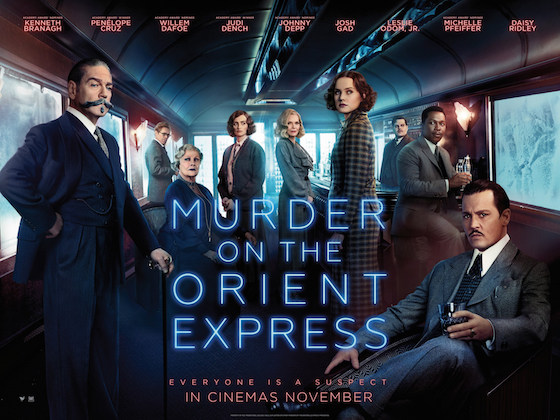
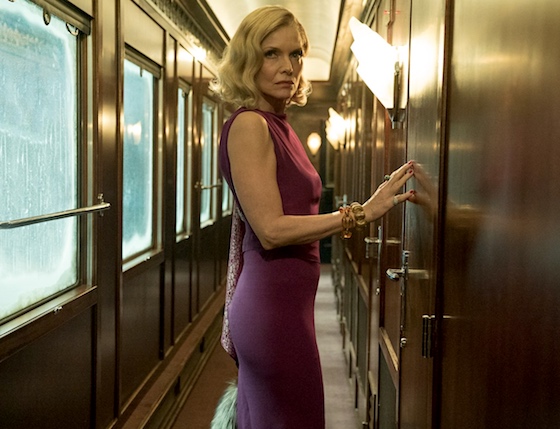
Having mentioned the all-star cast of the previous film, it must be said that this version doesn’t skimp in that department either. The key roles are filled with a veritable who’s-who of acting talent, including big names (Johnny Depp, Michelle Pfeiffer, Penélope Cruz), quality thesps (Olivia Colman, Willem Dafoe), people who’ve worked with Branagh before (many of the small roles), people who tick multiple of those boxes (Dame Judi Dench, Sir Derek Jacobi), and freshly-minted stars too (Star Wars‘ Daisy Ridley, Sing Street‘s Lucy Boynton; depending on your point of view, Beauty and the Beast‘s Josh Gad and Hamilton‘s Leslie Odom Jr as well). The size of the cast and style of the story means that even the most-featured only get a couple of scenes of their own (plus scattered lines in ensemble moments), but the talent involved imbues the roles with inherent character.

A dangerous liaison?

And then there’s Branagh himself as Monsieur Poirot. Most discussion of his performance has focused on the moustache, understandably. It’s certainly a magnificent feat. But Branagh is a very fine actor, of course, and he manages to make Poirot his own — an impressive job when there’s the spectre of David Suchet’s definitive performance looming. I wouldn’t say he’s surpassed Suchet in any way, but his take on the character is different enough to dodge too many direct comparisons, while not being so different that it no longer feels like Poirot, at least to me.

Frankly, I feel like an important element to enjoying the film is to approach it with an openness to it being its own thing — a courtesy I don’t believe it was afforded by some critics and viewers. Many reviews I’ve read had a tendency to compare it to the 1974 film, either in a specific “what I thought of each” sense or a broad “your opinions of that film may colour your view of this one”. I guess that’s a useful metric to some people, but it’s better to judge the film on its own merits, I feel. That said, I’ve also seen some call it too slow, others call it too fast; some say it’s too dull, others say it’s too full of action… No wonder it ended up with middling average scores: never mind not being able to please everyone, it seems like you can’t please anyone. Personally, I thought it largely hit the mark in all those respects.

Classical elegance

And it seems like the wider audience agreed: it ended up grossing $350 million worldwide, which places it in the top 30 releases of 2017. For a film of this type in the current box office climate, that’s an excellent achievement. For comparison, it’s just below the likes of Fifty Shades 2, Cars 3, and The Mummy Mk.III, and it also out-grossed films such as The LEGO Batman Movie, Blade Runner 2049, Split, Baby Driver, and even Get Out. I guess it appealed to a different audience than the one that routinely discusses movies online. It also means we’re getting a sequel, with Death on the Nile set for a 2019 release. Do we need another version of that too? Well, why not?

4 out of 5

Murder on the Orient Express was released on DVD, Blu-ray, and all the rest, in the UK this week.

Making of the Living Dead

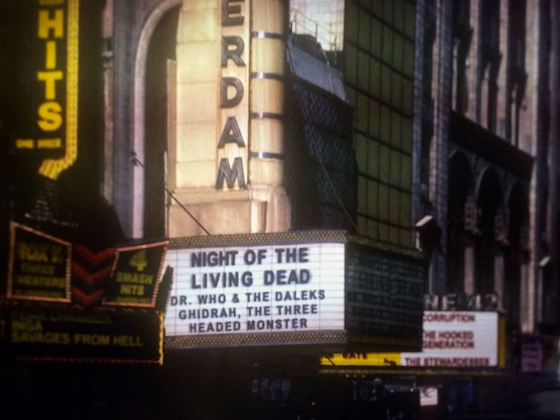
To mark the UK release of Criterion’s remastered, definitive Blu-ray edition of George A. Romero’s seminal subgenre-starting zombie classic Night of the Living Dead, I finally got round to watching two related feature-length documentaries that, er, aren’t included on that release. Never mind, eh?

Anyway, here are my thoughts on One for the Fire and Birth of the Living Dead.


One for the Fire:
The Legacy of “Night of the Living Dead”

(2008)

2018 #29
Robert L. Lucas & Chris Roe | 84 mins | Blu-ray (SD) | 16:9 | USA / English

One for the Fire Italian DVD

Made to mark the film’s 40th anniversary, this documentary interviews many of the surviving creators of Night of the Living Dead to tell the full story of the project’s genesis, making, release, and legacy.

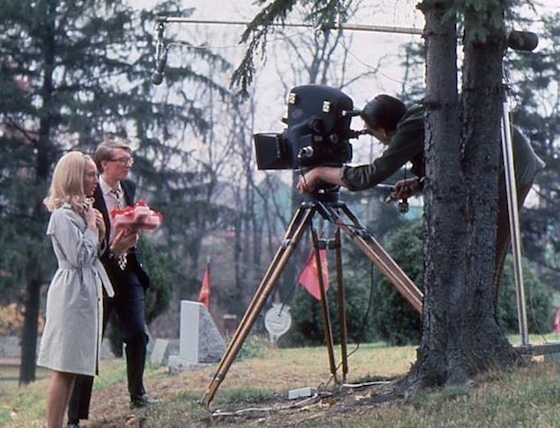
After an opening segment that imitates Night’s own beginning and interviews the graveyard scene’s stars, One for the Fire goes for a chronological telling of events. It starts with Romero’s college days, when he met most of the gang who would eventually create Night. There are some great tales of him as a flamboyant student, swishing around in a cape or dressing up as a Mexican bandit for no particular reason — if you put it in a biopic it’d look like an OTT sitcom-ish affectation. After that they set up a production company, The Latent Image, making local TV ads. The expertise (and equipment) gained there would eventually embolden them to make a feature film, choosing the horror genre because it would be a relatively easy sell.

“We were just a bunch of guys out to make a movie,” says Romero, which kind of sums up the whole shoot — they basically winged it, making up the process of moviemaking as they went along. Any one of them could’ve done each other’s jobs because they all knew about as much as each other did; if someone knew slightly more about something, they were assigned that role. Everyone mucked in, doing what was necessary, be that zombie make-up or running to the shop for lunch. But they were canny, reaching out to local TV personalities, police, and helicopter pilots to lend a sense of scale to some sequences, or popping to Washington D.C. on a quiet Sunday to shoot a scene guerrilla-style, all to make it look like the film had some budget.

Making Night of the Living Dead

Interestingly, Romero says that Night is not only his scariest film, it’s in fact his only scary film. Not what you expect from a renowned horror director. But he says a specific part of the impetus while making Night was to try to scare the viewer, which hasn’t been his goal on any film he’s made since, despite the genre.

The documentary’s general narrative is interspersed with short asides that focus on minor-seeming individuals and the contributions they made to the film, which is a nice way of giving people credit. One who merits a longer discussion is Duane Jones, the actor who played the heroic role of Ben. He died in 1988 and they all pay quite moving tribute to him — he was clearly very well liked; admired, even. His part was written as colourless… well, so they say — I’m sure they assumed he’d be white. But they were young, hip guys, and so they happily cast Jones because he was the best actor they knew. They proudly didn’t change a single thing about the script to accommodate the race change. Romero thought they were being hip, treating him exactly the same as if he were white, but Jones disagreed, arguing they should acknowledge his race at least a bit. Speaking now, Romero thinks Jones was right — they were so busy being cool about it that they didn’t really understand that, in those days, it really was different him being black.

One for the Fire doesn’t get too far into that kind of analysis, mind. It’s really an oral history of how the film was made, by many of the people who were there doing it. How much that interests you will dictate how much this film does. Movie buffs may prefer the next documentary…

3 out of 5

Birth of the Living Dead
(2013)

2018 #30
Rob Kuhns | 76 mins | Blu-ray | 1.78:1 | USA / English | 15

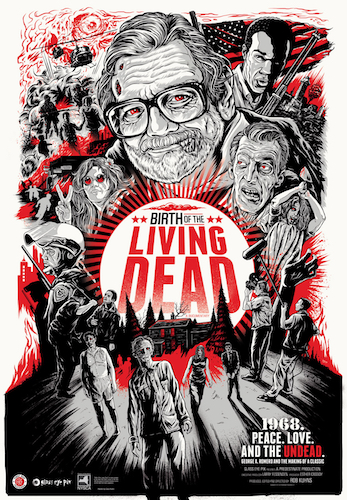
Birth of the Living Dead

As Birth of the Living Dead got underway, I was worried I’d made a mistake watching it so soon after One for the Fire: it seemed to be telling the same making-of story (though starting later: it jumps straight to the Latent Image days), but with only one interviewee who was there (at least that interviewee is Romero himself) and some slick animations to illustrate events. However, it moves very quickly on to commenting on and analysing the film’s construction, effect, and influence, and puts both the finished film itself and its production methods into wider social and historical contexts.

There are some familiar stories and anecdotes here, unsurprisingly, but there’s actually not that much overlap with One for the Fire, and Romero even tells some new behind-the-scenes stories. Much more of the film is about commentary from knowledgeable individuals — other people in the industry, journalists, movie experts, and so on. What the film lacks in not having other voices from the production, it makes up for with this outside analysis. This is all good stuff for those interested in the movie’s effect more than its production. Some of the discussion is obvious or reiterates well-known perspectives, but there’s a good variety of voices. It’s the kind of commentary that can enhance your appreciation of the film itself.

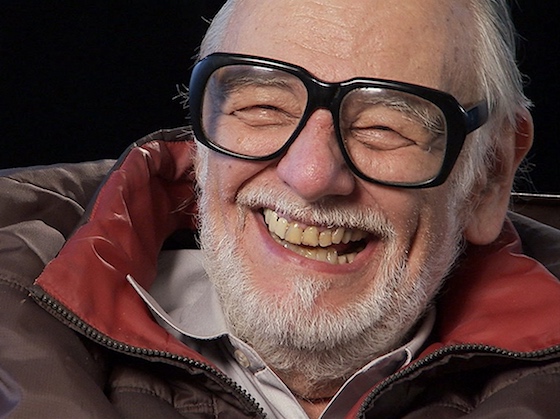
George Romero interviewed in Birth of the Living Dead

The only seemingly pointless thread follows a school teacher as he shows Night to a bunch of elementary school kids. No, that’s not a typo — they’re surely far too young for it! But they seem to delight in it. Nonetheless, it seems like a needless addition to the film, until quite late on. When the documentary gets on to discussing Night’s release, it talks about how horror had become a genre mainly marketed to kids — it was seen as colourful campy fun, with only the occasional hint of slight scariness. But then it was that audience that saw Night of the Living Dead, and they were fucking terrified (see: Roger Ebert’s contemporary article about watching it with an audience of children). I thought the documentary wouldn’t dare to revisit the modern teacher after that, but it does — and they still seem to love it. I don’t know what that says about our society now, if anything.

Aside from traumatising small children, Night of the Living Dead was initially dismissed by American critics as trash; but when it was re-released the next year, it was seen by a writer for Andy Warhol’s magazine, who called it art and said it should be playing in art houses. When it reached Europe in 1970, the French had a similar reaction. That fed back to the US: the Museum of Modern Art played it to a standing-room-only crowd. I guess that’s how we get to where we are today, with it acknowledged as a solid classic.

Now THAT's a triple bill

As I said earlier, when I decided to watch these two documentaries basically back to back I thought it would probably turn out to be a stupid idea. Fortunately, the overlap is minimal, meaning they actually compliment each other pretty well. Fans would surely benefit from seeing both. Alternatively, the fact that they offer distinctly different things means a viewer could pick the topic that particularly interests them. In that regard, I’d err towards recommending Birth of the Living Dead, for its critical appreciation and historical analysis that furnishes viewers with wider perspectives with which to appreciate one of the most significant horror movies — arguably, one of the most significant movies full stop — ever made.

4 out of 5

One for the Fire is available as a special feature on certain releases of Night of the Living Dead: the Australian and US 40th anniversary DVDs, the Japanese 40th anniversary Blu-ray, and Optimum’s UK Blu-ray (not the one released by Network). It seems it’s also available on an Italian DVD and Blu-ray, which provided the cover art above.

Birth of the Living Dead is available by itself on DVD in the US and on Blu-ray in the UK, as well as bundled with Network’s UK Blu-ray of Night. It’s also streaming free to Amazon Prime members in the US, and I’m sure available to rent and/or purchase from other digital providers.

The Duellists (1977)

2018 #26
Ridley Scott | 96 mins | DVD | 1.78:1 | UK / English | PG / PG

The Duellists

It’s 40 years this month since Ridley Scott’s debut feature appeared in British cinemas, which perhaps makes now the most appropriate time to have awarded him the BAFTA Fellowship (as he was this past weekend, of course).

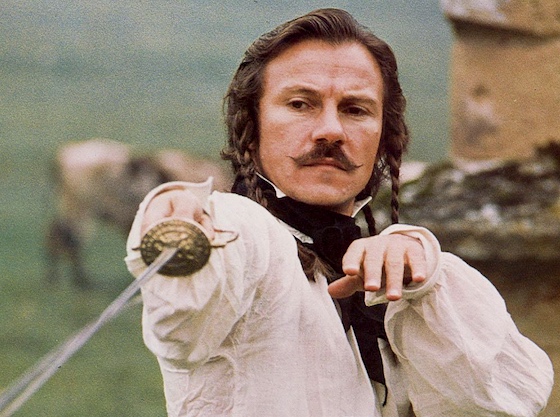
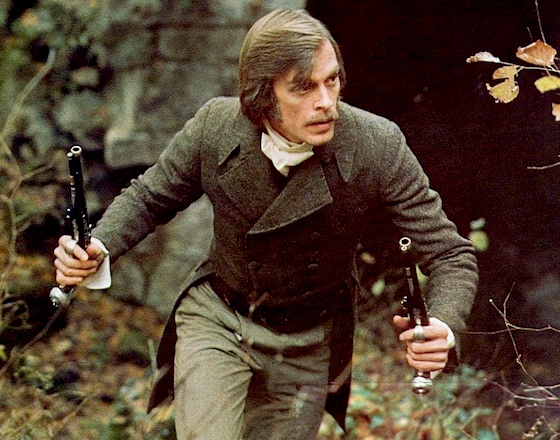
Adapted from a short story by Joseph Conrad, which was itself inspired by a true story, The Duellists stars Keith Carradine and Harvey Keitel as a pair of soldiers in Napoleon’s army who, for reasons only properly known to one of them, end up fighting a series of duels — or, really, one duel constantly reignited — over the better part of two decades. They become renowned for it (Conrad discovered the story through a newspaper article noting the death (by natural causes) of one of the real-life pair), to the chagrin of Carradine’s reluctant duellist. He dreads every potential encounter, aware of the fight’s futility and danger, but honour keeps drawing him back.

Ultimately, honour and the futility of fighting are what The Duellists is most about, if it’s about anything — if you like, you can enjoy it as merely a series of well-staged combats between two men, each stubborn in their own different way. They also each have slightly different ideas of honour, it would seem, but they’re compatible enough that it keeps drawing them back to the fight. “Acting with honour is all well and good,” the film seems to be saying, “but look where it gets them.” It doesn’t completely ruin their lives, but it does take a serious toll. A bit of common sense goes a long way, and acting with so-called honour, which might seem to be the moral course, doesn’t actually involve a great deal of common sense.

The bad duellist

Scott also intended the pointless, never-ending fight to represent a microcosm of war. Speaking to Empire magazine, Scott described Conrad’s story as “a very nice pocket edition of the Napoleonic Wars” because it “somehow encapsulated the craziness of an argument and how at the end of a 20-year period one of them forgot the reason why they were fighting. Isn’t that familiar?” Fighting for fighting’s sake; not wanting to be the one to back down… it seems it’s human nature, just as much in a conflict between two men as in between two nations. A bit of common sense would go a long way…

The other aspect of the film most worthy of comment is its photography. Reportedly Scott set out to imitate Stanley Kubrick’s Barry Lyndon, released just a couple of years earlier. It’s an appropriate inspiration: both tales are set in the same era, and Lyndon looks incredible. Scott undoubtedly succeeds in his goals — both that of copying Kubirck’s visuals and that of such copying being a good idea: much of The Duellists looks gorgeous, particularly wide scenery shots. Although the cinematography is credited to Frank Tidy, Scott says he operated the camera himself for the entire shoot, so who’s to know where exactly the credit for that achievement lies.

The good duellist

Resemblances to Barry Lyndon extend beyond just the visuals, mind. As noted, it’s set in the same era, so various visual trappings are similar, from costumes to some of the locations — if not direct copies, they certainly evoke Kubrick’s film more than once. There’s also the story itself: a tale focused on just one or two characters but spanning decades, and during a particularly tumultuous and eventful period in history. As Tim Pelan puts it (in this piece at Cinephelia & Beyond), “while Barry Lyndon advances with the forward momentum of one of Napoleon’s columns in its telling of a fool’s misfortune and slow glide towards the destruction of all he worked for and holds dear, The Duellists dashes pell-mell between the very different clashes of the antagonists.” Scott’s film feels like it thinks it is, or wants to be, an epic, just like Lyndon, even though it only lasts a little over 90 minutes.

Comparisons to such a lofty cinematic success would damn a lesser film, but The Duellists is a very fine work in its own right. Despite the similarities I’ve highlighted, it’s really a very different film: Barry Lyndon has a kind of leisurely elegance, whereas The Duellists is more economical and straightforward. It’s certainly not Scott’s greatest film (his next two immediately put paid to that), but it’s perhaps his most under-appreciated one.

4 out of 5

Fast & Furious 8 (2017)

aka The Fate of the Furious

2018 #21
F. Gary Gray | 136 mins | streaming (HD) | 2.39:1 | USA, China & Japan / English & Russian | 12 / PG-13

Fast & Furious 8

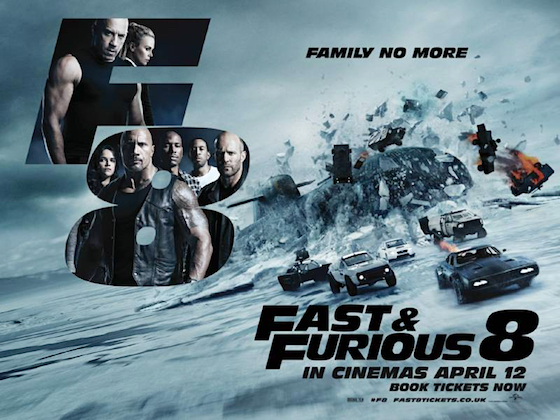
Anyone who’s watched a Fast & Furious movie will know that the most important thing to our heroes is not fast cars but family. Family, family, family — they don’t half go on about it. But what might make one of the team betray their all-important figurative family? Well, that’s what the series’ eighth instalment sets out to ask, as patriarch Dom (Vin Diesel) is forcibly recruited by terrorist Cipher (Charlize Theron), and government agent Mr Nobody (Kurt Russell) counter-recruits Dom’s family to track him down and stop Cipher’s evil plan.

You may remember that, once upon a time, these films were about street racers who occasionally carried out on-the-road heists, all the better to keep the focus on the cars. Those days are long gone, despite an opening sequence here that tries to pretend that’s still part of the game. No, nowadays we’re in the “international spy actioner” genre, and our former street racers have somehow become highly capable agents… whose primary tools/weapons are still vehicles. It’s utterly ridiculous… but, thank goodness, everyone involved seems to know that.

Well, most people do. I reckon Vin Diesel might think it’s a serious movie about the emotional turmoil of being kidnapped by a global cyberterrorist who lives on a plane and can remotely hijack a city-load of cars and is threatening your family unless you help her steal a nuclear submarine. I mean, we’ve all been there, right?

A lot of men would betray their family for Charlize Theron, to be fair

So, yeah, the story is thoroughly daft. But it exists primarily to connect up action sequences, and in a movie like this I’m fine with that — I’m here to watch people do cool shit in cars, hopefully with some funny bits around that action, not to be wowed by an intricate plot or ponder meaningful character development. On the things I expect, then, FF8 more or less delivers. I mean, the series has always been renowned for using CGI to augment its car chases, which is less thrilling than doing stunts for real, but it really blurs the line nowadays: you might think dozens of cars falling from a multi-storey car park is all CGI, but you’d be wrong.

Any time almost anyone besides Hobbs (Dwayne Johnson) or Deckard (Jason Statham) has their mouth open, FF8 is pretty dumb; but when those two are talking, especially when they’re bickering with each other, it’s often pretty funny (they’re definitely in on the joke). And when the action’s a-go-go, the film’s either solidly pulse-racing or, actually, being kinda witty — there’s a prison riot, for example, that is, appropriately enough, a riot. Though it’s as nothing to Statham engaging in a protracted gunfight-cum-punch-up against a bunch of goons while carrying a baby.

Bromance

Fast & Furious 8 isn’t strictly a comedy, but a sense of humour is required to enjoy it. There’s no way to take this palaver seriously, and fortunately the filmmakers have embraced that. It’s deliberately OTT, dedicated to being entertaining for almost every minute of its running time. Taken as just that, it’s a lot of fun. Also, probably the series’ best instalment since the fifth.

4 out of 5

Fast & Furious 8 is available on Sky Cinema from today.