Ice Age (2002)

The 100 Films Guide to…

Ice Age

Sub-Zero Heroes

Country: USA
Language: English
Runtime: 81 minutes
BBFC: U
MPAA: PG

Original Release: 14th March 2002 (Indonesia & Mexico)
US Release: 15th March 2002
UK Release: 22nd March 2002
Budget: $59 million
Worldwide Gross: $383.26 million

Stars
Ray Romano (Welcome to Mooseport, Paddleton)
John Leguizamo (Romeo + Juliet, Land of the Dead)
Denis Leary (The Thomas Crown Affair, The Amazing Spider-Man)
Goran Visnjic (Practical Magic, Elektra)

Director
Chris Wedge (Robots, Epic)

Co-Director
Carlos Saldanha (Ice Age: The Meltdown, Ferdinand)

Screenwriters
Peter Ackerman (Ice Age: Dawn of the Dinosaurs, eight episodes of The Americans)
Michael Berg (New Jersey Turnpikes, Ice Age: Continental Drift)
Michael J. Wilson (Shark Tale, Ice Age: Collision Course)

Story by
Michael J. Wilson (Alyce in Wonderland, The Tuxedo)


The Story
A trio of mismatched prehistoric animals endeavour to return a baby human to its tribe before the oncoming ice age cuts off the path to their camp.

Our Heroes
The aforementioned trio are overenthusiastic Sid the sloth, wannabe-loner Manny the mammoth, and Diego the sabre-tooth tiger, who has ulterior motives…

Our Villains
A group of bloodthirsty sabre-tooth tigers who want to kill the baby human in revenge for… something. I forget. Diego is their inside man.

Best Supporting Character
Weird squirrel-like creature Scrat — he was all over the marketing and is consistently associated with the franchise, so you’re probably vaguely familiar with him. He’s got nothing to do with the main story, instead popping up for asides of silent comedy. His opening scene was only added to the film because otherwise the first sequence featuring snow and ice wasn’t until over half-an-hour in, but he was so popular with test audiences that he was given more throughout the rest of the movie.

Memorable Quote
Sid: “For a second there I actually thought you were gonna eat me.”
Diego: “I don’t eat junk food.”

Memorable Scene
Walking through an ice-cave shortcut, Sid sees various other prehistoric creatures frozen in the ice: an ugly fish, a dinosaur, an evolutionary series that ends with him… and a flying saucer. (See also: Next Time.)

Letting the Side Down
Most of the time the deliberately stylised designs help the film get away with the early-’00s quality of its CG animation (and some flourishes, like fur, actually look rather good), but the tribe of humans move rather stiffly, and consequently look a bit like a computer game from the same era.

Making of
Believe it or not, Ice Age was originally pitched as a drama. Fox insisted that if it was animated it had to be a children’s comedy (because that’s what all major Western animation is, right? And when it isn’t, it flops, like Fox’s previous animated movie, Titan A.E. Incidentally, that failure is also why they abandoned plans to make Ice Age in 2D cel animation). The original dramatic concept is presumably why some slightly-too-serious stuff remains in the storyline.

Next time…
Four true sequels, plus the usual wealth of connected short films and TV specials that accompany popular kids’ animation franchises nowadays. A sixth film and/or TV series may be in development. Interestingly, each of the things Sid sees preserved in the ice (see Memorable Scene) is connected to one of the sequels. I’ve no idea if that was deliberate or a huge coincidence; though, either way, I’m sure it can’t’ve been planned from the outset.

Awards
1 Oscar nomination (Animated Feature)
7 Annie nominations (Animated Theatrical Feature, Directing in an Animated Feature, Writing in an Animated Feature, Character Animation, Character Design in an Animated Feature, Production Design in an Animated Feature, Music in an Animated Feature)
1 Saturn nomination (Animated Film)

Verdict

Ice Age was one of the first computer-animated franchises, though it doesn’t seem to have stuck in the collective consciousness as well as, say, Toy Story or Shrek. Personally, I first and last saw it sometime shortly after its original release, but all I could remember was enjoying it well enough. Well, all that is probably because it’s not as good as the best of Pixar or DreamWorks. It’s amenable enough, but it lacks the sharpness of concept, dialogue, character, and story that makes those movies truly memorable. I can see why I remember liking it but couldn’t recall much else. So, I’m not sure it deserves to be better-remembered than it already is, but it’s not at all bad for anyone who chooses to seek it out.

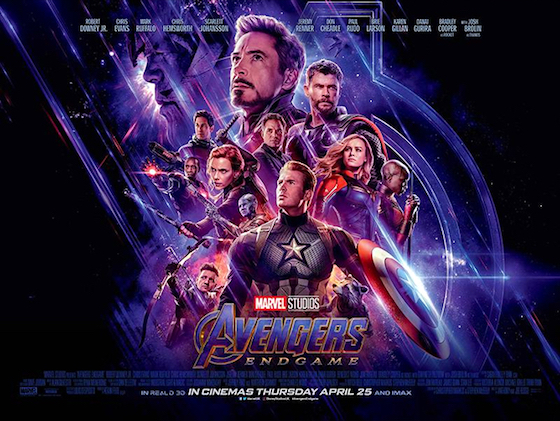
Avengers: Endgame (2019)

2019 #67
Anthony & Joe Russo | 181 mins | cinema | 2.39:1 | USA / English & Japanese | 12A / PG-13

Avengers: Endgame

A trilogy each of Iron Mans, Captain Americas, and Thors; a pair of Ant-Mans and two volumes of Guardians of the Galaxy; an Incredible Hulk, a Doctor Strange, a Black Panther, a Spider-Man, and a Captain Marvel; plus, of course, a trio of previous Avengers — they’ve all been leading us here, the culmination of 11 years and 22 movies in the Marvel Cinematic Universe. It’s an unparalleled achievement in moviemaking; a combination of blockbuster scope with TV-esque serial storytelling that is so 21st century. Within its three hours and one minute running time, Endgame encompasses and represents almost all of the tendencies of other MCU movies — for both good and ill. This is not a perfect movie, and this will not be a 5-star review, which I’m saying upfront because massive spoilers may follow. There’s not much to discuss about the film if we limit ourselves to what’s been revealed in trailers and promos, because they’ve purposely kept almost the entire movie a secret, so I’m just going to talk freely.

If you’ve seen the movie then a plot recap is unnecessary. But in case you just don’t care and have decided to read on regardless: Endgame picks up days/weeks after the cliffhanger ending of Infinity War (maybe I missed or misunderstood something, but I swear one character said it had been 23 days then later someone said it had been two days). The surviving Avengers, plus newly-summoned addition Captain Marvel, manage to track down super-villain Thanos and set off to retrieve the Infinity Stones and use them to bring back the 50% of the universe’s population he turned to dust. Unfortunately, Thanos has destroyed the stones. All hope is lost. Cue title card: five years later.

Thanos no more

Okay, we’ll return to the plot in a minute, because this is the first structural oddity of the film. This opening salvo — made up of a pre-Marvel logo sequence in which we learn what happened to Hawkeye and his family, a pre-titles sequence which sets up the plan to beat Thanos, and the pre-timejump action I just described — is almost a self-contained unit dealing with the hangover from the last film. It wouldn’t fit as a closing act to Infinity War — that movie ended at the perfect point in the story — but nor does it really belong at the start of Endgame, which begins properly after the “five years later” card. I have mixed feelings about it, because I like that we see both the heroes’ immediate attempts to rectify the situation, but also that they can’t, so we get to see how they’ve coped (or failed to) over the ensuing years. But, structurally, it felt a little clunky to me; a bit of business from the previous movie that has to be wrapped up before this one can start. I’m not sure what the solution is. If movies still bothered with opening credits, something as simple as separating it all off as a pre-titles sequence might’ve been the answer.

Anyway, back to the plot. It’s five years later and the world is still coming to terms with the snap. There are too many characters in too many different places to recap what everyone’s up to — that’s part of why this film has a three-hour running time, because there’s simply so much to tackle. But in many ways this is the best part of the movie, especially if you’re invested in these characters rather than just here for action or spectacle. It’s a bit grim, obviously — no one’s going to be cheery about half the world being wiped out — but it digs into the differing reactions this would provoke in ways that are character-specific and mostly plausible. I say “mostly” because, when Hulk (or whatever he is now) turns up, I didn’t quite follow the logic of why he’d turned himself into this Banner/Hulk hybrid. Still, seeing how the characters come to terms with their new reality is an effectively thoughtful way to start off.

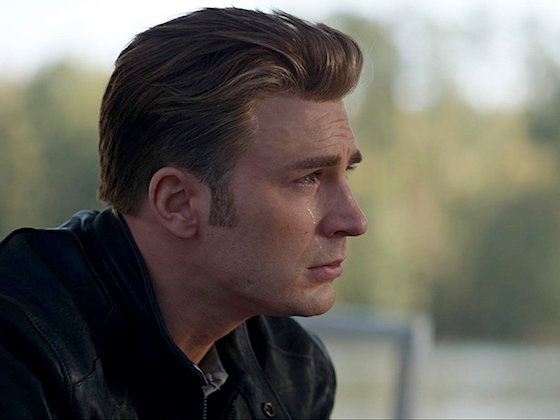
Crying Cap

But that’s not going to fuel a superhero blockbuster, is it? Here the little mid-credit scene from Ant-Man and the Wasp comes into play. Marvel have always used their credit stings to connect up the films, but has it ever been so vital as this? They’re normally little teases, basically trailers to remind you which film is next, but what happens in that Ant-Man 2 scene is vital to the plot of Endgame. Basically, Scott has been stuck in the Quantum Realm for the past five years, but this provides them with an opportunity: it might be possible to use it for time travel, allowing them to go back in time and undo Thanos’ actions. Or something. Endgame’s relationship with time travel is… variable. Time travel movies are always complicated, and because it’s not a thing that’s really possible they get to set their own rules for how it works. The problem is, Endgame isn’t very clear what those rules are. It makes a great show of saying “it’s not like in the movies” and reeling off a slew of pop culture references (Back to the Future is mentioned more than once), but then it struggles to clearly define how it does work in this movie. And once the characters set off into the past, any explanations it did give seem to go out the window.

It’s in this long middle act that Endgame was most often problematic for me. Act one is largely committed to being solemn, and act three is largely committed to being Epic, so it’s in the middle that the film shoots for the MCU’s trademark “light and breezy” tone. Unfortunately, sometimes this is so shoehorned in that it rubs against the serious stuff, resulting in a tonal mishmash. I’ve frequently advocated for movies that mix seriousness and comedy side-by-side, because real life often does the same, but there are points where Endgame undercuts its own stakes or undermines its characters for the sake of a one-liner or a comedy bit, rather than embracing the seriousness of the situation and letting comedy evolve naturally when it’s warranted.

There can be only one...

Conversely, some of the humour is accidental. One of the more egregious examples for me is when Black Widow and Hawkeye are faced with the Soul Stone dilemma: one of them has to die as a sacrifice for the stone to be released to the other. They both decide to sacrifice themselves, which leads to a protracted series of attempts to stop the other from committing suicide first. The constant back and forth of who had the upper hand gets almost to the point where it’s comical — I began to wonder if it was meant to be a comedy bit. But then, just as it was reaching the height of absurdity where I was about to conclude I should be laughing rather than just thinking “this is silly now”, it abruptly stops when one of them ‘wins’ and we get a Tragic Death Scene. It’s clearly meant to be a shocking, affecting moment of heroic sacrifice; instead, I found it a jumble of intentions that neutered any genuine feelings.

Another moment that’s well-meaning but fumbled comes during the big climax, when all the Lady Superheroes unite to do something. It’s a moment of such brazen, uncalled-for “feminism” that it feels like pandering, and that’s a bad thing. I’m searching for a better word to use in that last sentence, because overall feminism is a good thing, but this particular moment is so out-of-nowhere, so fundamentally meaningless (there’s no need for it to be just the women involved), that it’s egregious. When crybaby fanboy trolls scream about unnecessarily forcing political correctness onto genre movies, they’re unerringly wrong… except this time they’ll be right, because that’s exactly how this plays. There’s a broadly similar moment in Infinity War, when a couple of the female heroes defeat whichever of Thanos’ sidekicks is the female one, and I thought that worked, partly because no one made a big deal of it. Here, it’s clear they’re making a point. I’m not sure what the exact goal of it was — to say “women are as capable as men”; to say “look how many female heroes we have now”; or something else — but there are better, subtler ways to make that same point.

Nebulous plotting

Where Infinity War found room for almost all of the MCU’s ongoing franchises and characters (an impressive feat), Endgame cements its finale status by re-centring us on the original lineup from the initial Avengers team-up… er, plus a couple of other characters, who are important to varying degrees for various reasons. It’s that kind of “it’s almost this… but not quite” construction of content and/or theme that belies a certain lack of focus or forethought. If this is a last hurrah for the original team, why is Ant-Man vital to the story even being possible? Why does Nebula get one of the most significant subplots, intimately connected to her character arc from Guardians Vol.1 and 2? Why is brand-new (to the movies) character Captain Marvel repeatedly required to come in and save the day?

This extends to the time travel too: when they go back, it’s into the timelines of specific movies, but why those movies were chosen isn’t always clear. Avengers Assemble? Makes sense — it was where the crazy project of the MCU proved it was working, making that film both the end of the beginning and a beginning in itself. Guardians of the Galaxy? I mean, I guess — it’s where Marvel proved they could turn even the most obscure property into a massive, popular hit; plus it’s where a lot of the Thanos storyline really got going. Thor: The Dark World? …wait, what? Seriously?! Yes, perhaps the greatest trick Marvel have ever pulled is making Thor 2 — one of their least well regarded films — a moderately essential component of this finale. You need to have seen that movie to fully understand what’s going on here, and now you can’t really skip it in your rewatches either.

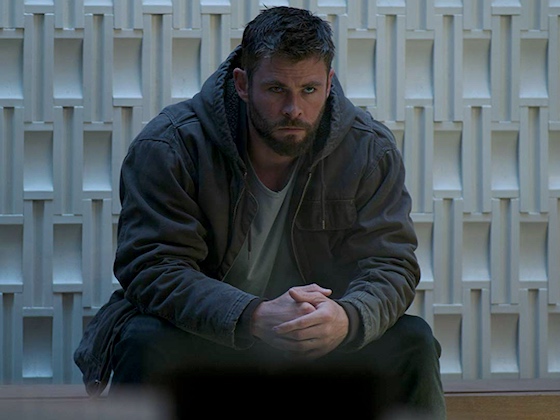
Thor after being told which movie he had to revisit

Talking of connectivity, Infinity War surprised by being a standalone movie, not just a Part 1. Okay, it was a standalone movie which ended with our heroes losing, which you could call a cliffhanger, but if you look at it from the other side — i.e. with Thanos as the main character — it’s a whole, completed, no-more-story-to-tell tale. Therefore it’s a fresh surprise (kinda) that Endgame is very much a Part 2 — and also, in fact, a Part 22 — freely nodding to and paying off stuff from previous movies on the assumption you’ll know what it’s referencing, more like the last instalment of a serial than a standalone film. Anyone who’s skipped a film or two (or three or four, etc) on the way to Endgame is likely to miss all the nuances, at the very least, and perhaps be left with more serious questions too. Newcomers definitely need not apply. But if there’s anyone who’s a fan of part of the MCU but not all of it, they’ll need to find their way into and through Endgame one way or another, because a whole bunch of stuff is wrapped up for good here; some heroes won’t be getting another standalone movie to put a button on their story.

I feel like this review has focused on the negatives and debatable drawbacks of Endgame, but that’s partly because a lot of the discussion right now seems unrelentingly praiseful. I mean, as I type this the film is ranked as the 5th best of all time on IMDb, a position it’s actually risen to over the past 24 hours (it debuted around 19th). I didn’t think it was perfect, or quite as good as that (for comparison: I thought Infinity War was more consistent and successful as a movie, and IMDb raters have currently ranked that 61st), but I did enjoy it overall. I don’t think it needed to be as long as it is (at times it meanders through scenes or comedic bits rather than getting on with things), but it doesn’t drag or bore. It’s a bit of an irreconcilable dichotomy that I think both it didn’t feel excruciatingly long and also that they should’ve tightened it up and brought the running time down.

The end for Tony?

Still, that runtime means they felt there was space for more than just action sequences. Allowing the film to focus on the emotions of the characters (at least some of the time) is suitable payoff for the investment people have in them. Indeed, as I said earlier, in many ways the first act is the film’s best stuff. This isn’t just an empty effects spectacle. But when it is a spectacle, it can be spectacular. Okay, the climax, where two sizeable armies rush at each other on a brown battlefield under a grey sky, degenerates into a massive free-for-all of whooshing pixels where it’s frequently hard to discern exactly what’s going on and who’s doing what to who (it actually reminded me of Aquaman, only with less colour. I’m sure such a comparison to a DC movie will be sacrilege to some Marvel fans, but it’s the truth). But within and around that there are still things that are a thrill, not least the big moment when the previously-dusted heroes turn up en masse in the nick of time. And when all is said and done, the end credits offer a special acknowledgement of the main Avengers who started it all, which was quite possibly my favourite bit of the whole movie.

There are no mid- or post-credit scenes, making this only the second MCU movie without them. (The first was The Incredible Hulk, which basically had its post-credit scene before the credits started. I’m sure they’d’ve placed that scene differently if they’d known it would become a trademark of the franchise.) It’s an appropriate decision: we know this isn’t the end (the next Spider-Man movie is out in a couple of months; many more officially-unannounced Marvel films are on the horizon after that), but this is supposed to serve as an ending nonetheless, and so letting it actually end, rather than attaching a tease for the future, is welcome. Though, really, how much of an ending is it? Yeah, it officially closes off the first era of MCU films, but a bunch of those characters are continuing into the future, and even some of the ones primarily associated with the first era — characters who died here — are coming back in prequels and the like.

Goodbye to MCU

However, the lack of credits scenes did allow me to enjoy some schadenfreude: I knew going in there were no scenes, but that there was a “meaningful sound effect” at the end of the credits. I had nowhere else to be, so I stayed to see what it was. Everyone else who stayed, however, was chattering about what the end credits scene might show. The credit roll came to an end, everyone went quiet in anticipation, that “meaningful sound effect” played, and I started getting ready to leave while all around me stared at a black screen while the cinema’s filler muzak played, thinking they were witnessing the beginning of another scene. It took them a good 30 seconds to twig. (Maybe I should’ve said something… maybe the usher stood at the front of the auditorium should’ve said something… maybe he and I are both just horrible people…)

That literally brings me to the end of Endgame. There’s much more that could be said about it, and will be said about it. For me, an interesting thing now will be to see what is its long-term reception. As I said, right now it’s riding high on a wave of audience euphoria, but it’s only just come out: most of the people who’ve seen it already are the really keen ones; the diehard fans. What will wider audiences think? What will the diehards think when they get a chance to revisit it, removed from the heat of initial emotion? Will the consensus remain that Avengers: Endgame ranks in the echelons of the very greatest movies of all time, or will cooler heads prevail?

4 out of 5

Avengers: Endgame is in cinemas everywhere (except Russia) now.

Teen Titans Go! To the Movies (2018)

2018 #246
Aaron Horvath & Peter Rida Michail | 84 mins | streaming (HD) | 16:9 | USA / English | PG / PG

Teen Titans Go! To the Movies

I don’t think I’d even heard of the Teen Titans Go! animated series until promotion for this big screen version started. Best I could tell, a lot of entitled fanboys hate it — it’s too childish and comical, whereas they’d prefer the ‘grown-up’ seriousness of cancelled animated series Teen Titans — and consequently weren’t at all impressed by it getting the honour of film adaptation. Whatever — I thought the trailer looked funny, and, fortunately, the end product lives up to it.

The Teen Titans are a superhero team made up of erstwhile Batman sidekick Robin, half-robot Cyborg (who, in other iterations, is a member of a certain major-league superhero team), shapeshifter Beast Boy, half-demon sorceress Raven, and alien princess Starfire. After they’re criticised for not having their own movie, the Titans set out to get one made. First step: get an arch-nemesis, for which they target Slade Wilson, aka Deathstroke.

Although ostensibly a children’s series, and therefore presumably a children’s movie, Teen Titans Go is actually full of gags and references aimed at older viewers, without resorting to cheap double entendres or the like designed to fly over kids’ heads, but instead focusing on the wider universe of superhero movies — it has less respect for the fourth wall than a Deadpool movie. It’s often genuinely witty, and burns through plot and jokes at a joyously fast pace (possibly a legacy of its short TV episodes). It also might be the first time I’ve ever seen a fart gag and thought, “that’s actually quite funny and kinda clever (for a fart gag).” That’s a special kind of achievement in itself.

4 out of 5

Teen Titans Go! To the Movies is available on Sky Cinema as of this weekend.

It placed 23rd on my list of The 26 Best Films I Saw For the First Time in 2018.

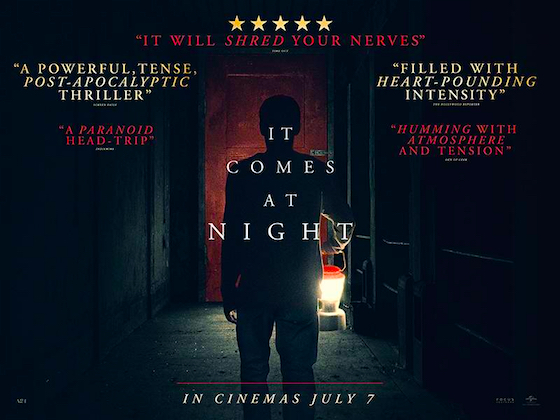
It Comes at Night (2017)

2018 #55
Trey Edward Shults | 88 mins | streaming (HD) | 2.40:1 | USA / English | 15 / R

It Comes at Night

Described by Kim Newman in his Empire review as “existing between a Sundance and a FrightFest film”, which is a neat way of putting “arthouse horror”, It Comes at Night went down very poorly with many viewers, seemingly because it was mis-sold by its trailers. As someone who went in pretty much cold, however, I thought it was very good.

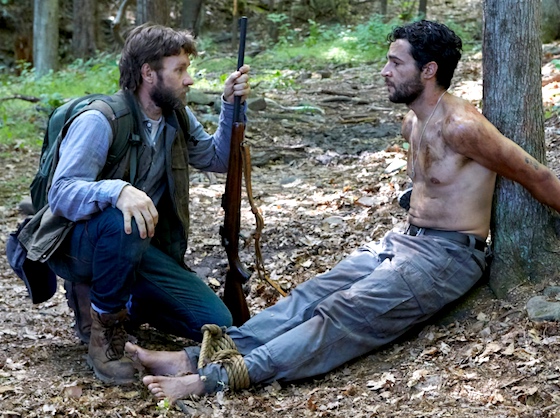
Sometime after some kind of contagion has wiped out civilisation, we’re introduced to a family — Paul (Joel Edgerton), his wife Sarah (Carmen Ejogo), and their teenage son Travis (Kelvin Harrison Jr.) — who’ve sequestered themselves in a secure house deep in the woods. But their existence is disrupted by the arrival of a couple (Christopher Abbott and Riley Keough) and their young son seeking refuge. Although Paul is deeply distrustful, he agrees to take them in. But is there some one, or some thing, else waiting for them in the woods?

Well, I should be careful there, lest I slip into doing what the trailers did. I watched one after the movie, and it certainly wasn’t a great representation of the film. So was it wrong to advertise it as a horror movie? Yes and no. I mean, it’s not your typical horror flick, but it is moody and creepy and tense, and scary because of it. I’m tempted to compare it to something like The VVitch, though their styles do diverge as they go on (I could say how, exactly, but it might be construed as a spoiler). It partly depends how you define genre. You could argue It Comes at Night is actually a psychological thriller with a dash of sci-fi (thanks to its post-apocalyptic setting) — and it definitely is those things — but, functionally, it’s a horror movie. It’s built to unnerve and scare you. It’s only really once those immediate terrors are out of the way — i.e. when the film ends — that what it leaves you to chew over is its commentary on paranoia and trust.

Distrust

In the case of the latter, and the way it executes its sci-fi-ish setting, it all feels very realistic and plausible. That realism is underscored by the pace, structure, and characterisation. The combination of the writing and an array of good performances mean all the characters come across as believable, supportable people — there are no clear heroes and villains here. And even things that look like clues to solving some mystery turn out to be, if not red herrings, then functional dead ends.

It’s a very well-made film on the whole. The cinematography by Drew Daniels looks incredible. Well, some of the daytime stuff just has a grainy, handheld, documentary-ish feel, which is appropriate and well done if fundamentally unremarkable; but everything in the house after dark — seemingly lit only by handheld lanterns and torches — looks fantastic. And all that darkness is suitably scary, of course. Plus film grammar nerds are going to love something subtle the visuals do later on, if they even notice it — it’s that low-key that it might pass you by, but it’s really effective. (Writer-director Trey Edward Shults discusses what it is, and why they did it, in this interview. I had so much of that article copied into my notes for this review that I decided I may as well just share the whole thing.) I also liked the score by Brian McOmber. Sometimes it feels a mite familiar from other movies of this style, but it remains highly effective — not overblown, but atmospheric, without being a mere background hum.

The best way to see It Comes at Night is as cold as possible — perhaps off the back of a positive, accurate review, say. A lot of the low viewer scores and negative comments do seem to stem from being mis-sold by the trailers, and I hope that, divorced from that, the film will be able to latterly find an appreciative audience; one not interested in gore and jump scares, but in tension, paranoia, and the psychology of fear.

4 out of 5

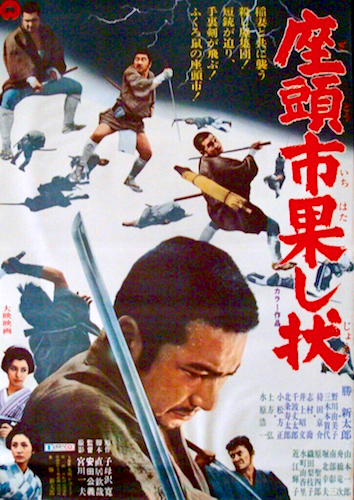
Samaritan Zatoichi (1968)

aka Zatôichi kenka-daiko

2019 #42
Kenji Misumi | 83 mins | Blu-ray | 2.35:1 | Japan / Japanese | 15

Samaritan Zatoichi

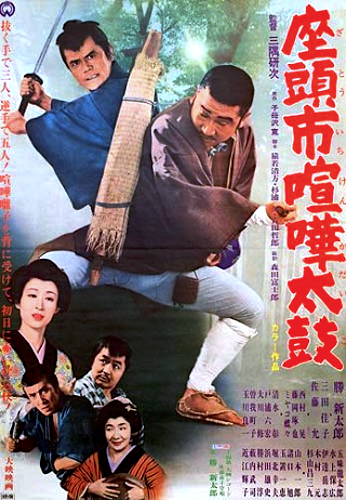
The 19th Zatoichi movie begins with our hero fulfilling some yakuza responsibilities: on the orders of a boss he’s been staying with, Ichi (Shintaro Katsu) is part of a group who try to collect overdue debts from a man. When he refuses to come peacefully, Ichi is forced to kill him. Only then does his sister, Osode (Yoshiko Mita), turn up, and Ichi learns what’s really going on: the debt was just a pretext for the boss to acquire Osode, who’s wanted by a local government official for, you know, the kind of thing corrupt officials want pretty young women for. Incensed, Ichi vows to protect Osode, although she’s not so keen on palling around with the guy who just murdered her brother…

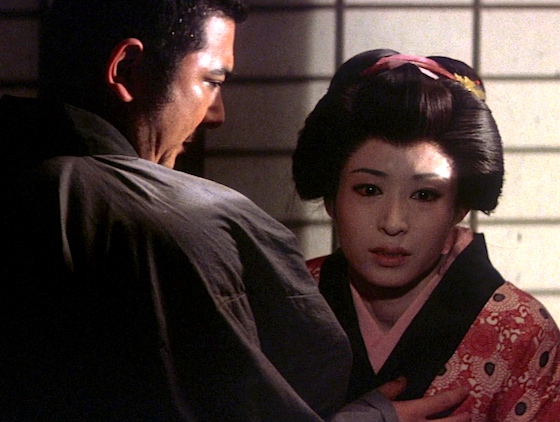
As opening acts go, it’s a strong setup. Okay, it’s similar to ones the series has played before (see Zatoichi’s Pilgrimage), but it finds its difference in the character of Osode. Where most characters quickly decide Ichi is the good guy and get on his side with no regrets, Osode struggles with her grief and her feelings towards the blind swordsman, swinging back and forth between acceptance and, well, not: at one point she gives serious consideration to murdering him and then committing suicide. It feels like a bit more psychological realism than we often get, especially from characters Ichi has wronged, and it’s realised on screen with some effectively different visuals. For example, when Ichi engages in a show of skill at a fairground ball game, Osode is initially as gleefully impressed as everyone, before she comes to realise it’s these skills that allowed him to murder her brother, an event she imagines in starkly-coloured purple/green ‘flashbacks’ as she looks at Ichi with new eyes. It’s a particularly striking departure from the series’ usual grounded visual style (one echoed when Osode has red/blue ‘flash forwards’ to killing Ichi), although the whole film is very nicely shot. Of course, Osode’s ambivalence can’t go on forever: eventually she forgives Ichi and falls in love with him, because she’s only a woman and, in the world of Zatoichi, nothing is more attractive than a blind, tubby, slovenly, rice-guzzling, depressed-by-his-own-conscience, roaming mass murderer.

Grief

Lest you think Samaritan Zatoichi is one of the series’ heavy instalments, fear not, because there’s some quite broad slapstick-ish comedy in counterbalance. The first half of that ball game, for instance, is definitely played for laughs. A later sequence sees Ichi wrapped in reeds to be dumped in the river, but fate gives him a chance to get to his feet, whereupon he engages in a fight with his would-be killers, stumbling around still wrapped up — despite which he still comes out victorious, of course. Ichi also ends up with a sidekick for part of the film, Shinsuke, played by Takuya Fujioka, who was a friend of Katsu and consequently pops up in a couple of Zatoichi films. Apparently he was mainly known for comic roles, which he brings a dash of here, but Shinsuke isn’t entirely useless, nor just played for comic relief, which makes a nice change for the sidekick role.

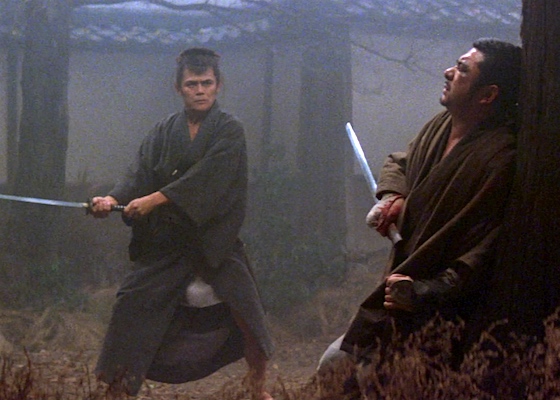
Other memorable sequences in this instalment include one where Ichi commandeers a horse to catch up with the villains, in which he takes to riding about as well as you’d expect for a blind man (i.e. not very); a dice gambling scene where, in an about turn from every other one featured thus far, it’s Ichi who’s doing the cheating; and a final one-on-one duel that is another classic in a series absolutely filled with them (I mean, how many times in these reviews have I referred to the climactic scene as “one of the best”? It must be a pretty long list at this point.) What’s different this time is how much of a challenge it is for our hero. According to IMDb trivia, it’s the longest one-on-one duel of the series, lasting 2 minutes 14 seconds, which feels like an eternity next to the mere seconds it usually takes Ichi to defeat a solo foe. It’s set as dawn breaks on a new year, and the drums at a nearby shrine begin to pound to mark the occasion, so loudly that they impair Ichi’s senses and, therefore, abilities. The film’s original title translates as something like Zatoichi Fighting Drums, and here we see why. Combining a duel that’s more protracted than usual with a thumping score courtesy of those drums, the finale feels like an epic confrontation… even if the fight’s happening for very little motivation.

Ichi struggles

And here we reach what’s wrong with Samaritan Zatoichi: despite an initial clean and clear setup, the plot gets a bit scrappy. Much of it is driven by the yakuza boss desperately pursuing Osode to please the government blokey, but it turns out he’s actually not that bothered about her. The boss doesn’t believe that, so he wastes time continuing to pursue Osode; but no, government blokey meant it, and it winds up with him not awarding a contract to the boss. Despite that, the boss continues to pursue Osode… Just Because, I think? Or maybe we’re supposed to take it he’s really after Ichi at that point? Other contrivances occur just to keep the plot rolling, too (at one point Osode sets off without Ichi — again, Just Because — which leads to a whole heap of trouble), and I wasn’t joking when I said the final ronin has little motivation: he seems to decide to pick a fight with Ichi just for shits and giggles.

But if you don’t worry about logical character behaviour too much, there’s an awful lot to enjoy in Samaritan Zatoichi. Such niggles hold it back from being amongst the series’ very best instalments, but there’s much else to recommend it, including likeable supporting characters, great fight scenes, and various other memorable set pieces.

4 out of 5

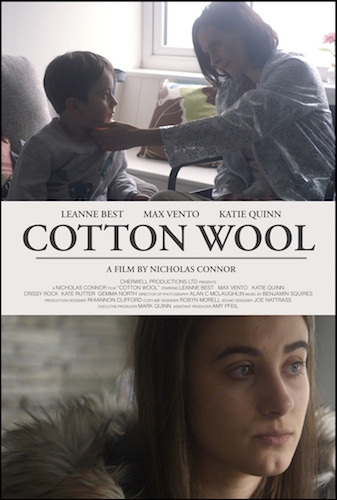
Cotton Wool (2017)

2019 #50a
Nicholas Connor | 38 mins | download (UHD) | 2.40:1 | UK / English | 12A

Cotton Wool

After single mum Rachel (Leanne Best) suffers a debilitating stroke, it marks a massive change for her two kids, stroppy teenager Jennifer (Katie Quinn) and sweet seven-year-old Sam (Max Vento): with no other family and minimal support from the authorities, it’s suddenly up to the kids to care for their mum.

As a closing title card informs us, there are around 243,000 carers under the age of 19 in England and Wales alone, with 22,000 of those under the age of nine. Writer-director Nicholas Connor’s short film seeks to highlight this issue — it’s quite shocking how many young lives are affected by the need to look after other family members because there’s no one else to do it. But the short is also “inspired by their courage”, and so it strikes an optimistic tone about the power of love and the value of family, rather than spending too much time in condemnation of a system that leaves these youngsters largely unsupported.

If you watch things like the BBC’s annual Children in Need telethon, these kind of facts and situations might be familiar — it’s the kind of thing they cover in short documentaries during the evening. Connor’s film differs thanks to the advantages of fictional storytelling: rather than just informing the viewer of facts and statistics, Cotton Wool connects us to the characters and explores the subject from different angles. The new life thrust unasked upon Rachel, Jennifer, and Sam affects them each differently, and Connor uses that to find generality in specificity: rather than tell us about all 243,000 young carers and the people they look after, here are three individuals who each struggle and cope in different ways.

Simply Leanne Best

In particular, the film presents a clear but not heavy-handed difference between the behaviour of the two kids: Jennifer professes that she helps around the house, but is really more concerned with escaping out with her mates, with maintaining her own life; Sam, meanwhile, does all that he can to look after his mum. It’s easy to see that Jennifer is ‘in the wrong’, but, again, the film doesn’t go out of its way to condemn her. She’s not a bad person, just conflicted. Her storyline culminates in a teary scene in bed where she talks about admiring everything her mum did for them, which is the nearest the film got to being too on-the-nose for me. Conversely, Sam’s storyline maintains a degree of understatement. Perhaps the most heartbreaking moment comes when he has a one-to-one chat with a care worker who notices the space paraphernalia around Sam’s room. Asked if he wants to be an astronaut when he grows up, Sam instead says he wants to care for his mum.

However, the best performance of the trio comes from Best (pun not intended!) With Rachel physically debilitated after her stroke, Best is stuck with a limited range of speech and movement, but still conveys a wealth of emotion while not at any point letting the effects of her condition slip. The film has won a variety of awards at film festivals around the world, including several of Best’s performance, and it’s well deserved.

It’s a handsomely mounted production all round. I don’t watch many shorts, really, so can’t make a fair comparison, but it doesn’t look cheap or limited in the way you might expect of a low-budget short. There are some very effectively staged moments, in particular the two strokes — the first a handheld, almost scary event seen from Sam’s eye level; the second a trippy, tense nightmare. Much of the film is shot with a sort of hazy beauty by DP Alan C. McLaughlin, and the wintery Yorkshire countryside locations help emphasise the isolation of the family.

Hazy shade of winter

As a calling card for the young writer-director, it could hardly be better. At the risk of making us all despair at the state of our lives, he made this when he was just 17, but it suggests a maturity of approach beyond that. There’s a certain lightness of touch in the storytelling that doesn’t ram home the hardship of the kids’ situation or the juxtaposition of their behaviour, and he refrains from the polemicising you might expect to find in an issue-driven short by a filmmaker of any age.

I’ve avoided mentioning it thus far, but it’s hard not to make comparisons to another recent British short film about a child coping with disability-related adversity in a chilly Northern setting, The Silent Child. That, of course, won an Oscar, and I’d say Cotton Wool is at least its equal.

4 out of 5

More information about Cotton Wool can be found on the director’s website, here.

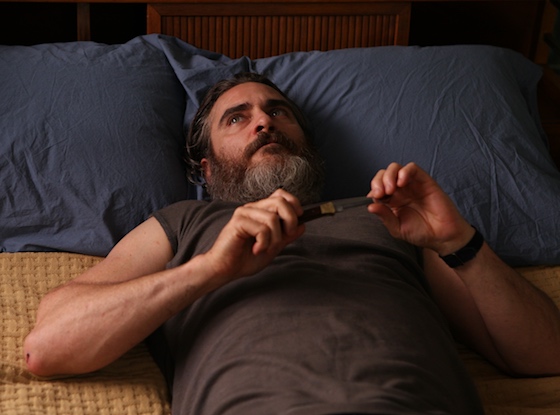
You Were Never Really Here (2017)

2019 #45
Lynne Ramsay | 90 mins | streaming (HD) | 2.35:1 | UK, France & USA / English | 15 / R

You Were Never Really Here

Writer-director Lynne Ramsay tackled serious dramatic subjects in her previous features (none of which I’ve seen, I’m ashamed to say, so I apologise if my “this is a change of direction” intro is off base), but here shifts into genre mode to adapt Jonathan Ames’ noir-ish crime-thriller novella, albeit while retaining a good deal of the arthouse idiosyncrasy you’d expect.

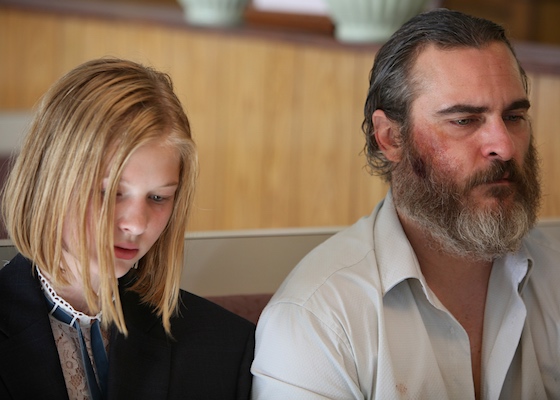
The film follows Joe (Joaquin Phoenix), a middle-aged-or-so guy who lives with is elderly ailing mother (Judith Roberts), and seems even more tired of life than she is, plagued by memories of things he’s witnessed. That history has given Joe a (as Liam Neeson would put it) very particular set of skills, which nowadays he puts to use for private clients, via multiple middle men, primarily (or wholly — the film doesn’t clarify) to rescue abducted children. But when he’s hired to rescue a US senator’s wayward teenage daughter (Ekaterina Samsonov), things end up going sideways in unforeseen ways.

Joe’s weapon of choice is a hammer. He uses it to take out multiple Very Bad Men in this film. But if the combination of “genre: thriller” and “using a hammer to take out bad men” makes you think You Were Never Really Here is about to unleash a low-budget action-fest upon your eyeballs, I refer you back to the writer-director being Lynne Ramsay and my mention of “arthouse idiosyncrasies”. I thought I’d mention this point upfront because I’ve seen others be disappointed by the lack of overt action in the film. Ramsay has instead chosen to keep most of the violence offscreen — we sometimes see the build-up or the aftermath, or both, or maybe neither, but only rarely the act itself. It’s not that kind of movie. And that’s not a problem, so long as you’re not expecting those kind of kicks.

Much to think about alone

Instead, the film becomes more of a character portrait, interrogating who Joe is and why. What kind of man does a job like that? What events in his life brought him here? What toll does it take on him? Or is there no toll because the damage has already been done? Explicitly writing these questions, which the film does seek to consider, causes me to question the worth of a serious-minded exploration of such a character’s psyche. It makes me wonder: are there real-life people like Joe? Does anyone actually do this job in the real world? Is the universe Joe moves in — a netherworld, parallel to our own but hiding from everyday view — a true one, or just the stuff that fills genre fiction? And if the answer to “is this real?” is a “no” — if these characters, situations, and environments are all just genre fodder — is there value in getting psychologically real about it?

Some would say “no”, because we don’t necessarily come to this kind of genre fiction for realism, even when it’s given a dark or gritty spin. I mean, take a slight genre sidestep into something like Paul Greengrass’ Bourne movies, for an example: they’re shot with a documentary-esque style, but no one thinks they’re plausible portraits of real life espionage activities. Stories like You Were Never Really Here have a greater reality claim than that, but I still question their actual adherence to our real world. But surely these extreme spins on reality are invented, at least in part, to justify simultaneously inventing heroes to put into them, who can then sort it all out by wielding some weaponry and special skills that we might not accept in a totally true-to-life story-world.

Much to think about together

Maybe I’m over-theorising this now. But You Were Never Really Here is the kind of movie that leaves gaps to invite you to think about it, to fill in your interpretations and personal notions. It’s a film with a lot of quiet space — literally, in the sense of its often minimal dialogue and, shorn of action scenes, little of the thudding and thumping you’d expect in the sound department; but also figuratively, with long scenes that make room for you to think about what you’re witnessing; scenes that don’t hand-feed you every piece of information, so you put it together yourself. (If you want an example: no one ever tells you where Joe got his skills, but flashbacks give you visual clues to put it together.) Maybe the film isn’t trying to say “guys like this exist outside of genre pieces, and they’re like this” — maybe it’s saying “if guys like this existed outside of genre pieces, what would they really be like?”

In the source novel, the title is explained via Joe’s methods: he uses fake identities, surgical gloves, and hides from cameras, all so that he was “never really there”. In the film he’s more low-tech and somewhat less scrupulous, meaning the same explanation doesn’t quite wash. I thought perhaps Ramsay meant it to have a new, arty meaning. Maybe it doesn’t — maybe it’s just the title of the book, so it stayed. Or maybe everything I’ve written is right, and people like Joe were never really here, in the real world… but if they were, they’d probably be like this.

4 out of 5

The UK network TV premiere of You Were Never Really Here is on Film4 tonight at 9pm.

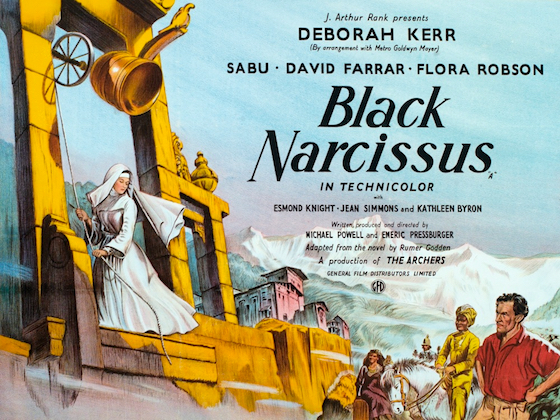
Black Narcissus (1947)

2018 #49
Michael Powell & Emeric Pressburger | 101 mins | Blu-ray | 1.33:1 | UK / English | U

Black Narcissus

It’s over a year since I watched Black Narcissus, but this review is only materialising now for two reasons: first, my overall tardiness at posting reviews nowadays (my backlog currently numbers north of 140); and second, but actually more relevant, I’ve struggled to make sense of what I thought of it.

On the surface a story about some nuns opening a convent in the Himalayas, there’s so much more going on beneath the film’s surface than just conflicts with locals and amongst the small group of nuns — that much is clear. But what else is going on? Critics often talk about the film’s eroticism, but (even allowing for the fact it was made in 1947 and so could hardly be overt about such things) I rarely felt that. In his video introduction on the Criterion Blu-ray, Bertrand Tavernier says it’s all about desire, specifically female desire, and the prohibition of said desire. Hm. I mean, I don’t disagree that’s in there somewhere, but it doesn’t feel like that’s what it’s “all about”. Writing in Criterion’s booklet (reproduced online here, critic Kent Jones says that “the reduction of Black Narcissus by admirers and detractors (and cocreators!) alike to the three Es — expressionist, exotic […] and erotic — has often deprived this bracing film of its many nuances and complexities.” So, I’m not alone in thinking there’s other stuff going on here… though I’d wager Mr Jones has a better handle on what that is exactly than I do.

I confess, I find this a bit frustrating — not the film itself, but my inability to ‘get’ it. I was never bored, so something kept me engaged, there’s something to it, but I can’t get at what this is. I felt a bit like there’s a germ of a good thing, but it’s not brought out. Like, the characters all being gradually driven mad or hysterical by the place — it’s an effect that’s almost there, but not quite; and it only affects, like, two-and-a-half of them anyway. But maybe I’m expecting the film to be too overt; maybe it was just too subtle for me. Whatever it is, it clearly disturbed the Christians: when the film was released in the US, Catholic weekly The Tidings reportedly asserted that “it is a long time since the American public has been handed such a perverted specimen of bad taste, vicious inaccuracies and ludicrous improbabilities.” Reason enough to like the film, there.

Nuns gone wild

Oh, but my overall confusion aside, there are many specifics that deserve concrete praise. The last 10 or 20 minutes, when it almost turns into a kind of horror movie, are fantastic. (Even the original trailer is largely composed of footage from the film’s final 25 minutes. It’s definitely the best bit.) It all looks ravishing, magnificently shot and designed. There’s the always-stunning work of DP Jack Cardiff (apparently a Technicolor executive claimed the film was the best example of the process), plus the work of production designer Alfred Junge and costumer Hein Heckroth. The luscious backdrops were blown-up black-and-white photos that the art department coloured with pastel chalks, which partly explains the film’s otherworldly beauty. Indeed, considering it was all shot in the UK, the location is very well evoked. That’s not least thanks to the constantly blowing wind, which ruffles clothing and hangings even during interior scenes — a detail that could’ve been easily overlooked during production, but whose presence certainly adds to the atmosphere.

It’s difficult to sum up and rate my reaction to Black Narcissus, because I feel like I missed something — not literally (I followed the plot ‘n’ that), but like I didn’t understand something about it. And yet I was engaged throughout, it’s gorgeous to look at, and the final 20 minutes are stunning on every level. One to revisit, for sure.

4 out of 5

Black Narcissus was viewed as part of my Blindspot 2018 project.

Coincidentally, it’s currently available on iPlayer, but only until tomorrow afternoon.

Zatoichi and the Fugitives (1968)

aka Zatôichi hatashijô

2019 #20
Kimiyoshi Yasuda | 82 mins | Blu-ray | 2.35:1 | Japan / Japanese | 15

Zatoichi and the Fugitives

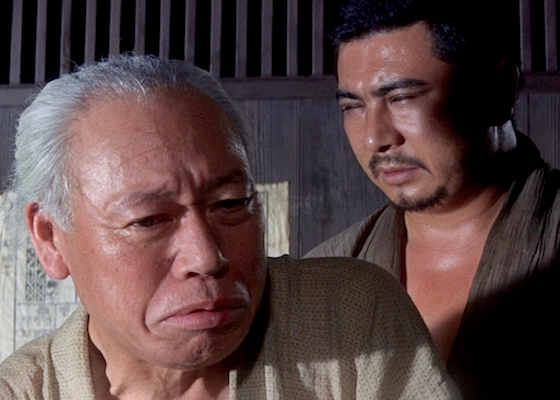
Not to be confused with the earlier Zatoichi the Fugitive (no fear in the original Japanese, where that’s titled something like Zatoichi’s Criminal Journey and this is along the lines of Zatoichi, A Letter of Challenge), the series’ 18th instalment pits our favourite blind masseur-cum-swordsman against a gang of six remorselessly violent fugitives. Along the way he shacks up with the venerable Dr. Junan and his caring daughter/assistant Oshizu (Kayo Mikimoto), and once again Ichi hopes he may’ve found a place to settle down, only for events to snatch the dream away.

That doctor is played by the great Takashi Shimura, star of Seven Samurai and Ikiru, amongst many, many other classics of Japanese cinema. He brings an effortless class to the role, which initially seems to be just an honourable and wise gentleman, but later has more to it. You see, in a thoroughly unsurprising twist, it turns out one of the fugitives — namely their leader, Genpachiro (Kyôsuke Machida) — is the doctor’s estranged son. When Genpachiro attempts to visit his father and sister, Oshizu is overjoyed to see his return, but the doctor refuses to even acknowledge his son’s presence.

As the gang’s leader and the one with the connection to Ichi’s new friends, naturally it’s Genpachiro who will prove to by Ichi’s nemesis in this film. Writing for The Digital Bits, Bill Hunt and Todd Doogan reckon he’s “one of Zatoichi’s single greatest enemies,” which is certainly a bold claim. They have something of a point, given his intelligence — an early encounter makes him aware of how skilled Ichi is with a sword, so he keeps stopping his hot-headed underlings from tackling Ichi head on — but I didn’t think he was as memorable an individual as several other foes have been.

Zatoichi and the doctor

The fugitives as a group do provide quite the challenge for Ichi, however, almost defeating him at one point. Naturally, our hero comes out on top in the end: spurred by righteous anger, his final-act slaughter is even more brutally efficient than normal. Having been shot and nearly killed in his first attempt at a climactic showdown, Ichi ain’t messing around the second time. Well, they have it coming. They’re a vicious lot, happily slaughtering innocents on practically anyone’s say-so, at one point even coming this close to murdering a baby. Indeed, this is quite a tonally dark instalment of the series. It’s certainly not the only one by this point — it may not even be the darkest, in fact — but it’s still not very cheery, with little of the humour we’re accustomed to from our hero. Even the final defeat of the villains is tinged with sadness. At one point he gets very introspective, as Oshizu asks him about his blindness: “At first I remembered all the colours — green, red, and so forth. I told myself I had to remember them and tried hard not to forget. But they gradually faded away. All that’s left now is darkness.”

Ichi could just as well be talking about his lifestyle, as once again he struggles with being a gangster. When a bunch of yakuza turn up at the doctor’s to pay their respects to Ichi (his reputation having preceded him once again), the truth of his position is exposed to his new potential-family, much to his shame. Again, it’s a point of conflict for the good doctor: he doesn’t like criminals, as we see with his attitude to his own son, but he’s also seen what a kind-hearted fellow Ichi really is. And if Ichi going on an emotional rollercoaster wasn’t bad enough, he’s put through the ringer physically too — I mean, he gets shot, then digs the bullet out by himself with his sword, lest you were in any doubt of his credentials as a badass. And if that doesn’t convinced you, multiple displays of his skill with a blade should.

Bloody Ichi

One of those demonstrations has led to cuts by the BBFC for the UK release. Yes, Criterion have finally bothered to get the films classified — I’ll write a bit more about that when it comes relevant again on a future film, but for now we’re concerned with the four seconds they’ve cut from Fugitives. At one point a snake drops on Ichi and he slices it in half, after which we see the bisected creature writhing on the ground. I guess they did it with a real snake, or real enough to the BBFC’s eyes, because that shot has been cut for animal cruelty. I know some people object on principle to the BBFC censoring anything, but I can’t say cutting that kind of thing bothers me much (though, as I have the US set, I’ve already seen it).

To quote Hunt and Doogan again, they reckon that “if this series were to be compacted into a trilogy, this would be at the tail-end of part two. In other words, this is Ichi’s Empire Strikes Back. No hyperbole”. Eh, I think there might be a bit of hyperbole there. It’s just coincidence that this instalment falls at the two-thirds point of the series (more or less), and I don’t even think it’s the darkest film there’s been — for what it lacks in humour, it has a lot of kindness in Ichi’s relationship with the doctor and his daughter, and some redemption for one of the gang members. Rather than comparing it to the consensus-greatest film of another series, I’m more inclined to Paghat the Ratgirl’s point of view: “After nineteen [sic] feature films, this story is entirely familiar. But great even so.” Zatoichi and the Fugitives is not one of my favourites in the series, but it is a good mid-tier one.

4 out of 5

Triple Frontier (2019)

2019 #39
J.C. Chandor | 125 mins | streaming (UHD) | 2.11:1 | USA / English, Spanish & Portuguese | 15 / R

Triple Frontier

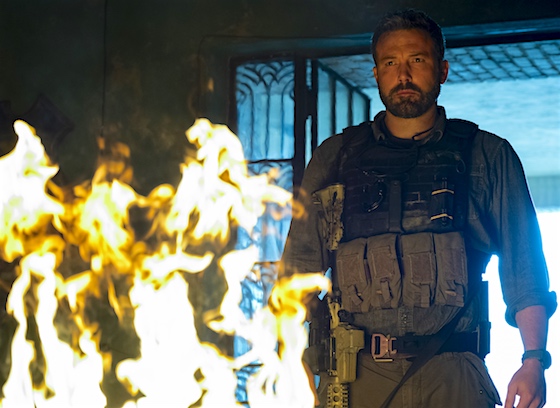
Former US soldier Santiago ‘Pope’ Garcia (Oscar Isaac) is struggling to make a difference as a consultant to a South American police force when his informant (Adria Arjona) finally gives him the location of powerful drug lord Gabriel Lorea (Reynaldo Gallegos), who’s hiding deep in the jungle surrounded by ill-gotten gains to the tune of many millions of dollars. Deciding the cops are too corrupt to handle this, Pope reaches out to his old military buddies — commander and strategist Tom ‘Redfly’ Davis (Ben Affleck), pilot Francisco ‘Catfish’ Morales (Pedro Pascal), and brothers Ben and William ‘Ironhead’ Miller (Garrett Hedlund and Charlie Hunnam) — to take on one last ‘off the books’ mission: kill Lorea and pocket the money for themselves. But they decide it’s too immoral so stay at home and do nothing.

Not really! Of course they agree to do it, risking their lives and their moral code for a big payday they all desperately need.

On the one hand Triple Frontier is a standard men-on-a-heist actioner, and a lot of people seem to have dismissed it as such. On the other, however, there’s quite a lot of different things going on here. Almost too many, in fact, as arguably the film doesn’t have time to explore them all. There’s a distinct thread about the treatment of veterans in the US — that these guys have been used up and spat out, and now struggle with their mental health and/or to even make a living in regular society. It also ties this into some “warrior code” mentality, which I’ve heard said is quite a realistic depiction of the mindset these kinds of guys have in real life, but does come across as a bit macho bullshit at times here (there’s a scene where they’re camping in the jungle, bemoaning that they’re the last of their kind, etc).

Men mid-mission

As well as these themes, there’s some surprise genre mash-ups going on, too. Nothing too radical, but the film doesn’t play out as I expected (vague-ish spoilers follow). At the start, it’s has almost a Sicario vibe, particularly in a sequence where Pope leads a violent raid on a gang hideout. Then it gets stuck into what the trailers promised: a bunch of military professionals pulling off a heist. Naturally, it doesn’t all go according to plan (no good heist movie has everything go according to plan!), and as the guys struggle to make their escape the film makes a hard turn into Treasure of the Sierra Madre territory, which I did not see coming. It doesn’t dig into the psychology of greed anything like as much as that film, but as the team trek through the jungle and feud amongst themselves, the film takes on a “jungle adventure” aspect I wasn’t expecting. This is where I think those claims of it being just a “standard” kinda military-men-on-a-mission movie are particularly wide of the mark.

Apparently the film has been struggling through development since 2010, presumably after screenwriter Mark Boal won his Oscar for The Hurt Locker. That film’s director, Kathryn Bigelow, was originally attached (she’s still credited as a producer), and the film also bounced around a couple of different studios (before winding up at Netflix) and churned through a long list of possible cast members (according to IMDb, they include the likes of Tom Hanks, Johnny Depp, Denzel Washington, Sean Penn, Leonardo DiCaprio, Mark Wahlberg, Will Smith, Tom Hardy, Channing Tatum, Mahershala Ali, and Casey Affleck).

Ben Affleck, pictured with his ties to the DC Universe

I feel like it ended up in a pretty decent place, however. The five guys are believable as ex comrades, and it’s all very well put together, with slick but not flashy direction from J.C. Chandor, helmer of the excellent All is Lost, plus Margin Call and A Most Violent Year, neither of which I’ve seen but I’ve heard are good. Triple Frontier does nothing to besmirch his rep. It’s crisply shot by DP Roman Vasyanov — like the direction, not excessively flashy but still strong, including some great aerial stuff. Apparently this is the first film to use the full 6.5K resolution of the ARRI Alexa 65 camera, which is why it retains the camera’s unique aspect ratio of 2.11:1. In truth, it doesn’t make much difference, because it’s near as dammit the 2:1 that’s so popular among other Netflix productions, but that works for me.

Triple Frontier doesn’t reinvent the wheel, but I think some of the commentary dismissing it as mere standard fare has done it some disservice. As a heist/action movie it’s more than competent, with some turns and developments that keep it surprising and fresh, and visuals that reward seeing it on the best-quality screen you can.

4 out of 5

Triple Frontier is available on Netflix now.