
Marv Newland | 2 mins | streaming | 1.37:1 | USA / English | U
At the risk of my blog becoming some kind of film-watching Inception, with a host of viewing goals within viewing goals (the titular one; “What Do You Mean You Haven’t Seen” / Blindspot; all those ones I mentioned in my review of Home on the Range), here’s something new I’m setting out to do (in a vague, loose, ‘will get there one day’ kind of way):
 Regular readers will surely remember iCheckMovies, the movie list website where you can check off films you’ve watched and see how many you’ve seen on particular lists, like the IMDb Top 250, or They Shoot Pictures’ 1,000 Greatest, or 179 other ‘official’ lists (or 8,603 user-added ones — seriously). Obviously you can use this as an empty-headed list-completing exercise (and some people do), but it’s also a way to motivate watching well-regarded movies, and to discover new ones.
(What does this have to do with Disney’s dear deer meeting Tokyo’s greatest monster? I’m getting to that.)
There are several lists in particular I have my eye on, for one reason or another. Getting around to some more films on those lists was part of the motivation behind my selections for this year’s WDYMYHS, for example (most of the motivation, if I remember rightly). However, even while I’m a decent way through completing some lists, I happened to notice last night that there are a handful of those 181 official lists on which I have precisely zero checks. 26, to be precise, which in some ways sounds like a lot, but in others is only 14%. Naturally, this inspired one particular thought: to endeavour to get at least one check on every single list.
(The bereaved fawn and gigantic lizard are coming up imminently.)
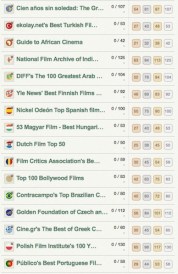 There are pretty obvious reasons why I’ve never seen any films on many of those lists — quite a lot are country or continent specific, and as Western film viewers we’re notoriously poor at having seen movies from, say, Africa. The lack of acclaimed films I’ve seen from the likes of Belgium, Finland, Holland, Hungary, Norway, Poland, Portugal, and Spain is my own fault though, I guess. Anyway, this is something I intend to rectify in the coming days / weeks / months / years / decades — however obscure some of my missing lists may seem, there’s at least one film I’ve heard of on all but one or two of them, so there’s that.
Anyway, I started with the easiest list of all lists: Best Cartoons Ever – A Gift List From Jerry Beck. This list contains “the 50 greatest cartoons of all time, from a poll of 1,000 animation professionals conducted by author/film historian Jerry Beck for the 1994 book The 50 Greatest Cartoons: As Selected by 1,000 Animation Professionals.” There’s all sorts of famous stuff on there, from 1914’s Gertie the Dinosaur, to Mickey Mouse’s debut in Steamboat Willie, to acclaimed classics that appear on multiple other lists, like Duck Amuck and What’s Opera, Doc? But I started with possibly the shortest of the lot: 92-second one-gag short Bambi Meets Godzilla.
I say “one-gag” — there’s one headline gag, but I’d argue there are at least five jokes slipped into the film’s minute-and-a-half running time. Describing the ‘plot’ would be pointless, especially when it would be almost as quick for you to watch it yourself on YouTube; or, if you really want, a couple of years back a fan restored/remade it in 4K with 5.1 surround sound (seriously), which you can watch here. It loses a lot of its charm in that form, if you ask me. Either way, there are less amusing ways to spend 90 seconds of your time.
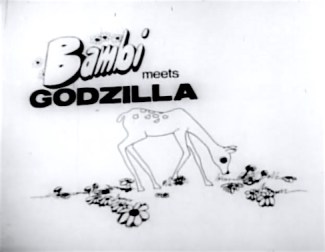 Why is this film notable? In fact, is it notable? Well, it was voted in to The 50 Greatest Cartoons by some of 1,000 animation professionals, so there’s clearly something there. It was created by animator Marv Newland while he was a film student in L.A., after a live-action project he’d been planning to submit was scuppered (according to Wikipedia, uncited, that was due to the loss of “an essential magic hour shot”). Newland created the short animated gag in his room and submitted that instead. It’s a pretty straightforward piece of animation — black-and-white line drawings, some text, few moving elements — with a couple of music tracks on top (Call to the Dairy Cows from Rossini’s William Tell, which you might not know by name but will certainly recognise, and the final chord from the Beatles’ A Day in the Life).
Maybe it’s the subversiveness that makes it significant? It comes from an era when that must have been a factor, surely — there’s a certain Monty Python-ness to it, and it was made the same year Flying Circus first aired. Perhaps it just has some familiarity — I’ve seen comments by people saying it was regularly screened at sci-fi conventions throughout the ’70s, and it was attached to film prints and VHS releases of Godzilla 1985. There are even two sequels, Son of Bambi Meets Godzilla and Bambi’s Revenge, which weren’t made by Newland and are apparently hard to come by. I suppose Beck’s book must explain its inclusion, but if anyone has a copy of that to hand then they’ve not bothered to quote its entry online.
Anyway, for what it is it’s very effective, but it is slight, so I shall give it:

 Back in the ’80s, everyone’s favourite actor whose name is also the punchline to a joke (“what do you call a man with three planks on his head?”), Edward Woodward, starred in
  and anyone who enjoys inventive deaths will be tickled by some sequences. Otherwise, it lacks originality, remixing familiar tropes and plot points into a passably-new shape.
 Based on a novella by esteemed author Harlan Ellison, this is a low-budget sci-fi comedy-drama about a horny teenager (Don Johnson) and his telepathic dog (voiced by Tim McIntire) surviving in a post-apocalyptic wilderness, who are lured into a weird underground world. It’s a film fuelled by weirdness, left-field ideas, and a controversial tragicomic ending.
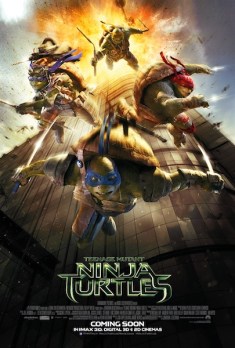 While I was killing time waiting for my coffee to brew before I sat down to watch Teenage Mutant Ninja Turtles, 2014 edition, I drafted the introductory paragraphs to this review. Yes, before I’d even started the movie, so sure was I that I would dislike it. Naturally they took an appropriately condemnatory tone, talking about how it was a product and not a movie, designed primarily to sell tie-in plastic to grown men who wish they were still children, etc etc. Unfortunately writing those paragraphs was a waste of my time, because I can’t use them, because — shock of shocks — I actually quite liked this movie.
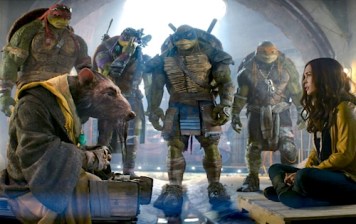 Mike into basically a turtle version of Michael Bay — i.e. he’s focused on lusting after Megan Fox and occasionally causing explosions — is a little cringe-y. Quite a few bits are a little cringe-y, actually; but they’re tempered by a few comedic bits that hit home, and a general veneer of “well, it could’ve been worse”.
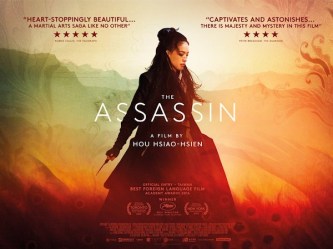 The Assassin is a martial arts drama about Nie Yinniang (Shu Qi), a woman trained since childhood to be a highly-skilled assassin. When her emotions lead her to renege on a mission, her master sets a difficult task for Yinniang to prove herself: she must return to her homeland and assassinate its leader, Tian Ji’an (Chang Chen) — her cousin, to whom she was once betrothed.
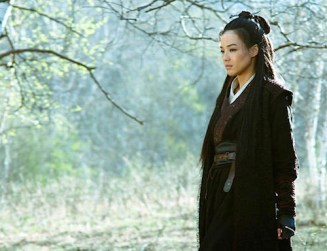 So little happens at times that it’s very easy to become disconnected from it. At one point my mind wandered to other films it reminded me of.
 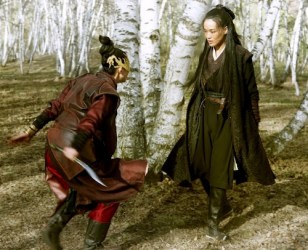 For all that, there is some action, but director Hou Hsiao-Hsien has said he’s more concerned about the before and after of a fight than the process itself — it’s about the mood, the tension, the ultimate outcome of winning or losing, rather than the choreography of the combat — so there’s a lot of build-up for very brief bursts of action. That’s certainly not an invalid way to handle it — it’s Leone-esque, in its way — but it does mean anyone looking for the detailed swordplay or fisticuffs you expect of a martial arts film will come away disappointed.
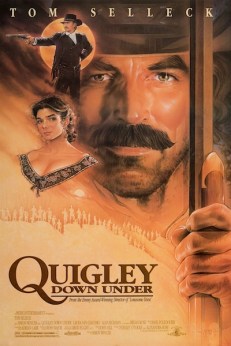 Tom Selleck is Quigley, who has the ability to shoot things at implausibly long distances, and whose hair has the ability to stay implausibly coiffed even after days abandoned in the outback. He’s been employed by Alan Rickman, who we know is the villain because this was released in 1990. Alan Rickman has brought Quigley to Australia on the pretence that he’s to kill dingoes, but he actually wants Quigley to kill Aborigines. Quigley doesn’t take kindly to this, because he’s the hero, and so pretty much as soon as he turns up he’s left to die in the outback. The end.
 I only heard about Quigley Down Under after Alan Rickman passed away, when a few blogs flagged it up as a great forgotten performance of his. He does bring some of his Die Hard /
 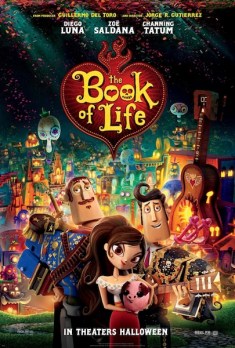 A myth-like animated musical adventure based around Mexico’s Day of the Dead, most notable for its unique art style that presents gorgeous visuals throughout.
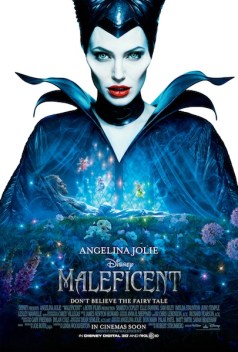 Disney seem to be embarking on a project to remake all of their most beloved animated movies in live action,
 However, this is a Disney movie — you don’t get to turn a villain into the central character and have her be evil throughout. This is where the film gets really revisionist, because Maleficent keeps an eye on cursed Princess Aurora (Elle Fanning) as she grows, doing more to keep her alive than the trio of fairies she’s supposedly in the care of, and her heart is gradually warmed to the girl. Unfortunately, Maleficent was too good at the cursing malarkey: unable to lift her own spell, it plays out regardless, and the film serves us new renditions of the impassable thorns, giant dragon, and true love’s first kiss. It’s in the last where Maleficent is thematically revisionist rather than just a massive rewrite. Your mileage may vary on whether this version is obvious and cheesy, or actually more meaningful and (for the primary audience of little kiddies) more thought-provoking than the original’s — I’d go with the latter.
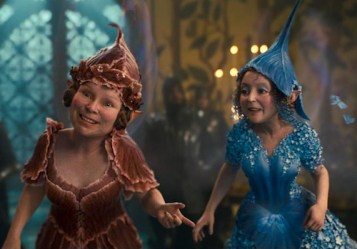 Parts of the film test-screened poorly — mainly the first act, with audiences wondering why it took so long for Jolie to turn up. Consequently, the whole thing was thrown out and reshot; in the process, Peter Capaldi and Miranda Richardson were deleted (and after they’d had to endure hours of transformative prosthetics for their roles, too), and Maleficent was given a new backstory. How far this extended into the rest of the movie, I’m not sure, but at times it feels like stuff has been cut or rearranged. Certainly the story flies past — if it wasn’t trimmed down in the edit, it needed expanding back at the screenplay stage.
 and even
  When a warrior family are betrayed and killed, the surviving siblings seek vengeance.
 The first US feature from the director of
  100Films.co.uk