Raiders!: The Story of the Greatest Fan Film Ever Made (2016)

2016 #162
Tim Skousen & Jeremy Coon | 93 mins | streaming (HD) | 16:9 | USA / English

Raiders!: The Story of the Greatest Fan Film Ever Made

You may have heard about this: in 1982, a group of teenagers decided to remake Raiders of the Lost Ark shot for shot, starring themselves. It was a project that ended up filling their whole adolescence, filming scenes here and there every summer for years. Decades later, their amateur recreation (known nowadays as Raiders of the Lost Ark: The Adaptation) was uncovered by director Eli Roth, who passed it to Harry Knowles to screen at a film festival he organises, and it began to gain cult notoriety. Eventually, that new appreciation led to the guys reuniting in an attempt to crowdfund production of the one scene they were never able to shoot originally. This documentary tells the stories of both the original production and the attempt to complete it.

It’s a great tale, but unfortunately it’s told in a really sloppily made documentary. The narrative is a complete jumble — it jumps in and out of stories all over the place, getting distracted by something else before looping back around. Exposition and setup are bungled, leaving the viewer constantly playing catch-up and trying to piece things together. It throws in general observations mid-film that really belong in an introduction or conclusion. It goes back and forth in time at will — presumably someone thought they’d structured it to tell the parallel stories of the original project and the 2014 shoot, but the editing isn’t clear enough to support that structure. Interviews are cut to shreds, leaving soundbite-sized snippets that often fade out while the person’s still talking, just moving away without letting them finish.

Some people never grow up...

As a viewer, you endure all of this because the underlying story is so good, but there’s a better film to be made here — one that tells the story more clearly, that better draws out the characters of the people involved, the psychology of what they’re doing, and any latent thematic points too. I mean, what these guys did is extraordinary in its dedication, but it’s also completely bizarre. Why did they start it? What does it say about them, or their lives, or maybe even the human condition? And it does say something, I’d wager — you can almost glimpse it around the edges and in the corners of the documentary, but it rarely comes close to actually exploring it. There is a section on the kids’ shitty home lives — that’s something they all seemed to share — and how the Raiders project was a refuge. At this point the editing calms down and it’s briefly very good. If the whole film had displayed that same clarity, it would merit a higher rating.

As it stands, Raiders! has a brilliant story to tell, meaning it’s worth watching to learn about that, but I yearned for it to be told better.

3 out of 5

The Saint’s Return (1953)

aka The Saint’s Girl Friday

2016 #154
Seymour Friedman | 65 mins | download | 4:3 | UK / English

The Saint's Return

Long-time readers may remember I reviewed all eight of RKO’s Saint films back in 2012. That series ended amidst an argument over rights (and they replaced it with the ever-so-similar Falcon series, which I also reviewed), but a decade later this continuation movie happened. I wasn’t even aware it existed until it was brought to my attention in the comments on another film. It’s technically not part of the same series (it was made years later by Hammer, believe it or not) so it’s harder to come by, but eventually I tracked it down… as a download that was clearly sourced from a VHS (it even lost tracking at one point!) that was quite possibly recorded off the telly.

The story sees Simon Templar, aka the Saint, rushing back to England to help a friend, but she’s killed in suspicious circumstances before he arrives. Investigating her death, Templar finds she was indebted to the River Gang, and sets about bringing them down.

The Saint, with a girl

Although this was made years after the RKO films and by a different studio, it’s not a reboot or remake. Even allowing for those terms having become more applicable recently than they probably were in the ’50s, The Saint’s Return actually seems to be making a concerted effort to appear connected to the earlier series: near the start there’s a small scene where Inspector Fernack, the Saint’s regular nemesis/ally in the NYPD, acknowledges that Templar has left for England, which serves no purpose other than to suggest a connection to the other films. It’s even shot in a way that’s reminiscent of the older films (though, I don’t know, had low-budget studio filmmaking changed much in the intervening decade?)

That said, there are changes: the Saint is now an American, for no particular reason, and it’s more serious than I remember the other films being; but that might be my memory being clouded by the Falcon films, which were similar but lighter. In a rare feat for these movies, it managed to trick me with a plot twist, as I incorrectly guessed who secretive villain ‘The Chief’ would turn out to be. That’s either an achievement or a sign of me underestimating the film just because it’s old and cheap…

The Saint, with another girl

Taking the lead role is Louis Hayward, who originated the Saint on screen fifteen years earlier in RKO’s first film, The Saint in New York. He only played the role once before, but nonetheless makes a convincing return here. The rest of the cast includes Britain’s answer to Marilyn Monroe, Diana Dors, whose charms haven’t dated, and a minor role for one Russell Enoch — aka William Russell, who’d go on to find fame in the title role of the BBC’s The Adventures of Sir Lancelot, before ensuring his screen immortality as one of the original leads in Doctor Who.

Still, there’s more to The Saint’s Return than before-they-were-famous star-spotting. Although it seems to be the black sheep of the Saint film family, it’s actually a pretty good little thriller. Indeed, there were definitely worse films in the series proper. I’m not going to quite stretch to four stars for it but, for fans of the series, it’s worth tracking down.

3 out of 5

Pirates of the Caribbean: Salazar’s Revenge (2017)

aka Pirates of the Caribbean: Dead Men Tell No Tales

2017 #71
Joachim Rønning & Espen Sandberg | 129 mins | cinema | 2.35:1 | USA / English | 12A / PG-13

Pirates of the Caribbean: Salazar's Revenge

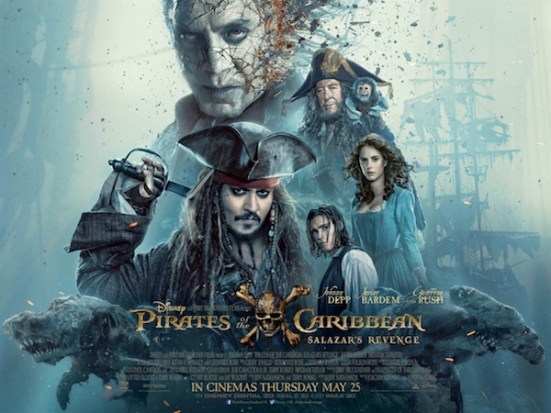
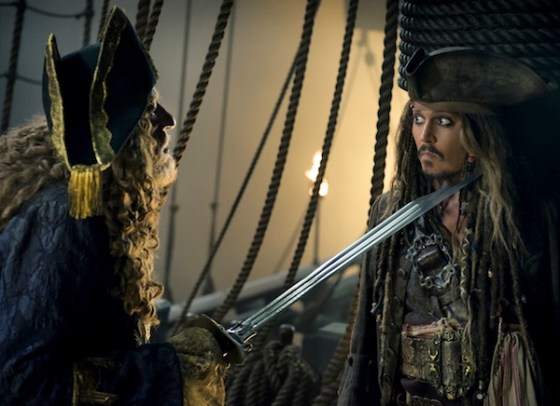
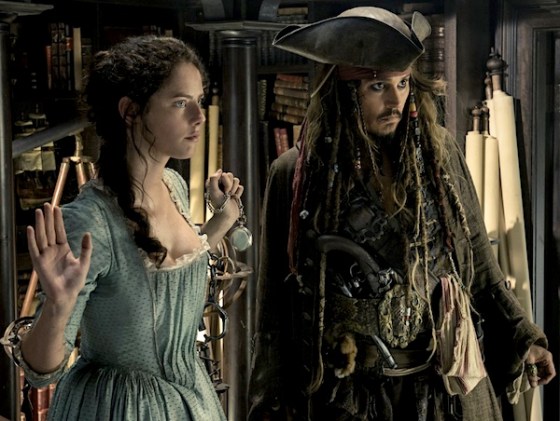
Dead men may tell no tales, but lucrative franchises never die, so Disney’s Pirates of the Caribbean has taken to the high seas once again. Johnny Depp is back in the role that once netted him an Oscar nomination (remember that?), the drunken pirate Captain Jack Sparrow, this time teaming up with the child of some old friends (Brenton Thwaites) and a bright young astronomer (Kaya Scodelario) for another MacGuffin hunt adventure, while again being pursued by some cursed seafarer (Javier Bardem) and a member of the British Navy (David Wenham).

Yes, despite the unusually-long six-year gap since the previous film, and all the promotional talk of this being a fresh start for the series that tonally harks back to the standalone fun of the first movie, Salazar’s Revenge (or, if you prefer, Dead Men Tell No Tales) seems doomed to repeat bits and bobs from the series’ other instalments. It’s not a complete wash-out, however, because it at least executes some of those bits quite well. Sadly, other bits are beginning to look a little tired. Perhaps the best single adjective to describe the film’s attitude would be “muddled”. Beware, me hearties: spoilers follow.

It seems likely that Disney do want this to be a soft reboot of the franchise — a reboot to combat the increasingly poor critical receptions that greeted the previous sequels, but a soft one so that Depp’s popular turn can continue being a part of things. This revivalist plan presumably included looking back in time, beyond the last movie (the least popular one) to the series’ heyday. However, rather than just try to replicate the tone of the earlier movies, storyliners Jeff Nathanson and franchise veteran Terry Rossio have revived some of the old plots too. So we have a film that attempts to move forward with new young leads and a new villain, all hunting for a new MacGuffin, but with motivations bedded in plots that were ostensibly wrapped up a decade ago. They can’t even bring themselves to ignore the previous movie, despite its lack of popularity, continuing narrative threads from there as well. So much for “reboot”.

Cutthroat, without the island

And yet, despite that, its consistency with previous films is sometimes poor. For example, Salazar is freed because Jack gives away his magic compass — but didn’t he do that in film two and/or three, with no such ill effects? Also, why does the compass now suddenly have the power to make you face things you dread? And how does that even work, considering other characters have had it and given it away and never had such issues? Maybe they were just hoping viewers wouldn’t remember the ins-and-outs of the plots of previous movies… though, if that’s the case, why is the story based on them?

Unfortunately, its internal consistency isn’t much better. Like, why do ghost pirates own zombie sharks? How come Salazar can suddenly possess someone when it becomes necessary for the plot? That ability is never mentioned, it just turns up. When Carina’s navigating them to the map-island, how do they end up at a completely different place (before later just setting off again)? Maybe I missed something…

This abundance of niggles stems from the film being overstuffed with ideas that it doesn’t invest in fully — just like the last film, which it was supposed to have learnt lessons from! One of the things that made the original Pirates movie work was its relative simplicity, which kept the story focused and driving forward. The sequels all throw in too much random stuff — see my previous paragraph, which isn’t even the half of it: I haven’t mentioned the witch, or the ruby-powered star map, or the nonsensical post-credits scene.

Salazar, out for revenge

It probably doesn’t help, then, that Salazar’s Revenge is the shortest Pirates film (though it doesn’t feel like it). The dearth of screen time may be why both Bardem and Wenham are ultimately wasted as the villains — they’re not working together, so the time typically afforded to the antagonist ends up split between them. Geoffrey Rush’s Captain Barbossa is back too, as much a series regular as Captain Jack now. He gets an emotional storyline that surfaces out of the blue just before the last act. It’s a nice idea, but appears too late in the game to have time to develop properly.

And how about the flashback showing Jack defeating Salazar, which seems to stop the film dead halfway through. Why not put that sequence at the start? Then cut straight to the existing opening scene of the naval ship accidentally sailing into the Devil’s Triangle. It’d work — the viewer thinking, “oh, the navy ship is going to sink, just like Salazar did all those years ago,” but then it doesn’t and Salazar attacks. (Hey, Hollywood — employ me!) Okay, fair enough, that structure would make it awkward to place Orlando Bloom’s opening cameo, but—

Oh, wait, that’s another thing! So, we know why Orlando Bloom only appears in bookend scenes and why Keira Knightley is reduced to a dialogue-less cameo — because Disney want this to be a fresh start with new stars — but it feels like, to do this particular story properly (trying to break the curse that’s imprisoning Bloom), they both should’ve been in it more. I mean, why isn’t the formerly strong and capable Elizabeth working with her son to free the love of her life? At least explain that, film, don’t just ignore it! Heck, tossing in even one line from Henry (“my mum’s given up hope, but I haven’t”) would’ve solved it.

A clever woman? What is the world coming to

As for the rest of the cast, Johnny Depp feels like he’s forgotten how to play Sparrow — it’s a pretty good imitation rather than the real thing. Kaya Scodelario plays Carina with an earnest intelligence, a trait which is exhibited dependably throughout the screenplay. That shouldn’t need to be worthy of note, but, for a female character, it is. Thwaites, on the other hand, is perfectly bland as Henry Turner, rarely even managing the enthusiasm or charming naivety suggested by that good line from the trailers (“I think I saw her ankles!”)

On the action-adventure front, there are some good set pieces, mainly early on — the bank robbery and the halted executions, particularly the spinning guillotine, are inventively handled. Sadly, later efforts are obscured by gloomy lighting and too much whizzing around of CGI — and, once again, the overabundance of out-of-nowhere ideas (why does the ship’s figurehead suddenly come to life?!) Geoff Zanelli’s score primarily recycles Hans Zimmer’s familiar themes, which I don’t mind too much because I like them. At least it does so in a less slapdash fashion than On Stranger Tides, where the music felt plonked on at random.

That's the second biggest pirate ship I've ever seen

So, I’ve moaned throughout this review, and here’s the main reason for that: there’s a decent action-adventure movie hidden in Salazar’s Revenge — probably not something that would equal the first Pirates, but a good effort — but all the times when plot necessities seem to have been filled with “invent something new!” rather than “make what we’ve got work”, plus all the little inconsistencies (both internally and with previous films), really get in the way. Maybe, now that all of the leftover business from previous films is well and truly resolved, and if this makes a lot of money, we’ll get a sixth film that finally does return to the joys of the first.

Hey, Disney: you own Lucasfilm now — how about Pirates of the Caribbean: The Secret of Monkey Island?

3 out of 5

Pirates of the Caribbean: Salazar’s Revenge is in some cinemas now. Pirates of the Caribbean: Dead Men Tell No Tales is in the others.

Twin Peaks: The Missing Pieces (2014)

2017 #68
David Lynch | 91 mins | Blu-ray | 1.85:1 | USA & France / English | 15

Twin Peaks: The Missing Pieces

When Twin Peaks: Fire Walk with Me was released in 1992, one of the things that disappointed fans was the absence of many of Twin Peaks’ beloved characters. A few of those absentees were due to scheduling conflicts or behind-the-scenes disagreements, but others were shot and left on the cutting room floor. Rumours circulated for years (still do at times) that David Lynch actually shot five hours of material, only two-and-a-quarter of which made it into the final cut. However, as early as ’92 itself, co-writer Robert Engels stated that the first cut ran 3 hours 40 minutes, adding that they hoped to put that extended version out on LaserDisc. Such a release never happened, and fans were left wanting. Campaigns were launched to get the deleted material on DVD, but there were issues with who held the rights, and then Lynch was only prepared to release them if they had been properly mastered and finished to theatrical standard.

Finally, after over two decades of waiting and hoping, the stars aligned and the series’ Blu-ray release was accompanied by those long-awaited scenes. Dubbed “The Missing Pieces”, there were 90 minutes of them — which, you’ll note, when added to the 135-minute film more-or-less equals the 3 hours 40 minutes Engels promised back in ’92. It’s also basically another movie’s worth of material; and, indeed, there were limited theatrical screenings as part of the promotion for the Blu-ray — hence why this counts as a film (look, it’s on IMDb and everything).

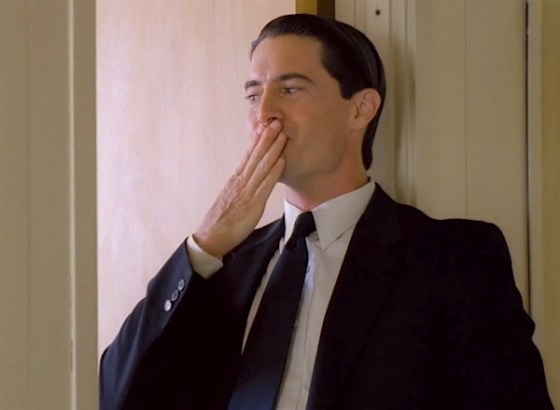
Diane, it's 9:27am and I am stood in your doorway blowing you a kiss...

Still, The Missing Pieces may just sound like an uncommonly long selection of discarded bits, same as most DVD deleted scene sections, but there’s more to it than that. There’s quality material here — even, some people say, some of the best scenes in the entire Twin Peaks canon. In fact, some people even reckon it stands confidently as a second Twin Peaks movie, albeit one that depicts events that occur concurrently to the existing film. Well, I don’t think I’d go quite that far, but there’s definitely more to this than a couple of missing lines or amusing asides.

The fact it isn’t a standalone work is evident from the off, which begins like a traditional deleted scenes package: a collection of context-free bits-and-pieces of FBI Agents Chet Desmond and Sam Stanley in the town of Deer Meadow. These go on for about ten minutes, including a bout of fisticuffs between Desmond and the uncooperative local sheriff that was a very wise removal from the final cut. These early scenes make it instantly clear that The Missing Pieces is a companion to Fire Walk with Me and needs to be watched alongside it, not a unique entity that’s capable of holding its own. These are “Missing Pieces” indeed, not “Meanwhile Pieces”.

That said, the interest level of the material increases quite quickly. There’s a scene between Stanley and Agent Cooper that doesn’t add a great deal to the story but does again reference the mysterious blue rose — was Lynch intending to go somewhere with that, or not, hence why the scene was deleted? It has a prominent place on the Blu-ray packaging, too… There’s also more David Bowie, though it doesn’t make his part a whole lot clearer. On the bright side, it includes a Buenos Aires hotel bellhop delivering the immortal line: “Oh, Mr. Jeffries! Oh, the shit, it come out of my ass.”

Oh, the shit, it come out of my ass.

As things move on to the Twin Peaks-set portion of the tale, we get what the fans really wanted: not mere odds and ends that were removed to expedite the plot, but bits featuring fan favourite characters. Whether the scenes are important or not is another matter, but it must’ve been great to see new material featuring some beloved characters. (I’m glad I’m only watching this now, when this is all available and there’s a new series with new answers on the horizon, rather than having had to endure the wait.)

That said, in the scope of the story Fire Walk with Me was telling, all of the townsfolk deletions make sense. There are a couple of scenes of Big Ed and Norma’s romance that help set up where they were at the start of the series, but it has little or no relation to Laura. Even less relevant is a scene at the sawmill showing Josie and Pete arguing with a customer over the size of a 2×4. It’s utterly pointless, the only possible reason for its existence to be to shoehorn those characters into the movie, and therefore it was an eminently sensible deletion. The same goes for scenes at the sheriff’s station, which felt like they had greater relation to the actual story of Fire Walk with Me but I still couldn’t quite make head nor tail of.

It’s not all townsfolk asides, however: there are more scenes with Laura, too. One at Donna’s house shows Dr Hayward being kind towards Laura, seemingly the only man in the entire town who treated her appropriately. That might’ve made a nice counterpoint if left in the movie. Similarly, there’s a scene of domestic bliss in the Palmer household, where Leland, Sarah and Laura practise speaking Norwegian round the dinner table and end up in hysterics. That would’ve made a nice mirror to the later dinner table scene where Leland goes all creepy.

How's Annie?

As you’d expect from a deleted scenes section, but in opposition to what some people claim about it, The Missing Pieces is a collection of just that — pieces; fragments divorced from their whole. It’s definitely an experience aimed squarely at fans, then, but that doesn’t mean it’s not one worth taking for the initiated.

It all ends with an epilogue — a couple of scenes that, for the first time, move beyond the end of the series’ finale. Again, how utterly thrilling it must’ve been to finally get such a continuation over twenty years later. In the first, we catch up with Annie in the hospital, where she repeats the statement her bloody possibly-corpse (though, as we can see, not a corpse) made in Laura’s bed. It also turns out she has the ring… until a nurse pilfers it. Then we cut to the Great Northern, where Coop’s just smashed his head into the mirror. He stages it as an accident when Harry and Doc Hayward rush in to help him, and they insist he returns to bed to rest.

And that’s it.

3 out of 5

Or that was it, because tonight it’s 25 years later and that gum you like is going to come back in style.

It is happening again.

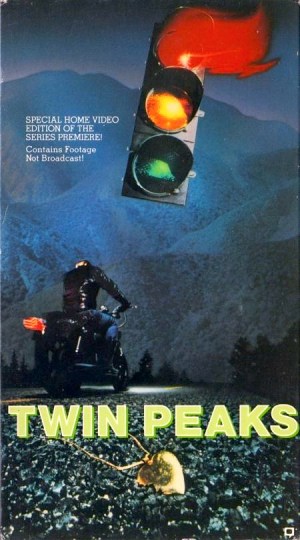
Twin Peaks (1990)

aka Twin Peaks: Pilot (International Version)

2017 #70
David Lynch | 113 mins | Blu-ray | 4:3 | USA / English | 15

Twin Peaks: Pilot (International Version)

While they were seeking funding for their feature-length TV pilot, creators David Lynch and Mark Frost agreed to demands that they film an alternative ending that wrapped up the episode’s primary mystery. The thinking was that, if the pilot didn’t get picked up to series, it could be released in Europe as a complete movie (why it couldn’t also be released in the US as a movie I don’t know), thereby recouping some of the cash spent on it. Apparently Lynch and Frost forgot they’d signed up for this until towards the end of the shoot, when they were reminded of their contactual obligation and so dashed something off.

But the series did get picked up, and that half-arsed ending should’ve been consigned to the dustbin of history. Instead, Twin Peaks became a massive worldwide phenomenon, and whoever owned the rights to release the movie version exercised said right, naturally including the tacked-on conclusion. Although the rights situation was settled long ago, the ‘extended’ version is still routinely included alongside the proper one on disc releases. I thought it was about time I checked it out — and judged it as a standalone movie, of course.

Welcome to Twin Peaks

Obviously, for most of its running time the so-called “international version” is identical to the broadcast version of the episode. I would contend that is one of the greatest episodes of television ever made. Everything about it is sublime. For starters, it establishes Twin Peaks’ world quite methodically. We’re gradually introduced to the police station, the mill, the Great Northern hotel, the Double R diner, the school, character’s homes — not just literally the locations, but the people who inhabit them, including their relationships to one another, both public and secret. There’s a ton of information to absorb here, but it’s all laid out so neatly that it doesn’t feel like a chore. There’s also a lot of potential plot lines started or hinted at, which makes a good deal of sense for kicking off a series but (as we’ll see in a bit) is not such a good idea for a two-hour movie…

The episode is also incredibly strong in a filmmaking sense. Thematically, there’s the typical Lynchian obsession with the darkness hiding behind seemingly normal, perfect American lives. It’s not just the weird murder, either: pretty much everyone is sleeping with someone they shouldn’t be, or having some other domestic issue. That’s also very soapy, but that’s deliberate. It’s neither parody nor homage per se, but it’s definitely influenced by how soaps perceive and portray the world. Interestingly, at this point Twin Peaks could be considered just a crime drama with a few quirky characters — all the supernatural weirdness the show’s so known for begins in the next episode (and doesn’t fully kick into gear until the second season).

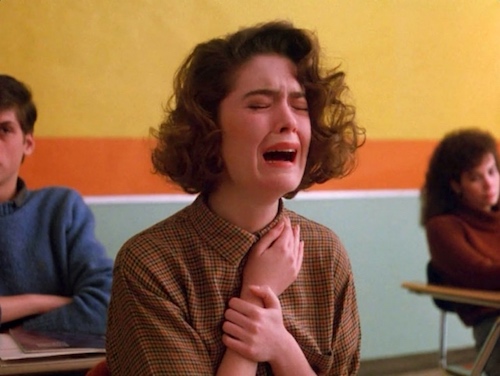
Visually, Lynch’s shot composition is fantastic, with a strikingly great use of the frame and blocking — very precise, very neat, ordered, but not in a self-conscious, Wes Anderson kind of way. It seems mindful of being shown on the relatively small television screens of the era, but also maintains a quality that carries over to this day. Beyond the purely visual, the content it creates is remarkable too. The sequence in the high school, where the news about Laura gradually comes out before it’s officially announced, is incredible — the way people slowly begin to suspect, the way characters react, the way Lynch is unhurried in letting this unfold. Having watched the episode a couple of times this year now, I think this part is one of my favourite scenes in the whole of cinema. The way it builds to that somehow-perfect shot of Donna sat at her school desk crying is majestic.

It's not just because everyone hates Lara Flynn Boyle

However, when judged as a standalone movie, Twin Peaks is a disaster.

After an hour-and-a-half of sheer quality, we reach the 19-minute tacked-on ending. This climax is rushed, simplistic, and refuses to touch on the vast majority of the episode’s subplots. I mean, of course it doesn’t — it was a rush job at the end of production to fill a contractual requirement. It wraps up the Laura Palmer case as quickly and perfunctorily as it can, then Lynch basically says a humungous “eff you” to the notion of having to do a movie version by bunging in a nonsensical dream sequence.

For those who are curious but not minded to sit through the whole thing, I’ll outline what actually happens. The deviation comes in the final scene of the episode as broadcast: instead of having a vision, Sarah Palmer has a flashback to when she was hunting for Laura that morning, realising she saw the killer hiding in Laura’s bedroom. (This, at least, is an effectively creepy notion. Was he actually visible in the quick panning shot of the room we saw earlier on? I daren’t go back to check. Seriously.) Sarah has Leland call Lucy, who’s hanging out at home with Andy (their amusing home life, otherwise unseen in the series, is probably the only reason to watch this). Lucy phones Sheriff Truman so he and Hawk can go to the Palmers and get a police sketch of the killer. Meanwhile, Agent Cooper is awoken by a mysterious phone call (there are lots of phone calls in this) from a man who knows unreleased details about the Teresa Banks murder. The man insists they meet at the hospital, so Coop calls Lucy and tells her to tell the sheriff to meet him there with the sketch.

At home with Punky

At the hospital, they discover the mysterious caller is the one-armed man, Mike, who identifies the sketch as Bob. He also babbles some other stuff which I’m not sure has much meaning in this version, but was recycled for one of his later appearances in the series proper. Mike reveals that Bob is currently down in the hospital basement. Harry and Coop pop down there, confront Bob, have a little natter with the creepy killer (whose creepiness is considerably diluted by his chattiness, if only for the duration of this scene). Then Mike barges in and shoots Bob dead. Coop delivers a kind of one-liner, before a title card informs us it’s “twenty-five years later”. Then the famous Red Room scene plays out, just like it does in Episode 2 — and if you thought it made almost no sense in the context of the series, it makes even less here. Where is Coop now? Who’s the little guy? Why does he talk funny? Why does his cousin look like Laura Palmer? What’s she on about? What does she whisper to Cooper? Why are we being shown any of this?! It came to Lynch in a vision, and he liked it so much he repurposed it for the series, where it eventually came to have meaning (some meaning, anyway)… but here it’s utterly aimless.

Let's rock!

This international version of Twin Peaks was never really meant to be seen, and it’s obvious Lynch and Frost felt that way when concocting its final act. That ending is rushed in what it does bother to conclude — and, compared to all the plots we’ve just spent nearly two hours watching, what it concludes is not very much. The killer isn’t even one of the people we were considering as suspects. Thank goodness this isn’t all Twin Peaks ever was.

The pilot as broadcast is a five-star masterpiece; not just the start of something truly special, but something remarkable in and of itself. The extended standalone version is so ruined by its final 19 minutes that I can only rate it:

3 out of 5

Tomorrow: fire, walk with me.

Alien: Covenant (2017)

2017 #69
Ridley Scott | 122 mins | cinema | 2.35:1 | USA, Australia, New Zealand & UK / English | 15 / R

Alien: Covenant

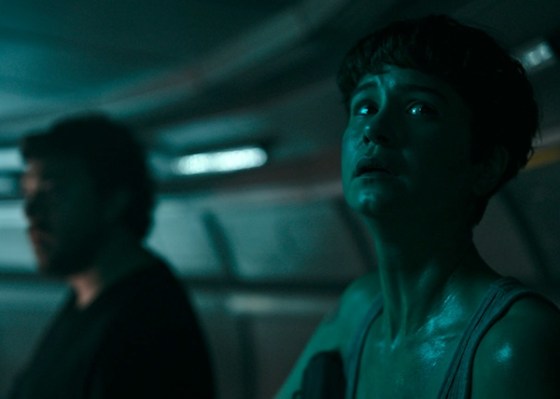
Following in the footsteps of half the other Alien movies (and “following in the footsteps” is definitely a theme when it comes to this movie), Alien: Covenant introduces us to a group of people who are the crew of a spaceship. This particular lot are on their way to establish a colony when a mid-flight disaster awakens them to deal with the damage. At the same time they detect a distress call from a nearby planet — a planet that looks even more suited to supporting human life than the one they were headed for. Changing course, they find suspiciously human vegetation growing on the planet, but are soon beset by terrible things. Well, it’s an Alien movie — I’m sure you can guess where most of this is going.

I say it’s an Alien movie, but really it’s a Prometheus movie. I don’t think that counts as a spoiler, does it? It’s no secret that Michael Fassbender is back. Sure, he starts the film playing a new robot, but did anyone really think that meant his old character wouldn’t be rocking up too? Sorry if I’ve spoiled it for anyone, but, c’mon. Besides, it’s clear that — despite the initial set dressing — Ridley Scott is far more interested in the concepts that launched Prometheus than he is in creating another Alien movie. The franchise-friendly stuff powers the slow-burn opening and the final act adrenaline rushes, but in between Scott reconnects to themes leftover from the apparently-aborted Prometheus trilogy.

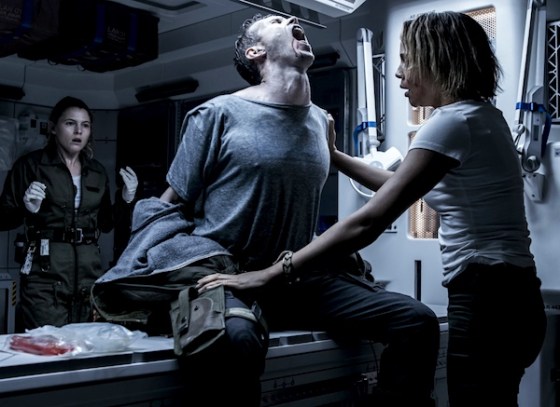
Fit to burst

Now, I’ve already professed to be avoiding spoilers, but suffice to say that if you put Prometheus, Aliens (as opposed to Alien), Blade Runner (yep), and Frankenstein into a blender, then poured the resulting mixture into a novelty tie-in glass from the Star Wars prequels, you’d get Alien: Covenant. Weirdly, it’s the Prometheus stuff in that blend that tastes finer than the Aliens stuff. In fairness, that’s because it’s complemented by the notes of Blade Runner and Frankenstein.

Still, it’s a mixed bag. The scenes of characters chatting hold more interest than the action sequences, which feel a little perfunctory, remixing bits of previous movies with little impact, and are too dark to really appreciate (though I should withhold judgement on that last point, because they looked gloomier in the film than they did in the trailer, so perhaps it was just my cinema?) There’d be no shame in Covenant working as just an action and/or horror movie, if well made — that’s what the films that originated this franchise are, after all — but Scott is interested in exploring something more profound. The problem is that the attempted profundity comes from characters standing around and explaining the plot and/or themes to each other. It’s further undermined by slightly sloppy construction, one that places a key flashback at entirely the wrong moment (coming much earlier than it should, thereby spoiling a later reveal), and a last-minute twist that will be easily guessable to anyone who’s ever seen another movie.

In space, no one can see you look worried...

Worst of all, however, is that this film just didn’t need to be made. As with Prometheus before it, do we want to know where the eponymous beasties come from? It ruins some of their mystique, especially as the answers feel oddly mundane. This is not something further films are going to fix, either; though at this point they may as well keep going until things join up properly to the original Alien, because hey, why not?

Alien: Covenant is better than Prometheus because at least the characters don’t act like total imbeciles who should know better. On the other hand, it’s worse than Prometheus because it scrubs out any ambiguity that film left about the Xenomorphs’ origins. Sometimes a mystery is better than an answer.

3 out of 5

Alien: Covenant is out in the half the world (including the UK) now, and is released in the other half (including the US) from tomorrow.

Prometheus 3D (2012)

Rewatchathon 2017 #10
Ridley Scott | 124 mins | Blu-ray | 2.40:1 | USA & UK / English | 15 / R

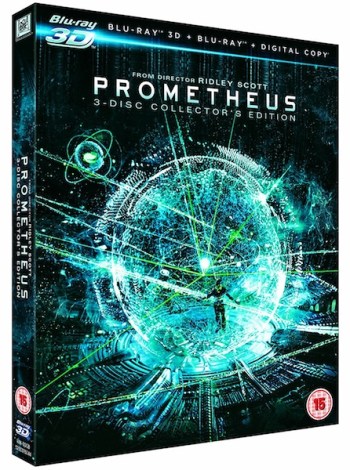
Prometheus 3D

80 years in the future, a starmap found in some caveman paintings provokes a trillion-dollar mission to the other side of the universe so that the world’s stupidest scientists can (spoilers!) get themselves killed.

It is, by complete coincidence, 4½ years to the day since I first and last watched Prometheus, and this revisit has of course been inspired by its just-released follow-up, Prometheus 2: Extraterrestrial Boogaloo Alien: Covenant, which I’m seeing tomorrow. Frankly, most of my original thoughts on the film still stand. To summarise: it has some really good bits, but then it stops making sense and turns into a braindead blockbuster that doesn’t bother to properly explain its own plot, never mind the potentially-interesting sci-fi ideas it initiated early on. Apparently the Blu-ray’s deleted scenes do clarify some of the plot holes and gaps in character motivation, but other stuff is just plain stupidity on the part of the characters. Or, rather, the writers. Well, one of the writers, at least.

But despite my basic opinion not changing, I’m posting about Prometheus again because this was the first time I watched it in 3D. Hailing from those brief couple of years where the term “post-conversion” was blasphemous, Prometheus was genuinely shot in 3D — and, however good post-conversion has become since then, I think parts of this film make a case for why doing things properly is still best. But I’ll come to that.

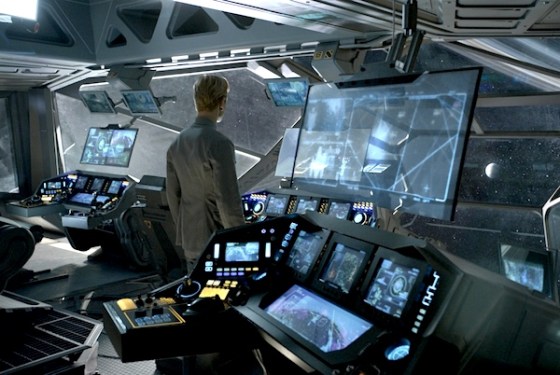
Building busy bridges

In general, Ridley Scott’s 3D mise en scène is exemplary, almost always placing objects and characters at various distances from the camera to emphasise and clarify the sense of depth. The busy layout of the Prometheus’ bridge helps this no end, making scenes set there some of the clearest examples. Even on less populous sets, Scott finds angles and compositions that offer nice dimensionality without slipping into being a vacuous 3D showcase. He frequently uses glass to good effect, creating an obvious separation between the clear material — be it a window, a spacesuit helmet, or a sleeping pod — and what’s on the other side, almost casually adding extra layers to any shot they appear in.

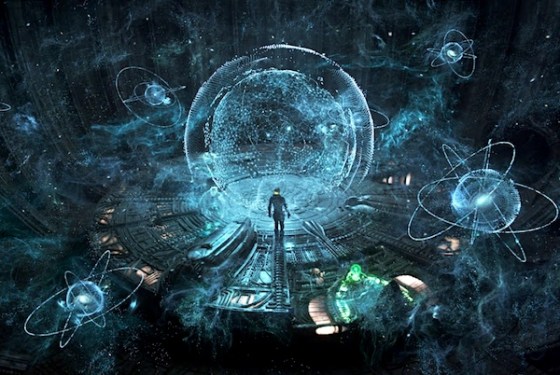
In terms of show-off effects, Scott never breaks the ‘window’ of the screen by having things poke out at the viewer, but there are still scenes where the extra dimension is really felt. The storm sequences are a perfect example, with bits of debris flying around all over the place. In-film computer elements like holograms or displays have their own shapely presence in front of, around, and distinct from the physical world they’re part of, making them seem all the more real. Perhaps most of all, the room-filling Engineer star chart David discovers looks great in 3D. My memory of it from the 2D version is an indecipherable array of lights filling the screen, which is probably because it was all perfectly in focus for the sake of the 3D. With that extra dimension, it looks like something worth marvelling at.

Maps to the stars

Having been shot ‘for real’, the 3D just gives everything, even dialogue scenes, a sense of space and distance. You can appreciate the gap between someone’s head and the neck-back of their spacesuit; or, in close-ups, the distinct (but not in-your-face) distance between someone’s nose and eyes and hair. Perhaps the most impressive element are textures, like the hieroglyphs David finds cut into rock, or even characters’ skin — at times you can ‘feel’ its surface, its pockmarks and pores. However good post conversions are, I’m not sure they’re ever that thorough!

Watching in 3D is never going to gloss over Prometheus’ more fundamental flaws — it’s never going to make up for issues with the screenplay or the edit (that said, I’ve heard it makes Transformers 4 considerably more entertaining, so maybe “never” is too strong a word). What you do get is a sense that effort was made to make the 3D experience worthwhile. It may be an inessential component of the movie (a virtual necessity when there will always be people watching in 2D, of course), but it’s one that nonetheless adds an appreciable extra dimension.

3 out of 5

Alien: Covenant is out in the half the world (including the UK) now, and is released in the other half (including the US) from Thursday.

Elstree 1976 (2015)

2017 #18
Jon Spira | 101 mins | streaming (HD) | 1.78:1 | UK / English | 12

Elstree 1976

In a studio near London in the summer of 1976, filming took place for a movie that the crew regarded as a children’s flick and several cast members assumed would be a flop. They couldn’t’ve been more wrong, because that film was Star Wars, probably the most influential movie of the last 40 years. You know the names of many of the people who were there: George Lucas, Harrison Ford, Mark Hamill, Carrie Fisher, Alec Guinness… But there was also an army of supporting actors and extras. This is their story.

Here’s where the point of Elstree 1976 runs aground for some viewers. It is not The Making of Star Wars; nor is it The Secret Making of Star Wars, where the “little people” dish the dirt on what really happened. There is a bit of that in here — a section where the interviewees tell their tales from the set — but it’s not what the film is about. Rather, it’s a study of what it’s like to be tangentially attached to something great; to be a bit player in a cultural phenomenon. Most of the contributors here just took any old job to earn some cash, but by happening to be in the right place at the right time they found themselves attached to something huge for the entire rest of their lives. How does that change the course of someone’s life? How does it change the very fabric of who they are as a person?

What it's actually like being on a film set

There are reviews of Elstree 1976 that espouse a “why should we care” perspective. “These people aren’t the leads, they were just little people, why should we give a hoot about their lives?” Well, isn’t that the point? They’re people, like you and I — people who have lives. They were involved with one of the largest, most enduring pop culture events of our time, and yet they were so on the periphery that it’s a tiny part of their lives… or it should have been. Star Wars may be this huge, defining thing for its lead actors and high-profile crew members, but there were also dozens (probably hundreds) of people who “just happened to work on it”, and who otherwise have led ordinary lives. Or haven’t, because of the effect the film has had.

You see, here’s the thing: some of these people were only on screen for a frame or two, or they were hidden under a prosthetic that means you never even saw their face… and yet they still attend conventions where people want to meet them, get their autograph, all that jazz. For all the people who don’t understand the appeal of a movie telling these performers’ life stories, there are fans who are so much more interested in them for so much less. I don’t know how much the documentary actually explores the psychology of that, but it does touch on some aspects — the behind-the-scenes hierarchy of conventions, for instance, and how some actors don’t think others are worthy of putting in an appearance.

Extras, extras, read all about it!

Providing you approach it with the right expectations, Elstree 1976 is interesting in its way. As a portrait of ordinary lives that were touched by something extraordinary it’s got an interesting thematic point to make, but the lives covered are still ordinary, and we therefore hear a lot about that ordinariness. Well, maybe that’s harsh — some of these people certainly have stories to tell. Still, it’s probably a bit too long, and a greater focus on the behind-the-scenes stories and conventions, plus a trim to the general life stuff, might’ve been beneficial. Nonetheless, it offers a unique perspective on a much-discussed movie and the culture that surrounds it.

3 out of 5

Elstree 1976 is available on Sky Cinema from today.

Green Room (2015)

2017 #1
Jeremy Saulnier | 95 mins | streaming (HD) | 2.35:1 | English / English | 18 / R

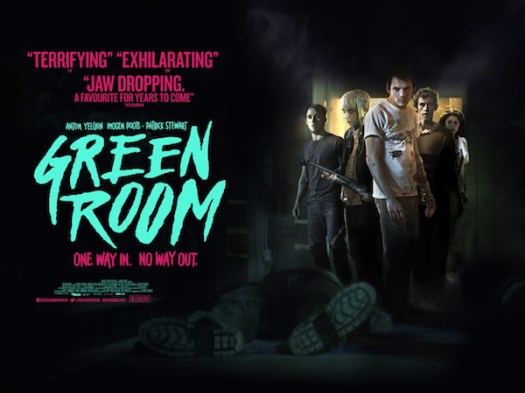
Green Room

In my review of 2016, I asserted that Denis Villeneuve was “one of the most exciting directors working right now.” Here we have, if not the other end of the spectrum, then certainly a different angle on it: Jeremy Saulnier, perhaps the most overrated director working right now.

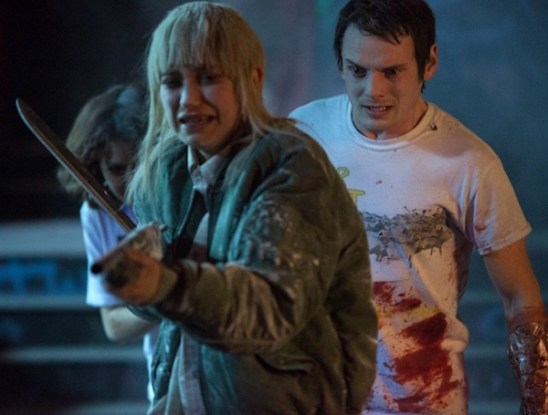
This, his third film, follows a struggling rock band who, in desperation for any work, take a gig at a remote club frequented and owned by extremist fascists. When the band see something they shouldn’t, the club’s violent owner and his gang try to kill them.

The main point everyone seems to make about Green Room is how unbearably tense it is. Well, I can imagine it might’ve been pretty tense if I hadn’t spent the whole time struggling to work out what was going on from all the mumbled dialogue. It’s not helped by much of the early chatter being music scene gobbledegook. Is this what watching sci-fi feels like to normal people? On one hand it doesn’t matter — the film is about the tension of the situation, not the vibrant wordplay. On the other, I was so distracted trying to decipher what was happening from the semi-unintelligible speech that I never really felt that fêted suspense.

Neither rock nor roll

The one time I did feel any real tension was right near the end. The form of the movie dictates that most of the cast are gonna get it, so it’s only in the closing stages that the final survivors (who are, naturally enough, the top-billed cast) may either win or finally be killed. The film has its indie-ness in its favour here, because you think that maybe the heroes will lose. Perhaps such a line of thought is me being too logical, not entering into the spirit of the fiction, but clearly the movie didn’t grip me enough before that point to feel anything sooner.

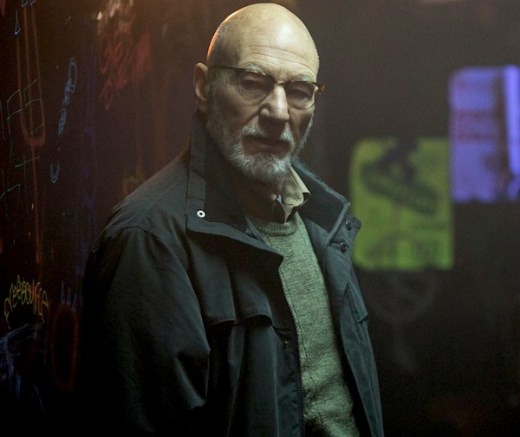
On the bright side, Patrick Stewart oozes class as the calmly in control villain, but I can see why he seemed to get pissed off at all the reviews/interviews going “OMG, this is such a departure for you!” Yeah, if your experience of his abilities extends no further than Star Trek: The Next Generation and the X-Men movies then this turn must be a revelation, but the guy’s got a long and exalted career playing all sorts of roles, on stage and screen. I’m not saying he’s bad here — he’s Patrick frickin’ Stewart, of course it’s a good performance — but I think some of the unreserved praise he’s received comes from a place of surprise at this role being a ‘departure’ for him.

These are the voyages of the starship Fascism

Labelling Saulnier the most overrated director currently working may be a bit harsh. It’s not that he’s a bad filmmaker, or even that he makes bad movies per se, but neither Blue Ruin nor Green Room have done very much for me, despite the adulation they’ve received elsewhere. Maybe if he continues this titular trend and next makes, I dunno, Red Mansion, which sounds like it might be a Gothic chiller, maybe then I’ll like him.

That said, I think Green Room is definitely more effective at its goals than Blue Ruin was. Even if I still think Saulnier is overrated, this is a step in the right direction.

3 out of 5

Review Round-up

Over the last ten-and-a-bit years I’ve prided myself on reviewing every new film I see. Well, at the start it was less pride and more just how I did things (and most of those early ‘reviews’ were only a couple of sentences long), but as I’ve maintained it for so long I’ve come to pride myself on it. However, of late my backlog has reached ridiculous proportions, and is only expanding.

But I’m not giving up just yet, dear reader — hence this round-up. There are some films I just don’t have a great deal to say about, where all I’ve really got are a few notes rather than a fully worked-up review. So as in days of old (i.e. 2007), I’ll quickly dash off my brief thoughts and a score. Hopefully this will become an irregular series that churns through some of my backlog.

In today’s round-up:

  • The Spy Who Came in from the Cold (1965)
  • Under the Shadow (2016)
  • Teenage Mutant Ninja Turtles: Out of the Shadows (2016)
  • Dazed and Confused (1993)


    The Spy Who Came in from the Cold
    (1965)

    2016 #167
    Martin Ritt | 112 mins | streaming (HD) | 16:9 | UK / English | PG

    The Spy Who Came in from the Cold

    John le Carré’s famed story of crosses, double crosses, triple crosses… probably quadruple crosses… heck, maybe even quintuple crosses — why not?

    The storytelling is very slow and measured, which I would guess is not to all tastes — obviously not for those who only like their spies with the action and flair of Bond, but even by Le Carré standards it’s somewhat slight. That’s not to say it’s not captivating, but it lacks the sheer volume of plot that can, say, fuel a seven-episode adaptation of Tinker Tailor Soldier Spy. Quite how the forthcoming miniseries from the makers of The Night Manager intends to be more than a TV movie… well, we’ll see.

    There’s also some gorgeous black and white photography, with the opening sequence at Check Point Charlie looking particularly glorious.

    5 out of 5

    Under the Shadow
    (2016)

    2017 #12
    Babak Anvari | 84 mins | streaming (HD) | 2.35:1 | UK / Persian | 15 / PG-13

    Under the Shadow

    Be afraid if your doll is took — it could be the Iranian Babadook.

    Honestly, for all the creepy quality on display in this UK-funded Iran-set psychological horror, I don’t think labelling it as something of a mirror to The Babadook is unfair. It’s about a lone mother (Narges Rashidi) struggling with an awkward child (Avin Manshadi) while a malevolent supernatural entity that may be real or may just be in her head attempts to invade their home. Where the Australian horror movie invented the mythology for its creature afresh, Under the Shadow draws from Persian folklore — so, same difference to us Western viewers. The devil is in the details, then, which are fine enough to keep the film ticking over and regularly scaring you, be it with jumps or general unease.

    The Babadook may have done it better, and certainly did it first, but Under the Shadow remains an effective chiller.

    4 out of 5

    Teenage Mutant Ninja Turtles:
    Out of the Shadows

    (2016)

    2017 #29
    Dave Green | 108 mins | streaming (HD) | 2.35:1 | USA, Hong Kong, China & Canada / English | 12 / PG-13

    Teenage Mutant Ninja Turtles: Out of the Shadows

    This first (and last? We’ll see) sequel to 2014’s Teenage Mutant Michael Bay Turtles ends with a cover of the theme from the original animated series, just in case you weren’t clear by then that it’s aspiring to be a live-action version of that particular cartoon.

    For one thing, there are appearances by a lot of popular characters who are primarily associated with that iteration of the franchise. For another, parts of the film have a very “rules of Saturday morning cartoons” feel — people thrown from a plane are immediately shown to be opening parachutes; all of the villains survive to fight another day; that kind of thing. They’ve clearly made an effort to make it lighter and funnier than its big-screen predecessor. The downside: they’ve gone a bit too far. The tone of the screenplay is “kids’ movie”, which isn’t a problem in itself, but Out of the Shadows retains the dark and realistic visual aesthetic of the first movie, plus enough violence and swears to get the PG-13 all blockbusters require, which means the overall effect is a little muddled.

    While it’s not a wholly consistent film, it does work to entertain, with funny-ish lines and kinetic CGI-fuelled action scenes. I must confess to ultimately enjoying it a fair bit… but bear in mind I was a big fan of the cartoon when I was five or six, so it did gently tickle my nostalgia soft spot.

    3 out of 5

    Dazed and Confused
    (1993)

    2017 #53
    Richard Linklater | 102 mins | streaming (HD) | 16:9 | USA / English | 15 / R

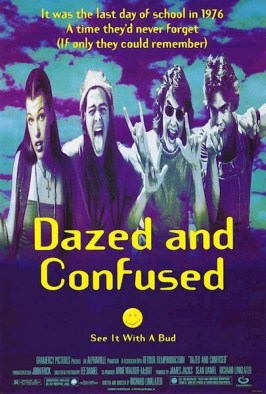
    Dazed and Confused

    Writer-director Richard Linklater has said that with Dazed and Confused he wanted to make an anti John Hughes movie; one that showed teenage life was mundane and uneventful. So here’s a movie about what it’s like to hang out, driving around aimlessly doing nothing. Turns out it’s pretty mundane and uneventful. And most of the characters behave like dicks half the time, which isn’t exactly conducive to a good time.

    Despite that, some people love this movie; it’s often cited as being nostalgic. Well, I can’t say it worked that way for me. Indeed, I’m kinda glad I didn’t know those people in school…

    3 out of 5