Southland Tales (2006)

2008 #63
Richard Kelly | 139 mins | DVD | 15 / R

Southland Tales

– confusing mess? or profound experience?

I won’t go into my full “how I discovered Donnie Darko” spiel [save that for whenever I finally watch the Director’s Cut!], but ever since I saw Richard Kelly’s first writing/directing effort way back on its original UK release I’ve been waiting eagerly for his second film. It’s a testament to the negativity of the reviews it received — and, perhaps, the influence of reviews in general — that I skipped Southland Tales at the cinema, left it five months after release before getting it on DVD… and even then it was only a rental.

At some point, Kelly split his story into six parts and, in a Star Wars-like move, the film was to be Parts 4-6, while the first three would be told in accompanying graphic novels. “The film will work fine without reading them,” he said (I paraphrase here), “but reading them will lead to a deeper experience.” Southland Tales: The Movie begins with a long recap of events from these books, going so far as to include images from their art. “Oops”?

You have to wonder, if you switched “Directed by Richard Kelly” for, say, “Directed by David Lynch”, would the critics’ reviews have suddenly jumped up a star or two? [some of it is certainly very Lynchian in feel — not a normal film with bemusing aspects, like Donnie Darko, but an all-out muddled weird-fest]

  • David Lynch fans may find this more entertaining than most. Or they may hate it for trying to be Lynchian but failing, or perhaps like it as an example of why Lynch is so good and others fail when they attempt similar feats. I don’t know how they’d use it like that, but I expect they would know.
  • the clear IV, V and VI presented at the start of each chapter — as well as showing I, II and III blatantly on screen during the recap, and having the narration have to recap bits of them — seems to hammer home that this is really for people who are prepared to invest in the whole thing, not people who just watch the film

** raises the question, should you ever have to go further (e.g. reading companion books, comics, websites, etc) to understand a film? Yes and no. If it’s consciously part of a wider ‘experience’, labelled and marketed as such, then why not? But if it’s sold as a film in its own right — or, at least, potentially in its own right (as this was) — then it should really work that way too.

  • narration: tries to explain everything, though does very little to help (difference between Kelly and someone like Lynch, who just leaves it all up to the viewer?) — at times almost uncomfortably over-explaining — you wish it could’ve been done properly, rather than with narration
  • Kelly spent months re-editing, following the critical panning it got at Cannes, trimming the length and restructuring it. And it seems to show, as it feels like a failed attempt to construct something legible out of a mess of half-thought-through scenes and subplots
  • one feels a good director’s commentary and/or the original cut might shed more light on things — this is the sort of film that could benefit from a decent DVD edition, that it probably won’t get due to its lack of popularity… unless it gains surprise critical acceptance years down the line, which isn’t unheard of… though I wouldn’t bank on it here. Perhaps, one day, when we’re all watching Data Crystals, Kelly will have gained enough reputation that a 20th anniversary release will finally explain the damned thing
  • seems to become clearer toward end — there are some answers, at least — but ultimately a lot is left out
  • too many of the ‘underlying ideas’ in the climax feel like a Donnie Darko rehash; odd musical numbers and long takes add to this feeling — almost like Kelly’s taken what he did in Darko and tried to expand it into some ensemble epic kinda thing

i thought, with respect to the film’s crazy half-constructed mess of half-ideas, i’d copy&paste my notes rather than a normal review. so at least that’s one answer at the end for you.

when it was originally conceived, it was set a couple of years in the future; now, it’s just set ‘now’; and soon, of course, it will be set in a fictional past — the copyright year on the film is 2005; it’s credited as 2006 on IMDb (which is when it turned up at Cannes); it was finally released in 2007; and it’s set in 2008

I really wanted to like Southland Tales, in spite of the critical mauling it received, and because I loved Donnie Darko and actually enjoyed Domino too (which Kelly wrote). Maybe — maybe — with time to invest in reading the prequel graphic novels, and exploring whatever official sites or crazy fan theories may be out there on the web, I could get more from this film. Personally, I don’t have that kind of time to invest right now, but I might give it a shot sometime. Until then, it will just remain a largely disappointing mess.

http://www.imdb.com/title/tt0405336/faq

this is the way the review ends, not with a bang but with a whimper

2 out of 5

Southland Tales featured on my list of The Five Worst Films I Saw in 2008, which can be read in full here.
Superhero Movie (2008)

2008 #52
Craig Mazin | 85 mins | in-flight | 12A / PG-13

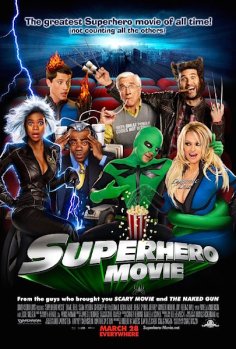
Superhero MovieYears ago, I saw Scary Movie. I don’t really know what I thought of it anymore, but I never expected I’d find myself watching another entry in the critically-derided …Movie series. But then I found myself on a plane, half asleep and with a choice of films I’d mostly rather watch on a decent-sized screen, and decided that maybe Superhero Movie wouldn’t be so bad after all…

As anyone who saw a trailer will have guessed, Superhero Movie is mainly a spoof of Spider-Man… a film that is now six years old. Unfortunately, this means that most of the best jokes have already been done in numerous other sketch-length spoofs, amongst them one at the MTV Movie Awards and one during Comic Relief 2005. The latter even did the green costume thing, though the hero was ‘Spider-Plant Man’ rather than the (less funny) Dragonfly employed here. Superhero Movie takes all this sketchery to the next level, however, crafting its story simply by reworking the first Spider-Man film almost scene by scene, inserting jokes (and, more often, ‘jokes’) where it can — which is about once per scene.

There are also asides that spoof X-Men, Fantastic Four and Batman, but they barely warrant a mention. They’re certainly not any funnier. In fact, the climax is the only wholly original plot point — or, at least, plot point not directly lifted from Spider-Man, as it may well come from some other comic source. This incessant copying makes the film feel like an over-extended sketch, and so it becomes clear that something like Mystery Men, with its genuinely original plot, makes for a much better superhero comedy movie.

As for the gags themselves, they’re childish, lewd, offensive (“isn’t Stephen Hawking funny!”), too specific to American culture, too topical (they’ll be dated within six months), already dated (“isn’t the Windows paperclip annoying!”), too obvious… It’s very much a movie made for now, not for posterity. Actually, to be fair, it’s very much a movie made for six years ago. In this respect I suppose it’s just like the rest of the …Movie series, which I’ve always felt looked like cheap TV specials owing to their specificity and, well, rubbishness. Still, believe it or not, some bits are actually amusing. Or amusing enough while they’re on. Perhaps I was just laughing out of desperation. I certainly can’t remember any of the jokes now.

Intriguingly (a word I use loosely here), there are a bunch of deleted scenes and gags during the end credits — not bloopers, but genuine deleted bits. It’s a mystery as to why these aren’t either in the film itself or relegated to DVD extras — it’s not like running time is an issue, and clearly pacing isn’t. In fact, some of the deletions are much funnier than gags that were left in. They’re probably the only reason to keep watching Superhero Movie to the end, though they’re not reason enough to start it in the first place.

2 out of 5

Superhero Movie featured on my list of The Five Worst Films I Saw in 2008, which can be read in full here.

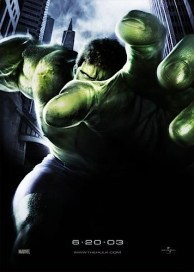
Hulk (2003)

2008 #36
Ang Lee | 132 mins | DVD | 12 / PG-13

HulkWith the Edward Norton-starring (and -penned), Louis Leterrier-directed sequel/re-imagining of the Hulk coming this summer, I decided it was finally time to watch Ang Lee’s much derided 2003 attempt at bringing Marvel’s green monster-hero-thing to the big screen. Much like the lead character — in a Jekyll & Hyde-style, he’s mild-mannered scientist Bruce Banner by day, but the big green monstrous Hulk when angry — this is very much a film of two vastly different sides.

Indeed, the most striking thing about Lee’s interpretation of the Hulk is what a mish-mash of styles it is. On the one hand, it wants to be a drama/thriller, focussed on father-child issues and military cover-ups. On the other, it has comic book action sequences and a bizarre editing style inspired by comics — a compilation of unusual techniques that look like a Media Studies teacher’s wet dream. Not even Spider-Man was that kooky. In the end, it just means the cutting style feel out of place, firstly because for much of the film (at least the first 45 minutes) it’s the only reminder of the film’s comic roots, but especially because Lee’s use of the tricksy techniques is inconsistent — sometimes confusingly overused, sometimes apparently forgotten. Other technical elements also detract. Danny Elfman’s score is blandly uninspired, a carbon copy of his work on similar films. Worst of all is the CGI Hulk — it looks like they used an action figure he’s so plasticky. It gets by OK in early appearances, swathed in moody shadows, but in the glaring desert sunlight he doesn’t stand a chance.

The big, destructive sequences starring the Hulk himself are too little too late. There’s nothing wrong with sneaking drama into blockbusters, but this feels like a blockbuster snuck into a drama. There are fights because there have to be, not because anyone involved in making the film seems to want them. They’re badly placed thanks to the plot structure and the film’s pace topples under their weight. Even the climax wants to be a battle of wills between father and son, but turns into a nonsensical messy CGI splurge. That said, the dramatic moments don’t fare much better. Usually so watchable, Eric Bana can do little with the material offered here. The rest of the cast don’t suffer as much, and there are times when it almost works, but neither the dramatic nor blockbuster sides fully function in themselves, and certainly not when slammed together.

Hulk is not a film anyone could love — even the weakest comic adaptations usually have their fans — and, for a film aimed at a devoted fan base, this is perhaps its biggest flaw. Equally, it retains too much of the superhero genre for anyone to consider admiring it as a purely dramatic film. Hopefully Hulk-fan Norton’s film can marry the two halves better… or if not, at least create some cool destruction-filled action.

2 out of 5

Henry V (1944)

2008 #28
Laurence Olivier | 131 mins | VHS | U

Henry V (1944)Or The Chronicle History of King Henry the Fift with His Battell Fought at Agincourt in France, as the title card (and therefore IMDb) would have it.

The works of Shakespeare tend to be a love-it-or-hate-it experience for most people, often based on one’s social class and/or experiences at school (obviously not exclusively). Just to be awkward, I’m going to say I have mixed feelings about his plays: on the one hand, I consistently enjoy Macbeth and find Much Ado About Nothing a diverting enough rom-com; on the other, I was bored by Richard III, even when played by Sir Ian McKellen, and never got on with A Midsummer Night’s Dream (to pick just two examples for each side). I imagine most people have their likes and dislikes of course, but I often feel I fall between the the dislike Normal people have for Shakespeare and the love that Cultured people have for him.

This may seem beside the point, but it does lead to Olivier’s Henry V. Simply put, I didn’t much care for it. It failed to engage me, and I’d put this down to Olivier’s infamous staging (literally) of it. The first half hour is a recreation of the play’s first performance in 1600, complete with fluffed sound cues and heckles from the crowd. The goings-on backstage and performer/crowd interactions heavily distract from the actual text being performed, as much as anything because they’re more entertaining. Then, cued by one of the Chorus’s lines, the film moves to showing the story in ‘reality’ — except this is a reality made of painted scenery, primary-coloured landscapes, and cardboard fairy castles. It’s a deliberate effect, designed to emulate pre-Renaissance painting, but it didn’t work for me — it’s over-stylised and distracting, and if you’re not familiar with the play (as I wasn’t) getting distracted is a problem. The concept of transition from performance to reality has potential (as would the idea of presenting the whole thing on stage with crowd interactions, actually, considering I missed them when they went), but I personally feel Olivier executed it poorly. For one thing, it spends too long bedding in the feel of the stage performance before it gets round to the shift to reality.

Stylised productions can work, and excellently, but here the direction and acting are sometimes as flat as the castles. Actors arbitrarily shout some lines, hush others, and put in emphasis of dubious relevance — it’s like Shakespeare-by-numbers, the sort of production that reveres the text so much it doesn’t bother to think about it. It hampers any understanding of what they’re saying, especially for newcomers. Perhaps more fairly, the performance style is incredibly stagey. My degree-related reading suggests this is one of the earliest proper Shakespeare films (previous adaptations being silent or even less complete), so perhaps the idea of a more subdued, screen-acting style had yet to permeate such productions. Things do pick up as the film goes on: the battles are effective, and the proposal scene is more comfortably performed than the pre-war politics. That said, the story seems to be over once Agincourt is won, so by modern structural standards the hasty single-scene romance that follows feels pointlessly tacked on.

Olivier’s Henry V has received plenty of praise in its time, as well as derision, largely for its conception as World War 2 propaganda. The latter is hard to ignore, with grand speeches delivered in a way reminiscent of Churchill’s and scenes removed so that Henry’s character becomes unquestionably good — both aspects that are distinctly less relevant to today’s more complex, war-dubious world. Even leaving the propaganda aside, the performances are outdated, the design several stylised steps too far, and on the whole the production failed to engage or hold my interest. However good it may once have seemed, I think this version has had its day.

2 out of 5

Next I’ll be reviewing Kenneth Branagh’s all-star 1989 version of Henry V, here.

Beowulf: Director’s Cut (2007)

2008 #19
Robert Zemeckis | 110 mins | DVD | 12

Beowulf Director's CutBack to catching up on last year’s films that I missed, this time with Beowulf in its Director’s Cut form — which, much to my amusement at the time, prominently featured a BBFC 18 icon on its initial cover art but only received a 12 when classified. Clearly the BBFC didn’t feel the “bolder, never-before-seen images” were any more unsuitable for kiddies than the originals. Personally, I’m not so sure. This version of the film is bloody violent (literally); more so than Lord of the Rings, which is the comparison the BBFC make. I’m not a parent and I’m not pro-censorship (far from it), but this feels more like a 15 to me.
Anyway, that’s not the point. What of the film itself? Well, let’s stick with the violence for a moment. It’s bloody and brutal… and completely undermined by the quality of the animation. I like animated films; I have absolutely no problem with animated films for adults; but the issue here is that most of the characters (especially the ‘extras’) seem of about the same quality as humans in Shrek. So while the battle scenes are often very violent, it becomes hard to take them seriously because it’s all too cartoony. Perhaps this is where classifying became problematic. But it’s not just the violence — the animation is awkward throughout. It’s not lifelike enough to be confused with reality, but not ‘animated’ enough to accept on that level. The characters move stiffly, are mostly too smooth (things do improve with aged characters in the final act), and are ‘dead behind the eyes’. The creatures are largely less realistic CGI than you’d see in a live action film. There are even times when things aren’t far above the graphics from a high-end computer game.

It’s not all bad. Anthony Hopkins is entertaining (and sounding more Welsh than ever), and I enjoyed Alan Silvestri’s score. The screenplay plays fast and loose with the original poem, but Gaiman and Avery have justified this and it’s mostly pretty good. While the third act initially slows the film’s pace to a crawl, the tiredness of an older Beowulf and an exciting duel with a dragon make it the best bit, despite the occasional lack of internal logic (why doesn’t the dragon’s fire burn his heart?) It goes someway to making up for the Beowulf-Grendel battle earlier on. In a rare attempt at genuine faithfulness, Beowulf strips naked for the fight so as to be on equal terms with Grendel. Understandably, the filmmakers don’t want his CGI manhood flying around, so he’s always shot with something helpfully blocking his groin. Problem is, the lengths and tricks involved in achieving this are too reminiscent of similar bits in Austin Powers, turning what should be a big heroic action sequence into a comedic exercise (though, it must be said, not an especially amusing one).

I wanted to like Beowulf. All those people on IMDb who whined that it was animated and you couldn’t do an animated action movie for adults annoyed me something rotten, and I really wanted them to be proved wrong. Plus I like many of Zemeckis’ other films, I like the poem, and there’s a lot of potential for a good adaptation. But the weak CGI, sometimes leaden dialogue (I forgot to mention the 300-wannabe “I am Beowulf” and comedically repetitive “I’ve come to kill your monster”), and uncertain level of violence all get in the way. For the majority of its running time, Beowulf left me with a sadly inescapable feeling of disappointment.

2 out of 5

There seem to be a couple of conflicting reports on how different the two cuts are. A comparison lists 90 seconds of new material, but shows the running times to be four-and-a-half minutes different (without credits). On the other hand, the BBFC list the director’s cut as being just 30 seconds longer. However much is completely new, there’s definitely added blood in existing scenes and some shots have been replaced with more graphic versions.

Jane Eyre (1944)

2008 #12
Robert Stevenson | 96 mins | download | PG

Jane EyreI was meant to read Jane Eyre in the first year of my degree, but, given a week to attempt what seemed a positively enormous tome (I partly blame the edition) and a coinciding essay deadline, I didn’t even attempt it. Instead I settled for a friend summarising it for me — I tuned out halfway through the very long retelling due to boredom, though whether that was the fault of the novel or its summariser I still don’t know. I finally got through Jane Eyre the year before last — not the novel, though, but the BBC’s apparently-definitive adaptation (has it been that long already!), following numerous extremely positive reviews at the time. That was good — because or in spite of the novel, I do not know.

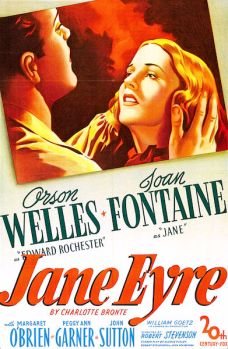
And so I come to this version, made in the wake of Rebecca (ironically, a novel clearly inspired in part by Jane Eyre) and also starring Joan Fontaine, alongside Orson Welles as the brooding love interest, Rochester. Well, he’s supposed to be brooding, but as played by Welles he comes across as merely gruff, apparently with a slightly unusual fake tan. Despite a suitably dramatic entrance, Welles’ stilted and occasionally overplayed performance, as well as a lack of chemistry with the equally weak Fontaine, does nothing to liven up what is already a rather uninspired production. The first 20 minutes are, at best, a Dickens rip-off, though without the appropriate comeuppance for the villains; in this version, it’s less Dickens and more obscene Christian morality play, complete with flat performances and (obviously) an over-reliance on God.

This section moves slowly… and then so does the rest of the film. Considering I’m primarily comparing this hour-and-a-half version to a four-hour miniseries, that’s quite a feat. The plot’s twists and revelations are all sadly underplayed, removing much of their dramatic effect; the same can be said of the abrupt ending. Perhaps there was an assumption that the audience would already be familiar with them, but true or not their weakening helps ruin this interpretation. And that’s all without mentioning the atrocious French accent of Adele, Rochester’s young ward, which often sounds as much like a bad Welsh accent as a French one.

All round, then, a very poor effort. A handful of redeeming features (the odd nice bit of cinematography, brief flashes of some decent performances) keep it from quite sinking to the lowest mark.

2 out of 5

The Mirror Crack’d (1980)

2008 #5
Guy Hamilton | 105 mins | TV | PG

The Mirror Crack'dA star-studded cast and the director of Battle of Britain, Goldfinger and three other Bond films can’t raise this adaptation of an Agatha Christie Miss Marple mystery far above the level of an ’80s TV movie.

There are some good lines, and it’s a Christie so obviously the fundamental story is good, but the direction is flat and lacks suspense, half the cast phone in their performances, and Angela Lansbury, lumbered with a sprained ankle and premature aging, seems to be in a dry run for Murder, She Wrote. The lack of involvement by the main character is something I always find problematic with Marple stories, even when the actress involved has the necessary twinkle. Edward Fox is her match as the detective who actually does most of the detecting for once (but is still robbed of the final revelation, of course).

The best bit, which I’ll just take a moment to highlight, is the opening. It’s a black & white murder mystery, the scene of the final revelation… and the print burns up just before the killer is revealed. The film cuts to a village hall, where the film was being screened and the projector’s just died. Miss Marple proceeds to explain what will happen to everyone, based on what she’s deduced from the film so far. A man at the back who’s seen it confirms she’s right. Much better than my summary makes it sound, this is by far the film’s highlight, one of the few whole scenes that rises above the pervading flaws.

Despite a few commendable elements, this is a good tale that’s not told as well as it could be.

2 out of 5

Churchill: The Hollywood Years (2004)

2008 #4
Peter Richardson | 84 mins | TV | 15

Churchill: The Hollywood YearsWhat if the Americans made a movie of Winston Churchill’s life, prone as they are to re-write World War 2 history to show they won it all by themselves?
This is ostensibly the premise of this spoof from some of the team behind Channel 4’s The Comic Strip. I say ostensibly, because the film is bookended (for padding, I suspect) with scenes that suggest that the real Churchill was an American GI, and the British simply re-wrote history using a somewhat chubby actor called Roy Bubbles. Sadly, the joke was funnier when it was riffing on those US historical re-writes.

The problem with killing that joke is, it’s the best one the film’s got. It’s also just about suitable for a five-minute comedy sketch, or, at a stretch, a series of sketches. The strategy for drawing this out to movie-length seems to have involved those bookends, as well as bunging some outtakes at the end and including a bunch of ridiculous, irritating, and unfunny subplots with Hitler and his entourage. It’s a shame to see the talents of actors such as Antony Sher and Miranda Richardson frittered away on such material.

This is all being a tad harsh, because Churchill actually has its fair share of amusing moments. The supporting cast of British TV comedians are mostly very good, Neve Campbell’s posh English accent (usually such a stumbling block for Americans-as-Brits) is as good as anything a British actress could have delivered, and Christian Slater and Romany Malco make for a likeable pairing. But, again, most of the best bits are of sketch length, and so wind up spread out among the padding.

In that respect it’s quite a shame, because there’s a good idea, good potential, and some good laughs in here.

2 out of 5

Play Time (1967)

aka Playtime

2007 #118
Jacques Tati | 115 mins | DVD | U

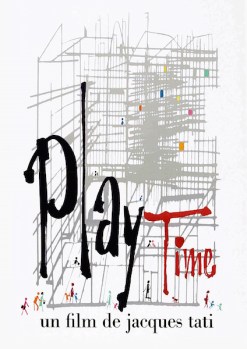
Play TimeI know some people love the work of Tati, just like there’s always someone who loves everything; personally, I find his films largely dull. His character, Monsieur Hulot, is like Mr Bean but less funny (don’t worry, I know Hulot comes first by a good few decades). There are some laughs to be had in Play Time, but they’re a long way in and not necessarily worth waiting for.

Play Time is certainly pertinent to the ‘Cityscapes’ course we were shown it as part of, but even the subtext (which is about as ‘sub’ as a space station), about the depressing similarity of modern cities, is repetitively over-done.

Recommended only as a cure for insomnia.

2 out of 5

Play Time featured on my list of The Five Worst Films I Saw in 2007, which can be read in full here.

Manhatta (1921)

2007 #109a
Paul Strand & Charles Sheeler | 10 mins | download

Another ’20s city film, showing off (as you might guess from the title) parts of New York. The focus appears to be industrial — skyscrapers under construction, finished architecture, tug boats, trains near the docks; the people of the city only crop up at the start and close, and then only in faceless crowds. It’s interspersed with poetic intertitles, which make for an odd contrast.

Once again, I feel that, unless you want to go getting a bit pretentious (and, to be fair, at least some of these films were made for just that), the main interest here is in an historical perspective: it provides another snapshot of a time and place long gone.

2 out of 5

The full short is available on Wikipedia.