The Night Comes for Us (2018)

2018 #215
Timo Tjahjanto | 121 mins | streaming (UHD) | 2.35:1 | Indonesia / Indonesian, English, Mandarin & French | 18

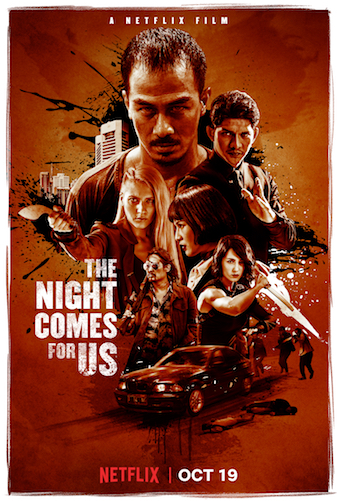
The Night Comes for Us

Tucked away amongst the raft of original content Netflix decided to release all at once yesterday was this, which caught my attention by dint of one of its stars: Iko Uwais, the action genius best known for starring in The Raid and The Raid 2 (or, alternatively, his cameo in The Force Awakens). Intrigued, I gave it a quick Google, coming across this piece at Birth.Movies.Death., which propelled the film straight to the top of my watchlist. Well, that BMD review majorly oversells it, in my opinion, but the film has its moments.

Joe Taslim (who played Uwais’ boss, the leader of the raid, in The Raid) is the star this time. He plays Ito, a Triad enforcer who suddenly grows a conscience halfway through massacring a village, killing his Triad underlings to rescue a little girl. He turns to his old pre-Triad gang for help, because sure enough the Triad want their revenge. To achieve this they send a whole army of henchmen (naturally — you need plenty of people for our hero and his chums to slaughter, right?), led by Arian (Iko Uwais), another member of Ito’s old gang who joined the Triad at the same. Cue person conflicts and switching allegiances.

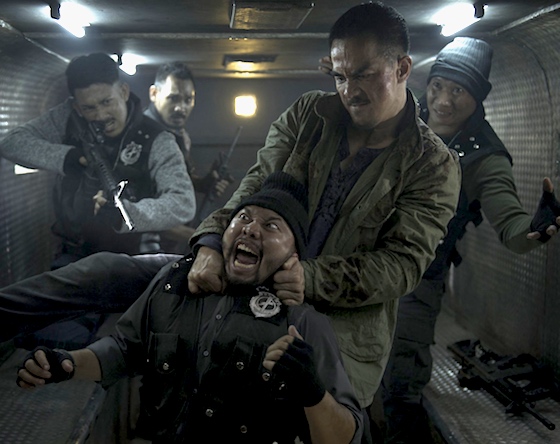
The whole storyline is quite perfunctory and rather something-and-nothing (and, considering that, gets a bit too much screen time), but it’s a sideshow because the real star is, of course, the action choreography. That’s as relentless and barmy as you’d expect given the pedigree of the cast and crew (director Timo Tjahanto was also responsible for another Uwais vehicle, Headshot), but it’s not just martial arts acrobatics being splattered across the screen: there’s enough blood and gore on show to rival any horror movie. It’s not just dainty little bullet wounds, knife scratches, or even some blood splatter — limbs are broken and dismembered, faces are graphically smashed in, and at least one person literally spills their guts. Viewers with a weak disposition need not apply.

One of the film's less brutal scenes

Uwais may be the most recognisable name, and Taslim is the main character, and they both get impressive action sequences (including a climactic one against each other), but mention must be made of Julie Estelle (who also starred in The Raid 2 and Headshot) as the mysterious Operative, whose role in all the plotting is never fully explained (or if it was, I missed it) — but she gets perhaps the best fight of all, taking out a couple of waves of henchmen with guns and explosives, before engaging in hand-to-hand and blade-to-blade combat with two fellow female equally-badass assassins.

But, all in all, it’s no The Raid 2. Well, that’s one of the greatest action movies of all time, so perhaps the comparison is unfair. But, personally, I would also put it a step behind something like The Villainess, another underworld actioner with a flair for crazy set pieces. Still, put aside the hyperbole you might encounter elsewhere online and, for viewers after a brutal, skilful action extravaganza, The Night Comes for Us does hit a spot.

4 out of 5

The Night Comes for Us is available on Netflix now.

Zatoichi’s Vengeance (1966)

aka Zatôichi no uta ga kikoeru

2018 #199
Tokuzô Tanaka | 83 mins | Blu-ray | 2.35:1 | Japan / Japanese

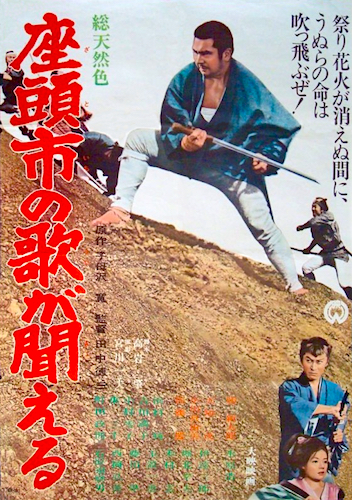
Zatoichi's Vengeance

Not to be confused with the series’ similarly-titled tenth film, Zatoichi’s Revenge (not a problem with the original Japanese titles, where the former translates as something like Zatoichi’s Two-Stage Sword and this is something along the lines of Zatoichi Hears the Song — I’m just using online translators to guess at these, so those translations may well be too literal), Zatoichi’s Vengeance marks the exact halfway point of the series — both chronologically and, according to Letterboxd users, for quality, too.

After encountering a dying man whose last wish is for Ichi to deliver a moneybag to someone called Taichi, our blind hero bumps into an equally blind priest and accompanies him to the village of Ichinomiya for their “thunder drum” festival. Once a quiet, peaceful place (er, despite all that drumming), that very calm has led a nearby yakuza boss to move in and take advantage, setting up a brothel and demanding protection payments from local businesses. One of the last holdouts is, it turns out, the dying man’s mother, along with her young grandson — Taichi. Naturally, Ichi’s sense of justice compels him to stop the yakuza, but he’s mindful of being a negative influence on the boy’s impressionable young mind.

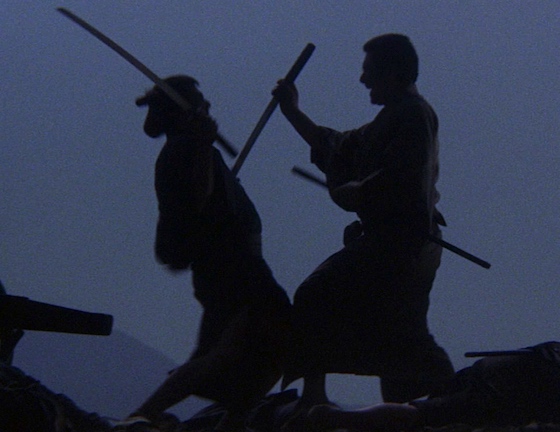
Vengeance starts out as a quieter, more dramatic Zatoichi film than many, at times marked by Ichi’s deliberate refusal to engage in combat… until he starts cutting everyone down in a flurry of second-half action sequences, anyway. There’s a couple of the requisite scenes of Ichi killing hordes of enemies, the best being an encounter on a bridge where the yakuza employ those thunder drums to frustrate Ichi’s hearing. It’s a beautifully staged sequence, shot in an almost-silhouetted manner.

Silhouette attack

But the action is the lesser element here, with some of it feeling almost perfunctory alongside the interesting ideas presented by the plot. It engages on multiple fronts. Firstly, there’s Taichi and Ichi’s potential influence on him. There’s a good explanation of the effect of this plot thread by Walter Biggins at Quiet Bubble. Biggins writes that “Taichi gets hope from the blind swordsman. He sees freedom through violence. He doesn’t see how conflicted, lonely, and desperate Zatoichi’s life is — the boy sees only the glamor, the swagger, the escape. [Zatoichi] allows the gang to beat him, allows Taichi to see him humiliated, so that he doesn’t get the wrong idea about this lifestyle. [Taichi’s story] ends the film on an ambiguous note — we don’t quite know how the poor kid will turn out, or if he’s learned the right lessons from Zatoichi. In this sense, Zatoichi’s Vengeance is an indictment of its very genre, and the boy is central to this critique.” (I’ve chopped that up somewhat from the original because I didn’t want to rip it off by quoting too extensively, but the full piece is even more insightful on this aspect of the film.)

Connected to this is the blind priest, a wise man who seems to see into Ichi’s very soul, and advises him on his interactions with the boy and, well, his lifestyle in general. This is one part of the film I wasn’t wholly convinced by, because I’m not sure how well the film pays it off. For one thing, he advises Ichi to be a good influence on Taichi, which leads Ichi to attempt to reason with the boss and get a beating for his trouble; but rather than pursue that diplomatic tack, it’s only a few minutes before he whips out his sword and gives them a good thrashing — once again setting a bad example. The priest reassures Ichi that sometimes violence is the only way. Um, you what? Well, the priest is presented as wise and insightful — almost too wise, because the film admits this advice seems contradictory, and Ichi can’t quite process that contradiction either. The priest also warns Ichi not to rely so much on his sword of he’ll die, which seems to pay off at the climax: when Ichi enters the yakuza’s lair, they’re all afraid of him, standing back to allow him to enter, take their money, and shut down their operation. But the reason they’re afraid of him is the awesome sword skills he demonstrated earlier, and when they attempt a last-minute stealth attack, he cuts them down.

Uh-oh, Ocho

While both of these characters and their associated views of Ichi’s methods provide food for thought, perhaps my favourite part of the film is the subplot about a prostitute, Ocho, who Ichi encounters at that recently-opened brothel. She’s a kindhearted woman — almost the stereotypical “whore with a heart of gold” — who’s revealed to have a tragic backstory when the samurai husband she ran away from arrives. He’s been searching for her for three years, but she doesn’t want him or his help, even as he’s desperate to win her back — so desperate that he agrees to take on Ichi for money, even though he’d had a good relationship with our hero. But the real success here is the beautiful portrayal of Ocho by Mayumi Ogawa, which makes her one of my favourite characters in the series: the way she’s so kind and generous at first, but then her personal tragedies are revealed, and her bleak ending… As the film goes on, Ogawa peels back the layers of who Ocho is and how she’s ended up this way, transcending any fears of a stereotypical character to instead reveal a sympathetic figure with a poignant ending.

Indeed, the whole film comes to a kinda melancholic, kinda bleak conclusion (spoilers here, naturally). Ichi ostensibly wins, of course — the boss is defeated, the town freed from his influence, no one (currently) out to kill him — but there are no real happy endings: Taichi’s father is still dead, the young boy in limbo about where his life will go; Ocho’s life has been ruined beyond repair (we last see her sprawled drunk on the floor, no longer caring that she finally has enough money to free herself from prostitution); and her samurai husband, the man who killed Taichi’s father and was only after Ichi because he was desperate for the money to free his lover, even though she didn’t love him, lies dead by Ichi’s reluctant hand, a fate he both deserved and didn’t. As Paghat the Ratgirl describes it, this is an “important element of Ichi’s most compelling adventures: the tragedy of victoriousness. He has won. He lives. But he has killed someone who was by no means a villain. […] Discovering himself to be a menace even to those he loves, he realizes he is undeserving even of little Taichi’s affection, and avoids the boy in order to flee the village toward his next horrific adventure”.

Ichi gets knocked down, but he'll get up again

My original conclusion to this review described it as a film of mixed success. It has some really nice ideas and spins on the usual Zatoichi formula, but I also felt like it didn’t carry some of them all the way to fruition. I wanted to love it, because I so liked some of what it did, but felt it didn’t all come together well enough. On reflection, and after reading some other reviews, like the ones I’ve quoted, I’m no longer sure it comes up so short. These Zatoichi films may just look like brief action flicks about an almost-supernaturally-gifted swordsman and righter-of-wrongs, but sometimes they leave you with a surprising amount to chew on.

4 out of 5

Criterion’s Blu-ray box set of the Zatoichi films is released in the UK next month.

Jin-Roh: The Wolf Brigade (1999)

aka Jin-Rô

2018 #212
Hiroyuki Okiura | 102 mins | DVD | 1.85:1 | Japan / Japanese | 15 / R

Jin-Roh: The Wolf Brigade

Jin-Roh has enough cool costumes and bursts of ultra-violence to cut together a trailer that looks like a kinda-typical anime action-fest, but that’s really hiding a thoughtful, complicated (oh so complicated) drama about an unlikely romance and military conspiracies.

If that sounds like a bizarre mix… well, it is. Jin-Roh is a film that likes to pull tricks on its audience (maybe those action-packed trailers were deliberate rather than marketers just doing their best to sell the thing!), and one of the tricks it plays is to constantly wrongfoot you about what kind of movie it’s meant to be. First it’s a kind of action thriller about terrorists vs. police; then it’s a subtle romance between two damaged individuals; then it’s a conspiracy thriller, and also an espionage drama; and finally it’s some kind of allegorical tragedy. As it moves through those various phases, the characters — and, by extension, us — are subjected to crosses, double crosses, and triple crosses. Good luck keeping up…

Set in an alternate history where Germany occupied Japan after World War 2 (I’m not sure that’s made clear enough in the film, but hey-ho — maybe it’s obvious to Japanese viewers), the film picks things up a couple of decades later, with Japan free from occupation but having to fight antagonistic forces from within. With many guerrilla cells having combined to form terrorist group The Sect, the security services consequently created Kerberos, a controversial police paramilitary unit, to combat them. When Kerberos corporal Kazuki Fuse fails to shoot a bomb-carrying girl and she blows herself up, he’s punished by being sent back to basic training. At the same, he meets the girl’s sister and begins to form a bond with her. Meanwhile, his failure has thrown the future of Kerberos into doubt, setting political machinations whirring every which way.

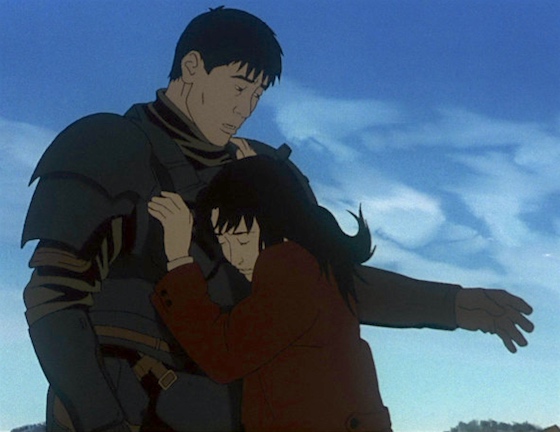
Little Red Riding Hood... and the Big Bad Wolf?

I’ll admit, I got pretty lost with all the various factions, who was plotting what and when and why, and which side everyone was supposed to be on. Perhaps I was lulled into not paying enough attention because, as I noted above, the film appears to be a tender, understated examination of the relationship between two scarred individuals struggling to cope with the same recent tragedy from different sides, before it abruptly takes a hard turn into an intricate conspiracy thriller. Reading a plot description afterwards, I managed to get my head around it, though it didn’t resolve one quandary I felt at the end of the film itself: that it’s hard to know who we’re meant to be rooting for. Did the good guys win? Did the bad guys win? Were there actually any good guys — was anyone right? Personally, I’m fine with a film where there are no heroes, where everyone’s a bad guy and one of those bad guys wins; my problem is that I was left feeling unclear about whether that was the case or not.

Mixed feelings, then. It’s a well-made film (even watching on a crummy window-boxed DVD), but all those whiplash-inducing turns and confusion-producing twists left me somewhat reeling and bewildered.

3 out of 5

The Korean live-action remake, Illang: The Wolf Brigade, is available on Netflix from today.

(As is Daredevil season 3, Making a Murderer season 2, a brand-new Derren Brown special, and over half-a-dozen other series and films I’ve not heard of — why dump so much on one day, Netflix?!)

Sartana’s Here… Trade Your Pistol for a Coffin (1970)

aka C’è Sartana… vendi la pistola e comprati la bara!

2018 #188
Giuliano Carnimeo* | 92 mins | Blu-ray | 2.35:1 | Italy / English | 15

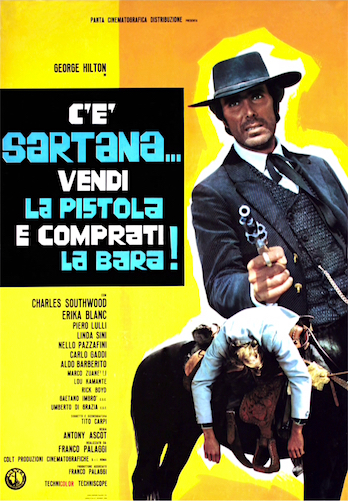
Sartana's Here… Trade Your Pistol for a Coffin

The third official Sartana movie is to this series what On Her Majesty’s Secret Service is to the Bond films: its one-shot leading man isn’t as good as the regular fella, but the film around him is a cut above.

Sartana’s just settling down to a nice picnic when he witnesses the robbery of a wagon by, apparently, a gang of horse thieves. The wagon was transporting gold… except it wasn’t: the bags are filled with sand. It’s all part of a scheme by the local rep of the mining company to rip off the hardworking miners and keep their earnings for himself. Naturally, Sartana embroils himself in the plotting, which also features a local impoverished saloon owner and several other gunslingers with competing interests in the gold.

The blurb for Arrow’s Blu-ray release states that Trade Your Pistol for a Coffin “finds the series taking a more tongue-in-cheek turn while retaining […] the usual blend of inventive gunplay, plot twists aplenty and a playful sense of humour.” It’s a pretty fair summation, to be brief: the film features quite a few fun bits of dialogue and a smattering of inventive shoot-outs. The plot isn’t bad either, at least for a while. The first half-hour or so sees Sartana follow things from one situation to the next, which keeps the story moving nicely and the narrative varied. After that, I’m not sure the villains’ plans all make 100% sense, and it only gets worse once the whole cast have been introduced and there are shifting alliances and double crosses galore. As it dove into the third act, I don’t know if I lost track of what the plan was meant to be or if the film just never explained it. That seems to be par for the course in these movies, though.

Playing games

New boy George Hilton is fine as Sartana, selling the character’s ingeniousness, and here gifted with a particularly nice line in magicking his trademark pistol up out of nowhere. Much like Lazenby in OHMSS, he lacks the cool iconicity of the guy who originated the role, but he makes a fair fist of it.

More of a standout is Charles Southwood as Sabbath (aka Sabata, depending which language you’re watching in), a rival gunslinger who makes for a fun addition to the film. He doesn’t turn up until halfway through, but from then he steals the show. It starts with a great introduction: he rides into town in a crisp white suit, sporting a straw boater and a girly parasol, before kicking the arses of some tough guys in the saloon. And then, to cap it off, he shares some amusing banter with Sartana over the card table. As the film goes on, the English-accented gent trades bons mots, reads Shakespeare and Tennyson, and reveals himself to be as quick-witted and gadget-stacked as the title character. Naturally it can only end one way: a Sartana vs Sabbath shoot-out. Their duel, saved for the film’s climax, is absolutely fantastic, as they take playful potshots at each other’s clothing before the victor executes an all-timer final move.

The film’s entertainment value is bolstered further by more good direction from Giuliano Carnimeo. There’s plenty of the usual Leone influence in shootouts and whatnot, but every once in a while there’s a delightful flourish — most memorably, the use of split-screen to show three adversaries dying together, and a split-focus shot that shows Sabbath watching as Sartana’s arrival is reflected in a teaspoon.

This often happened to the other fella

Trade Your Pistol for a Coffin isn’t the quintessential Sartana movie, owing to the absence of regular star Gianni Garko — Hilton’s a solid stand-in, but lacks the regular’s roguish charm. But the rest of the movie packs enough value that it’s my favourite in the series so far. Nonetheless, it’s still a bit too much of a B-movie to really transcend those roots; but, for the sake of differentiation from the other two if nothing else, I’m going to generously round my score up to a 4.

4 out of 5

* Credited as Anthony Ascott. ^

Zatoichi and the Chess Expert (1965)

aka Zatôichi jigoku-tabi

2018 #181
Kenji Misumi | 87 mins | Blu-ray | 2.35:1 | Japan / Japanese

Zatoichi and the Chess Expert

A more literal translation of the 12th Zatoichi movie’s title would be something like Zatoichi’s Trip to Hell. I can see why they changed it, though, because that seems a bit melodramatic: this is far from Ichi’s darkest, or most personally-threatening, adventure. Choosing to focus on the chess expert in the English-language title in some ways feels a little misleading — there’s a lot of other stuff going on in the story here — but, when it comes down to it, he is the film’s defining character.

Said chess master is Jumonji (Mikio Narita), a samurai Ichi bumps into on a sea voyage. Although they have mutual respect for each others’ skills and end up travelling together, it’s clear they have some differences in their moral codes. Meanwhile, Ichi is being pursued by a group of men — well, when isn’t he? A fight results in the injury of a little girl, and Ichi insists on helping her and her aunt, Otane (Kaneko Iwasaki). The four travel to a spa, where they encounter a young lord hunting for the man who killed his father.

After a lot of time spent moving pieces into place (appropriate for a chess-themed story, I suppose), the film almost takes a swerve into murder mystery territory — except it’s less of a whodunnit (we know that pretty quickly), more of a whydunnit, as both victim and perpetrator are people Ichi is on good terms with. And that’s only the half of it, because there’s more to Otane than meets the eye, too.

Board game expert Jumanji... sorry, Jumonji

The way all this plays out is a change of pace for the series. There’s still a peppering of the usual elements (Ichi-vs-hordes fight scenes; comical gambling bits where Ichi one-ups those who underestimate him), but around that it’s kind of slower, more emotional (there’s a very effective scene where Ichi recalls another Otane, his love interest from several of the early movies), and all gets a bit melancholic — it seems jovial enough at first, but that undercurrent of sadness is waiting to pounce. It also shows Ichi as more fallible than usual, with some of his usual tricks failing (he actually loses a dice game; later, he drops something important during a fight and has to fumble around on the ground), and the finale pits him against an adversary and dilemma the likes of which he hasn’t faced since perhaps even the first movie.

It also reminds a little of the fourth film, Zatoichi the Fugitive — which is appropriate, as a key sequence here contains a callback to the events of that movie. But the actual similarity comes in its effectiveness: when it’s working, it’s among the finest material in the whole series. Specific great sequences include the discovery of a murder in the rain, which is intensely atmospheric, while another where violence almost erupts between two friends plays out in complete silence and is all the more tense because of it. However, the consistency isn’t quite there across the whole film for me to count it among the series’ very best. There are a few too many major elements introduced late in the game, and, in balance to that, too much early stuff that doesn’t quite go where it needs to in order to feel justified. Perhaps this is a side effect of them churning out so many of these movies every year: with a couple more rounds of polishing to the screenplay, to streamline and coalesce all the plots appropriately, it might’ve been top drawer.

Sore loser

But I don’t want to be too harsh. Even if Chess Expert doesn’t thrill as much as some of the other movies, nor differ from the formula as thoroughly as some others, it does have its own charms for those prepared to indulge a somewhat more contemplative and chewy Ichi tale. Director Kenji Misumi previously helmed the original Tale of Zatoichi and Fight, Zatoichi, Fight, which are (best as I can ascertain) commonly regarded as being among the top two Zatoichi films. Many a fan would rank Chess Expert in close proximity to them. For me, it doesn’t crack the very top tier of Ichi flicks, but is still an above-average adventure for everyone’s favourite blind masseur swordmaster.

4 out of 5

Announced late last month, Criterion are bringing their fabulous Blu-ray box set of the Zatoichi series to the UK in November.

Rocky IV (1985)

2018 #152
Sylvester Stallone | 92 mins | Blu-ray | 1.85:1 | USA / English & Russian | PG / PG

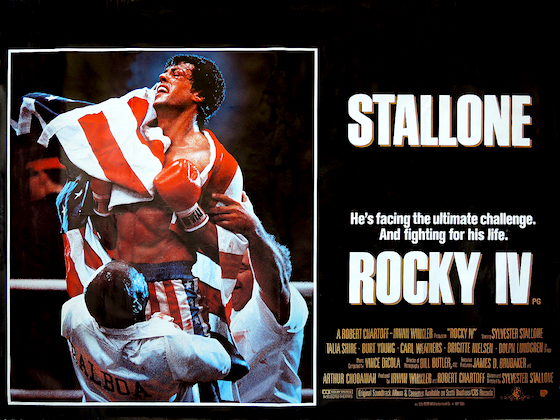
Rocky IV

Rocky goes a bit Rambo for an instalment that abandons the series’ early gritty social realism roots in favour of an anti-Soviet propaganda cartoon tone. And, in fact, it was released the same year as First Blood Part II, which actually marked Rambo’s shift from being about a vet with PTSD to an “America, fuck yeah!” action series. What was up with Stallone in ’85?

Anyway, back to Rocky. This time, his opponent in the ring is Ivan Drago (Dolph Lundgren), a poster boy for Soviet superiority and their advanced training methods. With Drago’s team harping about his brilliance, Rocky’s friend Apollo Creed (Carl Weathers) elects to come out of retirement to fight him and prove America’s supremacy. But the fight goes sideways, setting up a grudge match between Drago and Rocky.

Interpreting a sports movie as really being about the conflict between the USA and the Soviet Union might normally be considered subtextual analysis, but that’s not the case here — it couldn’t be more blatant. Sometimes this is as hilariously preposterous as you’d expect (Rocky’s victory speech is greeted by a standing ovation from the Soviet politburo!), but other bits actually work quite well. Take the sequence before the Creed-Drago fight: on one hand it’s a ludicrously OTT musical number; on the other, that’s the point, as shown by Drago’s confusion at the flashy spectacle going on around him, intercut with his wife’s exasperated sighs. It’s the mentality of the USA vs. the USSR encapsulated in a glitzy floorshow vs. a heavy frown.

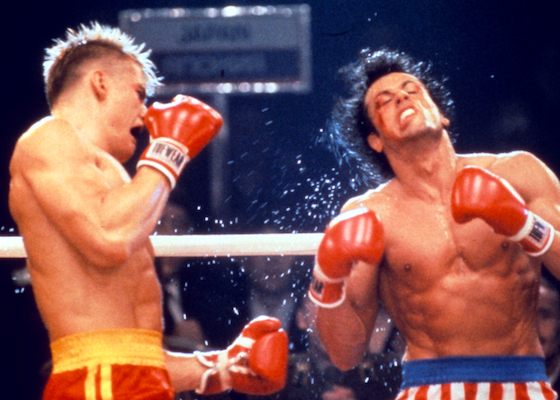
USSR in the back

This isn’t the only bit of music in Rocky IV, though. Oh no. Far from it. Halfway through, the film basically stops dead for the sake of a music video montage of scenes from all four movies. It’s meant to signify a moment of introspection for Rocky, but it goes on for the length of an entire song. And that’s certainly not the only montage. Oh no. Far from it. At one point there’s a training montage… followed by another training montage. It’s like a spoof of itself.

And I haven’t even mentioned the robot that Paulie receives as a gift, which seems to have an AI. No, seriously. Later, he gives it a woman’s voice and refers to it as “his girl” while it delivers him beer and plays its favourite song. No, seriously.

Some people were trying a bit harder than writer-director Stallone, though. There’s a good supporting turn from Brigitte Nielsen, giving off Lady Macbeth vibes as Drago’s wife — she’s like his voice, doing all the talking in America while he just glowers around as a silent hulk of muscle. Carl Weathers is also given some good material as a Creed who’s miserable when out of the limelight, jumping at the chance to revive his fame — he revels in the renewed attention, even if it might mean his death.

Rocky IV is not a good film, but between the so-ridiculous-it’s-fun bulk and the genuinely good flashes, it’s certainly entertaining.

3 out of 5


And now, a special bonus review…

Rocky VI
(1986)

aka Rock’y

2018 #152a
Aki Kaurismäki | 8 mins | streaming | 1.85:1 | Finland / English & Finnish

Rocky VI

An early work from Finnish director Aki Kaurismäki (one of those world cinema names I recognise but couldn’t tell you a single film by), Rocky VI is not, in fact, the sixth entry in the Rocky franchise, but a short parody of the fourth one (the Roman numerals in the title being an inversion of the real film’s IV, obv.). Kaurismäki described the short as “my revenge on Mr. Stallone, who I think is an asshole.” Don’t hold back, Aki, tell us what you really think!

The film is basically all a music montage — so that’s quite accurate, then. In it, weedy little American Rock’y fights burly bushy-browed Russian fatso Igor. Rock’y spends several rounds getting absolutely pummelled, eventually falling over dead without Igor having to throw a punch. And that’s the end.

It’s too slight to be especially funny, with nothing to say other than “hey, wasn’t Rocky IV just pro-American propaganda?”, which I think we all knew. Really, Rocky IV is a better parody of Rocky IV than Rocky VI is.

2 out of 5

My Life as a Courgette (2016)

aka Ma vie de Courgette / My Life as a Zucchini

2018 #3
Claude Barras | 66 mins | streaming (HD) | 1.85:1 | France & Switzerland / English | PG / PG-13

My Life as a Courgette

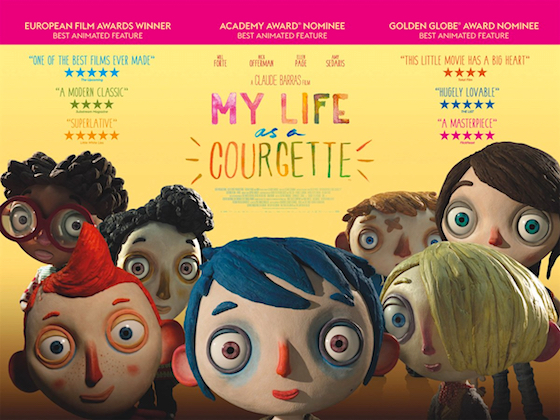
My Life as a Courgette (or, to use the American name for the vegetable, Zucchini) is the story of young lad Icare — who prefers to be called “Courgette”, his mother’s nickname for him — and his life after he is taken into an orphanage. If you’ve heard of it, it’s most likely because it was nominated for Best Animated Feature at the 2017 Oscars.

It’s adapted from the novel Autobiographie d’une Courgette by Gilles Paris, which was apparently a realistic portrayal of the lives of orphans in France. As you can see, the film takes a more cartoonish style, at least on the surface. In fact, the whimsical production design belies the very serious nature of the story — it’s not as monumentally grim as it could be, given the subject matter, but it doesn’t shy away from some very dark areas. It handles these with an understated, calm maturity that is both befitting and refreshing. The animation itself is equally sophisticated, with innumerable little touches that add finesse and richness to the work.

Orphaned

I watched the English dubbed version, because Amazon Prime gave me no choice (the original French version is available on Amazon Video, but for some reason not also included with Prime). Fortunately, despite having a US voice cast, they stuck with “Courgette”, meaning there’s no constant annoyance of the main character being called the wrong thing. (I do wonder, though: did they have to record it all twice, or did the American release rename the film My Life as a Zucchini but then call the kid Courgette anyway?) Fortunately, the dubbing wasn’t at all bad. Of particular note is Nick Offerman, giving a remarkable restrained performance as the gentle and kindly cop Raymond. As for Courgette and his fellow orphans, I don’t know if they cast actual kids or used adult soundalikes, but they also provided uniformly strong voice work.

My Life as a Courgette is one of those “weird foreign animations” that often manages an Oscar nod but doesn’t stand a snowball’s chance in Hell of winning thanks to the conservativeness of Oscar voters — there’s no way a mature, restrained animation with a quirky visual style is going to beat the latest shiny-CGI fun-time from Pixar or Disney. For those with broader tastes, however, it’s definitely worth a look.

4 out of 5

I Am Sartana, Your Angel of Death (1969)

aka Sono Sartana, il vostro becchino / Sartana the Gravedigger

2018 #169
Giuliano Carnimeo* | 103 mins | Blu-ray | 2.35:1 | Italy / English | 15

I Am Sartana, Your Angel of Death

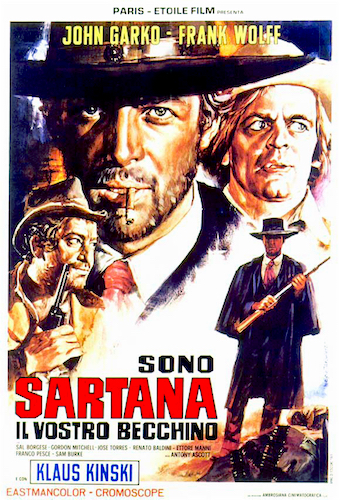
The second official movie to star Western antihero Sartana is, according to the blurb on Arrow’s Blu-ray release, “a more playful film than its predecessor, possessing an inventive visual style and developing its central character into a more creative and resourceful figure.” That’s bang on — and it’s a better film for it.

It starts with a bang, too: a bank robbery that turns into an action-packed shoot-out. The leader of the gang is posing as Sartana, which puts a price on our hero’s head. He sets about trying to prove his innocence and get his revenge, while three fellow bounty hunters set about trying to kill him.

Your Angel of Death is a lot slower paced than the non-stop action-fest of the first film, but that has its benefits: the plot is a lot clearer, and there’s more time invested in characters and non-violent set pieces (like Sartana’s card tricks), which I thought made for a more enjoyable watch overall. The storyline gives the film a “whodunnit” element, as the guy who framed Sartana is as much a mystery to us as it is to him. The film develops Sartana into a more interesting character, too, because his resourcefulness really comes out here. He doesn’t just shoot fast — he plans his strategy, uses objects as weapons in cunning ways, sometimes coming up with such things on the fly.

Sartana takes aim

Of the three men after Sartana, only the one played by Klaus Kinski gets any serious screen time. Kinski was a bankable actor in these kind of movies at the time, and so after his cameo-sized appearance in the first film he’s back here with a bigger role, as a somewhat camp bounty hunter. There’s a sort of running gag where he’s terrible at cards, and knows it, but can’t help playing anyway, which is quite fun. As for the other two hunters, one is used for a decent shootout-cum-chase sequence early on, but the third is introduced alongside the other two only to disappear entirely until the final duel, which makes the finale somewhat anticlimactic. One nice touch, though: Sartana clearly has a longstanding professional relationship with all three men — comrades in the bounty hunter game, or something like that — which adds an extra dimension to their encounters.

The other standout in the supporting cast is Frank Wolff as Buddy Ben. Sartana initially thinks Ben might’ve set him up, but he was in prison at the time. From there he takes on the role of Sartana’s sidekick, kinda — we’re still not quite sure if he’s to be trusted, which is a nice dynamic.

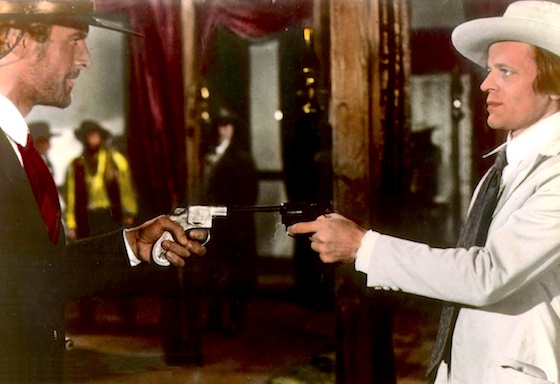
Barrel to barrel

Giuliano Carnimeo’s direction is less remarkable than Gianfranco Parolini’s work on the first film… or so I’m told: every review seems to mention it, as does Arrow’s booklet. There are some nice flourishes, however, with the most obvious being that almost anytime someone is shot the camera dramatically tips over sideways, mimicking their death. Apparently the film’s more humorous and ironic tone is in keeping with Carnimeo’s style, in contrast to the more straightforward action of Parolini, and that’s a positive in my book.

Your Angel of Death was a more enjoyable experience than the previous film, which was very welcome because (as I mentioned in my previous review) I’d been slightly concerned that taking a punt on this box set would turn out to be a mistake. (Well, there are still three more films to go, so we’ll see!) That said, although there’s a lot of inventiveness and fun, it’s to the film’s detriment that it often feels a little slow. My score errs on the harsh side, then, but to go the other way would be generous.

3 out of 5

* Credited as Anthony Ascott. ^

Seoul Station (2016)

aka Seoulyeok

2018 #184
Yeon Sang-ho | 92 mins | streaming (HD) | 1.85:1 | South Korea / Korean | 15

Seoul Station

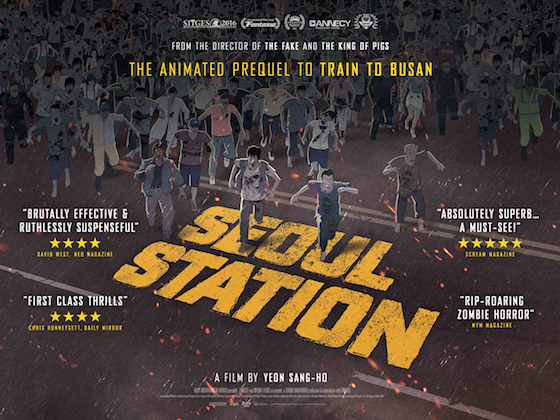
Before he made zombie masterpiece Train to Busan, director Yeon Sang-ho was an animation director with several features to his name. So perhaps it’s not surprising that, to accompany his aforementioned live-action debut, he also helmed this animated prequel.

Apparently set one day before the events of Busan (there’s no obvious indication on screen of how the films’ timelines line up), Seoul Station depicts events as the zombie outbreak expands at the titular transportation hub. Through this we follow Hye-sun (Shim Eun-kyung), a young runaway struggling to make ends meet living with her good-for-nothing boyfriend, Ki-woong (Lee Joon). Hye-sun’s father, Suk-gyu (Ryu Seung-ryong), has finally tracked her down, but arrives just after his daughter and Ki-woong have an argument and she runs off — and then the zombie thing happens. As Hye-sun struggles to escape the undead hordes, Ki-woong and Suk-gyu team up to search for her.

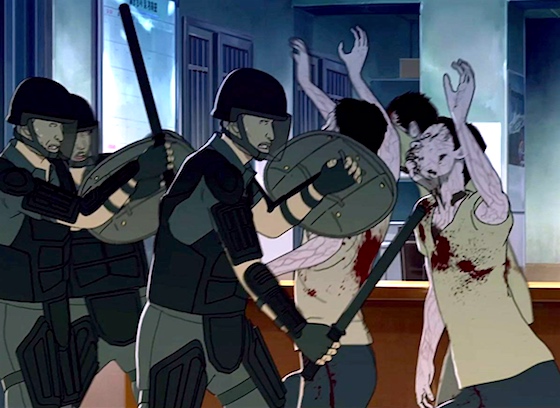
Like Train to Busan, then, Seoul Station revolves around a struggling father-daughter relationship — though this one’s of a very different sort. That’s apparent from the off, but to say too much more would be a last-act spoiler. Suffice to say, it all comes to a very dark, grim ending, with none of the redemption or hopefulness of the main film. It also continues the live-actioner’s theme of other humans being the real villains, with the actions of selfish cowards being as much a threat to survival as the flesh-eating monsters. It feels like Yeon is being critical of Korean culture, taking potshots at the treatment of the homeless, the uselessness of the police, and more. Most of that stuff plays universally, mind, but the film hardly connects with it in a meaningful way. For example, we see one homeless guy struggle to get help for his injured and dying brother, as person after person either refuses help or begrudgingly does the least they can. “They should do more,” the film implies. But if they had, what would change? In this scenario, nothing — the guy’s been infected by zombie-disease; they’d all wind up undead too and it would spread faster.

Police brutality

Half-assed social commentary aside, there are some really neat, original ideas in here, like a scene where Hye-sun must hold her nerve as she precariously tightrope-walks across the empty shell of a building, while behind her the mindless zombies throw themselves off the building onto the structure, their lack of dexterity leading most of them to plummet straight through it… but not all of them. Plus, as alluded above, there’s at least one solid twist. On the down side, it’s a bit slow — it takes 20 minutes for the zombie outbreak to start, for no particularly good reason; and though it mostly picks up after that, it occasionally loses focus again. The animation is of variable quality, too: some of it is very good, but at other times it feels kind of floaty, and there’s a very bizarre motion-blur effect applied to character movement.

Unlike Train to Busan, Seoul Station can’t quite coalesce its good ideas into anything more meaningful than a zombie thriller. Plus, the ultimate grimness of the finale feels almost mean-spirited and cruel rather than pointed. It’s not a bad zombie flick by any means, but there’s an even better movie waiting to be refined out of its best ideas, and so it’s not as transcendentally great as its live-action forebear.

3 out of 5

The UK TV premiere of Seoul Station is on Film4 tonight at 11:15pm.

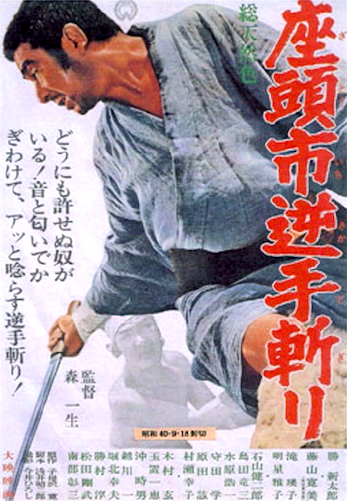
Zatoichi and the Doomed Man (1965)

aka Zatôichi sakate-giri

2018 #157
Kazuo Mori | 78 mins | Blu-ray | 2.35:1 | Japan / Japanese

Zatoichi and the Doomed Man

The eleventh film in the Zatoichi series is perhaps the first one that could legitimately be described as bad. It’s not outright terrible, but the plot doesn’t hold together very well, and there are only a couple of redeeming scenes.

The first of these is at the very start, when the film opens on the striking image of Ichi receiving lashes as punishment for an initially-unspecified crime. They seem almost a minor inconvenience to our hero, however, who is more concerned with questions he has for his punisher about this cellmate of the previous night. It turns out he was the eponymous “doomed man”: a fellow who’s been incarcerated on a murder charge, but claims he’s innocent, and urges Ichi to track down the gang bosses who can vouch for him. Uncharacteristically, Ichi resolves not to help, but fate has other plans…

That reliance on fate to marshal Ichi around led me to dub this Zatoichi and the Coincidental Coincidences of Coincidence. He’s constantly stumbling back onto the film’s plot even when he tries to avoid it, or bumping into the people he needs to find, or bumping into people who happen to be connected to other people he happens to know. It’s easily the most poorly-constructed story of the series so far. That’s not limited to its dependence on coincidence, either: half the stuff it sets up doesn’t even pay off or come together in a reasonable fashion. Although the initial “wrong man” setup is enticing, rather than do anything interesting or different with that, it just turns out to be the series’ usual: some bosses have betrayed the chap as part of a scheme to control the area. And to rub salt in the wound, we learn about this in a scene where one conspirator explains what they’ve already done to his co-conspirator. Oh dear.

Shenanigans

It’s a very slight story — not even enough to sustain the brief sub-80-minute running time, it would seem, as we’re ‘treated’ to an array of unrelated shenanigans. The primary one is a young man who starts following Ichi around, then later impersonates the famed blind masseur for financial gain — and, supposedly, for comic effect. He’s played by Kanbi Fujiyama, who (according to Chris D. in his notes accompanying Criterion’s release) “was a noted funnyman in mid-to-late-sixties Japan, appearing in sidekick roles in many of Toei studios’ ninkyo (chivalrous) yakuza films.” Reading other reviews, a lot of people seem to find his schtick hilarious, but I thought he was the most irritating comic relief character the series has yet foisted upon us — and he’s basically the co-lead of this instalment, so we get to see far too much of him. He eventually turns out to have a connection to the main plot too, which is emblematic of the whole movie: the connection is a complete coincidence, dumped on us via random exposition late in the game, and then not paid off in any way. It’s entirely pointless. At one point he disappears from the film entirely. Due to how it was handled, I began to wonder if we were meant to infer he’d died off screen. But then he turns up again in the epilogue, as it merely to confirm that wasn’t the case.

That stands in opposition to the film’s main plot — you know, the titular one about the “doomed man” — which is resolved offscreen while Ichi’s already going on his merry way. It’s just one aspect that feels rushed (despite the short running time and ‘comedy’ distractions), or as if scenes were deleted. This is particularly noticeable as it pertains to the female interest, Oyone (Eiko Taki). Ichi rescues her thanks to a little trick she pulls, but then she seems ungratefully indifferent to him… until she’s suddenly hanging around near the end, hoping (as the women in these films always do) that he won’t run off while her back’s turned. Which is exactly what he does, of course.

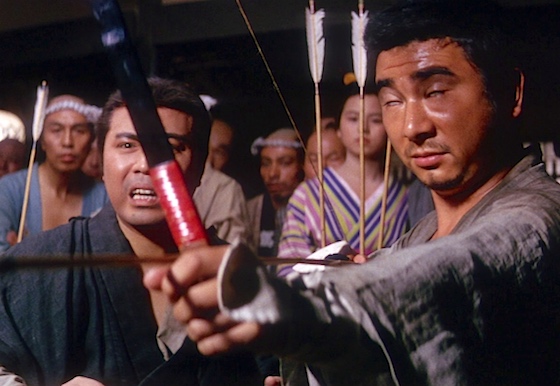
Zatoichi with the doomed man

You may remember I said there were some good bits. One is the pre-titles, which I already partly discussed. They’re effective thanks to some strong photography from Hiroshi Imai and the way they flip around with our expectations to create mystery (even if the reason Ichi’s receiving those lashings is completely irrelevant to the rest of the film). The other is the finale. As usual, the movie climaxes with Ichi having to take on an army of goons single-handed, but this one adds some spice with a seaside location, strewn with fishing nets (which get brought into the action) and covered with an early morning sea mist. It’s also beautifully shot, and there’s nicely choreographed combat. It’s easily the highlight of the film.

Other reviewers are not so harsh on The Doomed Man, going so far as to call it a “fine entry” in the series, or “thoughtful [and] hilarious”. And yet, those reviews can’t seem to help spotting the flaws in spite of themselves. Walter Biggins’ review at Quiet Bubble is a series of questions about why the film is so poor, with the last query being the most baffling of all: “why, despite all this opacity all my questions, did I end up liking this movie so much?” I’ve no idea, mate. Several other reviews make comments along the lines of, “Ichi behaves uncharacteristically here, but there must be a good reason for that” — or it’s just crappy, inconsistent writing. At least Letterboxd users agree with me: it’s ranked 24th out of the main series’ 25 films (the only one lower is the 23rd film, Zatoichi at Large — which, incidentally, is by the same director).

“Here's the end of the plot — go give it to someone and get this over with!”

For me, The Doomed Man is by a clear margin the weakest Zatoichi film so far. As nowadays I very much look forward to my regular appointments with Ichi, being so underwhelmed left me feeling disappointed: it wasn’t worth the wait since the last film, nor was it really enough to tide me over until the next one. For those reasons I considered giving it a lowly two stars, but that felt a bit harsh: it certainly isn’t without merit (the climactic fight is a stunner), and it’s always nice to spend time in Ichi’s company, even if he is being inconsistently written. Nonetheless, it only earns that third star by the skin of its teeth. This is a “for completists only” instalment.

3 out of 5