
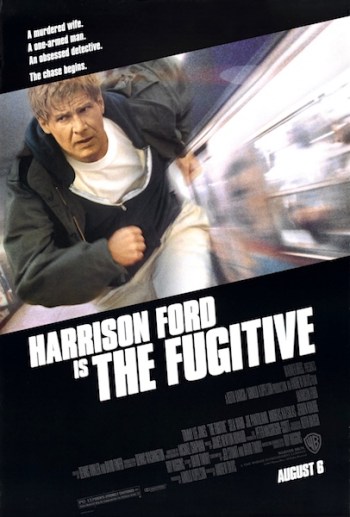
A one-armed man.
An obsessed detective.
The chase begins.
Country: USA
Language: English
Runtime: 130 minutes
BBFC: 12 (cinema, 1993) | 15 (video, 1994)
MPAA: PG-13

Original Release: 6th August 1993 (USA)
UK Release: 24th September 1993
Budget: $44 million
Worldwide Gross: $368.9 million
Stars
Harrison Ford (Witness, Air Force One)
Tommy Lee Jones (JFK, No Country for Old Men)
Sela Ward (54, Independence Day: Resurgence)
Joe Pantoliano (Risky Business, The Matrix)
Director
Andrew Davis (Under Siege, Holes)
Screenwriters
Jeb Stuart (Die Hard, Fire Down Below)
David Twohy (Waterworld, Pitch Black)
Story by
David Twohy (G.I. Jane, Riddick)
Based on
The Fugitive, a TV series created by Roy Huggins.
The Story
After Dr. Richard Kimble’s wife is murdered, he is framed for the crime. Managing to escape custody, Kimble sets out to prove his innocence, while being pursued by a team of marshals intent on recapturing the fugitive.
Our Hero
Dr. Richard Kimble, respected surgeon, convicted of killing his wife, a crime he didn’t commit. When an accident on his way to prison allows me to break free, he goes on the run to clear his name.
Our Villain
The mysterious one-armed man who did kill Mrs Kimble. Why did he do it? Why can’t he be found?
Best Supporting Character
U.S. Marshal Samuel Gerard is the big dog on Kimble’s trail after he escapes custody. He just aims to bring the doctor back in, but maybe his sense of justice will ultimately prevail…
Memorable Quote
Kimble: “I didn’t kill my wife!”
Gerard: “I don’t care!”
Memorable Scene
Kimble runs through drainage tunnels, pursued by Gerard, when he suddenly reaches the outlet — a massive drop over a dam. Gerard approaches, gun raised, his man cornered, Kimble left with no escape route — except to jump…
Truly Special Effect
The famous bus/train crash was done for real with a real train and a real bus on a real track, because that was actually cheaper than doing it with miniatures! The scale of the setup meant it could only be done once, so it was shot with multiple cameras — several of which were destroyed and their footage rendered unusable. Conversely, a couple of others were caught up in the crash but continued rolling. Although it may’ve been driven by cost-saving, the fact it was done for real makes it all the more effective, one of cinema’s iconic stunts.
Letting the Side Down
Despite years in development that created literally dozens of drafts, filming began without a completed screenplay — and sometimes it shows. Just don’t try to think through the logic of the villains’ nefarious scheme, nor wonder why the supposedly super-smart marshals never twig that maybe Kimble is investigating his wife’s murder.
Making of
The sequence in the St Patrick’s Day parade was conceived by director Andrew Davis late in the day — so late that it wasn’t part of the shooting schedule and there wasn’t time to plan it. On the day, the cast and crew made an early start so they could complete all of the schedule material before heading over to the parade. Shooting with a Steadicam, the director, cast, and cameraman improvised the action and shot it more-or-less in real-time.
Next time…
Five years later, Tommy Lee Jones reprised his Oscar-winning supporting performance as the lead in U.S. Marshals. It wasn’t as successful. Personally, I didn’t realise it was a sequel for years and have never bothered to see it.
Awards
1 Oscar (Supporting Actor (Tommy Lee Jones))
6 Oscar nominations (Picture, Cinematography, Sound, Editing, Sound Effects Editing, Score)
1 BAFTA (Sound)
3 BAFTA nominations (Supporting Actor (Tommy Lee Jones), Editing, Special Effects)
2 MTV Movie Awards (On-Screen Duo (Harrison Ford & Tommy Lee Jones), Action Sequence (train wreck))
2 MTV Movie Award nominations (Movie, Male Performance (Harrison Ford))
It must be at least 20 years since I last watched The Fugitive (it turns 25 next year), and it’s an interesting experience to revisit it today. Once upon a time this was a blockbuster; nowadays it’d be a mid-budget thriller… and probably wouldn’t get made because Hollywood doesn’t do those anymore. It’s a pleasingly ’90s manhunt movie — they can’t just track his mobile phone or zoom in with a satellite or what have you — but, aside from the nostalgia kick, the quality is a bit wobbly at times. It has strong performances, a breakneck pace (at least early on), and some stunning sequences, but the behind-the-scenes story of many, many drafts and a rushed schedule occasionally leave their mark on the screen, mainly in that the film’s whodunnit mystery isn’t all that engrossing or surprising. Maybe I’m just being nitpicky — it’s still a quality thriller. (The Blu-ray is a real dog, though. Could definitely do with a remaster.)












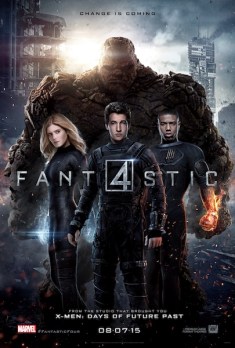 Sometimes you just have to see what all the fuss is about, even if that fuss is overwhelmingly negative. Obviously that’s the case with the most recent attempt to bring Marvel’s popular “first family” to the big screen. The behind-the-scenes stories are already the stuff of movieland legend, so I won’t repeat them here, but what of the film itself? Or the version that ended up available for public consumption, anyway.
 and serve as new pieces — like a shattered mug that’s been reassembled with lashings of superglue and using a handle from another vessel, which has inexplicably wound up a slightly different size and shape to how it used to be. Considering the studio got cold feet and insisted on massive reshoots, this is quite possibly exactly what happened.
 Fox like to keep their superhero movies Serious and Dark — and why not? Before this, it had worked pretty well for them across seven X-Men movies, while their colourful-and-cheery
 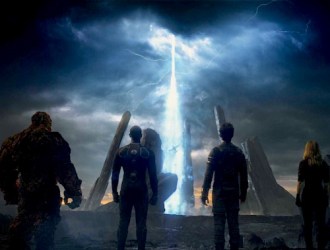 What could have been a comfortable 3-star movie, maybe even 4 if it followed through well enough, is dragged down to 2 by studio meddling. Will they never learn? Nonetheless, I actually enjoyed enough of Fantastic Four that, while it won’t be going on the long-list of contenders for the best movies I’ve seen this year, I won’t be putting it on the list for the worst either.
 When this TV movie kicks off with Ivy Levan sashaying her way around a cinema while she mimes to a pre-recorded and over-produced backing track of Science Fiction/Double Feature, full of licks and runs and finding four notes to hit where there used to be one, like a desperate X Factor wannabe who has no concept of the meaning of the lyrics she’s warbling but is ever so desperate to show she can saaang (that’s like singing but with added Cool), you get a pretty fair idea of the terrible experience about to be unleashed upon you by the not-so-catchily titled The Rocky Horror Picture Show: Let’s Do the Time Warp Again. That’s to say it’s been modernised, Americanised, and sanitised.
 The interpretation of the songs is appalling. The recordings are all overworked, full of needless warbles and added “oohs”. They’ve been modernised in such a way that, when current popular fads for over-singing things (“licks” or “runs” or whatever else they call them) have passed — as they surely will — these new versions will sound even more dated than the already-40-year-old originals, which have a certain timelessness. The lyrics are sung with the same amount of attention to what they mean as you get from a computer’s text-to-speech function, including or echoing parts of the original without understanding why they’re there or what function they perform; or if it does know the function, it doesn’t know how to replicate it.
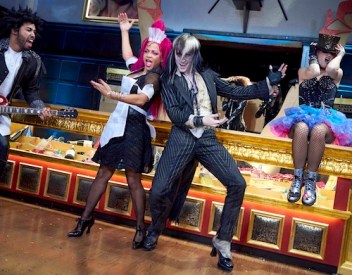 Everything is blunted further by Kenny Ortega’s ineffective direction. The camerawork is flat and uninteresting, the shot choices unimaginative. Some of the choreography looks interesting — it’s certainly more elaborate than in the original film — but the camerawork seems to be actively trying to obscure it. The editor must have struggled, unable to generate any additional excitement due to a shortage of options. At times it looks as if it was filmed live, under which circumstances its weaknesses might be understandable, if not excusable… but it wasn’t.
 I refer partly to her omnipresent cleavage, but also her acting. It’s not great by any means, but she’s suitably sweet and twee at the start, then manages to sell Janet’s near-instantaneous transformation from uptight goody-two-shoes to sex-mad strumpet using just a handful of expressions and line deliveries in the slight gap her character has between Over at the Frankenstein Place and Touch-a Touch-a Touch Me. The latter is one of the film’s rare highlights, for various reasons. One of those is actually Staz Nair as Rocky — undoubtedly the least challenging role in the piece, but at least he gets it right, and his musclebound chest counterbalances Justice’s for those of the other persuasion. The only downside are his tattoos: he was supposedly just grown in a tank, how does he have tattoos?!
 100Films.co.uk