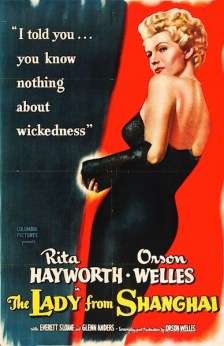
The Lady from Shanghai (1947)

2009 #37
Orson Welles | 84 mins | TV | PG

The Lady from ShanghaiThe Lady from Shanghai is an Orson Welles film… which means his original 155-minute cut was forcibly cut down by over an hour, the studio insisted he include more beauty shots of Rita Hayworth, as well as a song for her to sing, and the temp score he provided to the composer was ignored in favour of something Welles hated. Yet for all that — not to mention Welles’ distractingly atrocious Irish accent — it’s still a highly enjoyable film.

The plot is thoroughly noirish and offers up its fair share of twists along the way, while the performances are able if largely not particularly memorable. The exception to this is Glenn Anders, giving a gloriously unhinged performance as Grisby, drawling his vowels with high-pitched lunacy. Though Welles was heavily criticised for cutting and dying Hayworth’s hair — to the extent that some blamed it for the film’s box office failure — it hardly matters (I thought she looked better anyway), and the enforced beauty shots actually work thematically toward the conclusion.

Even more attractive are the skills Welles brings directorially, on display throughout. Every key sequence provides something genuinely worth looking at while still relating the intricate plot, though the cruise offers many of the best bits — the hot, sweaty foreign climes are conveyed brilliantly, aided by sumptuous location photography, and these sunny scenes contrast nicely with the noir plot. Mention must also be made of the the famous finale in the Hall of Mirrors, a precisely shot sequence that provides a fitting close. Elsewhere, Welles’ sense of humour is pleasingly present, lending the trial scenes in particular a distinctive style that brings some ever-welcome variety.

Brisk (at under an hour-and-a-half) but engagingly complex, and rarely less than beautifully shot, The Lady from Shanghai may be a compromised version of Welles’ intentions, but his undeniable ability (at directing, not accents) means it remains a compelling film noir.

4 out of 5

The Lady from Shanghai is showing on BBC Four at 10pm on Saturday 22nd August as part of a Film Noir Weekend. See this post at From the Cheap Seats for more details.

Stand By Me (1986)

2009 #29
Rob Reiner | 89 mins | download | 15 / R

Stand By MeStand By Me is a film an awful lot of people love an awful lot, which it always seemed to me was down to first seeing it at the right age (more or less the age of the main characters, I think) and possibly to being part of a certain generation — would it have the same effect for kids today, when the relative innocence and freedom of the ’50s is arguably lost? As I say, “seemed”, because now I’m not sure either of these factors really matter.

Irrespective of age, generation, or being able to remember the kinds of experiences suggested by the film, Stand By Me is still an effective and affecting little film. The level of enjoyment for some may depend on how much they can stomach child actors, though as kids go they’re mostly very good. River Phoenix in particular is brilliant, highly natural while bringing a lot of depth to perhaps the most important role. Wil Wheaton also makes a good account of himself, just one year before attracting derision as Wesley Crusher in Star Trek: The Next Generation. (Phoenix, of course, went on to have a tragically short-lived career.) Kiefer Sutherland is as effective a villain as he ever would be, though that aspect of the plot is almost an aside.

An aside, because the film isn’t about the fights between the young heroes and a group of older bullies. Rather, it’s a paean for childhood, with the adult perspective and the ‘lost age’ setting of the ’50s succinctly highlighting the nostalgic spirit. To be precise, it’s not so much reflecting on “childhood” as on “growing up” — the choices that are open when young that either disappear with time or, for whatever reason, become closed off. The whole film is arguably about choice: choice of friends, choice of social class, Ace’s constant listing of choices (the subtext breaking into the text, as many a film teacher would point out), even the obvious choice whether to follow the tracks or take shortcuts (surely symbolic). Thematically, it’s the choice to be put down or stand up for yourself; the choice to stick around and wind up a nobody or work hard and get out, also underlined in the present-day bookends.

Perhaps being the right age is helpful to a love for Stand By Me, but at any stage in life it’s easy to relate to its depiction of the experiences and choices of childhood, be they now lost, taken, or never even had.

4 out of 5

Stand By Me is on Channel 5 today, Sunday 12th October 2014, at 2pm.

The Man in the Iron Mask (1998)

2009 #30
Randall Wallace | 132 mins | download | 12 / PG-13

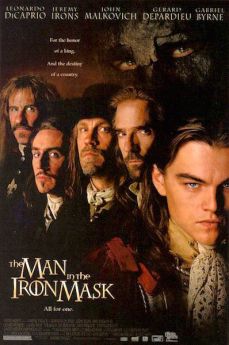
The Man in the Iron MaskFrom the off it’s clear that The Man in the Iron Mask is not going to go well. It’s an adaptation of a tale of the Three Musketeers, so naturally is set in historical Paris… where everyone has a different accent and very few of them are French. It is, to be blunt, a horrid mishmash — much like the whole film.

Wordy political intrigue tries to coexist with broad comedy which is squashed against swashbuckling adventure. The latter two could co-exist, but the film feels like it wants to be the former and so suffers for it. The comedy jars too much to be effective, while instances of unintentional comedy unfortunately provoke more frequent laughs. It should at least be able to swash buckles effectively — these are the Three Musketeers after all — but entirely fails to achieve this until the climax. The plot, semi-faithfully adapted from one of Alexandre Dumas’ original novels, offers a level of complexity to which the film clearly aspires, but the adaptation and acting struggle to match it.

The majority of performances are marred by overacting — John Malkovich, especially, is woefully miscast, while Leonardo DiCaprio doesn’t appear to give a particularly good performance as either Louis or Philippe. In DiCaprio’s defence I suspect this is actually the script’s fault, because he manages to clearly differentiate the two when they are silent or pretending to be the other — it’s when they open their mouths that it all goes wrong. Gérard Depardieu is fine as the comic relief, though that relief is tonally misplaced, while Gabriel Byrne makes an interesting d’Artagnan — there’s nothing at all wrong with him, and yet he doesn’t feel quite right. Which leaves just Jeremy Irons among the main cast. He fares the best of the lot, even getting the occasional scene or speech that is genuinely quite good, though it’s clear he is far better than the material. To be fair, the same is also true of everyone else.

For all this, The Man in the Iron Mask is more disappointing then bad. The Bastille-set climax is occasionally brilliant and never less than entertaining, delivering on the film’s swashbuckling promise in a copious fashion. Throughout, there’s the occasional good scene — or even just a decent line of dialogue — and you can briefly understand what inspired such quality actors to sign on.

Something went wrong somewhere though, and the obvious culprit must be writer/director Randall Wallace. The story’s good, but that’s Dumas’, while the adaptation’s weak — and that’s Wallace’s. The actor’s are good, but battle the poor script — and that, obviously, is Wallace’s. They don’t seem to have been given any significant direction, they’re not helped by an uneven tone, and even the cinematography falls short, failing to make the spectacular locations and costumes look suitably beautiful on screen — and we know who’s ultimately in charge of all that too.

The Man in the Iron Mask desperately wants to be better than it is — it’s a great tale, packed with politics and swashbuckling, and this particular version has the high calibre cast to pull it off. But both are left floundering by a writer/director who isn’t up to either task — poor dialogue, a gyratingly uneven tone and lacklustre direction abound. A missed opportunity, and all the more disappointing for it.

2 out of 5

Glory (1989)

2009 #28
Edward Zwick | 117 mins | DVD | 15 / R

GloryEd Zwick seems to like war. More accurately, Zwick likes making films about war, but clearly isn’t a fan of the act itself. Since gaining attention with multi Oscar-winner Glory, about the first black regiment during the American Civil War, he’s directed a number of films concerned with wars and those that fight them: Courage Under Fire (“Army officer investigates female chopper commander’s worthiness for the Medal of Honor”), The Siege (“a wave of terrorist attacks in New York lead to the declaration of martial law”), The Last Samurai (“American military advisor embraces the Samurai culture he was hired to destroy”), Blood Diamond (a group of people battle for a diamond during the war in Sierra Leone), and most recently Defiance (“Jewish brothers in Nazi-occupied Eastern Europe escape into the forests”). Whatever the reasons for Zwick’s preoccupation, he certainly has a talent for it.

In Glory, Zwick is helped by a story that’s definitely worth telling, one which I imagine seemed even more pertinent on its original release, when Nelson Mandela was still in prison and the state of race relations in the US would contribute to riots in Los Angeles inside of 18 months. Still, it would be easy to slide into Issue of the Week melodrama in handling such a tale, but Zwick manages it without undue sentiment — there’s an appropriate realisation of the importance of events, perhaps even occasional reverence, but time is taken to show doubts and prejudices. It may get too sentimental for some tastes toward the end, but considering the importance of the story I don’t think it’s unwarranted or overplayed.

Similarly, most of the hero characters are less than perfect, with Matthew Broderick’s Colonel of particular note as a conflicted and initially cowardly commanding officer, more concerned with propriety than what is right — until he’s led to a change of heart, of course. His is just one of several excellent performances: Morgan Freeman does what Morgan Freeman does best as the Authoritative Elder, while Denzel Washington’s angry young man justifiably earnt him his first Oscar. The wider supporting cast hold their own against these leads, particularly Andre Braugher as the idealistic but ultimately unsuited volunteer Thomas Searles.

The handful of battle sequences are effectively staged, suitably tense and brutal, though these are really ancillary — the regiment only engaged in conflict a couple of times and so, appropriately, actual fighting makes up a relatively slender portion of the film. The unfamiliarity of the story helps keep things tense both in and out of battle — for obvious reasons, the majority of battles depicted on film are famous ones, often because of their outcome, so it makes for an agreeable change to not know where events will lead.

These elements all blend to create a film that is, at the very least, the sum of its parts: a significant historical story with strong performances and a convincing depiction of war, which negotiates the thin lines that surround sentiment and reverence. Zwick may not be a fan of war, but he certainly knows how to put its stories on film.

5 out of 5

Solaris (2002)

2009 #13
Steven Soderbergh | 94 mins | DVD | 12 / PG-13

SolarisWhen Andrei Tarkovsky adapted Stanislaw Lem’s thoughtful science fiction novel in 1972, it took 165 minutes. When Steven Soderbergh did it 30 years later, it took just over 90. Lem hated them both, stating that he didn’t write about people’s “erotic problems in space”, but for those concerned with what the film is about rather than what it (perhaps) should have been about, it seems that an abbreviated running time is no barrier to loading any adaptation of Solaris with a weighty thoughtfulness.

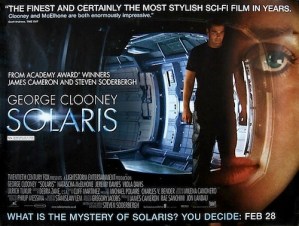
Everyone knows Solaris is a sci-fi film — the title sounds that way, for one thing, and George Clooney in a space helmet on the cover certainly does the rest. It’s a shame that’s so well known, because if one came to this version cold it would take a good few minutes before there was any inkling it wasn’t just a drama. The underplaying of the scientific elements may have angered Lem, but Soderbergh uses them to create a backdrop to the emotional story he wants to tell — Solaris the sentient planet was the point of the novel, as far as Lem was concerned, whereas to Soderbergh it’s a device to explore relationships and grief.

In doing this the film merrily mixes genres: it looks very much like it’s Science Fiction, all futuristic TVs and space station settings, and there are a few scientific concepts touched on; but it’s also a Romance, occasionally; and a Drama about coping with death, amongst other things; and an ‘arthouse’ film about notions of God and memory and reality and humanity; and there’s a huge chunk of Mystery in what the hell is going on; and there are a couple of moments that wouldn’t be out of place in a Horror film… About the only conventions Soderbergh doesn’t bother with belong to Action-Adventure, which as the normal stomping ground of big-name sci-fi certainly makes for a change.

It’s likely this that explains its low rating on IMDb and the like. A slow pace and obtuse storytelling that leaves plenty of gaps for the audience to fill is not the experience implied by an advertising campaign showing a Space Movie starring Movie Star Heartthrob George Clooney. Obviously it doesn’t fulfill these expectations, and will likely have still been too slow and difficult for even more viewers. (As it makes for a slow hour-and-a-half, I wonder how they would feel if told there’s a version over an hour longer.) The question is, does it also deserve such a low rating from those ‘clever’ or accepting enough to ‘get’ it? That depends on your perspective. It’s either Deep and Meaningful, or a bit Pretentious and Pointless. In this respect it’s highly reminiscent of The Fountain (or, rather, The Fountain is reminiscent of Solaris) — an unusual sci-fi/romance angle, slow pace, and ambiguous to the last. As one character says, “there are no answers, only choices.”

Soderbergh’s direction, plus the performances of Clooney and Natasha McElhone on which the film relies, do have the power to hold you, but only if you’re prepared for — and, more importantly, open to — the sort of experience Solaris offers. Undoubtedly not for everyone.

4 out of 5

Insomnia (2002)

2009 #33
Christopher Nolan | 113 mins | DVD | 15 / R

This review contains minor spoilers.

The Dark KnightBetween becoming a Geek God with Batman Begins and The Dark Knight and coming to everyone’s attention with a stunning more-or-less-debut that managed to elbow itself right up into the IMDb Top 10 (that’d be Memento — obviously, it’s slipped since), Christopher Nolan directed this: an American remake of a Norwegian police thriller, and the only one of Nolan’s five major films not to be on that be-all of film quality, the IMDb Top 250 (the fifth is of course The Prestige, while Begins is the lowest at #106.) So is Insomnia a forgotten classic robbed of a spot, or just a footnote to the rest of Nolan’s superb career?

These days, there’s a murder mystery/thriller on the TV most weeks — heck, most days thanks to the abundance of repeat-laden digital channels — and so a film attempting one can’t just settle for the usual array of clues, suspects, interviews and twists. Insomnia looks like it’s heading down this road early on — an interview with the victim’s boyfriend in particular could easily slot into any episode of Midsomer Murders or what have you — but soon does what’s required of any film entering this territory these days: it provides more. Most obviously, despite the early plot and stylistic conventions, this is not a “whodunnit”: the killer’s identity is revealed around the halfway mark (assuming you haven’t already guessed it from the opening credits) and from then on the film gradually moves into murky moral territory, quickly leaving behind those early trappings for a set of more complex noir-ish moral conundrums.

Al Pacino’s detective, for example, is a man under pressure — not just from the case, nor the usual clichés of a messy divorce or alcoholism, but from a pending Internal Affairs investigation that may or may not be justified, and an incurable bout of insomnia brought on by the Alaskan summer’s lack of night. The pressure mounts, he makes bad decisions (which I won’t spoil here), and even if the use of these plot points was merely that they occurred it would have offered something above the norm. Hillary Seitz’s screenplay pushes it further however, digging far deeper than usual for the genre into debates about the morals of police work, what seems acceptable and what is acceptable, and perhaps even what should be acceptable. The ending may seem to offer a Hollywoodised “everything’s set right then” denouement, but while it’s true that the plot is neatly resolved the considerations raised are not so easily ignored.

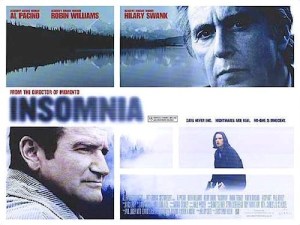
Cast-wise Insomnia fares pretty well. When it was released, around the same time as the excellent One Hour Photo, everyone was amazed at Robin Williams turning in a pair of non-comedic performances. The quality of them both makes it seem only natural now however, leaving that amazement as a distant memory. His turn as novelist Walter Finch here may owe something to Kevin Spacey’s John Doe in Se7en — indeed, Nolan seems to explicitly reference that film in locations such as the corridor of Finch’s apartment building — but isn’t as lowly as an impersonation. Hilary Swank offers able support as wide-eyed young cop Ellie Burr, while Pacino does a good job portraying the confusion induced by lack of sleep, aided by some effective camerawork, editing and sound design.

In the end, the main damage done to Insomnia is inadvertently by its director: while it is undoubtedly above average for a murder mystery/thriller, its relative straightforwardness pales in comparison to the work Nolan’s done before and since. However, as with every Nolan film so far, I found my perceived enjoyment increase the more I’ve thought about it since. It may not be objectionable that Insomnia hasn’t made it onto that IMDb list then, but if it is a footnote to Nolan’s career it’s a significant and enjoyable one.

4 out of 5

BBC One are showing Insomnia tonight at 10:45pm.

In Bruges (2008)

2009 #22
Martin McDonagh | 102 mins | TV | 18 / R

This review contains minor spoilers.

In BrugesIn Bruges has gathered quite a bit of indie-level praise and acclaim, culminating in wider recognition at the Oscars and other awards ceremonies at the start of this year. For those like me, finally getting round to seeing it in the wake of all this, it comes with quite a burden of expectation on its shoulders. Can it possibly be the modern classic many make it out to be? I mean, it is set in, y’know, Bruges…

First and (perhaps) foremost, In Bruges is hilariously funny, much more so than most by-the-numbers ‘comedy’ films can manage. The easily-offended might disagree, and some jokes are a tad too obvious (Americans are fat! Fat people can’t climb tight stairs!), but it’s nice to genuinely laugh at a film rather than force the odd smirk so as to at least get something from an otherwise wasted 90 minutes. It’s also dark and occasionally tragic though, and in this respect it’s unsurprising that writer/director McDonagh started out as an acclaimed and award-winning playwright, as stage plays mix humour and darkness more frequently (and with wider extremes) than films ever dare to. His theatrical roots also go some way to explaining the amount and ferocity of the swearing (again, something plays are more prepared to indulge in), but so too the brilliance of the dialogue. That it takes a playwright to craft such a good film is perhaps an irony, but not a troubling one.

Good dialogue is wasted without a good cast however, and thankfully everyone here gives a fantastic performance. The standout is Colin Farrell as hitman Ray. He initially seems a confident, cocky, experienced young hitman, and therefore verges dangerously close to stereotype, but we soon realise he’s actually twitchy, nervous, insecure, and genuinely sorry for the sole act of violence he committed. It might look like a Black Comedy With Nasty Violence to some — certainly, there are reviews that suggest some viewers are incapable of seeing anything beyond that — but there’s a lot more depth in the characters than the surface would suggest. Brendan Gleeson and Ralph Fiennes give consummate supporting performances, like Farrell chipping away at the stereotyped facades to find the hidden facets that the script is kind enough to reveal.

The quality of McDonagh’s writing (and direction) doesn’t stop with character and dialogue. The story is thematically considered, with a variety of paintings and associated imagery to occupy those who might be interested. Events are beautifully tied together and, best of all, none of the early scenes feel oddly inserted or have that nagging sense that they’re merely an excuse for something to be there later — everything works first time, and then has a seamless payoff too. Some viewers have criticised the ending, but I suspect they’re largely more used to mainstream fare and viewers who have ever enjoyed an indie film won’t bat an eyelid. All in, it’s easy to see why the screenplay has become the film’s prime awards nominee and winner.

Nominations, wins and buzz weigh heavy, but In Bruges has shoulders broad enough to carry such expectation with ease. “There’s never been a classic movie made in Bruges,” one character truthfully espouses, “until now.” It seems she couldn’t’ve been more right.

5 out of 5

In Bruges placed 2nd on my list of The Ten Best Films I Saw For the First Time in 2009, which can be read in full here.

Watchmen (2009)

2009 #9
Zack Snyder | 162 mins | cinema | 18 / R

This review contains major spoilers.
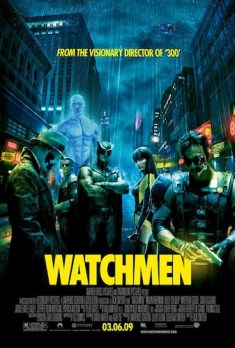
Watchmen didn’t flop. Let’s get that out of the way.

Did it do less business than expected? Yes. Were expectations unreasonably high? Unquestionably. After the barnstorming success of The Dark Knight I think some expected a repeat run, but they forgot that while TDK was dark, it still had clear heroes, clear villains, a massively popular franchise and — let’s be honest — a highly-publicised, highly-acclaimed final performance from a certain tragic young actor. Watchmen, by comparison, is densely plotted, morally ambiguous, a tad on the long side, with unknown characters, an unclear story (in the marketing at least) and no mass recognition. And it was rated R. All this considered, it did phenomenally well, and at the end of the day it’s WB’s fault for spending $150m on something that, realistically speaking, wasn’t going to make that back on opening weekend.

But this isn’t meant to be a rant about the box office. Now that the dust has settled somewhat from the initial flurry of reviews — which on the whole seemed to either hail it as an instant classic or an unrelenting mess (though some more reasonable ones found the middle ground) — and with the dubiously-featured UK DVD and Blu-ray releases just announced, it seems about time to add a few of my thoughts to the already-overflowing mix. In doing this I find it impossible to fully divorce myself from the fact that I’m a fan of the book, so can only really view this adaptation from that perspective; just as I think anyone who’s read the book can’t truly imagine quite how a non-reader will take this, whatever they may claim. The only people who can do that are people who haven’t read the book, and there have been plenty of those reviews around too.

But even as a fan, my opinions are not as predetermined as some might think. Watchmen is incredibly faithful to its source material (some notable tweaks and omissions aside), but while some have loved it for this, others have viewed it as weak or pointless. Perhaps some of the complaints about faithfulness stem from the fact that we’re actually unused to seeing faithful superhero adaptations — “adaptations” being the operative word. Across seven Batmans, five Supermans, four X-Mens, three Spider-Mans, two Hulks, and countless others, how many actually adapt a specific book? Most, if not all, develop their own story around the notion of the character(s), or take some degree of inspiration from various storylines, tailoring a new tale for the different medium (well, theoretically). In choosing to adapt the source rather than make a film starring the same characters, Watchmen places itself more in line with other literary adaptations than other superhero movies. Some would argue this context still renders it more of a Da Vinci Code than a Godfather, but it’s perhaps still appropriate to debate that rather than if it’s more a Hulk than a Dark Knight.

The consistent faithfulness is a bit of a mixed bag. For much of the film it’s a great story well re-told, and its climax actually manages to improve on the original’s to the extent that, if Alan Moore ever actually watched it (which he won’t), I’d like to think he’d be man enough to admit that this one change at least was an improvement. Similarly, in the novel I wasn’t convinced Rorschach’s final moments made sense — it seemed out of character. On screen, however, Jackie Earle Haley completely sells it, his final scream becoming one of the film’s most memorable moments. Other elements are retained with no thought, however: the intercutting of Dan and Laurie’s alley fight with Dr Manhattan’s press conference is an effective (if blunt) sequence in the novel, but on screen makes little sense — even though I know the story and know the events of both scenes, this choice left me struggling to follow events. Even worse, the sudden and unexplained presence of Ozymandias’ pet big cat is almost baffling to a viewer familiar with the source, and so I can only imagine how little sense Bubastis must make to a new viewer. Consequently, his demise has no emotional weight.

The final scene is a bit of a misstep as well. In the book it’s a perfect little coda, beautifully ambiguous and tied to several of the novel’s themes. On screen, Snyder overplays it, allowing it to drag on with pointless dialogue and leaving the point of the scene feeling forced — equally a fault of David Hayter and Alex Tse’s script, then. Part of the problem is that it’s lumbered with introducing a subplot and its characters for the sake of the payoff, both of which develop slowly and appropriately in the novel. The details of that particular subplot are not the only elements that are missed from the original: the novel contains a lot of details of street life in Manhattan, for example, which makes the city’s ultimate destruction more personal for the reader. Some of these scenes have been filmed and, knowing that an aptly-titled (for once) Director’s Cut is on the way, it’s at times hard not to view the theatrically-released Watchmen as an abridged version. While it is still more complex than some critics (both pro and fan) give it credit for, the missing nuances and subplots would strengthen the whole experience. We can but hope it’s these that the Director’s Cut will include, rather than just a collection of completist-pleasing trims.

It’s easy to complain about Watchmen — clearly — but, actually, I really enjoyed it. Snyder has arguably created a live-action version of the graphic novel rather than creating a film in its own right, but is that really a bad thing? It’s what many literary adaptations aspire to, the only difference here is there were already some pictures to directly transfer. Some will disagree, and if you do then this is a perfect argument for why Non-Fans should be in charge of film adaptions — Fans are too concerned with pleasing other Fans, in this case being rigorously faithful; Non-Fans often just want to make the best movie possible based on the source material, rather than making the best translation (or, perhaps, re-appropriation). Perhaps it’s too fine a line to walk; perhaps Snyder was too afraid to change anything; or perhaps it’s just a case of damned if you do (“it’s exactly the same, what’s the point?”) and damned if you don’t (“he changed too much, it’s not Watchmen!”).

In their faithfulness, Snyder, Hayter and Tse retain much of the story and character elements that made the original great. If the aim was to take the page and put it on screen, the screenplay is near flawless, embellishing some moments and even fixing others, while excising subplots so wisely I didn’t miss much. As stated, however, the definitive cut is surely the forthcoming one. As for Snyder’s direction, he mostly does a good job, recreating iconic panels — occasionally with too much reverence, true — but enlivening other sequences in his own way. In fact, for all the moans of reverence, some of the novel’s more filmic ‘cuts’ are actually abandoned (I’m thinking specifically of the ins & outs of flashbacks during the Comedian’s funeral). Photography wise, most of the film was far too dark, and I couldn’t help but wonder if it had been shot too much with DVD/Blu-ray in mind and suffered when projected. I suppose we’ll see later…

Snyder certainly left a clear directorial stamp on one element of the film: occasionally the action sequences smash into slowmo, sometimes to the point of freeze frame… exactly like they did for most of 300’s fights. Whereas there it looked kinda cool and felt like a stylistic tick unique to that film, here one can’t help but think time is being wasted that would be better spent on expanding the dense plot. And rather than being a stylstic quirk of 300, it now becomes one of Snyder’s; which means that, from the very first scene, “A Zack Snyder Film” is stamped all over this like a young boy with an abundance of name stickers. There’s nothing wrong with making it his own film, of course — I’m sure Gilliam’s or Greengrass’ versions would’ve slotted comfortably into their distinctive oeuvres — but it would be nice if it weren’t quite so intrusive. On the other hand, could it be that the expectation of this makes it seem worse than it is, and if any other director had pulled the same tricks it wouldn’t seem as apparent?

Similarly, the violence is incredibly brutal, gory and graphic — but that’s the point. Though they live in a heavily stylised world, these are ‘real’ superheroes, and real violence isn’t pretty. The level of brutality is appropriate to the theme but never lingered on more than is reasonable and rarely over-done. Those who aligned it with ‘torture porn’ flicks like Hostel in their criticism of the film were missing the point.

The film’s soundtrack has also come in for criticism in some quarters, where certain tracks have been accused of being entirely out of place and others have been suggested as replacements. However, the tracks lambasted and others put forth suggest that these particular critics (usually amongst fandom) have a rather narrow taste in music, with the suggestions often too obscure to suit. In fact, Watchmen’s soundtrack provides a nice variety of contemporary songs, spanning styles in order to quickly define an era rather than to evoke what a specific genre was doing at the time — so a 1970s riot is accompanied by disco, for example, rather than a niche rock track. It makes absolute sense from a filmmaking standpoint and, for those of us with broader tastes, is perfectly pleasant. Elsewhere, the choice of music references both the original text — Rorschach and Nite Owl’s arrival in Antarctica is set to Jimi Hendrix’s All Along the Watchtower (while the novel quotes Bob Dylan, here its use as an action cue means Hendrix fits better) — and other films — the Vietnam sequence is knowingly set to Ride of the Valkyries. There are some missteps — the use of Leonard Cohen’s Hallelujah over the sex scene is presumably meant to create a moment of euphoric triumph, but is instead laughably cheesy — but, most of the time, it’s a success.

The other major addition from the graphic novel is, of course, a cast. As already noted, Jackie Earle Haley is incredible in the default-lead role of Rorschach. He may’ve nicked Christian Bale’s Batman voice, but it’s much more suited here. Patrick Wilson’s Dan Dreiberg/Nite Owl II is also great, showing the benefit of hiring proper actors rather than stars. Jeffrey Dean Morgan and Matthew Goode hold their own in potentially challenging roles. Some didn’t — and don’t — think Goode was right for Adrian Veidt, but I preferred his portrayal so much that the more butch-looking Ozymandias of the novel now seems wrong to me. The female leads suffer more. Malin Akerman is about passable, but Carla Gugino is quite possibly miscast. It’s a tricky part to get right, having to be both young and sexy in the flashbacks but an old woman in the story’s present day, and so it may be more the fault of some poor old-age makeup than Gugino’s.

That’s not to mention Billy Crudup, who has the double challenge of playing a man who has become God-like, and of giving this performance underneath a big pile of CGI. And with a CG penis on show too. Personally I didn’t find the CG manhood as distracting as many others seem to have, and Crudup’s actual performance is captivating — there’s a thin line between aloof otherworldliness and reading dialogue aloud in a monotone, but Crudup managed to fall on the right side of it.

Surprisingly, I’ve made it through almost 2,000 words without mentioning the title sequence. There’s no need to describe it any more, it is simply brilliant. More dioramas were shot than made it into the final cut, so I can’t help but hope they’ll be reinstated in later versions.

In summary (if this ramble around Watchmen can be summarised), Zack Snyder’s Watchmen Film is not “the big screen equivalent of Alan Moore’s Watchmen” — that would be a movie, likely very different to the graphic novel, that examined and deconstructed representations of superheroes in cinema and television. Instead, Zack Snyder’s Watchmen Film is “Alan Moore’s Watchmen on the big screen”, a blisteringly faithful adaptation of the source. Crucially, however, it is not (always) blindly faithful — the ending being a case in point — but some will still ponder its relevance. Judged as an artistic work in its own right, then, it perhaps comes up lacking. Judged in comparison to other faithful adaptations of great literature, however, it’s arguably as good as many others. At the very least, it’s exposed a wider audience to the characters, themes and debates of the original, and, whether they like it or not, that can only be a good thing.

In closing, I’m reminded of a comment made by Danny Boyle when discussing his favourite film ever made: “it’s imperfect; which every film should be.”

5 out of 5

My review of Snyder’s preferred Director’s Cut can now be read here.

That version placed 3rd on my list of The Ten Best Films I Saw For the First Time in 2009, which can be read in full here.

La Antena (2007)

aka The Aerial

2009 #10
Esteban Sapir | 95 mins | TV | PG

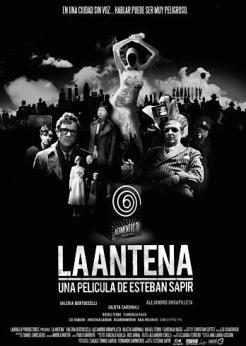
La AntenaLa Antena is a Silent Film. And by that I mean there is no dialogue, though there is music, and it’s in black and white with low-budget (looking, at least) effects, though it was made in the 21st Century — but it is entirely in the style of those films made in the era before sound was technically possible. It could sit comfortably alongside ‘real’ silent films to the extent that the uninitiated might reasonably be fooled into believing it was one.

In some respects this is neither here nor there, though it will undoubtedly put some viewers off. For those with a more open mind or who are fans of silent movies, however, it’s a joy. This is mainly because it’s incredibly imaginative, especially with its visuals, which are often pleasantly barmy. The setting is a dystopian future (or alternate reality) where people can no longer speak (thus justifying the silent film styling), and this world is wonderfully realised without a hint of realism or awkward attempts to explain why things are the way they are. These days it’s a rare filmmaker who doesn’t feel the need to explain everything and make it fit in relation to our world, but Sapir is one of the few who trusts us to accept what’s going on — much as the great silent film directors did.

Sadly it isn’t flawless. Some elements of the plot get forgotten as things roll on (what happened to Mr TV’s son, for example?), perhaps a victim of the 50 minutes of cuts they chose to make for pace. Most of the symbolism is also fairly heavy handed, though one could argue that’s in keeping with the style, and at least means it’s all nicely noticeable. Even then a few bits are unavoidably leaden — particularly, the use of the swastika and Star of David felt uncomfortably irreverent to me.

Ratings-wise, La Antena is borderline — the sort of film I give four stars to now but then beats most five-star films to a high place on my year-end top ten (like The Prestige or Hellboy II or the five others that have done it). In which case it seems only fair to run the risk of awarding it full marks.

5 out of 5

Oscar-winning modern silent movie The Artist is on BBC Two tonight, Saturday 24th January 2015, at 10pm, and is reviewed here.

Commentary! The Musical (2008)

2009 26a
Jed Whedon & Joss Whedon | 42 mins | DVD

Commentary! The MusicalCommentary! The Musical falls somewhere between DVD extra, TV episode and short film. Whatever it should be classed as, it’s utter genius.

You’ve surely heard of Dr. Horrible’s Sing-Along Blog, the project Joss Whedon created during the infamous US Writers’ Strike. (That in itself you could debate the status of. Three-part miniseries? Short film? Feature film? (At 42 minutes it’s over the Academy’s boundary.) And endlessly on.) Well, on the Dr. Horrible DVD can be found this — an alternate audio track, on which the cast and crew discuss the making of the feature… except it’s all scripted and the majority is sung. Not your traditional audio commentary then.

As an audio commentary, it does little to illuminate the production of Dr Horrible — though, surprisingly, it does do some — but instead focuses its energy on spoofing commentary tracks, DVD extras, and the American film and TV industry in general. Specific targets include the Writers’ Strike and its lack of success, rivalry between lead actors, the importance of ensemble cast members, Asians in US TV and film, the dissection of art by DVD extras, and many more. It’s almost all incredibly funny — inevitably there are a few duff gags and dull songs, although they are uncommonly rare — and it moves at a rate of knots, meaning it rewards multiple listens to pick up every gag. Having already re-listened to a couple of tracks, I can attest to noticing funny lines that I was too busy laughing through before. In a spot of technical impressiveness, the commentary is often surprisingly scene-specific, sometimes even shot-specific. When you consider the effort that must’ve been involved to script and time both songs and spoken dialogue to make this happen, it’s even more impressive.

It’s this careful scripting and the sure-handed attentiveness to theme that marks Commentary! The Musical out as a fictional work in its own right, rather than ‘merely’ a DVD extra, in much the same way that Mystery Science Theater 3000 or the short-lived (and easily forgotten) Rob Brydon series Director’s Commentary are original works. With its well-targeted thematically-appropriate comedy and plentiful gags, it’s pure delight for fans of DVDs, or anyone else with a mind open to the concept.

5 out of 5