Babel (2006)

2009 #41
Alejandro González Iñárritu | 138 mins | TV (HD) | 15 / R

BabelMulti Oscar nominated and one of Ebert’s Great Movies, Babel is one of those films that comes with a lot of expectation riding on it. The fact that the only Iñárritu film I’ve previously seen is 21 Grams, which I thought was distinctly overrated, takes the shine off those expectations. Probably for the best.

The quickest way to assess Babel is to say that it is about something — or, About Something. The plots, such as they are, aren’t really the point; nor is how they connect, or what chronology they actually occurred in — this isn’t a Memento or a Rashomon, a narrative in odd pieces designed to be reconstructed by the viewer. Naturally, because it is About Something, the Something it is About isn’t made blindingly clear, though there are many contenders — loneliness, miscommunication, culture clashes, the ripple effect, children, and on. Perhaps this means it isn’t as focused as it could (or should?) be; perhaps Iñárritu revels in ambiguity, which isn’t necessarily a problem.

On a relatively surface level, then: the Japanese story barely connects to the others, which are all more directly woven together. Even if their connectedness isn’t the point, when the others are so clearly and directly related it leaves the Japanese thread feeling the odd one out, almost tacked on to the others. It’s probably a coincidence that it’s also the film’s best story, containing about as much incident and interest as the other three put together.

The central character in that particular thread is portrayed by Rinko Kikuchi, who justly earnt a Best Supporting Actress Oscar nomination for her work. The film’s only other Oscar acting nomination went to Adriana Barraza, in the same category, for her role as a Mexican nanny. Again, a deserved nod, as these are easily the two most compelling performances in Babel. (They lost to Jennifer Hudson in Dreamgirls. I’ve not seen Dreamgirls, but as the other nominees were Abigail Breslin (for Little Miss Sunshine) and Cate Blanchett (for Notes on a Scandal), I’m willing to bet she was the least deserving of all five.)

If the Japanese thread is the best then Brad Pitt and Cate Blanchett’s story is the weakest of the bunch, managing to underuse both those leads and a host of British talent too. The other two stories are equally slight, but at least muster up some genuine emotion.

Babel is the kind of film that it’s easy to overrate because, ooh, doesn’t it seem clever. Conversely, it’s easy to underrate because, ooh, doesn’t it seem pretentious. Naturally, therefore, I’m going to come down right in the middle (but note that the Japanese story on its lonesome would earn a 4).

3 out of 5

Eastern Promises (2007)

2009 #32
David Cronenberg | 97 mins | DVD | 18 / R

Eastern PromisesArguably most famous for his horror films of the ’80s (though a couple of his ’90s efforts could stake a claim), director David Cronenberg widened his appeal somewhat with the excellent crime thriller A History of Violence. Here he reunites with star Viggo Mortensen for another grim tale, switching the bright searing heat of the American Midwest for the rain-drenched nighttime streets of our fair capital.

Despite some similarities in plot and theme, Eastern Promises failed to engage me in the same way as the earlier effort. Perhaps this is because it plays tag with its central character, beginning with Naomi Watts’ do-gooder nurse before shifting focus to Mortensen’s mafia chauffeur with nary a blink. It’s an unusual transition, and consequently it’s hard to tell whether it’s skillful writing or a fortuitous accident that it comes off seamlessly. One theoretical screenwriting argument would have it that the film is actually all about Christine, the baby, and that’s why it works, but that feels a little too pretentious to engage with now.

Tied around the baby’s fate, screenwriter Steven Knight factors in some appropriately dark elements, like white slavery or the relocated criminal underworld that currently operates in the UK. Though these are handled with a certain amount of care, they’ve been covered in greater depth elsewhere (the excellent miniseries Sex Traffic, for example) and here are reduced to pawns in a different tale. This isn’t necessarily inappropriate, but remembering the detail from other such dramas can leave the topics’ inclusion here feeling lightweight.

Elsewhere, the screenplay suffers from some awkward dialogue exchanges and barely credible logic contrivances being used to jump-start the plot. Most of these come from Watts’ character, who seems too competent for much of the film to pass off as a naïve fool at its start. This may be Watts’ fault, playing her as intelligent when a naïve approach might render her actions more believable, but it seems cruel to lay the blame with her as she’s very strong all round. Armin Mueller-Stahl also gives his typically accomplished turn in his typically key supporting role.

Mortensen’s Oscar-nominated performance is the focus, however. Apparently thoroughly immersed in the role, he gives a distinguished performance throughout and is central to what are by far the film’s most memorable moments: a nude steam baths fight, which has become justifiably infamous (I suspect for the “nude” part, but it’s the “fight” that deserves it), and a game-changing twist, that I sadly had ruined in advance, though there are plenty of clues scattered along the way.

By its end, Eastern Promises has the feel of the first part of something bigger: while the story of the baby is resolved, many others are left open. Unresolved threads aren’t always a problem, but it feels like Cronenberg has more to say in this world. So it’s nice to know a sequel is possibly in the works, because Eastern Promises has the potential to be a Hobbit to some Russian mafia epic’s Lord of the Rings. On the other hand, a similarly low-key follow-up would be just as appropriate.

Though it failed to capture me as much as A History of Violence, possibly due to too-raised expectations, Eastern Promises has the potential to grow with repeated viewings. And either type of continuation would be most welcome.

4 out of 5

Unfortunately, plans for a sequel ultimately fell apart in 2012. Some more details can be read here.

For Your Consideration (2006)

2009 #57
Christopher Guest | 79 mins | TV | 12 / PG-13

For Your ConsiderationThe makers of This is Spinal Tap and Best in Show — along with all their usual cast members — swing their satirical sights from others’ work to their own industry. Unfortunately, it’s not a patch on their previous efforts.

The biggest problem is that most of the gags feel a little familiar. It’s not that they’re unfunny, just that they don’t feel very original. Worst off are the numerous jokes about the internet, mobile phones and other technology, which feel more 1996 than 2006. It’s all lacking in subtlety, taking a broad swipe at the whole filmmaking industry rather than incisively mining its constituent parts for something insightful.

The best bits come in the second half, when the cast and crew (of the fictional film-within-a-film, that is) hit the campaign trail to promote their movie. The styles of TV shows that various people appear on — the different levels awarded to the leads, other cast members, the writers, and so on — has some decent satire, the closest For Your Consideration comes to being truly revealing.

Most disappointing is that this should have been so good. The team who basically invented the spoof documentary finally taking on their own industry? Brilliant! But it feels like they felt the same way and rushed into production without properly thinking it through. Which, in its own way, is rather ironic.

3 out of 5

Saw IV (2007)

2009 #62
Darren Lynn Bousman | 92 mins | DVD | 18 / R

This review contains minor spoilers.

Saw IVSaw IV is the final film in the series directed by Bousman, and will also be my jumping off point (for the time being). According to IMDb (which I presume is sourced from a commentary or something), Bousman had been intending to depart after Saw III, but was persuaded to stay when a twist in the fourth film’s script managed to surprise him, something he thought the franchise was by then incapable of. But do not let this get your hopes up, dear reader, because Saw IV lacks any twists that even come close to those in the preceding films. What caused Bousman to continue is a mystery, and some viewers will inevitably feel the same way about continuing with the series themselves.

After the overly gory third film, Saw IV returns to the franchise’s roots by playing more like a thriller than a horror film — even more so than the previous instalments, one might argue, as aside from a couple of jumps and a few instances of gore, the story and its key sequences move forward via police investigation, endless flashbacks and copious twists. The Saw franchise should be applauded for trying to be more than just another slasher series, but needs to learn the value of restraint in other areas.

The plot, for example, is incredibly complicated. This could be a good thing — it’s rare for the fourth film in a franchise, especially a horror one, to demand so much from its audience — and the viewer not only has to pay attention to the events on screen, but have a pretty good awareness of those from the last two films as well. Despite its complications, such connectedness is actually a reason to retain hope for the franchise, because it really tries to be about more than just how graphically it can slaughter people.

Unfortunately, any effort on the part of the viewer isn’t rewarded. Saw IV is too complex, ultimately descending into the realms of incomprehensibility. There are around four different plot threads, at least two of them jumping around in time like a TARDIS with ADD. Goodness knows how many different time zones are included, how many of them progress in a linear fashion, and whether or not they actually have any bearing on each other. Even references to previous films are confused: while this clearly begins some time after the end of Saw III, it then jumps back before Saw III, and then during Saw III, and then with Saw III, and then after Saw III again… but not as far after it as that opening scene. And that’s just the main plot.

A lot of the complexity is in aid of answering hanging questions from Saw II and, especially, III, but the mass of backstory leaves you wishing for a standalone ‘Test of the Film’ plot, which the first three essentially are. As already expressed, such an intricate array of stories is not necessarily a problem, but neither new writers Patrick Melton and Marcus Dunstan nor director Bousman have the required skill to guide the audience through such dense material. Nor the experience to know when less can be more, clearly.

Fortunately, Bousman seems to have learnt that “less is more” with the deaths. After the excess of Saw III, the gore feels pared back here. The one notable exception is an entirely extraneous autopsy that opens the film, which goes beyond the last entry’s brain surgery in the gruesome stakes. Apparently it’s to prove Jigsaw is unquestionably dead, but it does it with more glee and explicit medical detail than necessary.

Elsewhere, however, the savagery shortage is welcome — except that, in the process, Bousman seems to have misplaced the tension present in the first two films. The only real suspense is an opening trap that is, again, almost entirely extraneous to the rest of the plot, although one trap later on — featuring an abusive husband pinned to his wife — is moderately ingenious, achieving Jigsaw’s proclaimed ideas of apt justice in ways many previous traps failed to.

And what of Jigsaw this time? He may be dead, but instead we’re treated to flashbacks of John Kramer’s pre-Jigsaw life. As you may remember from my complaints in Saw III, revealing more about our villain is, in this case, not a good idea. Seeing Kramer before he was an Evil Bad Guy is clearly an attempt to make him a real person, one inspired to engage in a killing spree by every-day, real-life events. As with the other thriller elements, grounding the villain in the real world — and trying to give him plausible, relatable motivation — sets the Saw series apart from the vast majority of other horror franchises. But there’s no need to understand Jigsaw, and the more we learn about him the less impact he has. His soul is laid bare here, but by trying to make his actions plausible it continues to strip away the mystery and highlights how ludicrous his traps are in reality — they work fine in the conceit of a horror movie, but trying to imply it’s a real person doing these in the real world is one suspension of disbelief too far.

Which kind of sums up the film, really. Saw III went too far with its gore, and now Saw IV goes too far with its plot. As the series rattles on to its fifth instalment (and this year’s sixth, and next year’s seventh, and at least an eighth beyond that), its only hope for regaining a decent level of quality — in my opinion, of course — is to keep the gore at a manageable level, and keep the storytelling at one too.

2 out of 5

Technically I watched the Unrated/Extreme extended cut of Saw IV. The differences are numerous but ultimately minimal. Those desiring a full list of alterations can find one here.

AVPR – Aliens vs Predator: Requiem (2007)

2009 #19
The Brothers Strause | 97 mins* | DVD | 15 / R

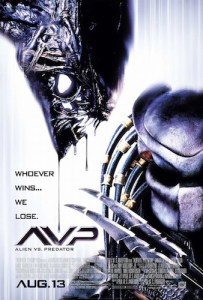
AVPRAliens vs Public Relations? Sadly not. And when a joke plot like that sounds more appealing than a rematch between two of sci-fi’s greatest monsters, you know you’re in trouble.

In my last Alien/Predator review, I made sure to attack director Paul W.S. Anderson a bit. As well as being renowned for making rubbish films, Anderson is also quite well known for being sequel-shy… and so it is with the AVP franchise, here handing the reins to the less-than-capable special effects-creating Brothers Strause. They supposedly set out with a fan-pleasing remit: primarily an R-rating, but they even make sure to use familiar fonts and sound effects right from the title card. Though said title card is blurry and unclear, obscuring the film’s very name — a sign of things to come, because their ability to please fans extends no further than some vague surface essentials.

To be fair, it can’t be easy to marshal all the familiar tropes of two different franchises into a single film that does something original with them. But that’s no excuse — things like facehuggers and skinned humans are present as if simply ticked off a list, having neither the surprise and mystery of the original appearance (obviously) nor anything new to make them worthwhile. They’re there because they ‘need’ to be, and while it makes some kind of sense to not play them as surprises, there’s nothing remotely new or different to hold our attention instead. Much of it is so poorly done that it’s not even set pieces strung together, it’s ideas for set pieces strung together.

If you thought AVP spent too much time focusing on the Predators rather than the humans (and I did), you’ll find AVPR even worse. It again tries to emulate the build-the-characters-first approach of the best Alien and Predator films, but intercuts their mundane lives with what the Predators and Aliens are up to. No, no, no. Part of the point of the character-based slow-build is to create tension — there’s none of that here. And by not withholding the monsters, the dull lives become even duller. One of the Alien series’ strengths was in making the extraordinary (space travel!) seem mundane (space truckers), but AVPR makes the ordinary seem mundane, and that’s no achievement at all; in fact, that’s a great big failure.

Even the action sequences are a mixed bag. There’s a nice line in harsh and surprising deaths — major characters are suddenly picked off, and with a cast so full of minor actors you can never be certain who’ll make it; and among them are a young boy, pregnant mums, and most of the town gets nuked by the army because the townsfolk trusted them. The final fight makes admirable use of suits and animatronics over CGI, but it’s so dark you can barely tell what’s happening. Similarly, the PredAlien may be great or it may be rubbish — you never see it well enough to tell. It’s not only the climax: over-dark cinematography and typically choppy editing obscure every action sequence. Why is it that in an age where special effects are so improved and there’s a preference for real actors over stunt doubles, action sequences have become harder to follow?

The overall feel is of a horror B-movie — a direct-to-DVD one. It may be a stock phrase for reviewers, but in this case it’s actually true: AVPR genuinely makes AVP look good. It’s a new low even for the Predator series, and it drags the Alien franchise from once lofty heights right down into the gutter with all the other too-long-running horror franchises. However permissable parts of AVPR might be (when judged on its own terms) (with a kindly eye), the inconceivably thorough degradation of a once-great franchise is its greatest crime.

Alien³ was a charming mess. This is just a mess. An irredeemable one.

1 out of 5

* AVPR on DVD is 7 minutes longer than in cinemas. This seems to be the only cut available (outside of Germany) and isn’t specially labelled, hence the lack of qualifying “Director’s Cut” or “Extended Cut” or “DVD Cut” in my title.

AVPR featured on my list of The Five Worst Films I Saw in 2009, which can be read in full here.

AVP: Alien vs. Predator – Extended Version (2004)

2009 #18
Paul W.S. Anderson | 98 mins | DVD | 15 / PG-13

This review contains minor spoilers.

AVPOnce upon a time — around the late ’90s, when he was only known for Event Horizon (and that video game thing no one wanted to mention) — director Paul W.S. Anderson was seriously and vocally attached to a film adaptation of Doctor Who. At the time it was such a good idea, a bright new hope for Who’s revival, with a Hollywood-level — yet, pleasingly, British — director at the helm. When it didn’t come together it was quite disappointing. In retrospect, I think we can breathe a collective sigh of relief.

Anderson’s films always come in for a critical drubbing and AvP was no exception. Sadly, it was well deserved. The main problems are a weak script, including an abundance of prologues in place of genuine character development, and poor performances, not helped by what sounds like a regular use of bad ADR. Characters make leaps of logic that would be reasonable if they’d seen the preceding six films, but make no sense whatsoever given what they know in context. The story begins moderately well, even pushing to the slow build in the franchises’ best entries (though without as much tension), until just 13 minutes in, when there’s a pointless scene on a Predator ship. Of course we know they’re coming — they’re in the title — but it’s a reveal too soon and ruins any mood Anderson’s managed to create. Constant updates on their progress exacerbate the problem.

There are actually some very inventive ideas scattered throughout — like the captured, frozen Alien Queen — but, in storytelling terms, their reveals are poorly handled, occuring too early and too far from the protagonists. However much time Anderson wants to spend getting his humans into position (a lot, just like the other six filmmakers before him), he clearly doesn’t trust the audience to go along with it without some hints of the creatures (unlike the best of the filmmakers before him). It’s not his only directorial misstep. He makes the fatal mistake of letting his monsters out into the light too much, though the choppy editing almost obscures them again. While effects can now withstand this level of scrutiny, the effect of the creatures can’t — they belong half-hidden in shadow, especially the Alien.

Elsewhere, every facehugger is treated to a graphic slow-mo shot. Once might’ve been cool, but it quickly becomes overkill — especially when the first instance features three, immediately rendering every solo example that follows unremarkable. And then there’s the ending nabbed from Predator 2. And the final beat that, though the groundwork is laid earlier in the film, still doesn’t really make sense (considering how fast chestbursters came out of the humans, or how long the Predator had been dead by the time it popped). When the director doesn’t know how to handle the titular monsters correctly, you know you’re in trouble.

That said, Anderson certainly delivers on the title’s Aliens-fighting-Predators promise. Most of the film’s limited imagination is lavished on these battles, but as with most monster-on-monster bouts we have no stake in either side, leaving them mostly heartless and only engaging on the level of “cool!” The human characters are left by the wayside at these moments, disappearing out of the way — and taking what little plot there is with them — for a few minutes. When they do appear there are some attempts at character development (yes, beyond those prologues) which are well-intentioned but painful. All things considered, Anderson has taken two horror franchises with an action-adventure tinge and turned them into an action-adventure film with a horror tinge.

This ‘extended version’ is a whopping 79 seconds longer than the theatrical cut, adding a whaling station prologue. This exacerbates the issue of revealing the monsters too early, but it does go some way to justifying the otherwise random glimpses of the Predator ship. Nonetheless, to be truly effective we shouldn’t know more about what the aliens are up to than the human characters do and it’s all a mistake. (An unrated version of the film is also available in some territories. It runs eight minutes longer, but the additions seem to just be the deleted scenes included on other releases.)

Flash forward however many years since that mooted Who movie, and Anderson’s career has mostly reverted to video game adaptations and trashing as many franchises as he can. AvP is surely the culmination of his efforts: here he manages to amalgamate a popular and acclaimed film franchise, its almost-as-beloved stablemate, and an equally popular and acclaimed comics & video game series, and then decimate all three in one 85-minute (without credits) swoop. Well done Mr Anderson, your efficiency knows no bounds.

2 out of 5

Tomorrow, AVPR – Aliens vs Predator: Requiem.

High Society (1956)

2009 #54
Charles Walters | 107 mins | DVD | U

High SocietyCole Porter-scored musical remake of The Philadelphia Story, which is probably most famous for featuring Who Wants to Be a Millionaire? and being star Grace Kelly’s final film before becoming a princess.

Despite rarely singing, Kelly is by far the film’s standout element — it’s easy to believe three different men would be vying for her affection, but she also gets the chance to show the greatest range of any cast member. Admittedly it’s shades of comedy rather than a full awards-worthy display of ability, but she carries the film beautifully. It’s no wonder her husband-to-be, Prince Rainier of Monaco, objected to her appearing in movies when she played roles such as this: a divorcee who at one point allegedly sleeps with another man on the eve of her wedding to a third is surely no role for a princess. (Turns out she didn’t sleep with him, mind.)

Bing Crosby and Frank Sinatra are more-or-less themselves as the male leads, though the sole song they perform together, Well, Did You Evah!, is one of the film’s best — despite being a late addition from a previous Cole Porter musical after it was realised Crosby and Sinatra didn’t have a number together. Louis Armstrong also plays himself, literally, and brightens up the screen whenever he appears. His band’s duet with Crosby, Now You Has Jazz, is another of the film’s highlights.

Despite being adapted from an acclaimed play and film, the plot feels like a relatively slight contrivance to link together a couple of songs — alternately of the Romantic and Comedic variety — and some farcical humour with a romance-based thread. That the right people end up together is no surprise — so little surprise, in fact, that the story doesn’t even bother with such trivial things as making the final entanglements come together believably.

No matter. It’s the journey to the inevitable conclusion, through a few comical scenes and a few decent tunes, that makes High Society a perfectly pleasant dose of entertainment.

4 out of 5

High Society is on TCM UK today, Saturday 4th April 2015, at 4:15pm, and on Sunday at 9:35am.

For All Mankind (1989)

2009 #42
Al Reinert | 77 mins | TV (HD)

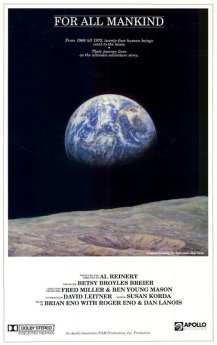
For All MankindFor All Mankind tells the story of NASA’s Apollo missions to the Moon using only NASA’s own footage of the real missions.
It’s not a documentary in the sense that most people perceive the form — i.e. a highly realistic presentation of the facts — but instead something a little more interpretive, aiming to recreate the feeling and experience of travelling to the moon, not the hard facts of who went when and how it was done. As such it is both beautiful and artistic, featuring stunning photography that has been sensitively edited and scored.

In this regard, it makes In the Shadow of the Moon look like a Hollywood remake. While they follow the same tack — telling the tale of the Moon missions with just the testimony of the astronauts, treating it as one big mission rather than taking them all in strict chronological order — For All Mankind does it with a greater sense of artistry. Where Shadow feels like a typical documentary, with talking heads and onscreen identification of who’s speaking, Mankind just uses original footage and astronaut’s narration, never bothering to identify the speaker. Both styles have their place, and Shadow adds a great deal to the story with its retrospective comments by the astronauts, but the glorious footage and skilled editing of Mankind — and the added wonder of seeing it in HD, it must be said — leaves one with a sense of awe that isn’t as present in the more informative Shadow.

These two films make an excellent pair then, but For All Mankind’s beauty provides the superior experience.

5 out of 5

For All Mankind placed 5th on my list of The Ten Best Films I Saw For the First Time in 2009, which can be read in full here.

In the Shadow of the Moon (2007)

2009 #40
David Sington | 96 mins | TV | U / PG

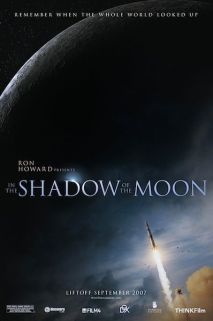
In the Shadow of the MoonIn the Shadow of the Moon tells the story of NASA’s Apollo missions using only contemporary footage and the words of the men who actually walked on the Moon.

The telling is dominated by the words of the actual astronauts, describing their personal experiences and feelings. Rather than following a mission-by-mission chronology it mixes all their stories together, thereby telling the tale of a journey to the Moon and exploring its surface only once. It’s a neat way of editing it, albeit essentially borrowed from For All Mankind, because it avoids repetition while also covering a variety of perspectives. The typically reticent Neil Armstrong is conspicuous by his unsurprising absence, but this allows the personalities of some of the others to come out more (Buzz Aldrin features relatively little too, for example), perhaps none more so than Mike Collins, the man ‘left behind’ while Armstrong and Aldrin stepped into the history books. He comes across as thoroughly likable and it’s a pleasure whenever he’s on screen.

Narration is limited to a couple of brief intertitles and that contained on archive footage, culled not only from NASA archives but also newsreels, adverts, speeches and so forth. In this it manages to avoid using some of the more obvious and over-played clips, such as Kennedy’s famous “not because it is easy, but because it is hard” speech, while unearthing some interesting bits of its own, like Armstrong’s parents on a game show the day he became an astronaut, being asked how they’d feel should he happen to be the first man on the Moon. Such found footage is often used to put the missions in the context of wider events at appropriate junctures, such as Vietnam and the Civil Rights movement during the time Apollo 8 led the first men to orbit the Moon, or showing the whole world watching the TV broadcast of Armstrong stepping on to the Moon for the first time.

Although this external perspective is welcome, while being kept to an appropriate minimum, it’s difficult not to note that this is exactly what the HBO dramatisation, From the Earth to the Moon, did at these points. Other points of emphasis feel similarly culled, such as the way Apollo 13 is almost glossed over, but there are only so many ways of telling the significant elements of the same story and any accusations of plagiarism, from either HBO’s series or For All Mankind, aren’t seriously justified.

A closing perspective treads the fine line that leads toward sentiment and preachiness, but errs on the right side of awe and significance. Some have criticised the end for having too much religion and spirituality and not presenting a conflicting, ‘accurate’ scientific perspective. As a staunch atheist, I found no such problem: beliefs are there to an extent, but they’re not overpowering and there’s no apparent religious agenda, as some critics might have you believe.

In the Shadow of the Moon may not offer the plain facts and figures of how we went to the Moon and who did it when, but it does present the reflections of the men who risked their lives to further the knowledge and reach of our species. Their thoughts on this are invaluable.

4 out of 5

Red Riding: 1983 (2009)

aka Red Riding: In the Year of Our Lord 1983

2009 #52
Anand Tucker | 100 mins | TV (HD) | 15

Red Riding: 1983The Red Riding Trilogy draws to a close with its finest instalment, a superior work in just about every respect.

From the off, 1983 returns to the story of the previous films, showing events from different perspectives. It’s dominated by a new story — the search for a child kidnapper in the titular year — but even this harks back to the past, the actual kidnapping closely resembling the one that kick-started 1974. Indeed, it’s 1974 that’s primarily drawn upon, confirming 1980 as little more than an aside in the scope of the trilogy.

1983 doesn’t just reiterate, however, but builds on previously-seen events and characters, both overtly — showing the police investigation into Clare Kemplay, which was the story of 1974 — and more subtly — Hunter’s apparent sidekick being present at secret meetings of the Evil Policemen in 1974. Despite clear links to the past, 1983 may also work well enough on its own. It’s undeniable that there’s more depth when viewed in light of the first two films, but most (perhaps all) of it would be comprehensible simply from what’s presented here.

Tucker’s film bests its predecessors in almost every assessable value. The story and characters have more genuine surprises and suspense than ever, while the performances are at the very least the equal of what’s gone before. Unlike the other two films, where the corrupt cops were little more than cartoon villains despite claims to the contrary, 1983 makes their brutality really felt; here, for the first time in the trilogy, their disregard for the law and their vicious methods made me feel sickened and angry, just as they should.

But best of all is the stunning sepia-tinged cinematography, which uses the popular RED cameras to amazing effect. The instances of beauty are too numerous to mention, from obvious moments such as the final scenes of white feathers drifting in slow motion through shards of sunlight as part of a heroic closing image (even if one finds it tonally incongruous, which some surely will, it looks gorgeous), to low-key scenes like Jobson lost in contemplation, the sepia-toned foreground standing out from the blues of the background. The omnipresence of lens flare, an idea that was so annoying when liberally sprinkled across Star Trek, seems to work perfectly here. Perhaps it’s due to consistency: every light source seems to cast streaks across the frame, not just the occasional flourish. The trilogy isn’t yet available on Blu-ray, but for some of the images in this film alone it really should be.

Sadly, 1983 still isn’t perfect. Many plot threads are tied off, or we can infer our own explanations for the missing bits, but significant others are left hanging, not least what happened to the numerous corrupt police officers. We don’t necessarily need to see them come to justice — though that might be nice, obviously — or even a summary of the rest of their life, but some nod of a conclusion to their stories would be appreciated. Elsewhere, BJ’s narration is slightly twee, which is a shame because his story is both compelling and one of very few that is actually told across all three films, even though he’s barely noticed at first, rather than just starring in one and cameoing in the others.

I enjoyed 1983 immensely, much more so than either of the preceding films, so it’s only minor flaws like these that hold it back from full marks.

4 out of 5