
John Moore | 103 mins | Blu-ray | 15
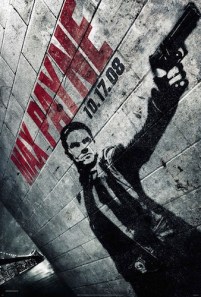 I was a bit of a gamer once. Not an especially hardcore one, but certainly a gamer. And I remember Max Payne, and I remember enjoying it, and I remember thinking it would make quite a good film, and I remember one of the biggest problems being that what made it so unique as a game was the bullet-time feature and what would make it so derivative as a film would be to use bullet-time. But it also had lots of other things going for it: the snow-bound nighttime New York setting, the dark revenge plot, the hard-boiled gravel-toned voiceover.
Luckily, director John Moore doesn’t use Matrix-derived bullet-time visuals, but, despite keeping a snow-bound New York and a revenge plot, he’s somehow managed to also throw out everything that made Max Payne: The Game good. Despite the similarities in plot and setting, this doesn’t feel at all like the game.
Max Payne: The Film, to put it simply, is a load of crap.
I’ll just reel off the bad points:
For something advertised as an action movie — at best, an action-thriller — there’s barely any action. Even the climax, where you might expect a fair bit, is virtually devoid of it. Moore exploits extreme slow motion to stand in for the game’s Matrix-esque combat. 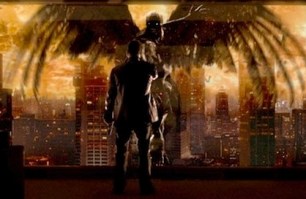 Unfortunately, he seems to be under the illusion that a couple of barely-moving slow-mo moments also stand in for a full action sequence. When an action movie can’t deliver any action, there’s a problem.
Instead, the budget seems to have been spent on some angel/demon CGI rubbish. Early on, one begins to wonder if the film’s headed toward Constantine-esque fantasy territory — it’s not in the game, but hey, that’s never bothered Uwe Boll. Eventually it becomes clear it isn’t, these are just some kind of junkie visions. At least, I’m sure they’re meant to be, but I’m not sure the film ever makes that explicit — I wouldn’t blame a casual viewer going away with the sense that these angel/demon/things are actually meant to be there and only the junkies can see them. Which would be just as irrelevant.
Despite this being the “Harder Cut”, it comes across as a PG-13 film playing at being an R. (Though the extended cut was released as ‘unrated’ in the US, the original MPAA rating was an R before a handful of changes needed to get it down to the more bankable PG-13.) It’s now around three minutes longer than the theatrical cut, but from what I can gather a significant chunk of that seems to be made up of people walking around longer.  The ‘harder’ bit merely comes from a couple of frames (literally) of violence and the odd bit of CG blood. Presumably the extra walking around is to artificially lengthen the running time and persuade the more gullible that they’re getting a tougher experience.
Mark Wahlberg has all the charisma and emotion of a wooden plank. No one else in the cast can offer anything better, least of all a miscast Mila Kunis. In fairness, it’s not like any of them are given proper characters to work with: most display no kind of arc, and even those that have one — Kunis, for example — are ultimately ignored, the events that might affect them on an emotional level serving only to further what stands in for a plot. Only Max himself is allowed any genuine emotional connection. And by “genuine” I mean some supporting characters we never see again tell us it’s had a real impact on him. Wahlberg certainly doesn’t convey it.
Olga Kurylenko is also in this film. She tries to sleep with the hero and fails, as per usual.
 At least some of it looks quite nice. The drifting snow-laden exterior shots are among the few bits of the film that might genuinely be considered good. But when you can get pretty images elsewhere, why suffer through this?
A short post-credits scene suggests a sequel. Why is this buried after the credits? Presumably so as the filmmakers didn’t embarrass themselves more widely by implying they thought this pathetic effort might earn itself a follow-up.
Uwe Boll wanted to get his hands on Max Payne. At times while watching this, I wished he had. You can’t get much more damning than that. Other than, maybe, something witty, like — “maximum pain is certainly what this film will cause you”.

Max Payne featured on my list of The Five Worst Films I Saw in 2010, which can be read in full here.
 So many consumers hold off for the DVD these days, especially with the added quality offered by Blu-ray, that the old answer of “what was released in the cinema” doesn’t necessarily hold true any more. Filmmakers know some will be waiting for the DVD, so are less concerned with releasing a studio-mandated, shorter, mass audience friendly cut into cinemas when their fuller vision can be found on DVD. Equally, the PR people know that “longer cut!” and “not seen in cinemas!” and other such slogans can help sell DVDs, and so may be forcing needless and unwelcome extensions onto filmmakers. Then there’s all those older directors who think they’re doing a good thing finally getting to tamper with their film 30 years on, who may well be misguided.
 There remains one argument for clarity, I think. How does one guarantee that, in the future, the ‘correct’ version remains accessible? With new formats always coming along, there’s no assurance that every cut of a film will be released; with TV showings, there’s no assurance the preferred version will always be the one shown (though there’s another argument for how much the latter matters considering they already mess around with aspect ratios and edits for violence/swearing/sex/etc.) But then, even if a filmmaker makes it clear that their preferred version is the one that only came out on DVD/Blu-ray, what chance is there that unscrupulous disc / download / unknown-future-format producers or TV schedulers won’t just revert to the theatrical version by default?
 Readers may remember that I opened my
 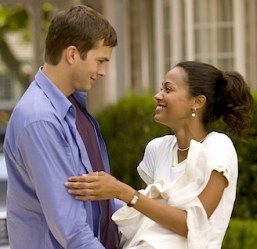 Mac and Kutcher play the roles they always play— No, actually, in fairness, I can’t say that: I think I’ve only seen Mac in the
 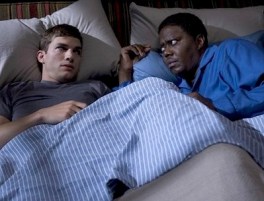 It’s as recognisable from TV sitcoms —
 It’s generally taken as a rule that an original film is better than the remake, particularly so if that original is in a language other than English and the remake is American. But there’ll always be something to buck the trend, and in my view that’s Insomnia.
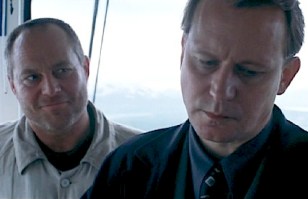 surprised how little his lack of sleep had to do with anything. Here, there are several scenes of Skarsgard struggling to sleep, he’s visibly rougher as the film progresses, and it seems to impact his judgement and sense of what’s going on more than in Nolan’s film. If the other character elements are apparently less developed, this is something the original does better.
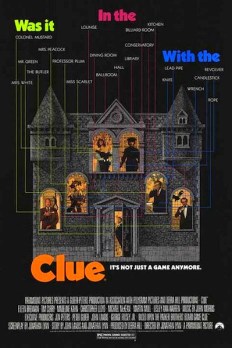 Although Disney have recently treated (I use the word loosely) us to a glut of films based on theme park attractions, movies adapted from good old board games seem a lot rarer. This is probably for good reason — even more so than Disney rides, the majority have no kind of useable narrative. Cluedo (aka Clue in the US) is one of the few that does, and consequently is one of the few (only?) board games that has reached the silver screen. So far, anyway.
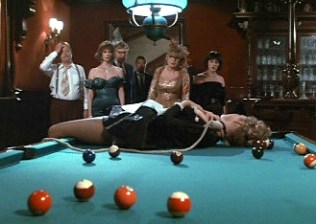 Other than the board game connection, Clue is best known for its three different endings, all of which were released, with each screening having just one attached. On TV the film shows with all three consecutively, and they perhaps work best this way — there’s a rising scale of ridiculousness, and the varied repetition of a couple of gags underlines rather than steals their amusement value. My personal favourite variant was the first, incidentally.
 Ah, Rambo. Rambo Rambo Rambo. The only Rambo film I’ve seen is
  Stallone is perfect for the character: suitably calm and ‘everyman’ at the beginning; muscular and mostly silent as the trained assassin; and even an actor capable of pulling off the final breakdown, when the horrors of war spill over. It’s difficult to imagine most muscle-men action stars pulling off Rambo’s closing speech. Throughout, Rambo’s PTSD is made obvious without being overdone: brief flashbacks suggest all the horror we need to know, topped by his final outburst. Rambo isn’t the beast, the men who made him that way are, along with those he did it for who fail to appreciate what he’s been through.
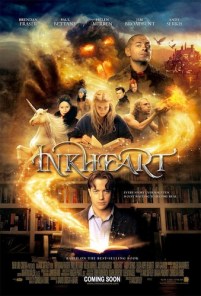 Shot in late 2006, originally scheduled for release in December 2007, ultimately pushed back twice and finally hit cinemas December 2008… what’s wrong with Inkheart?
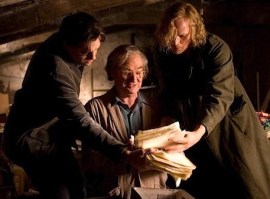 A side effect of not establishing the central concept’s rules is that the film doesn’t play with it enough. What, if anything, happens if you just change the words while reading? How is it determined what comes out of the book, what goes in, and can these be influenced? What happens if two Silvertongues read the same text at once? There are other things it would be interesting to see, but those require a more detailed description of some of the few rules that can be discerned so I won’t trouble you with them now.
 While everyone else is straightforward, predictable and/or pantomime, Dustfinger is torn back and forth between helping the heroes, his inherent selfishness, his fear of returning home, and his desire to see his family again. Brendan Fraser, the ostensible lead, is as adequate as ever but outshone by almost everyone else, not least Eliza Hope Bennett. She’s a minor find as Meggie (who I rather suspect is the main character in the book, but here is trumped by ‘star’ power), displaying more believability than most young teenage leads manage in films like this.
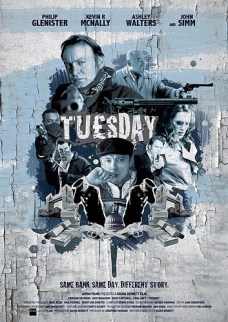 Tu£sday is a low-budget crime thriller, in which several groups of people all try to rob the same bank on the same day — hence the clever title. Unfortunately, the concept is much more interesting than the film writer/director Sacha Bennett has forced it into.
 As the film barely scrapes up to a theatrical running time, there’s a suspicion that the final re-run genuinely was left untouched to keep the length up.
 Unfortunately, it doesn’t go as all-out for the decade as
 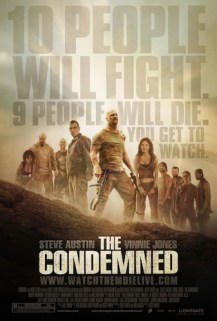 The Condemned is an old-fashioned-ish action movie, produced by WWE Films — i.e. the people behind all the wrestling claptrap. I should very much like to point out that I don’t care one jot about WWE or any other form of wrestling, real or faked. So why watch this? Because it’s got nothing to do with WWE itself aside from one (or more, I don’t know) former wrestlers acting in it.
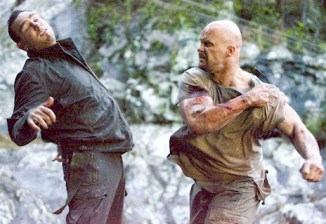 Indeed, in places it’s even satirical. Largely, though, the plot flatly commentates on society’s preoccupation with violent entertainment. Ironically, this is criticising not only organisations like WWE, who produced the film, but the genre of the film itself. It’s difficult to tell if director/co-writer Scott Wiper and his fellow filmmakers are aware of this irony/self-criticism, but if we give them the benefit of the doubt it becomes a nice layer.
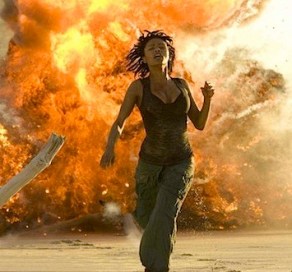 The same can be said of the action. With ten people, nine of whom will die, it could just be a series of fights where the designated Good One emerges victorious. And yes, there are a couple of fights of this nature, but as Things Go Wrong the realistically sick side of the ‘game’ is revealed: one female is cut up and presumably raped, all streamed live, while another is tortured before eventually being burned alive. It’s disgusting but, crucially, the film agrees that it is. That might sound obvious, but one suspects certain entries in the torture porn genre would disagree. That it draws you in to the brainless action movie mindset — fights! deaths! yay! — before twisting it with a dose of nasty reality suggests a greater degree of thought to both its structure and social message than one might expect. Maybe this is only a serendipitous side effect of the story path the writers chose, but even if it was an accident the success of it is still present.
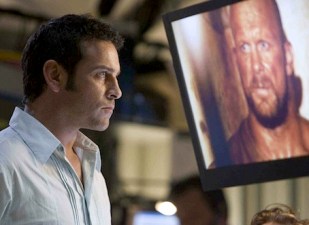 Something that amuses me is how many reviews call this “a brainless action movie” and make assertions like “the dialogue only serves to get from one action scene to the next”. Now, I’m not going to argue that The Condemned is actually some essayistic polemic on the evils of the media or modern violence-obsessed culture, but it has more to think about than the majority of action movies — meaning it’s neither brainless nor devoid of importance between action scenes. Perhaps you can enjoy this solely as a series of action scenes, but I have to wonder if those who do didn’t so much turn their brain off as have it removed (assuming there was one there in the first place) — the commentary on voyeurism and violence isn’t subtle and therefore certainly not accidental, so quite how it can be missed is beyond me.
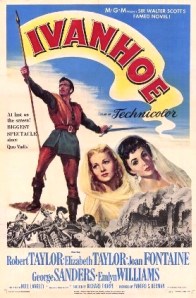 Ivanhoe is the kind of film they don’t often make any more, a pure swashbuckling romp. And when they do make them they tend to muck it up with over-complicated mythology-obsessed sequels — yes
 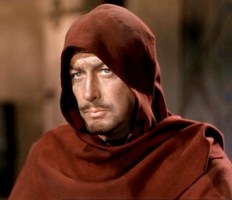 Though the final duel that ultimately follows can’t quite live up to this in terms of sheer scale and excitement, it impressively holds its own as a climactic action sequence.
 100Films.co.uk