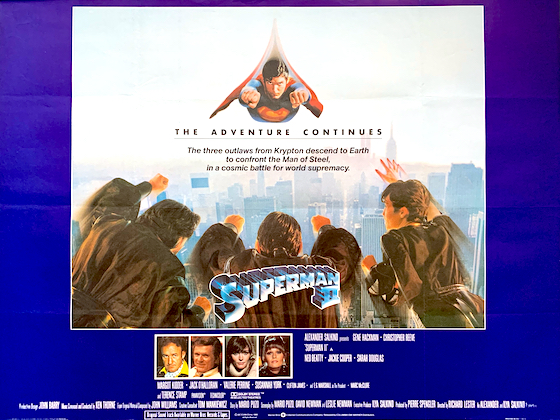
The Past Month on TV #59

Normally I format these TV columns with new (or new-ish) stuff first, followed by older/archive programmes, in a broad-sweep kinda way — i.e. it’s not strictly chronological. But this month not much truly counts as “new”, so I’ve gone for the strictly chronological approach.

In order of appearance, then, this month there’s an RSC production of Macbeth (staged and filmed in 2018 but debuting on BBC Four tonight); the most recent standup show from Daniel Sloss; Netflix’s revival of Lucifer; classic murder mysteries with Jonathan Creek; an early Doctor Who serial; and more of the worst of The Twilight Zone; plus the usual bits & bobs at the end.

Macbeth
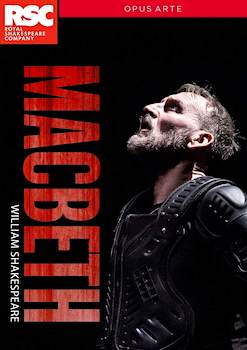
RSC Macbeth (2018)This Royal Shakespeare Company production from 2018, starring Christopher Eccleston and Niamh Cusack, has apparently been on iPlayer since April, but only came to my attention thanks to a TV screening scheduled for tonight (on BBC Four at 9:30pm).

You probably know the story: Scottish lord Macbeth bumps into three witches who prophesy he’ll become king, a goal he sets out to achieve by murder. This particular production has some nice ideas, including casting the witches as a trio of creepy little girls in pyjamas, covering the various ghosts in dust, and an ominously reimagined ending. The real high-point, however, comes when Macduff learns of the slaughter of his wife and children, which is thanks to Edward Bennett’s understated but powerfully emotional reaction. It justifies why it’s Macduff who gets to vanquish Macbeth at the climax. That’s another good bit, actually, with a convincingly-realised stage fight (something I’ve not seen achieved too often).

There’s also a big countdown clock that starts ticking when the king is killed and then remains visible throughout — I feel like it takes some balls to have a countdown running during a live performance! Unfortunately, for much of the time the clock just serves to remind you how long is left during a production that I often found a bit slow. The cast frequently race through their lines and run about the place as if a race is on to the finish line, but, counterintuitively, that does not add pace. Altogether, it’s not terrible, but there have been better versions.

Daniel Sloss: X
Daniel Sloss: XHaving really enjoyed Sloss’s two Netflix specials back in 2018, I jumped on this 2019 one as soon as I became aware it existed (it was filmed for HBO in the US, but hasn’t made it to any UK broadcaster or streamer (though it had a theatrical release!) But where there’s a will there’s a way…) Hopefully it will become more widely available, because not only is it hilariously funny but it’s packed with so many insightful, timely routines that I don’t even know where to start. Some of the stuff he has to say should be glaringly obvious (about improvements to sex ed, for instance), and yet has society changed? Obviously not. And then, as is Sloss’s style, he blindsides you with a finale that is hard-hitting but still manages to elicit laughs. Few other comedians, or forms of entertainment fullstop, manage to be so funny or so effectively thought-provoking, and I’m not sure any others manage to combine the two so well.

Lucifer  Season 4
Lucifer season 4After three seasons on network TV (or Amazon Prime Video here in the UK), Lucifer fell prey to 2018’s bloodbath cancellation season. It was ultimately revived by Netflix, and it seems to have gone well for them: after this they commissioned a fifth and final season, then upped its episode count, then changed their mind and are negotiating for a sixth season.

The move to streaming had minimal affect on the show itself, with many things remaining exactly the same: 45-minute-ish episodes, each with a case-of-the-‘week’ plot, and fades-to-black for ad breaks that will never, ever come. It’s only subtleties that are different; the kind of thing only production geeks might even register — that there’s marginally more swearing, violence, and nudity; more special effects, suggesting a slightly increased budget; and 4K HDR-enhanced photography, which makes the image richer and prettier without fundamentally changing the style or visual language of the show.

As for stuff everyone would care about — plot, characters, etc — a lot of this season has to deal with the fallout from the revelations in the season three finale. That means the show becomes a bit more invested in the supernatural stuff than before, although that’s mainly left to the arc plots — the cases of the week are still grounded in the mortal realm, with the usual array of reasons and settings to motivate murder. Cunningly, it all ends in a place that would’ve been suitable (if unsatisfying) for the series to never return, had this revival been short lived. Fortunately, we’ve more to look forward to.

Jonathan Creek  Series 1
Jonathan Creek series 1I used to love Jonathan Creek back in the day. It was a huge hit, too, gaining high viewing figures and a BAFTA award. On the surface it doesn’t look so special: two mismatched individuals solve murders. But it’s the execution that’s different: these are all “locked room” mysteries, and rather than interview a small array of suspects to guess who did it, they must work out how the murder was even physically possible. Creek is a magician’s trick designer, and the stories kind of work like magic tricks: something seemingly impossible that has a hidden rational explanation. Personally, that’s right up my street, and while some elements of the show are obviously dated (the hairstyles; the cars; the pace is leisurely by modern standards), I think it holds up pretty well.

Doctor Who  The Time Meddler
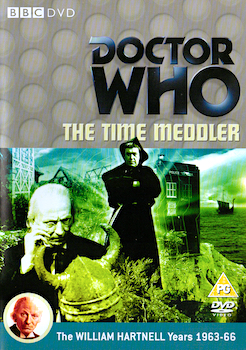
The Time MeddlerLast month, Doctor Who Magazine ran a Twitter ‘world cup’ to find the most popular stories starring the First Doctor. Many of the usual suspects did well, but I was surprised to see The Time Meddler wind up in second place — I’d never realised how much love there was for this story. In fact, I’d never seen it, so naturally I was inspired to dive in.

The serial is notable in the history of Doctor Who for being the first pseudo-historical — that’s to say, a story set in the past but with science-fiction elements (beyond the presence of the regular characters and the TARDIS, obviously). Also because (spoiler alert!) it’s the first time we meet another member of the Doctor’s race (besides Susan, obviously). That reveal is a long time coming, though. We get there in the Part 3 cliffhanger, which is one for the ages — I can only imagine how it must’ve played back in 1965. (Of course, without internet discussions or fandom as we know it today, I guess it wasn’t as impactful. But for those kids in the know, whew!) It cues a genuinely superb final episode.

Unfortunately, the three before it feel like we’re taking the long way round to get to the point. The initial setup is enticing, with anachronistic technology turning up in 1066, given an extra zhuzh because new companion Steven doubts the TARDIS can travel in time, and the out-of-place tech seems to prove him right. After that, there’s a lot of back-and-forthing — the kind of stuff that feels like forward momentum in the moment, but ultimately just moves pieces back to where they were. The Doctor even goes missing for an entire episode (so William Hartnell could have a holiday), which leads to even more wheel-spinning. At least Douglas Camfield’s direction is really rather good… until he attempts to stage a multi-combatant sword fight within the budgetary, scheduling, and technological limitations of 1960s children’s television. It’s not really his fault, I’m sure, but it fails to be an exciting bit of TV.

I feel like that’s an excellent two- or maybe even three-parter in The Time Meddler — when it finally gets to the point in the final episode, it’s fantastic, but the first three-quarters are much less engaging. It’s worth it for that final part, but there are more consistently excellent First Doctor stories that I’d rank higher.

The Twilight Zone  ‘Worst Of’
Jess-BelleThis third selection of episodes deemed the series’ worst (according to the consensus ranking I compiled) mean I’ve now seen the bottom 10% of episodes, which I think is a good time to call a day on being miserable and return to the good stuff. As for the following seven editions, many of them are not fundamentally flawed, but each has some element that doesn’t work or a stumble in their execution that prevents them from achieving the full quality of a good Twilight Zone episode.

Continuing to move up the rankings, in 149th place is Still Valley, in which TZ basically tells us there are “good people on both sides” as a Confederate soldier is presented with a book of witchcraft that he could use to change the tide of the war, but refuses to do it because it means calling on the powers of Satan. And that’s all for your 25 minutes. As Oktay Ege Kozak of Paste writes, “we watch The Twilight Zone for its morally complex and hard-hitting narratives. Still Valley is so vanilla, it belongs in a show called The Light Zone.” It’s a solid episode for the most part, but with a maddeningly uninteresting conclusion.

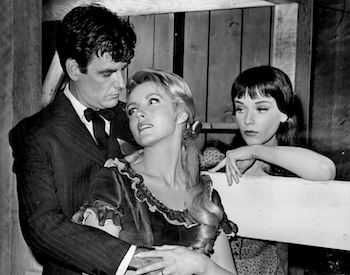
Next up is a season four episode (i.e. an hour-long one), Jess-Belle. At its core it’s a gender flipped version of The Chaser (reviewed last time), in which a young woman wants a particular man to fall in love with her. The main difference is that whereas before the (male) daemon was actually trying to help the main character (by hoping to talk him out of it), the (female) witch here seems more of a malicious, trickster-ish force. There are one or two effectively creepy bits, but it’s weak sauce by TZ standards, with no lesson to be learned and an irritating folksy song that keeps popping up throughout. On Blu-ray it comes with an audio commentary in which TZ expert Marc Scott Zicree spends the entire running time singing the episode’s praises and the writer, Earl Hamner, basically nods along with a “yes, I’m a genius” attitude. On the bright side, it did help me to see some of the episode’s qualities. For example, the extended running time allows room for scenes that would otherwise have been cut, and are actually among the episode’s better bits. And you learn that it was written in just a week as a last-minute replacement — bearing that in mind, it’s not so bad.
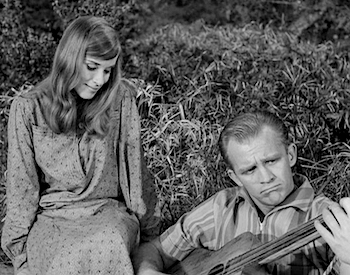
Come Wander with MeThe next episode in our rundown is also based around a song: Come Wander with Me, in which a wandering singer attempts to buy a folksong from a young woman, only to find he might be living the lyrics… maybe. It’s a bit unclear what’s really happening, or why. It’s got some nice ideas, with mysterious characters, the haunting song, and some atmospheric direction by Richard Donner, but it comes to no kind of conclusion. How has this happened before? Has it happened before? Why is it happening again now? The episode barely even begins to ask those questions, never mind answer them; and not in a Lynchian “it’s up to your interpretation” way, which would be fine, but it doesn’t even seem to be aware those questions exist. Frustrating.

The Brain Center at Whipple’s is set in the future year of 1967, when a company is replacing tens of thousands of staff with a machine. What an implausible notion, eh? This episode is no more than a rather dated lecture about automation — the warning has been ignored, but none of the terrible things foretold have come to pass (…yet). The ending is both painfully obvious (Mr Whipple himself gets replaced by a machine) and silly (said machine is Robby the Robot from Forbidden Planet, waddling around Whipple’s office spinning a keychain for no reason other than Mr Whipple used to). It doesn’t help any that “Whipple” is an inherently silly-sounding name.

Next up is one of the show’s frequent excursions into the Old West in Showdown with Rance McGrew. They surely made sense at the time, when Westerns were ubiquitous on US TV, but if you didn’t know that it can seem a bit weird that a sci-fi/fantasy show is so obsessed with the era. You do need to know that context for this episode, though, because it’s actually a riff on all those TV Westerns. The first half is basically a spoof of them, which I imagine was rather effective back in the ’60s, because it remains moderately amusing now. After establishing that the show’s star is a bit of a prima donna sissy, he’s magically transported back to the real West, where he must face up to the actual Jesse James, who’s been watching the show and is none too impressed. It’s quite a fun episode, but the idea that gunslingers in the afterlife spend all their time watching movies and TV and getting their feelings hurt about how they’re portrayed is… well, it feels kinda daft, but eh, why not? It makes me wonder if Serling didn’t like Westerns or their attitude to history, and so this whole episode was just an exercise in critiquing them. As such, it’s not too bad.
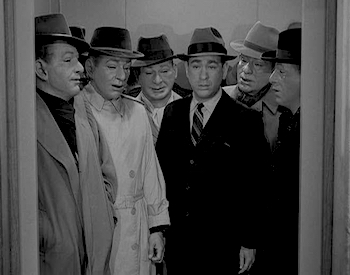
The Mind and the MatterThe ‘hero’ of The Mind and the Matter hates people. They bump into him on the subway; they squish against him in the elevator; they accidentally pour coffee over him at work. If he had his way, all the people would just disappear. After he reads a book about the power of the mind, he instantly gains the power to make his thoughts real (no practice required, apparently), and so immediately does away with everyone else. Hurrah! But after a morning’s work in peace and quiet, he’s bored, with no idea what to do. So the first thing he imagines to enliven his world is… an earthquake. Um, what? Unsatisfied with imagining different weather phenomena, and apparently unable to conceive of anything else whatsoever to occupy his interest, he decides to fill the world with people just like him. That results in a world full of grumblers and moaners, which he finds even more distasteful than how it was before — so he just puts it all back. It’s almost a lesson in what happens if you give unlimited power to unimaginative people… except that’s not the point the episode actually wants to make, so it doesn’t really make it. Instead it’s going for “this world isn’t perfect, but it’s better than the alternative and there’s a lot to like”. But it doesn’t make us feel that, it just tells us it. Heck, even the character doesn’t feel it — he’s just as miserable at the end as he was at the start. The whole affair is sort of an infinitely stupider rehash of the classic Time Enough at Last, only without any ironic point. And there are some terrible prosthetic effects, which I struggle to believe convinced anyone even on low-res ’60s TV. Basically, it’s a wholly inadequate episode from every angle.

Finally for now, The Mirror is the story of a Castro-analogous rebel general (played by Peter Falk) who has successfully taken control of his Central American country, when the former ruler introduces him to a magic mirror that will show any would-be assassins — which just so happens to be more-or-less everyone he knows. I guess it’s meant to be a study in paranoia, although Serling’s opening and closing voiceovers seem to be framing it more as a criticism of tyrants. As the latter, it borders on propaganda, which kind of undermines the former. It’s a reasonable concept, thinly executed.

Also watched…
  • Elementary Season 6 Episodes 1-14 — I last watched this modern-day Sherlock Holmes in 2017 (and last properly commented on it here in 2016), which I guess shows my level of dedication to it. In truth, I’ve warmed to it over the years. I’m still not convinced it’s a faithful adaptation of the original characters (and certainly not of the stories), but, taken on its own merits, it has good qualities. My favourite of those: the way it’s sometimes prepared to offer quite outlandish storylines, ones that border on science-fiction or pulp genre fare, rather than your bog-standard procedural homicide stuff.
  • Eurovision 2020 — Didn’t actually happen, of course. In its place, the BBC offered a special called Come Together, in which past highlights chosen by a panel of experts were voted on by the public. There were some spectacularly weird choices in there, and of course Waterloo won. That was followed by the official replacement show, Europe Shine a Light. The title is a reference to the last time the UK actually won — were they attempting to keep us on side? It was an odd affair, but still entertaining in its own way. There’s nothing quite like Eurovision… and this wasn’t quite like Eurovision. Still, I suspect it’ll be better than that Netflix film, if its trailer is anything to go by.
  • The Great British Bake Off Series 9 — Beginning a catch-up on the last couple of series. This is the 2018 one, if you need a point of reference. Also watched all of companion show An Extra Slice, which is sometimes even better than the main programme, mainly thanks to Tom Allen’s caustic humour.
  • The Rookie Season 1 Episodes 16-20 — Another handful of episodes (spanning from the unexpected, emotionally devastating Greenlight to the gripping and now-timely season finale (it’s about the risk of a deadly virus released into the population)) that remind this is a more-than-solid example of a US network TV police drama. Looking forward to season two… though with US networks currently cancelling many police-related series, I guess a third season looks uncertain.
  • Star Trek: Picard Season 1 Episode 8 — Just in case you think I’d forgotten about it. Hey, next month I might finish it!

    Next month… I’m not aware of anything in particular coming up, so hopefully I’ll finally dig into my massive pile of “stuff I’ve been meaning to get round to”. Roll a dice for whether that means The Mandalorian or Devs or Killing Eve or Westworld or Jack Ryan or Jessica Jones or The Witcher or Veronica Mars or Peaky Blinders or The Boys or…

  • The 100-Week Roundup IV

    When I started my 100-Week Roundup project, I thought I’d be posting a lot of unedited notes and/or summary paragraphs skirting across multiple films (like I did in my FilmBath shorts roundup, for example). Instead, I’ve mostly still been writing full, albeit short, reviews. Well, that continues here, although these reviews often stop dead rather than being fully-formed pieces.

    Today’s roundup contains the remainder of my unreviewed films from June 2018, with one exception: A Thousand and One Nights, the first film in the Animerama trilogy, which I intend to review along with its two brethren. I watched the second of those in 2019 and the third just this month, so that’ll come up in due course.

    As for what’s still here, if these weren’t linked by the theme of when I watched them, maybe I’d’ve bundled them together for having the same star rating. They are…

  • Doubt (2008)
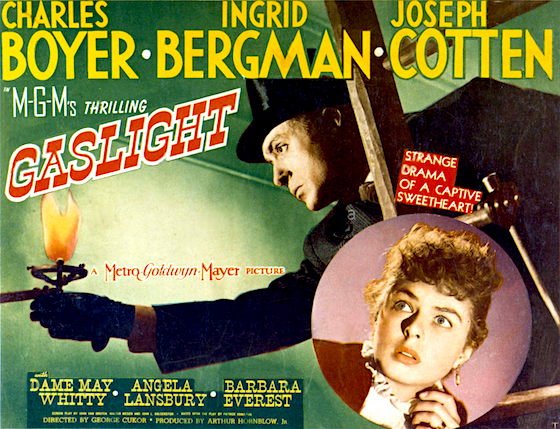
  • Gaslight (1944)
  • The Florida Project (2017)
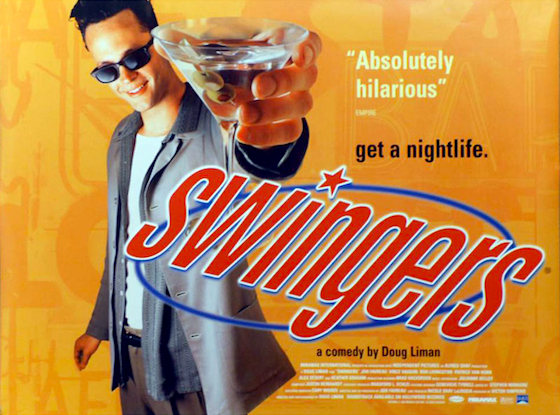
  • Swingers (1996)
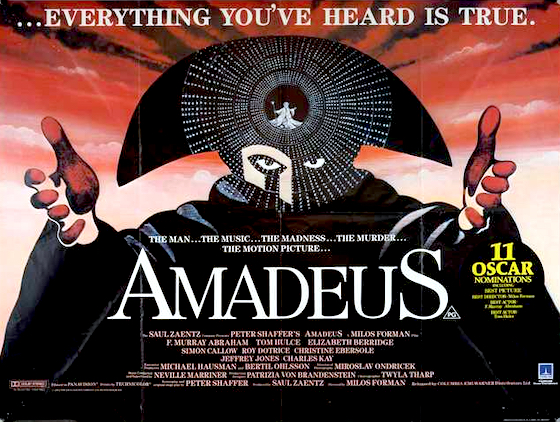
  • Amadeus: Director’s Cut (1984/2002)
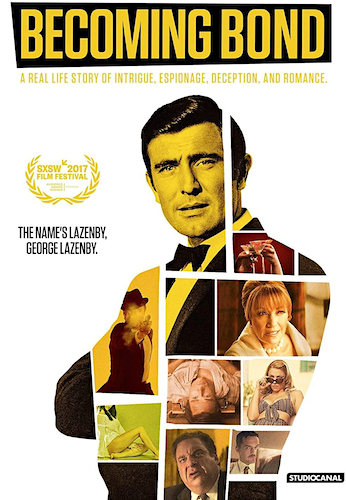
  • Becoming Bond (2017)


    Doubt
    (2008)

    2018 #133
    John Patrick Shanley | 104 mins | download (HD) | 1.85:1 | USA / English | 15 / PG-13

    Doubt

    It’s funny how time can change perspective. For instance: Doubt is a drama starring three widely acclaimed powerhouse actors, Meryl Streep, Philip Seymour Hoffman, and Amy Adams… except Adams doesn’t get above-the-title billing, which, yeah, is a bit of an inside technicality for people who are aware of these kind of things, but does remind you that this came out just a year after Enchanted helped propel her to mainstream awareness. But at least she makes the poster, unlike Viola Davis.

    All four stars earnt Oscar nominations (Adams and Davis went up against each other for Supporting Actress, which was instead won by Penélope Cruz for Vicky Cristina Barcelona), which only seems fair. The film may set itself up as a mystery (did this priest abuse a child?), but the film’s real qualities lie not in the investigation, but in the people involved — the confrontations, the act-offs, between these great players, all of whom give powerful, nuanced performances,

    This is a film that leans on ambiguity in almost every regard. I mean, we know what it’s about, and yet no one ever even outright says what they suspect the priest of, they just intimate it. It’s also there in the morality, which moves in shades of grey, something such emotive subject matter could easily lose in lesser hands. Writer-director John Patrick Shanley earnt the film’s fifth and final Oscar nomination for the screenplay he wrote based on his own play (losing to the ubiquitous Slumdog Millionaire), and that also seems well deserved.

    4 out of 5

    Gaslight
    (1944)

    2018 #134
    George Cukor | 109 mins | TV | 4:3 | USA / English | PG

    Gaslight

    In modern parlance, “gaslighting” is when you manipulate someone into disbelieving something they (correctly) believed was true, which has come up an awful lot in the past few years thanks to the actions of politicians in particular. It’s a bit of a random term, but that’s because it stems back to the plot of this film (and/or the 1938 play it’s adapted from, or the 1940 British film that inspired MGM to buy the remake rights to produce this version, which was originally titled The Murder in Thornton Square in the UK to avoid confusion). The connection comes because it stars Ingrid Bergman in an an Oscar-winning turn as Paula, whose new husband messes with her sanity to cover up his criminal activities.

    Leaving aside its cultural importance, as a tale in its own right this version of Gaslight is well performed and directed, but Evil Husband’s scheming is so damned obvious from very early on (at least to modern eyes_ that it becomes a bit of a finger-tapping exercise in waiting for someone, anyone, to do anything about it. I guess part of the point is that it’s a long, slow game of convincing her she’s mad, but it still felt like it needed to get a wriggle on to me. We know what he’s doing and how he’s doing it — how it will be undone and saved is what we’re left waiting (and waiting) for.

    At least it’s worth the wait, with a helluva climactic scene where Paula turns all her husband’s lies back against him. What it lacks in suspense it makes up for with a fantastically committed performance from Bergman, which evolves gradually and believably over the course of the film, and gets some excellent showcase moments too, not least the aforementioned confrontation. As her husband, Charles Boyer makes for a suitably sneering villain — too suitable, in a way, in that it’s almost hard to believe Paula would ever fall for him.

    4 out of 5

    The Florida Project
    (2017)

    2018 #136
    Sean Baker | 112 mins | streaming (HD) | 2.35:1 | USA / English | 15 / R

    The Florida Project

    A story of life on the poverty line in modern America, about a young single mother and her six-year-old daughter struggling to make ends meet in Kissimmee, Florida. You’d be forgiven for not having heard of the city, unless you’ve visited its neighbouring tourist magnet: Walt Disney World.

    It’s a slice-of-life kind of film — relatively light on plot, more about showing the difficulties of the characters’ lives. Some viewers will (indeed, have) lose patience with it for that, and at times it does feel a little long in the tooth. It’s worth sticking with, but paring it back by 10 or even 20 minutes would help.

    It’s mostly shown from the kid’s point of view, but there’s enough there that, as adults, we can see the struggles and choices the adults are dealing with. That these kids’ hand-to-mouth make-your-own-fun lives exists in the shadow of expensive, hyper-consumerised Disney World would seem like a contrivance were it not a truth, and the film acknowledges the juxtaposition (it’s hard not to — Disney is everywhere over there) without leaning into it too heavily (although the film’s title is a reference to how Disney referred to the park while it was in development).

    It’s a portrait that’s sympathetic to these people and their lives. How objective is it? It doesn’t blame them for the situation, but also shows it isn’t right, especially in their (limited) interactions with the authorities — maybe if there was different, better help offered earlier, the actions they eventually have to take wouldn’t be necessary.

    The film’s final sequence sits weirdly with the rest of the movie, which provokes some to write if off. The contrast is clearly a deliberate choice, but I’m not sure how I feel about it — it smacks of not knowing how to end the movie, or wanting to put a more upbeat capstone on something that’s become too depressing. It’s certainly striking, at least.

    4 out of 5

    Swingers
    (1996)

    2018 #141
    Doug Liman | 96 mins | streaming (HD) | 1.85:1 | USA / English | 15 / R

    Swingers

    To be honest, this is one I watched more out of box-ticking (of Doug Liman films) and vague curiosity (it’s sometimes (though decreasingly, I feel) mentioned as a key work of ’90s indie cinema), but I wound up genuinely enjoying it. It’s not what I expected from the posters and blurb — I thought it’d be all about slick operators and The Scene, but really it’s about some jobbing twentysomething mates just living and trying to have fun during the swing revival in ’90s Hollywood. In other words, it’s a lot less obnoxious than I’d feared. In fact, it has a kind of sweet positivity. That even extends to Vince Vaughn, who’s playing kind of a dick as usual, but he’s kinda likeable anyway. That said, if you cringe and squirm at people making fools of themselves in social situations (as I do), oh boy, this film has some examples that are more uncomfortable than any horror movie.

    It feels typically ’90s in so many ways, but then as it’s about the ’90s lifestyle, that’s wholly apt. One aspect of this is its cinematic literacy. For example, the characters debate whether Tarantino is copying or homaging Scorsese, and then later the film both homages (or copies) Reservoir Dogs and Goodfellas. And like Tarantino, the film came to be an influence on the ’90s itself, through catchphrases like “you’re so money” and “Vegas, baby!”, and popularising the term “wingman”. There’s probably a whole book to be written on the self-referential-ness of ’90s culture as an expression of angst at the forthcoming millennium, or something like that.

    4 out of 5

    Amadeus:
    Director’s Cut

    (1984/2002)

    2018 #142
    Miloš Forman | 180 mins | download | 2.40:1 | USA, France & Czechoslovakia / English | PG / R

    Amadeus

    The story of the one-sided rivalry between court composer Salieri (F. Murray Abraham) and wunderkind Mozart, aka Wolfgang, aka Wolfy (to his wife) — who also had the middle name Amadeus, of course, which for some reason lends itself as the title. (As per IMDb Trivia, “an important theme of movie is the change of Salieri’s belief in God. That might have been the reason for the title Amadeus, which means ‘love of God’.”)

    Amadeus‘s reputation places it as a 10-out-of-10 absolute-classic kind of Great Movie, including ranking in the top 100 of IMDb’s Top 250, the top 200 of Letterboxd’s equivalent, and placing on various other lists, like the 1,000 Greatest Films. I wouldn’t go that far, personally, although I did think it was good. There are very strong performances (amusingly, Tom Hulce studied the temperamental behaviour of John McEnroe to help inform his interpretation of Mozart). There are great depictions of music and its creation. The production values are strikingly high, including sumptuous sets, locations, and costumes; nice camerawork (apparently the entire film was shot with natural light, which makes the cinematography even more impressive); and some spots of excellent editing.

    The version released theatrically in 1984 was cut down to 160 minutes because, according to Forman, it was the era of MTV: a long movie about classical music was already a risk, so it was decided to limit the running time. 2 hours 40 minutes is hardly shot, though, is it? Anyway, come 2002 and the DVD release, Forman felt they may as well recreate the film as written, leading to the longer cut, which has since become the standard version (it’s even the one shown on TV, which is by no means guaranteed with director’s cuts, I find). Forman says the shorter version was created by ditching every scene not directly related to the plot, though I’m not sure how much I buy that. Having read what was added back, I’m sure an awful lot more could’ve gone without impacting the story a great deal, if that was indeed their goal. One thing the longer cut did achieve was up its US certification from a PG to an R, thanks to a brief appearance by boobies. Oh, you prudish Americans!

    The film also inspired the song Rock Me Amadeus. Now that’s something I might give five stars.

    4 out of 5

    Amadeus was viewed as part of What Do You Mean You Haven’t Seen…? 2018.

    Becoming Bond
    (2017)

    2018 #144
    Josh Greenbaum | 96 mins | streaming (HD) | 2.35:1 | USA / English | 15

    Becoming Bond

    A documentary about the life of George Lazenby, most famous — or, rather, only famous — for replacing Sean Connery as James Bond for the sum total of one film. The blurb tries to spin it as “a unique documentary/narrative hybrid”, but it’s just a docudrama — i.e. a documentary with some scenes dramatised by actors. In fact, it’s basically just an interview with Lazenby that’s been dressed up with reenactments.

    Lazenby comes across as likeable and it’s a helluva story, and it doesn’t hurt that they’ve had a lot of tongue-in-cheek fun with how the recreations are done (swearing, sex, nudity, hanging boots off erections…) It’s mostly a “mad, true story” kinda thing, but it pulls out some surprisingly heartfelt, emotional stuff later on, including regret of opportunities missed (and not just Bond ones). The only significant downside comes from being a British viewer, because the dramatisations were all clearly shot in the US with American actors: most of the British and Australian accents are terrible; their idea of the exterior of a British pub is questionable; frankly, I’m amazed they even bothered to use right-hand drive cars (err, most of the time).

    (Bit of an aside, but just think: there’s an alternate universe somewhere in which Lazenby didn’t behave like an idiot and instead starred in Diamonds Are Forever, and therefore probably carried on into Live and Let Die and The Man with the Golden Gun, and maybe The Spy Who Loved Me and Moonraker too… And I guess in that universe Roger Moore never played Bond (because surely they wouldn’t’ve cast him for the first time when he was over 50, would they?) Funny to think about, isn’t it?)

    There’s an interview clip included where David Frost asks Lazenby if he carries on the James Bond thing in real life, and Lazenby says no, it’s just a movie, no one could carry on like that in real life — which is funny because we’ve just been hearing all about how Lazenby basically did lead Bond’s life (minus, you know, the spying and killing). Whether that’s actually a desirable way to lead an entire life… you be the judge.

    4 out of 5

  • The 100-Week Roundup III

    In this selection of films I watched back at the end of May / start of June 2018…

  • The Wild Bunch (1969)
  • The Wild Bunch: An Album in Montage (1996)
  • The Warriors (1979)
  • Power Rangers (2017)
  • Three Billboards Outside Ebbing, Missouri (2017)


    The Wild Bunch
    (1969)

    2018 #115
    Sam Peckinpah | 139 mins | streaming (HD) | 2.40:1 | USA / English | 18 / R

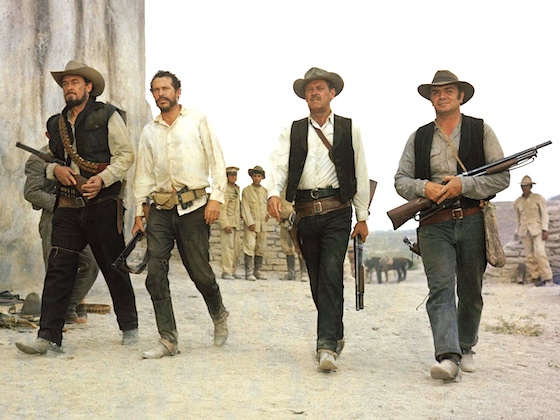
    The Wild Bunch

    After a gang of ageing crooks’ “one last job” goes sideways, they agree to rob a munitions train for a Mexican general, even as they’re hunted by a militia reluctantly headed by their leader’s former partner.

    The Wild Bunch is, of course, a Western, but it’s set in 1913 — not a time we particularly associate with “the Old West”. Well, change doesn’t happen overnight. And it certainly takes that “end of an era” thing to heart as a tale of old men, whose way of life is fading away. It’s also a ‘late Western’ in terms of when it was produced: this isn’t an old-fashioned “white hats vs black hats” kinda adventure, but one full of ultra-violence with a downbeat ending. The opening sequence gets pretty bloody, and then the climax is an absolute orgy of violence. It’s still almost shocking today, so you can see how it was controversial back in 1969.

    It’s not just the presence of violence and blood that’s remarkable, though, but how it’s presented, both in terms of filmmaking and morals. To the former, the speed of the cutting was groundbreaking at the time: reportedly it contains more cuts than any other Technicolor film, with 3,643 cuts in the original print. If that’s true, it gives it an average shot length of about 2.4 seconds. For comparison, the average in the ’60s was around 6 or 7 seconds, while even Moulin Rouge, a movie made decades later that was still notorious for its fast cutting, has an average shot length of 2.01 seconds. It’s not just speed that makes the editing so noteworthy, but its effectiveness, making juxtapositions and using shots to both tell the story and create the impression of being in the thick of it.

    Bad boys

    As for the morals, the film was all about showing these violent men as unheroic and unglamorous, setting out to “demystify the Western and the genre’s heroic and cavalier characters” (to quote IMDb). That piece goes on to say that screenwriters Sam Peckinpah and Walon Green “felt that this project required a realistic look at the characters of the Old West, whose actions on screen had rarely matched the violent and dastardly reality of the men on which they were based… Both Green and Peckinpah felt it was important to not only show that the film’s protagonists were violent men, but that they achieved their violence in unheroic and horrific ways, such as using people as human shields and killing unarmed bystanders during robberies.”

    Of course, antiheroes are ten-a-penny nowadays, so the idea that “men who commit violence are bad” doesn’t play as revolutionary anymore. Indeed, The Wild Bunch can be enjoyed as an action movie — there’s the opening and closing set pieces I’ve already mentioned, plus an excellent train robbery and ensuing chase in the middle too, and a couple of other bits. That said, the film has more on its mind than just adrenaline-generating thrills, and so (based on comments I’ve read elsewhere online) if you are watching just for action it can feel like a bit of a slog. While I wouldn’t be that critical, I did find it a bit slow at times. The original distributors must’ve felt the same, as the film was cut by ten minutes for its US release. (The version widely available today is the original 145-minute director’s cut. I watched a PAL copy, hence the 4% shorter running time.)

    4 out of 5

    The Wild Bunch was viewed as part of my Blindspot 2018 project.

    The Wild Bunch:
    An Album in Montage

    (1996)

    2018 #115a
    Paul Seydor | 33 mins | DVD | 4:3 | USA / English | 15

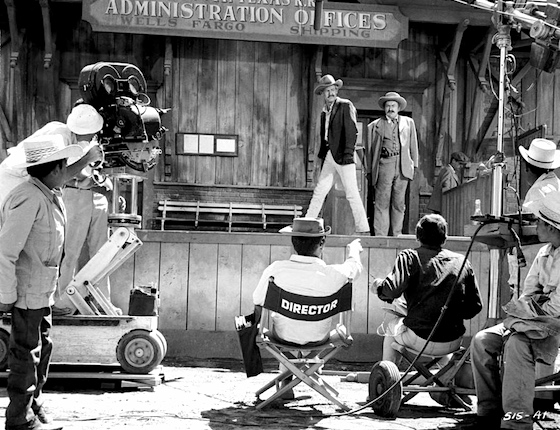
    Behind the scenes of The Wild Bunch

    This film came to exist because someone found 72 minutes of silent black-and-white behind-the-scenes footage shot during the filming of The Wild Bunch. No one knows why it was filmed — this was a long time before the era of EPKs and DVD special features. And, indeed, if it had been discovered just a couple of years later then a DVD special feature is exactly what it would’ve become; but, being just ahead of that, it ended up as a short film — an Oscar-nominated one at that, going up for the Best Documentary Short prize in 1997. Naturally, it has since found its rightful home as a special feature on DVD and Blu-ray releases of its subject matter.

    The silent film footage is accompanied by voice over of first-hand accounts from the people involved, either taken from recorded interviews (people like screenwriter Walon Green and actors Edmond O’Brien and Ernest Borgnine represent themselves) or actors reading out comments (Ed Harris is the voice of Sam Peckinpah, for example). From this we get not only making-of trivia and tales, but also discussion of the filmmakers’ intent and the film’s meaning. More material along the lines of the latter would’ve interested me.

    As it is, An Album in Montage feels very much at home in its current situation as a DVD extra. Fans of the film will certainly get something out of it, but I don’t think it’s insightful enough to stand independently. It’s by no means a bad little featurette, but it’s not worth seeking out outside of the context of the film itself.

    3 out of 5

    The Warriors
    (1979)

    2018 #123
    Walter Hill | 89 mins | streaming (HD) | 16:9 | USA / English | 18 / R

    The Warriors

    In the near future, a charismatic leader summons the street gangs of New York City in a bid to take it over. When he is killed, The Warriors are falsely blamed and now must fight their way home while every other gang is hunting them down.IMDb

    And that’s all you need to know, because The Warriors’ plot is really simple and straightforward, but that’s part of why it works. It doesn’t need dressing up; it’s got an almost an elegant directness, and it thrives off that. The action sequences feel unchoreographed, with a bruising realism in spite of their sometimes elaborate setups (duelling baseball bats!), and yet they carry an energy and impact that is wholly in keeping with something carefully designed and constructed. The characters are simply drawn, revealed through their actions rather than telegraphed Character Moments or heartfelt speeches. Similarly, the kind-of-romance between the Warriors’ leader and the girl they run into on the streets is so well handled — okay, there are some scenes where they almost talk about it directly, but mostly it’s just moments or lines that indicate a world of feeling. The way this character stuff is sketched in — subtly, sometimes in the background — is quite masterful, actually.

    Such skill extends throughout the film’s technical side. For all the film’s ’70s grit, there’s some beautiful stuff in the editing and shot choices, especially at the end on the beach. It’s not just beauty in an attractive sense, but meaningful, effective imagery, in a way that impresses without being slick or pretty. The music choices are bang-on too. The film intercuts to a radio station that functions like some kind of Greek chorus, linking the action and helping to create a heightened atmosphere — one that’s there in the whole film, incidentally, with its colourful gangs and detached police presence — without ever shattering the down-to-earth, gritty, almost-real feel the whole thing has.

    Gang wars

    I loved The Warriors, and I think that last point is a big part of why: it sits at an almost inexplicable point where it feels incredibly grounded, gritty and realistic, but at the same time a heightened fantasy kind of world. Here I’m trying to describe why I adored the film bu breaking it down into these constituent parts, but there’s something more to it than that — a kind of magic where it just… works.

    All of that said, it seems I was lucky to catch the original version (via Now TV / Sky Cinema), rather than the so-called Director’s Cut that seems to be the only version available on Blu-ray. Looking at the changes, they don’t seem particularly in keeping with the tone of the movie, smacking of decades-later revisionism. Apparently there’s also a TV version that includes 12 minutes of additional scenes, none of which are included on the film’s disc releases. I wish Paramount would license this out to someone like Arrow to do it properly…

    5 out of 5

    The Warriors placed 11th on my list of The 26 Best Films I Saw For the First Time in 2018.

    Power Rangers
    (2017)

    2018 #126
    Dean Israelite | 124 mins | streaming (HD) | 2.35:1 | USA, Hong Kong, Japan, Mexico, Canada & New Zealand / English & Mandarin | 12 / PG-13

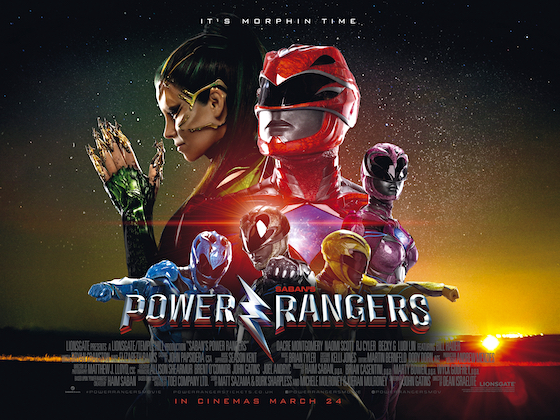
    Power Rangers

    High school outcasts stumble upon an old alien ship, where they acquire superpowers and are dubbed the Power Rangers. Learning that an old enemy of the previous generation has returned to exact vengeance, the group must harness their powers and use them to work together and save the world.IMDb

    Far from the cheesy TV series of old, this Power Rangers reboot clearly wants to be a somewhat gritty, largely realistic, socially conscious take on the concept. But it’s like it was written by people behind the original, because it’s still full of clunky dialogue, earnest characters (with a thin veneer of outsider ‘cool’), and nods to serious issues without having the time or interest to actually engage with them. Like, one of the kids is the sole carer for his sick mother, or another is on the autistic spectrum, but, beyond spending a line or two to tell us these things, those issues have no bearing on the plot or the characterisation. Plus, it can’t overcome some of the fundamental cheesiness of the original. And when it tries to give in to it, like by playing the Power Rangers theme the first time the giant “dinocars” run into action, it’s too late for such shenanigans and the tones clash horrendously. It wants to escape the tackiness of the original series, but simple can’t.

    And somehow it gets worse as it goes on. The early character stuff is derivative but alright. Then you begin to realise how shallow it is. You’re waiting for the super-suits to show up and the action to start. Then you have to wait some more while it works through plot beats so stale it can’t even be bothered to play them out fully. Then, when the suits finally arrive and the action starts, turns out it’s the worst part of the movie. Almost entirely CGI, under-choreographed, a mess of nothingness with little correlation from shot to shot, no sense of rhythm or construction. When their dinocars all merge into one giant dinocar, the villain screams “how?!”, and you will feel the same.

    Bryan Cranston (yes, Bryan Cranston is in this) tries to inject some character into his role, but it’s too underwritten and his screen time too slight to let him do much with his supposed arc. Elizabeth Banks, meanwhile, is barely in it and has no arc whatsoever, but she chews scenery like a pro. She seems to be aware it’s all stupid and over the top and plays it appropriately.

    2 out of 5

    Three Billboards Outside Ebbing, Missouri
    (2017)

    2018 #127
    Martin McDonagh | 115 mins | Blu-ray | 2.39:1 | UK & USA / English | 15 / R

    Three Billboards Outside Ebbing, Missouri

    a darkly comic drama from Academy Award nominee Martin McDonagh. After months have passed without a culprit in her daughter’s murder case, Mildred Hayes (Frances McDormand) makes a bold move, painting three signs leading into her town with a controversial message directed at William Willoughby (Woody Harrelson), the town’s revered chief of police. When his second-in-command, Officer Dixon (Sam Rockwell), an immature mother’s boy with a penchant for violence, gets involved, the battle between Mildred and Ebbing’s law enforcement is only exacerbated.IMDb

    As well as being as deathly serious and sometimes horrifying as the subject matter deserves, Three Billboards is also as funny as you’d expect from the writer-director of In Bruges. Not to the extent — the subject matter is far too serious for it to be an outright comedy like that — but in subplots and interludes it’s hilarious.

    It’s got a helluva cast, and all of the performances are excellent. Frances McDormand is so fucking good that she even manages to make talking to a badly CGI’d deer incredibly emotional. Apparently some people had a massive problem with the film’s treatment of Sam Rockwell’s character, I think because he was a bad guy who got redeemed. But, really, imagine thinking people who once did bad things can never turn themselves around and be better people. What a pessimistic way to view the world. And yet I guess that’s what today’s “cancel culture” is all about.

    Two outta three ain't bad

    It’s nicely shot by DP Ben Davis (except for that deer), while Carter Burwell’s Western-esque score has some really cool bits. It really emphasises the film’s formal overtures at being a revenge Western, even if the way it goes down in the end doesn’t necessarily support such a reading.

    There was a huge backlash to the film at some point; bring it up online and you’re likely to come across people who assume everyone hates it… but it’s got 90% on Rotten Tomatoes and is still ranked the 150th best film of all time on IMDb, so I think we know where the majority stand. I’m happy to stand with them.

    5 out of 5

    Three Billboards Outside Ebbing, Missouri placed 14th on my list of The 26 Best Films I Saw For the First Time in 2018.

  • Once Upon a Time… in Hollywood (2019)

    2019 #120
    Quentin Tarantino | 161 mins | cinema | 2.39:1 | USA, UK & China / English | 18 / R

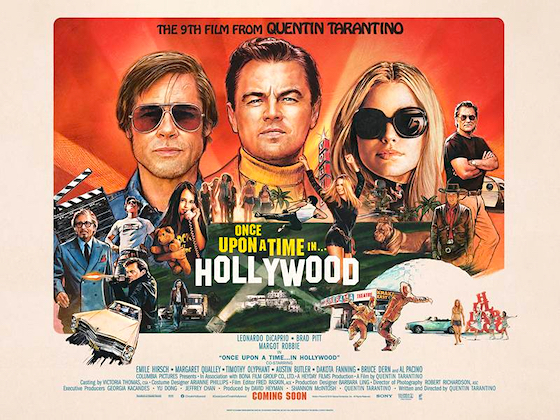
    Once Upon a Time in Hollywood

    The 9th film by Quentin Tarantino follows the fortunes of struggling actor Rick Dalton (Leonardo DiCaprio) and his stuntman and best mate Cliff Booth (an Oscar-winning Brad Pitt) over a couple of days in Los Angeles, 1969, when they were next-door neighbours to one Sharon Tate (Margot Robbie)…

    I haven’t reviewed Once Upon a Time until now because I didn’t have much to say about it (even my Letterboxd ‘review’ was just a comment on its variable title presentation). Even after reflecting on it, and reading other’s critical reactions, then reflecting on it some more (for over eight months at this point), I didn’t have much to contribute. Why was that? And I’ve kind of realised it’s because the film didn’t make me feel very much.

    Sure, there are moments where it did. There are plenty of scenes that are amusing, to varying degrees. The tension as Cliff explores the house of an old friend that’s been occupied by a bunch of hippies. The catharsis and humour of the ultra-violent climax, and the attendant cognitive dissonance of whether we should be revelling so in this historically-revisionist execution of real people — not to mention the factors that further complicate that (you know what they are by now).

    And overall I didn’t dislike the film. I wasn’t bored, despite the length; if anything, that helps suck you into the world of 1969. You can certainly feel Tarantino’s love for the era, his desire to recreate — and, indeed, improve — it. (It’s also clear that he really wants to make another Western. The excerpted scenes from Rick’s TV pilot go on for ages, ultimately contributing nothing to the overall story, other than getting to hang out in a ’60s TV Western.) The three main performances are all very good, DiCaprio and Pitt great both as a double act and in their own storylines, and Robbie off in her own little world in a role that arguably offers little on the page but she breathes so much life into.

    “Don’t cry, man. It’s only one blogger's opinion.”

    It’s all these successes that mean I do consider Once Upon a Time to be a very good film. But at the same time, I didn’t leave the cinema feeling moved or wowed. I expected the history-changing ending ever since the film’s plot was announced, that expectation only cemented further as I learnt of Tarantino’s love for Tate, so I certainly didn’t leave feeling surprised. It ended, and that was that, and I went home.

    Tarantino has talked in the past about how Jackie Brown is a “hangout movie”, where the point is not the story but spending time with the characters, and getting to re-spend that time when you watch the movie again, so that you enjoy it more and more with each viewing. I didn’t really get that feeling from Jackie Brown (I didn’t dislike it, but I was underwhelmed and in no rush to revisit it), but I wonder if that’s how Once Upon a Time will work best. The way it wanders through its loose narrative, before arriving at a climax that is, really, only tangentially related to everything else we’ve been watching, does suggest that’s the goal Tarantino had in mind. I can certainly believe he would like to just hang out in the world of Hollywood, 1969. I suspect that’s the driving factor behind why he even made this movie — getting to imagine an alternate history and career for his characters (I’ve seen interviews where he fills in way more backstory than is actually in the film), and using his clout to literally recreate that time and place in real-life rather than through CGI fill-ins.

    So, it’s a movie I’ll surely revisit at some point, which is more than can be said for many a film. Perhaps then I’ll have something to say about it.

    5 out of 5

    Once Upon a Time in Hollywood is available on Sky Cinema and Now TV from this weekend.

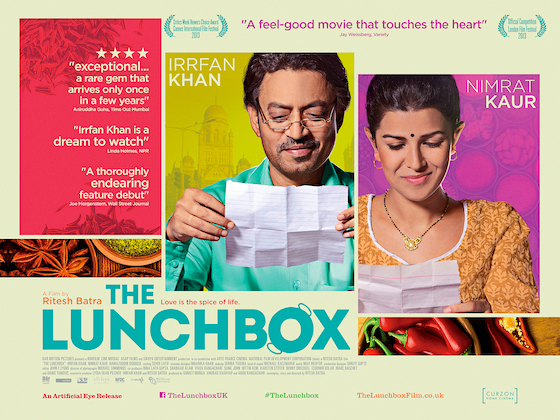
    The Lunchbox (2013)

    2020 #94
    Ritesh Batra | 99 mins | download (HD) | 2.35:1 | India, France, Germany & USA / Hindi & English | PG / PG

    The Lunchbox

    Yesterday the world heard the sad news that the actor Irrfan Khan had passed away aged just 53. An award-winning film star in India, Khan also had a noteworthy presence as a supporting actor in Western films — the police inspector in Slumdog Millionaire; the owner of the eponymous park in Jurassic World; the adult version of the main character in Life of Pi; not to mention The Darjeeling Limited, The Amazing Spider-Man, Inferno, and more. I’d seen all of those films and noted Khan’s presence — he’s the kind of actor who turns up and elevates the film almost just by being there, bringing a depth and interest to even the smallest roles. But I’d never seen any of the many films (he has 151 acting credits on IMDb) in which he played the lead, so it seemed appropriate to turn to one of the most internationally acclaimed of his films, The Lunchbox, in tribute.

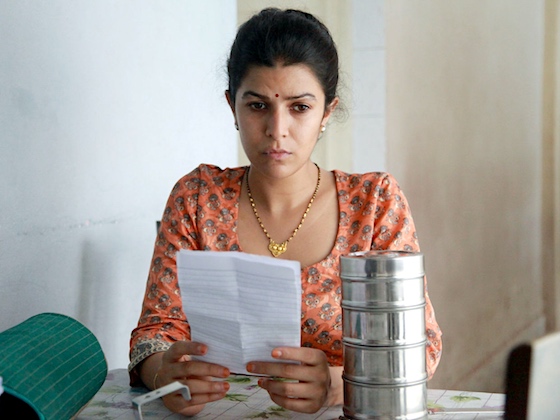
    Khan plays Saajan, an office worker who receives his lunch every day via the dabbawala service. It’s a remarkable network that delivers 200,000 lunches daily across Mumbai with unerring accuracy. Indeed, their precision is so famed that one of the major criticisms of this film in some quarters was that its premise is too far-fetched — that being that, due to a continued mixup, Saajan begins to receive the lunches Ila (Nimrat Kaur) has prepared for her husband, rather than the ones he ordered from a local restaurant. He’s so impressed with the quality of the food, when the lunchbox is returned Ila observes that it looks to have been licked clean. This is good news, because she was trying to up the quality of her lunches as a way to reignite her stagnant marriage; but when her husband returns home still disinterested, with only thin praise for something she hadn’t even included in his lunch, she realises the delivery mistake immediately. But politeness compels her to send lunch again, this time with a note explaining the mixup. After a rocky start, soon Saajan and Ila are in daily communication through short letters passed back and forth in the lunchbox.

    Saajan

    Both are characters desperately in need of that connection. Ila’s loveless marriage, and young daughter who spends most of the day at school, means her primary human contact comes in shouted conversations with her upstairs neighbour. Saajan, meanwhile, is taking early retirement, but first must train Shaikh (Nawazuddin Siddiqui), the overeager new recruit appointed to replace him. He tries to duck even this level of interaction; at home, he tells off kids for playing in the road outside his house, refusing to return their ball. We could infer Saajan is a misanthrope, and the impression is given that his colleagues do (they share a story that he once kicked a cat in front of a bus then casually walked away), but the film affords us more insight than that, primarily through Khan’s performance. It’s the underlying sadness in his eyes that first give the clue to his true loneliness, and the way his demeanour begins to brighten as the relationship with Ila brings a spark back into his life.

    Lest you think this is all somewhat dour, the way it plays is uplifting. Saajan and Ila may be miserable at the start, and continue to confront problems in their lives throughout the film, but their connection injects a measure of happiness into both their lives, the mutual support helping them through. Plus there’s a strong vein of humour, at first from the faltering beginnings of our leads’ relationship, then from the antics of Siddiqui’s junior employee. This isn’t the kind of broad comedy you might expect from a Bollywood movie, but something more grounded and closer to reality. At first Shaikh seems as irritating to us as he is to Saajan, but soon the latter’s growing empathy leads him to become a father figure to the younger man, and we too begin to see the truth underneath his cheery facade.

    Ila

    While that subplot is a bonus, the film really comes down to Saajan and Ila, and consequently the performances of Khan and Kaur. That’s particularly important because so much of the story occurs in the form of letters, and so the characters’ true reactions come across in doleful expressions, or changes in posture or behaviour; subtle, human indicators that leave us in no doubt what they’re feeling, and only strengthen our own connection to and investment in these characters. This pair of deeply-felt performances carefully steer The Lunchbox into being a heartfelt, quietly affecting film.

    5 out of 5

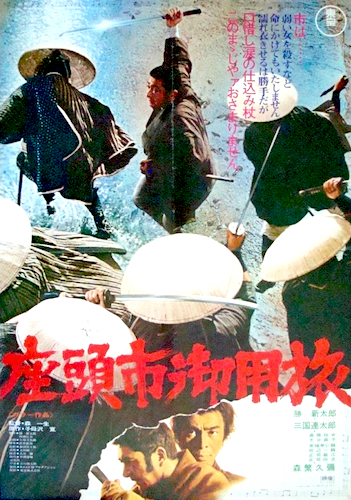
    Zatoichi at Large (1972)

    aka Zatôichi goyôtabi

    2019 #118
    Kazuo Mori | 88 mins | Blu-ray | 2.35:1 | Japan / Japanese | 15

    Zatoichi at Large

    I never thought doing a good deed for someone would end up making me a demon.

    The 23rd film in the Zatoichi series is also the worst according to Letterboxd users, who rate it below even the ’00s spinoff, Ichi. But as with all things in this crazy, mixed-up world of ours, there are those who disagree: The Digital Bits give it a B+, which puts it in the series’ top half (to be precise, it makes it =7th, but with seven other films). You can add me to that (very short) list. It’s not an exceptional Zatoichi film by any means, but it is a middle-of-the-range entry, and a long way from the worst the series has to offer.

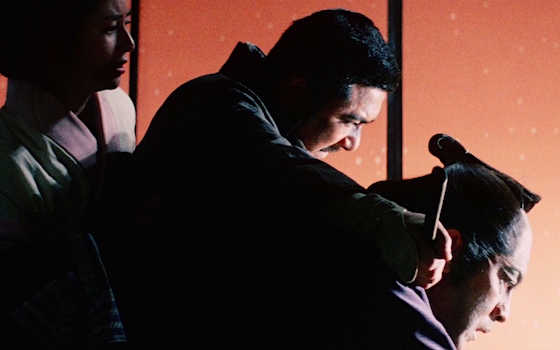
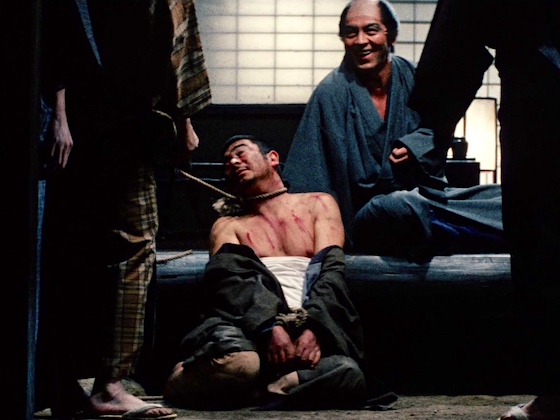
    Between how reviled it is by Letterboxd users and the cartoonish art Criterion chose for it, I assumed this was going to be another woeful attempt at comedy like Doomed Man (which is, in my opinion, by far one of the series’ worst films). It’s quite the opposite: a tragic film, where good and bad alike are faced with impossible choices, or misinterpret evidence that leads them to make rash, fatal decisions. At one point Ichi is captured, tied up, teased and beaten until he’s bruised and bloody — it’s very unpleasant. If the unpleasantness was why it was so disliked then I could see where people were coming from, but criticism seems to hinge mainly on the familiarity of the plot.

    Well, it begins with Ichi stumbling across a dying pregnant woman. He delivers her baby, and her dying wish is that he takes the child to her husband in a nearby village. Naturally, Ichi complies, followed all the way by a young boy who won’t stop throwing stones at him. With the help of the village’s old but honourable constable, Tobei, he locates the baby’s aunt, Oyae. But then the yakuza arrive, demanding taxes from local performers and threatening to force Oyae into prostitution, and once again it’s up to Ichi to save the day.

    Saving the day

    Yes, anyone familiar with Ichi’s adventures can see how that’s a pretty standard storyline. The devil is in the detail, and At Large offers a few interesting characters and subplots. For starters, there’s Tobei — a non-corrupt official is a rarity in this series, but that doesn’t make him dull. He gains depth from both how he treats Ichi (when he finds out the truth about our hero’s past, he doesn’t arrest him) and his relationship with his wayward son, who’s a conman. Their relationship is quite poignant. It’s only when his father finally hits him that the son realises he cares, which makes him happy… but then things take a turn for the worse, leading the former good-for-nothing to set out as an avenger of honour.

    As the villain, yakuza boss Tetsugoro, there’s an interesting performance by Rentarô Mikuni (who previously appeared in Zatoichi the Outlaw, and is also great in the samurai classic Harakiri). He choose to play Tetsugoro as constantly bored, or world-weary, barely interested by or caring about what’s going. For example, he’s been paying everyone 1 ryo to kill Ichi, but when someone demands 50 ryo he does no more than hand-wave his approval. All of which might sound like a criticism, but it’s a surprisingly effective portrayal of disinterested everyday evil. Nothing he does brings him pleasure; nothing that happens causes frustration or surprise — he just exists, doing the only things he knows. Well, that is until he observes Ichi being tortured — then he smiles and laughs. And when he finally kills Tobei — the most moral man around — then he laughs again. Ooh, he’s a nasty piece of work and no mistake!

    Zatoichi tortured

    There are various other bits and pieces that work nicely. Ichi gets to show off, as usual, but it’s always fun. The filmmaking gets a bit of ’70s verve, with a score that is at times very contemporary-pop, and supplementing the series’ normal visual style with some handheld closeup stuff. And the final one-on-one duel is not the usual big showpiece: oddly exposed, almost silent, flash-edited, and over in seconds, with a hard cut to a “the end” card. Depending on your point of view, this is either “almost comically tacked on” (DVD Talk) or “one of the most badass final thirty seconds of any film in this series” (The Digital Bits). I don’t know if I’d go as far as the latter, but it’s certainly a change of pace.

    Zatoichi at Large may just be a remix of various plot bits we’ve seen before, but they’re done with a seriousness and darkness that works. There’s a bit of comedic stuff early on that’s a nonstarter, but once that’s out the way it’s a decent, if fundamentally unoriginal, adventure for Ichi. Indeed, it’s that lack of originality that hurts it most. In itself it’s a perfectly good Zatoichi movie, but we’ve seen almost all of it before. At Large (re)does it all solidly, but it doesn’t do much to improve on previous versions. If more people watched the films out of sequence and came to this earlier, perhaps it would be better liked.

    4 out of 5

    The Elephant Man (1980)

    2018 #187
    David Lynch | 124 mins | Blu-ray | 2.35:1 | USA & UK / English | PG / PG

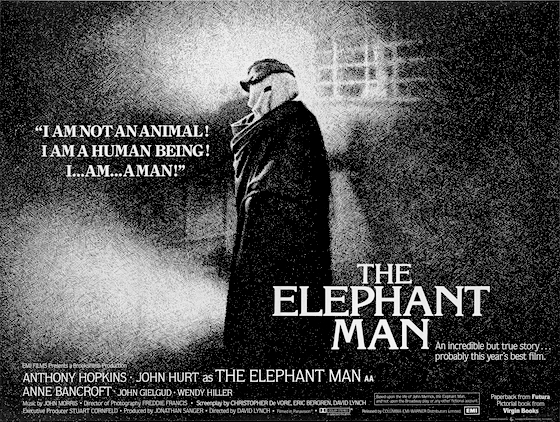
    The Elephant Man

    This biopic of Joseph Merrick — better known as ‘the Elephant Man’, a Victorian circus sideshow ‘freak’ who became a star of London society during his stay at the London Hospital — is noteworthy not only for its documentation of a key figure in Victorian life, who perhaps transformed people’s views of what it meant to be human, but also because it’s a film directed by David Lynch.

    The Elephant Man is sometimes placed alongside Dune and The Straight Story as anomalies in Lynch’s filmography, which is more often characterised for its horror-inducing oddness and sometimes-incomprehensible plotting. Of course, upon proper examination, all three of these movies exhibit Lynchian touches, perhaps none more so than The Elephant Man. It’s there in the avant-garde opening; the dream sequence; the sound design, for which he’s co-credited; the focus on industrial machinery. The film can certainly be read as a Victorian melodrama, but in execution it’s far from a Merchant Ivory movie.

    It’s also a very human and humane film, perhaps more so than you might expect from Lynch. But then again, look to The Straight Story, which in my review I described as “understatedly human and kind of heartwarming”; or Fire Walk with Me, which is about exposing the tragic injustices inflicted upon Laura Palmer. He may not come at it from the most obvious angles, but I think Lynch is consistently a compassionate filmmaker. Indeed, some critics even accused the film of “excessive sentiment”, probably due to being partly based on the memoirs of Merrick’s friend and physician, Frederick Treves. I disagree because, even if it is pretty sentimental, I think it hits the sweet spot — the point is that we should care.

    Treves and Merrick

    A significant boost to our emotional connection is the absolutely superb performances from Anthony Hopkins as Treves and John Hurt as Merrick. The latter earnt a BAFTA win and an Oscar nomination (losing to Robert De Niro in Raging Bull) in what became a truly iconic performance, but it’s a wonder Hopkins wasn’t similarly recognised. One of the themes the film tackles is the dichotomy of Treves being Merrick’s friend but also, to an extent, exploiting him to further his career, and finding the truth in that balance is down to Hopkins. They also both contribute enormously to the graceful beauty found throughout the film, not least in close-ups where a single tear can convey so much complex emotion, or the understated but moving final scene.

    So too the gorgeous black-and-white photography by Freddie Francis. As Tom Huddleston writes in his essay accompanying the film’s StudioCanal Blu-ray releases, “imagine the film in colour, how fleshy and grotesque the makeup would have appeared, how gaudy and nauseating the carnival sequences.” It doesn’t bear thinking about. Instead, the monochrome visuals mix “gothic horror with documentary realism, lush drawing-room drama with mist-shrouded flights of fantasy”, to create a film that feels realist and historical, but also timeless and fantastical.

    5 out of 5

    The Elephant Man is on BBC One tonight at 10:30pm (11pm in Scotland).

    It was viewed as part of my What Do You Mean You Haven’t Seen…? 2018 project.

    Extraction (2020)

    2020 #88
    Sam Hargrave | 116 mins | streaming (UHD) | 2.35:1 | USA / English, Hindi & Bengali | 18 / R

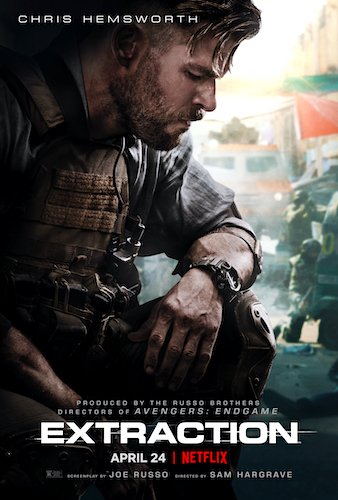
    Extraction

    Chris “Thor” Hemsworth stars in this action-thriller masterminded by the Russo brothers (directors of Avengers: Infinity War and Endgame) and directed by Sam Hargrave, who has dozens of stunt coordinating credits to his name, including three Hunger Games, Atomic Blonde, and work on six Marvel Studios movies. But don’t take all those MCU connections to heart — this is not a Marvel-style PG-13 action-comedy. Oh no.

    We first meet mercenary Tyler Rake (Hemsworth) engaged in a gunfight on a bridge. He’s covered in wounds, spitting up blood, looks like he’s about to die. Cut to two days earlier! No, really, it’s one of those openings. They just won’t bloody die. Never mind “skip titles” or “watch credits”, Netflix needs to add a “skip pointless in media res prologue” button. It would improve almost any film/TV episode where it was featured.

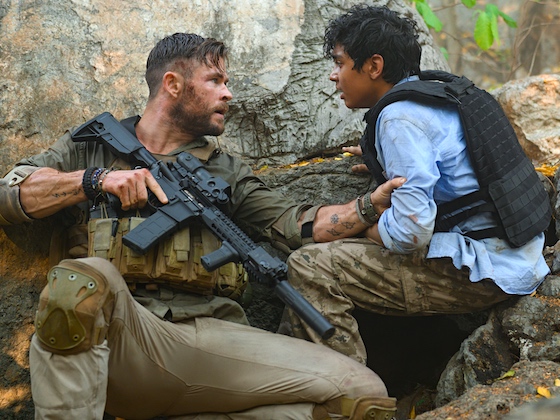
    Anyway, two days earlier we’re introduced to Ovi (Rudhraksh Jaiswal). Just an ordinary, well-to-do schoolboy in India… except his dad’s an imprisoned drug kingpin, and when Ovi slips out to a club one evening he’s kidnapped by goons from the competition, run by the thoroughly ruthless Amir Asif (Priyanshu Painyuli). With daddy behind bars, it falls to Saju (Randeep Hooda) to get the kid back, for which he hires some organisation, I guess — the film is incredibly light on specifics here. Basically, it involves Nik (Golshifteh Farahani) sending in Mr Rake and a support team to extract the kid. Naturally the mission goes sideways, leaving it up to Rake alone to get Ovi and himself out of a city crawling with henchman and corrupt cops who are all out to get them.

    School's out

    Of course, Rake has issues in his backstory, and rescuing the kid becomes more than just a job, etc, etc. The “Man on Fire Lite” plot is as predictable as this sentence ending with a simile. When David Harbour turns up halfway through as an old mate of Rake’s who lives in the city and agrees to help him out, I’ll be surprised if you can’t guess what inevitably happens a couple of scenes later. Though it is amusingly bold of the film to try to make us believe David “dad bod” Harbour could hold his own in a fight against Chris “literally a Norse God” Hemsworth.

    That minor brawl aside, the action sequences are great, more than making up for the lightweight plot mechanics. Letting stunt coordinators move into full-on directing has been the saviour of the action movie genre in recent years, working wonders for the John Wick series in particular, but also several other movies that have followed suit. Hargrave is the latest to suggest he might have a bright career ahead of him on the basis of his ability to stage electrifyingly choreographed combat scenes. The action is fast and hard-hitting; not unnecessarily horror-movie gory like it was in fellow Netflix actioner 6 Underground, but certainly not PG-13 material either. Clearly Netflix don’t force the makers of their expensive movies to hit that PG-13, presumably tied to not having to worry about box office takings. One advantage of going direct to streaming.

    The highlight of the film is undoubtedly an already-much-discussed 11½-minute single-take action sequence. We’ve seen plenty of these trick shots in the past few years (Atomic Blonde and, obviously, 1917 particularly come to mind), but Extraction offers another belter. It starts as a full-blown car chase, which transitions into a game of cat-and-mouse around a warren-like apartment block, then tumbles into a mano-a-mano knife duel on a busy street, before ending in a second car chase. Obviously there are myriad hidden cuts in there, but that’s almost beside the point: it’s not physically doing it in one long shot that’s impressive, it’s the design and choreography and planning and execution to make it feel like one. It pays off handsomely.

    Street fighter

    You wonder if Netflix might look to turn Extraction into a franchise — in many non-English-speaking countries it’s been titled Tyler Rake, which might suggest that’s what they’re thinking. But then, they could’ve retitled it that in English if they wanted, so maybe not. It’s not the most sophisticated thriller ever made, and it doesn’t reach the giddy heights of John Wick in the action department, but it’s nonetheless entertaining at what it sets out to achieve. If they do decide to make more, I’ll definitely be there.

    4 out of 5

    Extraction is available on Netflix now.

    Review Roundup: Superman Sequels

    Superman: The Movie is one of the greatest superhero movies ever made, perhaps even the greatest. Its sequels… not so much.

    It took three movies to get there, but through them you’ll believe a franchise can die…

    Superman II
    (1980)

    2018 #128
    Richard Lester | 127 mins | Blu-ray | 2.40:1 | USA, UK & Canada / English | PG / PG

    Superman II

    I feel like I must’ve seen Superman II as a kid — I know I saw Superman and enjoyed it, so why wouldn’t I have seen the sequel? But all the things people go on about from it (“kneel before Zod!”) I only know because other people go on about them, not from any memory of my own, so maybe I never saw it? Well, sitting down to watch it now, I didn’t remember any part of it. But that doesn’t mean I definitely didn’t see it because, frankly, I didn’t find Superman II particularly worthy of being remembered. I know some people love it — heck, James Gunn even included it in a list of “sequels that are better than the original” the other day. But James Gunn is wrong.

    For me, the film breaks down into a few simple and distinct sections. First, it begins with an eight-and-a-half-minute recap of the first movie. That’s… long. And largely unnecessary. I mean, when it bothers to include the telephone booth gag but omits the turning-the-world-backwards climax of the movie, you get the impression it’s not there to get you properly up to speed on the plot.

    Next, Lois and Clark spend most of the first hour titting about at Niagara Falls investigating a honeymoon hotel scam (a what now?!), while evil Kryptonian General Zod and his gang veeery slooowly make their way to somewhere significant. Then there’s half-an-hour of Lois and Clark being too self-absorbed to notice Zod take over the world. Not-so-super, Superman. Then, finally, the all-action last half-hour actually gives us some Superman stuff. Hurrah!

    Who's kneeling now, bitch?

    The humour quotient is waaay upped from the first movie. Based on his previous work, I guess much of that was the influence of replacement director Richard Lester. He wasn’t a good choice all round: Margot Kidder disliked working with him; Gene Hackman didn’t return (all his scenes are either footage previously shot or done with a lookalike and impersonator); John Williams walked off the film after seeing Lester’s footage. He reshot a bunch of stuff original director Richard Donner had already filmed, partly to get a sole director credit, partly because he didn’t approve of the epic visual style Donner had chosen. Instead, Lester aimed for a visually flat “comic book” style. Ugh.

    25 years after Superman II’s release, Warner Bros relented and let Donner complete his original cut of the movie, released in 2006 as The Richard Donner Cut. Maybe that version’s better — I haven’t watched it yet, but it does have a much higher score on IMDb. But how anyone could genuinely love the originally-released version, I don’t understand. It’s not outright bad, it’s just mediocre, and not a patch on its predecessor.

    3 out of 5

    Superman III
    (1983)

    2018 #161
    Richard Lester | 125 mins | Blu-ray | 2.40:1 | UK & USA / English | PG / PG

    Superman III

    If you said “imagine a Superman film by a director who won the Palme d’Or”, you wouldn’t picture Superman: The Slapstick Comedy… and yet here we are.

    The director in question is Richard Lester, returning after Superman II, a movie he inherited, so I guess it’s only here that he’s really allowed to show what he thinks a comic book movie ought to be. Turns out, that’s more like Airplane or a Jacques Tati film than the David Lean influence he felt Richard Donner was aiming for on Superman: The Movie. He even lets the title card appear over the epic superhero imagery of… three phone boxes that have been knocked over dominoes-style by a hot dog cart. Wow.

    Ironically, almost all of the film is humour-focused apart from the scenes starring comedian Richard Pryor (who thought the screenplay was terrible, but did like the $5 million salary). Concurrently, the technological and scientific parts of the plot make absolutely no sense. Like, a weather monitoring satellite can be accessed from a small-town wheat firm and then be reprogrammed to control the weather. And that same satellite can then use its lasers to analyse rocks millions of miles away to find out what elements make up another element, which just… Ugh. It so doesn’t make sense that it’s too much effort to explain why it doesn’t make sense.

    With Gene Hackman presumably only too happy to be rid of this franchise, the villain is now Robert Vaughn, who has an entourage that feels like a blatant attempt to emulate Lex Luther & co from the previous films. There’s also an all-powerful supercomputer, which Superman defeats with what appears to be a bubbling-over pot of strawberry jam.

    That's Larry Lamb on the left, would you believe

    The story also involves Superman going bad — you can tell because he’s grown a five o’clock shadow, developed bags under his eyes, and started wearing a suit with a colour scheme more suited to a Zack Snyder interpretation of the character. And he begins to do really terrible things, like… straightening the leaning tower of Pisa, and… blowing out the Olympic flame. Ooh, edgy. Why does he do it? God, I don’t know. There’s no logic in this. There’s a fight between good Superman and bad Superman, which some think is brilliant; “a highlight of the series”, said one comment I read. Maybe it’s just because Evil Superman is so damn cartoonish, but I didn’t particularly care for it.

    It did inspire the original title of the movie, though, which was Superman vs. Superman, and that in turn led to a bit of trivia more batshit insane than anything in the film itself: that original title was dropped after legal action was threatened by… the producers of Kramer vs. Kramer. What in the fucking what now?! I know America is famed for spurious lawsuits, but c’mon!

    Of course, if you take the whole film at the face value of its tone, it doesn’t really matter — it’s just a daft comedy. But it shouldn’t be, should it? This isn’t the Superman the first film promised us.

    2 out of 5

    Superman IV:
    The Quest for Peace

    (1987)

    2020 #79
    Sidney J. Furie | 90 mins | Blu-ray | 2.35:1 | UK & USA / English | PG / PG

    Superman IV: The Quest for Peace

    At one point in this movie, a young character calls Superman “the Dude of Steel”. Yeah, we’re down with the kids now! Superman (okay, Clark Kent) even does aerobics. Hip and happening!

    After Superman III tried its damnedest to turn Superman into a comedy, Superman IV swings the other way and turns it into a polemic. It’s like an 8-year-old was asked to write an anti-nuclear weapons essay and chose to do it in the form of a Superman story. It seems like a mercy that it only runs 90 minutes, although that’s part of the problem: the original final cut was 134 minutes, but the producers chopped out 45 minutes of material. No wonder it grows increasingly nonsensical as it goes on. But then so did Superman III and they had no such excuse, so there’s no saying the longer cut would’ve been better.

    Indeed, on the evidence of what’s left, I think we can assume it wouldn’t have been. Gene Hackman’s Lex Luthor is back (goodness knows how they talked him into it), but his plan involves creating a physical adversary for Superman: Nuclear Man! Nuclear Man has many of Supes’ powers and strengths, but none of his brains, as he stomps around just roaring at people. He flies around the world basically just being a vandal, and Superman follows along to clean up after him, like some kind of super-powered babysitter. Then he punches Supes once and… he loses all his powers? And then Nuclear Man sees a woman on a cover of a newspaper and suddenly getting her is his only motivation; and Superman’s back, thanks to a magic crystal, and he somehow knows exactly what/who Nuclear Man is after; and so Superman defeats him by… tricking him into an elevator… which he drops off on the Moon; but not the dark side, so the sun’s rays revitalise Nuclear Man… when the sun rises. On the Moon. Jesus wept.
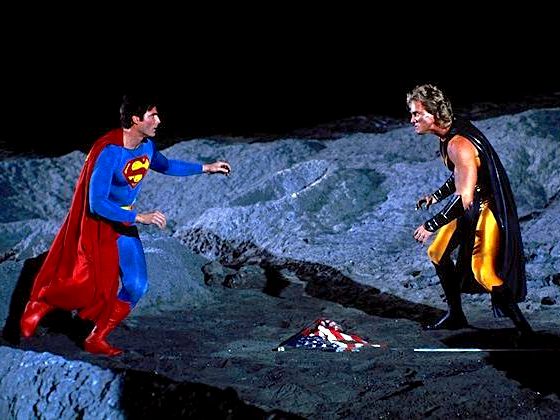
    The Moon isn't made of cheese, but this film...

    There are some good ideas in Superman IV. As co-writer Mark Rosenthal discusses on his audio commentary, the idea had been to explore the age-old question of “if God is all-good and all-powerful, why is there still suffering” — because, with all his powers, Superman is basically a mythological God; so why doesn’t he just get rid of all those nasty nukes? The answer, of course, is that he’s not real. And so in the fictional world of the fictional film, the fictional hero gets rid of the nukes, which is nice for the fictional people but not so much use to the rest of us.

    Because Lois Lane is in love with Superman but not so much Clark Kent, they decided to give Clark a love interest, which I’m not sure quite understands the characters or their dynamic properly, but whatever. It did inspire one fun idea, though: a double date between Superman & Lois and Clark & new-lady. The idea was for a quick-paced farce of a scene, with Clark and Supes coming and going at speed, like something out of a Cary Grant screwball romantic comedy. I guess no one told the director, because the scene as filmed lacks the fast pace needed to make it work. You can have all the great ideas in the world, but if you don’t have the skills to execute them properly, it’s worthless.

    Apparently it was really Christopher Reeve who fought to make the movie happen, and everyone involved had good intentions and didn’t want to let him down. Well, they did. The returning cast are the only people who emerge unscathed from this mess — Reeve is as wonderful as ever as Superman; just perfect. His chemistry with Margot Kidder is great, and Gene Hackman is still managing to have fun as Lex. But why suffer through the rest of this terrible movie for those scant bright spots when you could just watch the first Superman instead?

    1 out of 5

    Superman IV featured on my list of The Worst Films I Saw in 2020.

    19 years later, after a couple of decades relegated to various TV incarnations, they attempted to return the Man of Steel to the silver screen in big-budget style with Superman Returns, which was conceived as a continuation of the Christopher Reeve series. My original review of that movie is here.

    The Avengers (1998)

    The 100 Films Guide to…

    The Avengers

    Saving the World in Style.

    Also Known As:
    Chapeau melon et bottes de cuir (France — Bowler Hat and Leather Boots)
    Mit Schirm, Charme und Melone (Germany — With Umbrella, Charm and Bowler Hat)

    Country: USA
    Language: English
    Runtime: 89 minutes
    BBFC: 12
    MPAA: PG-13

    Original Release: 13th August 1998 (Israel)
    UK Release: 14th August 1998
    Budget: $60 million
    Worldwide Gross: $48.6 million

    Stars
    Ralph Fiennes (Schindler’s List, Harry Potter)
    Uma Thurman (Batman & Robin, Kill Bill: Vol. 1)
    Sean Connery (Goldfinger, The League of Extraordinary Gentlemen)

    Director
    Jeremiah Chechik (National Lampoon’s Christmas Vacation, Benny & Joon)

    Screenwriter
    Don MacPherson (Absolute Beginners, The Gunman)

    Based on
    The Avengers, a ’60s British TV series created by Sydney Newman.


    The Story
    After the UK’s weather control project is destroyed, apparently by one of its own scientists, Ministry agent John Steed is assigned to investigate. Teaming up with that scientist, Mrs Emma Peel, they uncover a plot to hold the world’s governments to ransom…

    Our Heroes
    Extraordinary crimes against the people and the state must be avenged by agents extraordinary: John Steed: traditional, stylish, reserved, lethal. Emma Peel: doctor, atomic scientist, poet, meteorologist, physicist, marksman.

    Our Villain
    A former agent of the Ministry, Sir August de Wynter is now head of BROLLY, the British Royal Organization for Lasting Liquid Years, who have developed the technology to control the weather and now seek to put it to nefarious ends.

    Best Supporting Character
    Machine-gun firing granny Alice. Eileen Atkins was offered the role of the Ministry’s deputy leader, Father, but thought the part of Alice sounded more fun, so they re-wrote to enlarge it for her.

    Memorable Quote
    “Now is the winter of your discontent!” — Sir August de Wynter

    Memorable Scene
    Instructed to meet Steed at his gentleman’s club, Mrs Peel waltzes into the place, despite the objections of the receptionist. She marches through the building, shocking the patrons, until she finds Steed in the steam room — naked but for the newspaper he’s reading. “Please, don’t get up.” “I was about to throw in the towel.”

    Memorable Music
    Michael Kamen was originally hired to score the film, but eventually quit after being constantly given revised cuts of the movie to work with. His replacement, Joel McNeely, had to turn something round in short notice, and I’ve seen his score described as clearly rushed, dull and uninspired. But at least the TV series’ classic theme is in there, and fairly well used — once right at the start (although there’s an ever-so-’90s X-Files-y number over the main credits), and then again perfectly as a farewell over the final scene. Rumour has it Kamen’s score was darker and more atmospheric, with a greater and more interesting use of the original theme. Given the general disregard for the movie, I don’t imagine it’ll ever be unearthed for us to find out for ourselves.

    Letting the Side Down
    The teddy-bear meeting, where the participants are kept anonymous by wearing giant teddy-bear costumes. It’s an attempt at emulating the whimsy of the TV series, but an empty one — as the series’ regular writer Brian Clemens once commented, if the plot’s about controlling the weather then the meeting should’ve been weather-themed somehow.

    Some people would say there’s a lot more wrong with the film than just that one scene, but there’s more to it than that…

    Making of
    When Warner Bros execs saw the first cut of the movie, it was not what they were expecting. I don’t know what they were expecting, but I guess not something so tongue-in-cheek, whimsical, and camp. Apparently the first test screening in Phoenix, Arizona, was to a “largely Spanish-speaking, working class” audience — hardly the film’s target market, and unsurprisingly they hated it. The studio forced cuts and reshoots, taking the movie from 115 minutes to a sprightly 89, sacrificing plot coherence for the sake of speed. And so a true disaster was born.

    Previously on…
    This is a reboot rather than continuation of the original TV series — it shows how Steed and Mrs Peel met for the first time. I don’t know if the TV series actually covered that (I really should watch it all one of these days), but I don’t imagine it went like this.

    Next time…
    The Avengers ultimately became a massively successful multi-film franchise under the auspices of Marvel Studios. Oh, no, wait, that’s some other thing. No, after suffering atrocious reviews (it’s sometimes cited as one of the worst movies of all time), the ’98 Avengers slinked off into relative obscurity (it’s probably better remembered here than in the US thanks to the TV series connection, but Marvel’s super-friends are gradually replacing it in the consciousness, sadly). Still, the world of the TV series lives on in occasional comic books and audio dramas.

    Awards
    1 Razzie (Worst Remake or Sequel (tied with Godzilla and Psycho))
    8 Razzie nominations (Worst Picture, Actor (Ralph Fiennes), Actress (Uma Thurman), Screen Couple (Fiennes & Thurman), Supporting Actor (Sean Connery), Director, Screenplay, Original Song (Storm by Grace Jones))

    Verdict

    I was one of the half-dozen people who actually saw The Avengers at the cinema in 1998. I don’t remember disliking it, but then I was all of 12 so what would I have known? Its poor reputation has only grown in the intervening decades, so I wasn’t expecting to think much of it as a more critically sophisticated adult. But, much to my surprise, I kind of loved it.

    I guess in ’98 people were expecting some kind of serious-minded thriller, probably in the Bond mould — this was just after GoldenEye and Tomorrow Never Dies had relaunched that series to much acclaim and box office success, of course, and The Avengers was another hallmark of ’60s British spy-fi. But The Avengers and Bond were never the same tonally, and the film embraces the mannered, quirky tone of the TV series, then turns it up to eleven. Personally I think it’s a tonne of fun, with arch performances, ripe dialogue, and a deliciously camp air.

    If it wasn’t for WB’s post-production fiddling, which has left the plot feeling a bit janky and spasmodic, I reckon this would be a cult classic by now. They really ought to have a bad reputation for that kind of fiddling at this point — Batman Forever, Suicide Squad, and Justice League come to mind. But never mind the Snyder cut, I want them to #ReleaseTheChechikCut. Sadly, it’ll never happen.