
Paul Gross | 105 mins | TV (HD) | 2.35:1 | Canada / English | 15 / R
 Despite winning a bunch of Canadian film awards, this First World War drama seems to have been really poorly received by critics — the Radio Times even saw fit to award it just 1 star! I must dissent, however, because I thought it was very good.
The story concerns a Canadian soldier who is invalided out of the war, returns to Canada to recuperate, falls for a local outcast woman, and eventually returns to the front in time for the titular battle. There’s more to it than that, but I’ll leave that for you to discover. Sandwiched between the two battles, the stuff in Canada makes up the bulk of the film, making this more of a period social/romantic drama than a war film. You could class this bit as a melodrama, something that never seems to go down well with critics, but I don’t think is necessarily a bad thing. In the ’40s, say, that would probably be considered the height of cinema. I appreciate we’re not in the ’40s any more, but that kind of epic feeling is still welcome to some, in the right place. That said, it does get a bit cheesy at times — the climax in particular is a bit heavy-handed with its symbolism.
On the whole, however, the bookending battle scenes are suitably evocative. The opening owes a lot to Saving Private Ryan & co in its style (the film’s relatively low budget makes it look distinctly like something from Band of Brothers), but many things owe their style to many other things, so I don’t think this is a problem either. Besides, that look has become the visual shorthand for This Is A Gritty Real War, that’s all. And besides, the sequence does its own thing with it. It’s quite a chilling, effective opening.
The later scenes at Passchendaele itself have more of their own feel. This is the muddy, rain-soaked First World War, and the fighting is chaotic, brutal, messy. Some have criticised it for not showing the scale of the event, which confused me because I thought it had a grand scale. And even if the scale isn’t big enough, the up-close-and-personal fighting surely gives an indication of what it was like to be there. If you were there, you wouldn’t have got an aerial shot of a huge battlefield with thousands dying, would you.
Serving triple time as star, writer and director, Paul Gross’ work as the latter is very good — see again comments on the battle scenes. Cinematographer Gregory Middleton also gives the Canadian scenes a painterly style, making a pleasant contrast. Gross’ screenplay… well, see the comments on the melodrama again. I think it’s mostly fine; we’ve all witnessed a lot worse — there’s nothing clunkingly bad here. His acting is equally solid.
For all the apparent critical bile you’d expect there to be obvious flaws, like terrible acting, but I really don’t think that’s the case. Again, like with the melodrama, some of it is occasionally a little mannered and some of the smaller roles are a fraction below par; but goodness, I’ve seen much worse performances in bigger roles in much better-regarded films.
Passchendaele may not be an exceptional achievement in cinematic quality, but it is very good and I really don’t see why some have such apparent hatred for it. In its own way it conveys well the lives and horrors of that time, and by being made from a Canadian perspective it offers a slightly different view to the one we normally see. And to be honest, I appreciate a film that remembers and in some way honours those that fought in the First World War — thanks in no small part to the Americans, we’ve had an endless stream of World War Two pictures, but the very particular circumstances of the Great War are less often put on screen. I think Passchendaele does a solid job of rectifying that, at least a little.

This review is part of the 100 Films Advent Calendar 2012. Read more here.
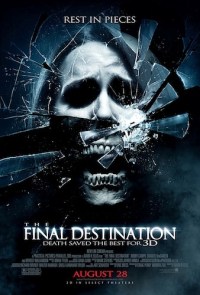 The best thing about The Final Destination is its title, because turning the series’ familiar name into a definitive article for the final entry is really quite a neat move. Sadly, it was a hit and they’ve made more. Why it was a hit… God only knows.
 The focus is clearly on the deaths — at 11 it has the highest of the series, and with its short running time that means there’s a fatality every seven minutes. They’re also very gory, more so than in previous films I’d say, but they’re not commensurately more inventive. There’s a very thorough line in misdirection at times, but the whole enterprise feels painfully lacking in creativity. I’m not sure some of them even make sense. But then do they need to? Similarly, there’s some customary low-rent-horror-movie completely-gratuitous nudity too, which I’m sure delighted teenage boys even more in 3D.
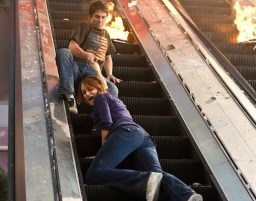 that’s a sure sign it was meant for cheap 3D thrills, but otherwise fine — here, stuff pokes straight out. That means in 2D you see, say, the flat end of a pole, with absolutely zero sense of depth. This happened with one trap in
 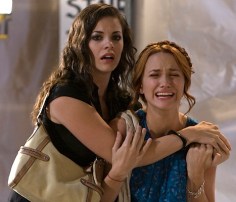 Elsewhere, one character starts talking about déjà vu before getting killed in the same way as the first film’s most famous death. I suppose it’s meant to be Meta and Funny, and maybe it kinda is, but again the CG is so cheap that the half-trained eye will spot an effect is about to happen, and the manner of death once again doesn’t really make sense. Later, we learn that shopping mall sprinklers can instantly extinguish all fires — handy!
 There’s potential in the concept of the Final Destination films, but clearly it’s either limited or the people in charge don’t know how to exploit it, because after making two quite-good films they’ve turned it into a repetitive, stale, uncreative, formulaic disaster. And there’s now a fifth too, and a sixth hasn’t been ruled out — surely it/they can’t be any worse than this? Based on form, maybe they can…
 In the wake of highly successful franchise launches for
  which
which 
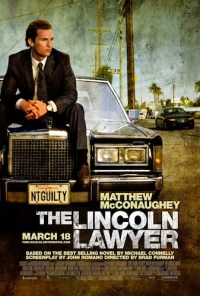 Adapted from a novel by best-selling author Michael Connelly, The Lincoln Lawyer seemed to appear out of nowhere and garner an uncommonly high amount of praise. I’m glad that intrigued me, because, while not a revelatory experience, it’s certainly worth your time.
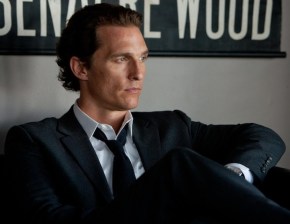 I’m not sure I’ve ever seen McConaughey in anything (nothing I remember, anyway), but my impression has been he’s not all that. Here, though, he nails the slightly-smarmy-but-kinda-likeable street-wise defence attorney Mick Haller. He’s buoyed by a quality cast: Ryan Phillippe is eminently plausible as a rich kid used to getting his own way, while the likes of William H. Macy, Marisa Tomei, John Leguizamo and Bob Gunton offer typically consummate support.
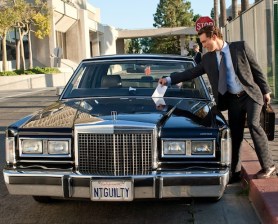 after languishing in development hell for 20 years, he recently paid Paramount $3 million for the rights to his most prolific character. With said character being the half-brother of Haller, and that Lincoln Laywer sequel in development, maybe Connelly’s work is destined to become the Marvel Cinematic Universe of crime/legal film adaptations. This could be the time to get in on the ground floor.
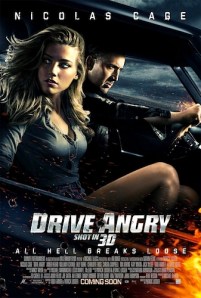 Nic Cage does the
  Only in that stuff flies at the camera and whatnot. You can indeed tell it was made for 3D, but that doesn’t mean it needs it. Indeed, the poke-the-audience stuff aside, none of it suggests it would look great in 3D — for all the pointlessness of cinema’s new money-spinning format, it can add something to the vistas in a film like
  As noted, director Lussier does not have an inspiring CV: he started with numerous straight-to-video sequels, then a big screen sequel-no-one-wanted (even with Nathan Fillion in it) in
 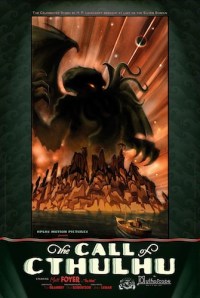 I must admit to not being at all familiar with the work of H.P. Lovecraft. I know the name, of course, and the titles of some of his stories, not to mention being aware of the array of well-known fans. Aside from that, I’ve only encountered his work through its influence — there’s some stuff in the
 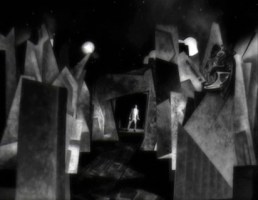 The marriage of low-budget and silent film style is one made in heaven, particularly when you add in the dedication of the makers. They built impressive props, ingenious sets, and employed model work in various inventive ways, all to execute a story that includes a cultist swamp orgy, a mysterious island, a sea battle, and a skyscraper-sized monster. Some online reviews have criticised the effects, but those people are quite frankly idiots. This isn’t meant to be slick CGI — it’s re-creating lo-fi early film techniques, and (aside from one or two rough-round-the-edges spots of greenscreen) it all looks fabulous.
 I have no idea how closely it hews to Lovecraft’s original, but there’s a layered stories-within-stories approach (I think it gets four deep at one point) that is difficult to pull off with clarity, but never falters here. Christopher Nolan would be proud. It also effectively builds a sense of uncanny mystery; not outright scares, but a kind of disquieting unease. It’s my impression that was absolutely Lovecraft’s aim too, so another job well done.
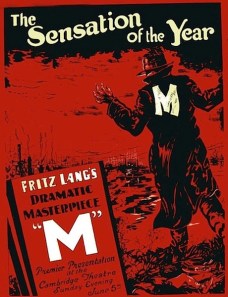 Let’s establish one thing right away: this is unquestionably an inferior version of Fritz Lang’s masterpiece,
  4) It’s mostly dubbed into English. The bits that aren’t have been re-shot. Primarily, there’s a phone call between the police commissioner and the minister, which is really quite poorly performed — watch out for an unintentionally comical bit with the wrong end of a pencil. These two actors are also edited into another scene, a large meeting which their characters attend, and it’s glaringly obvious where Lang’s work begins and ends and the basically-shot bits (flatter angles, simplistic sets) have been dropped in. The director of the English re-shoots isn’t specifically credited, but it certainly wasn’t Lang: Fischer’s examination of M’s export versions informs us that it was the localised version’s “Supervisor”, Charles Barnett.
 There’s no way anyone would reasonably recommend this variation of M over the original, but it does hold interest as a curio. It may leave one wondering how and why this practice of exporting films — where multiple versions in different languages were shot at the same time, rather than dubbing/subtitling later — died out. Cost, I imagine. Despite producing interesting asides like this, it’s probably a good thing it did.
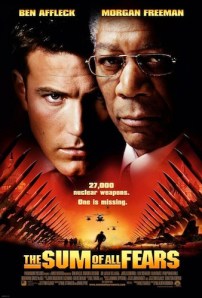 Paramount had a burgeoning franchise on their hands in the early ’90s with adaptations of Tom Clancy’s Jack Ryan novels. He first appears in
 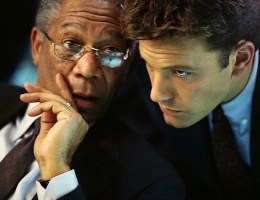 Ben Affleck is Ben Affleck, which means a lot of people won’t like him but he’s OK. Morgan Freeman brings instant gravitas to his role, though it’s not his most likeable or memorable part.
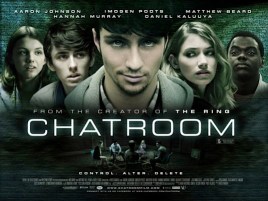 Chatroom is born of — or, at least, partly formed around — trying to find a viable way of depicting the world of online chatrooms on film. Putting on film this world it As It Really Is — people sat at a computer typing at each other — might work well enough for a single scene in
 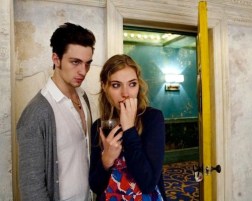 in this environment is also truthful. There have been many reviews that are completely dismissive of this facet of the film, leaving me to wonder if they were written by people who haven’t used or experienced such things. It’s a shame, then, that the film’s degeneration into a thriller hides the arguably-worthwhile potential to explain to such people what that online world can be like for people/kids using it.
 Despite a strong-ish start, perhaps the whole second half of the film is a wobbly mess; not directionless exactly, because by then it does know broadly where it’s going, but it doesn’t do much to suggest to the viewer that it has a real goal in mind. Character motivations and relationships feel as if they’ve not been fully thought out, or at least not fully brought together on screen. Some threads take inexplicable jumps; others aren’t adequately explained or justified. Occasionally it’s Nakata’s direction that overdoes things, for instance laying the soppy “this bit is emotional” music on thick when Matthew Beard’s performance could easily carry a particular sequence.
 The aforementioned Matthew Beard, perhaps the least recognisable cast member (his
  Consensus holds that the work of once-acclaimed director M. Night Shyamalan has managed a near-perfect trajectory of decreasing returns. I’m not talking about box office — I have no idea (or much interest) in how that’s gone for him — but quality, starting with supernatural chiller
 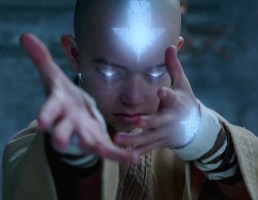 Chunks of it seem to be missing, conveyed through clunky voiceover rather than on-screen action. The first rule of screenwriting — literally, the first — is Show Don’t Tell, but Shyamalan does exactly the opposite.
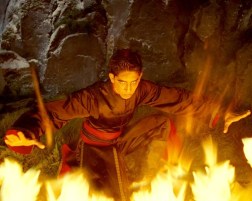 I wouldn’t call myself a Shyamalan apologist, but I think he has at times suffered harshly at the hands of critics and audiences disappointed that he’s never re-reached the heights of The Sixth Sense (though, personally, I prefer
  100Films.co.uk