100 Films @ 10: Most-Played Soundtracks

For today’s top ten I’ve opened up iTunes, sorted all my songs by play count, and seen which are my most-listened-to cues from film & TV soundtracks. I’m not a great musical connoisseur, really, so because of that and this just being a statistical most-played list, expect lots of exciting action music — especially as this includes plays from when I wrote a blockbuster-style screenplay for one of my university dissertations, so I listened to an awful lot of that kinda stuff then.

Couple of other points: These are all score cues rather than songs that are on soundtracks, because, well, that’s what I chose to do. However, I have included trailer music, but only when it was composed especially for the trailer — nothing from those generic “music for trailers”-type albums. Finally, I’ve ditched repeats from the same album, because I thought this would basically be the track list for Pirates of the Caribbean otherwise. Turns out that wouldn’t’ve been the case, and instead it removed a track from, of all things, Torchwood.

10
Suite from X2

from X-Men 2

I’ve written before of my fondness for John Ottman’s X-Men theme. As this was the only version of it for years, I listened to it plenty. I guess it’ll be supplanted by the version from X-Men: Apocalypse eventually, because the tracks on that album are less ‘cluttered’ with other bits of the score. (As the confusion about X2’s title continues, let me note this: the UK soundtrack album is called X-Men 2 and this track on it is called Suite from X2; the US soundtrack album is called X2 and this track on it is called Suite from X-Men 2.)

9
Wheel of Fortune

from Pirates of the Caribbean: Dead Man’s Chest

From the second Pirates movie, this is the cue from the big sword fight climax — which, as you may remember, includes a runaway water wheel, hence the title. For all his production-line type methods, Hans Zimmer can deliver a very effective action cue.

8
Closing Credits: “Bolero”

from Moulin Rouge

As with much of the music in Baz Luhrmann’s musical, this is a track that suggests a lot of drama, even if it ‘only’ plays over the end credits. I can’t really explain why I like it so much, but I do. For whatever reason I listened to it every day on my way to work when I interned for a summer in New York, which (a) didn’t do its play count any harm, and (b) means I always associate it with riding the Subway, weirdly. As to who wrote it, I’ve got it down as being by the film’s composer, Craig Armstrong, but Wikipedia says Steve Sharples and Allmusic says Simon Standage, so I dunno.

7
This is Gallifrey: Our Childhood, Our Home

from Doctor Who: Series 3

Murray Gold has been composing all of Doctor Who’s music for over a decade now, which is quite an achievement, especially for a show that so regularly changes its style — week to week, in many respects. My favourite piece of his work is probably his theme for the 11th Doctor, created for series five, but I’ve most listened to this elegiac piece for the Doctor’s home planet from the series three finale.

6
Mind Heist

from the Inception trailer

Braaaam! Christopher Nolan’s film is perhaps most famous for defining trailer music for the next… well, it’s still kinda ongoing, isn’t it? Yet that recognisable cue used in the trailers isn’t actually from the film itself. Heck, it’s not even by the film’s composer, Hans Zimmer (him again!) The story behind it is a mite more complicated, but Zack Hemsey was one of the main people involved in the final trailer, and it was he who put out a track with his version of that work, so here it is.

5
The James Bond Theme

from the Casino Royale trailer

Monty Norman’s James Bond Theme has been re-worked countless times down the years, but this version struck me as soon as I first heard it for one key reason: voices. The final part of the track has the familiar tune accompanied by a choir, I believe for the first time, and it sounds fantastic. It was created by trailer music outfit Pfeifer Broz. Music specifically for the Casino Royale trailer, so you won’t find it on the soundtrack CD, but, of course, it’s still out there to be found…

4
Can You Dig It (Iron Man 3 Main Titles)

from Iron Man 3

Despite their continued success, there are criticisms regularly raised against Marvel’s shared universe movies. One is the weak villains. Another is the painfully generic music. That’s precisely why Brian Tyler’s title theme from the third Iron Man stands out so: it accompanies the ’70s-action-show-style credit sequence with a ’70s-action-show-style reworking of the film’s main theme (which I also quite like, but is much more standard “modern blockbuster music” in sound).

3
Drink Up Me Hearties

from Pirates of the Caribbean: At World’s End

More Zimmer Pirates. This is the final cue, accompanying the end credits of the film, and as such is something of a summation of the series’ music. It’s kind of the epitome of modern blockbuster scores, for good or ill.

2
The Chase

from Torchwood

More Murray Gold, here composing with his Doctor Who orchestrator, Ben Foster. This ticks many of the boxes I mentioned at the start: an action cue from my screenwriting playlist. Gold’s Whoniverse music has most often been in the style of modern blockbuster movies, because that’s the feel the show has gone for, but by distilling the essence of that style he has on occasion produced tracks that exceed its big-budget counterparts for effectiveness. This is one such occasion: as fast-paced action tracks go, this is often one of the fastest and actioniest.

1
He’s a Pirate

from Pirates of the Caribbean: The Curse of the Black Pearl

The creation of Pirates of the Caribbean’s soundtrack is a notorious clusterfuck of composers literally competing against each other to produce something for the Disney movie. Reports vary on what exactly went on, but I believe the long and the short of it is Klaus Badelt wrote the most music that was actually used and so got the credit on the CD. Presumably Hans Zimmer didn’t think the film would be all that big and didn’t care — he certainly took the credit for the sequels’ scores, though. Anyway, this recognisable main theme actually has its roots in another Zimmer score, Drop Zone, as you can hear here. Shocking self-plagiarism, ain’t it? Still, this improved version is the one everyone knows now, and it’s wound up my most-played soundtrack track.

Tomorrow: never-ending stories.

100 Films @ 10: Great Scenes

Howard Hawks famously said that a good movie was simply “three good scenes and no bad ones”. For today’s list, I’m focusing on examples of the former.

There’s no set average for the number of scenes in a feature film, but a good rule of thumb is that a typical movie scene lasts two or three minutes — which means I’ve probably seen in excess of 48,000 scenes as part of this blog. That’s rather a lot to recall, so I’m not presuming to say these ten are the very greatest from that lot. What they are is ten that stuck in my memory particularly, for one reason or another. Even if they’re not the greatest, they are great.

10
The Swimming Pool

from Let the Right One In

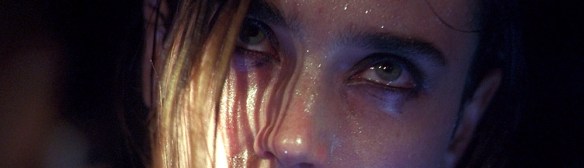
The bullies that have plagued young Oskar throughout the film corner him in a public swimming pool and, brandishing a knife, inform him that if he can’t hold his breath for three minutes he’ll lose an eye. They push Oskar under the water. The seconds tick by. Then, we reach the real reason this scene is here: as the shot holds on Oskar underwater, we hear the muffled sounds of breaking glass, then screams. Feet run backwards across the water. Heads and limbs drop into the pool. The water begins to turn red. This could’ve been a brutal action climax like any other, but by staging it in a brightly-lit swimming pool, by not showing us the meat of the action, and by achieving it all in one shot, director Tomas Alfredson creates a sequence of supernatural force that is eerily grounded.

9
The Opening Shot

from Touch of Evil

Long takes are all the rage nowadays, made even easier by advances in digital cinematography and editing, but this hails from a time when they were a bit more special. It remains one of the most famous because of its content: we see a bomb planted on a car, then follow it as its unsuspecting owners drive through the streets. When will it go off? And, beyond that, Welles’ preferred soundtrack — overlapping snippets from multiple sources as the camera moves through the town — helps establish the melting-pot world of the film about to follow.

8
The Train Robbery

from The Assassination of Jesse James by the Coward Robert Ford

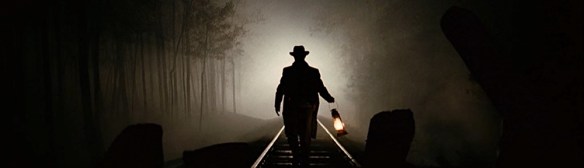
Another opening scene where the photography is the star. This time, it’s the work of the great Roger Deakins, as a gang of crooks await a train in a forest at night, lit only by the orange glow of lanterns. Then the train itself arrives, its stark headlight throwing sharp relief on the shadowy trees. Deakins himself has said it’s his best work, and who are we to disagree? The effectiveness is only heightened by the slow, deliberate, tension-mounting pace maintained by director Andrew Dominik.

7
The Superfreak Dance

from Little Miss Sunshine

After all the trials and tribulations of the movie, the Hoover family finally make it to the Little Miss Sunshine pageant and little seven-year-old Olive gets up on stage… where she dances a striptease-style routine to Superfreak. It neatly satirises and pillories the ludicrous sexualisation of these beauty pageants. Then the sequence only gains in stature when the officials try to pull Olive off stage early, which ends up with the whole family throwing dignity to the wind and dancing with her — the previously disjointed family finally united.

6
The Tanker Chase

from Mad Max 2

I already discussed this at length in my review, so to quote myself, it’s “an almighty action sequence […] a speeding battle through the outback. It feels wrong to just call it ‘an action sequence’, like that’s selling it short. You get the sense that this is why the movie exists; that co-writer/director George Miller’s goal with the entire rest of the film has been to get us to this point. It’s not just ‘the climax’, it’s ‘the third act’, and it’s stunning — the choreography of it, the editing, the stunts, as dozens of vehicles chase each other, people run around on top of them, jump between them… I don’t think it’s hyperbolic to say it must be one of the greatest action sequences ever committed to film.” It’s so good, they later remade it as an entire movie. And if you want to see something equally awesome, here’s the Mad Max 2 scene re-scored with music from Fury Road.

5
The Henley Royal Regatta Boat Race

from The Social Network

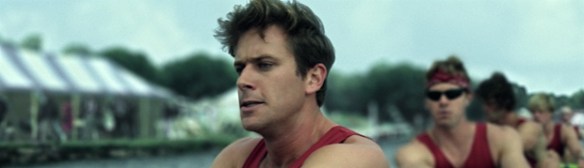
You could cut this 100-second sequence out of The Social Network and it would have no impact on the film’s plot, but it would also rob us of one of the most striking sequences in the CV of director David Fincher — and considering his continued visual mastery, that’s saying something. The tilt-shift-style photography came out of necessity, as the sequence was shot just months before the film’s release and they had to shoot the close-ups somewhere else entirely, but it gives the whole thing a unique visual style that, particularly when combined with a version of In the Hall of the Mountain King from composers Trent Reznor and Atticus Ross, is something very special.

4
The Poem

from Skyfall

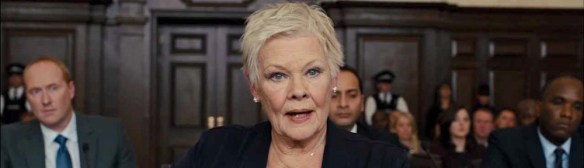
Whoever thought we’d one day find moviemaking artistry in the James Bond series? Skyfall isn’t even the first time that happened (see: the opera escape from Quantum of Solace), but the reason this sequence is even better is the way it sums up the film’s themes. As I described it in my review: “Bond races to an inquiry where M is giving evidence, in pursuit of Silva who is intending to finalise his revenge, with the soundtrack sharing only Judi Dench’s voice delivering a reading from Tennyson: ‘though we are not now that strength which in old days moved earth and heaven,’ she says, cementing [the] themes of what the role of the secret service (and, indeed, Britain) is in the modern world; and continues, ‘heroic hearts, made weak by time and fate, but strong in will to strive, to seek, to find, and not to yield,’ as a weakened, past-it Bond races to her rescue. It’s so perfect it could have been written for the film especially.”

3
The Truck Flip

from The Dark Knight

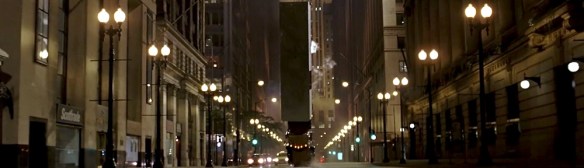
Pure spectacle seems hard to come across in movies post-CGI, where anything that can be imagined can be created on screen by even relatively small-scale movies. But when you combine the first time a narrative feature film had been shot in IMAX with an incredible stunt performed for real, you’re reminded of the magic of cinema. It’s the most memorable part of a car chase sequence that is exceptionally well executed on the whole, too.

2
The Montage

from Requiem for a Dream

To quote my review: “I’m not sure you can quite be prepared for what comes [at the end]. Even if you were told what happens, or see some of the imagery, or feel like you can see worse stuff on the internet without even looking too hard (which, of course, you can)… that’s not the point. It’s the editing, the sound design, the sheer filmmaking, which renders the film’s final few minutes — a frenzied montage that crosscuts the climaxes of all four characters’ stories — as some of the most powerful in cinema. It’s horrendous. It’s brilliant.”

1
The Basement

from Zodiac

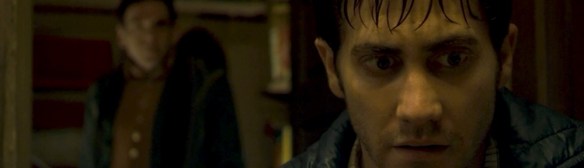
When I first thought of this idea for a top ten, this was the first thing that came to mind. In it, Jake Gyllenhaal’s obsessive investigator Robert Graysmith visits the home of a suspect’s friend. The pair are alone in the house, and they both go down into the basement to see something… when Robert hears someone upstairs. Describing this scene does it no justice — it’s one of the most hair-raisingly chilling in screen history.

Tomorrow: New York, London, Paris, Munich, everybody talk about… film music.

Raising Arizona (1987)

2016 #164
Joel Coen | 94 mins | streaming (HD) | 1.85:1 | USA / English | 12 / PG-13

Raising Arizona

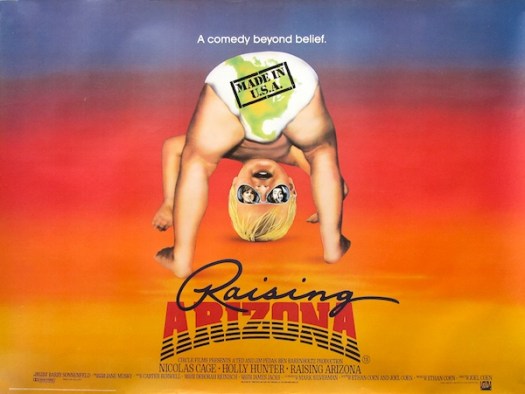
Once upon a time I did a Media Studies A level, and (for reasons I can’t remember) our teacher showed us the pre-titles sequence of Raising Arizona because it was noteworthy for being the longest pre-titles sequence ever. As it happened our teacher was wrong, because The World Is Not Enough had already exceeded it a couple of years earlier.* And now it’s completely meaningless because most blockbusters don’t bother to show any credits until the end of the film, technically rendering the entire movie as the pre-titles “sequence”.

My point here is twofold. One: I miss the structure of all films having title sequences somewhere near the start. Two: before now all I could have told you about Raising Arizona is that “it has the longest pre-titles ever (except it doesn’t)”. Well, that and it stars Nic Cage and was directed by the Coen brothers. But now I’ve watched it and, three months after the fact, …that’s still almost all I can tell you. I also remember there was a kinda-cool semi-fantastical thing going on with, like, a demon biker or something. Oh, and it’s quite funny. Not very funny, but quite.

I have an awkward relationship with the Coen brothers. I always feel like I should be enjoying their movies more than I actually do, and I think some of their stuff is downright overrated. Unfortunately, Raising Arizona has done little to change this situation.

3 out of 5

* For what it’s worth, the length of TWINE’s pre-titles wasn’t intended. It was originally supposed to be just the stuff in Spain, with the MI6 explosion and subsequent Thames boat chase coming after the titles, but it was decided that didn’t make for a strong enough opening and it was recut. It runs about 17 minutes vs Raising Arizona’s 11. ^

Tomorrow Never Dies (1997)

100 Films’ 100 Favourites #91

Yesterday is a memory. Today is history.
Tomorrow is in the hands of one man.
Bond. You know the rest.

Country: UK & USA
Language: English, German, Danish, Mandarin & Cantonese
Runtime: 119 minutes
BBFC: 12 (cut, 1997) | 12 (cut more, 1998) | 15 (uncut, 2006) | 12 (uncut, 2012)
MPAA: PG-13

Original Release: 12th December 1997 (UK)
US Release: 19th December 1997
First Seen: cinema, December 1997

Stars
Pierce Brosnan (Dante’s Peak, The Ghost)
Jonathan Pryce (Brazil, Pirates of the Caribbean: The Curse of the Black Pearl)
Michelle Yeoh (Supercop, Crouching Tiger, Hidden Dragon)
Teri Hatcher (Tango & Cash, Coraline)
Judi Dench (Mrs Brown, The Best Exotic Marigold Hotel)

Director
Roger Spottiswoode (Turner & Hooch, A Street Cat Named Bob)

Screenwriter
Bruce Feirstein (GoldenEye, The World Is Not Enough)

Based on
James Bond, a character created by Ian Fleming.

The Story
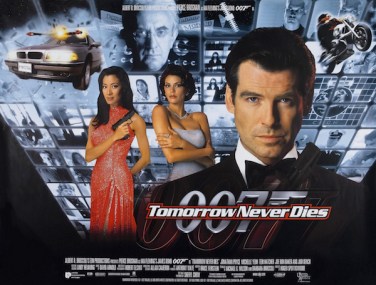
Secret agent James Bond is deployed to investigate a media baron who is plotting to ignite a war between the UK and China to further his business empire.

Our Hero
The name’s Bond, James Bond. In his second outing as agent 007, Pierce Brosnan has settled comfortably into his interpretation of the hero, a mix of Roger Moore’s eyebrow-raising levity with some of Sean Connery’s slightly harder, man-of-action edge.

Our Villain
Elliot Carver is a megalomaniac media mogul — the owner of the newspaper Tomorrow, who intends to secretly provoke a war in order to boost sales and ratings. James Bond does satire? Kinda.

Best Supporting Character
Wai Lin, a spy who’s investigating Carver for the Chinese. A skilled martial artist, she kicks all kinds of ass. Despite initial mistrust, she and Bond ultimately team up. Lin is arguably one of the first Bond girls who can genuinely claim to be a competent character in her own right. Still ends up sleeping with Bond, though.

Memorable Quote
Admiral Roebuck: “With all due respect, M, sometimes I don’t think you have the balls for this job.”
M: “Perhaps. But the advantage is I don’t have to think with them all the time.”

Memorable Scene
Remote control car, James Bond style: Bond lies in the backseat of his BMW, driving it around a multi-storey car park with his mobile phone, deploying its weapons against a gang of attackers. It was a fun concept back in ’97, but I imagine you could do it yourself with an app now. Apart from the weapons. And the legal implications. So maybe not.

Memorable Music
After the disastrous ‘modern’ score for GoldenEye, music duties were here handed to David Arnold. At the time he had composed the scores for Stargate and Independence Day, but, even more pertinently, he had produced Shaken and Stirred, an album of contemporary-styled covers of great Bond themes. The album was heard by iconic Bond composer John Barry, who then recommended Arnold to producer Barbara Broccoli. Arnold’s score is much more in-keeping with classic Bond music, but given a modern (well, ’90s) flavour. Backseat Driver, the soundtrack to my Memorable Scene pick, is a particularly great action cue. Arnold would become the series’ composer for the next four films, until Sam Mendes chose to use his regular collaborator Thomas Newman for Skyfall and Spectre. With Mendes moving on, perhaps Arnold will be back for Bond 25…

Write the Theme Tune…
Arnold wanted to have a hand in writing the title song and integrate it into his soundtrack, like the great Bond composers of old. To that end he wrote a theme sung by k.d. lang… which plays over the end credits and is titled Surrender, though has a tellingly prominent use of the phrase “tomorrow never dies” in its lyrics.

Sing the Theme Tune…
The producers went with a more marketable proposition for the final opening credits song, however, in the shape of Sheryl Crow, famous for her pop-rock-y hits like All I Wanna Do, A Change Would Do You Good, and Everyday is a Winding Road. In the pantheon of Bond title themes, her Tomorrow Never Dies sits firmly in the middle — it’s not a GoldenEye, but it’s not a Die Another Day either.

Making of
The film was originally called Tomorrow Never Lies, referencing Carver’s newspaper, Tomorrow. Some kind of production mix-up (a typo, a smudged fax — pick your story) led to it being misread as Tomorrow Never Dies, and the new, less meaningful title stuck.

This Category Sponsored By BMW
Apparently Tomorrow Never Dies was the first movie in history to have its entire budget covered by product placement endorsements — that’s over $100 million in advertising. Featured companies include BMW, L’Oréal, Heineken, Dunhill, Ericsson, Omega, Smirnoff, Brioni, Bollinger, and Avis, plus a tie-in game from Electronic Arts.

Previously on…
17 previous Bond films (which are all technically in the same continuity). The previous one, GoldenEye, was the first to star Pierce Brosnan and relaunched the series to mass popularity after a fallow period.

Next time…
Two more Brosnan Bonds, before he was unceremoniously dumped to reboot the series for the first time. With a 25th film now in the works, the series is set to continue indefinitely.

Awards
1 Saturn Award (Best Actor (Pierce Brosnan))
3 Saturn nominations (Action/Adventure/Thriller Film, Supporting Actress (Teri Hatcher), Music)
2 MTV Movie Awards nominations (Action Sequence for the motorcycle/helicopter chase (somehow it lost to Face/Off), Best Fight for “the fight between Michelle Yeoh and some ‘bad guys’.”)

What the Critics Said
“East meets West, yin meets yang and chop-socky meets kiss-kiss bang-bang in Tomorrow Never Dies, a zippy 007 romp that draws as heavily from the Asian action genre as from the formula that has served the series so well for 35 years. Goldeneye and Pierce Brosnan’s debonair Bond resuscitated the creaky franchise in 1995, but […] Tomorrow, jazzier, wittier and more costly than its predecessor, also comes closer to catching up with ’90s style and politics. […] Hong Kong kung-pow chick Michelle Yeoh, as the cool-headed Chinese agent Wai Lin, proves 007’s equal at kicking post-Cold War butt. The two take on craven communications baron Elliot Carver (Jonathan Pryce), a deliciously exaggerated — or is it? — composite of Ted Turner, Rupert Murdoch and the late Robert Maxwell. Carver’s not only the most plausible Bond nemesis ever but the perfect one for the current global villain shortage.” — Rita Kempley, The Washington Post

Score: 57%

What the Public Say
TND is somewhat underrated. Jonathan Pryce plays a villain who is essentially Rupert Murdoch smooshed together with Ted Turner. His plan isn’t to take over the world so much as it is getting rich by starting a war and then covering it on his news outlets. This just may be the most plausible Bond villain scheme of all times – which admittedly isn’t saying much. […] TND may not be among the best Bonds, but it’s got more going for it than I think it gets credit for.” — Lebeau, Lebeau’s Le Blog

Verdict

I know some of you will be thinking, “how can you leave out Goldfinger / Thunderball / The Spy Who Loved Me / For Your Eyes Only / The Living Daylights / Licence to Kill [delete according to personal preference] but include Tomorrow Never Dies?!” It’s true, TND is far from the most popular Bond film, but it was the first I saw on the big screen, and that gives me a certain soft spot for it. It’s not just that, though.

Here’s a thing: one of the criticisms levelled at the film is that it’s just an action movie, lacking the peculiarly Bondian thrills a Bond adventure should have. But if it is “just an action movie” then it’s the best action movie in the Bond series. The pre-titles gunfight at the arms meet, the ‘backseat driver’ sequence, and the motorbike-vs-helicopter chase are three of the finest action scenes in the entire franchise, and that’s without even touching on Michelle Yeoh kicking ass. Couple that with Brosnan still new and confident in the lead role, and Jonathan Pryce nibbling the scenery as a lightly satirical villain, and I think you have a Bond film that is pretty entertaining, even if it’s mainly on an adrenaline-pumping level.

#92 has… a friend in me.

On Her Majesty’s Secret Service (1969)

100 Films’ 100 Favourites #66

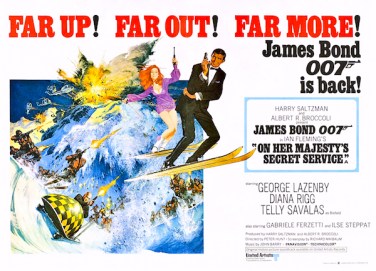
Far up! Far out! Far more!
James Bond 007 is back!

Country: UK & USA
Language: English, German & French
Runtime: 142 minutes
BBFC: A (cut, 1969) | PG (1987)
MPAA: M (1969) | PG (1994)

Original Release: 13th December 1969 (Japan)
UK Release: 18th December 1969
US Release: 18th December 1969
First Seen: TV, c.1995

Stars
George Lazenby (Who Saw Her Die?, Gettysburg)
Diana Rigg (The Assassination Bureau, Theatre of Blood)
Telly Savalas (The Dirty Dozen, Kelly’s Heroes)

Director
Peter Hunt (Shout at the Devil, Death Hunt)

Screenwriter
Richard Maibaum (From Russia with Love, The Spy Who Loved Me)

Additional dialogue by
Simon Raven (Unman, Wittering and Zigo, The Pallisers)

Based on
On Her Majesty’s Secret Service, the tenth James Bond novel by Ian Fleming.

The Story
After James Bond saves the life of Teresa DiVincenzo, her mob boss father offers him information on the location of Ernst Stavro Blofeld, who Bond has been unsuccessfully tracking for years. Operating against orders to drop his investigation, Bond goes undercover in Blofeld’s Swiss research facility to find out what nefarious scheme he’s plotting now…

Our Hero
Bond, James Bond, agent 007 of the British secret service. On this mission, he falls in love and gets married — that never happened to the other fella!

Our Villain
Bond’s second face-to-face confrontation with the head of S.P.E.C.T.R.E., evil mastermind and archetypal uber-villain Ernst Stavro Blofeld, now played by Telly Savalas. It’s a very good villainous performance, though possibly suffers by coming after Donald Pleasance’s iconic turn in You Only Live Twice.

Best Supporting Character
Contessa Teresa Draco DiVincenzo — aka Tracy, the only woman headstrong, intelligent, and bold enough to tie down international playboy James Bond.

Memorable Quote
“It’s all right. It’s quite all right, really. She’s having a rest. We’ll be going on soon. There’s no hurry, you see. We have all the time in the world.” — James Bond

Quote No One’s Going to Use in Everyday Conversation Anymore, That’s For Sure
Bond: “I find her fascinating, but she needs a psychiatrist, not me.”
Draco: “What [my daughter] needs is a man… to dominate her! To make love to her enough to make her love him! A man like you!”

Memorable Scene
As M, Q, and Moneypenny sit around wondering where the devil 007 is, a shadowy man drives an Aston Martin accompanied by the Bond theme. (As in we hear it — he’s not got it on the stereo.) To his surprise, he’s overtaken by a woman. A few miles down the road, he sees her car stopped by the beach, and she’s walking out to sea. He runs after her, scoops her up and carries her back to the shore. As she wakes up, we see his face for the first time — and it’s not Sean Connery! But he does say, “My name’s Bond. James Bond.” Then he has a punch-up. A tradition (keeping the new Bond’s face a ‘secret’ until some kind of reveal*) is instantly born.

* Not that this happens in Live and Let Die. Or Casino Royale, really. Oh well.

Write the Theme Tune…
Regular series composer John Barry aimed to help cover for the absence of Connery by making the score “Bondian beyond Bondian”, and this certainly applies to the main title theme: an instrumental number (of which there are only three in the entire series) which is surely second only to the main James Bond theme in its Bondianness. It’s a fantastic action number that sits just as well over the ski sequences as it does the opening titles. (There’s also a great cover version by the Propellerheads on David Arnold’s Shaken Not Stirred album, by-the-by.)

Sing the Theme Tune…
Nonetheless, the film does contain an original song, composed by Barry with lyrics by Hal David, and — most famously — sung by Louis Armstrong in his final recording: We Have All the Time in the World. Considering the 1967 Casino Royale also produced The Look of Love, it was clearly an unusually fertile time for Bond films to produce songs that transcended their origins.

Technical Wizardry
Various methods were used to capture the Alpine action scenes, including camera operators skiing alongside the stuntmen (backwards while holding a camera!), and using Swiss Olympic athletes for the bobsled chase (with the sequence rewritten to incorporate their accidents). Most remarkable, though, was the aerial photography achieved by cameraman Johnny Jordon. To get flexibility to shoot scenes on the move from any angle, he developed a system where he was dangled 18 feet below a helicopter in a parachute harness. Mad.

Looking good, Lazenby!Letting the Side Down
There’s little doubt that George Lazenby is the worst big-screen Bond (though all of those who came after have their detractors), but he’s not actually that bad — he certainly sells the film’s emotional ending in a way I can’t quite picture Connery managing. If he’d stuck around for a few more movies I imagine he’d be better regarded. What really lets him down is his costuming — that frilly-shirt-and-kilt outfit is half the reason people who dislike the film dislike it so much, I swear. (Here it is bigger, if you want a good look.)

Making of
Various stars of The Avengers (the classic British TV series, not the Marvel superheroes) have appeared in the Bond series — Honor Blackman in Goldfinger, Patrick Macnee in A View to a Kill (plus narrating loads of the DVD documentaries), and of course Diana Rigg here — all after they appeared on the TV show. The exception is Joanna Lumley, who appears in a small part here a few years before joining The New Avengers. Despite the diminutive size of her role, Lumley spent two months on the production, dubbing the voices of Blofeld’s whole cadre of women using German, Chinese, and Norwegian accents. She also taught the other actresses to crochet, so that was nice.

Previously on…
Five James Bond films starring Sean Connery.

Next time…
After Lazenby pulled out of his contract, Connery returned for Bond’s next adventure. There have been 17 Bond adventures on the silver screen since that, and the series continues indefinitely, with a 25th entry due in 2018 or so. On Her Majesty’s Secret Service was adapted for radio in 2014, the fourth of (to date) five Bond radio adaptations starring Toby Stephens as 007.

Awards
1 Golden Globe nomination (Most Promising Male Newcomer (George Lazenby))

How OHMSS Got a Bad Reputation
“I suspect the average filmgoer still believes Lazenby was fired because the movie flopped. Wrong on both counts. OHMSS was not a blockbuster on the scale as Connery’s previous two films, but it was a solid hit. Box-office returns were no reason to fire Lazenby, and he wasn’t fired. He quit. […] OHMSS would go over schedule and over budget and [director Peter Hunt] would continually clash with his producers as well as his star. When OHMSS didn’t prove to be a runaway success, the public would blame Lazenby, but Saltzman and Broccoli and United Artists privately blamed Hunt along with his insistence on creating a tense, serious action film faithful to Fleming. Perversely, the finest film in Broccoli and Saltzman’s series became the model of everything they wanted to avoid in the future. In their desire to run from all that OHMSS represented, they turned the next film, Diamond Are Forever, into the dumbest, sloppiest mess in the series’ history. But Connery had returned so it was another substantial box-office hit, and the producers felt vindicated in their artistically disastrous decisions. The success of Diamonds Are Forever dealt a hit to OHMSS’s reputation. Thankfully, quality cannot go ignored for long and as more people discovered Hunt’s neglected masterpiece, the more admired it has become.” — Jeffrey Westhoff, Culture Spy (that whole piece is excellent, by-the-by)

What the Critics Said
“it is nothing short of miraculous to see a movie which dares to go backward, a technological artefact which has nobly deteriorated into a human being. I speak of the new and obsolete James Bond, played by a man named George Lazenby, who seems more comfortable in a wet tuxedo than a dry martini, more at ease as a donnish genealogist than reading (or playing) Playboy, and who actually dares to think that one woman who is his equal is better than a thousand part-time playmates. […] The love between Bond and his Tracy begins as a payment and ends as a sacrament. After ostensibly getting rid of the bad guys, they are married. They drive off to a shocking, stunning ending. Their love, being too real, is killed by the conventions it defied. But they win the final victory by calling, unexpectedly, upon feeling. Some of the audience hissed, I was shattered.” — Molly Haskell, The Village Voice

Score: 82%

What the Public Say
“Not everybody is wrong about this film, of course. Steven Soderbergh and Christopher Nolan are both fond of this film. As am I. There are problems with this film, to be certain, and the problems do lie (mostly) with Lazenby. […] Having gone with the amateur Bond, they upped the ante for the girl. Diana Rigg was already a star from The Avengers and was perfectly suited to be a Bond girl. [She] is the answer, of course, as to why this film ranks as high as it does on the list of Bond films when Lazenby is so lackluster a Bond. Yes, there are good things in the film beside her – the ski scenes, the bobsled scene (you can tell the close-ups are rear projection but the longshots are real and exciting), the tragedy of the ending. But, for the first 40 years of the series she was the height of the Bond girls and she pulls this film higher than we had any right to originally expect.” — Erik, News from the Boston Becks

Verdict

The history of opinion on OHMSS is a fascinating one: written off as a failure, the series’ black sheep thanks to Lazenby and the less fantastical tone than the films that surround it; then gradually rehabilitated precisely because of that tone, to the point where it’s now almost “the Bond fan’s Bond film” (it certainly still has its detractors, who are either baffled by or in denial of its acclaim in other quarters). The ways it subverts the Bond formula are part of what makes it so memorable, but so are the ways it plays up to it, like Blofeld’s mountaintop base: considerably more plausible than the hollowed-out volcano (it’s a real place, for one thing), but no less incredible. Similarly, there’s an atypical plot, but also incredible action sequences — all done for real, too (well, aside from some iffy back projection). It does have faults that hold it back from being the best Bond movie in my estimation, but it’s up with the series’ best nonetheless.

#67 will be… a Western fairytale.

Spy: Extended Cut (2015)

2016 #106
Paul Feig | 125 mins | streaming (HD) | 2.35:1 | USA / English | 15

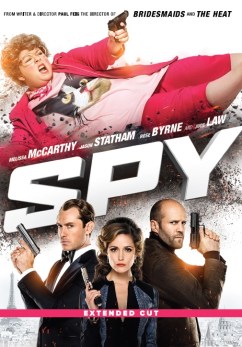
The cinema was blessed — or, depending on your point of view, blighted — by an abundance of espionage-related movies last year (see: the intro to my initial thoughts on Spectre for more on that), and even writer-director/star team Paul Feig and Melissa McCarthy got in on the act with this comedy.
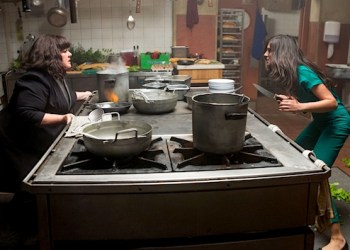
McCarthy is Susan Cooper, a CIA agent who provides desk-bound support for Bond-esque super-spy Bradley Fine (Jude Law). When Fine is killed while investigating the villainous Rayna Boyanov (Rose Byrne), Cooper insists she go into the field to finish what he started. This doesn’t impress experienced agent Rick Ford (Jason Statham), who goes rogue to deal with Boyanov himself.

Technically speaking, Spy is a spy comedy rather than a spy spoof — a perhaps subtle distinction, but one that does inform the kind of comedy you’re getting; i.e. rather than a send-up that relies on you knowing the material being parodied to get the jokes, this is almost a workplace comedy… just one where the workplace is international espionage. Put another way, less Naked Gun or Austin Powers, more Kingsman with the comedy dialled up higher in the mix.

This is perhaps why it’s sporadically amusing rather than regularly hilarious; on the bright side, it only occasionally slides too far into dull toilet/gross-out ‘humour’. Similarly, it means that there are a handful of fun and/or exciting action beats scattered throughout the film, which you might not expect. They’re typically brief, but — even more surprisingly — there’s a fight between McCarthy and a henchwoman in a kitchen which is a genuinely good action sequence. It’s also surprisingly gruesome. Yes, it’s R-rated, but in the world of comedy that usually just means an overabundance of the F-word. Here we have at least one clear headshot, a dissolving throat, a knife through a hand, and more photos of a henchman’s penis than you ever needed to see. (That last one’s only describable as “gruesome” depending on your personal predilections, of course.)
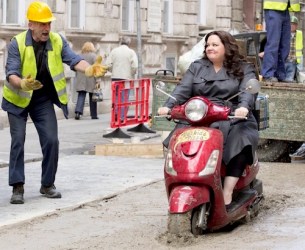
Apparently Feig is a fan of James Bond and developed, wrote, produced, and directed Spy because he knew no one would ever let him do a real Bond movie. I guess that explains why some of it does work passably well as a genuine action/thriller. Composer Theodore Shapiro does an equally good job of evoking Bond’s musical stylings throughout his score. In my experience most comedies don’t show such consistent commitment in their music. Talking of music: as I mentioned in my June monthly update, there’s a random cameo by Verka Serdyuchka, Ukraine’s Eurovision entry from 2007. That gets the film some bonus points in my book.

The quality of the cast’s performances are variable in ways I didn’t expect. Statham almost steals the film, playing essentially himself — but exaggerated, I’m sure. McCarthy is a solid lead, at her best when sparking off Rose Byrne, who makes anything more watchable. Miranda Hart has a large supporting role as McCarthy’s CIA colleague, but I’m not sure that her strengths are wholly played to. I guess if you like her you’ll like her here (and if you don’t…) Peter Serafinowicz’s lecherous Italian is disappointingly overplayed, however, and I’m not sure why you’d cast ever-so-British Jude Law as a James Bond type and then give him an American accent.

The extended (aka unrated) cut contains almost 10 minutes of extra material, detailed here. Reading that list really demonstrates how some bits were tightened up for the theatrical release. I’d even wager that some parts are the result of improvising to find one good line, but in the extended cut they’ve strung half a dozen of the options together. I don’t think any casual viewer would miss much by sticking to the theatrical cut. That said, despite it running to two hours, I didn’t find it to be too long. It still wouldn’t hurt if it was tighter in places, but I didn’t get that “oh dear God why is this longer than 90 minutes?!” feeling you can get from 120-minute comedies.
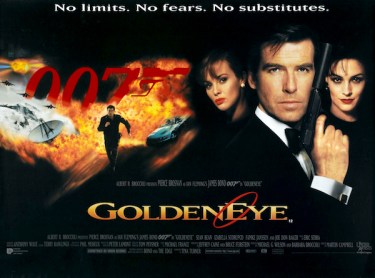
Amusing rather than hilarious, but with a pleasing commitment to its genre, Spy isn’t going to tap into the zeitgeist in the way Austin Powers did almost 20 years ago(!), but it does provide a largely entertaining couple of hours.

3 out of 5

Feig and McCartney’s latest collaboration, the Ghostbusters reboot, is in UK cinemas from today, and launches around the world over the coming weeks.

GoldenEye (1995)

100 Films’ 100 Favourites #40

You know the name.
You know the number.

Country: UK & USA
Language: English, Russian & Spanish
Runtime: 130 minutes
BBFC: 12 (cut, 1995) | 15 (uncut, 2006)
MPAA: PG-13

Original Release: 16th November 1995 (Canada)
US Release: 17th November 1995
UK Release: 24th November 1995
First Seen: VHS, 1996

Stars
Pierce Brosnan (Mrs. Doubtfire, Mamma Mia)
Sean Bean (Patriot Games, The Lord of the Rings: The Fellowship of the Ring)
Izabella Scorupco (Reign of Fire, Exorcist: The Beginning)
Famke Janssen (X-Men, Taken)
Judi Dench (A Room with a View, Notes on a Scandal)

Director
Martin Campbell (The Mask of Zorro, Casino Royale)

Screenwriters
Jeffrey Caine (The Constant Gardner, Exodus: Gods and Kings)
Bruce Feirstein (Tomorrow Never Dies, The World is Not Enough)

Story by
Michael France (Cliffhanger, The Punisher)

Based on
James Bond, a character created by Ian Fleming.

The Story
When Russian crime syndicate Janus steal the activation codes for a new satellite weapons system called “Goldeneye”, there’s only one man who can stop them using it for nefarious ends: Jack Bauer. Only kidding — it’s Jason Bourne. No, ‘course not — it’s Bond, James Bond.

Our Hero
Pierce Brosnan is Bond, James Bond, for the first time. After the almost-franchise-killing seriousness of Timothy Dalton, Brosnan nails Bond for the nostalgic ’90s: a dash of Sean Connery’s grit, a dash of Roger Moore’s raised-eyebrow humour, a whole lot of suaveness. For a while, the old “Connery or Moore?” question became “Connery, Moore or Brosnan?”

Our Villain
The mysterious Janus, who (spoiler alert!) turns out to be former MI6 agent and Bond’s chum Alec Trevelyan, out for revenge against the British Empire for betraying his family after World War 2, and against Bond for setting the bombs’ timers for three minutes instead of six.

Best Supporting Character
It was a bold choice to cast a woman as M back in 1995, even though she was inspired by the real director of MI6 at the time. Fortunately they cast the inestimable Dame Judi Dench, who naturally made the role her own — so much so that she survived the otherwise series-wide reboot in 2006, and having a male in the part now feels kinda odd.

Memorable Quote
“I think you’re a sexist, misogynist dinosaur. A relic of the Cold War” — M
(If a single line saved the Bond series, it’s this. In one fell swoop Dame Judi proves that a female M will work, and that this is a franchise aware of the need to drag itself into the present day.)

Memorable Scene
The villains are driving off with the kidnapped love interest. There’s no Aston Martin in sight. Does Bond take another car? Of course not — he takes a bloody tank.

Write the Theme Tune…
Bono and The Edge of U2, hired after…

Sing the Theme Tune…
Tina Turner. According to Wikipedia, “the producers did not collaborate with Bono or The Edge,” hence why (unlike previous Bonds) there’s nothing in the main score that references the title theme. That would rather become the Bond M.O. as the ’90s went on.

Truly Special Effect
The bungee jump off the damn — because it’s not a special effect, it’s real. The Bond series’ legacy of incredible, groundbreaking stunts continues with considerable style.

Letting the Side Down
Éric Serra’s score. Hiring someone to write a very modern (for the early ’90s) score for the newly-relaunched Bond must’ve seemed like a good idea at the time… but it wasn’t. It hasn’t improved any with age, either. Tellingly, after the score was finished the producers had someone else re-score the film’s big action sequence, the St. Petersburg tank chase, with music that sounds far more classically Bondian. Bonus problem: if you had an N64 (like I did), chances are you played GoldenEye the game far more than you watched the film. It too used Serra’s score, meaning I can’t hear it without being transported back to an idyllic adolescence playing blocky video games.

Making of
Pierce Brosnan was originally cast as Bond in 1986, but was forced to pull out when his TV series, Remington Steele, was unexpectedly renewed (according to one telling, that was purely to prevent him playing Bond — they only made six more episodes). Previously, Timothy Dalton had almost been cast when Roger Moore became Bond, and Moore had almost been cast before Sean Connery. Don’t be too surprised if Henry “Superman” Cavill — who was almost cast before the producers settled on Daniel Craig — is taking his martinis shaken not stirred in a few years’ time.

Previously on…
16 previous Bond films (which are all technically in the same continuity). The last was six years earlier, and the least financially successful for 15 years in the US (did alright worldwide, though).

Next time…
Brosnan played Bond thrice more, to increasing box office (if not critical) acclaim. He was due to do a fifth, but then the producers won back the rights to Casino Royale and the rest is history.

Awards
2 BAFTA nominations (Special Effects, Sound)
2 Saturn nominations (Action/Adventure Film, Best Actor (Pierce Brosnan))
2 MTV Movie Awards nominations (including Best Sandwich in a Movie for the submarine sandwich with tomatoes and provolone. It lost to the ham and cheese sandwich in Smoke).

What the Critics Said
“James Bond, the British spy with a taste for the high life and a licen[c]e to kill, comes back in surprisingly hardy and supple form. Gadgets firing, quips racing, libido unfurling, surrounded by a top-notch supporting crew of actors, designers and demolition experts, the new Agent 007 (now played by Pierce Brosnan) delivers whatever Bond devotees could reasonably want, or what newcomers anticipate. […] So much familiarity may lead to contempt in some quarters. But Bond, like Sherlock Holmes, Jeeves, Tarzan, Frankenstein or Dracula, is one of those mythical British pop figures who seem ageless, infinitely adaptable. […] Perhaps the reason is that Bond — as his detractors have always noted — is an adolescent fantasy figure, a Peter Pan popped onto the stage of international espionage. Like Peter, he can’t — won’t — grow up. [He has] caught the world’s imagination because he played out its darker dreams with fairy-tale lightness.” — Michael Wilmington, Chicago Tribune

Score: 78%

What the Public Say
“Rarely in the Bond franchise have directing, acting, cinematography, action, and music come together to create such a stylishly sublime experience. GoldenEye has undeniably earned its now-solidified status as a classic.” — Lukas, Lukas + Film

Verdict

After diminishing box office in the Dalton years, a long gap forced by legal battles, and the Cold War ending in the interim, bringing Bond back for the ’90s was perhaps a bit of a long shot. Fortunately, this fact didn’t escape the makers: there are numerous nods to Bond’s somewhat old-fashioned values (see also: memorable quote), and a whole heap of effort was expended on large-scale action sequences and stunts. Couple that with a solid storyline, several memorable villains, and a “greatest hits”-style leading performance from Brosnan, and you have a series that wasn’t just revived but was set to reach new heights (of box office, if nothing else).

Frankly my dear, #41 doesn’t give… a damn.

From Russia with Love (1963)

100 Films’ 100 Favourites #32

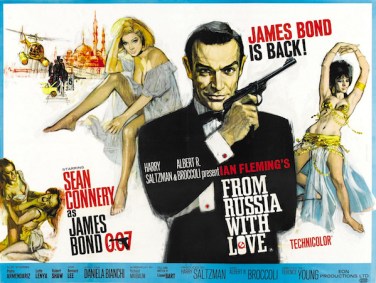
James Bond is back!
His new incredible women!
His new incredible enemies!
His new incredible adventures!

Country: UK
Language: English, Russian, Turkish & Romany
Runtime: 115 minutes
BBFC: A (1963) | PG (1987)
MPAA: GP (1971) | PG (1994)

Original Release: 11th October 1963 (UK)
US Release: 8th April 1964
First Seen: TV, c.1995

Stars
Sean Connery (Darby O’Gill and the Little People, Zardoz)
Daniela Bianchi (Special Mission Lady Chaplin, Operation Kid Brother)
Pedro Armendariz (Fort Apache, 3 Godfathers)
Lotte Lenya (The Threepenny Opera, The Roman Spring of Mrs. Stone)
Robert Shaw (A Man for All Seasons, Jaws)

Director
Terence Young (Dr. No, Wait Until Dark)

Screenwriter
Richard Maibaum (Bigger Than Life, Licence to Kill)

Adapted by
Johanna Harwood (Dr. No, Call Me Bwana)

Based on
From Russia with Love, the fifth James Bond novel by Ian Fleming — one of John F. Kennedy’s favourite novels.

The Story
When Soviet consulate clerk Tatiana Romanova offers to defect, she has one condition: that she is extracted by James Bond. Although M smells a trap, as collateral Tatiana offers a Lektor, a decoding machine MI6 have wanted for years. Bond travels to Istanbul to steal the Lektor, unaware he’s being manipulated by the criminal organisation SPECTRE…

Our Hero
The name’s Bond, James Bond. In only his second big-screen outing, so Connery is still establishing the character here — considering all the ‘fun’ antics that came since, Bond is quite a hard bastard in Dr. No and From Russia with Love (which is only appropriate for a government-sponsored killer, of course).

Our Villains
They may not be as grandiose as the volcano-dwelling types that came later in the series, but From Russia with Love has two of Bond’s most memorable adversaries: the hard former KGB officer Rosa Klebb, with her deadly shoe (well, it sounds silly when you put it like that), and assassin Red Grant, who may not know what wine to have with fish but could certainly gut you like one. A fish, that is. Not wine. You can’t gut wine.

Best Supporting Character
Kerim Bey, British Intelligence’s man in Turkey. An affable, witty soul, he’s also an invaluable ally during Bond’s time in Istanbul.

Memorable Quote
Tatiana: “I think my mouth is too big.”
Bond: “I think it’s a very lovely mouth. It’s just the right size… for me, anyway.”

Memorable Scene
On the Orient Express, SPECTRE assassin Red Grant manages to corner Bond in his compartment. Although he has Bond at gunpoint, Grant is distracted by the offer of gold coins hidden in Bond’s case. Bond tricks Grant into setting off the case’s booby trap, allowing Bond to tackle him. A rough close-quarters fight ensues.

Write the Theme Tune…
Having arranged and performed Monty Norman’s James Bond Theme for Dr. No (for which he didn’t receive a credit), John Barry was the main composer for Bond’s second adventure. However, the producers tapped Lionel Bart — then popular from Oliver! — to write the title song. Barry didn’t like that Bart’s lyrics had nothing to do with the film’s story, a point he set out to rectify when given full control of the soundtrack to Goldfinger.

Sing the Theme Tune…
A good answer if you’re ever faced with a trivia question about James Bond theme singers, Matt Monro was — so Wikipedia tells me — known as “The Man With The Golden Voice” and “became one of the most popular entertainers on the international music scene during the 1960s and 1970s.” With the Bond formula not yet fully established, a snippet of his song is heard on a radio early in the film, but not played in full until the end credits. (The title credits are scored with an instrumental version of the song, plus the James Bond Theme.)

Technical Wizardry
Projecting the title credits on writhing half-naked girls? It’ll never catch on.

Making of
Although Red Grant is presented as a physically-imposing male specimen, including showing off his half-naked physique the first time he appears, in reality actor Robert Shaw had to stand on a box when opposite Sean Connery because he was so much shorter than the Scot. (4 inches shorter, according to CelebHeights.com. Yes, that’s a real website.)

Previously on…
This is the second film about the adventures of James Bond, after the previous year’s Dr. No.

Next time…
The next film, Goldfinger, set the template for much of the rest of the Bond series. To date, that has encompassed a further 22 canonical movies, with the series’ 25th already in development. From Russia with Love was adapted for radio in 2012, the third of (to date) five Bond radio adaptations starring Toby Stephens as 007.

Awards
1 BAFTA nomination (British Cinematography (Colour))

What the Critics Said
“Don’t miss it! This is to say, don’t miss it if you can still get the least bit of fun out of lurid adventure fiction and pseudo-realistic fantasy. For this mad melodramatization of a desperate adventure of Bond with sinister characters in Istanbul and on the Orient Express is fictional exaggeration on a grand scale and in a dashing style, thoroughly illogical and improbable, but with tongue blithely wedged in cheek.” — Bosley Crowther, The New York Times

Score: 96%

What the Public Say
From Russia with Love turned out to be amongst the best of the Bonds. Distinctly low key, and relying on the strength of its cast over the spectacular thrills and gadgetry that would come to define the series, it’s a great couple of hours’ cinema that may delight viewers who come to it expecting the same old nonsense from 007.” — Mike, Films on the Box

Elsewhere on 100 Films
I reviewed From Russia with Love as part of a retrospective on Connery’s Bond back in 2012, when I noted it was “a very faithful rendition of the book. That makes it a Cold War spy thriller, albeit one with fantastical touches […] Mostly, though, it feels remarkably plausible. Sequences like the theft of a decoding machine from the Russian consulate, or the famous confined train carriage fight with Red Grant, have real-world heft rather than typical Bond action sequence fantasticism.”

Verdict

It’s only the second Bond movie, so there’s no template yet, but in retrospect From Russia with Love is an oddity among the Bond flicks of the ’60s and ’70s. Although it has many of the series’ regular trappings — exciting action, exotic locations, beautiful women, grotesque villains, nifty gadgets — it also functions as a straight-up ’60s Cold War spy thriller, with few of the fantastical touches the Bond films would become known for. Such atypicality means anyone looking for a “Bond formula” movie will be disappointed, but otherwise it’s an accomplished thriller, and one of the series’ finest instalments.

The first rule of #29 is… don’t talk about #29.

Casino Royale (2006)

100 Films’ 100 Favourites #18

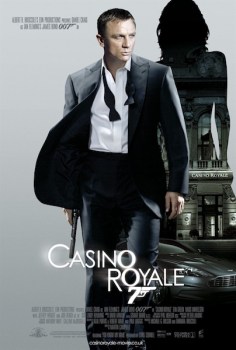
Everyone has a past.
Every legend has its beginning.

Country: UK, USA, Czech Republic & Germany
Language: English
Runtime: 144 minutes
BBFC: 12A (cut, 2006) | 15 (uncut, 2012)
MPAA: PG-13 (cut)

Original Release: 14th November 2006 (Kuwait)
UK Release: 16th November 2006
US Release: 17th November 2006
First Seen: cinema, 16th November 2006

Stars
Daniel Craig (Layer Cake, The Girl with the Dragon Tattoo)
Eva Green (The Dreamers, Sin City: A Dame to Kill For)
Mads Mikkelsen (Valhalla Rising, The Hunt)
Judi Dench (Iris, Philomena)
Jeffrey Wright (Shaft, The Hunger Games: Catching Fire)

Director
Martin Campbell (GoldenEye, Green Lantern)

Screenwriters
Paul Haggis (Crash, The Next Three Days)
Neal Purvis (Die Another Day, Johnny English)
Robert Wade (Stoned, Skyfall)

Based on
Casino Royale, the first James Bond novel by Ian Fleming.

The Story
British agent James Bond, newly promoted to exclusive double-oh status, investigates a terrorist plot that leads him to Le Chiffre. Banker to the world’s terrorists, Le Chiffre has managed to lose a lot of his clients’ money, and intends to win it back in a high-stakes poker game at the eponymous establishment. Bond is charged with joining the game and bankrupting the banker, with treasury employee Vesper Lynd along to keep an eye on the money and off Bond’s perfectly-formed arse.

Our Hero
“James before he was Bond,” as the awful US tagline went. Daniel Craig instantly disproved the not-that-numerous-but-certainly-vocal critics (remember all the “Bond isn’t blond” rubbish?) by being perhaps the most convincing actually-is-a-highly-trained-agent Bond since Connery.

Our Villain
Le Chiffre, a total banker. Fond of poker, bleeds from his eye, brilliantly played by Mads Mikkelsen, who has deservedly gone on to many other things, no doubt some wholly due to this.

Best Supporting Character
Eva Green is Vesper Lynd, a woman so remarkable that Bond names his personal Martini recipe after her. He also falls in love with her. Considering the rest of the Bond canon, that’s not likely to end well.

Memorable Quote
“I’m afraid your friend Mathis is really… my friend Mathis.” — Le Chiffre

Memorable Scene
At dinner on the train to Montenegro, Bond meets Vesper for the first time. They verbally size each other up. She wins. “How was your lamb?” “Skewered. One sympathises.”

Write the Theme Tune…
Easily the best Bond theme of the Craig era (though I like the QoS one more than most, and my main objection to Adele’s is that it’s about a flying baby horse and its receptacle for bread waste), You Know My Name was co-written by the series’ regular composer since the mid ’90s, David Arnold. That meant he could integrate the tune into his score, which was a Good Thing.

Sing the Theme Tune…
Far removed from Bond’s Bassey-imitating default style, the slightly gravelly sound of Soundgarden’s Chris Cornell (the first male vocalist on a Bond theme for nearly 20 years) helped indicate the series’ harder, manlier new direction.

Technical Wizardry
After four films of honing the Maurice Binder “naked silhouettes” style, title designer Daniel Kleinman cuts loose with an array of inventive playing card-based imagery. The most original Bond title sequence since at least Thunderball and, by being so atypical, the most unique of them all.

Truly Special Effect
Chasing after a kidnapped Vesper in the middle of the night, Bond suddenly sees her in his headlights, tied up in the middle of the road. He swerves, his Aston Martin crashes, and barrel rolls… seven times. The stunt team set a world record with that, which (despite Fury Road’s best efforts) is still unbeaten a decade later.

Making of
James Ferguson, a doctor from Aberdeen, came up with the idea for the scene in which Bond is poisoned and then remotely diagnosed by experts at MI6 HQ in London. Ferguson, a Bond fan, was retained as medical adviser for future Bond films.

Previously on…
Casino Royale was adapted for TV in 1954, starring the great Peter Lorre as Le Chiffre, and its title (and little else) was used for the awful 1967 Bond spoof. This version is the 21st in the canonical James Bond film series, and the first time that series has performed a reboot: the film opens with Bond attaining his famed double-oh status, something we’ve never seen before.

Next time…
Daniel Craig’s second outing, the somewhat misunderstood and underrated Quantum of Solace, was the first direct sequel in the Bond canon, picking up on various plot threads from Casino Royale and even resolving a few of them. After Craig’s third, Skyfall, went off on its own, last year’s Spectre tried to tie together the entirety of Craig’s era, with mixed success. Beyond that, James Bond will return indefinitely, though Craig may not.

Awards
1 BAFTA (Sound)
8 BAFTA nominations (British Film, Actor (Daniel Craig), Adapted Screenplay, Music, Cinematography, Editing, Production Design, Visual Effects)
1 Saturn Award (Action/Adventure/Thriller Film)
4 Saturn nominations (Actor (Daniel Craig), Supporting Actress (Eva Green), Writing, Music)
2 World Stunt Awards (Best High Work, Best Stunt Coordination and/or 2nd Unit Director)
1 World Stunt Awards nomination (Best Fight)

What the Critics Said
“I never thought I would see a Bond movie where I cared, actually cared, about the people. But I care about Bond, and about Vesper Lynd, even though I know that (here it comes) a Martini Vesper is shaken, not stirred. Vesper Lynd, however, is definitely stirring, as she was in Bertolucci’s wonderful The Dreamers. Sometimes shaken, too. Vesper and James have a shower scene that answers, at last, why nobody in a Bond movie ever seems to have any real emotions.” — Roger Ebert

Score: 95%

What the Public Say
“While there is very much a dramatic and sensitive undercurrent to this Bond film, Casino Royale doesn’t shortchange the audience on action. From Bond chasing a skilled free runner enemy to a brutal staircase battle, Casino Royale delivers a harsher and bleaker sense of violence that had been missing from some of the predecessors and not seen since Timothy Dalton’s dark turn in Licence to Kill.” — vinnieh

Elsewhere on 100 Films
Just before Quantum of Solace was released in 2008, I wrote that Casino Royale was “a damn fine Bond film, returning to Fleming and resetting the character without losing anything truly essential about the franchise. […] this one’s up there with the very best, not just of Bond but of action-spy-thrillers in general.”

Verdict

In the early ’00s, it didn’t feel like the Bond series was in need of a reboot. Die Another Day had been a huge hit at the box office and gone down pretty well with critics (no, really, it did), and Brosnan was all set to do a fifth (though, considering his age, likely final) film as Britain’s top secret agent. Then Bourne happened, shifting the playing field of the spy-action genre, at the same time as Bond’s producers finally regained the rights to Fleming’s very first Bond novel. For the first time in the series’ 40-year history, they decided to reboot.

What Casino Royale does skilfully is acknowledge the changes brought by Bourne, but adapt them to Bond’s slightly more classical style (something Quantum of Solace fumbled). At the same time, it acknowledges and frequently subverts that Bond formula (“Shaken or stirred?” “Do I look like I give a damn.”), the antithesis of DAD’s uber-referentiality. In itself, it took Fleming’s relatively slight novel, with its lack of action by modern blockbuster standards, and expanded and modernised it effectively to fit current tastes. The result is arguably the best Bond movie ever made.

#19 will be… the last days of the human race.

Spectre (2015)

2015 #168
Sam Mendes | 148 mins | cinema | 2.35:1 | UK & USA / English | 12A / PG-13

Regular readers will remember I shared my spoiler-free thoughts on Spectre when it came out. Consequently, this review contains major spoilers, of the “if you read this you will know every twist that happens in the movie” variety.

The 24th official James Bond movie had a funny old ride on its cinema release a few months ago. It started well, with near-universal praise from UK critics; audience reaction was more mixed but erred towards the positive; then US critics tore into it, and US audiences (as usual) followed suit. The latter seems to have become the more accepted view, with the consensus seemingly that it’s decent enough, but a definite step down from the high of Skyfall and a middle-of-the-road instalment in the context of the entire series.
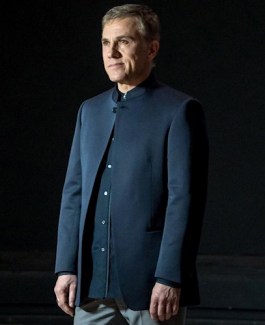
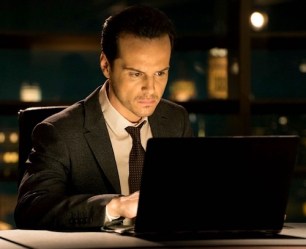
Spectre sees Bond (Daniel Craig) charged by dead-M (a Judi Dench cameo) with tracking down an assassin, as a way in to a secretive organisation that Bond’s other recent nemeses seem to have been a part of. While new-M (Ralph Fiennes) is distracted in London dealing with MI5 upstart Denbigh (Andrew Scott) and his dubious information-sharing plan that will make MI6 obsolete, Bond follows a trail of breadcrumbs to Rome, Austria, and Africa as he attempts to track down the organisation’s leader (Christoph Waltz).

That’s the foreshortened version of the plot, because much of Spectre plays like a detective movie: Bond uncovers clues that send him in new directions moving closer and closer to his goal. Where this falls down is there’s no mystery for him to unearth, at least not to the audience. We (and he) know this secret organisation exists, and we also know who’s in charge — it’s pretty hard to have not heard that Christoph Waltz is playing a Bond villain. So what twist does the film wheel out to keep this worthwhile? Is Waltz actually a front for the real villain? No. Perhaps there will be an incredible reveal about who Waltz’s character really is? Well…

Spectre, to put it bluntly, pulls a Star Trek Into Darkness — and considering writer Damon Lindelof recently admitted they’d messed up the reveal that (spoiler!) Benedict Cumberbatch was actually Khan (and J.J. Abrams admitted they’d messed up the film more generally, but that’s another issue), it’s a shame Spectre tried to repeat the same trick. So yes, as everyone predicted since the day he was cast, Waltz is playing Blofeld. The problem is, the film plays this as a twist/reveal, but it’s not a revelation to the characters, only to the viewer. In this interview with Empire magazine, director Sam Mendes says that not revealing Blofeld’s identity to the viewing public in advance was important because it’s a detective story and Bond doesn’t know the identity of the ‘murderer’, and we shouldn’t know before Bond. Which is poppycock, frankly, because the name Blofeld means nothing to Bond — the revelation for him is that his deceased childhood acquaintance is, a) alive, b) has become a super-villain, and c) has spent the last few years deliberately toying with Bond because of some childhood grudge. That’s why it’s just like the Khan ‘twist’: it means absolutely bugger all to the characters, but it does mean something to the audience. I’m certain there were ways to handle it in-film to make it work both ways — to make it a twist that Oberhauser is also Blofeld — but they don’t pursue that option even a little bit. And of course we all knew anyway, so it feels even sillier. If they’d played the “someone else we’re keeping secret might be Blofeld” game — if there’d been some misdirection to make us thing Denbigh would be unmasked as the big man behind it all — maybe it would’ve worked. But they didn’t.

For me, this is the point where the whole film went off the boil. It occurs at the start of a torture scene, which I thought was an over-complicated wannabe-Casino Royale sequence that consequently doesn’t work, and provides the gateway to an underwhelming final section in London. It seems the film’s third act was always a problem — if you read about what was revealed by the Sony leaks (in this coverage, for example), it’s clear the film entered production with the climax still not nailed down, because no one could quite agree on it. From that article, it indeed sounds like most of the film remained the same (or at least near enough), but the third act has definitely been re-worked, albeit retaining the same general thrust. I still don’t think it works. There’s too much of M, Q and Moneypenny sat in an office trying to stop a man typing something into a computer (more on this in a minute), while Bond is busy running around a building and shooting at a helicopter. Personally, I’d’ve thrown it out and started again, but I guess they’d run out of time, and maybe it was better than the alternative.

The leaked draft also ended with Bond executing Blofeld, shooting him in the head at point blank range. The studio thought this callous. In the finished film, he spares him, the movie justifying this as Bond rejecting his former life as a government assassin to go off and be with the woman he’s fallen completely in love with in the last three days. Was it Sony’s note that changed Blofeld’s fate, or a desire to keep Bond’s Moriarty in play for future instalments? I guess we’ll find out once Bond 25 starts ramping up. I wouldn’t mind seeing a good deal more of Waltz in the role. In Spectre he’s almost entirely constrained to the third act, thanks to that attempt at a twist; now he’s been established, surely next time they can let him loose across the entire movie? Reports indicate the return or otherwise of Waltz will hinge on Craig’s decision about returning (despite ‘news’ to the contrary last week, this seems to still be up in the air), so we’ll have to wait and see on both fronts.

Back to the issue of M, Q and Moneypenny. I’ve seen critics of the film assert that it was a mistake to cast actors of the calibre of Ralph Fiennes, Naomie Harris, and Ben Whishaw only to give them so little to do. This tickles me a little, because if anything I thought they played too large a role. All three have their place within a Bond narrative, and that place may have changed somewhat over the years (particularly with regards to Moneypenny), but it feels like we spend as much time with them saving the day as with Bond. This isn’t Mission: Impossible — it isn’t a team effort. Is it realistic that a lone agent goes around saving the world? No, of course it isn’t, and it never was; but the point of Bond has never been realism. And besides, the reason you cast quality actors in minor roles is so they can pop in for a day or two and make their one scene exceptionally good. Bulk their part up if you’ve got a story to tell, by all means, but don’t shoehorn them in just because you’ve got them. For my money, Spectre is too much doing the latter.
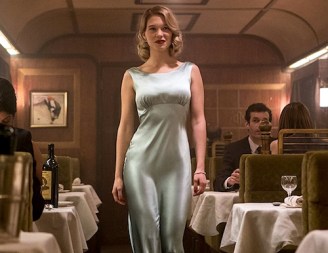
I could go on and on about a Bond movie (as anyone who’s read my 5,000 words on Skyfall will know), and obviously there are whole swathes of the film I’ve not touched on (the girls, the gadgets, the titles, that bloody song, the action sequences, the emptiness of Rome’s streets), but for now I’ll finish off with some more thoughts on that Mendes interview. (If you’re interested in “why we did that” behind-the-scenes stuff, do read the whole thing — there’s more interesting stuff there than I’m going to mention.) For starters, he reveals that the memorable opening “single take” is actually four shots stitched together, and challenges you to spot the cuts. It’s a fantastic opener, but, to be frank, I don’t think the transitions are that hard to ascertain. (From memory: there’s definitely one as they enter the building, another before they enter the hotel room, and the third is somewhere around when Bond climbs out the window onto the rooftops).

Despite the Sony leaks, Mendes thinks Bond killing Blofeld was never an option. He says it’s “sewn into the fabric of the film” that the story takes a man who kills for a living (and states as much at one point) to a position where he chooses not to kill. See too: M saying a licence to kill is also a licence not to kill; and the idea that, to Blofeld, being exposed and incarcerated is worse than being killed. This is a thematic thread the film arguably gets right, though sending Bond off to a “happy ending” seems a risky strategy when it comes to luring back a leading man they hope to retain but who may prefer to leave. Or perhaps they’re just planning to go On Her Majesty’s Secret Service on us. Mendes also says the ending was deliberately written as a way for Craig to leave, intending it to be an in-film conclusion that would serve as an exit if he chose not to come back, but which was also open enough that he could return without it being implausible. Time will tell which it will be.

As I mentioned in my ‘initial thoughts’ piece, it takes time and repeated viewings to settle a film into a ranking among the Bond pantheon… but it’s no fun just waiting, so let’s have a crack now. The broadest way of categorising that is, “is Spectre top ten material?” As a widely divisive Bond film, everyone’s going to have a very different opinion (when don’t they?), but when I tried to list my top ten Bond films for the sake of comparison, I got easily into double digits before I began to consider Spectre. Maybe I’m being too harsh now — I did fundamentally like it for most of the running time, but there are niggles throughout and the last couple of reels left a sour taste. For a film that should build on the excellence of Casino Royale and Skyfall, as well as finally fulfil a decade-long promise to restore more “classic Bond” elements to the franchise, it wasn’t all it could’ve been.

4 out of 5

Spectre is released on DVD and Blu-ray in the UK on Monday.