
Stanley Kubrick | 185 mins | Blu-ray | 1.78:1 | UK, USA & Ireland / English, German & French | PG / PG
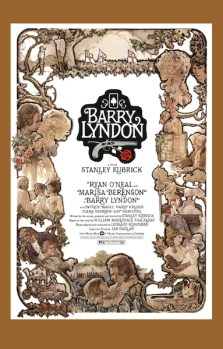 Stanley Kubrick made a good many exceptionally well-regarded films — indeed, with possibly the exception of his first semi-amateur feature, Fear and Desire, every one of his works can lay claim to being someone’s favourite. Nonetheless, although you wouldn’t guess it from its barebones also-ran type treatment on DVD and Blu-ray, three-hour period drama Barry Lyndon places among his top works in terms of consensus audience favourites, in that it’s on the IMDb Top 250. That said, it’s at #230, while the other six films on there are in the top 100, and he only made 13 features anyway — so it sits at the precise halfway point of his oeuvre, at least on IMDb.
Adapted from a novel by William Makepeace Thackeray, commonly called The Luck of Barry Lyndon but whose full original title is going in a footnote because it’s so long,* Kubrick’s film narrates the life of the eponymous Irish rogue (Ryan O’Neal) as he falls in love, runs away from home, joins the army, becomes a spy, becomes a con artist, marries a wealthy heiress (Marisa Berenson), runs an estate, and is a man of dubious virtue and questionable likeability throughout the whole affair.
Apparently the novel is considered to be the first English-language ‘novel without a hero’, aka antihero, and Lyndon certainly fits that bill. He serves his own interests throughout the tale, which is rarely seen as a desirable characteristic but can certainly be an understandable one, though at times you may despair at how his stubborn dedication to certain causes actually works against his interests. On the other hand, he has a great propensity for blagging his way through a war, and the ensuing complications, so I guess he learns from his mistakes… some of them, at any rate. It would be tough to say that Barry is a character you empathise with, but that doesn’t stop him from being a fascinating one to follow for a couple of hours. Some of this dislike may stem from the film’s voiceover narrator, 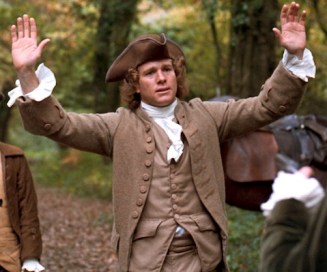 who often tells us less-than-favourable things about the lead character. Apparently this is an example of an unreliable narrator, and I suppose some of the things we’re told aren’t directly evidenced on screen, but I’m afraid I’m going to have to leave that seam to be mined by other writers, because (on a first viewing at least) I didn’t see where or to what effect the narrator was lying to the viewer.
As played by O’Neal, Barry’s accent places him as coming from the same part of Westeros as Littlefinger. Although I wouldn’t say he did a bad job, there seems little doubt he was miscast. The story of how he came to be in the film is more interesting than his performance, really: Warner Bros would only finance the film if Kubrick cast a top-ten box office star, based on the annual Quigley Poll of Top Money-Making Stars. O’Neal was second on the 1974 poll, just behind Clint Eastwood and ahead of people like Steve McQueen, Robert Redford, Paul Newman, John Wayne, and Marlon Brando. Barbra Streisand was the only woman on the list, so you’d think Kubrick had nine options, but apparently they were all considered “too old or inappropriate for the role” with the exception of O’Neal and Redford. O’Neal was the bigger star thanks to also securing a Best Actor Oscar nomination in the past, but Kubrick was smart enough to offer it to Redford first, but he turned it down so O’Neal it was. Ironically, 1973 was the only year O’Neal appeared in that top ten, while Redford placed first in 1974, 1975, and 1976.
Whether it was the intention or not, O’Neal often gets by thanks to the style of the narrative, in which a series of variously-plausible events keep happening to Barry as much as he is proactive in making them occur. This is not a simple, narrow-focused, cause-and-effect kind of story,  but a fictional biopic, that ranges across Europe and across time to… what effect? It’s a Kubrick film, so the ultimate goal of the tale, the message(s) it may be trying to impart, are debatable. You could see a story of the pitfalls of hubris. You could see an exploration of how a certain class lived in this time period. You could just see a man who led an adventurous life.
Whatever the merits of the tale, its telling is a frequent wonder. Its length and pace are surely barriers to entry for some — this is not a thrill-a-minute rollercoaster ride; it’s more analogous to a BBC miniseries, perhaps, albeit one where you’re watching all three episodes at once. Well, binge viewing is the TV watching style du jour, so that shouldn’t be a problem for anyone nowadays. Much has been made of the film’s candle-lit photography, using special lenses adapted from NASA, and rightly so; though perhaps it’s beginning to look less remarkable as we move into an era where digital cameras can produce exceptional range and quality. That’s not to say the potential commonality of such lighting decisions dulls the excellence of John Alcott’s photography, but, without knowledge of the production challenges, a modern viewer might not be so readily wowed.
Maybe I’m one of them, because for me the best shots are to be found elsewhere. The film is littered with recreations of art from the era — not obvious “ooh, I know that painting” recreations, but photographic imitations of the painters’ style, subjects, and composition. The opening shot, for instance, really looks like a painting. It’s incredible. I’d even go so far as to say it’s the best shot in the film; which is not to say the ensuing three hours are a visual disappointment, 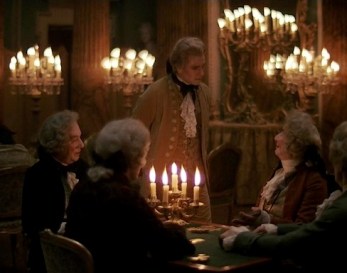 just that it remains the best among greats. (That said, having looked up images online for this review, it seems slightly less striking to me now. That may be the quality of the screengrabs; it may be that the painterly quality is so remarkable at first appearance (before becoming more familiar when the whole movie has that quality) that its memorableness is heightened.)
With its measured pace, obfuscated meaning, and sporadically likeable characters, Barry Lyndon is not the most readily accessible movie ever made. Well, it’s Kubrick, isn’t it? There’s so much to commend it though, especially if you consider visual style a reason to watch a movie (not everyone is satiated by that, but, for a visually-driven medium, I think it’s a perfectly acceptable element to be particularly engaged by). It’s an imperfect film (for Ryan O’Neal if nothing else), but perhaps a brilliant one. Certainly I’d put it in the high-middle of my Kubrick viewing so far — and as his only films that I’ve seen are all on the IMDb Top 250, that’s an upgrade from me, at least.

The restored 40th anniversary re-release of Barry Lyndon is in UK cinemas from today.
Barry Lyndon was viewed as part of my What Do You Mean You Haven’t Seen…? 2016 project, which you can read more about here.
* The Memoirs of Barry Lyndon, Esq. Of The Kingdom Of Ireland Containing An Account of His Extraordinary Adventures; Misfortunes; His Sufferings In The Service Of His Late Prussian Majesty; His Visits To Many Courts of Europe; His Marriage and Splendid Establishments in England And Ireland; And The Many Cruel Persecutions, Conspiracies And Slanders Of Which He Has Been A Victim. ^


 Score:



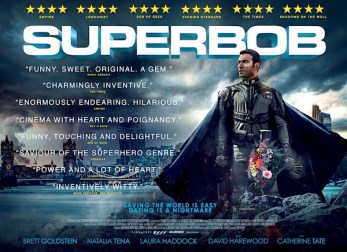 Comedies about superheroes tend to come in the form of big-bucks mainstream-aimed effects-y pieces (
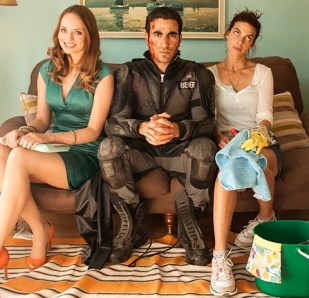 though, because the conceit is all but dropped fairly early on, and the film begins to develop in nice directions. It starts out as pure comedy, and while it doesn’t lose that aspect, it does develop a strand of endearingly genuine sweetness. That helps to see it through the predictable rom-com beats that follow, leaving you (or this viewer, at least) not minding that it’s predictable where the story’s going to go because, thanks to the characters, that’s where you want it to go.



 From the director of
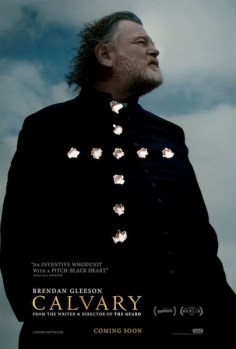
  So could it, instead, merely be a snapshot of Irish society, in particular its current relationship with the church? Surely that’s part of what’s in play, with the cynical, dismissive, teasing, sometimes hateful attitudes of the parishioners surely no coincidence. Some viewers have certainly taken this as the film’s primary talking point, and some have been less than impressed that it doesn’t align with their view of modern Ireland. (I’m in no position to comment.) Neither of these feel like they’re getting at the totality of what it’s saying, though.
 and Owen Sharpe (as a Brooklyn-accented promiscuous gay) — though if you watch

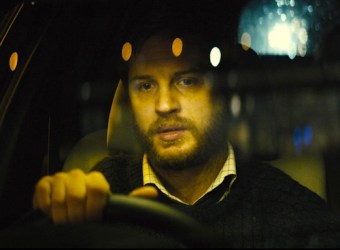
 “Tom Hardy goes for a drive and makes some phone calls” is the plot of this film, which is often mislabelled as a thriller. That’s not to degrade its thrillingness, but rather to say that if you’re expecting a single-location single-character phone-based thrill-ride like
 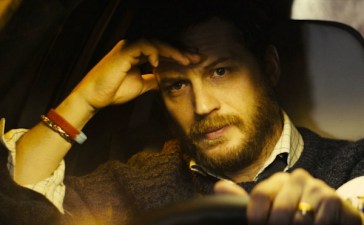 and in the process turning his life upside down. Another part was to tell a story about an ordinary guy dealing with events that aren’t going to change the world, aren’t even going to make the papers, but are a big deal in his life. Something like this could happen to any of us, and how would we deal with it?
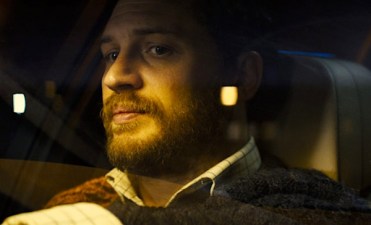 The rest of the cast appear as voices only on the other end of the phone, and in their own way are quite starry — faces that you may recognise, mainly from British TV, in even some of the smaller roles. Not that you see their faces, so, you know, you might have to look them up, or watch the making-of. Some of the performances err a little towards radio acting for me, which is kind of understandable seeing as how that’s basically how they were recorded, but there are particularly good turns from Andrew “Moriarty in
 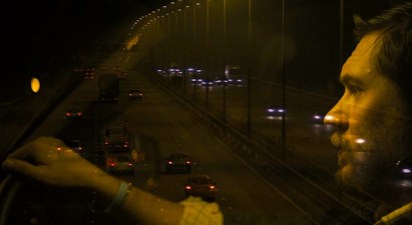 this is about what’s happening on Hardy’s face, not with his whole body. And in either form you’d lose all the photography of nighttime motorways, which have their own kind of hazy beauty. For a movie about someone making phone calls, it is intensely cinematic.
 the supporting cast are so much more than “voices on the phone” (listen out, too, for Tom “


 100Films.co.uk