
Michael Reeves | 83 mins | TV | 18
 Notorious for having numerous cuts forced upon it by censors, over 40 years after its initial release Witchfinder General — now uncut — seems almost tame. But gore and sadistic violence certainly aren’t the main attractions — there’s a lot more to the film than that.
Though I’m sure it was quite horrific in its day, there’s nothing here to rival the gore or gruesomeness of today’s horror movies; or, indeed, of horror movies being produced in other countries around the same period. Not that I’m advocating censorship, but one advantage to the previous cutting of the film is that it’s been restored from vastly inferior sources (it looks about VHS quality to me), making it possible to note what the censors felt needed removing. It’s interesting that, with only one brief exception, all the cuts are of violence to women, while similar violence towards men remains intact. Very moral.
(There are two ‘complete’ versions available now, often labelled the Director’s Cut and the Export Cut. As usual, Movie-Censorship.com has more details, but there seems to be no difference in violence (despite what IMDb may claim) — the latter merely uses some alternate takes, 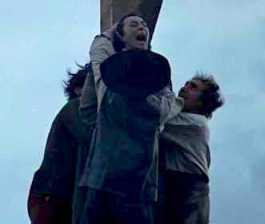 shot against Reeves’ wishes, featuring needlessly topless wenches. This is the cut shown by the BBC.)
If the violence isn’t disgustingly gory, what’s truly horrific is how real it is. I have no idea if the torture and execution methods are historically accurate (the lead characters were real people but the plot is far from historically accurate), but the opening hanging is nasty due to the woman’s distress, the later burning tortuous because we know that, at some point in history, for whatever reason, this kind of death penalty was dolled out… If it’s horrific or scary it’s down to the threat of violence, or the cynical sadism with which people are tortured, rather than gory special effects (indeed, the blood on display is marvellously fake) or supernatural goings-on (of which there are resolutely none).
In fact, if we’re discussing genre, it’s more like an historical action-adventure, with soldiers dashing around the countryside, horseback chases, bar brawls, ambushes, and the occasional sword fight. If you changed the villain from a witchhunter who tortures and murders in Very Nasty Ways for money, to a dastardly chap who just stabbed people for money, the film would still function and the controversy would instantly evaporate. I’m not saying they should have, because that’s not the point; just that, in structure and (in many places) tone,  Witchfinder General is more action-adventure than horror.
Tom Baker (not that one) and director Reeves’ screenplay (adapted from Ronald Bassett’s novel and nothing to do with the inspiration for its US title, Edgar Allan Poe’s poem The Conqueror Worm) adds a surprising amount of depth for either genre. It largely eschews the politics of the era — both the good and bad characters are on the side of Cromwell, the civil war only cropping up to provide period detail or motivation for characters’ movements — instead developing character and thematic interest.
Take hero Richard Marshall’s relationship with his beloved Sara’s guardian uncle, John Lowes. Lowes dislikes both Richard’s cause and his prospects, but is prepared to condone their marriage so Sara can escape the witchfinder’s path. Or the myriad minor characters who are well prepared to do as they’re told, or report people as witches just to get rid of them, often in silent agreement with the witchfinder and/or magistrate that everyone knows these people aren’t guilty of any real crime, but are still prepared to say or do whatever because someone wants rid of them. Thematically, one can read points about the corruption power can bring, in particular abuse of political situations.
 Best of all is the witchfinder himself, excellently portrayed by horror stalwart Vincent Price. Indeed, all the credit may lay with him, because it’s his line deliveries and uncertain looks that make the character conflicted early on, a man who may believe he is genuinely doing good for Christian values, but is seduced down darker paths by money, power, lust, and the prospect of revenge. When he allows himself to be lured to Sara’s bedroom as payment for leniency on her uncle, we’re uncertain if he’ll take what’s intended or use her loose ways as proof of witchery. That it’s the former quickly indicates how seriously he takes his espoused Christianity.
In the rest of the cast, Ian Ogilvy makes for a suitably dashing, morally centred hero as Richard, while Robert Russell is equally suited to the part of brutish, loutish, but insightful torturer Stearne.
The picture is nicely shot, with a suitable realism to the locations. Though one of the most horrific things about the whole movie is some of the most dire day-for-night footage I’ve ever seen — it seems to consist of leaving the sky rather bright while everything else is darkened  to near-silhouette levels of blackness. It’s even less convincing than that fake blood. I enjoyed the score too. A completely new one was written for the US release, but I presume this was the original because it was slightly calmer and more haunting than one might expect from an action-adventure-horror movie (which I presume was the reasoning for the replacement).
Despite the controversy, Witchfinder General will no longer please the gore-seeking brigade of certain horror fans — no bad thing. While it’s undeniably sadistic in places, it’s appropriate for the dark, realistic theme of the story. It may not be factually accurate, but it conveys well the sense of a dangerous, violent, morally bankrupt era. Its place as a British horror classic is well earnt.

Witchfinder General is on BBC Four tonight at 10:10pm.
Witchfinder General is on BBC Two tonight, Friday 31st October 2014, at 12:05am.
 Back in this blog’s early days, I established the rule that where a different cut of a film was not significantly different to the original version it wouldn’t be counted towards my total (assuming I’d seen the original, that is — if it’s the first time I’ve seen any version of the film, it still counts). There’s no hard criteria for what counts as “significantly different” though. A couple of additional minutes? No. A lot of additional minutes? Yes. Where’s the line between “a couple” and “a lot”? No idea. Thus far, I’ve left it up to “a feeling”, perhaps not always correctly (the
  but other than that if you’d told me this was the cut I watched in cinemas I’d believe you. This longer cut doesn’t make the film better or worse, just less suitable for younger viewers.
 It’s still riddled with flaws, mind. Some of the dialogue is fairly atrocious (but at least it’s only some); exposition is often blatant and repetitive (we’re told what the preferiti are three or four times in as many minutes); some of the deductive leaps are a bit much; and the whole antimatter bomb still seems scientifically suspect. It all depends how much you’re willing to forgive, really. In a similar vein, one of the most contentious issues of Dan Brown’s novels is his use of “truth”. He mixes well-researched fact with his own creation at will, often leaving you to wonder if what you’re hearing is pure truth, truth bent to the plot, or a total fabrication. But then this isn’t a history or art lesson, it’s a mystery thriller, and if one wants to know more I’m sure there are books to read and documentaries to watch.
 Origin stories are, as we well know, all the rage at the moment, and so Ridley Scott follows in the footsteps of
 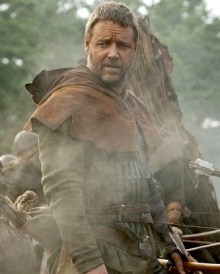 a likely-fictional creation, and so the style is suitably believable, whether it be precisely factual or not.
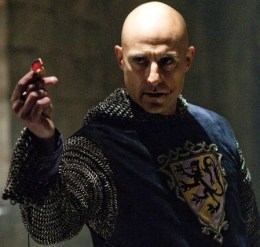 Mark Strong in a villainous role (it might be nice to see him play a good guy sometime, I’m sure he’s capable). Danny Huston’s King Richard is a nicely revisionist take — not the flawless hero we’re used to seeing — which sadly gets too little screen time. Oscar Isaac’s Prince/King John is suitably brattish and inconsistent, but by playing the part fairly straight he doesn’t come close to being as memorable as Alan Rickman, Keith Allen or Toby Stephens in the key villain’s role.
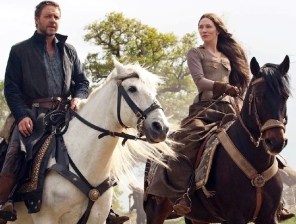 after numerous scenes of them doing stuff, they just are. King John ums and ahs about various things, and if we’re being charitable his chief characteristic is ‘changeable’; and if we’re not, he’s a weakly-written, inconsistent character. Do I believe he’d go charging into the fray during the climax? No, I don’t. If he’d gone in when it was virtually over, just so he could later claim he had? Yes, that would fit.
 I wanted the reviews to be wrong; for Ridley Scott’s Gritty And Realistic™ take on Robin Hood to be worth the potential of the concept. In places, it almost is — the era is evoked stylishly, the battles are largely well-staged if not perfect — but it drags, and ultimately Robin only becomes Robin Hood proper at the film’s end. (In fact, a surprisingly large amount of the trailer was taken from the film’s closing minutes, obviously to imply the usual Robin Hood story.) It’s copied Batman Begins and Casino Royale too precisely in this respect, perhaps. It also makes it feel like nowt but setup for a sequel, over-explaining how (this version of) Robin came to be where he was. As the final card says, “And so the legend begins”.
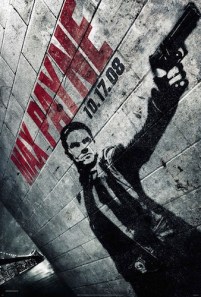 I was a bit of a gamer once. Not an especially hardcore one, but certainly a gamer. And I remember Max Payne, and I remember enjoying it, and I remember thinking it would make quite a good film, and I remember one of the biggest problems being that what made it so unique as a game was the bullet-time feature and what would make it so derivative as a film would be to use bullet-time. But it also had lots of other things going for it: the snow-bound nighttime New York setting, the dark revenge plot, the hard-boiled gravel-toned voiceover.
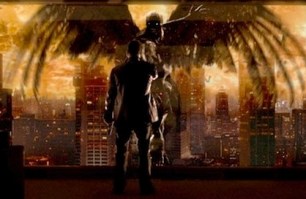 Unfortunately, he seems to be under the illusion that a couple of barely-moving slow-mo moments also stand in for a full action sequence. When an action movie can’t deliver any action, there’s a problem.
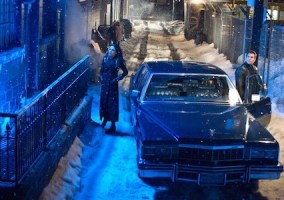 The ‘harder’ bit merely comes from a couple of frames (literally) of violence and the odd bit of CG blood. Presumably the extra walking around is to artificially lengthen the running time and persuade the more gullible that they’re getting a tougher experience.
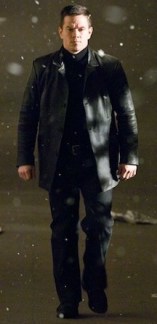 At least some of it looks quite nice. The drifting snow-laden exterior shots are among the few bits of the film that might genuinely be considered good. But when you can get pretty images elsewhere, why suffer through this?
 So many consumers hold off for the DVD these days, especially with the added quality offered by Blu-ray, that the old answer of “what was released in the cinema” doesn’t necessarily hold true any more. Filmmakers know some will be waiting for the DVD, so are less concerned with releasing a studio-mandated, shorter, mass audience friendly cut into cinemas when their fuller vision can be found on DVD. Equally, the PR people know that “longer cut!” and “not seen in cinemas!” and other such slogans can help sell DVDs, and so may be forcing needless and unwelcome extensions onto filmmakers. Then there’s all those older directors who think they’re doing a good thing finally getting to tamper with their film 30 years on, who may well be misguided.
 There remains one argument for clarity, I think. How does one guarantee that, in the future, the ‘correct’ version remains accessible? With new formats always coming along, there’s no assurance that every cut of a film will be released; with TV showings, there’s no assurance the preferred version will always be the one shown (though there’s another argument for how much the latter matters considering they already mess around with aspect ratios and edits for violence/swearing/sex/etc.) But then, even if a filmmaker makes it clear that their preferred version is the one that only came out on DVD/Blu-ray, what chance is there that unscrupulous disc / download / unknown-future-format producers or TV schedulers won’t just revert to the theatrical version by default?
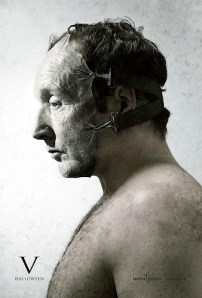 And so the never-ending Saw franchise trundles on to its fifth part. Indeed, Saw Part 5 might be a more apt moniker for this film: it picks up directly from the end of
  One of the franchise’s Big Things has always been the last-minute twist. Signalled by the Saw theme beginning to play and emphasised with an explosion of very brief flashbacks to earlier in the film, the twist shows us what we’ve missed all along and turns the story on its head. The
 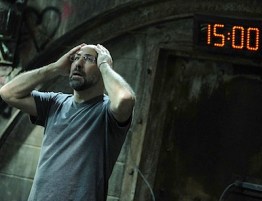 In fact, it’s this side of the film that holds a bigger and better twist than the highlighted arc plot one, though some viewers may miss its significance as it goes so unheralded. (Arguably this ease with which it might be missed says something about how significant it is; equally, perhaps I’m assuming a lack of intelligence on the part of Saw’s regular audience by implying they would miss it.)
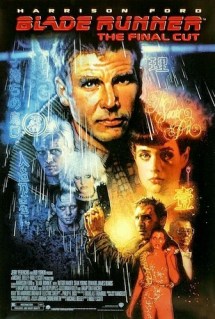 You don’t need me to tell you about Blade Runner. It’s one of the most popular movies ever, if not with a mass audience then with a significantly-sized cult following and even wider-spread respect. Still, I’m going to go on about it for a bit anyway.
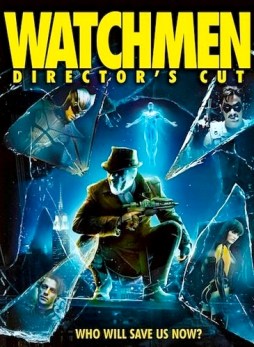 Hitting US Blu-ray so long ago that it’s shameful I haven’t watched it ’til now, and finally arriving in the UK next Monday, the Director’s Cut is Zack Snyder’s final vision of Watchmen: The Movie.
  A wandering man with magic wine and no memory; a clan prince who’s also his beloved sister; a master swordsman who’s almost blind; his wife, who loves his best friend; a persistent peasant girl after revenge for her little brother, with only eggs for payment; a young swordsman with no shoes and a camel; a large gang of bandits with a left-handed member; and a desert-dwelling problem solver who connects them all. Oh if only Ashes of Time were as simple as that sounds.
 Saw IV is the final film in the series directed by Bousman, and will also be my jumping off point (for the time being). According to
  100Films.co.uk